
Showing 20 items matching "double wings"
-
 Moorabbin Air Museum
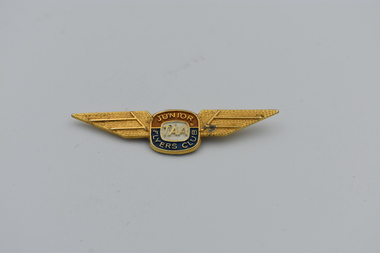
Badge (item) - TAA Junior Flyers Club Badge, TAA Junior Flyers Club Badge - Double wings
... TAA Junior Flyers Club Badge - Double wings...TAA Junior Flyers Club metal badge, gold wings surrounding "TAA' emblem TAA Junior Flyers Club Badge - Double wings Badge TAA Junior Flyers Club Badge ...TAA Junior Flyers Club -
 Moorabbin Air Museum
Book - Eyewitness guides - aviation, Flying Machines
... ...Double wings...Eyewitness guides - aviation Balloons Gliders Powered flight Double wings Light aircraft Aero engines The propeller Jetliner Jet propulsion Landing gear In the cockpit Flying instruments Rotating wings Helicopters Airship Kites Overview of history of aircraft for young people, including basic technical information, circa 1990 Flying Machines Book Eyewitness guides - aviation ...Overview of history of aircraft for young people, including basic technical information, circa 1990non-fictionOverview of history of aircraft for young people, including basic technical information, circa 1990balloons, gliders, powered flight, double wings, light aircraft, aero engines, the propeller, jetliner, jet propulsion, landing gear, in the cockpit, flying instruments, rotating wings, helicopters, airship, kites -
 Orbost & District Historical Society
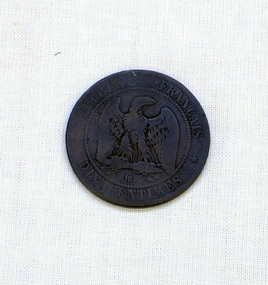
coin, 1855
... double letter below the eagle. This pattern with Napoleon appears on bronze French coins from 1852 to 1865. This coin reflects the late 19th century history of France. coin french-ten-centime napoleon A bronze 1855 French 10 Centimes. The denomination is on the reverse: " DIX CENTIMES" around an eagle with open wings ...Eagles on coins do not necessarily indicate that they are American eagles or coins from the United States but they are symbols of strength or power. The 10 Centimes was made at various mints and the mint mark appears as a single or double letter below the eagle.This pattern with Napoleon appears on bronze French coins from 1852 to 1865. This coin reflects the late 19th century history of France.A bronze 1855 French 10 Centimes. The denomination is on the reverse: " DIX CENTIMES" around an eagle with open wings. Above that is: "EMPIRE FRANCAIS" or French Empire. On the obverse is: "NAPOLEON III EMPEREUR BARRE 1855" around the head of man facing left.coin french-ten-centime napoleon -
 Eltham District Historical Society Inc
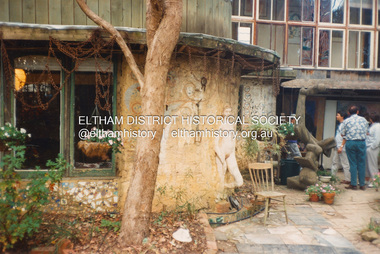
Photograph, Fay Bridge, Clifton Pugh's Artists' Colony, Dunmoochin, Barreenong Road, Cottles Bridge, c.1995
... In place of Pugh's house rose two double-storey mud-brick artists' studios topped with corrugated iron rooves curved like the wings of a bird with accommodation for seven. ...In place of Pugh's house rose two double-storey mud-brick artists' studios topped with corrugated iron rooves curved like the wings of a bird with accommodation for seven. ...Visit to Dunmoochin prior to Clifton Pugh's home being destroyed by fire in 2002. Following military service in the second world war, Clifton Pugh studied under artist Sir William Dargie at the National Gallery School in Melbourne as well as Justus Jorgensen, founder of Montsalvat. For a while he lived on the dole but also worked packing eggs for the Belot family saving sufficient to purchase six acres (2.4 ha) of land at Barreenong Road, Cottles Bridge. He accumulated more land and persuaded several other artists and friends to buy land nearby, resulting in a property of approximately 200 acres, stablishing it as one of the first artistic communes in Australia alongside Montsalvat in Eltham. It was around 1951 that Pugh felt he had '"done moochin' around" and so the name of the property evolved. He bought timber from Alistair Knox to build his house on the crest of a hill. Inspired by local goldminer's huts, it was a one room wattle-and-daub structure with dirt floor. Over the years it expanded with thick adobe walls made from local clay, high ceilings and stone floors. All materials other than the local earth were sourced from second hand materials, most found at wreckers' yards. Artists from across the nation were drawn to Dunmoochin, with several setting up houses and shacks on the property, maintaining their independence but sharing their artistic zeal. Artists who worked or resided at Dunmoochin included Mirka Mora, John Perceval, Albert Tucker, Fred Williams, Charles Blackman, Arthur Boyd and John Olsen. In 2002, Pugh's house along with its treasure trove of art and a library of some 20,000 books was destroyed by fire. Traces of Pugh's home remain with the presence of the Victorian doorframe archway with leadlight of intricate design, procured from a demolished Melbourne mansion; and two bronze life-sized female statues created by Pugh and cast by Matcham Skipper. In place of Pugh's house rose two double-storey mud-brick artists' studios topped with corrugated iron rooves curved like the wings of a bird with accommodation for seven. The original studios, gallery and other buildings survived the fire.fay bridge collection, 1995, barreenong road, cottles bridge, dunmoochin -
 Eltham District Historical Society Inc
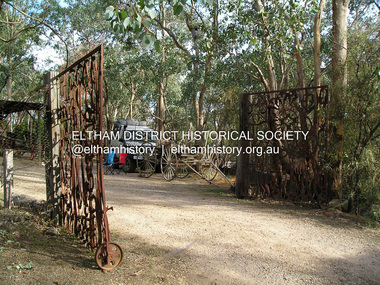
Photograph, Fay Bridge, Clifton Pugh's Artists' Colony, Dunmoochin, Barreenong Road, Cottles Bridge, 14 May 2016
... In place of Pugh's house rose two double-storey mud-brick artists' studios topped with corrugated iron rooves curved like the wings of a bird with accommodation for seven. ...In place of Pugh's house rose two double-storey mud-brick artists' studios topped with corrugated iron rooves curved like the wings of a bird with accommodation for seven. ...Following military service in the second world war, Clifton Pugh studied under artist Sir William Dargie at the National Gallery School in Melbourne as well as Justus Jorgensen, founder of Montsalvat. For a while he lived on the dole but also worked packing eggs for the Belot family saving sufficient to purchase six acres (2.4 ha) of land at Barreenong Road, Cottles Bridge. He accumulated more land and persuaded several other artists and friends to buy land nearby, resulting in a property of approximately 200 acres, stablishing it as one of the first artistic communes in Australia alongside Montsalvat in Eltham. It was around 1951 that Pugh felt he had '"done moochin' around" and so the name of the property evolved. He bought timber from Alistair Knox to build his house on the crest of a hill. Inspired by local goldminer's huts, it was a one room wattle-and-daub structure with dirt floor. Over the years it expanded with thick adobe walls made from local clay, high ceilings and stone floors. All materials other than the local earth were sourced from second hand materials, most found at wreckers' yards. Artists from across the nation were drawn to Dunmoochin, with several setting up houses and shacks on the property, maintaining their independence but sharing their artistic zeal. Artists who worked or resided at Dunmoochin included Mirka Mora, John Perceval, Albert Tucker, Fred Williams, Charles Blackman, Arthur Boyd and John Olsen. In 2002, Pugh's house along with its treasure trove of art and a library of some 20,000 books was destroyed by fire. Traces of Pugh's home remain with the presence of the Victorian doorframe archway with leadlight of intricate design, procured from a demolished Melbourne mansion; and two bronze life-sized female statues created by Pugh and cast by Matcham Skipper. In place of Pugh's house rose two double-storey mud-brick artists' studios topped with corrugated iron rooves curved like the wings of a bird with accommodation for seven. The original studios, gallery and other buildings survived the fire.fay bridge collection, 2016-05-14, art gallery, barreenong road, clifton pugh, cottles bridge, dunmoochin, maurice hurry -
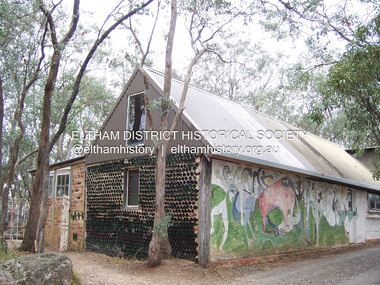 Eltham District Historical Society Inc
Photograph - Digital Photograph, Marguerite Marshall, Art Gallery at Clifton Pugh's Artists' Colony, Dunmoochin, Barreenong Road, Cottles Bridge, 5 February 2008
... Now in place of Pugh’s house, are two double-storey mud-brick artists’ studios topped with corrugated roofs curved like birds’ wings, with accommodation for seven. ...Now in place of Pugh’s house, are two double-storey mud-brick artists’ studios topped with corrugated roofs curved like birds’ wings, with accommodation for seven. ...Art Gallery with mural painted by Clifton Pugh (1924-1990) at his Artists' Colony, Dunmoochin, Barreenong Road, Cottles Bridge. Following military service in the second world war, Clifton Pugh studied under artist Sir William Dargie at the National Gallery School in Melbourne as well as Justus Jorgensen, founder of Montsalvat. For a while he lived on the dole but also worked packing eggs for the Belot family saving sufficient to purchase six acres (2.4 ha) of land at Barreenong Road, Cottles Bridge. He accumulated more land and persuaded several other artists and friends to buy land nearby, resulting in a property of approximately 200 acres, stablishing it as one of the first artistic communes in Australia alongside Montsalvat in Eltham. It was around 1951 that Pugh felt he had '"done moochin' around" and so the name of the property evolved. He bought timber from Alistair Knox to build his house on the crest of a hill. Inspired by local goldminer's huts, it was a one room wattle-and-daub structure with dirt floor. Over the years it expanded with thick adobe walls made from local clay, high ceilings and stone floors. All materials other than the local earth were sourced from second hand materials, most found at wreckers' yards. Artists from across the nation were drawn to Dunmoochin, with several setting up houses and shacks on the property, maintaining their independence but sharing their artistic zeal. Artists who worked or resided at Dunmoochin included Mirka Mora, John Perceval, Albert Tucker, Fred Williams, Charles Blackman, Arthur Boyd and John Olsen. In 2002, Pugh's house along with its treasure trove of art and a library of some 20,000 books was destroyed by fire. Traces of Pugh's home remain with the presence of the Victorian doorframe archway with leadlight of intricate design, procured from a demolished Melbourne mansion; and two bronze life-sized female statues created by Pugh and cast by Matcham Skipper. In place of Pugh's house rose two double-storey mud-brick artists' studios topped with corrugated iron rooves curved like the wings of a bird with accommodation for seven. The original studios, gallery and other buildings survived the fire. Covered under Heritage Overlay, Nillumbik Planning Scheme. Published: Nillumbik Now and Then / Marguerite Marshall 2008; photographs Alan King with Marguerite Marshall.; p153 It’s not surprising that artist Clifton Pugh was drawn to Cottles Bridge to establish his artists’ colony Dunmoochin. Undisturbed by the clamour of modern life at Barreenong Road, Pugh was surrounded by the Australian bush he loved, and where his ashes were later scattered. The 200 acres (81ha) of bushland, broken by glimpses of rolling hills, has more than 50 species of orchids and Pugh shared his property with native animals including kangaroos, emus, phascogales, wombats, and diverse bird life. Pugh encouraged these creatures to join him in the bush by creating, with Monash University, a holding station where the animals were raised. Dunmoochin inspired Pugh for such paintings as in a book on orchids and the Death of a Wombat series.1 But his love for the bush was accompanied by the fear that Europeans were destroying it and much of his painting illustrated this fear and his plea for its conservation.2 However it was his house rather than the surrounding bush that was to be destroyed. Tragically in 2002 Pugh’s house, with its treasure of art and library of 20,000 art books, was destroyed by fire. Traces of the beauty of Pugh’s home still remain, however, in the magnificent Victorian doorframe archway with leadlight of intricate design procured from a demolished Melbourne mansion; and two bronze life-sized female statues created by Pugh and cast by Matcham Skipper. Now in place of Pugh’s house, are two double-storey mud-brick artists’ studios topped with corrugated roofs curved like birds’ wings, with accommodation for seven. The original studios, gallery and other buildings remain.3 Pugh grew up on his parents’ hobby farm at Briar Hill and attended the Briar Hill Primary School, then Eltham High School and later Ivanhoe Grammar. At 15 he became a copy boy for the Radio Times newspaper, then worked as a junior in a drafting office. Pugh was to have three wives and two sons. After serving in World War Two in New Guinea and Japan, Pugh studied under artist Sir William Dargie, at the National Gallery School in Melbourne.4 Another of his teachers was Justus Jörgensen, founder of Montsalvat the Eltham Artists’ Colony. Pugh lived on the dole for a while and paid for his first six acres (2.4ha) at Barreenong Road by working as an egg packer for the Belot family. Pugh accumulated more land and persuaded several other artists and friends to buy land nearby, resulting in the 200 acre property. They, too, purchased their land from the Belot family by working with their chickens. Around 1951 Pugh felt he had ‘Done moochin’ around’ and so the name of his property was born. Pugh bought some used timber from architect Alistair Knox to build his house on the crest of a hill. Inspired by local goldminers’ huts it was a one-room wattle-and-daub structure with a dirt floor. It was so small that the only room he could find for his telephone was on the fork of a tree nearby.5 Over the years the mud-brick house grew to 120 squares in the style now synonymous with Eltham. It had thick adobe walls (sun-dried bricks) made from local clay, high ceilings and stone floors with the entire structure made of second-hand materials – most found at wreckers’ yards. Pugh’s first major show in Melbourne in 1957, established him as a distinctive new painter, breaking away from the European tradition ‘yet not closely allied to any particular school of Australian painting’.6 Pugh became internationally known and was awarded the Order of Australia. He won the Archibald Prize for portraiture three times, although he preferred painting the bush and native animals. In 1990 not long before he died, Pugh was named the Australian War Memorial’s official artist at the 75th anniversary of the landing at Gallipoli. Today one of Pugh’s legacies is the Dunmoochin Foundation, which gives seven individual artists or couples and environmental researchers the chance to work in beautiful and peaceful surroundings, usually for a year. By November 2007, more than 80 people had taken part, and the first disabled artist had been chosen to reside in a new studio with disabled access.1 In 1989, not long before Pugh died in 1990 of a heart attack at age 65, he established the Foundation with La Trobe University and the Victorian Conservation Trust now the Trust for Nature. Pugh’s gift to the Australian people – of around 14 hectares of bushland and buildings and about 550 art works – is run by a voluntary board of directors, headed by one of his sons, Shane Pugh. La Trobe University in Victoria stores and curates the art collection and organises its exhibition around Australia.2 The Foundation aims to protect and foster the natural environment and to provide residences, studios and community art facilities at a minimal cost for artists and environmental researchers. They reside at the non-profit organisation for a year at minimal cost. The buildings, some decorated with murals painted by Pugh and including a gallery, were constructed by Pugh, family and friends, with recycled as well as new materials and mud-bricks. The Foundation is inspired by the tradition begun by the Dunmoochin Artists’ Cooperative which formed in the late 1950s as one of the first artistic communes in Australia. Members bought the land collaboratively and built the seven dwellings so that none could overlook another. But, in the late 1960s, the land was split into private land holdings, which ended the cooperative. Dunmoochin attracted visits from the famous artists of the day including guitarists John Williams and Segovia; singer and comedian Rolf Harris; comedian Barry Humphries; and artists Charles Blackman, Arthur Boyd and Mirka Mora. A potters’ community, started by Peter and Helen Laycock with Alma Shanahan, held monthly exhibitions in the 1960s, attracting local, interstate and international visitors – with up to 500 attending at a time.3 Most artists sold their properties and moved away. But two of the original artists remained into the new millennium as did relative newcomer Heja Chong who built on Pugh’s property (now owned by the Dunmoochin Foundation). In 1984 Chong brought the 1000-year-old Japanese Bizan pottery method to Dunmoochin. She helped build (with potters from all over Australia) the distinctive Bizan-style kiln, which fires pottery from eight to 14 days in pine timber, to produce the Bizan unglazed and simple subdued style. The kiln, which is rare in Australia, is very large with adjoining interconnected ovens of different sizes, providing different temperatures and firing conditions. Frank Werther, who befriended Pugh as a fellow student at the National Gallery Art School in Melbourne, built his house off Barreenong Road in 1954. Werther is a painter of the abstract and colourist style and taught art for about 30 years. Like so many in the post-war years in Eltham Shire, as it was called then, Werther built his home in stages using mud-brick and second-hand materials. The L-shaped house is single-storey but two-storey in parts with a corrugated-iron pitched roof. The waterhole used by the Werthers for their water supply is thought to be a former goldmining shaft.4 Alma Shanahan at Barreenong Road was the first to join Pugh around 1953. They also met at the National Gallery Art School and Shanahan at first visited each weekend to work, mainly making mud-bricks. She shared Pugh’s love for the bush, but when their love affair ended, she designed and built her own house a few hundred yards (metres) away. The mud-brick and timber residence, made in stages with local materials, is rectangular, single-storey with a corrugated-iron roof. As a potter, Shanahan did not originally qualify as an official Cooperative member.This collection of almost 130 photos about places and people within the Shire of Nillumbik, an urban and rural municipality in Melbourne's north, contributes to an understanding of the history of the Shire. Published in 2008 immediately prior to the Black Saturday bushfires of February 7, 2009, it documents sites that were impacted, and in some cases destroyed by the fires. It includes photographs taken especially for the publication, creating a unique time capsule representing the Shire in the early 21st century. It remains the most recent comprehenesive publication devoted to the Shire's history connecting local residents to the past. nillumbik now and then (marshall-king) collection, art gallery, clifton pugh, dunmoochin, cottlesbridge, cottles bridge, barreenong road -
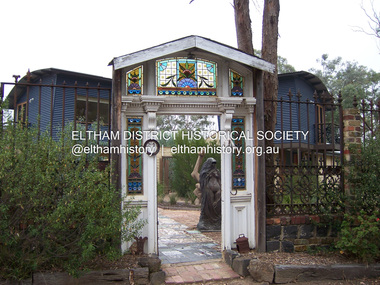 Eltham District Historical Society Inc
Photograph - Digital Photograph, Marguerite Marshall, Doorway of Clifton Pugh's former house at Dunmoochin, Barreenong Road, Cottles Bridge, 5 February 2008
... Now in place of Pugh’s house, are two double-storey mud-brick artists’ studios topped with corrugated roofs curved like birds’ wings, with accommodation for seven. ...Now in place of Pugh’s house, are two double-storey mud-brick artists’ studios topped with corrugated roofs curved like birds’ wings, with accommodation for seven. ...Following military service in the second world war, Clifton Pugh studied under artist Sir William Dargie at the National Gallery School in Melbourne as well as Justus Jorgensen, founder of Montsalvat. For a while he lived on the dole but also worked packing eggs for the Belot family saving sufficient to purchase six acres (2.4 ha) of land at Barreenong Road, Cottles Bridge. He accumulated more land and persuaded several other artists and friends to buy land nearby, resulting in a property of approximately 200 acres, stablishing it as one of the first artistic communes in Australia alongside Montsalvat in Eltham. It was around 1951 that Pugh felt he had '"done moochin' around" and so the name of the property evolved. He bought timber from Alistair Knox to build his house on the crest of a hill. Inspired by local goldminer's huts, it was a one room wattle-and-daub structure with dirt floor. Over the years it expanded with thick adobe walls made from local clay, high ceilings and stone floors. All materials other than the local earth were sourced from second hand materials, most found at wreckers' yards. Artists from across the nation were drawn to Dunmoochin, with several setting up houses and shacks on the property, maintaining their independence but sharing their artistic zeal. Artists who worked or resided at Dunmoochin included Mirka Mora, John Perceval, Albert Tucker, Fred Williams, Charles Blackman, Arthur Boyd and John Olsen. In 2002, Pugh's house along with its treasure trove of art and a library of some 20,000 books was destroyed by fire. Traces of Pugh's home remain with the presence of the Victorian doorframe archway with leadlight of intricate design, procured from a demolished Melbourne mansion; and two bronze life-sized female statues created by Pugh and cast by Matcham Skipper. In place of Pugh's house rose two double-storey mud-brick artists' studios topped with corrugated iron rooves curved like the wings of a bird with accommodation for seven. The original studios, gallery and other buildings survived the fire. Covered under Heritage Overlay, Nillumbik Planning Scheme. Published: Nillumbik Now and Then / Marguerite Marshall 2008; photographs Alan King with Marguerite Marshall.; p155 It’s not surprising that artist Clifton Pugh was drawn to Cottles Bridge to establish his artists’ colony Dunmoochin. Undisturbed by the clamour of modern life at Barreenong Road, Pugh was surrounded by the Australian bush he loved, and where his ashes were later scattered. The 200 acres (81ha) of bushland, broken by glimpses of rolling hills, has more than 50 species of orchids and Pugh shared his property with native animals including kangaroos, emus, phascogales, wombats, and diverse bird life. Pugh encouraged these creatures to join him in the bush by creating, with Monash University, a holding station where the animals were raised. Dunmoochin inspired Pugh for such paintings as in a book on orchids and the Death of a Wombat series.1 But his love for the bush was accompanied by the fear that Europeans were destroying it and much of his painting illustrated this fear and his plea for its conservation.2 However it was his house rather than the surrounding bush that was to be destroyed. Tragically in 2002 Pugh’s house, with its treasure of art and library of 20,000 art books, was destroyed by fire. Traces of the beauty of Pugh’s home still remain, however, in the magnificent Victorian doorframe archway with leadlight of intricate design procured from a demolished Melbourne mansion; and two bronze life-sized female statues created by Pugh and cast by Matcham Skipper. Now in place of Pugh’s house, are two double-storey mud-brick artists’ studios topped with corrugated roofs curved like birds’ wings, with accommodation for seven. The original studios, gallery and other buildings remain.3 Pugh grew up on his parents’ hobby farm at Briar Hill and attended the Briar Hill Primary School, then Eltham High School and later Ivanhoe Grammar. At 15 he became a copy boy for the Radio Times newspaper, then worked as a junior in a drafting office. Pugh was to have three wives and two sons. After serving in World War Two in New Guinea and Japan, Pugh studied under artist Sir William Dargie, at the National Gallery School in Melbourne.4 Another of his teachers was Justus Jörgensen, founder of Montsalvat the Eltham Artists’ Colony. Pugh lived on the dole for a while and paid for his first six acres (2.4ha) at Barreenong Road by working as an egg packer for the Belot family. Pugh accumulated more land and persuaded several other artists and friends to buy land nearby, resulting in the 200 acre property. They, too, purchased their land from the Belot family by working with their chickens. Around 1951 Pugh felt he had ‘Done moochin’ around’ and so the name of his property was born. Pugh bought some used timber from architect Alistair Knox to build his house on the crest of a hill. Inspired by local goldminers’ huts it was a one-room wattle-and-daub structure with a dirt floor. It was so small that the only room he could find for his telephone was on the fork of a tree nearby.5 Over the years the mud-brick house grew to 120 squares in the style now synonymous with Eltham. It had thick adobe walls (sun-dried bricks) made from local clay, high ceilings and stone floors with the entire structure made of second-hand materials – most found at wreckers’ yards. Pugh’s first major show in Melbourne in 1957, established him as a distinctive new painter, breaking away from the European tradition ‘yet not closely allied to any particular school of Australian painting’.6 Pugh became internationally known and was awarded the Order of Australia. He won the Archibald Prize for portraiture three times, although he preferred painting the bush and native animals. In 1990 not long before he died, Pugh was named the Australian War Memorial’s official artist at the 75th anniversary of the landing at Gallipoli. Today one of Pugh’s legacies is the Dunmoochin Foundation, which gives seven individual artists or couples and environmental researchers the chance to work in beautiful and peaceful surroundings, usually for a year. By November 2007, more than 80 people had taken part, and the first disabled artist had been chosen to reside in a new studio with disabled access.1 In 1989, not long before Pugh died in 1990 of a heart attack at age 65, he established the Foundation with La Trobe University and the Victorian Conservation Trust now the Trust for Nature. Pugh’s gift to the Australian people – of around 14 hectares of bushland and buildings and about 550 art works – is run by a voluntary board of directors, headed by one of his sons, Shane Pugh. La Trobe University in Victoria stores and curates the art collection and organises its exhibition around Australia.2 The Foundation aims to protect and foster the natural environment and to provide residences, studios and community art facilities at a minimal cost for artists and environmental researchers. They reside at the non-profit organisation for a year at minimal cost. The buildings, some decorated with murals painted by Pugh and including a gallery, were constructed by Pugh, family and friends, with recycled as well as new materials and mud-bricks. The Foundation is inspired by the tradition begun by the Dunmoochin Artists’ Cooperative which formed in the late 1950s as one of the first artistic communes in Australia. Members bought the land collaboratively and built the seven dwellings so that none could overlook another. But, in the late 1960s, the land was split into private land holdings, which ended the cooperative. Dunmoochin attracted visits from the famous artists of the day including guitarists John Williams and Segovia; singer and comedian Rolf Harris; comedian Barry Humphries; and artists Charles Blackman, Arthur Boyd and Mirka Mora. A potters’ community, started by Peter and Helen Laycock with Alma Shanahan, held monthly exhibitions in the 1960s, attracting local, interstate and international visitors – with up to 500 attending at a time.3 Most artists sold their properties and moved away. But two of the original artists remained into the new millennium as did relative newcomer Heja Chong who built on Pugh’s property (now owned by the Dunmoochin Foundation). In 1984 Chong brought the 1000-year-old Japanese Bizan pottery method to Dunmoochin. She helped build (with potters from all over Australia) the distinctive Bizan-style kiln, which fires pottery from eight to 14 days in pine timber, to produce the Bizan unglazed and simple subdued style. The kiln, which is rare in Australia, is very large with adjoining interconnected ovens of different sizes, providing different temperatures and firing conditions. Frank Werther, who befriended Pugh as a fellow student at the National Gallery Art School in Melbourne, built his house off Barreenong Road in 1954. Werther is a painter of the abstract and colourist style and taught art for about 30 years. Like so many in the post-war years in Eltham Shire, as it was called then, Werther built his home in stages using mud-brick and second-hand materials. The L-shaped house is single-storey but two-storey in parts with a corrugated-iron pitched roof. The waterhole used by the Werthers for their water supply is thought to be a former goldmining shaft.4 Alma Shanahan at Barreenong Road was the first to join Pugh around 1953. They also met at the National Gallery Art School and Shanahan at first visited each weekend to work, mainly making mud-bricks. She shared Pugh’s love for the bush, but when their love affair ended, she designed and built her own house a few hundred yards (metres) away. The mud-brick and timber residence, made in stages with local materials, is rectangular, single-storey with a corrugated-iron roof. As a potter, Shanahan did not originally qualify as an official Cooperative member.This collection of almost 130 photos about places and people within the Shire of Nillumbik, an urban and rural municipality in Melbourne's north, contributes to an understanding of the history of the Shire. Published in 2008 immediately prior to the Black Saturday bushfires of February 7, 2009, it documents sites that were impacted, and in some cases destroyed by the fires. It includes photographs taken especially for the publication, creating a unique time capsule representing the Shire in the early 21st century. It remains the most recent comprehenesive publication devoted to the Shire's history connecting local residents to the past. nillumbik now and then (marshall-king) collection, art gallery, clifton pugh, dunmoochin, cottlesbridge, cottles bridge, barreenong road -
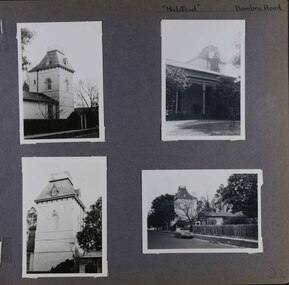 Glen Eira Historical Society
Album - Album page, Halstead, Bambra Road, Circa 1972
... The later tower is of architectural interest for its use of Medieval Romanesque enrichment. trevor hart caulfield north bambra road 1850's halstead james dickson mansion villa residence cast iron verandah pavillion wings halstead street victorian tower balustrading decorative brackets mansard roof brick cast iron slate roof curved windows single storey mansions streetscapes Medieval Romanesque style slate roofs gardens cast iron work Hand written: "Halstead" Bambra Road [top right] / 32 [bottom right] Page 32 of Photograph Album with four photographs of the exterior of this double storey house, focussing on different angles for the house's tower. ...This photograph is part of the Caulfield Historical Album 1972. This album was created in approximately 1972 as part of a project by the Caulfield Historical Society to assist in identifying buildings worthy of preservation. The album is related to a Survey the Caulfield Historical Society developed in collaboration with the National Trust of Australia (Victoria) and Caulfield City Council to identify historic buildings within the City of Caulfield that warranted the protection of a National Trust Classification. Principal photographer thought to be Trevor Hart, member of Caulfield Historical Society. Most photographs were taken between 1966-1972 with a small number of photographs being older and from unknown sources. All photographs are black and white except where stated, with 386 photographs over 198 pages.From the Victorian Heritage Register Database - Citation for Halstead, 23 Bambra Road as at (as at 12/10/2020) https://vhd.heritagecouncil.vic.gov.au/places/276 Halstead is believed to be the oldest standing residence in Caulfield constructed in 1857 with subsequent additions during the 19th Century. The house was built for and owned by James Dickson, a stock agent, until his death in 1880. Although on a much reduced parcel of land, Halstead is one of the few remaining remnants of Caulfield when it was an area of mansion houses occupied by town residing squatters, professional and business men. It is important for its place in the socio-economic history of south eastern suburban Melbourne, the inland pattern of development stretching from Malvern through Murrumbeena. Architecturally the single storey building displays a history of alteration and addition. Its main front presents with a single storey cast iron verandah across the full width, including the two pavilion wings at each end. Located towards the rear on the Halstead Street side is the substantial three storey tower with its Mansard roof and cast-iron balustrade which makes the house clearly visible from Halstead Street and Bambra Road. Because of internal alteration the importance of the building relates to the exterior only of the main house. Halstead is believed to be the oldest standing residence in the city of Caulfield. https://vhd.heritagecouncil.vic.gov.au/places/43645 "Halstead" is regionally important as a surviving large villa from the early Victorian (1850's) period, offering insights into the lifestyles of the privileged in Caulfield at that time. The later tower is of architectural interest for its use of Medieval Romanesque enrichment.Page 32 of Photograph Album with four photographs of the exterior of this double storey house, focussing on different angles for the house's tower.Hand written: "Halstead" Bambra Road [top right] / 32 [bottom right] trevor hart, caulfield north, bambra road, 1850's, halstead, james dickson, mansion, villa residence, cast iron verandah, pavillion wings, halstead street, victorian, tower, balustrading, decorative brackets, mansard roof, brick, cast iron, slate roof, curved windows, single storey mansions, streetscapes, medieval romanesque style, slate roofs, gardens, cast iron work -
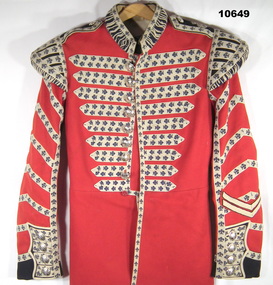 Bendigo Military Museum
Uniform - BAND TUNIC, GRENADIER GUARDS, Peter MASLEN, 1981
... Tunic has wings and shoulder straps (epaulettes) with embroidered Battalion motto - Queen's crown above circular ribbon with the words (in french) "HONI-SOIT-QUI-MAL-Y-PENSE. Translation is "Shame To Him Who Thinks Evil of Him" or "Evil Be To Him Who Evil Thinks"; in the centre is the Royal Cypher. Tunic fronts are trimmed with nine bars of double...Tunic has wings and shoulder straps (epaulettes) with embroidered Battalion motto - Queen's crown above circular ribbon with the words (in french) "HONI-SOIT-QUI-MAL-Y-PENSE. Translation is "Shame To Him Who Thinks Evil of Him" or "Evil Be To Him Who Evil Thinks"; in the centre is the Royal Cypher. Tunic fronts are trimmed with nine bars of double ...This uniform Tunic belonged to Peter MASLEN Regiment No. 24125234. Unit 2nd Battalion Grenadier Guards. MASTER TAILOR British Army. retired from 1985 when came to Australia with wife. Information from Donation form- "Band uniform for Military Tattoo/ (England) Grenadier Orchestra/ 1981 - Berlin Tattoo/ - uniform is to do with the choir/2nd Battalion Grenadier Guards/ handmade - Peter made all the uniforms".Uniform tunic Army. Tunic fabric - scarlet superfine wool with black velvet cuffs and stand up collar. Collar edges with narrow white with red cotton Drummers Lace (braid) and has blue and white worsted fringing. Tunic has wings and shoulder straps (epaulettes) with embroidered Battalion motto - Queen's crown above circular ribbon with the words (in french) "HONI-SOIT-QUI-MAL-Y-PENSE. Translation is "Shame To Him Who Thinks Evil of Him" or "Evil Be To Him Who Evil Thinks"; in the centre is the Royal Cypher. Tunic fronts are trimmed with nine bars of double Drummer's Lace (Braid) and fastened with eight large regimental plastic silver buttons with shank and moulded insignia - Queens Crown with Royal Cypher. There is additional lace on the back, skirt sleeves and on both shoulder epaulettes. Additional buttons on back, shoulders and sleeve cuffs. Left sleeve has two rank stripes - Corporal. Two brass belt hooks at waist. Tunic Lining - cotton fabric. Cream colour to body of tunic and sleeves. Red colour to skirt of tunic Two white cotton fabric labels attached front interior tunic lining. Handwritten details on back lining. Information details on labels - top, black ink print. "GRENADIER GUARDS/ DRUMMER/ WARRANT NO. 102/110/ NAME???/ HEIGHT???/ BREAST ??? WAIST ???/ B.L. WAIST??/ COLLAR ??/ KAS ??? & PARTNERS LTD " (Many details illegible) lower label - red ink print " ??? + ??? / MADE IN ENGLAND/ NAME". Information on back lining - blue ink pen - handwritten "6176/CARUANA/ ML/ DRUMS".uniform, tunic, army, grenadier guards, england -
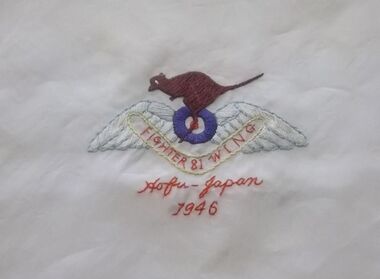 Bendigo Historical Society Inc.
Clothing - GERMAN HERITAGE SOCIETY COLLECTION: SILK SCARF
... Material sewn double. One end has an embroidered airman's wings in cream and light blue, In the centre of the wings is a red, white and blue bull's eye and over the bull's eye is a brown kangaroo. ...Material sewn double. One end has an embroidered airman's wings in cream and light blue, In the centre of the wings is a red, white and blue bull's eye and over the bull's eye is a brown kangaroo. ...Item 19. Cream silk scarf. Material sewn double. One end has an embroidered airman's wings in cream and light blue, In the centre of the wings is a red, white and blue bull's eye and over the bull's eye is a brown kangaroo. Below the bull's eye is a pale yellow boomerang shaped area with 'Fighter 81 Wing' embroidered in it. Underneath it all is embroidered 'Hofu - Japan 1946'. At the other end are some embroidered flowers and leaves. The leaves are pale grey and cream and the flowers are three shades of pink. One pink flower has a cream edge and one flower is cream. The flowers have red centres.bendigo, clubs, bendigo heritage, german heritage society collection - silk scarf, fighter 81 wing, hofu japan -
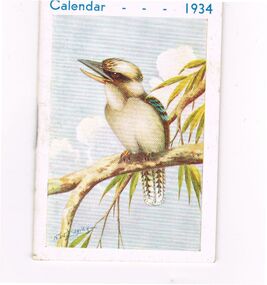 Bendigo Historical Society Inc.
Domestic Object - POCKET CALENDAR 1934, 1934
... wings sitting on a brown tree branch with green leaves. Behind the kookaburra is white clouds and blue sky. At the top in blue print is Calendar - - - 1934. Inside is Calendar 1934 printed in black with a black border. At the bottom is *Printed in Australia* A double...wings sitting on a brown tree branch with green leaves. Behind the kookaburra is white clouds and blue sky. At the top in blue print is Calendar - - - 1934. Inside is Calendar 1934 printed in black with a black border. At the bottom is *Printed in Australia* A double ...BHS CollectionPocket Calendar 1934:- White background with a kookaburra brown and white with blue on the wings sitting on a brown tree branch with green leaves. Behind the kookaburra is white clouds and blue sky. At the top in blue print is Calendar - - - 1934. Inside is Calendar 1934 printed in black with a black border. At the bottom is *Printed in Australia* A double page has the month at the top and the date and day at the left side and lines at each day to take notes. Several pages at the back were blank with Notes in black ink at the top. Box 625Luxton & Hooper, Printers, Sydneyephemera, mementoes, calendars, luxton & hooper printers, sydney -
Coal Creek Community Park & Museum
Music Sheets
... / Poor Little Me 12 - My Dear / Why / You're as Pretty as a Picture / My Own (2 Copies) 13 - Cinderella Sweetheart / Hi-Ho Silver 14 - That Week In Paris / Two Sleep People 16 - Rock it for me / Say THat You Care For Me 17 - On The Bumpy Road to Love / There's Honey On The Moon Tonight 18 - The Same Sweet You / On Parade 21 - Cinderella / The Chestnut Tree 22 - Skating Down The Old Mill Stream / What Have You Got That Gets Me 26 - All Ashore / Sixty Seconds Got Together 32 - I Go For That / Junior 33 - The Great Waltz / Don't Wake Up My Heart 34 - Strike Up The Band / Kinda Lonesome 35 - Peace Of Mind / minute For Modern Miss 37 - The Night / Honolulu 38 - Hang Your Heart On A Rickory Limb / That Sly Old Gentleman 40 - Grandma Said / Something to Sing about 41 - Loving You / Killy-Ka-lee / I'll Still Be Loving You 91 - Waltzes From Vienna 96 - To You Sweetheart Aloha / Did I Remember 102 - At The Close Of A Long, Long Day / I Have Lost Me Heart In Budapest 111 - Man Of My Dreams / Life Is Empty Without Love 120 - Have You Ever Been Lonely / Sitting In The Dark 121 - And So I Married The Girl / Someone to Care For 122 - Thank Heaven For You / All Over Italy 123 - There's a Bridle Hanging On The Wall / You'll Never Go To Heaven 125 - There's a Lull in my Life / A Nic Cup Of Tea 138 - On Wings of a Song / Harmony Lane 149 - Swing it Here to Sway / The One Rose 150 - What Harlem is Tome 156 - Fifty Million Robins Can't Be Wrong / Nice Work If You Can Get It 162 - Sail Along, Silvery Moon / I Love To Whistle 164 - I Double Dare You / The Snake Charmer 168 - Sweet As A Song / Toodle Do 177 - I've Got A Pocketful of Dreams / When The Organ Played Promise Me 182 - This May Be The Night / I've Got A Date With A Dream 179 - At A Perfume Counter / On Linger Longer Island 183 - I Married An Angel / Spring is Here.../ Poor Little Me 12 - My Dear / Why / You're as Pretty as a Picture / My Own (2 Copies) 13 - Cinderella Sweetheart / Hi-Ho Silver 14 - That Week In Paris / Two Sleep People 16 - Rock it for me / Say THat You Care For Me 17 - On The Bumpy Road to Love / There's Honey On The Moon Tonight 18 - The Same Sweet You / On Parade 21 - Cinderella / The Chestnut Tree 22 - Skating Down The Old Mill Stream / What Have You Got That Gets Me 26 - All Ashore / Sixty Seconds Got Together 32 - I Go For That / Junior 33 - The Great Waltz / Don't Wake Up My Heart 34 - Strike Up The Band / Kinda Lonesome 35 - Peace Of Mind / minute For Modern Miss 37 - The Night / Honolulu 38 - Hang Your Heart On A Rickory Limb / That Sly Old Gentleman 40 - Grandma Said / Something to Sing about 41 - Loving You / Killy-Ka-lee / I'll Still Be Loving You 91 - Waltzes From Vienna 96 - To You Sweetheart Aloha / Did I Remember 102 - At The Close Of A Long, Long Day / I Have Lost Me Heart In Budapest 111 - Man Of My Dreams / Life Is Empty Without Love 120 - Have You Ever Been Lonely / Sitting In The Dark 121 - And So I Married The Girl / Someone to Care For 122 - Thank Heaven For You / All Over Italy 123 - There's a Bridle Hanging On The Wall / You'll Never Go To Heaven 125 - There's a Lull in my Life / A Nic Cup Of Tea 138 - On Wings of a Song / Harmony Lane 149 - Swing it Here to Sway / The One Rose 150 - What Harlem is Tome 156 - Fifty Million Robins Can't Be Wrong / Nice Work If You Can Get It 162 - Sail Along, Silvery Moon / I Love To Whistle 164 - I Double Dare You / The Snake Charmer 168 - Sweet As A Song / Toodle Do 177 - I've Got A Pocketful of Dreams / When The Organ Played Promise Me 182 - This May Be The Night / I've Got A Date With A Dream 179 - At A Perfume Counter / On Linger Longer Island 183 - I Married An Angel / Spring is Here Music Sheets ...A collection of 41 music sheets. 5 - The Blackpool Walk / Angels of the Mons 6 - Love is Where you Find It / A Little Love, A Little Kiss 9 - Brown Eyes, Why are You Blue? / Poor Little Me 12 - My Dear / Why / You're as Pretty as a Picture / My Own (2 Copies) 13 - Cinderella Sweetheart / Hi-Ho Silver 14 - That Week In Paris / Two Sleep People 16 - Rock it for me / Say THat You Care For Me 17 - On The Bumpy Road to Love / There's Honey On The Moon Tonight 18 - The Same Sweet You / On Parade 21 - Cinderella / The Chestnut Tree 22 - Skating Down The Old Mill Stream / What Have You Got That Gets Me 26 - All Ashore / Sixty Seconds Got Together 32 - I Go For That / Junior 33 - The Great Waltz / Don't Wake Up My Heart 34 - Strike Up The Band / Kinda Lonesome 35 - Peace Of Mind / minute For Modern Miss 37 - The Night / Honolulu 38 - Hang Your Heart On A Rickory Limb / That Sly Old Gentleman 40 - Grandma Said / Something to Sing about 41 - Loving You / Killy-Ka-lee / I'll Still Be Loving You 91 - Waltzes From Vienna 96 - To You Sweetheart Aloha / Did I Remember 102 - At The Close Of A Long, Long Day / I Have Lost Me Heart In Budapest 111 - Man Of My Dreams / Life Is Empty Without Love 120 - Have You Ever Been Lonely / Sitting In The Dark 121 - And So I Married The Girl / Someone to Care For 122 - Thank Heaven For You / All Over Italy 123 - There's a Bridle Hanging On The Wall / You'll Never Go To Heaven 125 - There's a Lull in my Life / A Nic Cup Of Tea 138 - On Wings of a Song / Harmony Lane 149 - Swing it Here to Sway / The One Rose 150 - What Harlem is Tome 156 - Fifty Million Robins Can't Be Wrong / Nice Work If You Can Get It 162 - Sail Along, Silvery Moon / I Love To Whistle 164 - I Double Dare You / The Snake Charmer 168 - Sweet As A Song / Toodle Do 177 - I've Got A Pocketful of Dreams / When The Organ Played Promise Me 182 - This May Be The Night / I've Got A Date With A Dream 179 - At A Perfume Counter / On Linger Longer Island 183 - I Married An Angel / Spring is Here -
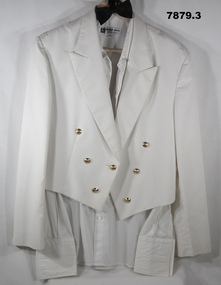 Bendigo Military Museum
Uniform - MESS DRESS, RAAF, 1993
... wings - RAAF. Lining - white colour polyester fabric. White cotton manufacturers label inside right side of jacket. 2. Shirt - white colour polyester/cotton fabric, dress shirt, collar, stiff front with buttonholes for studs and long sleeves with double cuff and buttonholes for cufflinks. ...wings - RAAF. Lining - white colour polyester fabric. White cotton manufacturers label inside right side of jacket. 2. Shirt - white colour polyester/cotton fabric, dress shirt, collar, stiff front with buttonholes for studs and long sleeves with double cuff and buttonholes for cufflinks. ...Uniform, Sqd Leader Shane Wright. For his Service History Refer Cat No. 7877.61. Jacket - white colour polyester viscose fabric, mess dress style - Summer. Collar and long lapels. Shoulder tapes for epaulettes. Gold colour plastic buttons with shank and metal pin. Raised emlem, crown and wings - RAAF. Lining - white colour polyester fabric. White cotton manufacturers label inside right side of jacket. 2. Shirt - white colour polyester/cotton fabric, dress shirt, collar, stiff front with buttonholes for studs and long sleeves with double cuff and buttonholes for cufflinks. White colour plastic buttons. White colour polyester manufacturers label, below collar inside. 3. Bowtie - black colour polyester/cotton fabric. Bowtie is prefolded and stitches on ribbon with black metal hook and ring closer.Manufacturers information - black ink print. 1. "ADI/ VICTORIA/ 1993^/ 8405-66-131. 8010/ SIZE 110R/ TO FIT CHEST 110/ SERVICE NO/ NAME/ 65% Poly 35% Visc/ Dry Clean Only". 2. "RA/ PHILIPPE ANTON/ MADE IN AUSTRALIA/ 44".uniform, raaf, mess dress, summer -
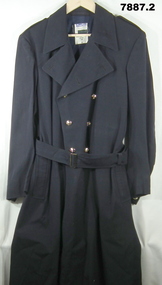 Bendigo Military Museum
Uniform - OVERCOAT, RAAF, 1966
... Collar, shoulder epaulettes with grey colour embroidered lettering - "RAAF", double breasted, gold colour plastic buttons with shank and raised emblem, Queens crown and wings - RAAF. ...Collar, shoulder epaulettes with grey colour embroidered lettering - "RAAF", double breasted, gold colour plastic buttons with shank and raised emblem, Queens crown and wings - RAAF. ...1. Coat - dark blue colour wool fabric RAAF overcoat. Collar, shoulder epaulettes with grey colour embroidered lettering - "RAAF", double breasted, gold colour plastic buttons with shank and raised emblem, Queens crown and wings - RAAF. Inset side pockets. Blue colour cotton lining with concealed pocket. White cotton manufacturers label. Inside back below collar. 2. Belt - fabric as coat with gold colour plastic slide buckle.Manufacturers Information - blue and black ink print. 1. Blue ink print "DAVID KLEIN/ PTY LTD/ 22 PATRICK ST. MEL/ 32 3771/ NAME/ DATE/ PURE WOOL" Black ink print - "DAVID KLEIN PTY LTD/ VICTORIA / 1966/ ^/"uniform, raaf, overcoat -
 St Kilda Historical Society
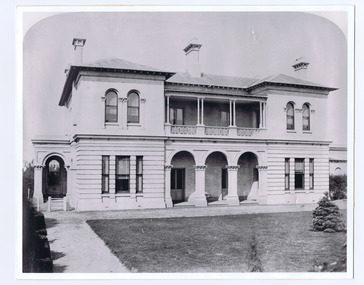
Photograph - Building, Donald McDonald, Inverleith, c.1872
... Picture of late 19th century double storey mansion with central arcaded entry way with two symmetrical wings with arched portico to the side. ...Picture of late 19th century double storey mansion with central arcaded entry way with two symmetrical wings with arched portico to the side. ...Picture of late 19th century double storey mansion with central arcaded entry way with two symmetrical wings with arched portico to the side. Classical romanesque style. Part of Donald McDonald collection of images.J F McMullen. Backed, unmounted copy of black and white photo, good condition.Inverleith, Acland St, E side, residence of J F McMullen banker,photograph 1872, flats now stand on Acland St frontage'acland street, st kilda, mansions, inverleith -
 Nillumbik Shire Council
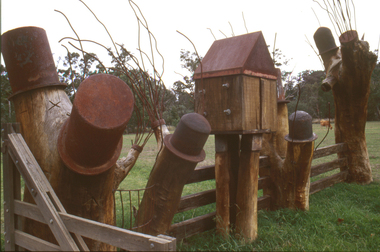
Sculpture: Tony Trembath (b.1946 Sale, Victoria), Tony Trembath, The Fences Act 1968 - Location: Edendale Farm (entrance) 30 Gastons Road, Eltham, 1989 - 1994
... wings, which bend inward. To the left of the entrance, a simple architectural element indicates an isolated farmhouse. The rustic fence runs between the groups of tree trunks with native planting in clumps along it. The fence-line incorporates a functional engineered double...wings, which bend inward. To the left of the entrance, a simple architectural element indicates an isolated farmhouse. The rustic fence runs between the groups of tree trunks with native planting in clumps along it. The fence-line incorporates a functional engineered double ...Eltham Council (now the Shire of Nillumbik) commissioned this work in 1989 to create an entrance / gateway to Edendale Community Farm. It was also aided by a grant from the Ministry of the Arts (now Arts Victoria). The former name of this work was "Gateway to Edendale Farm". Edendale Farm is a demonstration farm modelling sustainable environmental practices, providing support to the local residents of Nillumbik. Established in 1986, the land was purchased in 1970. It was previously an English gentleman's residence and was used for grazing. It consists of 5.6 hectares, with the Diamond Creek meandering through the property. The Victorian Fences Act 1968 governs liability of occupiers of adjoining lands to fence, and deals with disputes between neighbours regarding boundaries fences and costs. This work took into consideration ideas and suggestions from residents and committees, who required the use of recycled materials and that the work celebrate man's relationship with nature, animals and the earth, as well as relate to the fence-line on the far side of the carpark. Trembath also absorbed significant aspects of local history, making references to Eltham's agricultural past, the clearing of the land, the destruction of trees, the ruthless pruning of trees by suburban Councils and incorporated such Australian features as the post and rail fence. 'The Fences Act 1968' is significant for aesthetic, historic and social reasons at a regional level. It makes prominent the historical and social significance of Edendale and the rural aspects of Nillumbik. The use of existing tree stumps and salt pots in the work explores the iconography of the countryside such as the isolated farmhouse, pioneering farming practices, post and rail fencing and the regrowth of lopped trees. The title of the work, as well as the extensive community involvement in its creation, also makes reference to the Victorian Fences Act 1968, which makes neighbours jointly responsible for the cost of construction and maintenance of fences in the partitioning of land for settlement. 'The Fences Act 1968' has been classified as of regional significance by the National Trust of Australia. The work is an installation of wood and metal, approximately twenty five meters long. The design is very informal and rustic and runs the full width of the fence-line. It comprises groups of recycled tree trunks fitted with metal caps (chrome-nickel 'salt pots' that are shaped like tall bowler / top hats). Metal rods protrude from the trunks and some of these rods have metal birds. Two larger, sentinel-like stumps at the two outer ends have metal flame-like wings, which bend inward. To the left of the entrance, a simple architectural element indicates an isolated farmhouse. The rustic fence runs between the groups of tree trunks with native planting in clumps along it. The fence-line incorporates a functional engineered double gate and post and rail fencing. There may be many interpretations of the work and the intention is to stimulate interest and imagination rather than alienate. Interpretation is based on the personal experience that a visitor brings. The artist recommended that no explanation of the design logic be positioned with the work. N/Apublic art, sculpture, edendale, recycled, wood, metal, fences act 1968, gate, trembath, salt pot, tree stumps -
 Hume City Civic Collection
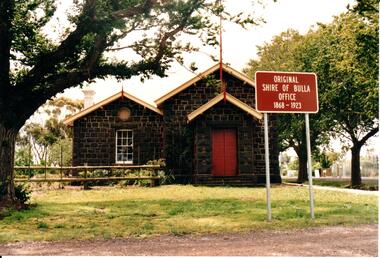
Photograph
... It is a bluestone building, double fronted with a pitched roof on both wings and above the porch. ...It is a bluestone building, double fronted with a pitched roof on both wings and above the porch. ...The former bluestone Bulla Shire Hall building was constructed in 1867 and remained the centre of local government until the early 20th century when the administration was moved to Sunbury. In the 1990's the Alister Clark Rose Garden was established in the surrounding grounds. The garden is open to the public all the year round. In 1999 the rose garden was officially opened.A coloured photograph of the front elevation of the original Shire of Bulla offices. It is a bluestone building, double fronted with a pitched roof on both wings and above the porch. The woodwork trims have been painted in cream and red. The double wooden front door is painted red. The sign outside the building indicates the former function of the building and its importance.ORIGINAL/SHIRE OF BULLA/OFFICE/1868-1923shire of bulla, council chambers, rose gardens, rose growing, bulla township, roses, clark, alistair, george evans collection -
 Surrey Hills Historical Society Collection
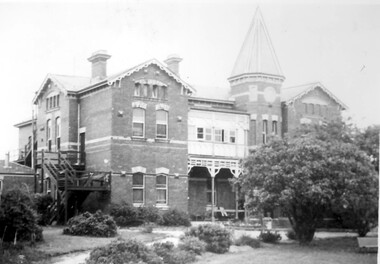
Photograph, Nethercourt Private Hospital, Union Road Surrey Hills in late 1930s
... Black and white photo of a double-storey brick building with a tower. There is a veranda between the tower and one of the wings of the building. ...No & if missing"; "This is a copy"; "595" Black and white photo of a double-storey brick building with a tower. There is a veranda between the tower and one of the wings of the building. ...In 1935 Mrs Eliza tank transferred her private hospital 'Nethercourt' from Wilson Street to 219-223 Union Road. She has operated it at the Wilson Street address from 1916. The Union Road building had originally been Surrey College, a boarding school for boys built in 1889 by Rev Dr Darling. It was not the success hoped for. In 1905 it briefly became Milverton College for girls, after which it was used as a nursing home or small private hospital. By the 1960s it was known as 'Norwich Hospital' and later still 'St Jude's'. It closed as a hospital in 1983. The land at the front facing Union Road was sub-divided off and the building became a private home fronting Barton Street. As a private residence it was rendered and painted.Black and white photo of a double-storey brick building with a tower. There is a veranda between the tower and one of the wings of the building. This is enclosed at the upper level. On one side there is an external set of stairs and an out building. The building is approached by a circular driveway. There are mature bushes in front of the building.On copy photo in lead pencil: "? No & if missing"; "This is a copy"; "595"nethercourt hospital, milverton college, matron eliza tank, norwich private hospital, rev darling, st judes private hospital, hospitals, surrey college -
 Dandenong/Cranbourne RSL Sub Branch
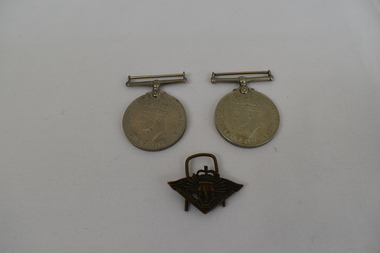
Medal - Australion Service Medal/ War Medal .Return From Active Service Badge. No ribbons on medals
... The reverse depicts a lion standing on a double headed dragon. 1939 - 1945 in inscribed above lion. The Return From Active Service Badge is a Tri - Service badge with ( anchor - wings and rising sun) surmounted by the Queen's Crown....The reverse depicts a lion standing on a double headed dragon. 1939 - 1945 in inscribed above lion. The Return From Active Service Badge is a Tri - Service badge with ( anchor - wings and rising sun) surmounted by the Queen's Crown. ...R. Murphy VX30391 was born in Colac (Vic). 26th June 1906. Enlisted Royal Park (Vic). on the 31st May 1940. Served with 2/8th Field Company .R.A.E.Australian Service Medal 1939-1945. 1939 - 1945 Defence Medal. Return From Active Service Badge.Australian Service Medal has Crowned effigy of George the V1 on obverse face. The reverse depicts the Australian Coat of Arms with kangaroo and emu surrounded by words The Australian Service Medal. 1939 1945. Inscribed on rim of medal VX30381 R. Murphy. Defence Medal has crowned effigy of George the V1 on the obverse face. The reverse depicts a lion standing on a double headed dragon. 1939 - 1945 in inscribed above lion. The Return From Active Service Badge is a Tri - Service badge with ( anchor - wings and rising sun) surmounted by the Queen's Crown. -
 Linton and District Historical Society Inc
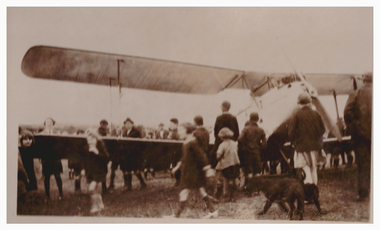
Photograph, Aeroplane Landing at Linton Park, 1928, 1928
... To promote ASTOR RADIO a Gypsy Moth double seater aircraft flew low over towns to advertise. ASTOR RADIO was written under both wings. by Boltes) staying overnight. ...To promote ASTOR RADIO a Gypsy Moth double seater aircraft flew low over towns to advertise. ASTOR RADIO was written under both wings. by Boltes) staying overnight. ...Picture in photograph album donated by Mrs Faull. The plane landed at Linton Park as part of an advertising campaign by Astor Radios in 1928. Information provided by Ron Preston of Linton: "The day the plane landed in Linton Park / late 20s. Fairbanks and Harrison operated a garage in Sussex St opposite Bryant's shop. Fairbanks was married to Carrie Murrell's sister Dorrie and William (Bill) Harrison was married to Dulcie Nicol. Among other things that the garage sold were ASTOR RADIOS. To promote ASTOR RADIO a Gypsy Moth double seater aircraft flew low over towns to advertise. ASTOR RADIO was written under both wings. by Boltes) staying overnight. Both Harrison & Fairbanks were taken up for a ride. The pilot "dive-bombed" the local children, many of them seeking shelter under the bridge, as they were frightened, not having seen a plane up close before." Sepia photograph of a biplane surrounded by a crowd of people. One of three photographs of this occasion, the others are Registration nos. 627.1 & 627.2"1st aeroplane to land in Linton 1928". events, faull collection, aeroplanes, linton park
