
Showing 7 items matching "dr. w f bottomley"
-
 Emerald Museum & Nobelius Heritage Park
Booklet - File of medical-related information
... ...Dr. W F Bottomley...Documents relating to medicines, some relating to items in the Dr Bottomley collection Emerald Victoria Australia doctors (medical) Dr. W F Bottomley Photocopy of document 'Obstetric Forceps' pp16 (unreferenced)|instruction booklet for Haemacytometer|First Aid Hints (Trafalgar Trading Co. ...Documents relating to medicines, some relating to items in the Dr Bottomley collectionPhotocopy of document 'Obstetric Forceps' pp16 (unreferenced)|instruction booklet for Haemacytometer|First Aid Hints (Trafalgar Trading Co. Pty Ltd)|Wartime newspaper cutting advertisement for Lantigen C|Stypwool instruction leafletemerald, victoria, australia, doctors (medical), dr. w f bottomley -
 Emerald Museum & Nobelius Heritage Park
Functional object - Apothecary weights, H.B. Selby, 1900s
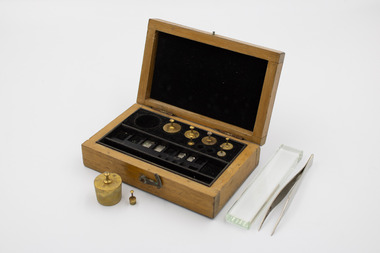
... ...Dr. W F Bottomley...They are also significant because they were used by Dr William Bottomley, who owned property in Emerald and whose business dealings significantly shaped the development of the town. Emerald Victoria Australia Gold weights Apothecary weights Bottomley Fischer Dr. W F ...These Victorian-era apothecary scales are from the collection of equipment used by Dr William Bottomley. Dr Bottomley was born in Fitzroy in 1881 and obtained a Bachelor of Surgery from the University of Melbourne in 1906. He lived in South Yarra with a weekend log cabin called Forest Lodge in Emerald and practiced in Collins Street in Melbourne. These weights were used with a scale to dispense correct quantities of drugs or ingredients; the tweezers may have been used to combine substances on the glass slide ready for use. In the 1920s Dr Bottomley and business partner W.H. Treganowan initiated the Emerald Country Club syndicate to purchase land from Carl Axel Nobelius' Gembrook Nurseries estate, which led to the formation of the golf course and Country Club facilities. Bottomley Drive in Emerald is named after Dr Bottomley; the street is located near Silver Birches, the house commissioned by the doctor from modernist architect Harry Norris. These weights were used with a scale to dispense correct quantities of drugs or ingredients; the tweezers may have been used to combine substances on the glass slide ready for use. The apothecary system of weights was tailored to measuring medicinal ingredients; it and the Troy system (which was used for measuring precious metals such as silver and gold) both have twelve ounces to the pound, in comparison to the Avoirdupois method which was used for heavier items and had sixteen ounces to the pound. These measurement systems were used extensively throughout the world until the 1960s when the widespread adoption of the metric system standardised processes.These items are significant as they provide insights into medical practice in the early Twentieth-Century in Melbourne and surrounds. They are also significant because they were used by Dr William Bottomley, who owned property in Emerald and whose business dealings significantly shaped the development of the town.Wooden box with a metal latch, maker's label and owner's name. Inside the box there is a black cloth lining to encase eight brass and five tin weights, a glass slide and tweezers. There is space for an additional brass weight and eight tin weights, but these spaces are empty.Obverse: D W H BOTTOMLEY / H.B SELBY & CO. LTD. / SCIENTIFIC APPARATUS / MELBOURNE & SYDNEY /emerald, victoria, australia, gold weights, apothecary weights, bottomley, fischer, dr. w f bottomley, w.h. treganowan, harry norris, forest lodge, silver birches, medical practice, drug dispensing, pharmacy equipment, h.b. selby & co, emerald country club and golf course -
Emerald Museum & Nobelius Heritage Park
Functional object - Hellige Normal Haemometer, F. Hellige & Co, 1927/1928
... ...Dr. W F Bottomley...Dr Hermann Sahli. It comprises of measurement and extraction vials and a bakelite receptacle that is used to test hemoglobin concentration in blood. These items are significant as they provide insights into medical practice in the early Twentieth-Century in Melbourne and surrounds. They are also significant because they were used by Dr William Bottomley, who owned property in Emerald and whose business dealings significantly shaped the development of the town. Emerald Victoria Australia Bottomley Fischer Dr. W F ...This Victorian-era Normal Haemometer is from the collection of equipment used by Dr William Bottomley. Dr Bottomley was born in Fitzroy in 1881 and obtained a Bachelor of Surgery from the University of Melbourne in 1906. He lived in South Yarra with a weekend log cabin called Forest Lodge in Emerald and practiced in Collins Street in Melbourne. In the 1920s Dr Bottomley and business partner W.H. Treganowan initiated the Emerald Country Club syndicate to purchase land from Carl Axel Nobelius' Gembrook Nurseries estate, which led to the formation of the golf course and Country Club facilities. Bottomley Drive in Emerald is named after Dr Bottomley; the street is located near Silver Birches, the house commissioned by the doctor from modernist architect Harry Norris. This is a haemometer set which was manufactured in Germany by the Hellige company in 1928. It is based on the haemoglobin estimation system developed by the Bernese (Swiss) haematologist, Dr Hermann Sahli. It comprises of measurement and extraction vials and a bakelite receptacle that is used to test hemoglobin concentration in blood.These items are significant as they provide insights into medical practice in the early Twentieth-Century in Melbourne and surrounds. They are also significant because they were used by Dr William Bottomley, who owned property in Emerald and whose business dealings significantly shaped the development of the town.Rectangular maroon case made of leatherette with a hinge lid and two metal latches. Internally has blue and cream satin and velvet designed to cushion and protect the materials. Within the case is; The Haemometer unit made of bakelite, flanked by two permanent tinted glass reference bars on the front face. A square measuring tube with dual scales. Pipette and two glass stirring rods other different lengths. a Reagent vial, possibly filled with hydrochloric acid.Case: 'Hellige / Normal Haemometer' Haemometer: 'HELLIGE / GERMANY' Measuring Tube: Yellow/White Scales features numerals '10-140' in multiples of 10. Followed by 'Sahli-Wert / Hellige' Red Scales features numerals '10-170' in multiples of 10. Followed by '%Hgb'emerald, victoria, australia, bottomley, fischer, dr. w f bottomley, w.h. treganowan, harry norris, forest lodge, silver birches, medical practice, drug dispensing, pharmacy equipment, h.b. selby & co, emerald country club and golf course -
Emerald Museum & Nobelius Heritage Park
Functional object - Hillege Haemacytometer, F. Hellige & Co, 1920s
... ...Dr. W F Bottomley...They are also significant because they were used by Dr William Bottomley, who owned property in Emerald and whose business dealings significantly shaped the development of the town. Emerald Victoria Australia Bottomley Fischer Dr. W F ...This Victorian-era Hellige Haemacytometer is from the collection of equipment used by Dr William Bottomley. Dr Bottomley was born in Fitzroy in 1881 and obtained a Bachelor of Surgery from the University of Melbourne in 1906. He lived in South Yarra with a weekend log cabin called Forest Lodge in Emerald and practiced in Collins Street in Melbourne. In the 1920s Dr Bottomley and business partner W.H. Treganowan initiated the Emerald Country Club syndicate to purchase land from Carl Axel Nobelius' Gembrook Nurseries estate, which led to the formation of the golf course and Country Club facilities. Bottomley Drive in Emerald is named after Dr Bottomley; the street is located near Silver Birches, the house commissioned by the doctor from modernist architect Harry Norris. The Hellige Cell-Counting Haemocytometer is a precision glass microscope slide and diluting kit used to manually count the number of red blood cells or white blood cells in a specific volume of blood.These items are significant as they provide insights into medical practice in the early Twentieth-Century in Melbourne and surrounds. They are also significant because they were used by Dr William Bottomley, who owned property in Emerald and whose business dealings significantly shaped the development of the town.Rectangular maroon case made of leatherette with a hinge lid and two metal latches. Internally has blue velvet designed to cushion and protect the materials however this colouring has since faded. Within the case is; Haemacytometer / Neubauer Counting Chamber: rectangular and made of glass with four grooves in the centre. Underneath are several glass slips. Red Blood Cell Pippete: glass pippete with chamber in the centre containing a red bead with orange rubber tubing at both ends. White Blood Cell Pippete: slightly shorter glass pippete with a smaller chamber containing a white bead, has a piece of tubing at the top. Stirrer rod (broken into two pieces): stirrer rod made of glass with tubing on one end. Case: 'Hellige / Haemacytometer' Haemacytometer / Neubauer Counting Chamber: 'Neubaur', Symbol/Logo of F. Hillege & Co, '70344', '0,1mm D / 1⁄400sq.mm' Red Blood Cell Pippete: 'HILLEGE / 31077 / K', contains numerals '05 / 1 / 101' White Blood Cell Pippete: 'HILLEGE / 79112 / K', contains numerals '05 / 1 / 11' Glass Stirrer Rod: '20cmm'emerald, victoria, australia, bottomley, fischer, dr. w f bottomley, w.h. treganowan, harry norris, forest lodge, silver birches, medical practice, drug dispensing, pharmacy equipment, h.b. selby & co, emerald country club and golf course -
Emerald Museum & Nobelius Heritage Park
Functional object - Klinostik 'Super Diagnostic' ENT & Ophthalmic Instrument Set, F. Hellige & Co, 1920s
... ...Dr. W F Bottomley...They are also significant because they were used by Dr William Bottomley, who owned property in Emerald and whose business dealings significantly shaped the development of the town. Emerald Victoria Australia Bottomley Fischer Dr. W F ...This Victorian-era Hellige Haemacytometer is from the collection of equipment used by Dr William Bottomley. Dr Bottomley was born in Fitzroy in 1881 and obtained a Bachelor of Surgery from the University of Melbourne in 1906. He lived in South Yarra with a weekend log cabin called Forest Lodge in Emerald and practiced in Collins Street in Melbourne. In the 1920s Dr Bottomley and business partner W.H. Treganowan initiated the Emerald Country Club syndicate to purchase land from Carl Axel Nobelius' Gembrook Nurseries estate, which led to the formation of the golf course and Country Club facilities. Bottomley Drive in Emerald is named after Dr Bottomley; the street is located near Silver Birches, the house commissioned by the doctor from modernist architect Harry Norris. The Hellige Cell-Counting Haemocytometer is a precision glass microscope slide and diluting kit used to manually count the number of red blood cells or white blood cells in a specific volume of blood.These items are significant as they provide insights into medical practice in the early Twentieth-Century in Melbourne and surrounds. They are also significant because they were used by Dr William Bottomley, who owned property in Emerald and whose business dealings significantly shaped the development of the town.Rectangular brown case made of leatherette with a hinge lid and a single metal latch. The inside of the case is a velvet light brown with thin walls and shapes to house the materials. Within the case is; Battery Handle: Large Cylindrical black textured handle with a chrome cap and pocket clip. Rectangular brown case made of leatherette with a hinge lid and a single metal latch. The inside of the case is a velvet light brown with thin walls and shapes to house the materials. Within the case is; Battery Handle: Large Cylindrical black textured handle with a chrome cap and pocket clip. Spare light bulbs: Three small spare light bulbs, one with a blue glass mount, one with a white glass mount and the third seems to be a copper bulb. Othoscope: Chrome and black-enameled attachment. Features a hinged, swiveling magnifying glass at the top and attached to ear speculums. Removable Magnifying Window/Cap: Circular, chrome-rimmed glass piece that screwed onto rear viewing end of the Otoscope. Ear/Nasal Speculum: Three brown ear speculums, all three have different nozzle widths and lengths. Laryngeal / Post-Nasal Mirror: Two post-nasal mirrors of different sizes on a thin metal stem with an attachment on the end to connect to the light carrier. Bent-Arm Illuminator / Laryngeal Stem: Long, curved chrome has a tiny light bulb at one end and a smaller handle at the other end.Case: Exterior 'National' and Interior 'National' attached to a ribbon on the inside roof of the lid. Battery Handle: 'OFF' engraved on the top end, 'Klinostick / REGD' Laryngeal / Post-Nasal Mirror (Smaller): '2 / BOILABLE' Laryngeal / Post-Nasal Mirror (Larger): '4 / BOILABLE' Ear/Nose Speculum (Widest Nozzle): 'NATIONAL E.I. CO. / NASAL' Ear/Nose Speculum (Medium Nozzle): 'NATIONAL E.I CO. / MEDIUM' Ear/Nose Speculum (Skinniest Nozzle): 'NATIONAL E.I CO. / CHILD' emerald, victoria, australia, bottomley, fischer, dr. w f bottomley, w.h. treganowan, harry norris, forest lodge, silver birches, medical practice, drug dispensing, pharmacy equipment, h.b. selby & co, emerald country club and golf course -
 Emerald Museum & Nobelius Heritage Park
Booklet, W.S.F. Bottomley, An Old Plague And a New Remedy, 1911
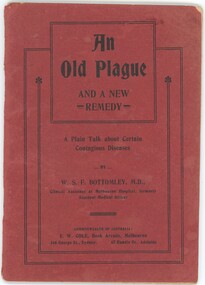
... Dr Bottomley's argument for treating sexually transmitted diseases as a public health problem in the early 20th century when this was not a widely held view. Dr Bottomley also has close connections with the origin of the Emerald Country Club. Dr Bottomley An Old Plague and a New Remedy 1911 Silver Birches Emerald Country Club On front cover: 'An / Old Plague / And A New / Remedy / A Plain Talk About Certain / Contagious Diseases / By / W. S. F ...Dr William Bottomley (1881-1952) was a specialist based at Collins Street who advocated for humanist and practical solutions to public health issues. His love of the Emerald countryside which he visited at weekends with his family led him to being the primary instigator of the late 1920s development - the iconic and beautiful Emerald Country Club. He later retired to Emerald where he built a Modernist-inspired home, Silver Birches, which is of architectural significance. This 1911 booklet outlines his argument for sexually transmitted diseases to be treated as a public health issue instead of the practice at that time which was to blame the victim.This book is significant because it outlines Dr Bottomley's argument for treating sexually transmitted diseases as a public health problem in the early 20th century when this was not a widely held view. Dr Bottomley also has close connections with the origin of the Emerald Country Club.Booklet with dark red paper cover. 30 pages.On front cover: 'An / Old Plague / And A New / Remedy / A Plain Talk About Certain / Contagious Diseases / By / W. S. F. Bottomley M. D., / Clinical Assistant at Melbourne Hospital, formerly / Resident Medical Officer / Commonwealth of Australia / E. W. Cole, Book Arcade, Melbourne / 346 George St., Sydney 67 Rundle St., Adelaide'dr bottomley, an old plague and a new remedy, 1911, silver birches, emerald country club -
Emerald Museum & Nobelius Heritage Park
Certificate - Medical degree
... Medical degree for Dr Bottomley Emerald Victoria Australia education doctors (medical) W F Bottomley University of Melbourne University of Melbourne degree Doctor of Medicine W F Bottomley 1906 Certificate Medical degree ...Medical degree for Dr BottomleyUniversity of Melbourne degree Doctor of Medicine W F Bottomley 1906emerald, victoria, australia, education, doctors (medical), w f bottomley, university of melbourne
