
Showing 8 items matching "dress regulations"
-
 Bendigo Military Museum
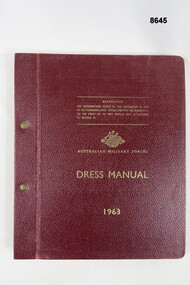
Manual - DRESS MANUAL 1963, Australian Military Forces, 1963
... ...Dress Regulations...Passchendaele Barracks Trust PBT 70 Manual Dress Regulations Army The manual applies to all ranks of the Regular Army, Citizens Military Forces, the Reserve of Officer, the Engineer and Railways Staff Corps, and the Australian Cadet Corp when in uniform. ...The manual applies to all ranks of the Regular Army, Citizens Military Forces, the Reserve of Officer, the Engineer and Railways Staff Corps, and the Australian Cadet Corp when in uniform. It also gives guidance for the wearing of civilian clothes.passchendaele barracks trust, pbt 70, manual, dress regulations, army -
 Heidelberg Golf Club
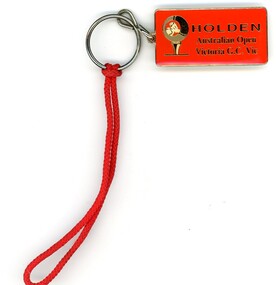
Badge - Admission Badge, Braider Pty Ltd, Admission tag to Australian Open 2002, 2002
... Victoria Golf Club 21-24 Nov 2002. Dress regulations apply”...Victoria Golf Club 21-24 Nov 2002. Dress regulations apply” Red enamel on metal with red strap. ...Admission tag to Australian Open 2002. Played at Victoria Golf Club 21-24 Nov 2002. Bruce Harding was a rules official at this Australian Open at Victoria Golf Club.Bruce Harding is a past HGC President and was involved with Victoria's junior teams, the Victorian Golf Association and was a rules official..Red enamel on metal with red strap. Keyring style.Obverse: “Holden Australian Open Victorian GC Vic” Reverse: “Admits to course and clubhouse. Victoria Golf Club 21-24 Nov 2002. Dress regulations apply”bruce harding, australian open (golf) -
 Heidelberg Golf Club
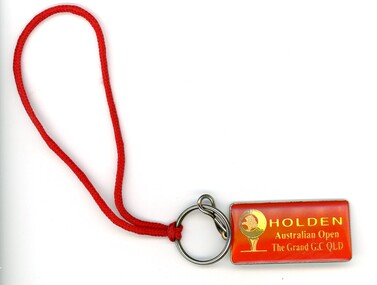
Badge - Admission Badge, Braider Pty Ltd, Admission tag to Australian Open 2001, 2001
... The Grand Golf Club 22-25 Nov 2001. Dress regulations apply”...The Grand Golf Club 22-25 Nov 2001. Dress regulations apply” Red enamel on metal with red strap. ...Admission tag to Australian Open 2002. Played at The Grand Golf Club, Queensland 22-25 Nov 2001. Bruce Harding was a rules official at this Australian Open at The Grand Golf Club, Queensland.Bruce Harding is a past HGC President and was involved with Victoria's junior teams, the Victorian Golf Association and was a rules official..Red enamel on metal with red strap. Keyring style.Obverse: “Holden Australian Open The Grand GC QLD” Reverse: “Admits to course and clubhouse. The Grand Golf Club 22-25 Nov 2001. Dress regulations apply”bruce harding, australian open (golf) -
 Montmorency–Eltham RSL Sub Branch
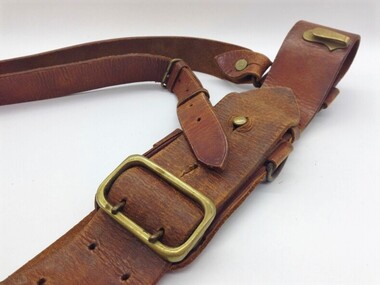
Uniform - Sam Browne Belt, Sam Browne Belt (brown leather)
... In 1858, Browne lost his left arm in battle (as a result of a sword cut) and as the dress regulations of his regiment required officers to wear their waist belts under their tunics, Browne found this ungainly and devised an external belt supported on the left-hand (sword) side by a shoulder strap. ...In 1858, Browne lost his left arm in battle (as a result of a sword cut) and as the dress regulations of his regiment required officers to wear their waist belts under their tunics, Browne found this ungainly and devised an external belt supported on the left-hand (sword) side by a shoulder strap. ...The Samuel Browne belt is named after Sir Samuel James Browne VC. In 1858, Browne lost his left arm in battle (as a result of a sword cut) and as the dress regulations of his regiment required officers to wear their waist belts under their tunics, Browne found this ungainly and devised an external belt supported on the left-hand (sword) side by a shoulder strap. The belt had two shoulder straps when a holster was worn. In the Australian Army, a brown leather version is worn on ceremonial occasions by officers and Warrant Officers Class One of all corps, except those who wear silver dress embellishments (Armoured, Aviation and Nursing Corps). These members wear a black Sam Browne belt. Wide brown pattern stitched brown leather belt with adustable shoulder strap, brass buckle and brass loop fittings (4 at the top and 2 at the bottom) attached to the belt by stitched leather straps.Nonesam browne, belt, clothing -
 City of Melbourne Libraries
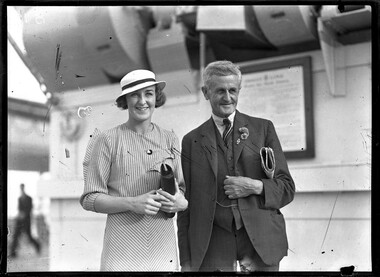
Photograph, Bull, Hugh Jones, 1897-1993, Miss Joan Hartigan and Mr Harley Malcolm embark on the RMS Orford for Wimbledon
... At the 1933 Wimbledon Women’s Final, in front of the King and Queen, English champion Dorothy Round wore her trademark sleeveless dress with a divided skirt and her American competitor Helen Jacobs wore white, tailored shorts with a black stripe on each side, described as “mannish, though businesslike.” In November 1933, the Victorian Lawn Tennis Association officially allowed shorts as regulation...At the 1933 Wimbledon Women’s Final, in front of the King and Queen, English champion Dorothy Round wore her trademark sleeveless dress with a divided skirt and her American competitor Helen Jacobs wore white, tailored shorts with a black stripe on each side, described as “mannish, though businesslike.” In November 1933, the Victorian Lawn Tennis Association officially allowed shorts as regulation ...“MISS JOAN HARTIGAN, the well known New South Wales tennis player, who intends to play at Wimbledon this year. A photograph taken on board R.M.S. Orford before she sailed yesterday.” - The Age Photographer notations on slide: "B19" Published: Age (Melbourne, Vic. : 1854 - 1954), Wednesday 21 March 1934, page 13 Published title: MISS JOAN HARTIGAN Published caption: MISS JOAN HARTIGAN the well-known New South Wales tennis player, who intends to play at Wimbledon this year. A photograph taken on board R.M.S. Orford before she sailed yesterday. Trove article identifier: http://nla.gov.au/nla.news-article203827087 Description: On the deck of a ship, a smiling young woman wearing a white hat, printed fabric dress with brooch and holding a black clutch bag stands next to a middle aged man wearing a dark three piece suit and necktie with cornflower buttonhole and lapel pin and a newspaper under his arm. Research by project volunteer, Fiona Collyer: Twenty-one year old Australian Championships, (now known as the Australian Open) winner Miss Joan Hartigan and Mr Harley Malcolm, Lawn Tennis Association of Australia (LTAA) Honorary Secretary and referee, embark on the R.M.S. Orford at Station Pier, Port Melbourne on their way to Wimbledon. The Australian Test cricket and Davis Cup teams were also on the same voyage. Joan Marcia Hartigan (Bathurst) 1912-2000 from Sydney, won the Australian Championships three times in 1933, 1934, 1936 and was a Wimbledon semifinalist in 1934, 1935. A tall, stylish presence in visor and pleated dress, Joan was renowned for her power game and her “upside down backhand” i.e. striking the shot with the same face of the racquet that she hit her forehand. Joan’s world ranking was No.8 in 1934. Unfortunately, her career was interrupted by the outbreak of WW11 with international matches suspended for five years. Joan enlisted in the Australian Military Forces during WW11 and in 1947 she married Hugh Bathurst, private secretary to Senator James Fraser, Prime Minister Ben Chifley’s Health Minister. They had a daughter Mary and a son Thomas who became Chief Justice of NSW. Joan died in Sydney in 2000. In October 1933, Mr Harley Malcolm, declared “I consider shorts not regulation costume and would stop both men and women, particularly women, wearing them. I think women’s desire to strut in such a costume is unreasonable.” However, Harley was on the wrong side of history. In Europe and USA, many women tennis players were swapping their long skirts and stockings for bare legs, short skirts and shorts and men their long flannels for tailored shorts. In 1933, Henry “Bunny” Austin stunned the Wimbledon crowd when he wore shorts onto Centre Court - the first top male player to do so. He found it too hot to play in long trousers so he asked his tailor to run up some prototype shorts. At the 1933 Wimbledon Women’s Final, in front of the King and Queen, English champion Dorothy Round wore her trademark sleeveless dress with a divided skirt and her American competitor Helen Jacobs wore white, tailored shorts with a black stripe on each side, described as “mannish, though businesslike.” In November 1933, the Victorian Lawn Tennis Association officially allowed shorts as regulation dress at Kooyong for both sexes. In 1935, Dorothy wore her shorts while competing in Melbourne at the Australian Championships, Kooyong and there was hardly a murmur of dissent. Mr Harley Malcolm was involved with Australian tennis for 57 years, first as a player, then as a referee and administrator. He always wore a cornflower buttonhole on his lapel as he said the blue in that flower was his favourite colour. Cornflowers are sometimes referred to as “bachelor’s button” due to the old practice of men wearing cornflower buttonholes to indicate they are either in love or ready for courting. The Bleuet de France is the French flower of remembrance. References: WOMEN CITIZENS' MOVEMENT. (1934, March 21). The Age (Melbourne, Vic. : 1854 - 1954), p. 13. Retrieved March 20, 2024, from http://nla.gov.au/nla.news-article203827087 'Joan Hartigan', Wikipedia, https://en.wikipedia.org/wiki/Joan_Hartigan Leading Tennis Referee Condemns Wearing of Shorts (1933, October 5). The Herald (Melbourne, Vic. : 1861 - 1954), p. 11. Retrieved March 6, 2024, from http://nla.gov.au/nla.news-article243193607 REMEMBERING 57 YEARS OF TENNIS (1947, December 10). Daily Mercury (Mackay, Qld. : 1906 - 1954), p. 5. Retrieved April 1, 2024, from http://nla.gov.au/nla.news-article171166922Photographer notations on slide: "B19".tennis, 1930-1939, ships, sport, clothing and dress -
 City of Melbourne Libraries
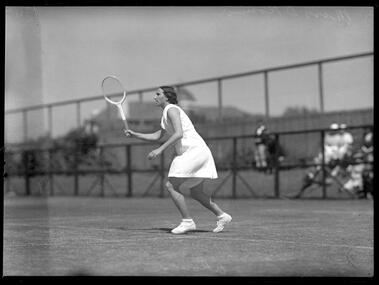
Photograph, Bull, Hugh Jones, 1897-1993, Tennis player, Dorothy Round, Albert Grounds, Melbourne
... (Herald 5/10/1933) However, by November 1933 the Victorian Lawn Tennis Assn officially allowed shorts as regulation dress at Kooyong for both sexes. One speaker suggested that as the majority of women were knock-kneed, the privilege of wearing shorts would not be taken up extensively by them. ...(Herald 5/10/1933) However, by November 1933 the Victorian Lawn Tennis Assn officially allowed shorts as regulation dress at Kooyong for both sexes. One speaker suggested that as the majority of women were knock-kneed, the privilege of wearing shorts would not be taken up extensively by them. ...Dorothy Round in shorts English-born Dorothy Round (1909-1982) plays tennis at Albert Park Cricket Ground, wearing her signature white sleeveless dress with divided skirt, pleated to form loose shorts. Dorothy won Wimbledon in 1934 and 1937, and the Australian Open in 1935. In the early 1930s, many women players in Europe and USA swapped stockings and long skirts for bare legs, short skirts and shorts. In October 1933, Mr Harley Malcolm, Secretary of Lawn Tennis Association Australia (LTAA) declared, “I consider shorts not regulation costume and would stop both men and women, particularly women, wearing them. I think women’s desire to strut themselves in such a costume is unreasonable.” However by November, the Victorian Lawn Tennis Association (VLTA) officially allowed shorts at Kooyong for both sexes. At the July 1934 Wimbledon Women’s Final, played in front of the King and Queen, Dorothy wore a sleeveless dress with the skirt divided. Her American competitor, Helen Jacobs, wore white tailored shorts with a black stripe on either side, described as “mannish, though businesslike”. In October, Australian tennis player Mrs Nell Hopman warned, “When Miss Dorothy Round arrives in a few weeks’ time, the LTAA will have to reconsider its decision about women playing in dresses, as she is sure to bring a trunkful of shorts. Miss Round has a “shorts only” rule which I fancy she will stick to here. She is the most stylish player I saw abroad.” The papers also reported that “Mrs Hopman saw no “he girls” among tennis players in Europe. Even the almost universal rule for shorts did not make them look masculine.” Dorothy said, “I wear shorts because they do not get in the way as a frock does. Mine are made in one piece and this avoids any tightness around the waist.” Featured in "Newsworthy: Melbourne in photographs 1933-1936" exhibition at East Melbourne Library, October to December 2023. Exhibition caption by project volunteer, Fiona Collyer. Photographer notations on slide: "Mrs D Round; D Round B6" Description: Dorothy Round plays tennis at Albert Grounds, Albert Park, Melbourne. She is wearing her signature white sleeveless dress with divided skirt, pleated to form loose shorts. Research by project volunteer, Fiona Collyer: Dorothy Round (1909-1982) was an English tennis champion from Dudley, Worcestershire. She won the Wimbledon Women’s Singles in 1934 and 1937. In 1935 she won the Australian Championships Women’s Singles in Melbourne. Dorothy won the Mixed Doubles at Wimbledon in 1934, 1935 and 1936. Dorothy was a staunch Methodist and taught Sunday School at Dudley Wesleyan Methodist Church throughout her career. She did not drink, smoke, dance or play tennis on Sundays and declined to compete in the 1933 French Open as tennis officials refused to comply to her scheduling preferences of No Sundays. During the Wightman Cup in New York when play was rained out on the Saturday, Dorothy refused to return on the Sunday. Officials reluctantly agreed to reschedule the clash for Monday, where she put in a sub par performance, prompting the New York Times to quip “Miss Round doesn’t play on Sundays, and doesn’t play particularly well on Mondays!”. In the early 1930s many women tennis players in Europe and USA abandoned their stockings and long skirts for bare legs, short skirts and shorts and some men swapped their long flannel trousers for shorts. British player Henry “Bunny” Austin was the first top male player to wear shorts at Centre Court Wimbledon in 1933, and his sister Joan Lycett nee Austin became the first female player to play without stockings on Centre Court, appearing with bare legs and ankle socks in 1931. In 1933 Mr Harley Malcolm, Secretary of the Lawn Tennis Association Australia (LTAA) and referee of big tournaments , said “the rules say regulation costume must be worn – I consider shorts are not regulation costume and would stop both men and women, particularly women, wearing them. I think women’s desire to strut themselves in such a costume is unreasonable.” (Herald 5/10/1933) However, by November 1933 the Victorian Lawn Tennis Assn officially allowed shorts as regulation dress at Kooyong for both sexes. One speaker suggested that as the majority of women were knock-kneed, the privilege of wearing shorts would not be taken up extensively by them. He added that women were not intended by nature to wear such garments. Another member mentioned that men were rather handsome objects and “works of art” and would carry off the short pants vogue nicely. (Sun Sydney 15/11/33) At the 1934 Wimbledon Singles Finals, playing in front of King George V and Queen Mary, Dorothy wore her signature outfit of sleeveless white dress with the skirt divided and pleated to form loose shorts and American Helen Jacobs wore white tailored shorts with a black stripe on either side described as “mannish, though business like.” In the lead up to Dorothy’s arrival in Australia to compete in the Australian Championship of 1935, there was much speculation written in the press about Dorothy’s preference for wearing shorts. Tennis player Mrs Nell Hopman warned “When Miss Dorothy Round arrives in a few weeks’ time, the Australian Lawn Tennis Association will have to reconsider its decision about women playing in dresses, as she is sure to bring a trunkful of shorts.” “Miss Round has a “shorts only” rule which I fancy she will stick to here. She is the most stylish player abroad.” Mrs Hopman saw no “he girls” among the tennis players in Europe. Even the almost universal rule for shorts did not make them look masculine. Mrs Hopman brought back a couple of pleated pairs that tennis player and designer Mrs Fearnley-Whittingstall (nee Eileen Bennett) made popular and worn by most English players. “They are really quite radical for they look no more startling than a short, pleated skirt” she said. (Newcastle Sun 1/10/1934) Writing for the Sydney Morning Herald 6/12/34, Dorothy said ”I have heard that a photograph of a player wearing shorts was sent to the Queen for her approval and I understand that she said in reply “that they were very attractive”. The Queen is a frequent and interested visitor to Wimbledon so this story is most credible and possibly explains the lack of official opposition to shorts this year.” “I wear shorts because they do not get in the way as a frock does. You have probably noticed that mine are made in one piece and this avoids any tightness around the waist. I don’t know whether shorts have come to stay. They do not suit everybody and the majority of the men don’t like the women in them and this may help condemn the fashion. I really think the men dislike them because too many people who shorts obviously do not suit rushed to be in the fashion and the result was devastating. For my part, I hope that this comfortable fashion endures.” Dorothy’s doubles partner, English tennis champion Fred Perry, did not approve of shorts for men and was particularly perturbed at the idea of women wearing them. Fred always wore long, white flannel trousers and white collared polo shirt on the tennis court. In July 1935 Dorothy took up a post as a dress designer and sportswear design advisor at British outfitters Jaeger. She published two books – “Modern Lawn Tennis” in 1935 and ”Tennis for Girls” in 1938 – described as cheerful and sensible guides. In 1937, Dorothy married Dr Douglas Leigh Little at Dudley Wesleyan Methodist Church. Her wedding dress was designed by renowned fashion designer Teddy Tinling who specialised in designing tennis dresses. (Tinling designed the dress worn by Billie Jean King for the famous “Battle of the Sexes” tennis match against Bobby Riggs in 1973.) News reel co. Gaumont British News filmed the wedding, showing 10,000 people, mostly women, surging towards the couple, describing it as a riot, and quipping that Dorothy’s forehand was useful when cutting the wedding cake. The city of Dudley gifted the couple an antique walnut bedroom suite chosen by them. Dorothy and Douglas had a son, Ian, and a daughter, Patricia. She gave up competitive tennis to coach and write newspaper articles. In later life she took up golf. Dorothy died of cancer in 1982 aged 73. She was inducted into the International Tennis Hall of Fame 1986. In 2004 a bronze bust of Dorothy was installed at Wimbledon, and in 2013 a life size bronze statue was erected at Priory Park, Dudley. References: MRS. HOPMAN RETURNS (1934, October 1). The Newcastle Sun (NSW : 1918 - 1954), p. 9. Retrieved September 20, 2023, from http://nla.gov.au/nla.news-article166292409 FIGURED IT OUT (1933, November 15). The Sun (Sydney, NSW : 1910 - 1954), p. 13 (FINAL EXTRA). Retrieved September 20, 2023, from http://nla.gov.au/nla.news-article230199908 FASHIONS OF THE TENNIS COURTS. (1934, December 6). The Sydney Morning Herald (NSW : 1842 - 1954), p. 7 (Women's Supplement). Retrieved September 20, 2023, from http://nla.gov.au/nla.news-article28021332 Leading Tennis Referee Condemns Wearing of Shorts (1933, October 5). The Herald (Melbourne, Vic. : 1861 - 1954), p. 11. Retrieved September 20, 2023, from http://nla.gov.au/nla.news-article243193607 DOROTHY ROUND Chooses Going-Away TROUSSEAU (1937, September 4). The Australian Women's Weekly (1933 - 1982), p. 39. Retrieved September 20, 2023, from http://nla.gov.au/nla.news-article51588090 Ban On Shorts For Tennis Girls? (1934, April 15). The Sun (Sydney, NSW : 1910 - 1954), p. 3. Retrieved February 5, 2024, from http://nla.gov.au/nla.news-article230535547 Dorothy Round Little - one of Britain's greatest champions, 13 September 2009, Tennis Forum, https://www.tennisforum.com/threads/dorothy-round-little-one-of-britains-greatest-champions.409612/Photographer notations on slide: "Mrs D Round; D Round B6".tennis, clothing and dress, 1930-1939 -
 Bendigo Military Museum
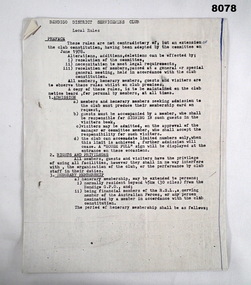
Document - RULES BDSC, Bendigo District Servicemen's Club, C.1978
... The document relates to the Rules and Regulations of the new Bendigo District Servicemen's Club Havilah Rd Bendigo. Rules cover among other, admission, rights, membership, dress, misconduct, guests, gambling, club hours, trading & complaints. ...The document relates to the Rules and Regulations of the new Bendigo District Servicemen's Club Havilah Rd Bendigo. Rules cover among other, admission, rights, membership, dress, misconduct, guests, gambling, club hours, trading & complaints. ...The document relates to the Rules and Regulations of the new Bendigo District Servicemen's Club Havilah Rd Bendigo. Rules cover among other, admission, rights, membership, dress, misconduct, guests, gambling, club hours, trading & complaints. Refer Cat No 8073P for more details. Item in the collection re David Patterson, refer cat No 8070.Document paper 4 pages stapled in top RH corner, all text in black with sections underlined re headings, item is a photo copy."Bendigo District Servicemen's Club - Local Rules"brsl, smirsl, bdsc, rules -
 St Vincent's Hospital Melbourne Archives
Album - Agnes McLean, photographs at St Vincent's Hospital Melbourne, circa 1926-1928
... Nurses are in full uniform, cap, starched loose fitting, long sleeved white linen dresses buttoned to drop waist with belt, white stockings and heeled court leather regulation shoes. ...Nurses are in full uniform, cap, starched loose fitting, long sleeved white linen dresses buttoned to drop waist with belt, white stockings and heeled court leather regulation shoes. ...Photos include nursing colleagues in uniform, in theatre and night duty, social occasions at St Vincent's. Nurses are in full uniform, cap, starched loose fitting, long sleeved white linen dresses buttoned to drop waist with belt, white stockings and heeled court leather regulation shoes. Religious Sisters of Charity in full black winter habits, veils and rosary beads. Laying of new building (later: Healy) Foundation Stone 1928, celebrations in Druids Wing, Brenan Hall.st vincent's hospital melbourne, brenan hall, religious sisters of charity, nurses, foundation stone 1928
