
Showing 132 items matching "during flight"
-
 Moorabbin Air Museum
Document (item) - CA-15 Emergency procedures during flight Survey of commercial pilots metal fatigue Die penetrants HPR3 Handley Page performance and design details Boeing A300 B767 Turkish airline DC10 crash 3 march 1974 Avro Anson Nomad N24A high speed flight WW1 Australian pilots Australian aircraft registration Aermacchi MB-326H Jim Bede CAC Wallaby ESAMS remote piloted helicopter types of British aircraft up to 1918 SR71 U2 Ken Wallis Little Nelly Jean Batten Bob Miles Gypsy Moth Molyneux helicopter CA 25 FLUT-R-Bug Chipmunk Chris Neale Perfectus Ellis Walker New Comet Beagle Landing areas in Australia Fishermans Bend airport Southern Cross Southern Cross Junior Akro Laser Short Scion Pierpont Langley Jeep plane Homebuilt plane criteria R33 R101 R100 Graf Zeppelin Corrosion DEF Aust 143 Weight control of aircraft DCA No.17 Airtruck F14 B-1 F-4 F-15 A-6 F-16 F/A-18 CH-53E AH-64 A-10 F-5 Space Shuttle Winjeel DC-3 Her Majesty the Queen ME 410 Nestler Scout Bellmodel 214 Loire 11 Schweizer model 300 Antonov An-8 camp Nanchang cj-6 Nieuport de Lage ni-D.122 Junker K 39 ICA Brasov IAR-823 Les Mureaux 120 F&W C-3603 Spitfire Lockheed C-36 Pilatus PC-6 Heinkel He 115 Canadair CL-215 Curtiss JN-4 Jenny Antonov An-2 colt Boeing KC-135 Stuka Liberator B-52 Morane Saulnier Bf-109 Dewoitine Yak-3 F-5 KFIR F-100 B-1B B-25 B-17 Fokker D VII Mustang F-16 Aeritalia Aermacchi Fishbed Mikoyan Hawker Hunter PZL P.11 Yakovlev Yak-11 Dassault Alpha jet Westland Lynx Magni PM-3-4 Letov S 50 Partenavia P.64 Piaggio P.149D Breda Ba 64 Aerotec A-122 Farman F.40 McCulloch H-30 Junkers K 53 Cessna U-3 Bf 161, CAC Keith Meggs collection
... CA-15 Emergency procedures during flight Survey of commercial pilots metal fatigue Die penetrants HPR3 Handley Page performance and design details Boeing A300 B767 Turkish airline DC10 crash 3 march 1974 Avro Anson Nomad N24A high speed flight WW1 Australian pilots Australian aircraft registration Aermacchi MB-326H Jim Bede CAC Wallaby ESAMS remote piloted helicopter types of British aircraft up to 1918 SR71 U2 Ken Wallis Little Nelly Jean Batten Bob Miles Gypsy Moth Molyneux helicopter CA 25 FLUT-R-Bug Chipmunk Chris Neale Perfectus Ellis Walker New Comet Beagle Landing areas in Australia Fishermans Bend airport Southern Cross Southern Cross Junior Akro Laser Short Scion Pierpont Langley Jeep plane Homebuilt plane criteria R33 R101 R100 Graf Zeppelin Corrosion DEF Aust 143 Weight control of aircraft DCA No.17 Airtruck F14 B-1 F-4 F-15 A-6 F-16 F/A-18 CH-53E AH-64 A-10 F-5 Space Shuttle Winjeel DC-3 Her Majesty the Queen ME 410 Nestler Scout Bellmodel 214 Loire 11 Schweizer model 300 Antonov An-8 camp Nanchang cj-6 Nieuport de Lage ni-D.122 Junker K 39 ICA Brasov IAR-823 Les Mureaux 120 F&W C-3603 Spitfire Lockheed C-36 Pilatus PC-6 Heinkel He 115 Canadair CL-215 Curtiss JN-4 Jenny Antonov An-2 colt Boeing KC-135 Stuka Liberator B-52 Morane Saulnier Bf-109 Dewoitine Yak-3 F-5 KFIR F-100 B-1B B-25 B-17 Fokker D VII Mustang F-16 Aeritalia Aermacchi Fishbed Mikoyan Hawker Hunter PZL P.11 Yakovlev Yak-11 Dassault Alpha jet Westland Lynx Magni PM-3-4 Letov S 50 Partenavia P.64 Piaggio P.149D Breda Ba 64 Aerotec A-122 Farman F.40 McCulloch H-30 Junkers K 53 Cessna U-3 Bf 161...CAC Keith Meggs collection Document CA-15 Emergency procedures during flight Survey of commercial pilots metal fatigue Die penetrants HPR3 Handley Page performance and design details Boeing A300 B767 Turkish airline DC10 crash 3 march 1974 Avro Anson Nomad N24A high speed flight WW1 Australian pilots Australian aircraft registration Aermacchi MB-326H Jim Bede CAC Wallaby ESAMS remote piloted helicopter types of British aircraft up to 1918 SR71 U2 Ken Wallis Little Nelly Jean Batten Bob Miles Gypsy Moth Molyneux helicopter CA 25 FLUT-R-Bug Chipmunk Chris Neale Perfectus Ellis Walker New Comet Beagle Landing areas in Australia Fishermans Bend airport Southern Cross Southern Cross Junior Akro Laser Short Scion Pierpont Langley Jeep plane Homebuilt plane criteria R33 R101 R100 Graf Zeppelin Corrosion DEF Aust 143 Weight control of aircraft DCA No.17 Airtruck F14 B-1 F-4 F-15 A-6 F-16 F/A-18 CH-53E AH-64 A-10 F-5 Space Shuttle Winjeel DC-3 Her Majesty the Queen ME 410 Nestler Scout Bellmodel 214 Loire 11 Schweizer model 300 Antonov An-8 camp Nanchang cj-6 Nieuport de Lage ni-D.122 Junker K 39 ICA Brasov IAR-823 Les Mureaux 120 F&W C-3603 Spitfire Lockheed C-36 Pilatus PC-6 Heinkel He 115 Canadair CL-215 Curtiss JN-4 Jenny Antonov An-2 colt Boeing KC-135 Stuka Liberator B-52 Morane Saulnier Bf-109 Dewoitine Yak-3 F-5 KFIR F-100 B-1B B-25 B-17 Fokker D VII Mustang F-16 Aeritalia Aermacchi Fishbed Mikoyan Hawker Hunter PZL P.11 Yakovlev Yak-11 Dassault Alpha jet Westland Lynx Magni PM-3-4 Letov S 50 Partenavia P.64 Piaggio P.149D Breda Ba 64 Aerotec A-122 Farman F.40 McCulloch H-30 Junkers K 53 Cessna U-3 Bf 161 ... -
Moorabbin Air Museum
Document (Item) - List of items checked during a flight, Ansett Flight check form for Captain Elford
... List of items checked during a flight....Ansett Flight check form for Captain Elford Document List of items checked during a flight. ... -
Moorabbin Air Museum
Book - Flying - behind the scenes, Behind the Flight Deck Door
... ...During flight...Flying - behind the scenes Before departure During flight After landing Uniform Aircraft equipment Common questions asked of airline pilots , circa 2018 Behind the Flight Deck Door Book Flying - behind the scenes ...Common questions asked of airline pilots , circa 2018non-fictionCommon questions asked of airline pilots , circa 2018before departure, during flight, after landing, uniform, aircraft equipment -
 National Vietnam Veterans Museum (NVVM)
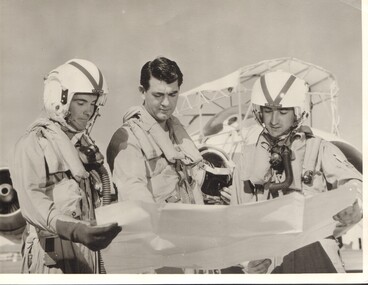
Photograph, Pre-flight Briefing during Conversion to Canberra's
... Pre-flight Briefing during Conversion to Canberra's....John Downing. Pre-flight Briefing during Conversion to Canberra's. Photograph Photograph ...B/w photo of 3 Air Force men examining a document. Two have helmets on.The man in the middle appears to be Wg. Audio, CDr. John Downing.john downing, royal australian air force -
 Dandenong/Cranbourne RSL Sub Branch
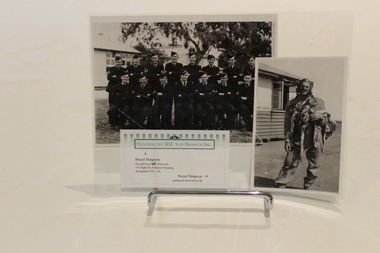
Photograph - 2 x photographs, Unknown
... Both photos contain a picture of A34219 Stuart Simpson during flight training in Archerfield Australia....Both photos contain a picture of A34219 Stuart Simpson during flight training in Archerfield Australia. ...Korean War/Japanese Occupation period historical significance2 x laminated black and white photographs. Both photos contain a picture of A34219 Stuart Simpson during flight training in Archerfield Australia.On rear of photograph hand written 'A' Flight No 8 Aircrew Training Course, Archerfield 1951/52. Stuart Simpson 2nd from left - front row. -
 Bendigo Military Museum
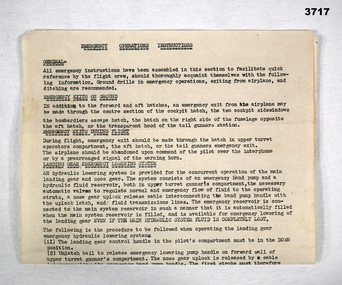
Document - DOCUMENT - AIRCRAFT EMERGENCY OPERATIONS INSTRUCTIONS, c.WWII
... Topics: General, Emergency Exits on Ground, Emergency Exits During Flight, Landing Gear Emergency Lowering System, Emergency Hydrulic Operation of Main Landing Gear Down Position Latches, Caution....Topics: General, Emergency Exits on Ground, Emergency Exits During Flight, Landing Gear Emergency Lowering System, Emergency Hydrulic Operation of Main Landing Gear Down Position Latches, Caution. ...Item in the collection of Arthur Thomas MANLY No 431130 RAAF. Refer Cat No 3710 for his service details.Foolscap size, typed instructions, single sided. Topics: General, Emergency Exits on Ground, Emergency Exits During Flight, Landing Gear Emergency Lowering System, Emergency Hydrulic Operation of Main Landing Gear Down Position Latches, Caution.In black type at top: EMERGENCY OPERATIONS INSTRUCTIONSdocument, raaf, ww2 -
 Port Melbourne Historical & Preservation Society
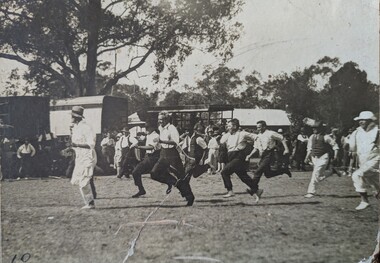
Photograph - Garden City Progress Association, first annual picnic, 17 Feb 1929
... In full flight during a men's spring footrace at the Garden City Progress Association - First Annual Picnic held at Warrandyte....In full flight during a men's spring footrace at the Garden City Progress Association - First Annual Picnic held at Warrandyte. ...In full flight during a men's spring footrace at the Garden City Progress Association - First Annual Picnic held at Warrandyte.Digital duplicate photogarden city, garden city progress association, arts and entertainment, built environment - domestic -
 Ambulance Victoria Museum
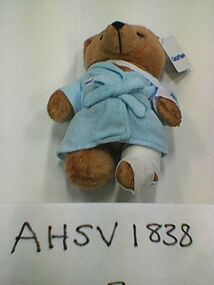
Toy, Bear, CareFlight, circa 2012
... These toys were given to Child Patients during emergency flights. (source: Ian Donaldson the donor worked as a Mica Paramedic on both Rotary and fixed wing aircraft between 1982 and 1990.)...These toys were given to Child Patients during emergency flights. (source: Ian Donaldson the donor worked as a Mica Paramedic on both Rotary and fixed wing aircraft between 1982 and 1990.) careflight Small Brown Toy Bear With blue bathrobe with CareFlight on the front. ...Found in Op Shop by Ian Donaldson in Lilydale price paid 50 cents. These toys were given to Child Patients during emergency flights. (source: Ian Donaldson the donor worked as a Mica Paramedic on both Rotary and fixed wing aircraft between 1982 and 1990.)Small Brown Toy Bear With blue bathrobe with CareFlight on the front. Bandaged arm and leg. Left arm in Sling with CareFlight inscription careFlight label attached to left ear in original package.careflight -
 National Vietnam Veterans Museum (NVVM)
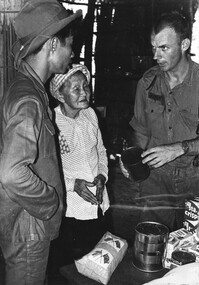
Photograph, Gibbons, Denis, Food Packages
... A black and white photograph of 2Lt Mike Meehan of 161 (Indep) Recce Flight, during a civil affairs visit to Xuyen Moc, explains to a local female villager through an interpreter, the type and use of the food packages being distributed at that time....Photograph 161 Reconnaissance Flight Xuyen Moc 5 RAR 2Lt Mike Meehan Gibbons Collection Catalogue Vietnamese People Interpreter Food Packages Denis Gibbons A black and white photograph of 2Lt Mike Meehan of 161 (Indep) Recce Flight, during a civil affairs visit to Xuyen Moc, explains to a local female villager through an interpreter, the type and use of the food packages being distributed at that time. ...Denis Gibbons (1937 – 2011) Trained with the Australian Army, before travelling to Vietnam in January 1966, Denis stayed with the 1st Australian Task Force in Nui Dat working as a photographer. For almost five years Gibbons toured with nine Australian infantry battalions, posting compelling war images from within many combat zones before being flown out in late November 1970 after sustaining injuries. The images held within the National Vietnam Veterans Museum make up the Gibbons Collection. A black and white photograph of 2Lt Mike Meehan of 161 (Indep) Recce Flight, during a civil affairs visit to Xuyen Moc, explains to a local female villager through an interpreter, the type and use of the food packages being distributed at that time.photograph, 161 reconnaissance flight, xuyen moc, 5 rar, 2lt mike meehan, gibbons collection catalogue, vietnamese people, interpreter, food packages, denis gibbons -
 Running Rabbits Military Museum operated by the Upwey Belgrave RSL Sub Branch
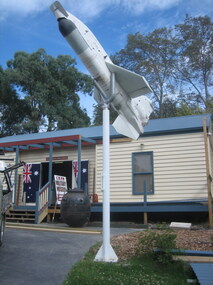
Ikara Missile, Maribyrnong Ordinance Factory in Victoria. et al, 1965
... The upper stabilizer (SVU) housed and electronic package that transmitted flight data back to the launch platform and received updated target acquisition data during flight. Flight maneuverability was provided by elevons fitted into the trailing edge of each wing, these were operated by an actuator system that received flight correction data transmitted to the autopilot from the fire control system. ...The upper stabilizer (SVU) housed and electronic package that transmitted flight data back to the launch platform and received updated target acquisition data during flight. Flight maneuverability was provided by elevons fitted into the trailing edge of each wing, these were operated by an actuator system that received flight correction data transmitted to the autopilot from the fire control system. ...During the 1950’s, the growing threat from Submarines, led the Royal Australian Navy to consider a quick reaction, long range ASW torpedo delivery system as an alternative to the USN’s ASROC and the RN’s Match. Full scale research and development began in 1960 using the Turana target drone as the basis for the delivery platform. Shipboard tests began in 1963 and the Government Aircraft Factory (GAF) began production of three variants M3, M4 and M5 in 1965. The M4 variant had a guidance system designed to interface to a full tactical data handling system while the M3 and M5 variants used a simpler system with a dedicated fire control system. The IKARA is an unmanned miniature aircraft with clip on upper and lower stabilizers and wings. The upper stabilizer (SVU) housed and electronic package that transmitted flight data back to the launch platform and received updated target acquisition data during flight. Flight maneuverability was provided by elevons fitted into the trailing edge of each wing, these were operated by an actuator system that received flight correction data transmitted to the autopilot from the fire control system. The payload, either the Mk44 or Mk46 lightweight torpedo was suspended to the underside of the airframe and faired into the body to provide and aerodynamic shape. The forward section of the body housed the autopilot and the thermal battery unit. Propulsion was provided by the MURAWA steel cased, solid propellant rocket motor with a combined boost and sustainer stage. IKARA was capable of engaging a target to the maximum range of the ships sonar, regardless of weather conditions. Target information is fed into the fire control system, which calculated to drop zone for the torpedo taking into account speed and direction of launch platform and target, win speed etc, then tracking the missile to the drop zone where command signals initiate torpedo release. The IKARA is an unmanned miniature aircraft with clip on upper and lower stabilizers and wings. navy, torpedo, rocket, submarine, missile -
 The Beechworth Burke Museum
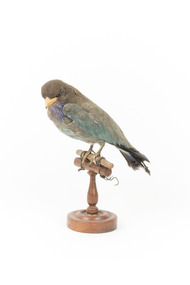
Animal specimen - Dollarbird, Trustees of the Australian Museum, 1860-1880
... Their main source of food is insects which they hunt during flight. They capture these foods while displaying skillful aerial pursuits. ...Their main source of food is insects which they hunt during flight. They capture these foods while displaying skillful aerial pursuits. ...The DollarBird is the only member of the Roller family found in Australia and can be found in forests and woodland areas. The name of this bird comes from the large white spot on the underside of each wing which resemble silver dollars. They travel to Australia each year to breed from New Guinea and the surrounding area. Their main source of food is insects which they hunt during flight. They capture these foods while displaying skillful aerial pursuits. They then return to the same perch they were upon when they left to catch their food. This specimen is part of a collection of almost 200 animal specimens that were originally acquired as skins from various institutions across Australia, including the Australian Museum in Sydney and the National Museum of Victoria (known as Museums Victoria since 1983), as well as individuals such as amateur anthropologist Reynell Eveleigh Johns between 1860-1880. These skins were then mounted by members of the Burke Museum Committee and put-on display in the formal space of the Museum’s original exhibition hall where they continue to be on display. This display of taxidermy mounts initially served to instruct visitors to the Burke Museum of the natural world around them, today it serves as an insight into the collecting habits of the 19th century.This specimen is part of a significant and rare taxidermy mount collection in the Burke Museum. This collection is scientifically and culturally important for reminding us of how science continues to shape our understanding of the modern world. They demonstrate a capacity to hold evidence of how Australia’s fauna history existed in the past and are potentially important for future environmental research. This collection continues to be on display in the Museum and has become a key part to interpreting the collecting habits of the 19th century.This juvenile Dollar bird's feet are a faded brown and the bill is a light yellow. The colour of this specimen's head and neck are a cool grey which fades to a patch of bright purple on its upper chest. The back is grey while the underbelly and wings are a light blue-grey. The tail feathers are tipped in black. The specimen is standing on a wooden mount.taxidermy mount, taxidermy, animalia, burke museum, beechworth, australian museum, skin, reynell eveleigh johns, bird, dollar bird -
 Department of Energy, Environment and Climate Action
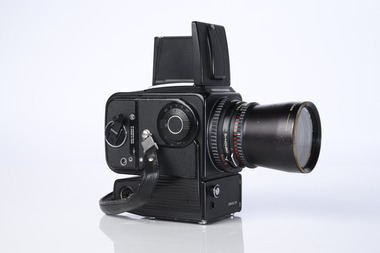
Hasselblad aerial camera
... Motorised cameras with a large film capacity had obvious advantages and were essential when access to the camera was not possible during flight. It is also essential for the shutter to operate at low temperatures and those lubricated with silicones were recommended. ...Motorised cameras with a large film capacity had obvious advantages and were essential when access to the camera was not possible during flight. It is also essential for the shutter to operate at low temperatures and those lubricated with silicones were recommended. ...Aerial photos were used to make maps of forest types, timber resources, to survey logging areas and regeneration, to mark boundaries of public land and new plantations, to identify new roads and tracks, as well as for fire suppression. Infrared film was sometimes used to monitor insect and disease attack. The images needed to sharp, with high contrast, and in a large format (most were printed in B&W on 9-inch by 9-inch glossy photographic paper) with at least a 60% overlap to enable stereoscopic viewing and with a 20-30% side lap to allow for aircraft drift. Preferably, the photo scale was close to the final map scale avoid to problems when enlarging and to reduce distortion. Something was needed to supplement the very expensive and infrequent large-area photography programs. From the mid-1960s Victorian foresters began experimenting with small format 70mm and 35mm cameras which proved simple, practical, cheap and flexible. It was found that any SLR camera could be used provided it had a good quality lens and fast shutter speed (preferably down to 1/1000 second). Motorised cameras with a large film capacity had obvious advantages and were essential when access to the camera was not possible during flight. It is also essential for the shutter to operate at low temperatures and those lubricated with silicones were recommended. Components of a typical FCV Divisional Office system included – A Hasselblad or Vinten 70 mm format aerial camera with a focal plane shutter which could be electrically operated. Interchangeable lenses to allow for different photo scales and flying heights. Several large film magazines, which were loaded in a darkroom, each with a capacity of 100 feet or approximately 500 frames. A remote control for the camera in single-shot mode or automatic firing at selected intervals of 2 to 50 seconds. It also needed a frame counter. A light aircraft was modified with an internal mounting for the camera to keep it level and steady. Often a hole was cut through the floor for the lens. The aircraft also needed an inbuilt 12 Volt DC battery to operate the motorised camera shutter. The front passenger seat was generally removed to improve access to the camera. An Aldis drift sight was also fitted. This might be likened to an inverted periscope and is used to determine drift, to facilitate accurate navigation along flight lines and to determine the exposure interval for stereoscopic overlap. This item is kept at Traralgon.Hasselblad 500 ELM camera with 70mm lens, film pack, motor drive and battery In 1964 Hasselblad started production of a motorized camera, the 500 EL The EL/M is a modified version of the EL, "M" means modified, "EL" electric. Perhaps the most famous use of the Hasselblad camera was during the Apollo program missions when man first landed on the Moon. Almost all of the still photographs taken during these missions used modified Hasselblad cameras. forests commission victoria (fcv), forest measurement, surveying, mapping -
 Department of Energy, Environment and Climate Action
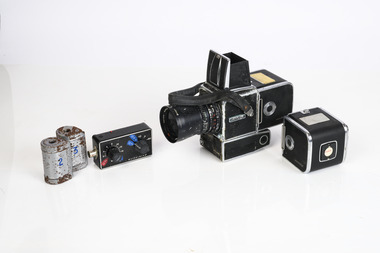
Hasselblad aerial camera with carry case, spare batteries, and film cases (overall poor condtion)
... Motorised cameras with a large film capacity had obvious advantages and were essential when access to the camera was not possible during flight. It is also essential for the shutter to operate at low temperatures and those lubricated with silicones were recommended. ...Motorised cameras with a large film capacity had obvious advantages and were essential when access to the camera was not possible during flight. It is also essential for the shutter to operate at low temperatures and those lubricated with silicones were recommended. ...Aerial photos were used to make maps of forest types, timber resources, to survey logging areas and regeneration, to mark boundaries of public land and new plantations, to identify new roads and tracks, as well as for fire suppression. Infrared film was sometimes used to monitor insect and disease attack. The images needed to sharp, with high contrast, and in a large format (most were printed in B&W on 9-inch by 9-inch glossy photographic paper) with at least a 60% overlap to enable stereoscopic viewing and with a 20-30% side lap to allow for aircraft drift. Preferably, the photo scale was close to the final map scale avoid to problems when enlarging and to reduce distortion. Something was needed to supplement the very expensive and infrequent large-area photography programs. From the mid-1960s Victorian foresters began experimenting with small format 70mm and 35mm cameras which proved simple, practical, cheap and flexible. It was found that any SLR camera could be used provided it had a good quality lens and fast shutter speed (preferably down to 1/1000 second). Motorised cameras with a large film capacity had obvious advantages and were essential when access to the camera was not possible during flight. It is also essential for the shutter to operate at low temperatures and those lubricated with silicones were recommended. Components of a typical FCV Divisional Office system included – A Hasselblad or Vinten 70 mm format aerial camera with a focal plane shutter which could be electrically operated. Interchangeable lenses to allow for different photo scales and flying heights. Several large film magazines, which were loaded in a darkroom, each with a capacity of 100 feet or approximately 500 frames. A remote control for the camera in single-shot mode or automatic firing at selected intervals of 2 to 50 seconds. It also needed a frame counter. A light aircraft was modified with an internal mounting for the camera to keep it level and steady. Often a hole was cut through the floor for the lens. The aircraft also needed an inbuilt 12 Volt DC battery to operate the motorised camera shutter. The front passenger seat was generally removed to improve access to the camera. An Aldis drift sight was also fitted. This might be likened to an inverted periscope and is used to determine drift, to facilitate accurate navigation along flight lines and to determine the exposure interval for stereoscopic overlap. This item was found in storage at the Beechworth museum and its in poor condtionHasselblad 500 ELM camera with 70mm lens, film pack, motor drive and battery In 1964 Hasselblad started production of a motorized camera, the 500 EL The EL/M is a modified version of the EL, "M" means modified, "EL" electric. Perhaps the most famous use of the Hasselblad camera was during the Apollo program missions when man first landed on the Moon. Almost all of the still photographs taken during these missions used modified Hasselblad cameras. forests commission victoria (fcv), forest measurement, surveying, mapping -
 Melbourne Tram Museum
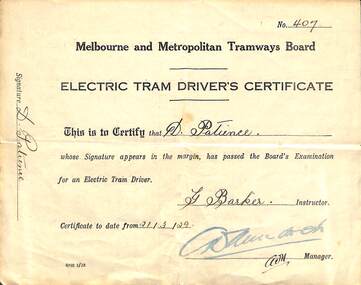
Photograph - Digital Image, Cheryl Williams, "Electric Tram Driver's Certificate No. 407", Original 1929
... Ran in the Stawell Gift of 1925 (injured foot during the race), was a Navigator on Transport RAF/RAAF flights during WW2. ...Ran in the Stawell Gift of 1925 (injured foot during the race), was a Navigator on Transport RAF/RAAF flights during WW2. ...Digital image of "Electric Tram Driver's Certificate No. 407", issued to D. (Daniel) Patience, signed by G. Barker Instructor, with "A. W. Murdoch" stamp authorising the document, dated 23/3/1929. Donated by Betty (daughter - aged 90) and Cheryl Williams (grand daughter) of Daniel. Reported to have been the first driver leaving the then new Camberwell depot. Born in Avoch Scotland, was a police constable there, before emigrating to Melbourne. Was a cable tram Gripman in the Albert Park Area. Became an electric tram driver, then signalman at St Kilda Junction and trained as an inspector, but did not like the green uniform. Ran in the Stawell Gift of 1925 (injured foot during the race), was a Navigator on Transport RAF/RAAF flights during WW2. War memorabilia to the War Memorial Canberra. Cheryl advised 26/11/2019 - My grandfather was born 2nd June 1903 and died 11th Nov 1977.trams, tramways, drivers, gripmen, camberwell depot, signalmen, certificates -
 Australian Gliding Museum
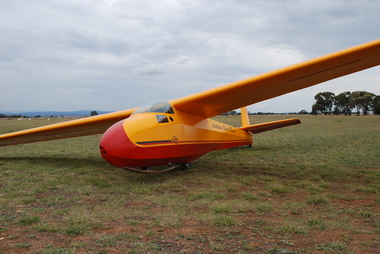
Machine - Glider - Sailplane, 1967
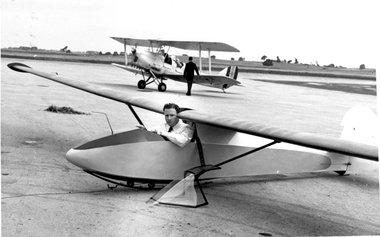
... A notable flight recorded in the logbook is dated 31 October 1971 when W. Kenny reached 11,000 feet in height during a flight of 5 hours 10 minutes. ...A notable flight recorded in the logbook is dated 31 October 1971 when W. Kenny reached 11,000 feet in height during a flight of 5 hours 10 minutes. ...The Ka 8 was designed by Rudolf Kaiser in 1957 and built by Alexander Schleicher. It has been described as the single seat version of the Ka 7 Rhonadler. The Ka 8 proved popular with clubs in its role as a sailplane for early solo flying. Over 1100 were produced. The Museum’s example is a Ka 8B which is the second variant of the design, distinguishable by a larger blown Plexiglas canopy and improved ailerons. The particular glider was built by the RAAF Williamtown Gliding Club from kit supplied by Edmund Schneider Ltd of South Australia as agent for Alexander Schleicher. It was test flown on 8 July 1967. For a period from August 1994 it was owned by a syndicate at the Bendigo Gliding Club. The last entry in the log book is dated January 1995 at which time the glider had accumulated 1148 hours from 2303 flights. From 1967 to 1994, the glider was flown at numerous places including Williamtown, Bellata, Warkworth, Dubbo, Waikerie, Quirindi, Tamworth, Redding, Narromine, Leeton and Keepit. During 1994 and 1995 it was flown a small number of times at Bendigo. A notable flight recorded in the logbook is dated 31 October 1971 when W. Kenny reached 11,000 feet in height during a flight of 5 hours 10 minutes. The last owner prior to the transfer of the glider to the Australian Gliding Museum in 2015 was John Ashford of the Geelong Gliding Club. The glider carries Serial Number 8478-SH and appears to have been registered firstly as VH-GPA and secondly as VH-GMA. The last registration (VH-GMA) was cancelled in 2011.This Kaiser Ka8B sailplane, when fully restored, will be an airworthy example of a popular 1960s German club sailplane type. It is a rarity in Australia as only 4 of the type have been registered and flown here.Single seat sailplane made with a steel tube framed fuselage and wooden wings. A glass plastic moulding has been used to form the top of the fuselage forward of the cockpit. The structure is fabric covered.The glider serial number 8478-SH and the registration VH-GMA.australian gliding, glider, sailplane, schleicher, kaiser, ka 8, schneider, raaf williamtown gliding club, bendigo gliding club, geelong gliding club, ashford -
 Australian Gliding Museum
Machine - Glider – Sailplane, 1955
... For instance, in 1956 Ted Pascoe succeeded in a 36 mile goal flight during which he attained a maximum height of 4500 feet. ...For instance, in 1956 Ted Pascoe succeeded in a 36 mile goal flight during which he attained a maximum height of 4500 feet. ...The EP-1 "Spruce Goose" sailplane was designed and built by Ted Pascoe in 1955 as a smaller than average single seat sailplane that could be operated by two or three people. At times it was launched by auto-towing by Ted Pascoe and his wife without the aid of a third person at the wing tip. The glider exhibited good soaring capability and was used for some cross country flights. For instance, in 1956 Ted Pascoe succeeded in a 36 mile goal flight during which he attained a maximum height of 4500 feet. It was flown at the Mt Gambier Gliding Club from 1956 until about 1961. The Log Book shows that it was flown at Everard in 1961 and at Everard, Waikerie, Gawler and Keith in 1962. There is a gap in flying record for this aircraft from 1962 until 1967. From 1967 to 1972 it was flown regularly at various places in South Australia including Whitwarta, Stonefield, Renmark, and Gawler. For many years it was owned and flown by Mervyn Gill of the Balaklava Gliding Club.The EP-1 glider is an example of a successful Australian home built design from the 1950s. It was one of a small number of notable locally designed gliders of less than the usual 15 metre wing span from the 1950s and 1960s.Small, light weight, sailplane of wooden construction with fabric covering on wings (strutted), elevator and rudder. Instruments have been removed and control column is not in place. Serial Number GFA/HB/24 australian gliding, glider, sailplane, spruce goose, ep 1, ted pascoe, mt gambier gliding club, mervyn gill, balaklava gliding club -
 Mt Dandenong & District Historical Society Inc.
Object, Kyeema Wreckage Fragment, Pre 1938
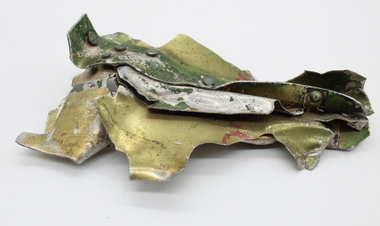
... There were 18 people on board the DC-2: 14 passengers, the captain, the first officer, an air hostess, and a cadet pilot who operated the radio during the flight. The victims were :— THE CREW. ...There were 18 people on board the DC-2: 14 passengers, the captain, the first officer, an air hostess, and a cadet pilot who operated the radio during the flight. The victims were :— THE CREW. ...The Kyeema airline crash took place on 25 October 1938 when the Australian National Airways Douglas DC-2 Kyeema, tail number VH-UYC, flying from Adelaide to Melbourne, commenced final approach to Essendon Airport through heavy fog and crashed into the western slopes of Mount Dandenong, killing all 18 on board instantly. There is strong evidence that the pilots were becoming unsure of their position. According to Macarthur Job's book, Disaster in the Dandenongs, the radio operator had requested the controller at Essendon give them a radio bearing. Essendon had acknowledged and told them to leave their transmitter on, but the signal stopped and no further contact was made. It is thought that this is the moment that Kyeema hit the mountain. There were 18 people on board the DC-2: 14 passengers, the captain, the first officer, an air hostess, and a cadet pilot who operated the radio during the flight. The victims were :— THE CREW. CAPTAIN A. C. D. WEBB, 32, pilot, married, of Essendon, Victoria. JUNIOR CAPTAIN ALAN J. STEEN, 25, pilot, married, of Essendon North, Victoria. ELVA JONES, 27, air hostess, single, of Toorak, Victoria. PHILIP D. PRING, about 20, cadet pilot attached to Australian National Airways' Aeronautics School, Sydney. PASSENGERS. CHARLES ALLAN SEYMOUR HAWKER, M.P., 44, single, of Adelaide. LEONARD SYDNEY ABRAHAMS, K.C., 51, married, barrister, of Sydney. SIDNEY HILL SMITH, 41, married, managing director of S. Smith and Son, of Yalumba, South Australia. ALFRED CECIL GAIN, 42, married, barrister, of Sydney. GORDON H. GODDARD, 30, single, accountant, of North Sydney. LANCELOT WILLIAM SHIRLEY, 27, single, solicitor, of Manly. JAMES IAN MASSIE, 25, single, solicitor, of Sydney. VAUGHAN PATE, 42, refrigeration cabinet manufacturer, married, of Unley, South Australia. THOMAS M. HARDY, 48, married, head of the firm of Thomas Hardy and Sons, vignerons, of Seacliff, South Australia. GEORGE WILLIAM LING, 72, of Kingswood, South Australia, former building inspector of the Municipal Tramways Trust, Adelaide. LOUIS HUGO GRAMP, 43, married, managing director of G. Gramp and Sons, Ltd., vignerons, Rowlands (sic) Flat, South Australia. Mrs. ELIZABETH MARY SCHRADER, 69, widow, of Adelaide. Mr. and Mrs. HANS L. GLOE, of Perth.Small section of the Kyeema DC-2 fuselage made up of 5 pieces of piece of twisted and torn aluminium riveted together. Marking can be seen in red but is indistinct. Aluminium has gold, silver and green colouring.kyeema, a webb, j steen, elva jones, philip pring, charles hawker, leonard abrahams, sidney hill smith, alfred gain, gordon goddard, lancelot shirley, james massie, vaughan pate, thomas hardy, george ling, hugo gramp, elizabeth schrader, mr hans gloe, mrs gloe -
 Flagstaff Hill Maritime Museum and Village
Book, The Old Bus
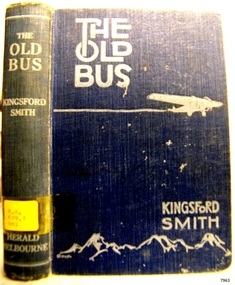
... flight took less than 10 days. He beat four other planes that had left England before him and he was 5.5 days faster than Hinkler. Sadly Kingsford Smith’s “Southern Cloud” was lost during a flight from Sydney to Melbourne in 1931 with no surviving crew or passengers; in 1958 the wreckage was discovered in the Snowy Mountains. ...flight took less than 10 days. He beat four other planes that had left England before him and he was 5.5 days faster than Hinkler. Sadly Kingsford Smith’s “Southern Cloud” was lost during a flight from Sydney to Melbourne in 1931 with no surviving crew or passengers; in 1958 the wreckage was discovered in the Snowy Mountains. ...Sir Charles Edward Kingsford Smith is a famous Australian, well known in civil aviation history for his courageous endeavours in flight. He broken many flight records for long distance and time travelled and he was also a war hero in World War 1. He has been referred to as being “known to millions of Australians as “Smithy” … he was one of Australia’s true twentieth-century legends”. In honour of his place amongst the world’s famous pioneers his image is featured on Australia’s $20 note, Sydney airport is named after him, there is a memorial to Kingsford Smith, Taylor and Ulm at the Anderson Park, also in Sydney and his plane “Southern Cross” is on view at Brisbane Airport. Kingsford Smith wrote ‘The Old Bus’ (1932) and he and Ulm were co-authors of ‘Story of 'Southern Cross' Trans-Pacific Flight’ (1928). His also wrote a book about his own life ‘My Flying Life’ which was published after his death in 1937. and the story of his life was filmed in Australia in 1946. A BRIEF HISTORY OF SIR CHARLES EDWARD KINGSFORD SMITH (1897 – 1935) … Kingsford Smith was born 9th February 1897 in Brisbane, Queensland, Australia. His parents were William Charles Smith and Catherine Mary, nee Kingsford. His mother’s maiden name of “Kingsford” was added to the family name when they spent time in Canada from around 1903 to 1907, after which they returned to Sydney, Australia. In 1915 Kingsford Smith enlisted in Australian Imperial Force. He served in 4th Signal Troop, 2nd Division Signal Company at Gallipoli Peninsular as a ‘sapper’ or combat engineer and later in Egypt and in France as a dispatch rider. In 1916 Kingsford Smith was transferred to the Australian Flying Corps as a sergeant. He was discharged after training in England and commissioned as a second lieutenant in the Royal Flying Corps. He was appointed fling officer and soon joined the 23rd Squadron in France. He brought down four machines in his first month there and also did invaluable work attacking enemy targets. He was wounded and shot down and later awarded the Military Cross ‘for conspicuous gallantry and devotion to duty’. He was promoted to lieutenant in 1918 and served as a Flying Instructor with the R.F.C. Kingsford Smith was not allowed to participate in the 1919 England to Australia air race because of assumed lack of navigational experience. He and his pilot friend Cyril Maddocks formed a business and flew joy-flights in both England and America. In America he did some stunt flying with a Flying Circus. Kingsford Smith returned to Australia in 1921 and found employment as a pilot. He soon realised the value of air transport in such a vast country. He formed a partnership with pilot Keith Anderson in 1924 and they purchased two Bristol Tourer biplanes. Their business broadened to include Charles Ulm and became the Interstate Flying services in Sydney. Together they performed important ‘demonstration’ flights including a flight around Australia in 10 days and 5 hours using very limited navigational equipment. Kingsford Smith immediately started to search for support to do a trans-Pacific flight. This support came from the New South Wales government, Sidney Myer and G. Allan Hancock, an American oil magnate. On 31st May 1928 Kingsford Smith, Charles Ulm and two American crewmen, Harry Lyan and Jim Warner, took off from Oakland, California and flew to Brisbane via Hawaii and Suva. This historic flight took 83 hours and 38 minutes. Their Fokker plane had three engines and was named the “Southern Cross”. This amazing achievement resulted in huge financial subscriptions. Kingsford Smith was awarded the Air Force Cross and appointed as honorary squadron leader, Royal Australian Air Force. Kingsford Smith flew his Southern Cross plane from Point Cook in Victoria to Perth nonstop. Then in September – October 1928, with Charles Ulm and an Australian crew, he piloted the Southern Cross from Sidney to Christchurch New Zealand. This flight showed that was possible for regular passenger and mail services across the Tasman Sea. Kingsford Smith flew his plane to England to an order for four aircraft, planning to use them for an inter-capital air service in Australia. Sadly on 1st April 1929 he was forced to land, having lost radio contact with the ground and having run into bad weather over north – west Australia. Keith Anderson and Robert Hitchcock both perished before the search party reached them. Once official enquiries were completed the flight to England continued in June and was completed in record time of 12 days and 18 hours. In January 1930 Kingsford Smith piloted the “Southern Cloud”, one of the new Avro Ten planes, on the first flight of his airline, the Australian National Airways, from Sydney to Melbourne. The “Southern Cross” was overhauled in Holland by the Fokker Aircraft Co. and in June 1930 Kingsford Smith achieved an east-west crossing of the Atlantic from Ireland to Newfoundland in 31.5 hours. Kingsford Smith returned to England and took delivery of an Avro Avian biplane that he named the “Southern Cross Junior” and flew solo from England to Darwin, Australia. This record breaking flight took less than 10 days. He beat four other planes that had left England before him and he was 5.5 days faster than Hinkler. Sadly Kingsford Smith’s “Southern Cloud” was lost during a flight from Sydney to Melbourne in 1931 with no surviving crew or passengers; in 1958 the wreckage was discovered in the Snowy Mountains. Later that year Kingsford Smith flew his “Southern Cloud” from Australia to Timor, collecting mail from a damaged Imperial Airways plane in Timor. Other flights followed. Kingsford Smith was knighted in 1932 for his services in Aviation. He returned to selling joy flights then established the Kingsford Smith Air Service, a flying training school in Sydney. In 1933 Kingsford Smith flew the amazing record flight in “Miss Southern Cross” – a Percival Gull - from London to Wyndham in Western Australia in just over ten days. The Australian Commonwealth then gave Kingsford Smith a large grant and he was also appointed as aviation consultant to Vacuum Oil Co. Another flying record was made when Kingsford Smith and Sir P.G. Taylor flow “Lady Southern Cross” from Brisbane to San Francisco in order to sell her there; the west-east-trans-Pacific flight made aviation history. They returned to Australia to make an attempt at the trans-Tasman flight but their attempt failed due to engine failure; they managed to get back to Sydney safely, minus most of their cargo. Kingsford Smith had his unsold “Lady Southern Cross” shipped back to England, from where he and J. T. Pethybridge in the “Lady Southern Cross” attempted another record breaking flight from England The Old Bus Author: Charles Kingsford Smith Publisher: Distibuted by Herald Feature Service Date; 1932Label on spine cover with typed text RA 629.1309 KIN flagstaff hill, warrnambool, shipwrecked coast, flagstaff hill maritime museum, maritime museum, shipwreck coast, flagstaff hill maritime village, great ocean road, the old bus, charles kingsford smith -
Frankston RSL Sub Branch
Training Manual, Fitters 11.A Carpenter Riggers Flight Riggers Course Notes
... Cpl Manton served in the RAAF during World War 2. Fitters 11.A Carpenter Riggers Flight Riggers Course Notes Training Manual ...Training manual issued by the RAAF to trainees during World War 2. Training manual issued by the RAAF to trainees during World War 2. Training manual issued to Corporal Manton service number 33247. Cpl Manton served in the RAAF during World War 2. -
Frankston RSL Sub Branch
Training Manual, Fitters 11E Flight Mechanics Course Notes
... Training manual issued by the RAAF to trainees during World War 2. Training manual issued to Corporal (later Flight Sergeant) C. ...Training manual issued by the RAAF to trainees during World War 2. Training manual issued to Corporal (later Flight Sergeant) C. ...Training manual issued by the RAAF to trainees during World War 2. Training manual issued to Corporal (later Flight Sergeant) C. S. Woods service number 19633. Cpl Woods served in the RAAF during World War 2. -
 Lara RSL Sub Branch
Picture Print, Hurricane, Unknown
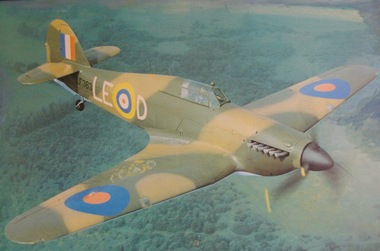
... during Battle of Britain in 1940, but the Hurricane actually inflicted 60 percent of the losses sustained by the Luftwaffe in the engagement, and it went on to fight in all the major theatres of the Second World War. Url Hurricane.html. The Hawker Hurricane Mk.IIc - LF363, first flew on the 1st January 1944 and is believed to be the last Hurricane to enter service in the RAF. It was in service with 63 squadron and 26 squadron. After hostilities, LF363 was spared the scrap yard and used on various station flights...during Battle of Britain in 1940, but the Hurricane actually inflicted 60 percent of the losses sustained by the Luftwaffe in the engagement, and it went on to fight in all the major theatres of the Second World War. Url Hurricane.html. The Hawker Hurricane Mk.IIc - LF363, first flew on the 1st January 1944 and is believed to be the last Hurricane to enter service in the RAF. It was in service with 63 squadron and 26 squadron. After hostilities, LF363 was spared the scrap yard and used on various station flights ...The Hawker Hurricane is a British single-seat fighter aircraft of the 1930s–40s that was designed and predominantly built by Hawker Aircraft Ltd. for service with the Royal Air Force (RAF). It was overshadowed in the public consciousness by the Supermarine Spitfire's role during Battle of Britain in 1940, but the Hurricane actually inflicted 60 percent of the losses sustained by the Luftwaffe in the engagement, and it went on to fight in all the major theatres of the Second World War. Url Hurricane.html. The Hawker Hurricane Mk.IIc - LF363, first flew on the 1st January 1944 and is believed to be the last Hurricane to enter service in the RAF. It was in service with 63 squadron and 26 squadron. After hostilities, LF363 was spared the scrap yard and used on various station flights and also appeared in films 'Angels one five', 'Reach for the Sky' and 'The Battle of Britain'. Whilst flying to Jersey in September 1991, LF363 suffered engine problems and had to be diverted to RAF Wittering but on the final approach the aircraft suffered complete engine failure and had to make an emergency landing. The pilot was saved with relative minor injuries (a broken ankle and minor burns) but the aircraft suffered severe damage. Historic Flying Limited completely rebuilt LF363 and by 1998 it was flying again as part of the B.B.M.F. LF363 currently wears the colour scheme of a Mk.I Hurricane of 17 squadron, P3878 'YB-W' which was flown by Flying Office Harold Bird-Wilson at Debden and Tangmere. Harold 'Birdy' Bird-Wilson had previously been badly burned in a pre-war flying accident. Upon his recovery he joined 17 squadron and fought through the 'Battle of France' and the 'Battle of Britain' achieving 6 confirmed kills. On 24th September 1940, 'Birdy' was shot down by Adolf Galland, his 40th 'kill', and had to bale out. 'Birdy' survived the war and when he retired from the RAF he had reached the rank of Vice Marshall and had been awarded the CBE, DSO, DFC & Bar and the AFC & Bar. British single-seat fighter aircraft manufactured by Hawker Aircraft, Ltd., in the 1930s and ’40s. The Hurricane was numerically the most important British fighter during the critical early stages of World War II, sharing victory laurels with the Supermarine Spitfire in the Battle of Britain (1940–41) and the defense of Malta (1941–42). Hurricanes served in all theatres of war where British forces were engaged. https://www.britannica.com/technology/Hurricane-airplane Framed coloured picture print on plastic sheetOn the aircraft are the markings LF 363 -
 Lara RSL Sub Branch
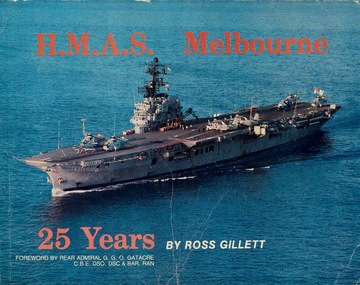
Book, Nautical Press, HMAS Melbourne 25 Years
... flight deck. Delays in construction and integrating the enhancements meant that the carrier was not commissioned until 1955. Melbourne never fired a shot in anger during...flight deck. Delays in construction and integrating the enhancements meant that the carrier was not commissioned until 1955. Melbourne never fired a shot in anger during ...HMAS Melbourne (R21) was a Majestic-class light aircraft carrier of the Royal Australian Navy (RAN). Operating from 1955 until 1982, she was the third and final conventional aircraft carrier to serve in the RAN. Melbourne was the only British Commonwealth naval vessel to sink two friendly warships in peacetime collisions. The ship was laid down for the British Royal Navy as the lead ship of the Majestic class in April 1943, and was launched as HMS Majestic (R77) in February 1945. At the end of World War II, work on the ship was suspended until she was purchased by the RAN in 1947. At the time of purchase, it was decided to incorporate new aircraft carrier technologies into the design, making Melbourne the third ship to be constructed with an angled flight deck. Delays in construction and integrating the enhancements meant that the carrier was not commissioned until 1955. Melbourne never fired a shot in anger during her career, having only peripheral, non-combat roles in relation to the Indonesia-Malaysia confrontation and the Vietnam War. However, she was involved in two major collisions with allied vessels. On the evening of 10 February 1964, Melbourne collided with and sank HMAS Voyager when the Daring class destroyer altered course across her bow. Eighty-two of Voyager's crew were killed, and two Royal Commissions were held to investigate the incident. The second collision occurred in the early morning of 3 June 1969, when Melbourne collided with and sank the Allen M. Sumner class destroyer USS Frank E. Evans in similar circumstances. Seventy-four United States Navy (USN) personnel died, and a joint USN–RAN Board of Inquiry was held. These incidents, along with several minor collisions, shipboard accidents, and aircraft losses, led to the reputation that Melbourne was jinxed. Melbourne was paid off from RAN service in 1982. A proposal to convert her for use as a floating casino failed, and a 1984 sale was cancelled, before she was sold in 1985 and towed to China for breaking. The scrapping was delayed so Melbourne could be studied by the People's Liberation Army Navy (PLAN) as part of a secret project to develop a Chinese aircraft carrier and used to train PLAN aviators in carrier flight operations. HMAS Melbourne was decommissioned on 30 June 1982, having spent 62,036 hours underway and having steamed 868,893 nautical miles. A proposal to convert her for use as a floating casino failed, and a 1984 sale was cancelled, before she was sold for scrap in 1985 and towed to China for breaking. The scrapping was delayed so Melbourne could be studied by the People's Liberation Army Navy (PLAN) as part of a secret project to develop a Chinese aircraft carrier and used to train PLAN aviators in carrier flight operations.The pictorial history of HMAS Melbourne with rare photos. Now a scarce title and highly desirable title that is now long out of print. Has provenance history of all ships movements from 1955 till decommissioned.HMAS Melbourne 25 YearsOn the front page is a picture of HMAS Melbourne with the words at top "H.M.A.S. Melbourne. At bottom are the words in orange, '25 Years'. In white, are the words 'by Ross Gillett' then 'Forward by Rear Admiral G.G.O. Gatacre C.B.E. DSO. DSC & Bar, RAN'. On the rear page is a list of all the Captains that served on the HMAS Melbourne between 1955-1980.hmas melbourne, aircraft carrier, royal australian navy, australian navy, westland whirlwind, sea venom, fairy gannet, bristol sycamore, westland wessex, douglas skyhawk, grumman tracker, westland sea king, fleet air arm, hmas albatross, nowra -
 Federation University Historical Collection
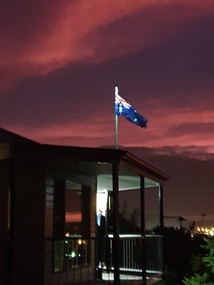
Photograph - Colour, ANZAC Dawn Remembrance During the Covid-19 Pandemic, 2020, 25/04/2020
... However, the new case in Queensland was linked to the Rydges on Swanston cluster in Melbourne when a man who travelled from Melbourne to Brisbane on Virgin flight VA313 on 1 June tested positive. covid-19 corona virus pandemic social distancing anzac day driveway remembrance dawn australian flag mount warrenheip Colour photographs of an ANZAC dawn remembrance from Armstrong Street South, Ballarat looking East towards Mount Warrenheip. Due to the Covid-19 Pandemic and associated social distancing requirements regular ANZAC Day services and marches could not be held. People were encouraged to remember from their driveways at dawn on 25 April 2020. ANZAC Dawn Remembrance During ...On 12 January, the World Health Organization (WHO) confirmed that a novel coronavirus was the cause of a respiratory illness in a cluster of people in Wuhan City, Hubei Province, China, who had initially come to the attention of the WHO on 31 December 2019. On 3 March, the Reserve Bank of Australia became the first central bank to cut interest rates in response to the outbreak. Official interest rates were cut by 0.25% (25 base points) to a record low of 0.5%. On 12 March, the Federal Government announced a A$17.6 billion stimulus package, the first since the 2008 GFC. he package consists of multiple parts, a one-off A$750 payment to around 6.5 million welfare recipients as early as 31 March 2020, small business assistance with 700,000 grants up to $25,000 and a 50% wage subsidy for 120,000 apprenticies or trainees for up to 9 months, 1 billion to support economically impacted sectors, regions and communities, and $700 million to increase tax write off and $3.2 billion to support short-term small and medium-sized business investment. On 16 March, Premier Dan Andrews and Minister for Health Jenny Mikakos declared a state of emergency for Victoria for at least four weeks. On 19 March, the Reserve Bank again cut interest rates by a further 0.25% to 0.25%, the lowest in Australian history. On 22 March, the government announced a second stimulus package of A$66bn, increasing the amount of total financial package offered to A$89bn. This included several new measures like doubling income support for individuals on Jobseeker's allowance, granting A$100,000 to small and medium-sized businesses and A$715 million to Australian airports and airlines. It also allowed individuals affected by the outbreak to access up to A$10,000 of their superannuation during 2019–2020 and also being able to take an additional same amount for the next year. on the same day Victorian Premier Daniel Andrews announced on 22 March that the state will bring the school holiday forwards to 24 March from 27 March. On 30 March, the Australian Federal Government announced a $130 billion "JobKeeper" wage subsidy program offering to pay employers up to $1500 a fortnight per full-time, part-time or casual employee that has worked for that business for over a year. For a business to be eligible, they must have lost 30% of turnover after 1 March of annual revenue up to and including $1 billion. For businesses with a revenue of over $1 billion, turnover must have decreased by 50%. Businesses are then required by law to pay the subsidy to their staff, in lieu of their usual wages. This response came after the enormous job losses seen just a week prior when an estimated 1 million Australians lost their jobs. This massive loss in jobs caused the myGov website to crash and lines out of Centrelink offices to run hundreds of metres long.The program was backdated to 1 March, to aim at reemploying the many people who had just lost their jobs in the weeks before. Businesses would receive the JobKeeper subsidy for six months. On 2 April, the number of cases in Victoria exceeded 1,000, including over 100 healthcare workers. On 5 April, New South Wales Police launched a criminal investigation into whether the operator of Ruby Princess, Carnival Australia, broke the Biosecurity Act 2015 (Cwth) and New South Wales state laws, by deliberately concealing COVID-19 cases. On 6 April, the Department of Health revealed that 2,432 people recovered from the infection as the federal government started reporting recovery statistics. This is more than a third from the official number reported so far, Deputy Chief Medical Officer Professor Paul Kelly stating, "I think it is important. Firstly it really reinforces that message, which is a true one, that most people who get this disease do recover”. The day before, at 3pm, it was announced that 2,315 of the 5,687 confirmed coronavirus cases had recovered. May 2020 - An outbreak in Victoria at a meatworks that was later revealed to be Cedar Meats was announced on 02 May with eight cases. By 8 May, the cluster of cases linked to Cedar Meats in Victoria was 71, consisting of at least 57 workers and 13 close contacts, including a nurse, aged care worker and high school student. The number had increased to 75 by 9 May, 88 by 13 May, and 90 by 14 May. On 9 May, two Victorian cases were announced to be related to McDonald's Fawkner. By 18 May, this had increased to 12 cases, and on that day it was revealed that a delivery driver had tested positive, prompting the closing for cleaning of 12 more McDonald's locations: Melton East, Laverton North, Yallambie, Taylors Lakes, Campbellfield, Sunbury, Hoppers Crossing, Riverdale Village, Sandown, Calder Highway Northbound/Outbound, Calder Highway Southbound/Inbound, and BP Rockbank Service Centre Outbound. On 15 May, South Australia became the second jurisdiction, after the ACT, to be free of any active cases, however on 26 May, a woman returning from overseas who was granted exemption into South Australia from her hotel quarantine in Victoria tested positive for COVID-19. This was the first new case in 19 days for the state.[101] On 4 June, it was announced that the woman had recovered and the state was free of any active cases once again.[102] On 17 May, Victoria announced two further business sites had been shut down due to a suspected case at each. Domino's Pizza in Fairfield has been shut for two weeks, and mattress manufacturer The Comfort Group in Deer Park was closed from Friday 15 May to at least Wednesday 20 May. On 6 June, both New South Wales and Victoria reported no new cases for the previous 24 hours, with only Queensland and Western Australia reporting one new case each, the lowest national total since February. Western Australia also announced two old cases. However, the new case in Queensland was linked to the Rydges on Swanston cluster in Melbourne when a man who travelled from Melbourne to Brisbane on Virgin flight VA313 on 1 June tested positive.Colour photographs of an ANZAC dawn remembrance from Armstrong Street South, Ballarat looking East towards Mount Warrenheip. Due to the Covid-19 Pandemic and associated social distancing requirements regular ANZAC Day services and marches could not be held. People were encouraged to remember from their driveways at dawn on 25 April 2020. covid-19, corona virus, pandemic, social distancing, anzac day driveway remembrance, dawn, australian flag, mount warrenheip -
Federation University Historical Collection
Document, Federation University Coronavirus Updates, 2020-2021, 17/05/2021
... However, the new case in Queensland was linked to the Rydges on Swanston cluster in Melbourne when a man who travelled from Melbourne to Brisbane on Virgin flight VA313 on 1 June tested positive. covid-19 corona virus pandemic federation university australia covidsafe plan response face masks blended workfore lock down office capacity gatherings physical distancing social distancing cotact tracing exams safe start on campus transition to campus employee assistance program Printout of a number of regular Coronavirus updates that were distributed during the Covid-19 Pandemic. ...On 12 January, the World Health Organization (WHO) confirmed that a novel coronavirus was the cause of a respiratory illness in a cluster of people in Wuhan City, Hubei Province, China, who had initially come to the attention of the WHO on 31 December 2019. On 3 March, the Reserve Bank of Australia became the first central bank to cut interest rates in response to the outbreak. Official interest rates were cut by 0.25% (25 base points) to a record low of 0.5%. On 12 March, the Federal Government announced a A$17.6 billion stimulus package, the first since the 2008 GFC. he package consists of multiple parts, a one-off A$750 payment to around 6.5 million welfare recipients as early as 31 March 2020, small business assistance with 700,000 grants up to $25,000 and a 50% wage subsidy for 120,000 apprenticies or trainees for up to 9 months, 1 billion to support economically impacted sectors, regions and communities, and $700 million to increase tax write off and $3.2 billion to support short-term small and medium-sized business investment. On 16 March, Premier Dan Andrews and Minister for Health Jenny Mikakos declared a state of emergency for Victoria for at least four weeks. On 19 March, the Reserve Bank again cut interest rates by a further 0.25% to 0.25%, the lowest in Australian history. On 22 March, the government announced a second stimulus package of A$66bn, increasing the amount of total financial package offered to A$89bn. This included several new measures like doubling income support for individuals on Jobseeker's allowance, granting A$100,000 to small and medium-sized businesses and A$715 million to Australian airports and airlines. It also allowed individuals affected by the outbreak to access up to A$10,000 of their superannuation during 2019–2020 and also being able to take an additional same amount for the next year. on the same day Victorian Premier Daniel Andrews announced on 22 March that the state will bring the school holiday forwards to 24 March from 27 March. On 30 March, the Australian Federal Government announced a $130 billion "JobKeeper" wage subsidy program offering to pay employers up to $1500 a fortnight per full-time, part-time or casual employee that has worked for that business for over a year. For a business to be eligible, they must have lost 30% of turnover after 1 March of annual revenue up to and including $1 billion. For businesses with a revenue of over $1 billion, turnover must have decreased by 50%. Businesses are then required by law to pay the subsidy to their staff, in lieu of their usual wages. This response came after the enormous job losses seen just a week prior when an estimated 1 million Australians lost their jobs. This massive loss in jobs caused the myGov website to crash and lines out of Centrelink offices to run hundreds of metres long.The program was backdated to 1 March, to aim at reemploying the many people who had just lost their jobs in the weeks before. Businesses would receive the JobKeeper subsidy for six months. On 2 April, the number of cases in Victoria exceeded 1,000, including over 100 healthcare workers. On 5 April, New South Wales Police launched a criminal investigation into whether the operator of Ruby Princess, Carnival Australia, broke the Biosecurity Act 2015 (Cwth) and New South Wales state laws, by deliberately concealing COVID-19 cases. On 6 April, the Department of Health revealed that 2,432 people recovered from the infection as the federal government started reporting recovery statistics. This is more than a third from the official number reported so far, Deputy Chief Medical Officer Professor Paul Kelly stating, "I think it is important. Firstly it really reinforces that message, which is a true one, that most people who get this disease do recover”. The day before, at 3pm, it was announced that 2,315 of the 5,687 confirmed coronavirus cases had recovered. May 2020 - An outbreak in Victoria at a meatworks that was later revealed to be Cedar Meats was announced on 02 May with eight cases. By 8 May, the cluster of cases linked to Cedar Meats in Victoria was 71, consisting of at least 57 workers and 13 close contacts, including a nurse, aged care worker and high school student. The number had increased to 75 by 9 May, 88 by 13 May, and 90 by 14 May. On 9 May, two Victorian cases were announced to be related to McDonald's Fawkner. By 18 May, this had increased to 12 cases, and on that day it was revealed that a delivery driver had tested positive, prompting the closing for cleaning of 12 more McDonald's locations: Melton East, Laverton North, Yallambie, Taylors Lakes, Campbellfield, Sunbury, Hoppers Crossing, Riverdale Village, Sandown, Calder Highway Northbound/Outbound, Calder Highway Southbound/Inbound, and BP Rockbank Service Centre Outbound. On 15 May, South Australia became the second jurisdiction, after the ACT, to be free of any active cases, however on 26 May, a woman returning from overseas who was granted exemption into South Australia from her hotel quarantine in Victoria tested positive for COVID-19. This was the first new case in 19 days for the state.[101] On 4 June, it was announced that the woman had recovered and the state was free of any active cases once again.[102] On 17 May, Victoria announced two further business sites had been shut down due to a suspected case at each. Domino's Pizza in Fairfield has been shut for two weeks, and mattress manufacturer The Comfort Group in Deer Park was closed from Friday 15 May to at least Wednesday 20 May. On 6 June, both New South Wales and Victoria reported no new cases for the previous 24 hours, with only Queensland and Western Australia reporting one new case each, the lowest national total since February. Western Australia also announced two old cases. However, the new case in Queensland was linked to the Rydges on Swanston cluster in Melbourne when a man who travelled from Melbourne to Brisbane on Virgin flight VA313 on 1 June tested positive.Printout of a number of regular Coronavirus updates that were distributed during the Covid-19 Pandemic. covid-19, corona virus, pandemic, federation university australia, covidsafe plan, response, face masks, blended workfore, lock down, office capacity, gatherings, physical distancing, social distancing, cotact tracing, exams, safe start on campus, transition to campus, employee assistance program -
 Geelong RSL Sub Branch
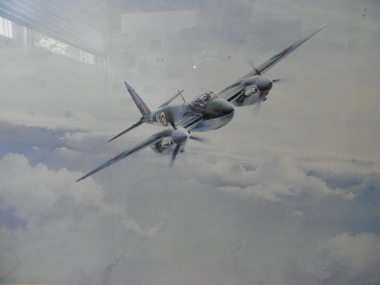
Print - 'Mosquito', Mid 20th century
... during WW2 and was created Baron of Cheshire in 1991 in recognition of his charitable work. This print 'Mosquito' has been personally signed by Leonard Cheshire. Leonard Cheshire, VC., Group Capt RAF, WW2, Baron of Cheshire Each print is individually signed by Leonard Cheshire, VC. The original painting is by Robert Taylor. The print is published by The Military Gallery, Bath. A print of the aircraft Mosquito, the aircraft is portrayed in flight ...The print is of a 'mosquito' aircraft and has been signed by Leonard Cheshire, VC. Group Captain RAF. Group Captain Cheshire became a most decorated pilot during WW2 and was created Baron of Cheshire in 1991 in recognition of his charitable work.This print 'Mosquito' has been personally signed by Leonard Cheshire.A print of the aircraft Mosquito, the aircraft is portrayed in flight on a sky background. The print is in a silver metal frame with a white backing.Each print is individually signed by Leonard Cheshire, VC. The original painting is by Robert Taylor. The print is published by The Military Gallery, Bath. leonard cheshire, vc., group capt raf, ww2, baron of cheshire -
 Geelong RSL Sub Branch
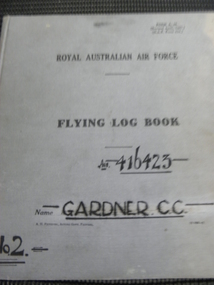
RAAF Flying Log Books, circa April 1937
... There is no information in the Flight Log Book relating to his training and Service, however there is a parcel of personal letters, paper clippings, telegrams etc that would indicate that 416423 C C Gardner was in England during WW2, one letter advises of his Award of Distinguished Flying Cross. 403619 A Kennedy enlisted into the RAAF in 1941 and trained in Narrandera. ...These RAAF Flight Log Books are originals and belong to 4166423 C C Gardner DFC and 403619 A Kennedy, both served during WW2. 416423 C C Gardner RAAF, 403619 A Kennedy RAAF, RAAF Flight Log Books London, Alberta One Book belongs to Aus 416423 C C Gardner. ...416423 C C Gardner enlisted into the RAAF In Adelaide, SA. There is no information in the Flight Log Book relating to his training and Service, however there is a parcel of personal letters, paper clippings, telegrams etc that would indicate that 416423 C C Gardner was in England during WW2, one letter advises of his Award of Distinguished Flying Cross. 403619 A Kennedy enlisted into the RAAF in 1941 and trained in Narrandera. Later in the Flight Log Book there are entries of him being at MacLeod, Alberta. At this point in time there is no other information on 403619 A Kennedy.These RAAF Flight Log Books are originals and belong to 4166423 C C Gardner DFC and 403619 A Kennedy, both served during WW2.Two x Flying Log Books, Form A18 (Revised April, 1937) (RAF Form 414). The books are almost square, blue cloth covers, white pages.One Book belongs to Aus 416423 C C Gardner. One Book belongs to 403619 A Kennedy.416423 c c gardner raaf, 403619 a kennedy raaf,, raaf flight log books, london, alberta -
 Dunkeld Museum Inc.
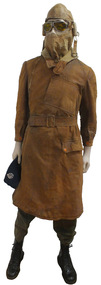
Coat, Flying, During World War 1
... During the war he was a pilot and photographer and took hundreds of reconnaissance photos over occupied territory. He was involved in photographing enemy positions and supplying information to the artillery batteries which then shelled those positions. He was involved in a number of missions involving direct contact with the enemy including Baron von Richtofen and was involved in the "dog fight" which led to von Richtofen's death. In May 1918 he had been promoted to Flight...During the war he was a pilot and photographer and took hundreds of reconnaissance photos over occupied territory. He was involved in photographing enemy positions and supplying information to the artillery batteries which then shelled those positions. He was involved in a number of missions involving direct contact with the enemy including Baron von Richtofen and was involved in the "dog fight" which led to von Richtofen's death. In May 1918 he had been promoted to Flight ...This coat was owned and worn by Lieutenant T L(known as Leigh) Simpson D.F.C. who joined the Royal Flying Corps during Workd War 1. He was born in Hamilton Victoria and had an interest through his family in flying, before the war. In 1916 he transferred from the Light Horse Field Ambulance to the 68th Australian Sqd. Royal Flying Corps. He was promoted to lieutenant of the 3rd Squadron. During the war he was a pilot and photographer and took hundreds of reconnaissance photos over occupied territory. He was involved in photographing enemy positions and supplying information to the artillery batteries which then shelled those positions. He was involved in a number of missions involving direct contact with the enemy including Baron von Richtofen and was involved in the "dog fight" which led to von Richtofen's death. In May 1918 he had been promoted to Flight Commander and temporary Captain when his cousin Captain Duigan was wounded. He represented Australia at von Richtofen's funeral and presented the Australian wreath. Following his discharge after being seriously wounded, he returned home and became a grazier in the Dunkeld area. He maintained his interest in aviation throughout his life with a strong connection with Reg Ansett and was a director of Ansett Airways Pty Ltd for many years. He died in Dunkeld in 1960This flying coat is significant because it was owned by Lieutenant Thomas Leigh Simpson DFC while he was in the Australian Flying Corps during World War 1. World War 1 Flying coat. Tan leather, nap finish. Lining wool fabric. Map pocket on front of chest. Internal pocket on left front behind map pocket and external pocket below the waist on the left hand front towards the side.L Simpson on the inside left front.t leigh simpson, royal flying corps, baron von richtofen, australian aviation -
Glenelg Shire Council Cultural Collection
Book, Jon Cleary, A Flight of Chariots, c. 1964
... fiction Australia adventure A Flight of Chariots is a 1963 novel written by Australian author Jon Cleary about two friends who fly planes during the Berlin Airlift and Korean War then become involved in the space program Front: Inside front and back covers, stamps from Portland Free Library, Museum and Literary Institue Book, hardcover, dark blue cover, gold print on spine A Flight of Chariots Book Book Jon Cleary COLLINS ...A Flight of Chariots is a 1963 novel written by Australian author Jon Cleary about two friends who fly planes during the Berlin Airlift and Korean War then become involved in the space programBook, hardcover, dark blue cover, gold print on spinefictionA Flight of Chariots is a 1963 novel written by Australian author Jon Cleary about two friends who fly planes during the Berlin Airlift and Korean War then become involved in the space programfiction, australia, adventure -
 Australian Commando Association - Victoria
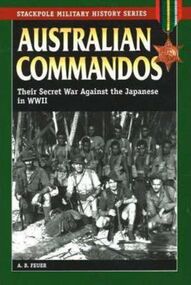
Book, A.B.Feure, Australian Commando: Their Secret War against the Japanese in World War II
... during World War II. While M Unit secretly set up coast-watching posts to monitor Japanese shipping movements and bombing flights, operatives of Special Operations Australia also known as the Allied Intelligence Bureau were inserted deep behind enemy lines, where they attacked Japanese targets in brutal terrain and where capture meant death by beheading. ...during World War II. While M Unit secretly set up coast-watching posts to monitor Japanese shipping movements and bombing flights, operatives of Special Operations Australia also known as the Allied Intelligence Bureau were inserted deep behind enemy lines, where they attacked Japanese targets in brutal terrain and where capture meant death by beheading. ...non-fictionww2, australian commandos, australian special operations, australian special forces, world war ii -
 Bendigo Military Museum
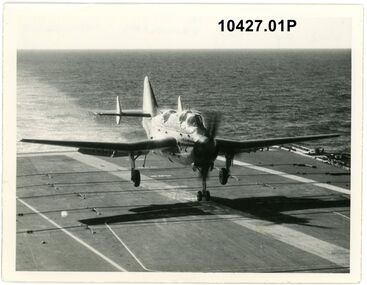
Photograph - JAMES LESLIE PELL RAN PHOTOGRAPHIC ALBUM, HMAS Melbourne
... during the Korean War 1951-52. He later served on HMAS Melbourne, a Majestic-class light fleet aircraft carrier later in the 1950's. These photographs are from his personal album, and portray events and place to which he would have been witness. Refer to catalogue item 5455 for his service details. HMAS MELBOURNE HMAS BATAAN Korean War Royal Australian Navy James Leslie Pell These photographs depict flight ...James Leslie Pell RAN No 35213 Stoker mechanic, served on HMAS Bataan, (D9/I91/D191) a Tribal-class destroyer during the Korean War 1951-52. He later served on HMAS Melbourne, a Majestic-class light fleet aircraft carrier later in the 1950's. These photographs are from his personal album, and portray events and place to which he would have been witness. Refer to catalogue item 5455 for his service details. These photographs depict flight operations on HMAS Melbourne in the 1950's. They are part of a collection of over 200 photographs housed within an archive folder.hmas melbourne, hmas bataan, korean war, royal australian navy, james leslie pell
