
Showing 13 items matching "dutch migration"
-
 Dutch Australian Heritage Centre Victoria
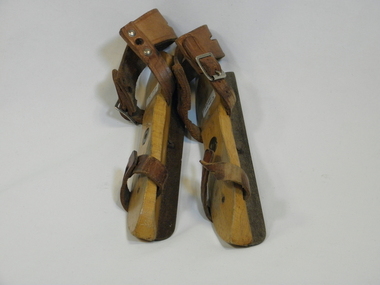
Child-size Wooden Skates, Early 20th century
... dutch migration skates wood...Skating is a tradition which remains popular. dutch migration skates wood Letter R for right foot No letter for left foot Wooden skates, with brown leather straps. ...Skates were and still are widely used in winter time in The Netherlands, when the rivers, canals, creeks, ponds etc. are frozen solid. Paintings out of around 1600-1700 show models of skates very much like the one shown. Even until as recent as 40 years ago, the wooden skates (with steel blade) that are tied to the shoe with leather strap and laces, were widely used in the Netherlands. Even now they are still made in children sizes, because of there flexibility in adjusting to a range of shoe sizes.Skating is a tradition which remains popular.Wooden skates, with brown leather straps. It has a metal strip on the base of the wood, which is necessary for gliding on ice.Letter R for right foot No letter for left footdutch migration skates wood -
 Dutch Australian Heritage Centre Victoria
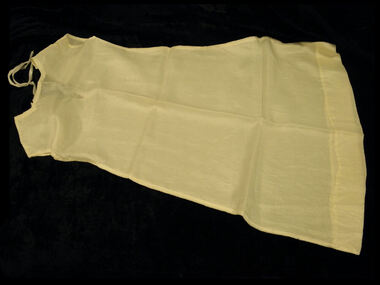
Child's Petticoat, 1945
... dutch...migration...This material was very welcome after the deprivations suffered during the 5 year German occupation. dutch migration Petticoat to be worn under child's white First Communion dress, made of white parachute silk sewn in extremely tiny stitches by machine and hand. ...This petticoat dress was sewn by Mrs. van den Heuvel and her friend M/s Jos Tersteeg for Marjo van den Heuvel to wear under a white dress on the occasion of her cousin Peter Beeker's First Holy Communion.The material was obtained from one of the many parachutes that became available during the Allied offensive of 1944/45. This material was very welcome after the deprivations suffered during the 5 year German occupation. Petticoat to be worn under child's white First Communion dress, made of white parachute silk sewn in extremely tiny stitches by machine and hand. French seams are used for the sides and shoulders; the hem is handsewn. The garment is fastened at the neck with a narrow white satin ribbon.dutch, migration -
 Dutch Australian Heritage Centre Victoria
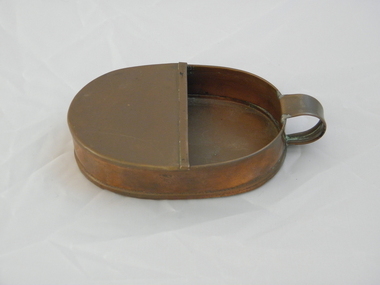
Copper collection tin
... ...dutch migration...Brought out to Australia by Dutch migrants as a reminder of their heritage. street organ collection tin dutch migration Oval tin, copper with soldered sides and half lid. ...These tins were used to take up collection of money from the public by the operators of street organs. These wheeled mechanical organs used to be trundled around the streets of the Netherlands stopping at intervals to grind out some tunes.Brought out to Australia by Dutch migrants as a reminder of their heritage. Oval tin, copper with soldered sides and half lid. D-shaped handle at one end.street organ, collection tin, dutch migration -
 Dutch Australian Heritage Centre Victoria
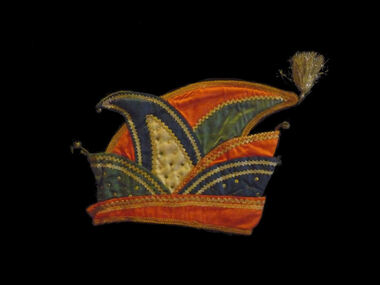
Carnival Hat (carnavalshoed), 1970s - 1980s
... carnival hat; brabant; limburg; dutch migration...For people from the southern provinces of the Netherlands, the annual "Carnaval" is an important cultural event. carnival hat; brabant; limburg; dutch migration Has the name "L. Havel" on the inside. ...Carnival (Dutch: Carnaval) is an important annual event heralding Lent in the southern provinces of The Netherlands, with each village often having its own "Carnavalsclub" and traditions. Many Dutch immigrantsg from the southern provinces have continued this tradition and formed their regional Carnavals Clubs in Australia. Each club has its own colourful uniforms, including specific hats. There are potentially three types of hats: A formal hat for official events, a work hat for use during normal club nights and for those members lucky enough to be chosen for a year as the "Prince" of the club, a Prince's Hat. Dutch Carnival is primarily a festival celebrating human folly which is why the hats are like jesters' caps. "Carnaval" comes with a rich tradition of ridiculing people and institutions of authority, and so, for instance, the "Prince" is saluted with military salutes which are performed the wrong way round, to the great merriment of onlookers. Special songs celebrating the foolishness of people in high places, such as politicians, are composed each year for "Carnaval". For people from the southern provinces of the Netherlands, the annual "Carnaval" is an important cultural event.Decorative hat from silk-like material, coloured orange, green and cream and finished off with silvery gold band and other decorative items (see picture - also see items 6352 and 6353).Has the name "L. Havel" on the inside.carnival hat; brabant; limburg; dutch migration -
 Dutch Australian Heritage Centre Victoria
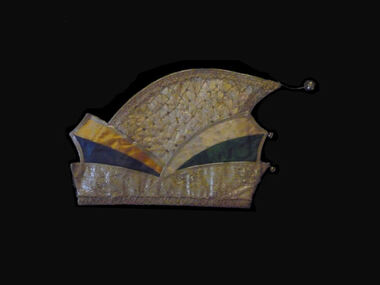
Prince Hat of Carnavals Club
... prince carnaval limburg brabant dutch migration...For people from the Southern Provinces of the Netherlands, Carnavall is an important cultural event. prince carnaval limburg brabant dutch migration has a 6 on the inside Decorative hat from silky type silver, gold, blue and aqua material, finished of with bells at front of hat (see picture - also see items 6351 and 6352). ...Carnaval is an important annual event in the Southern Provinces of The Netherlands, with each village often having its own Carnavals Club and traditions. The Dutch People coming from the Southern Provinces continued in many cases this tradition and formed their regional Carnavals Clubs in Australia. Each Carnalvals Club has its own colourful uniforms, including a hat. There are potentially three types of hats: A Formal Hat for official events, a Work Hat for use during normal club nights and for those members lucky enough to be for a year chosen as the "Prince" of the club, a Prince Hat.For people from the Southern Provinces of the Netherlands, Carnavall is an important cultural event.Decorative hat from silky type silver, gold, blue and aqua material, finished of with bells at front of hat (see picture - also see items 6351 and 6352).has a 6 on the insideprince carnaval limburg brabant dutch migration -
 Wodonga & District Historical Society Inc
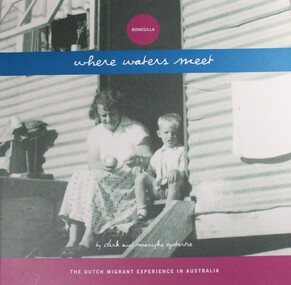
Book - Bonegilla Where Waters Meet: The Dutch Migrant Experience in Australia, Dirk Eysbertse and Marijke Eysbertse, 1997
... ...dutch migration...The Dutch were one of the largest groups at the camp. bonegilla dutch migration bonegilla reception centre An illustrated account of the experiences of people who migrated to Australia from Holland in the 1950s and 60s and passed through the Bonegilla Reception Centre before settling in their new land. ...An illustrated account of the experiences of people who migrated to Australia from Holland in the 1950s and 60s and passed through the Bonegilla Reception Centre before settling in their new land. Presents reminiscences from the people involved about their journey to Australia, conditions in Bonegilla and their impressions of life in Australia. Published as an accompanying volume to the exhibition 'Where Waters Meet'non-fictionAn illustrated account of the experiences of people who migrated to Australia from Holland in the 1950s and 60s and passed through the Bonegilla Reception Centre before settling in their new land. Presents reminiscences from the people involved about their journey to Australia, conditions in Bonegilla and their impressions of life in Australia. Published as an accompanying volume to the exhibition 'Where Waters Meet'bonegilla, dutch migration, bonegilla reception centre -
 Dutch Australian Heritage Centre Victoria
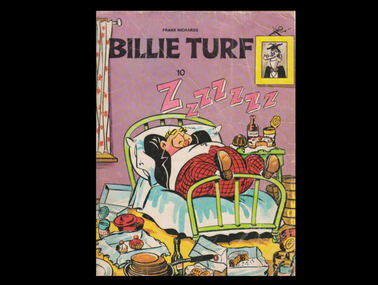
Comic Book - Billy Turf, Billy Turf 10
... Comic Book Dutch UK Migration...Comic Book Dutch UK Migration slightly worn Soft-cover comic book Billy Turf 10 Comic Book - Billy Turf Frank Richards / Amsterdam Book ...The Billy Turf series of stories is one of the few comic books originating in the UK instead of the area Belgium, The Netherlands and France.Comic Books are traditionally more popular in The Netherlands (and France and Belgium) than they are in Australia. There are in the Netherlands shops that only sell comic books. Most of these comic books originate from the area The Netherlands, Belgium and France.Soft-cover comic bookslightly worncomic book dutch uk migration -
 Dutch Australian Heritage Centre Victoria
Jewellery Box (Sieradendoosje)
... Links to Dutch East Indies, colonial and Dutch migration history. arts and crafts Wooden box with lid, brass hinges, inlaid design on lid depicting a farm worker, surrounded by foliage, birds and mythical creatures, possibly garuda. ...Links to Dutch East Indies, colonial and Dutch migration history.Wooden box with lid, brass hinges, inlaid design on lid depicting a farm worker, surrounded by foliage, birds and mythical creatures, possibly garuda. Multiple types of wood. Light coloured inlaid piping around sides.arts and crafts -
 Ithacan Historical Society
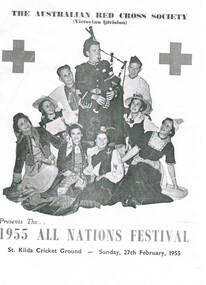
Poster, All Nations Festival, 1955
... Dutch. The event held in 1955 by the Australian Red Cross promoted multicultural Australia and members of the Ithacan Philanthropic Club participated. It was the period of post WW2 mass migration ...An advertising poster for the 1955 All Nations Festival which was presented by the Australia Red Cross Society, Victorian Branch. Nina and Olga Black participated in the festival and were featured on the poster (seated at front first and second from left) wearing Greek traditional costumes. Other recognisable national costumes are Scottish Piper and Dutch.The event held in 1955 by the Australian Red Cross promoted multicultural Australia and members of the Ithacan Philanthropic Club participated. It was the period of post WW2 mass migration which saw many nationalities making Australia their home.Photocopy of a poster for the 1955 All Nations Festival. Consisting of a group 3 men and 6 women dressed in different national traditional dress. There is a Red Cross symbol either side of the group.THE AUSTRALIAN RED CROSS SOCIETY / VICTORIAN DIVISION/PRESENTS THE / 1955 ALL NATIONS FESTIVAL / ST. KILDA CRICKET GROUND - SUNDAY, 27TH FEBRUARY 1955folk dancing, national costimes -
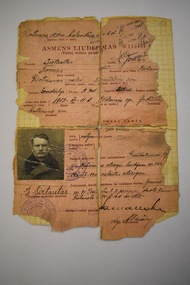 Warrnambool and District Historical Society Inc.
Document (Collection) - Collection of personal papers, Jonas Sirtautas and Fanni Rosenhammer, 20th Century
... Holland. Some documents are in German. These paper are of interest as mementoes of a post-World War 11 Warrnambool migrant couple Jonas Sirtautas and Fanni Rosenhammer lithuanian migrants waeenambool warrnambool migrants post WW2 migration This is a collection of personal papers and identity documents belonging to Jonas Sirtautas and Fanni Rosenhammer. ...Donation from familyPersonal HistoryItems kept in foldersPersonal Papersjonas sirtautas and fanni rosenhammer, lithuanian migrants, waeenambool, warrnambool migrants, post ww2 migrationjonas sirtautas and fanni rosenhammer, lithuanian migrants, waeenambool, warrnambool migrants, post ww2 migration -
Whitehorse Historical Society Inc.
Audio - Oral History Transcript, ADMIRAAL, Nel, Nell Admiraal, 24 April 2006
... Dutch in Australia...Oral History Migration Program...Dutch in Australia Oral History Migration Program Emigration Nell Admiraal Interview with Mrs (Nell) Pieternella Admiral, who emigrated to Australia from Holland in 1954 by Liz Chapman on 24 April 2006. ...Interview with Mrs (Nell) Pieternella Admiral, who emigrated to Australia from Holland in 1954 by Liz Chapman on 24 April 2006.Interview with Mrs (Nell) Pieternella Admiraal, who emigrated to Australia from Holland in 1954, by Liz Chapman 24 April 2006. Tape at NP3453Interview with Mrs (Nell) Pieternella Admiral, who emigrated to Australia from Holland in 1954 by Liz Chapman on 24 April 2006.dutch in australia, oral history migration program, emigration, nell, admiraal -
Whitehorse Historical Society Inc.
Document, Durk Marcus, /04/2006
... Oral History Migration Program...Dutch...Marcus Durk Emigration Oral History Migration Program Dutch in Australia Interview with Durk Marcus, who migrated to Australia from Holland in 1951. ...Interview with Durk Marcus, who migrated to Australia from Holland in 1951.Interview with Durk Marcus, who migrated to Australia from Holland in 1951. Interviewed by Jan Harper 3 April 2006Interview with Durk Marcus, who migrated to Australia from Holland in 1951. marcus, durk, emigration, oral history migration program, dutch in australia -
Whitehorse Historical Society Inc.
Audio - Oral History, Johanna van Hoek, 21/04/2006
... Oral History Migration Program...Dutch...Dutch oil company, Shell. The family returned to Netherlands after being interned during the Second World War. Johanna trained as a medical analyst and in 1954 migrated to Australia with her husband. The family settled near Blackburn Lake. Emigration Oral History Migration ...Johanna van Hoek, who was born in Borneo, where her father was stationed for his work with the Dutch oil company, Shell. The family returned to Netherlands after being interned during the Second World War. Johanna trained as a medical analyst and in 1954 migrated to Australia with her husband. The family settled near Blackburn Lake. Cassette recording of an interview with Johanna van Hoek, who was born in Borneo, returned to Netherlands after the Second World War, trained as a medical analyst and in 1954 migrated to Australia with her husband. The family settled near Blackburn Lake. The interview was conducted by Melanie Farrow on 21 April 2006. emigration, oral history migration program, dutch in australia, van hoek, johanna, migrant skills
