
Showing 12 items matching "early pin manufacture"
-
 Embroiderers Guild, Victoria
Tool - Pin (antique), c1860
... ...Early pin manufacture...Mourning pin Early pin manufacture Steel (or iron) pin, coated with black lacquer. ...Pins have a very important role in social history. Pins were made from steel with separate heads which were applied to the shaft. The lacquering of this steel pin may indicate that it was a mourning pin,.Mourning clothes were the social custom from Regency period when it was not acceptable to wear anything which might glitter. The lacquer coating both smoothed the rough steel and prevented any inappropriate glitter.Steel (or iron) pin, coated with black lacquer. Head was made separately and attached to shankmourning pin, early pin manufacture -
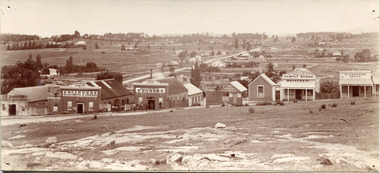 The Beechworth Burke Museum
Photograph, c1900
... early establishment of the town. New Town Newtown Newtown Beechworth local business 1858 1850s Beechworth Joseph E. Bishop coach builder coach Mark Straughair M. Straughair Straughair and Duncan John Duncan J. Duncan Beechworth Foundry Mackenzie Family Store T. Pratten grocer Beechworth grocers Beechworth Mental Asylum Beechworth Mental Hospital Mayday Hills Mental Asylum Mental Hospital Alexander Rogers New Ford Street Foundry 1860s Beechworth 1860s mining machinery agricultural machinery manufacturing Bridge Road Obverse: [Pin holes from circular tacks in all four corners] Reverse: 84.216-1/ Newtown/ 1997.2650/ 21/ BMM3056/ Sepia rectangular photograph printed on photographic paper mounted on board Photograph Photograph ...Taken around 1858, depicting a row of five business buildings on a rocky, sloping hillside at New Town, with a view across to residences and open land. Businesses included, Joseph E. Bishop, Coach Builders; Straughair Duncan, Engineers, Blacksmiths & Farriers; Straughair Duncan, Beechworth Foundry; Wholesale & Retail Est. 1855, Mackenzie Family Store ; and T. Pratten, Grocer. The Mental Hospital can be seen in the background. Mark Straughair and John Duncan, established the Beechworth Foundry, Newtown in 1858 and went on to build an important industry, employing around sixteen men, after acquiring Alexander Roger's New Ford Street Foundry in the late 1860s. Making and repairing mostly mining and agricultural machinery for the Ovens District and a Beechworth brewery, the business continued to function after Straughair's death in 1882, up until the death of Duncan in 1896, when the business folded. This photograph is historically significant because it shows the development of the businesses in Beechworth from the early establishment of the town.Sepia rectangular photograph printed on photographic paper mounted on boardObverse: [Pin holes from circular tacks in all four corners] Reverse: 84.216-1/ Newtown/ 1997.2650/ 21/ BMM3056/new town, newtown, newtown beechworth, local business, 1858, 1850s beechworth, joseph e. bishop, coach builder, coach, mark straughair, m. straughair, straughair and duncan, john duncan, j. duncan, beechworth foundry, mackenzie family store, t. pratten, grocer, beechworth grocers, beechworth mental asylum, beechworth mental hospital, mayday hills mental asylum, mental hospital, alexander rogers, new ford street foundry, 1860s beechworth, 1860s, mining machinery, agricultural machinery, manufacturing, bridge road -
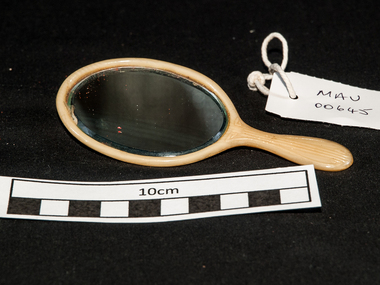 City of Moorabbin Historical Society (Operating the Box Cottage Museum)
Personal Effects, miniature oval hand mirror, c1900
... earlier have been manufactured from ivory, horn or other expensive animal products. It was often referred to as "Ivorine" or "French Ivory". It was also used for dressing table sets, dolls, picture frames, charms, hat pins, buttons, buckles, stringed instrument parts, accordions, fountain pens, cutlery handles and kitchen items. ...earlier have been manufactured from ivory, horn or other expensive animal products. It was often referred to as "Ivorine" or "French Ivory". It was also used for dressing table sets, dolls, picture frames, charms, hat pins, buttons, buckles, stringed instrument parts, accordions, fountain pens, cutlery handles and kitchen items. ...Celluloids are a class of compounds created from nitrocellulose and camphor, with added dyes and other agents. Generally considered the first thermoplastic, it was first created as Parkesine in 1856 and as Xylonite in 1869, before being registered as Celluloid in 1870. Celluloid is easily moulded and shaped, and it was first widely used as an ivory replacement. The main use was in movie and photography film industries, which used only celluloid films prior to acetate films that were introduced in the 1950s. Celluloid is highly flammable, difficult and expensive to produce and no longer widely used, although its most common uses today are in table tennis balls, musical instruments and guitar picks. Celluloid was useful for creating cheaper jewellery, jewellery boxes, hair accessories and many items that would earlier have been manufactured from ivory, horn or other expensive animal products. It was often referred to as "Ivorine" or "French Ivory". It was also used for dressing table sets, dolls, picture frames, charms, hat pins, buttons, buckles, stringed instrument parts, accordions, fountain pens, cutlery handles and kitchen items. The main disadvantage the material had was that it was flammable.. It was soon overtaken by Bakelite.A miniature, oval, Ivorine hand mirror with floral engraving on back. An accoutrement for use in a lady's Evening bag c19thCFloral design engraving on back of mirrormoorabbin, brighton, early settlers, pioneers, cheltenham, craft work, mirors, ivorine, evening bags, celluloids, bakelite, plastics, -
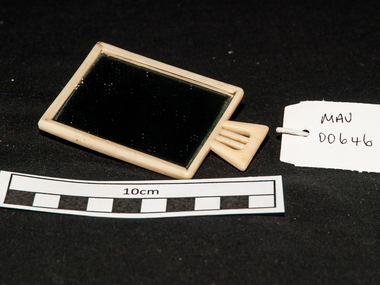 City of Moorabbin Historical Society (Operating the Box Cottage Museum)
Personal Effects, miniature square hand mirror, c1900
... earlier have been manufactured from ivory, horn or other expensive animal products. It was often referred to as "Ivorine" or "French Ivory". It was also used for dressing table sets, dolls, picture frames, charms, hat pins, buttons, buckles, stringed instrument parts, accordions, fountain pens, cutlery handles and kitchen items. ...earlier have been manufactured from ivory, horn or other expensive animal products. It was often referred to as "Ivorine" or "French Ivory". It was also used for dressing table sets, dolls, picture frames, charms, hat pins, buttons, buckles, stringed instrument parts, accordions, fountain pens, cutlery handles and kitchen items. ...Celluloids are a class of compounds created from nitrocellulose and camphor, with added dyes and other agents. Generally considered the first thermoplastic, it was first created as Parkesine in 1856 and as Xylonite in 1869, before being registered as Celluloid in 1870. Celluloid is easily moulded and shaped, and it was first widely used as an ivory replacement. The main use was in movie and photography film industries, which used only celluloid films prior to acetate films that were introduced in the 1950s. Celluloid is highly flammable, difficult and expensive to produce and no longer widely used, although its most common uses today are in table tennis balls, musical instruments and guitar picks. Celluloid was useful for creating cheaper jewellery, jewellery boxes, hair accessories and many items that would earlier have been manufactured from ivory, horn or other expensive animal products. It was often referred to as "Ivorine" or "French Ivory". It was also used for dressing table sets, dolls, picture frames, charms, hat pins, buttons, buckles, stringed instrument parts, accordions, fountain pens, cutlery handles and kitchen items. The main disadvantage the material had was that it was flammable. Items made in celluloid are collectible today and increasingly rare in good condition. It was soon overtaken by Bakelite and Catalin.. A miniature, square, Ivorine hand mirror with bird engraved on back. An accoutrement for use in a lady's Evening bag c 19thCbird engraved on back of mirrormoorabbin, cheltenham, brighton, market gardeners, pioneers early settlers, mirrors, ivorine, celluloids, bakelite, plastics, -
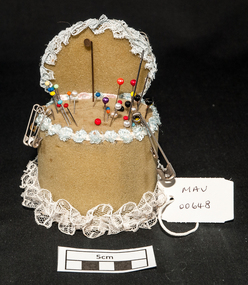 City of Moorabbin Historical Society (Operating the Box Cottage Museum)
Craft work, pin-cushion, c1950
... manufactured with a foaming agent to create an air-filled matrix structure. Foam rubber was first produced in 1929 by Dunlop researcher chemist Eric Owen using whipped latex. In 1937 isocyanate based materials were first used for the formation of foam rubbers, after World War II styrene-butadiene rubber replaced many natural types of foam. Foam rubbers have been used commercially for a wide range of applications since around the 1940s. moorabbin brighton early settlers pioneers cheltenham dressmaking craftwork A foam rubber ,cylindrical, pin ...Foam rubber (also known as cellular, sponge, or expanded rubber) refers to rubber that has been manufactured with a foaming agent to create an air-filled matrix structure. Foam rubber was first produced in 1929 by Dunlop researcher chemist Eric Owen using whipped latex. In 1937 isocyanate based materials were first used for the formation of foam rubbers, after World War II styrene-butadiene rubber replaced many natural types of foam. Foam rubbers have been used commercially for a wide range of applications since around the 1940s. A foam rubber ,cylindrical, pin-cushion decorated with lace ribbon c1950 With steel dressmaking pinsmoorabbin, brighton, early settlers, pioneers, cheltenham, dressmaking, craftwork -
 Kiewa Valley Historical Society
Dress Knitted
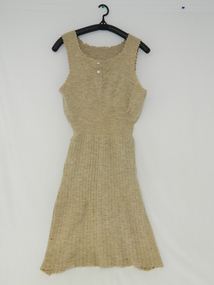
... early 1900s was made by a very competent seamstress (lack of manufacturer's label). It demonstrates that the conditions of relative isolation within the Kiewa Valley was not extreme and that local manufacture of clothing items were available and at a very high level of quality. This item demonstrates that the hand made era was alive and an essential part of community/social adhesion within the valley. costume woollen knitted dress female clothing no manufacturer's label suggesting manufacturer was a very talented local seamstress Beige knitted dress, sleeveless ladies pin weaved running from waist to bottom. ...This dress was possibly manufactured by a local seamstress in the period circa early 1900.The quality of the dress suggests that the lady who wore it was from middle to upper range of the socio-economic structure within the Kiewa ValleyHistorically this item dating in the early 1900s was made by a very competent seamstress (lack of manufacturer's label). It demonstrates that the conditions of relative isolation within the Kiewa Valley was not extreme and that local manufacture of clothing items were available and at a very high level of quality. This item demonstrates that the hand made era was alive and an essential part of community/social adhesion within the valley.Beige knitted dress, sleeveless ladies pin weaved running from waist to bottom. Fine pin weave from bust to waist. Two mother of pearl buttons fastening opening front neck 11cm from neck to upper breastno manufacturer's label suggesting manufacturer was a very talented local seamstress costume, woollen, knitted, dress, female clothing -
 Kiewa Valley Historical Society
Hat Pin
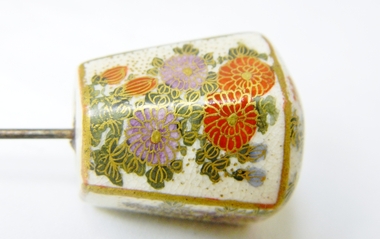
... The fine hand painted pictures with gold boarders and porcelain body suggests the item was bought either in Europe or Britain and brought into Australia in the late 19 th to early 20 th century by a wealthy landed gentry This item is a reflection of both the fashion mode of the 1800s to mid 1900s when long hair needed to be controlled by hair pins rather than later manufactured hair sprays. ...Historically this item could be a valuable antique worn originally by a wealthy upper class woman. The fine hand painted pictures with gold boarders and porcelain body suggests the item was bought either in Europe or Britain and brought into Australia in the late 19 th to early 20 th century by a wealthy landed gentryThis item is a reflection of both the fashion mode of the 1800s to mid 1900s when long hair needed to be controlled by hair pins rather than later manufactured hair sprays. It is also an example of society's mores of tidiness and quasi religious beliefs of covering the hair and head when outdoorsHead of pin is six sided, domed top made of porcelain. Two sides have hand painted pictures of grapes, two sides with flower arrangement , two sides detailing cypress tree tips of branch, top has flowers and leaves with hidden small birdshat pin, porcelain hat accessory, millinery clothing -
 Kiewa Valley Historical Society
Pin Drawing, Brass tacks, mid to late 1900's
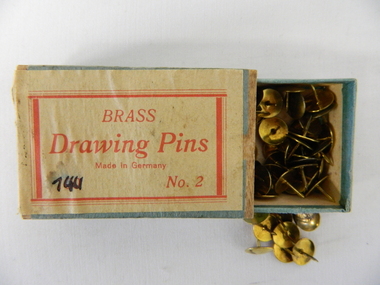
... pins manufactured in Asia. The box construction and label would suggest that supply of this boxes contents could have been in the early 1950's. ...pins manufactured in Asia. The box construction and label would suggest that supply of this boxes contents could have been in the early 1950's. ...This particular box of brass drawing pins would have been used before the introduction of cheaper polished chrome drawing pins manufactured in Asia. The box construction and label would suggest that supply of this boxes contents could have been in the early 1950's. Drawing pins or push pins were first invented in 1900 by Mr Edwin Moore. The need for a secure fastener to accommodate temporary signs and notes for domestic and commercial environments sprang up from the need to cope with an increasing faster method of presenting information on removable surfaces such as temporary notice boards. In the 1950's and later the increase in the pace of "living" brought about many time saving written communication notices. This temporary method of providing fast temporary notices is being surpassed by the computer age and mobile telephone "applications". The information spectrum of the computer age has made many "hands on" (drawing pin) applications go to the "dodo" level. This box of drawing pins is very significant to the Kiewa Valley and its region because it demonstrates that the pace in rural regions especially those that were once semi remote regions has moved at the same pace as the bigger towns and cities. Differences are still noticeable, such as the requirement of drawing pins for temporary signs and mail box commercially important "sales" notifications. The pressures that produce the "rat" syndrome, that is pressure by increased population levels infringing upon the individual's day-to-day existence is still not present in rural areas such as the Kiewa Valley. Drawing pins are still a requirement for leased accommodation (which are usually short term accommodation) for the personalisation of "home" wall decorations and shopper's "notice and information boards"This small box, similar to a "match box" (thumb activated slide, top open, cardboard container), holds brass drawing pins. These brass pins are also known as brass tacks, thumbtacks or push pins. The top of the brass tack has a "domed head" with the manufacturer's logo stamped on it. The number "2" on the bottom right of the label is the "weight" of the drawing pin. On the front and within a red border and red letters "BRASS" and below this in script form "Drawing Pins" and below this in smaller letters "Made In Germany" Below this and on the bottom left side "100" and also on the bottom but to the right "No. 2"notice and information boards, quick temporary fasteners., pins, tacts, brass tacts, domestic, decorations -
 Coal Creek Community Park & Museum
Rolling Pin
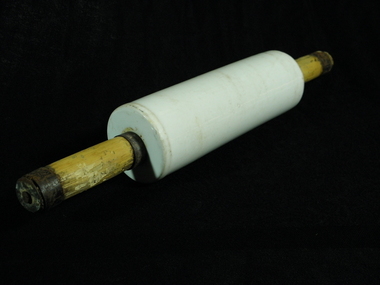
... Ceramic rolling pin was manufactured pre 1900, and was used for pastry production in a domestic kitchen, in the South Gippsland area. This rolling pin is an early ...Ceramic rolling pin was manufactured pre 1900, and was used for pastry production in a domestic kitchen, in the South Gippsland area.This rolling pin is an early to late Colonial item, and important for pastry production. The bamboo handles possibly indicate an Oriental background.2069.1 - White glazed ceramic rolling pin, with bamboo handles, secured with metal rings to handles.rolling pin, food preparation -
 Chiltern Athenaeum Trust
Domestic object, Stewart Dawson and Co, Unknown
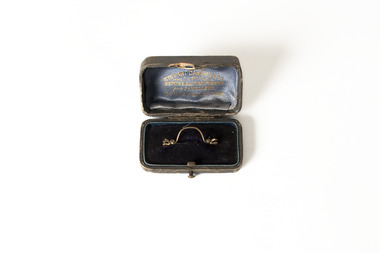
... Early Fifties'. Busse died in 1960. This particular object was owned by Busse. It is a tie pin and, as inscribed on its box, it was manufactured by Stewart Dawson and Co, a successful jewellery company - founded in Sydney in the late nineteenth century - that is still active today. ...Early Fifties'. Busse died in 1960. This particular object was owned by Busse. It is a tie pin and, as inscribed on its box, it was manufactured by Stewart Dawson and Co, a successful jewellery company - founded in Sydney in the late nineteenth century - that is still active today. ...Wilfred Clarence Busse was born in Chiltern, Victoria in 1898. His family first arrived in this region during the gold rush era, purchasing a piece of land adjacent to the Murray River. The spectacular scenery and rich history of the area is said to have inspired Busse in his writing. He attended Wesley College in his school days, before going on to study law at the University of Melbourne. After graduating from university, Busse would go on to become a barrister, but he is best known as a writer of fiction, publishing two novels: 'The Blue Beyond: A Romance of the Early Days in South Eastern Australia' and 'The Golden Plague: A Romance in the Early Fifties'. Busse died in 1960. This particular object was owned by Busse. It is a tie pin and, as inscribed on its box, it was manufactured by Stewart Dawson and Co, a successful jewellery company - founded in Sydney in the late nineteenth century - that is still active today. This object is significant as it was owned by Wilfred Clarence Busse, an accomplished barrister and writer from Chiltern, Victoria. It was also manufactured by Stewart Dawson and Co, a successful jewellery company, founded in the nineteenth century, that is still active today. A thin, curved, gold-coloured tie pin placed inside an open velvet-lined jewellery box. Inscribed beneath the lid are the words 'Stewart Dawson and Co. / Watch Manufacturers / and Jewellers / Sydney & London.Box open: Stewart Dawson and Co. / Watch Manufacturers / and Jewellers / Sydney & London w.c. busse, wilfred clarence busse, gold rush, gold rush chiltern, busse barrister, busse author, "the golden plague: a romance of the early fifties., "the golden plague”, "the blue beyond: a romance of the early days in south eastern australia", "the blue beyond", tie pin, jewellery, jewellery manufacturers, sydney jewellers nineteenth century, stewart dawson and co -
 Geelong Cycling Club
Functional object - Storage Box, c. 1950
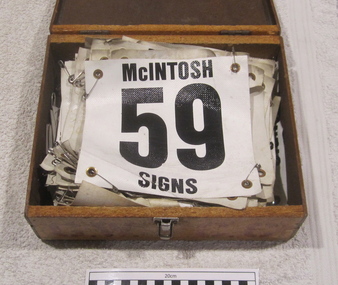
... Circa 1930s cyclists' numbers were manufactured in plastic material and attached to the riders' back with safety pins. Provides examples of early rider numbers and material used at that time geelong cycling club geelong west cycling club cyclists numbers storage box "G.W.C.C. ...Circa 1930s cyclists' numbers were manufactured in plastic material and attached to the riders' back with safety pins.Provides examples of early rider numbers and material used at that timeGeelong West Cycling Club storage box containing plastic squares of cyclists' numbers. Includes cyclist numbers from 1-100. The wooden box has a medal handle on the top of the box and a metal clip securing the lid to the box. "G.W.C.C. /Riders Numbers"geelong cycling club, geelong west cycling club, cyclists numbers, storage box -
 Friends of Westgarthtown
Costume - Hatpin, c.1890-1910
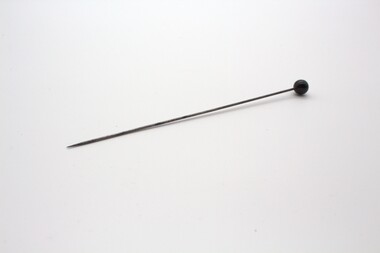
... pin featuring a decorative black top, possibly manufactured from jet or vulcanite. Hat pins such as this were used to secure women's hats to elaborate hairstyles and were an essential fashion accessory during the late nineteenth and early twentieth centuries....pin featuring a decorative black top, possibly manufactured from jet or vulcanite. Hat pins such as this were used to secure women's hats to elaborate hairstyles and were an essential fashion accessory during the late nineteenth and early twentieth centuries. ...Ladies' metal hat pin featuring a decorative black top, possibly manufactured from jet or vulcanite. Hat pins such as this were used to secure women's hats to elaborate hairstyles and were an essential fashion accessory during the late nineteenth and early twentieth centuries.
