
Showing 8 items matching "eat beach"
-
 Port Fairy Historical Society Museum and Archives
Coin - English Coin, 1842
... ...eat beach...Found on South Beach Port Fairy in 1972 by Wayne Archibald who decided in 2018 to return it to the town where he had found it coin shilling silver eat beach 1 shilling 1842 Silver English 1 shilling piece. ...Found on South Beach Port Fairy in 1972 by Wayne Archibald who decided in 2018 to return it to the town where he had found itSilver English 1 shilling piece. Young Queen Victoria's head on face- unreadable words with crown, oak leaves, denomination and date on reverse1 shilling 1842coin, shilling, silver, eat beach -
 Bendigo Military Museum
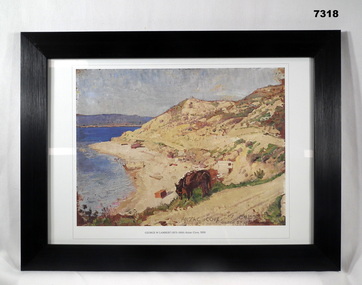
Print - PRINT, FRAMED WW1, Reader's Digest (Australia) Pty Limited, 2015
... Ruined buildings and structures visible on the beach. Horse eating grass in the foreground. Frame - Black plastic framing with glass front and MDF board backing with adhered black paper....Ruined buildings and structures visible on the beach. Horse eating grass in the foreground. Frame - Black plastic framing with glass front and MDF board backing with adhered black paper. ...From Information book; "Reader's Digest/ Gallipoli/ 25th April 1915 - 9th January 1916/ Centenary Commemorative Prints". Collection of 20 prints. Refer Cat No. 7300.Framed print. Print - colour print on paper. Copy of an oil painting with pencil on wood. Depicts a cove with sea, sand and hills. Ruined buildings and structures visible on the beach. Horse eating grass in the foreground. Frame - Black plastic framing with glass front and MDF board backing with adhered black paper.Details below print - in black ink; " GEORGE W LAMBERT (1873-1930) Anzac Cove, 1919" “GEORGE W LAMBERT, unable to enlist in the Australian Imperial Force in London, joined Voluntary Training Corps". Appointed an official Australia War Artist, Australian Imperial Force 1917. framed accessories, prints, ww1, gallipoli, centenary -
 Flagstaff Hill Maritime Museum and Village
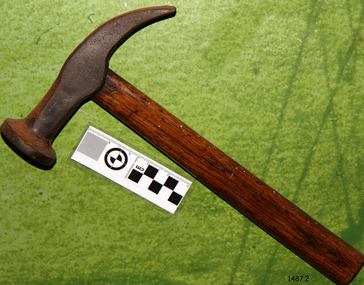
Tool - Sheathing hammer, Mid-to-late 20th century
... In previous centuries the sheathing was timber but on long voyages, the sea worms could eat through the timber and their holes would weaken the sheathing, sometimes causing the vessel to break up in the rough sea or if the ship was beached. ...In previous centuries the sheathing was timber but on long voyages, the sea worms could eat through the timber and their holes would weaken the sheathing, sometimes causing the vessel to break up in the rough sea or if the ship was beached. ...A sheathing hammer is used for attaching the copper or Muntz sheathing to the outside of a vessel. The outside cover of the hull of a ship or boat is called sheathing. In previous centuries the sheathing was timber but on long voyages, the sea worms could eat through the timber and their holes would weaken the sheathing, sometimes causing the vessel to break up in the rough sea or if the ship was beached. Copper or Muntz sheathing was later used. It was effective but very expensive. In modern times the hulls of ships are iron. The shipwright’s tools on display in the Great Circle Gallery are connected to the maritime history of Victoria through their past owner, user and donor, Laurie Dilks. Laurie began his career as a shipwright in the mid-1900s, following in the wake of the skilled carpenters who have over many centuries used their craft to build and maintain marine vessels and their fittings. You can see Laurie’s inscription on the tool called a ‘bevel’. Laurie worked for Ports and Harbours, Melbourne, for over 50 years, beginning in the early 1960s. He and a fellow shipwright inscribed their names on a wheelhouse they built in 1965; the inscription was discovered many decades later during a repair of the plumbing. Many decades later Laurie worked on the Yarra moving barges up and down the river and was fondly given the title ‘Riverboat Man’ His interest in maritime history led him to volunteer with the Maritime Trust of Australia’s project to restore and preserve the historic WWII 1942 Corvette, the minesweeper HMAS Castlemaine, which is a sister ship to the HMAS Warrnambool J202. Laurie Dilks donated two handmade displays of some of his tools in the late 1970s to early-1980s. The varnished timber boards displayed the tools below together with brass plaques. During the upgrade of the Great Circle Gallery Laurie’s tools were transferred to the new display you see there today. He also donated tools to Queenscliffe Maritime Museum and Clunes Museum.The shipwright’s tools on display in the Great Circle Gallery are connected to the maritime history of Victoria through their past owner, user and donor, Laurie Dilks. Laurie began his career as a shipwright at Ports and Harbours in Melbourne in the mid-1900s, following in the wake of the skilled carpenters who have over many centuries used their craft to build and maintain marine vessels and their fittings.The sheathing hammer has a wooden handle and metal head. One side of the head has a long claw for removing nails with minimum damage to the surrounding surface. The other side has a wide, flat round head for hammering in the large nails used in shipbuilding. It once belonged to shipwright Laurie Dinks.flagstaff hill, warrnambool, great ocean road, shipwreck coast, maritime museum, maritime village, shipwright, carpenter, shipbuilding, ship repairs, hand tool, equipment, ship maintenance, cooper, tool, marine technology, sheathing hammer, hammer, shipwright's hammer, ship's sheathing, laurie dilks, l dilks, port and harbours melbourne -
 Orbost & District Historical Society
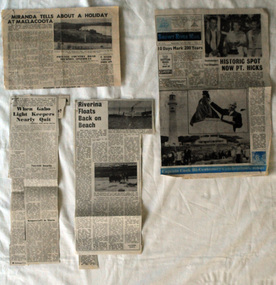
newspaper clippings, mid 20th century?
... A manila folder of black / white newspaper articles relating to Orbost and the surrounding district. 744.2 is titled, " Miranda Tells About a Holiday at Mallacoota". 744.3 is from the Snowy River Mail and is titled, " Historic Spot Now Pt Hicks". 744.4 is from the Snowy Mail and is titled, "Riverina Floats Back on Beach". 744.5 is from the Snowy River Mail and has three articles: "When Gabo Light Keepers Nearly Quit"; "Sydney Convicts For Gabo?'; "Nothing to Eat...These articles are contemporary records of interest in places close to Orbost and are a useful reference tool. newspaper-articles-Gabo- Point Hicks Riverina A manila folder of black / white newspaper articles relating to Orbost and the surrounding district. 744.2 is titled, " Miranda Tells About a Holiday at Mallacoota". 744.3 is from the Snowy River Mail and is titled, " Historic Spot Now Pt Hicks". 744.4 is from the Snowy Mail and is titled, "Riverina Floats Back on Beach". 744.5 is from the Snowy River Mail and has three articles: "When Gabo Light Keepers Nearly Quit"; "Sydney Convicts For Gabo?'; "Nothing to Eat ...This folder of newspaper articles was compiled by Mary Gilbert. Mary Isabelle Gilbert was born in 1905 in Orbost, Australia. She was born to John Gilbert and Annie Cameron Gilbert, and had seven sisters and one brother. Four siblings died at a young age. .She was a teacher historian loved and respected by her family and the wider community. The articles are generally pertaining to Gabo and Point Hicks.These articles are contemporary records of interest in places close to Orbost and are a useful reference tool.A manila folder of black / white newspaper articles relating to Orbost and the surrounding district. 744.2 is titled, " Miranda Tells About a Holiday at Mallacoota". 744.3 is from the Snowy River Mail and is titled, " Historic Spot Now Pt Hicks". 744.4 is from the Snowy Mail and is titled, "Riverina Floats Back on Beach". 744.5 is from the Snowy River Mail and has three articles: "When Gabo Light Keepers Nearly Quit"; "Sydney Convicts For Gabo?'; "Nothing to Eat But Shark".newspaper-articles-gabo- point hicks riverina -
 Phillip Island and District Historical Society Inc.
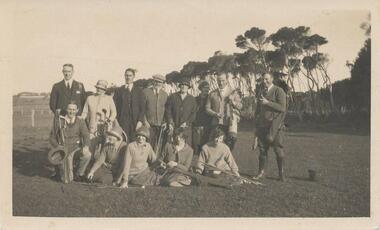
Photograph, Early 1920's
... One hole was placed on the flat land on the beach. There were red flags and the cows used to eat them. ...One hole was placed on the flat land on the beach. There were red flags and the cows used to eat them. golf links san remo lyn chambers On back: San Remo Golf Links early 1920's Black & White photograph of a group of people with their golf clubs. ...One of 5 photographs donated by Lyn Chambers & Frank Dominick - Wonthaggi Historical Society The following information was sent by a reader of VC for which we are very thankful. The golf course in San Remo was opened in 1922 and was on the land adjacent to Ocean Grove where Griffiths point lodge and Davis Point road now stand. One hole was placed on the flat land on the beach. There were red flags and the cows used to eat them. Black & White photograph of a group of people with their golf clubs. Noted on back of photo "San Remo Golf Links". A question mark re location as it seems too flat. Maybe it was in Cowes?? This has now been updated - see below under "Historical Information" 4/9/2016On back: San Remo Golf Links early 1920'sgolf links san remo, lyn chambers -
 Bendigo Military Museum
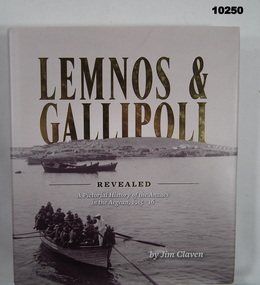
Book - PICTORIAL BOOK, WW1, Jim CLAVEN OAM, "LEMNOS & GALLIPOLI", 2019
... beach and hills. Back - Nurse holding kitten with background group of nurses. Dust cover - paper. print and illustrations as above. Inside of dust cover - illustrated three black and white photographs of rest campsites with background of sea and shopping. 326 pages - cut, plain, white colour paper. Pictorial book, black and white and colour photographs. End papers - black and white photographs. Front - soldiers eating...beach and hills. Back - Nurse holding kitten with background group of nurses. Dust cover - paper. print and illustrations as above. Inside of dust cover - illustrated three black and white photographs of rest campsites with background of sea and shopping. 326 pages - cut, plain, white colour paper. Pictorial book, black and white and colour photographs. End papers - black and white photographs. Front - soldiers eating ...Hardcover book with dust cover. Hardcover - cardboard with illustrated adhered paper cover. Gold, white and black colour print on front, spine and back. Illustrated black and white photographs. Front - a group of soldiers in a boat moving towards land with background of beach and hills. Back - Nurse holding kitten with background group of nurses. Dust cover - paper. print and illustrations as above. Inside of dust cover - illustrated three black and white photographs of rest campsites with background of sea and shopping. 326 pages - cut, plain, white colour paper. Pictorial book, black and white and colour photographs. End papers - black and white photographs. Front - soldiers eating a meal. Back - group of nurses. publication, book, military history, anzacs, ww1 -
 National Vietnam Veterans Museum (NVVM)
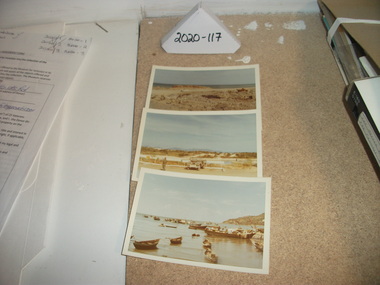
Photograph
... 16 coloured photos of soldiers relaxing, eating & drinking outdoors. 30 b/w photos of various soldiers, landscape & battle machines. 14 coloured &b/w photos of beach and desert....Photograph 16 coloured photos of soldiers relaxing, eating & drinking outdoors. 30 b/w photos of various soldiers, landscape & battle machines. 14 coloured &b/w photos of beach and desert. ...16 coloured photos of soldiers relaxing, eating & drinking outdoors. 30 b/w photos of various soldiers, landscape & battle machines. 14 coloured &b/w photos of beach and desert.photograph -
 City of Greater Bendigo - Civic Collection
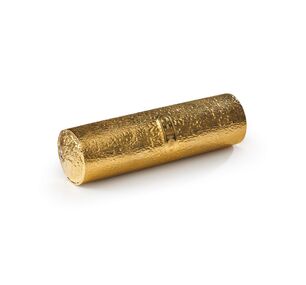
Artwork, other - Gold Chicko Roll, Simplot Australia, Chicko, 2001
... In 2008 with a push towards healthier eating, Chicko Roll reviewed its advertising and although it continues to target young men, it switched to using a 'fun, active' young women, riding a retro pushbike near the beach to improve its image. ...In 2008 with a push towards healthier eating, Chicko Roll reviewed its advertising and although it continues to target young men, it switched to using a 'fun, active' young women, riding a retro pushbike near the beach to improve its image. ...Commemorative object produced by The Simplot Company (Food Service) and presented to the City of Greater Bendigo on the occasion of the 50th anniversary of the creation of the Chicko Roll by Bendigo born boiler maker, Frank McEncroe. The Chicko Roll has been an Australian icon since the 1960's and 70's. Inspired by the Chinese spring roll and first sold in 1951 as the "Chicken Roll" despite not actually containing chicken. The snack was designed to be easily eaten on the move without a plate or cutlery and is typically deep-fried in vegetable oil. By 1965 the ubiquitous Chicko Roll was sold in every fish and chip shop throughout the country and at the height of their popularity in the 1970s, 40 million Chiko Rolls were being sold Australia-wide each year and more than one million were exported to Japan.(Wikipedia https://en.wikipedia.org/wiki/Chiko_Roll). Advertised with the slogan 'Grab a Chiko', 'Hit the Hot Spot' and 'You Can't Knock the Roll' the marketing around the Chicko Roll was aimed towards the male population with women perched on Harley Davidson's provocatively preparing to bite into a Chicko Roll. In 2008 with a push towards healthier eating, Chicko Roll reviewed its advertising and although it continues to target young men, it switched to using a 'fun, active' young women, riding a retro pushbike near the beach to improve its image. In 1995 J.R. Simplot, an American company who also own Leggo's, Birds Eye, Edgell and John West acquired Chicko Roll to sure up their foothold in the Australian market. Life size gold plated chicko roll in a hinged wooden presentation box with red lining. Double sided, printed letter accompanying the object explains its creation and significance.CHICKOcity of greater bendigo commerce, mayor acherman
