
Showing 37 items matching "eight ball"
-
 Bendigo Military Museum
Newsletter - BEHIND THE EIGHT BALL 1989
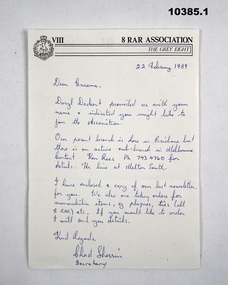
... BEHIND THE EIGHT BALL 1989...eight ball...With the letter was the No 3 Issue of Eight Ball. The Newsletter had articles re the Association with events, committee's, cartoons,copies of old newspaper articles with several from Malaya. ....1) Letter, white paper, print in black with hand written note in blue pen. .2) Newsletter, "Behind the Eight Ball", 13 print pages all in black, photos, articles, cartoons, held by one staple in top LH corner....Newsletter BEHIND THE EIGHT BALL 1989 ...Collection re G.A. Jones 3790932, refer Cat No 10053.2P for his service details. The letter to Graeme from Chad Sherrin states that Daryl Deckart gave Chad his details that Graeme might like to join the Association, that there was an active Sub Branch in Melbourne and to contact Ken Rees. With the letter was the No 3 Issue of Eight Ball. The Newsletter had articles re the Association with events, committee's, cartoons,copies of old newspaper articles with several from Malaya. This edition was in the early days of the Associations formation. It states at this point they had names/addresses of 722 Vietnam members, 66 Malaya and 10 who were 8/9 RAR members..1) Letter, white paper, print in black with hand written note in blue pen. .2) Newsletter, "Behind the Eight Ball", 13 print pages all in black, photos, articles, cartoons, held by one staple in top LH corner..1) "22 February 1989 - Dear Graeme - Kind regards Chad Sherrin Secretary" .2) "8 RAR Association - Issue No 3 - January 1989"eight ball, 8 rar, ga jones -
 The Beechworth Burke Museum
Decorative object - Clock, New Haven Clock Company, 1881
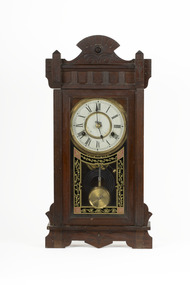
... ball ; / if too slow, raise it. The minute hand may be / moved at any time forward, but never backward / further than the figure XII. / Should the Clock strike wrong, lift the wire / under the figure VII until it strikes right. Markings on reverse: 2496 / 3526 / 4190 / 4873 / 5936 / 7107 Decoratively carved and etched wooden eight ...The New Haven Clock Company from Connecticut, USA, was incorporated by clockmaker Hiram Camp (1811-1893) in 1853. Camp studied clockmaking under his uncle Chauncey Jerome (1793-1868) from the age of 17. New Haven Clock Company supplied brass clock movements to Chauncey Jerome's own business, Jerome Manufacturing Company, until that company declared bankruptcy two years later. New Haven Clock Company acquired Jerome Manufacturing Company and continued to manufacture clocks for over a century. They grew to such a scale that they were outproducing all other clockmakers in the state of Connecticut. Their 'Duna' model was created circa 1881 and features a solid walnut cabinet with ornate carvings and a glass door decorated in gold, black, and red detail. The 8-day clock is designed to be wound once per week with a key; the clock features instructions on the reverse side should the timing need adjustment.This object is part of the Burke Museum Collection and represents the detailed craftmanship of one of the leading clock manufacturers of the late nineteenth and early twentieth centuries.Decoratively carved and etched wooden eight day striking mantle clock with a white face and black roman numerals.Engraving on rim above clock face: PATD FEB.11.1879 Engraving on pendulum: PAT'D MCH.1st 1881 Reverse label: 8 Day Duna / STRIKING./ New Haven Clock Co., / NEW HAVEN, CONN. / NOTICE. / If the Clock should go too fast, lower the ball ; / if too slow, raise it. The minute hand may be / moved at any time forward, but never backward / further than the figure XII. / Should the Clock strike wrong, lift the wire / under the figure VII until it strikes right. Markings on reverse: 2496 / 3526 / 4190 / 4873 / 5936 / 71078-day clock, new haven clock company, mantel clock, hiram camp -
 Mission to Seafarers Victoria
Photograph - Photograph, Colour, 1984
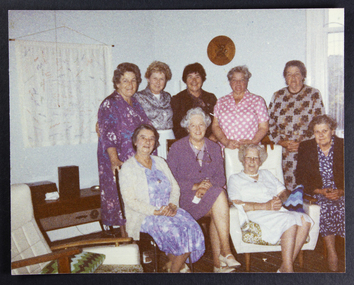
... Two of the Ladies standing centre back are Sadie Wilson and one other, Berenice who provided personal memories of their time as young hostesses at the Mission on the DVD 'The Lightbearers' produced by Csilla Tsongaray circa 2005 The donations of Sadie Wilson are key sources of dates and information re the role of LHLG members mid to late 20th Century at the Mission, this photograph is thought to originate from one of these gifts of selected personal papers presented (date unknown) by Miss Wilson. sadie wilson lhlg ladies harbour lights guild hostesses Blue Ball point pen handwritten on verso: Jessie, Marg, Sadie, Berenice, / & Eunice / Pat, Mable, Nora, Sheela [sic] / Joan took the photo / Jan 1984 Colour photograph of a group of eight senior age women four standing and four seated Photograph Photograph, Colour ...Features a number of post-WW2 members of the Ladies Harbour Lights Guild. Two of the Ladies standing centre back are Sadie Wilson and one other, Berenice who provided personal memories of their time as young hostesses at the Mission on the DVD 'The Lightbearers' produced by Csilla Tsongaray circa 2005The donations of Sadie Wilson are key sources of dates and information re the role of LHLG members mid to late 20th Century at the Mission, this photograph is thought to originate from one of these gifts of selected personal papers presented (date unknown) by Miss Wilson. Colour photograph of a group of eight senior age women four standing and four seated Blue Ball point pen handwritten on verso: Jessie, Marg, Sadie, Berenice, / & Eunice / Pat, Mable, Nora, Sheela [sic] / Joan took the photo / Jan 1984sadie wilson, lhlg, ladies harbour lights guild, hostesses -
 City of Moorabbin Historical Society (Operating the Box Cottage Museum)
Barbers' Equipment, hair clippers 'BURMAN", c1950
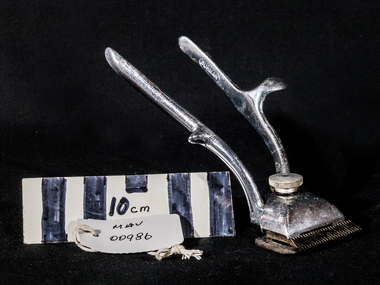
... Their recirculating worm and ball design of steering gear was fitted to pre-war vehicles such as the Ford Eight and the Ford Prefect, the Bedford CA, plus heavy trucks and off-road vehicles - both pre and post-war. ...Their recirculating worm and ball design of steering gear was fitted to pre-war vehicles such as the Ford Eight and the Ford Prefect, the Bedford CA, plus heavy trucks and off-road vehicles - both pre and post-war. ...Hair clippers are specialized implements used to cut human head hair. They work on the same principle as scissors, but are distinct from scissors and razors. :Hair clippers comprise a pair of sharpened comb-like blades in close contact one above the other which slide sideways relative to each other, a mechanism which may be manual or electrical to make the blades oscillate from side to side, and a handle. The clipper is moved so that hair is positioned between the teeth of the comb, and cut with a scissor action when one blade slides sideways relative to the other. Friction between the blades needs to be as low as possible, which is attained by choice of material and finish, and frequent lubrication. Hair clippers are operated by a pair of handles that are alternately squeezed together and released. Barbers used them to cut hair close and fast. The hair was picked up in locks and the head was rapidly depilated. Mid 20thC such haircuts became popular among boys, and young men in the military and in prisons. Burman & Sons Ltd, of Ryland Road, Birmingham, West Midlands, manufactured Burman-Douglas steering gear. Their recirculating worm and ball design of steering gear was fitted to pre-war vehicles such as the Ford Eight and the Ford Prefect, the Bedford CA, plus heavy trucks and off-road vehicles - both pre and post-war. In its day, Burman-Douglas steering-gear was regarded as.... a "quality" feature of a car chassis specification, but the worm and ball design was eventually surpassed by the cheaper rack and pinion design that dominates today. The company also manufactured motorcycle gearboxes, horse clippers and barbers’ clippers. 1871 Company founded. 1897 Private company. 1930s Gearbox for Ariel Square-four motorcycle. (Exhibit at Birmingham Thinktank museum) 1933 Burman and Sons Limited, manufacturers of horse and barbers' clippers, sheep shearers, motor cycle gear boxes and steering gears, Ryland road, Edgebaston 1953 S. F. Burman, M.B.E., Managing Director, Burman and Sons, Ltd 1955 Acquired by Vono Industrial Products. 1961 Manufacturers of motor and motorcycle accessories. 1,500 employees. 1968 Supplied rack and pinion steering units to Ford 1978 Adwest Group acquired Burman and Sons, the steering gear part of Duport. 1986 Major reduction in staffing at Burman due to fall in demand for its products and delivery problems. A set of hand held barbers’ hair clippers with an adjustable screw, from Burman and Sons Ltd of Birmingham, England. Chrome plated, in good condition, c1950. On left arm ; BURMAN On right arm ; MADE IN ENGLANDbarbers, hairdressing, hair clippers, grooming, horse clippers, cars, motor cycles, gear boxes, rack and pinion , worm and ball, steering gears, steel manufacture, birmingham england, burman and sons ltd, moorabbin, bentleigh, ormond, cheltenham, market gardeners, -
 Bendigo Military Museum
Photograph - Lithographic Technicians Preparing Printing Plates at the Army Survey Regiment, c1960s to c1980s
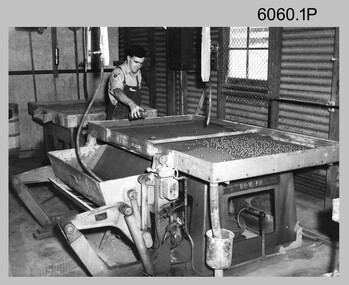
... eight photographs were most likely taken from the 1960s to the 1980s in Lithographic Squadron at the Army Survey Regiment, Fortuna, Bendigo. Photos .1P, .7P, and .8P are not annotated although .7P and .8P are positively identified. The others have the name of the technicians written on the back. In these photos the technician preparing printing plates for offset printing. The Printing Technician in photo .1P is resurfacing a zinc printing plate with ball...eight photographs were most likely taken from the 1960s to the 1980s in Lithographic Squadron at the Army Survey Regiment, Fortuna, Bendigo. Photos .1P, .7P, and .8P are not annotated although .7P and .8P are positively identified. The others have the name of the technicians written on the back. In these photos the technician preparing printing plates for offset printing. The Printing Technician in photo .1P is resurfacing a zinc printing plate with ball ...These eight photographs were most likely taken from the 1960s to the 1980s in Lithographic Squadron at the Army Survey Regiment, Fortuna, Bendigo. Photos .1P, .7P, and .8P are not annotated although .7P and .8P are positively identified. The others have the name of the technicians written on the back. In these photos the technician preparing printing plates for offset printing. The Printing Technician in photo .1P is resurfacing a zinc printing plate with ball bearings. In photos .2P to .6P the Printing Technicians are applying a light sensitive coating on the printing plate. In photos .7P and .8P the Printing Technicians are placing a map negative on top of the printing plate in a vacuum frame before light exposure. This is a set of photographs of lithographic technicians preparing printing plates at the Army Survey Regiment, Bendigo from c1960s to c1980s. The photographs were printed on photographic paper and are part of the Army Survey Regiment’s Collection. The photographs were scanned at 300 dpi. .1) - Photo, black & white, c1960s, SPR Bruce, Lithographic Squadron .2) - Photo, black & white, c1970s, Lance Percey, Lithographic Squadron .3) - Photo, black & white, c1970s, LCPL Col Hardisty, Lithographic Squadron .4) - Photo, black & white, c1970s, SPR Dave Edwards, Lithographic Squadron .5) - Photo, colour, c1970s, John Cain, Lithographic Squadron .6) - Photo, colour, c1970s, SGT Ken Slater, Lithographic Squadron .7) - Photo, black & white, c1980s, Roy Hicks, Lithographic Squadron .8) - Photo, black & white, c1980s, CPL Gary Drummond, Lithographic Squadron.1P - annotated 'SPR Bruce' on back of dupicate photo located in Volume 7 folder. .2 to .7 – personnel names (less rank) annotated on back. .8P – no annotationroyal australian survey corps, rasvy, army survey regiment, army svy regt, fortuna, asr, printing, litho -
 Eltham District Historical Society Inc
Photograph, Yeoman and Co, Florence May Shillinglaw, c.1906
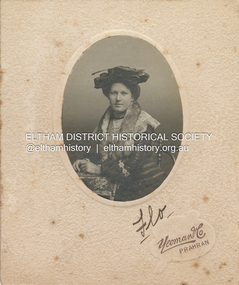
... She married Edward Thomas Bunker September 6, 1906 and they had eight children all born in Eltham where they had a cherry orchard and all lived full lives. Florence died July 26, 1969 at Ivanhoe. Marg Ball ...Florence May Shillinglaw born September 21, 1886 at Eltham, Victoria was the tenth child of Phillip Shillinglaw and Sarah Ann (nee Kidd). She commenced school at Eltham State School No. 209 (Register No. 552) in 1891 at age 4. She married Edward Thomas Bunker September 6, 1906 and they had eight children all born in Eltham where they had a cherry orchard and all lived full lives. Florence died July 26, 1969 at Ivanhoe."Mary Shillinglaw"marg ball collection, 1883-1918, 1906, florence may bunker (nee shillinglaw) (1886-1969), yeoman & co photographer prahran -
 Eltham District Historical Society Inc
Photograph, Yeoman and Co, Florence May Shillinglaw, c.1906
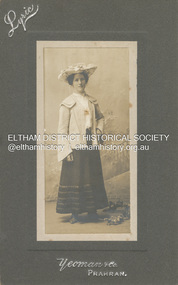
... She married Edward Thomas Bunker September 6, 1906 and they had eight children all born in Eltham where they had a cherry orchard and all lived full lives. Florence died July 26, 1969 at Ivanhoe. Marg Ball ...Florence May Shillinglaw born September 21, 1886 at Eltham, Victoria was the tenth child of Phillip Shillinglaw and Sarah Ann (nee Kidd). She commenced school at Eltham State School No. 209 (Register No. 552) in 1891 at age 4. She married Edward Thomas Bunker September 6, 1906 and they had eight children all born in Eltham where they had a cherry orchard and all lived full lives. Florence died July 26, 1969 at Ivanhoe."Mary Shillinglaw"marg ball collection, 1883-1918, 1906, florence may bunker (nee shillinglaw) (1886-1969), yeoman & co photographer prahran -
 Bendigo Military Museum
Photograph - PHOTOGRAPH, WEDDING WW2, 2022
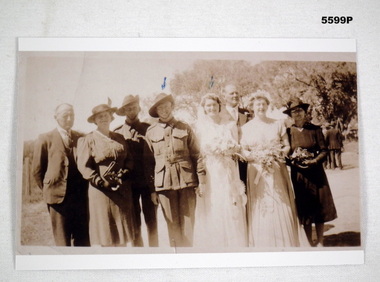
... Ball. For Jack Bruns service history/collection refer Cat No 5592. photographs On the rear in pencil from left to right, "Mr & Mrs Ray Bruns, Dad, Jack, Peggy, Grandad, Dorothy Bruns, Grandma, Jacks wedding 10.3.1942" Photograph sepia tone shows a wedding party of eight persons in an outside setting, on the rear of original photo was writing in pencil. ...The marriage of John (Jack) Raymond Bruns VX88627 to Margaret Joyce Ball (Peggy) "Dad" per inscription is Alan Ball VX85724 refer Cat No5589P. Grandad, Grandma is Arthur & Gertrude Ball. For Jack Bruns service history/collection refer Cat No 5592.Photograph sepia tone shows a wedding party of eight persons in an outside setting, on the rear of original photo was writing in pencil.On the rear in pencil from left to right, "Mr & Mrs Ray Bruns, Dad, Jack, Peggy, Grandad, Dorothy Bruns, Grandma, Jacks wedding 10.3.1942"photographs, -
 Bendigo Military Museum
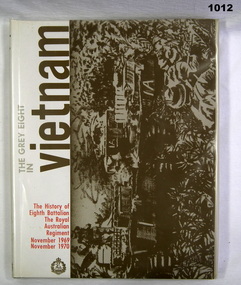
Book, The Grey Eight in Vietnam, 1989
... BALL" Hard cover, green buckram. Dust cover paper and plastic cover. Brown/grey print (illustration). White background, red print. Pages 160 Illustrated The Grey Eight ...Illustrated history of the 8th Battalian RAR in Vietnam 1969-70 with index of awards and nominal rollHard cover, green buckram. Dust cover paper and plastic cover. Brown/grey print (illustration). White background, red print. Pages 160 IllustratedInside cover "PETER BALL"book, military history, vietnam -
 Bendigo Historical Society Inc.
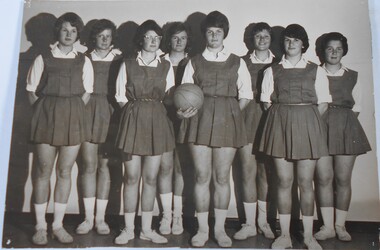
Photograph - Golden Square High School basketball team
... Black and white photo of the Golden Square High School female basketball team from 1962. eight players are in the photo, the one in the middle is holding the ball....Black and white photo of the Golden Square High School female basketball team from 1962. eight players are in the photo, the one in the middle is holding the ball. Photograph Golden Square High School basketball team ...Black and white photo of the Golden Square High School female basketball team from 1962. eight players are in the photo, the one in the middle is holding the ball.1962, basketball. ten inches X four and a half (crossed out), 100#, G.S.H.S.basketball team 1962, golden square high school -
 Royal Australian and New Zealand College of Obstetricians & Gynaecologists (RANZCOG)
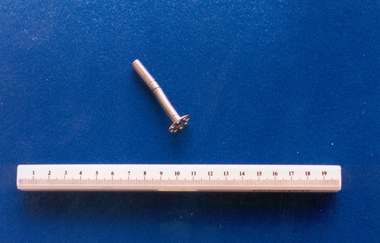
Duke's stem pessary associated with Dr Frank Forster
... ball, on which the cervix uteri then rested. Connected to this flange was an external part or wire frame, which in turn was attached at one extremity to a flat tubular portion, passing into the vagina. This was then fixed to the intrauterine portion. The wire frame was then made to press on to the pubis, so that the pessary could be kept in position in utero. Pessary Intrauterine device Pessary, Duke's stem design. Metal pessary with hollow stem, and a rounded flange at one end. The flange has eight ...Part of the collection of Dr Frank Forster. The philosophy of this object was to keep the uterus dilated. It was commonly believed at this time that the cervix was the cause of dysmenorrhoea. The stem pessary was an object used to rectify uterine displacements - either anteversion or retroversion. The device consisted of a stem which is introduced into the uterus, the stem was then attached to an ovoid flange or ball, on which the cervix uteri then rested. Connected to this flange was an external part or wire frame, which in turn was attached at one extremity to a flat tubular portion, passing into the vagina. This was then fixed to the intrauterine portion. The wire frame was then made to press on to the pubis, so that the pessary could be kept in position in utero.Pessary, Duke's stem design. Metal pessary with hollow stem, and a rounded flange at one end. The flange has eight small holes surrounding the central hole. The stem is flexible and is made from coiled metal which has then been attached (perhaps by soldering) to the flange.pessary, intrauterine device -
 Bendigo Historical Society Inc.
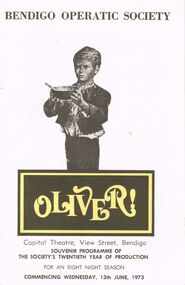
Programme - BENDIGO OPERATIC SOCIETY ''OLIVER''
... Eight Night Season Commencing Wednsday, 13th june, 1973. Producer: Max Collis - Musical Director: Gwen Grose - Pianist: Dianna Cohn - Assistant Producer, Wardrobe and Ballet Mistress: Madge Welch - Stage Manager: Malcom Cannon. Cast: Michael Frayne, Mark Edebone as Oliver - Douglas Sayle as Mr. Bumble - Patricia Lyon as Widow Corney (The Matron) - Valerie Griffiths as Old Sally (A Pauper) - Pauline Speedy as A Pauper Woman - Bary Burns as Mr. Soweberry (The Undertaker) - Ann Ball...Eight Night Season Commencing Wednsday, 13th june, 1973. Producer: Max Collis - Musical Director: Gwen Grose - Pianist: Dianna Cohn - Assistant Producer, Wardrobe and Ballet Mistress: Madge Welch - Stage Manager: Malcom Cannon. Cast: Michael Frayne, Mark Edebone as Oliver - Douglas Sayle as Mr. Bumble - Patricia Lyon as Widow Corney (The Matron) - Valerie Griffiths as Old Sally (A Pauper) - Pauline Speedy as A Pauper Woman - Bary Burns as Mr. Soweberry (The Undertaker) - Ann Ball ...Bendigo Operatic Society ''Oliver'' Capital Theater, view Street Bendigo. Souvenir Programme ot the Society's Twentieth year of Production. For an Eight Night Season Commencing Wednsday, 13th june, 1973. Producer: Max Collis - Musical Director: Gwen Grose - Pianist: Dianna Cohn - Assistant Producer, Wardrobe and Ballet Mistress: Madge Welch - Stage Manager: Malcom Cannon. Cast: Michael Frayne, Mark Edebone as Oliver - Douglas Sayle as Mr. Bumble - Patricia Lyon as Widow Corney (The Matron) - Valerie Griffiths as Old Sally (A Pauper) - Pauline Speedy as A Pauper Woman - Bary Burns as Mr. Soweberry (The Undertaker) - Ann Ball as Mrs. Soweberry (His Wife) - Annette Beckwith as Charlotte (Their Daughter) - Graeme Daws as Noah Claypole (Their Apprentice) - Fred Trewarne as Fagin - Shane Brennan,Bruce Ashman as The Artful Dodger - Kathie Farn as Nancy - Marion Wright as Bet - David Daenke as Bill Sikes - Ray Edebone as Mr. Brownlow - John Beaumont as Dr. Grimwig - Jill James as Mrs. Bedwyn.program, theatre, bendigo operatic society -
 Bendigo Historical Society Inc.
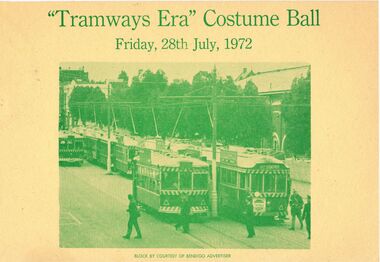
Document - PETER ELLIS COLLECTION: TRAMWAYS ERA COSTUME BALL, 28th July, 1972
... 'Tramways Era' Costume Ball held on Friday, 28th July, 1972. A photo on the card has eight trams parked close to each other. ...'Tramways Era' Costume Ball held on Friday, 28th July, 1972. A photo on the card has eight trams parked close to each other. ...Yellow card with green printing. 'Tramways Era' Costume Ball held on Friday, 28th July, 1972. A photo on the card has eight trams parked close to each other. Five men are in front of the trams. Trams lined up outside the Grandstand at the QEO in View Street. They lined up waiting for the footy crowd.entertainment, dance, ball, peter ellis collection, tramways era costume ball 1972, bendigo advertiser -
 Warrnambool and District Historical Society Inc.
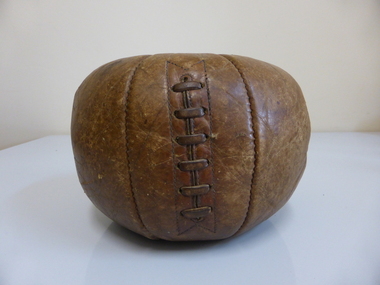
Functional object - Sporting goods, Medicine Ball
... Items of similar design and construction have been used by many different cultures and peoples. medicine ball physical culture warrnambool Brown leather with eight segments, laced on side. ...Medicine balls are a weighted ball used to improve fitness and strength. Their use is recorded as early as 1000BC when skins were sewn and stuffed with sand. They are still used to the present time and come in various sizes and weights. This example probably belongs to the turn of the 20th century.An item which was in common use by people interested in fitness. Items of similar design and construction have been used by many different cultures and peoples.Brown leather with eight segments, laced on side. It has two small leather circles either end, each with two holes. medicine ball, physical culture, warrnambool -
 Bendigo Historical Society Inc.
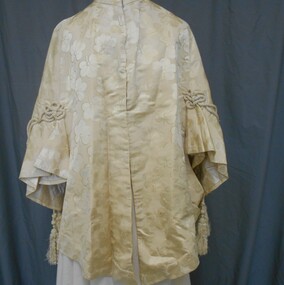
Clothing - CREAM SILK EVENING CAPE (RELATED TO 11400.842), Evening Cape
... Eight metal hook and eyes fasten the front in a concealed way. Heavy cording, finished with pearl trimmed tassels,a double inverted pleat, 22cm long at the centre back hemline. Three darts at shoulders giving a 'sleeve-like' shape. Lower edges of which are elaborately corded. A 12cm'slit' at the lower edge seam with the front panel gives more flexibilty to the wearer. Tassel head and decorative 1.5cm ''ball...Eight metal hook and eyes fasten the front in a concealed way. Heavy cording, finished with pearl trimmed tassels,a double inverted pleat, 22cm long at the centre back hemline. Three darts at shoulders giving a 'sleeve-like' shape. Lower edges of which are elaborately corded. A 12cm'slit' at the lower edge seam with the front panel gives more flexibilty to the wearer. Tassel head and decorative 1.5cm ''ball ...Cream silk, woven in a jacquard style, featuring a floral design. Fully lined with cream silk satin. A 4cm deep, stand-up mandarin style collar. Eight metal hook and eyes fasten the front in a concealed way. Heavy cording, finished with pearl trimmed tassels,a double inverted pleat, 22cm long at the centre back hemline. Three darts at shoulders giving a 'sleeve-like' shape. Lower edges of which are elaborately corded. A 12cm'slit' at the lower edge seam with the front panel gives more flexibilty to the wearer. Tassel head and decorative 1.5cm ''ball'' are woven in a ''turks head'' style. A 2.5cm wide silk ribbon, attached at centre back, and possibly tied around the waist.A card with the cape is hand written - ''For Historical Soc.if wanted, From M.Bush's Collection. Could have been from Mrs. Mueller's. Gift from Mrs. E.G.JARRETT''costume, female, cream silk evening cape -
 Bendigo Historical Society Inc.
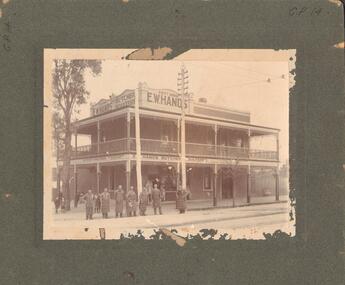
Photograph - E.W. HANDS, BUTCHER, 1902-04
... Eight men wearing striped aprons standing at front. Six children at bottom left. Meat carcasses hanging in doorway. Electricity pole. Pole on corner. Tree at L. Tram wires. Inscriptions: in image - on building 'EST. 1859, EW Hands, Butcher, Poulterer', Refrigerating Chamber on the premises'. On back - hand written in ball...Eight men wearing striped aprons standing at front. Six children at bottom left. Meat carcasses hanging in doorway. Electricity pole. Pole on corner. Tree at L. Tram wires. Inscriptions: in image - on building 'EST. 1859, EW Hands, Butcher, Poulterer', Refrigerating Chamber on the premises'. On back - hand written in ball ...Black and white photograph on green mount. Two storey brick building with verandahs, parapet. Eight men wearing striped aprons standing at front. Six children at bottom left. Meat carcasses hanging in doorway. Electricity pole. Pole on corner. Tree at L. Tram wires. Inscriptions: in image - on building 'EST. 1859, EW Hands, Butcher, Poulterer', Refrigerating Chamber on the premises'. On back - hand written in ball point pen 'EW Hands Butcher Shop, Crn Barnard and Forest Sts., Bendigo. Period about 1902-04. 'Note carcasses of meat hanging in open doorway on the footpath'. 'Hands 1204 fsp' IN BALL POINT PEN. 'Hands' in lead pencil. (2), 'Royal Historical society of Victoria, Bendigo Branch' Circular stamp on back of photo. 71% reduction copy in plastic bag.buildings, commercial, ew hands, butcher -
 Bendigo Historical Society Inc.
Document - MY FAIR LADY, CAPITAL THEATRE, BENDIGO, 14 November, 1973
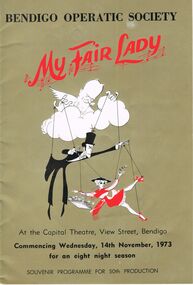
... eight night season. Souvenir Program for 50th Production. Bendigo Operatic Society... President: Mr J M Cannon... Vice President: Mr F Trewarne... Hon. Secretary: Miss A Ball...eight night season. Souvenir Program for 50th Production. Bendigo Operatic Society, President: Mr J M Cannon, Vice President: Mr F Trewarne, Honn. Secretary: Miss A Ball...eight night season. Souvenir Program for 50th Production. Bendigo Operatic Society President: Mr J M Cannon Vice President: Mr F Trewarne Hon. Secretary: Miss A Ball ...My Fair Lady, Capital Theatre, View Street, Bendigo. Commencing Wednesday, 14th November, 1973 for an eight night season. Souvenir Program for 50th Production. Bendigo Operatic Society, President: Mr J M Cannon, Vice President: Mr F Trewarne, Honn. Secretary: Miss A Ball, Hon. Treasurer: Mr L Spencely, Hon. Subscription Secretary: Mrs P Lyon. Committee: Mesdames I Brown, J Cannon, Misses P Speedy, M Welch, Messrs. J Beamont, J Boquest, G Daws. Photographs of Mr J Cannon, Max Collins, Carol McKenzie, John Beamont, Kathie Farn, Ralph Watkins, Patricia Lyon, Peter Pritchard, John Boquest, Russell Baxter, Max Rule, David Daenke, Gwen Grose, Diana Chon. Article on: Max Collins, Carol Mckenzie, John Beaumont. Synopsis of Scenes. Bendigo Operatic Society presents by arrangement with J C Williamson Theatre, Ltd., and Tams-Witmark Music Library of New York ' My Fair Lady.' Adapted from George Bernard Shaw's Play and Gabrial Pascal's Motion Picture 'Pygmalion'. Music by Frederick Loewe. Book and Lyrics by Alan J Lerner. Musical Director: Gwen Rose, Stage Manager Malcom Cannon, Wardrobe Miss M Welch, Choeography Miss M Welch & Mrs A Ball. Cast: Carol McKenzie, Max Rule, Kathie Farn, Ralph Watkins, John Beamont, Gary Burns, John Boquest, Russell Barter, Peter Pritchard, Patricia Lyon, Pauline Speedy, Jull James, David Daenke. Synopsis of Story. Bendigo Concert Orchestra from the following:- Violins: Mrs R Wheldon, Mrs A Boulton, Mrs M Robbins, Mrs C Messer, Mr C Gill, Mr P Phillips, Mr J Jordan. Violas: Mr E Jarratt, Mr J Werry. Cellos: Mrs C Bubb, Miss D Nankivell. Bass: Mr Chester White, Mr Tom French. Flute: Mr C Bubb. Clarinets: Mr R Holyoake, Mr G Ellul. Trombones: Mr W Neuman. Bassoon & French Horn: Mr Stuart Anderson. Trumpets: Mr D Aitken. Pianoforte: Miss Diana Cohn. Female Chorus: Marion Alcock, Wilma Baldwin, Mary Barbour, Valerie Barter, Gwen Cox, Shirley Dawson, Jo-anne Edgar, Dorothy Field, Valerie Griffith, Lorraine Hatch, Julie Howbert, Faye Hughes, Ruth Iredale, Sue Kemp, Dawn Mackay, Cheryl Marshall, Jull Matthews, Adrenne Nankivell, Fay Olive, Barbara Potter, Lois Semmens, Coral Rivett, Anne Truscott, Kathie Watson, Pamela Wiltshire, Marion Wright. Male Choras: Albert Charlton, David Aaenke, Graeme Dawes, Ken Deutchman, Jim Feteris, Philip Johnston, Hugh Sayle, Bryan Slattery, Len Symons, Fred Trewarne, Ian Unmack,Philip Wilkins. Ballet: Dianne Austin, Annette Bassett, Annette Galvin, Coral Rivett, Pam Sutton, Den Deutschman, Ian Unmack, Brian Slettery, Len Symons, Philip Johnston. Acknowledgements: Bendigo Advertiser, BVC 8, 3BO, 3CV. Publicity Officer: Mrs J Cannon. Scenery Design: Mr Malcom Cannon. Prperties: John Cannon, Jim Moncrieff, Gerard Fullarton, Peter Edgley. Art Work: M Cannon, Geoff Proctor, J Hall, Kerry Noakes, Michael Frayne, Mark Edebone & Pamela Caswell. Prompts: Mrs J Cannon, Mrs H Lindhe. Make-Up: Mrs J Cannon, B Downing, H Coia, Lighting: L Reed, H Bridges & T Vincent. Hairdressing: Ross Coiffure. House Managers: Basil Bennett, Ron Thomas, Bruce Ralph. Advertisments: Powneys Toyland, Golden Hills Motel 'The Inn', Marong Road, Bendigo. Ross Coifure Beauty Salon, Allans Walk, Bendigo. Don Semmens Photographic Studio, Hargreaves Street, Bendigo.program, theatre, bendigo operatic society, my fair lady, capital theatre, view street, bendigo. commencing wednesday, 14th november, 1973 for an eight night season. souvenir program for 50th production. bendigo operatic society, president: mr j m cannon, vice president: mr f trewarne, hon. secretary: miss a ball, hon. treasurer: mr l spencely, hon. subscription secretary: mrs p lyon. committee: mesdames i brown, j cannon, misses p speedy, m welch, messrs. j beamont, j boquest, g daws. photographs of mr j cannon, max collins, carol mckenzie, john beamont, kathie farn, ralph watkins, patricia lyon, peter pritchard, john boquest, russell baxter, max rule, david daenke, gwen grose, diana chon. article on: max collins, carol mckenzie, john beaumont. bendigo operatic society presents by arrangement with j c williamson theatre, ltd., and tams-witmark music library of new york ' my fair lady.' adapted from george bernard shaw's play and gabrial pascal's motion picture 'pygmalion'. music by frederick loewe. book and lyrics by alan j lerner. musical director: gwen rose, stage manager malcom cannon, wardrobe miss m welch, choeography miss m welch & mrs a ball. cast: carol mckenzie, max rule, kathie farn, ralph watkins, john beamont, gary burns, john boquest, russell barter, peter pritchard, patricia lyon, pauline speedy, jull james, david daenke. synopsis of story. bendigo concert orchestra from the following:- violins: mrs r wheldon, mrs a boulton, mrs m robbins, mrs c messer, mr c gill, mr p phillips, mr j jordan. violas: mr e jarratt, mr j werry. cellos: mrs c bubb, miss d nankivell. bass: mr chester white, mr tom french. flute: mr c bubb. clarinets: mr r holyoake, mr g ellul. trombones: mr w neuman. bassoon & french horn: mr stuart anderson. trumpets: mr d aitken. pianoforte: miss diana cohn. female chorus: marion alcock, wilma baldwin, mary barbour, valerie barter, gwen cox, shirley dawson, jo-anne edgar, dorothy field, valerie griffith, lorraine hatch, julie howbert, faye hughes, ruth iredale, sue kemp, dawn mackay, cheryl marshall, jull matthews, adrenne nankivell, fay olive, barbara potter, lois semmens, coral rivett, anne truscott, kathie watson, pamela wiltshire, marion wright. male choras: albert charlton, david aaenke, graeme dawes, ken deutchman, jim feteris, philip johnston, hugh sayle, bryan slattery, len symons, fred trewarne, ian unmack, philip wilkins. ballet: dianne austin, annette bassett, annette galvin, coral rivett, pam sutton, den deutschman, ian unmack, brian slettery, len symons, philip johnston. acknowledgements: bendigo advertiser, bvc 8, 3bo, 3cv. publicity officer: mrs j cannon. scenery design: mr malcom cannon. prperties: john cannon, jim moncrieff, gerard fullarton, peter edgley. art work: m cannon, geoff proctor, j hall, kerry noakes, michael frayne, mark edebone & pamela caswell. prompts: mrs j cannon, mrs h lindhe. make-up: mrs j cannon, b downing, h coia, lighting: l reed, h bridges & t vincent. hairdressing: ross coiffure. house managers: basil bennett, ron thomas, bruce ralph. powneys toyland, golden hills motel 'the inn'. ross coifure beauty salon. don semmens photographic studio. -
 Bendigo Historical Society Inc.
Photograph - SANDHURST BOYS CENTRE COLLECTION: FANCY DRESS BALL
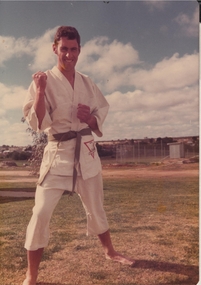
... Eight coloured photographs of the annual fancy dress ball....BENDIGO Institutions sandhurst boys centre Eight coloured photographs of the annual fancy dress ball. Photograph SANDHURST BOYS CENTRE COLLECTION: FANCY DRESS BALL ...Eight coloured photographs of the annual fancy dress ball.bendigo, institutions, sandhurst boys centre -
 Ithacan Historical Society
Photograph, IPS Celebrating 60 years, 1976
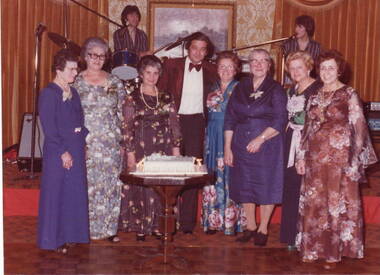
... Ball which celebrated 60 years since the formation of the society. This group of loyal supporters of the IPS are about to blow out the 60 candles to mark the occasion. Most of the ladies in the photograph arrived in Australia from Ithaca during the first half of the twentieth century. They are photographed with Peter Lucas, who served on the IPS Committee for many years. The ladies are from L-R: Dora Callis, Kalypso Sofianos, Anthoula (Anthi) Chilianis, Matina Dracoulis, Ioulia Raftopoulos, Kassiana Raftopoulos, Aspasia Flocas. A coloured photograph of eight ...The photograph was taken at the 1976 Annual Ithacan Philanthropic Society Ball which celebrated 60 years since the formation of the society. This group of loyal supporters of the IPS are about to blow out the 60 candles to mark the occasion. Most of the ladies in the photograph arrived in Australia from Ithaca during the first half of the twentieth century. They are photographed with Peter Lucas, who served on the IPS Committee for many years. The ladies are from L-R: Dora Callis, Kalypso Sofianos, Anthoula (Anthi) Chilianis, Matina Dracoulis, Ioulia Raftopoulos, Kassiana Raftopoulos, Aspasia Flocas. A coloured photograph of eight ladies and a man in evening attire standing around a large decorated cake. Two musicians are standing on a dais behind the group. -
 Ithacan Historical Society
Photograph, Ithacan Ball, 2006
... ITHACAN PHILANTHROPIC SOCIETY/ 96th ANNIVERSARY DEBUTANTE BALL/2006 A coloured photograph with a black border of a deb group of eight debs and their partners, a flower girl and four adults. ...The photograph was taken at the 90th Anniversary Debutante Ball in 2006.A coloured photograph with a black border of a deb group of eight debs and their partners, a flower girl and four adults. The names of the group are listed underneath the photograph. The dsetails of the event are at the top of the photograph as well as the IPS logo. ITHACAN PHILANTHROPIC SOCIETY/ 96th ANNIVERSARY DEBUTANTE BALL/2006 -
 Ithacan Historical Society
Photograph, Ithacan Ball, 1959
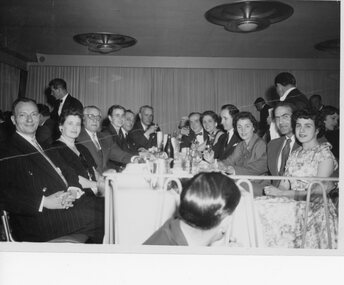
... Ball. On the RHS of the photo are Jim and Leah Kandiliotis together with a group of family and friends (names unknown). A black and white photograph of four ladies and eight men seated around a table at a social function. ...The photograph was taken at the 1959 Ithacan Ball. On the RHS of the photo are Jim and Leah Kandiliotis together with a group of family and friends (names unknown).A black and white photograph of four ladies and eight men seated around a table at a social function. -
 Ithacan Historical Society
Photograph, Olympic Athletic Club Melbourne, 1948
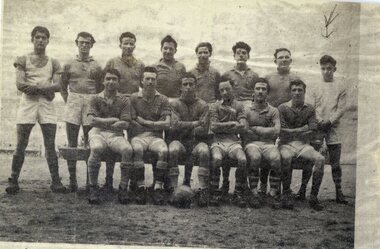
... A black and white newspaper photograph on paper backing of an Olympic soccer team. 14 are in the team, eight are standing at the and six are seated in the front back with the soccer ball at the feet of the player seated third from the left....A black and white newspaper photograph on paper backing of an Olympic soccer team. 14 are in the team, eight are standing at the and six are seated in the front back with the soccer ball at the feet of the player seated third from the left. ...The Olympic Athletic Club was a sporting and social club established in the 1940s for young Greeks. Young Ithacans participated in the various sporting teams and social and fundraising activities organised by the club. People in the photo are unknown.A black and white newspaper photograph on paper backing of an Olympic soccer team. 14 are in the team, eight are standing at the and six are seated in the front back with the soccer ball at the feet of the player seated third from the left. -
 Ballarat Tramway Museum
Booklet - Souvenir Programme, "Popular Conductress Competition - Gala Ball", August 1944
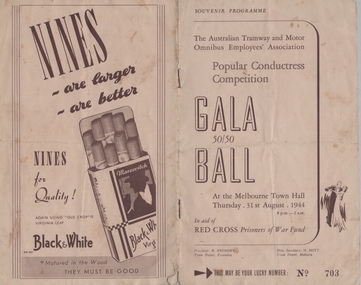
... ball gowns. Demonstrates work to support the Red Cross Prisoner of War fund raising. Most Popular Conductress Sylvia Mitchell tramways Red Cross Events Union ATMOEA SECV Memorabilia Eight page booklet, printed centre stapled. ...Booklet - "Popular Conductress Competition - Gala Ball" - Melbourne Town Hall 31/8/1944 - 8pm to 2am. Gives details of the event, the entrants, Red Cross work for some 23,000 Prisoners of War and their thanks to the Australian Tramway and Motor Omnibus Employees Association. Includes a photo of each entrant and written in ink is the amount raised by each conductress. Programme number 703. Has an advertisement for Black and White cigarettes on the back cover. See 8823 for a photograph of the entrants in their ball gowns.Demonstrates work to support the Red Cross Prisoner of War fund raising.Eight page booklet, printed centre stapled.most popular conductress, sylvia mitchell, tramways, red cross, events, union, atmoea, secv, memorabilia -
 St Kilda Historical Society
Ephemera - Dance card, Ball in aid of the funds of the St Kilda Soldiers' Lounge, 1917
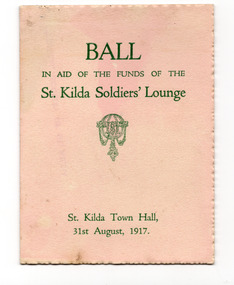
... eight hundred servicemen. The lounge remained popular until it closed in 1920. WWI World War I St Kilda - history St Kilda Town Hall Cream coloured card folded once to make 4 pages, printed in green on 3 pages. The program of dances is set out on the inside pages. Ball ...The former St Kilda Soldiers’ Lounge was opened by the St Kilda Patriotic League and the YMCA in 1915, and run by Mrs Lucie Hallenstein. Located in the refreshment rooms of the former Comedy Theatre, Lower Esplanade, it provided a place for returned soldiers to relax and socialise. By mid-1916 the average weekly attendance had reached eight hundred servicemen. The lounge remained popular until it closed in 1920.Cream coloured card folded once to make 4 pages, printed in green on 3 pages. The program of dances is set out on the inside pages.wwi, world war i, st kilda - history, st kilda town hall -
 St Kilda Historical Society
Ephemera - Ticket, Ball in aid of the funds of the St Kilda Soldiers' Lounge, 1917
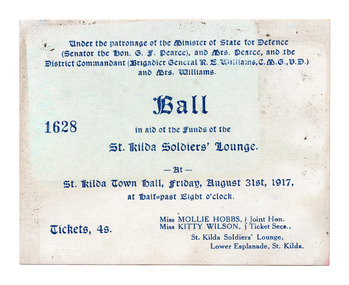
... eight hundred servicemen. The lounge remained popular until it closed in 1920. WWI fund-raising St Kilda Soldiers Lounge WWI World War I White coloured card printed in blue Ball in aid of the funds of the St Kilda Soldiers' Lounge Ephemera Ticket ...The St Kilda Soldiers’ Lounge was opened by the St Kilda Patriotic League and the YMCA in 1915, and run by Mrs Lucie Hallenstein. Located in the refreshment rooms of the former Comedy Theatre, Lower Esplanade, it provided a place for returned soldiers to relax and socialise. By mid-1916 the average weekly attendance had reached eight hundred servicemen. The lounge remained popular until it closed in 1920.White coloured card printed in bluewwi fund-raising, st kilda soldiers lounge, wwi, world war i -
Clunes Museum
Photograph
... .1 CLUNES TENNIS CLUB DEBUTANTE BALL 22ND AUGUST 1986, DEBS AND PARTNERS .2 CLUNES TENNIS CLUB DEBUTANTE BALL 1986 OFFICIAL PARTY .3 TENNIS CLUB DEB BALL, DATE UNKNOWN DEBUTANTES ONLY .4 EIGHT LADIES IN EVENING GOWNS...debutante ball 1968 tennis club .1 ON BACK: CLUNES TENNIS CLUB DEBUTANTE BALL 22ND AUGUST 1986 BACK ROW: JOHN HIND, ADAM PARR, PAUL PARDOEL, SCOTT CAMERON, MARK ANDREWS, JAMIE ANDREWS, DOUG GARTH SECOND BACK:NEIL RUMLER, PETER WITCHER, WAYNE STEPMALL, HOWARD SMITH, ROD SALKOVIC, WAYNE WESTCOMBE, ROB POLLACK GIRLS STANDING:JULIE CHANT, LIZ HARRISON, PENNY MITCHELL, KIM VAN BERKEL, ANDREA MCFARLANE, CHRISTINE DUNNE, KAREN SOBIE SITTING:JODIE JOBUNG, KATRINA WILLIAMS, KERRY NUGENT, ANNITA PARKS, AMBER JESSER, ROBIN GOLDSMITH, PAGE BOY DANNY ANDREWS, FLOWER GIRL RACHEL NUGENT .2 OFFICIAL PARTY: ALLAN BARTLEY, MARIE BARTLEY, BARB ADAMS, CATHIE KELLER, PETER KELLER .3 JENNY HILL, COLLINS , BARB ADAM, KAYE SADOWITH , GEOFF MILLER .4 NOT A DEB BALL .1 CLUNES TENNIS CLUB DEBUTANTE BALL 22ND AUGUST 1986, DEBS AND PARTNERS .2 CLUNES TENNIS CLUB DEBUTANTE BALL 1986 OFFICIAL PARTY .3 TENNIS CLUB DEB BALL, DATE UNKNOWN DEBUTANTES ONLY .4 EIGHT LADIES IN EVENING GOWNS Photograph PHOTOGRAPH ....1 CLUNES TENNIS CLUB DEBUTANTE BALL 22ND AUGUST 1986, DEBS AND PARTNERS .2 CLUNES TENNIS CLUB DEBUTANTE BALL 1986 OFFICIAL PARTY .3 TENNIS CLUB DEB BALL, DATE UNKNOWN DEBUTANTES ONLY .4 EIGHT LADIES IN EVENING GOWNS.1 ON BACK: CLUNES TENNIS CLUB DEBUTANTE BALL 22ND AUGUST 1986 BACK ROW: JOHN HIND, ADAM PARR, PAUL PARDOEL, SCOTT CAMERON, MARK ANDREWS, JAMIE ANDREWS, DOUG GARTH SECOND BACK:NEIL RUMLER, PETER WITCHER, WAYNE STEPMALL, HOWARD SMITH, ROD SALKOVIC, WAYNE WESTCOMBE, ROB POLLACK GIRLS STANDING:JULIE CHANT, LIZ HARRISON, PENNY MITCHELL, KIM VAN BERKEL, ANDREA MCFARLANE, CHRISTINE DUNNE, KAREN SOBIE SITTING:JODIE JOBUNG, KATRINA WILLIAMS, KERRY NUGENT, ANNITA PARKS, AMBER JESSER, ROBIN GOLDSMITH, PAGE BOY DANNY ANDREWS, FLOWER GIRL RACHEL NUGENT .2 OFFICIAL PARTY: ALLAN BARTLEY, MARIE BARTLEY, BARB ADAMS, CATHIE KELLER, PETER KELLER .3 JENNY HILL, COLLINS , BARB ADAM, KAYE SADOWITH , GEOFF MILLER .4 NOT A DEB BALL debutante ball 1968, tennis club -
 Melton City Libraries
Photograph, Country Women's Association Choir Victoria, Unknown
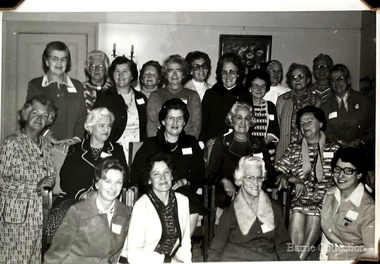
... Ball held for Baby Health Centre effort. Admission 3/- 1945 February- Mrs Lemke present at meeting May August- Miss Strahan of Womens Hospital gave a talk on “Work of Almoner Departments in Public Hospitals” November Annual meeting. eight food parcels sent to Britain, 2 to Lampeter 1946 meetings held every two months May- Congratulations to Mrs Swan, Group President Elect June – 20 members present. ...Ball held for Baby Health Centre effort. Admission 3/- 1945 February- Mrs Lemke present at meeting May August- Miss Strahan of Womens Hospital gave a talk on “Work of Almoner Departments in Public Hospitals” November Annual meeting. eight food parcels sent to Britain, 2 to Lampeter 1946 meetings held every two months May- Congratulations to Mrs Swan, Group President Elect June – 20 members present. ...Information from research by Mabel Rogers from the first meeting in August 1939 – 1969 Notable Events of the CWA The document contains information about meetings and events and numbers of members who attended. December 2013 – a selection of some of the items of interest have been extracted by Wendy Barrie NOTABLE EVENTS Page 1 1938 August 10th 1938 Minutes of inaugural meeting of Melton Branch Country Women’s Association. Cr Coburn introduced Mrs Toose, Ballarat G.P. [Group President] 42 ladies were present, including visitors from Bacchus Marsh and Smeaton Branches. September – Miss A Raleigh was elected Magazine Secretary October- 26 members present. Penny Collection for Million Members Fund November December – Mrs Swan gave demonstration of basketry, using stringy bark, Eucalyptus bark and reeds 1939 February 1939 – 18 members present. Branch total 50. Donation towards Pedal Transmitting Set. Inquiries made of Shire Council re permission to fence War Memorial March April – cost of fence material beyond Branch Funds May- 24 members present June, July, August – birthday celebrations. September 25 members present October – Meeting hled at Toolern Vale Bird Sanctuary 36 members present November – 1st Annual Meeting December – Owing to harvest operations, only 11 members present. 1940 February electric kettle and urn to be purchased for Mechanics Institute. Also to install a power point. [Electricity was connected to Melton in December 1939] April end of page 1 Page 2 May – Council Permission to be sought, to plant trees on oval below Shire Hall P.M.G. to be asked to supply a seat outside telephone booth for convenience of callers after P.O. was closed. June- Wives of A.I.F. soldiers be made honorary members. “1d per week drive” for gift for the Empire. July, September, October November – Group President stressed the importance of keeping Branches together during time of war. Collection of sheep skins to be made into vests for fighting forces worthy of consideration. Group President, Mrs Morgan-Paylor. December 1941 February 30 members present March – Eight members attend Ballarat Group Conference. Approach Council re fencing and preparation of land for tree plantation May – Mrs Swan demonstrated making of slippers from pieces of sheepskin June – Empire Gift Scheme of 1d per week to be continued for another year or duration of the war. July – Demonstration on making camouflage nets August, September Group Conference at Smeaton, October, November meetings held 1942 February- Enquiries to be made as how to help with A.R.P. work March, April, May, June,- Headquarters busy on war work. July end of page 2 Page 3 August, September. October – 15 Camouflage Nets forwarded to Headquarters November- Mrs Glasson Group President presided at Annual Meeting. Meetings to be held at 3 monthly intervals. Overseas link, enquiries be made of Melton Mowbray had a C.W.A. Branch 1943 February- Overseas link to be Lampeter, Cardiganshire, Wales May- 7 Camouflage Nets to Headquarters. American overseas link Nov 5th Annual Meeting, letters received from Wales and America 1944 May – Approach to be made to Council re formation of Baby Health Centre July – Ball held for Baby Health Centre effort. Admission 3/- 1945 February- Mrs Lemke present at meeting May August- Miss Strahan of Womens Hospital gave a talk on “Work of Almoner Departments in Public Hospitals” November Annual meeting. eight food parcels sent to Britain, 2 to Lampeter 1946 meetings held every two months May- Congratulations to Mrs Swan, Group President Elect June – 20 members present. August- 8th Birthday celebrated with a Social Evening Music was supplied by Mrs E.W. Barrie September - Scone competition 1. Mrs Beaty, 2. Miss Robinson 3. Mrs Exell November- Eggs sent to Somers House 1947 February – Demonstration of Glove-making March – revert to monthly meetings April - decided to have an auto tray made for the Branch May – Branch decided to plant a tree for Princess Elizabeth’s 21st Birthday.. Council to be asked if agreeable to continue arrangements in 1940, to fence C.W.A. Plantation end of page 3 Page 4 June - Food parcels sent to Overseas Link July – Invitations to birthday celebrations sent to Bacchus Marsh, Ballan, Sunbury, Mt Egerton August September - Collection of silver coin taken a donation from Branch towards wedding gift to Princess Elizabeth … forwarded to H.Q. November – C.W.A. together with Red Cross and Bacchus Marsh C.W.A. to provide afternoon tea and luncheon at Eynesbury sale. 1948 February – Food parcels sent to ex-Prisoner-of-war. Publicity agent appointed April – Decided to apply for trees to be planted in area already chosen a beauty spot May – Additional listeners to Broadcast Session were appointed June July – Gift of books received from Overseas Link. I was decided to stat a Library . Miss Raleigh to at a Librarian. August – 5 pound donation from Branch funds to “Save the Children” Appeal. September, October, November 1949 January – At Group Conference, delegates to vote in favour of resolution that State School children be allowed to sit for exams in own school March – Decided to contact Council for permission to fence off Water Reserve April, May – Another parcel to be sent to Ret. British P.O.W. Association June July – Fancy Dress Children’s Ball to be held for Annual Effort August – 11th Birthday September – Bank Balance November – 11th annual Meeting. Members agree to supply small gifts to Ballarat Mental Hospital 1950 February – Five books were received from Lampeter March – Branch to support idea of holding a Music Drama Festival in Group April – Miss Smith elected Group President May – C.W.A. Science Van visited Melton June – Demonstration of Macrame work - July August – 12th Birthday Celebration end page 4 Page 5 September, October November 12th Annual Meeting, Miss Smith Group President. Melton's Country Women's Association Choirlocal special interest groups, local identities -
 Sunbury Family History and Heritage Society Inc.
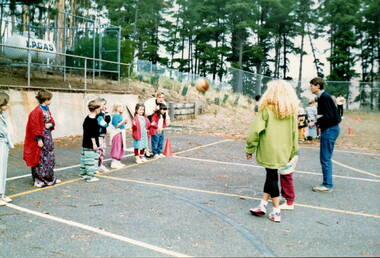
Photograph, Bulla Primary School - Dress-up Day, C1993
... A coloured photograph showing eight children standing on the boundary of a netball court with two adults, who are playing a ball game with the children....Bulla Primary School Dress-up DAy Barbara Springfield Ball games A coloured photograph showing eight children standing on the boundary of a netball court with two adults, who are playing a ball game with the children. ...The children in photograph are not wearing their school uniform as it was taken on a Bulla Primary School dress-up day. Although they didn't wear their uniforms, classes carried on as normal. This young group are practising ball handling skills needed for netball. The teacher with her back to the camera is Barbara Springfield. A coloured photograph showing eight children standing on the boundary of a netball court with two adults, who are playing a ball game with the children.bulla primary school dress-up day, barbara springfield, ball games -
 Tennis Australia
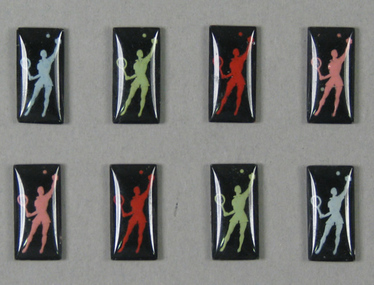
Enamel lozenges, Circa 1890
... Eight enamel lozenges featuring icon of figure serving tennis ball. Figure is blue in two, red in tw, green in two and pink in two of the items. ...Tennis Eight enamel lozenges featuring icon of figure serving tennis ball. Figure is blue in two, red in tw, green in two and pink in two of the items. ...Eight enamel lozenges featuring icon of figure serving tennis ball. Figure is blue in two, red in tw, green in two and pink in two of the items. Materials: Enameltennis -
 Linton and District Historical Society Inc
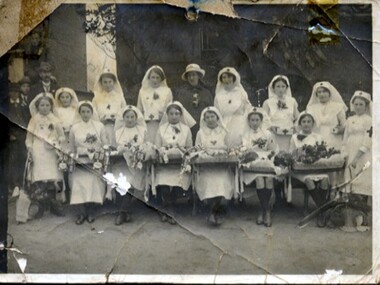
Photograph, School girls dressed as Red Cross nurses : Australia Day 1915
... Ball, Miss Barry, Millie Todd, Effie Gascoigne, Stella Todd, unnamed. L-R, seated - Stella Ralf (spelled Ralph), Rita Morgan, three girls in centre are unnamed, Daisy Smith. The girls were pupils of the Misses Barry, who were assisted in costuming the girls by Mrs A. J. Smith. The stall raised eight...Ball, Miss Barry, Millie Todd, Effie Gascoigne, Stella Todd, unnamed. L-R, seated - Stella Ralf (spelled Ralph), Rita Morgan, three girls in centre are unnamed, Daisy Smith. The girls were pupils of the Misses Barry, who were assisted in costuming the girls by Mrs A. J. Smith. The stall raised eight ...This photograph was taken on the first 'Australia Day', held 30 July 1915. Across Australia, this day was set aside for a nation-wide fundraising effort for the Patriotic Relief Fund, raising money to assist wounded soldiers returning to Australia during WWI. Other days had been set aside to raise funds for specific nations, e.g. 'Belgian Day' had been held earlier in 1915.. In Linton Australia Day 1915 was celebrated with a jumble sale, raffles, and collection of donations. There was also a stall near the Shire Offices, attended by a group of girls dressed as Red Cross nurses, which sold flowers, postcards, toys etc. People identified in photograph: Standing slightly behind the group - Mr Smith (Alf J. Smith, Grenville Shire Secretary). L-R, standing: Kathleen Nicol, Violet Smith, Jean Gascoigne, Elva Ball, Miss Barry, Millie Todd, Effie Gascoigne, Stella Todd, unnamed. L-R, seated - Stella Ralf (spelled Ralph), Rita Morgan, three girls in centre are unnamed, Daisy Smith. The girls were pupils of the Misses Barry, who were assisted in costuming the girls by Mrs A. J. Smith. The stall raised eight pounds for the Patriotic Relief Fund. See article from the 'Grenville Standard', Saturday August 7, 1915, p.1. A copy of this article is in the "Australia Day 1915" file, kept with "Linton" files in the drawer underneath the photocopier in Room-01.Black and white photograph showing school girls dressed as Red Cross nurses. Older lady in middle of back row (Miss Barry) and three gentlemen wearing suits and hats at left hand side of photograph.kathleen nicol, mr smith, violet smith, daisy smith, jean gascoigne, effie gascoigne, elva ball, miss barry, millie todd, stella todd, stella ralf (ralph), rita morgan, world war 1914-1918, australia day 1915, red cross, nurses, patriotic relief fund, fundraising
