Emerald Museum & Nobelius Heritage Park
Container - Tin for Gramophone Needles, The Gramophone Company Limited, 1899 - c. 1931
... This specific tin was almost certainly made between 1899 - when the trademark was acquired - and 1931, when the Gramophone Company merged with the English Columbia Graphophone Company to form Electric and Musical Industries Ltd (EMI). However, the Gramophone Company was still used in some cases after this point, so it is not impossible that this tin could come from later. ...This specific tin was almost certainly made between 1899 - when the trademark was acquired - and 1931, when the Gramophone Company merged with the English Columbia Graphophone Company to form Electric and Musical Industries Ltd (EMI). However, the Gramophone Company was still used in some cases after this point, so it is not impossible that this tin could come from later. ...
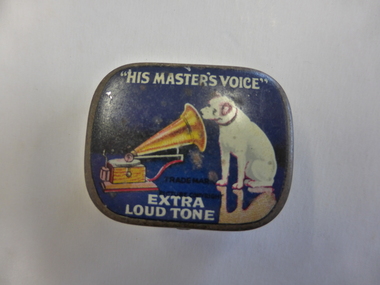
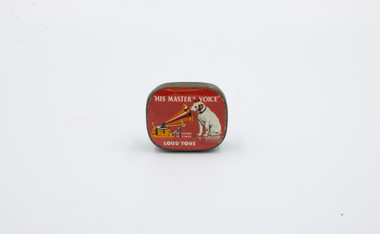
The Gramophone Company Limited acquired Francis Barraud's 1898 "His Master's Voice" artwork in 1899, after Edison Bell manager James Hough declined to purchase the artwork by stating that "dogs don't listen to phonographs." William Barry Owen of the Gramophone Company purchased the trademark on the condition that the original phonograph be replaced with a gramophone, and began using the artwork first in catalogues and gramophone machines, and in 1909 on record labels. It is unclear exactly when the artwork began to appear on gramophone needles. This specific tin was almost certainly made between 1899 - when the trademark was acquired - and 1931, when the Gramophone Company merged with the English Columbia Graphophone Company to form Electric and Musical Industries Ltd (EMI). However, the Gramophone Company was still used in some cases after this point, so it is not impossible that this tin could come from later. Gramophone needles were typically worn out after only one or a few uses, necessitating the purchasing of tins like this one filled with hundreds of needles to allow for constant replacements. "His Master's Voice" was an iconic brand in Australia for much of the 20th century, from the time of the Gramophone Company (when gramophones were still in use) through the subsequent EMI and HMV brands and the popularity of record players.This small tin is decorated with a red-painted lid surface, depicting Nipper the dog - an iconic symbol of the company - curiously looking into a gramophone. The red background is punctuated by white lettering, announcing the brand name and type of gramophone needle inside - 'Loud Tone'. The exposed metallic surface elsewhere on the tin is heavily tarnished everywhere except for parts of the bottom of the tin (which may have been exposed less than the rest of the tin if it was stored face-up). There is also partly faded, black lettering on the bottom of the tin, and a label on the stop side (opposite the hinge). The tin opens with a hinge, though it is now quite difficult to open. The inside of the tin is empty and undecorated, with similarly tarnished metallic surfaces.Front: " "HIS MASTER'S VOICE" / REGISTERED / TRADE MARK / LOUD TONE"
Stop Side: "MADE IN Gt BRITAIN"
Reverse: "APPROXIMATELY / 200 ENGLISH / GRAMOPHONE / NEEDLES / THE GRAMOPHONE / COMPANY LIMITED"music, 20th century

 Warrnambool and District Historical Society Inc.
 Emerald Museum & Nobelius Heritage Park