
Showing 22 items matching "electronic control systems"
-
 Moorabbin Air Museum
Book - Northrop Institute of Technology publications, Electricity and Electronics for Aerospace Vehicles
... ...Electronic control systems...Northrop Institute of Technology publications Fundamentals of electricity Magnetism & electromagnetism Capacitors & inductors Alternating ciurrent Electric Measuring Instruments Batteries Generators D-C & A-C generators & controls Electric motors Installation of electrical systems Principles of electronics Receivers & transmitters Electric instruments Electronic control systems Radar 2 way radio for light aircraft Radio systems for modern ( as of 1961) airliners Electronic navigation equipment Autopilot for light aircraft & airliners Missile guidance & control Communication systems for space vehicles Basic electrical & electronic theory for students, circa 1961 Electricity and Electronics for Aerospace Vehicles Book Northrop Institute of Technology publications ...Basic electrical & electronic theory for students, circa 1961non-fiction Basic electrical & electronic theory for students, circa 1961 fundamentals of electricity, magnetism & electromagnetism, capacitors & inductors, alternating ciurrent, electric measuring instruments, batteries, generators, d-c & a-c generators & controls, electric motors, installation of electrical systems, principles of electronics, receivers & transmitters, electric instruments, electronic control systems, radar, 2 way radio for light aircraft, radio systems for modern ( as of 1961) airliners, electronic navigation equipment, autopilot for light aircraft & airliners, missile guidance & control, communication systems for space vehicles -
Moorabbin Air Museum
Manual - Boeing 747 APU, GTCP 660-4 747 APU
... system...Control electrical/electronic turbine systems...Boeing 747 APU Installation & specifications Basic function & construction Lubrication system Fuel system components Bleed air system Control electrical/electronic turbine systems Control system operation Indicating systems Trouble shooting Installation & maintenance of Boeing 747 GTCP 660-4 auxiliary power unit ( APU ) , circa 1970 Loose pages stapled top left hand corner GTCP 660-4 747 APU Manual Boeing 747 APU ...Installation & maintenance of Boeing 747 GTCP 660-4 auxiliary power unit ( APU ) , circa 1970Loose pages stapled top left hand corner non-fiction Installation & maintenance of Boeing 747 GTCP 660-4 auxiliary power unit ( APU ) , circa 1970 installation & specifications, basic function & construction, lubrication system, fuel system components, bleed air system, control electrical/electronic turbine systems, control system operation, indicating systems, trouble shooting -
 Kiewa Valley Historical Society
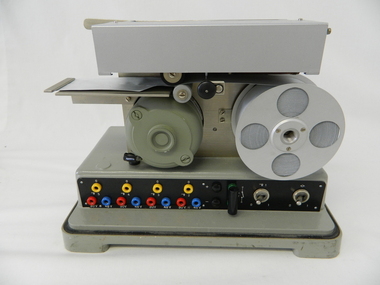
Timer Favag, Circa 1950
... This Favag Timer apparatus was a part of the first electronic control system -(1960's), in Victoria), which worked using telephone stepping selectors to convey a change in voltage providing a regulated pulse from the control centre(Mount Beauty) to the remote Power Stations opening and closing (stop/start) of various devices at the Power Station and a return signal confirmed the action taken. ...This Favag Timer apparatus was a part of the first electronic control system -(1960's), in Victoria), which worked using telephone stepping selectors to convey a change in voltage providing a regulated pulse from the control centre(Mount Beauty) to the remote Power Stations opening and closing (stop/start) of various devices at the Power Station and a return signal confirmed the action taken. ...This Favag Timer apparatus was a part of the first electronic control system -(1960's), in Victoria), which worked using telephone stepping selectors to convey a change in voltage providing a regulated pulse from the control centre(Mount Beauty) to the remote Power Stations opening and closing (stop/start) of various devices at the Power Station and a return signal confirmed the action taken. Testing of this unit was carried out using a "dummy" device at the remote Power Station so as not to disrupt the power plant's operation. This timer was one of many electrical apparatus connected to the large SEC Victoria Hydro Scheme's electrical power producing generators. These generators are powered by the hydro force of "stored" water at a higher altitude. The establishment of both the NSW and Victorian Hydro Schemes was achieved from the early 1900's to the 1960's. At this point in time the need for additional power sources to quench both an industrial and domestic demand for electricity was purely an economic and not and environmental (carbon reduction) factor. This hydro scheme was instigated by "the Government of the day" as a bold move and was the major force of the World War II refugee and "technical" workforce,inclusion of skilled and unskilled, migration into the Australian environment. Although this mass "invasion" of workers with families was thought of in some circles as intrusive, the expansion of population post war years and its integration into the Australian rural sector, produced the multi- lingual multi-cultural diversity of later years. This Favag Timer was one of the crucial pieces of equipment that made it possible for the Mount Beauty Terminal Station to control the operations of these Power Stations; McKay, Clover, West Kiewa Power Stations and the Dederang Terminal Station. This aluminium and anodised "FAVAG" (pulse) timer is fastened to a base structure which comes with its own metal cover that is fastened by two metal hooks. From the top of these hooks runs a thick leather "carry" strap.The instrument, itself, a small "micro motor" at one end tape feeding spool on the other. Aluminium metal structures offer a preventative barrier against any electronic spikes from static electricity sources. There are two toggle switches to the bottom right hand side and twelve coloured "pin" connection points.There is a sliding access sleeve which exposes a circuit board.with various leads fastened on each side. In front of one of this slide are two "screw in" fuses, spare fuses are in a small envelope taped above. Circuit diagrams are etched white on black background on the top face of the main structure. At the base of the back section is a two pronged input terminal. There is a fine black rubber layer (cushioning) for the mian top cover. On the cover fastened with two rivets "FAVAG" underneath in small print "Fabrique d'appareils electriques S.A." underneathe "NEUCHATEL-SUISSE". on one end is a "STATE ELECTRICITY COMMISSION OF VICTORIA" metal label screwed on.The back label has manufacturers' type and model number. sec vic kiewa hydro scheme, alternate energy supplies, alpine population growth -
 Running Rabbits Military Museum operated by the Upwey Belgrave RSL Sub Branch
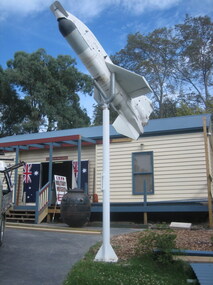
Ikara Missile, Maribyrnong Ordinance Factory in Victoria. et al, 1965
... control system. The IKARA is an unmanned miniature aircraft with clip on upper and lower stabilizers and wings. The upper stabilizer (SVU) housed and electronic package that transmitted flight data back to the launch platform and received updated target acquisition data during flight. ...control system. The IKARA is an unmanned miniature aircraft with clip on upper and lower stabilizers and wings. The upper stabilizer (SVU) housed and electronic package that transmitted flight data back to the launch platform and received updated target acquisition data during flight. ...During the 1950’s, the growing threat from Submarines, led the Royal Australian Navy to consider a quick reaction, long range ASW torpedo delivery system as an alternative to the USN’s ASROC and the RN’s Match. Full scale research and development began in 1960 using the Turana target drone as the basis for the delivery platform. Shipboard tests began in 1963 and the Government Aircraft Factory (GAF) began production of three variants M3, M4 and M5 in 1965. The M4 variant had a guidance system designed to interface to a full tactical data handling system while the M3 and M5 variants used a simpler system with a dedicated fire control system. The IKARA is an unmanned miniature aircraft with clip on upper and lower stabilizers and wings. The upper stabilizer (SVU) housed and electronic package that transmitted flight data back to the launch platform and received updated target acquisition data during flight. Flight maneuverability was provided by elevons fitted into the trailing edge of each wing, these were operated by an actuator system that received flight correction data transmitted to the autopilot from the fire control system. The payload, either the Mk44 or Mk46 lightweight torpedo was suspended to the underside of the airframe and faired into the body to provide and aerodynamic shape. The forward section of the body housed the autopilot and the thermal battery unit. Propulsion was provided by the MURAWA steel cased, solid propellant rocket motor with a combined boost and sustainer stage. IKARA was capable of engaging a target to the maximum range of the ships sonar, regardless of weather conditions. Target information is fed into the fire control system, which calculated to drop zone for the torpedo taking into account speed and direction of launch platform and target, win speed etc, then tracking the missile to the drop zone where command signals initiate torpedo release. The IKARA is an unmanned miniature aircraft with clip on upper and lower stabilizers and wings. navy, torpedo, rocket, submarine, missile -
Moorabbin Air Museum
Document (series) - Nomad Development Material - Collection of Vilem Gottlieb
... 106 Nomad Nomad Series N22 Maintenance Manual figure 203 - Horizontal Stabiliser Trim Control System 107 Nomad Nomad series N22 - N24 108 Map of Portartlington 109 Folder Nomad GAF Nomad N22B Float Plan - Performance Summary 1981 110 Disc Case Nomad 5 computer discs 111 Disc Case 5 computer discs 112 Metal Plate Nomad GAF N24A - 98F 113 Folder Engineering Standard Method for Weighing Aircraft with Portable Electronic Weighing Kits 1988 114 Stapled book Hartzell Propellor Inc Blade Specifications 1981 115 Nomad GAF Brochure: Nomad - The Australian N22B and N24A Turboprop 116 Bound book Nomad ASTA Nomad Performance Torque Charts - N24A-21021 1992 117 Photocopy Nomad SFTE Copy of article: Australian Searchmaster II Delivered to United States - Volume 21, January 1990 1990 118 Photography Nomad Air Safaris Nomad N24A near Mt Cook New Zealand 119 Bound book Nomad GAF N22C - Nomad Performance Summary for DOA Normal Catagory (sic) Operations 120 Stapled book Nomad GAF N24A - Performance Summary for Air Taxi and Commercial Operations to United States FAA/FAR 135 121 Technical Drawings Nomad N22A 122 Bound book Nomad ASTA Acceptance Test Schedule for Nomad N22S Searchmaster Series II Aircraft (does not include radar or FLIR) 1989 123 Manila Folder Nomad GAF Folder of paperwork pertaining to the delivery of aircraft to US Customs 1987 124 Suspension folder Nomad ASTA Project Note N2/120 - Nomad Horizontal stabiliser report 1991 125 Nomad ASTA Army Nomad Modification Program - Acceptance Test Plan 1991 126 Nomad ASTA Memo: Discussion points raised by ARDU 1991 127 Nomad ASTA Minute: NMP Acceptance Test Plan (ATP) 1991 128 Suspension folder Copies of the Civil Aviation Regulations 129 Blank Aircraft weighing and balance sheets 130 Print out of the Computerised track and balance for the H60 helicopter 1989 131 ASTA Letter: Seahawk Flying program 1990 132 ASTA Letter: Training for panel operator 1990 133 ASTA Memo: RAN Seahawk flight operations role 1990 134 Memo: Avionics Course detail 1990 135 Bound book Jetstream Handley Page Flight Manual 1972 136 Bound book Jetstream Handley Page Flight Manual 1969 137 Folder Jetstream Lots of Jetstream data and papers 138 Suspension folder American Jet Industries Publication/brochure 139 Metro II Swearingen Brochure: Metro II by Swearingen 140 Cheyenne IIIA Piper Aircraft Specifications and Performance 19855 141 Australian Light Wing Howard Huges Engineering Brochure: Australian Light Wing 1993 142 SAAB MFI 15 SAAB Brochure: SAAB MFI 15 King Air Exec-Liner Beechcraft Brochure: Beechcraft King Air Exec-Liner 1986 International Corporate Aviation Publication: British Aerospace 125-800 Turbine Islander Article: Turbine Islander in the air 1981 ...106 Nomad Nomad Series N22 Maintenance Manual figure 203 - Horizontal Stabiliser Trim Control System 107 Nomad Nomad series N22 - N24 108 Map of Portartlington 109 Folder Nomad GAF Nomad N22B Float Plan - Performance Summary 1981 110 Disc Case Nomad 5 computer discs 111 Disc Case 5 computer discs 112 Metal Plate Nomad GAF N24A - 98F 113 Folder Engineering Standard Method for Weighing Aircraft with Portable Electronic Weighing Kits 1988 114 Stapled book Hartzell Propellor Inc Blade Specifications 1981 115 Nomad GAF Brochure: Nomad - The Australian N22B and N24A Turboprop 116 Bound book Nomad ASTA Nomad Performance Torque Charts - N24A-21021 1992 117 Photocopy Nomad SFTE Copy of article: Australian Searchmaster II Delivered to United States - Volume 21, January 1990 1990 118 Photography Nomad Air Safaris Nomad N24A near Mt Cook New Zealand 119 Bound book Nomad GAF N22C - Nomad Performance Summary for DOA Normal Catagory (sic) Operations 120 Stapled book Nomad GAF N24A - Performance Summary for Air Taxi and Commercial Operations to United States FAA/FAR 135 121 Technical Drawings Nomad N22A 122 Bound book Nomad ASTA Acceptance Test Schedule for Nomad N22S Searchmaster Series II Aircraft (does not include radar or FLIR) 1989 123 Manila Folder Nomad GAF Folder of paperwork pertaining to the delivery of aircraft to US Customs 1987 124 Suspension folder Nomad ASTA Project Note N2/120 - Nomad Horizontal stabiliser report 1991 125 Nomad ASTA Army Nomad Modification Program - Acceptance Test Plan 1991 126 Nomad ASTA Memo: Discussion points raised by ARDU 1991 127 Nomad ASTA Minute: NMP Acceptance Test Plan (ATP) 1991 128 Suspension folder Copies of the Civil Aviation Regulations 129 Blank Aircraft weighing and balance sheets 130 Print out of the Computerised track and balance for the H60 helicopter 1989 131 ASTA Letter: Seahawk Flying program 1990 132 ASTA Letter: Training for panel operator 1990 133 ASTA Memo: RAN Seahawk flight operations role 1990 134 Memo: Avionics Course detail 1990 135 Bound book Jetstream Handley Page Flight Manual 1972 136 Bound book Jetstream Handley Page Flight Manual 1969 137 Folder Jetstream Lots of Jetstream data and papers 138 Suspension folder American Jet Industries Publication/brochure 139 Metro II Swearingen Brochure: Metro II by Swearingen 140 Cheyenne IIIA Piper Aircraft Specifications and Performance 19855 141 Australian Light Wing Howard Huges Engineering Brochure: Australian Light Wing 1993 142 SAAB MFI 15 SAAB Brochure: SAAB MFI 15 King Air Exec-Liner Beechcraft Brochure: Beechcraft King Air Exec-Liner 1986 International Corporate Aviation Publication: British Aerospace 125-800 Turbine Islander Article: Turbine Islander in the air 1981 Nomad Development Material - Collection of Vilem Gottlieb Document Nomad Development Material - Collection of Vilem Gottlieb ...Donation from Anna Gottlieb -
Moorabbin Air Museum
Book - Aircraft maintenance, Acceptable Methods, Techniques and Practices Aircraft Inspection, Repair & Alterations
... Aircraft maintenance Aircraft wood structures Aircraft metal structures Fabric covering Control cables & terminals Aircraft hardware Corrosion protection Identification/testing/inspection of materials Aircraft equipment Windshields/enclosures & exits Hydraulic & pneumatic systems electrical systems Propellers / rotors & associated equipment Engines & fuel systems Radio & electronic systems Methods, techniques & practices acceptable for inspection & repair of civil aircraft, circa 1988 Acceptable Methods, Techniques and Practices Aircraft Inspection, Repair & Alterations Book Aircraft maintenance ...Methods, techniques & practices acceptable for inspection & repair of civil aircraft, circa 1988non-fiction Methods, techniques & practices acceptable for inspection & repair of civil aircraft, circa 1988 aircraft wood structures, aircraft metal structures, fabric covering, control cables & terminals, aircraft hardware, corrosion protection, identification/testing/inspection of materials, aircraft equipment, windshields/enclosures & exits, hydraulic & pneumatic systems, electrical systems, propellers / rotors & associated equipment, engines & fuel systems, radio & electronic systems -
Moorabbin Air Museum
Book - Instrument Flying, Instrument Flying Handbook Department of Transportation Federal Aviation Administration
... Electronic aids...Using the navigation instruments...Radio communications...The Federal airways system & controlled airspace...Air traffic control...Instrument flying Training considerations Physiological factors Aerodynamic factors Basis flight instruments Attitude instrument flying Electronic aids Using the navigation instruments Radio communications The Federal airways system & controlled airspace Air traffic control ATC operations & procedures Flight planning Training guide on instrument flying for general aviation, circa 1975 Instrument Flying Handbook Department of Transportation Federal Aviation Administration Book Instrument Flying ...Training guide on instrument flying for general aviation, circa 1975non-fiction Training guide on instrument flying for general aviation, circa 1975 training considerations, physiological factors, aerodynamic factors, basis flight instruments, attitude instrument flying, electronic aids, using the navigation instruments, radio communications, the federal airways system & controlled airspace, air traffic control, atc operations & procedures, flight planning -
 Wodonga & District Historical Society Inc
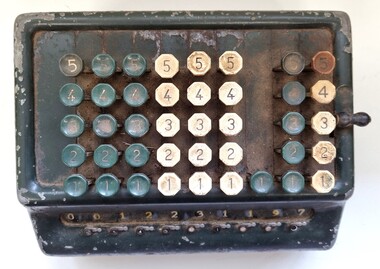
Functional object - Adding Machine - J. Mann & Sons, Bell Punch Co. Ltd, 1950s
... Control Systems. The Bell Punch Company was a British company manufacturing a variety of business machines, including several generations of public transport ticket machines and the world's first desktop electronic calculator The company was founded on 5 July 1878. ...Control Systems. The Bell Punch Company was a British company manufacturing a variety of business machines, including several generations of public transport ticket machines and the world's first desktop electronic calculator The company was founded on 5 July 1878. ...J. Mann and Sons was first established as a farm produce store in 1921. The range of products was extended in the 1930s and included groceries and hardware, as well as the first petrol bowser in Wodonga outside the store. After WWII, the premises were extended and the range of products continued to increase. In the 1960s the Mann Family opened a new supermarket in Wodonga, in addition to the hardware business, providing steel, plumbing and industrial supplies, and they employed over 100 people at one stage. With changes in the retail industry, the Mann Family sold the main hardware business to Bunnings and the steel and rural produce business to the Kelly brothers in 2006. Bell Punch A/sia Ltd was a subsidiary of The Bell Punch Company, itself a part of (Cash) Control Systems. The Bell Punch Company was a British company manufacturing a variety of business machines, including several generations of public transport ticket machines and the world's first desktop electronic calculator The company was founded on 5 July 1878. By 1961 it employed a workforce of 2000 people. The circular mark on the back of the machine was adopted in the 1950s. On Back of machine: Supplied by BELL PUNCH LTD. A/SIA BPC CASH CONTOL SYSTEMS 160 CASTLEREAGH ST. SYDNEY, MA9337 427 LITTLE COLLINS ST. MELBOURNE. CENT. 2038 AGENTS AND SERVICE IN ALL STATES ADDING MACHINES TICKET REGISTERS CHANGE MACHINES TICKET PRINTERS GUM TAPE SEALING MACHINES, ETC. j. mann & sons, vintage adding machines, bell punch australasia -
 The Beechworth Burke Museum
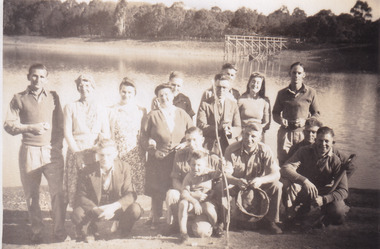
Photograph, 1944
... electronic warfare. They enable commanders to implement highly dynamic battle control against opposing forces by using a number of methods including radio, fibre optic, micro-wave, information systems and satellite links. ...Taken in 1944, depicted are members of the Army Signal Detachment Unit with local residents at at Lake Kerferd. David Pittard (back row, right) is standing beside Dorrie Elliot. The other people are unidentified. A secret experimental micro-wave radio station was established and tested at this site by the Army Signal Detachment Unit during World War II. It was part of an experimental Ultra High Frequency (UHF) link between Melbourne and Sydney. At the time, it was highly classified. It intended to enquire into the hitherto unexplored transmission of micro-waves; that is, a radio signal which could only be transmitted by line of sight, and thus required hill-top to hill-top location. The photograph is historically significant as it pertains to World War II; the largest global conflict in history. This significance is enhanced by Australia's prominent involvement in campaigns across the Pacific, particularly on land in New Guinea and across the Huon Peninsula. It was also the first time that the Australian mainland came under direct attack by the Axis, with Japanese forces targeting north-west Australia and Sydney Harbour. These battles became Australia's largest and most complex offensives during the war. The record is also historically significant as it relates to the Royal Australian Corps of Signals, or "RA Sigs". This significance is strengthened by Australia's unique distinction of having the first established signal unit under the British Empire. This unit provides electronic warfare. They enable commanders to implement highly dynamic battle control against opposing forces by using a number of methods including radio, fibre optic, micro-wave, information systems and satellite links. The record has strong research potential. This is due to the ongoing scholarly and public interest in war, military history, the ANZAC legend, and the continuing existence of the RA Sigs. The historic context of this record can provide insight into Australia's history, military, technological innovation and advancements, as well as national economic, defence and foreign policies after 1945. Sepia rectangular photograph printed on matte photographic paper. Reverse: BMM5095.5 / Relaxing with some of / the Stanley locals / David Pittard (back row Rt.) / next to Dorrie Elliot / I can't recall the others / Lake Sambell, I think / Kerferd / military album, army album, lake kerford, army signal detachment unit, royal australian corps of signals, military, war, wwii, world war ii, beechworth, victoria, sydney, melbourne -
 The Beechworth Burke Museum
Photograph, 1944
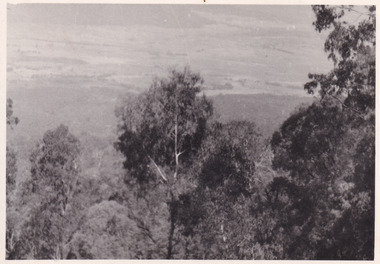
... electronic warfare. They enable commanders to implement highly dynamic battle control against opposing forces by using a number of methods including radio, fibre optic, micro-wave, information systems and satellite links. ...Taken in 1944, the photograph depicts the surrounding farmland from Mt. Stanley in Victoria. A secret experimental micro-wave radio station was established and tested at this site by the Army Signal Detachment Unit during World War II. It was part of an experimental Ultra High Frequency (UHF) link between Melbourne and Sydney. At the time, it was highly classified. It intended to enquire into the hitherto unexplored transmission of micro-waves; that is, a radio signal which could only be transmitted by line of sight, and thus required hill-top to hill-top location. The photograph is historically significant as it pertains to World War II; the largest global conflict in history. This significance is enhanced by Australia's prominent involvement in campaigns across the Pacific, particularly on land in New Guinea and across the Huon Peninsula. It was also the first time that the Australian mainland came under direct attack by the Axis, with Japanese forces targeting north-west Australia and Sydney Harbour. These battles became Australia's largest and most complex offensives during the war. The record is also historically significant as it relates to the Royal Australian Corps of Signals, or "RA Sigs". This significance is strengthened by Australia's unique distinction of having the first established signal unit under the British Empire. This unit provides electronic warfare. They enable commanders to implement highly dynamic battle control against opposing forces by using a number of methods including radio, fibre optic, micro-wave, information systems and satellite links. The record has strong research potential. This is due to the ongoing scholarly and public interest in war, military history, the ANZAC legend, and the ongoing existence of the RA Sigs. The historic context of this record can provide insight into Australia's history, military, technological innovation and advancements, as well as national economic, defence and foreign policies after 1945. Black and white rectangular photograph printed on matte photographic paper. Reverse: BMM5095.1 / military album, army album, wwii, world war ii, army signal detachment unit, mt. stanley, beechworth, victoria, 1940s, australian army, melbourne, sydney, royal australian corps of signals -
 The Beechworth Burke Museum
Photograph, 1944
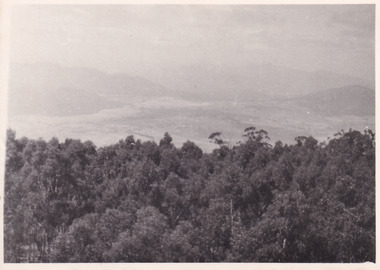
... electronic warfare. They enable commanders to implement highly dynamic battle control against opposing forces by using a number of methods including radio, fibre optic, micro-wave, information systems and satellite links. ...Taken in 1944, the photograph depicts the view from Mt. Stanley. A secret experimental micro-wave radio station was established and tested at this site by the Army Signal Detachment Unit during World War II. It was part of an experimental Ultra High Frequency (UHF) link between Melbourne and Sydney. At the time, it was highly classified. It intended to enquire into the hitherto unexplored transmission of micro-waves; that is, a radio signal which could only be transmitted by line of sight, and thus required hill-top to hill-top location. The photograph is historically significant as it pertains to World War II; the largest global conflict in history. This significance is enhanced by Australia's prominent involvement in campaigns across the Pacific, particularly on land in New Guinea and across the Huon Peninsula. It was also the first time that the Australian mainland came under direct attack by the Axis, with Japanese forces targeting north-west Australia and Sydney Harbour. These battles became Australia's largest and most complex offensives during the war. The record is also historically significant as it relates to the Royal Australian Corps of Signals, or "RA Sigs". This significance is strengthened by Australia's unique distinction of having the first established signal unit under the British Empire. This unit provides electronic warfare. They enable commanders to implement highly dynamic battle control against opposing forces by using a number of methods including radio, fibre optic, micro-wave, information systems and satellite links. The record has strong research potential. This is due to the ongoing scholarly and public interest in war, military history, the ANZAC legend, and the continuing existence of the RA Sigs. The historic context of this record can provide insight into Australia's history, military, technological innovation and advancements, as well as national economic, defence and foreign policies after 1945. Black and white rectangular photograph printed on matte photographic paper. Reverse: BMM5095.4 / 32 / military album, army album, wwii, world war ii, mt stanley, beechworth, victoria, melbourne, sydney, royal australian corps of signals, army signal detachment unit, military, war -
 The Beechworth Burke Museum
Photograph, 1944
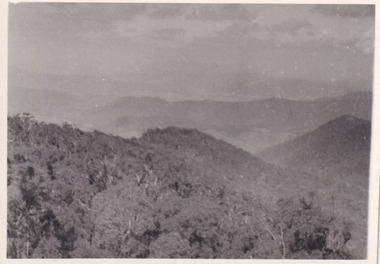
... electronic warfare. They enable commanders to implement highly dynamic battle control against opposing forces by using a number of methods including radio, fibre optic, micro-wave, information systems and satellite links. ...Taken in 1944, the photograph depicts the view of surrounding hills from Mt. Stanley. A secret experimental micro-wave radio station was established and tested at this site by the Army Signal Detachment Unit during World War II. It was part of an experimental Ultra High Frequency (UHF) link between Melbourne and Sydney. At the time, it was highly classified. It intended to enquire into the hitherto unexplored transmission of micro-waves; that is, a radio signal which could only be transmitted by line of sight, and thus required hill-top to hill-top location. The photograph is historically significant as it pertains to World War II; the largest global conflict in history. This significance is enhanced by Australia's prominent involvement in campaigns across the Pacific, particularly on land in New Guinea and across the Huon Peninsula. It was also the first time that the Australian mainland came under direct attack by the Axis, with Japanese forces targeting north-west Australia and Sydney Harbour. These battles became Australia's largest and most complex offensives during the war. The record is also historically significant as it relates to the Royal Australian Corps of Signals, or "RA Sigs". This significance is strengthened by Australia's unique distinction of having the first established signal unit under the British Empire. This unit provides electronic warfare. They enable commanders to implement highly dynamic battle control against opposing forces by using a number of methods including radio, fibre optic, micro-wave, information systems and satellite links. The record has strong research potential. This is due to the ongoing scholarly and public interest in war, military history, the ANZAC legend, and the ongoing existence of the RA Sigs. The historic context of this record can provide insight into Australia's history, military, technological innovation and advancements, as well as national economic, defence and foreign policies after 1945. Black and white rectangular photograph printed on matte photographic paper. Reverse: BMM5095.2 / 32 / military album, army album, wwii, world war ii, army signal detachment unit, royal australian signal army corps, war, beechworth, victoria, mt. stanley -
 The Beechworth Burke Museum
Photograph, 1944
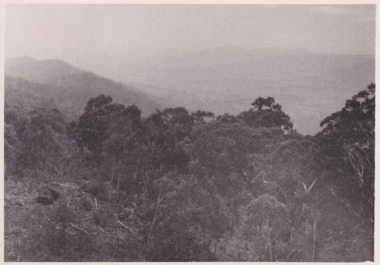
... electronic warfare. They enable commanders to implement highly dynamic battle control against opposing forces by using a number of methods including radio, fibre optic, micro-wave, information systems and satellite links. ...Taken in 1944, the photograph depicts the view from Mt. Stanley. A secret experimental micro-wave radio station was established and tested at this site by the Army Signal Detachment Unit during World War II. It was part of an experimental Ultra High Frequency (UHF) link between Melbourne and Sydney. At the time, it was highly classified. It intended to enquire into the hitherto unexplored transmission of micro-waves; that is, a radio signal which could only be transmitted by line of sight, and thus required hill-top to hill-top location. The photograph is historically significant as it pertains to World War II; the largest global conflict in history. This significance is enhanced by Australia's prominent involvement in campaigns across the Pacific, particularly on land in New Guinea and across the Huon Peninsula. It was also the first time that the Australian mainland came under direct attack by the Axis, with Japanese forces targeting north-west Australia and Sydney Harbour. These battles became Australia's largest and most complex offensives during the war. The record is also historically significant as it relates to the Royal Australian Corps of Signals, or "RA Sigs". This significance is strengthened by Australia's unique distinction of having the first established signal unit under the British Empire. This unit provides electronic warfare. They enable commanders to implement highly dynamic battle control against opposing forces by using a number of methods including radio, fibre optic, micro-wave, information systems and satellite links. The record has strong research potential. This is due to the ongoing scholarly and public interest in war, military history, the ANZAC legend, and the ongoing existence of the RA Sigs. The historic context of this record can provide insight into Australia's history, military, technological innovation and advancements, as well as national economic, defence and foreign policies after 1945. Black and white rectangular photograph printed on matte photographic paper. Reverse: BMM5095.3 / 32 / military album, army album, beechworth, victoria, mt. stanley, australian army, wwii, world war ii, royal australian signal corps, army signal detachment unit -
 The Beechworth Burke Museum
Photograph, 1944
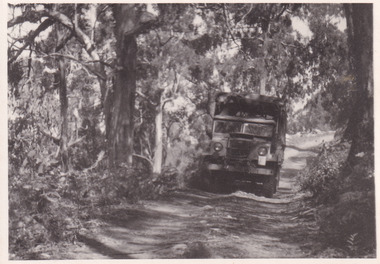
... electronic warfare. They enable commanders to implement highly dynamic battle control against opposing forces by using a number of methods including radio, fibre optic, micro-wave, information systems and satellite links. ...Taken in 1944, the photograph depicts an Australian Army truck driving along an unsealed road from Stanley to the top of Mt. Stanley. A secret experimental micro-wave radio station was established and tested at Mt. Stanley by the Army Signal Detachment Unit during World War II. It was part of an experimental Ultra High Frequency (UHF) link between Melbourne and Sydney. At the time, it was highly classified. It intended to enquire into the hitherto unexplored transmission of micro-waves; that is, a radio signal which could only be transmitted by line of sight, and thus required hill-top to hill-top location. The photograph is historically significant as it pertains to World War II; the largest global conflict in history. This significance is enhanced by Australia's prominent involvement in campaigns across the Pacific, particularly on land in New Guinea and across the Huon Peninsula. It was also the first time that the Australian mainland came under direct attack by the Axis, with Japanese forces targeting north-west Australia and Sydney Harbour. These battles became Australia's largest and most complex offensives during the war. The record is also historically significant as it relates to the Royal Australian Corps of Signals, or "RA Sigs". This significance is strengthened by Australia's unique distinction of having the first established signal unit under the British Empire. This unit provides electronic warfare. They enable commanders to implement highly dynamic battle control against opposing forces by using a number of methods including radio, fibre optic, micro-wave, information systems and satellite links. The record has strong research potential. This is due to the ongoing scholarly and public interest in war, military history, the ANZAC legend, and the continuing existence of the RA Sigs. The historic context of this record can provide insight into Australia's history, military, technological innovation and advancements, as well as national economic, defence and foreign policies after 1945. Black and white rectangular photograph printed on matte photographic paper. Reverse: BMM5095.7 / The track up (?) from / Stanley to the top / 32 / military album, army album, military, war, wwii, world war ii, army signal detachment unit, royal australian corps of signals, beechworth, victoria, stanley, mt stanley, melbourne, sydney -
 The Beechworth Burke Museum
Photograph, 1944
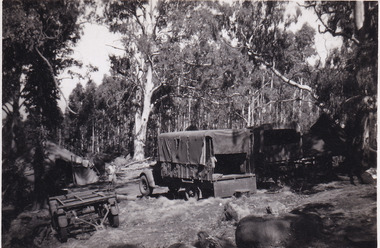
... electronic warfare. They enable commanders to implement highly dynamic battle control against opposing forces by using a number of methods including radio, fibre optic, micro-wave, information systems and satellite links. ...Taken in 1944, the photograph depicts two trucks and a trailer park at an undisclosed location inside the Stanley forest. An unidentified young man is standing in the background. There are also two tents installed on either side of the vehicles. A secret experimental micro-wave radio station was established and tested in Stanley, Victoria by the Army Signal Detachment Unit during World War II. It was part of an experimental Ultra High Frequency (UHF) link between Melbourne and Sydney. At the time, it was highly classified. It intended to enquire into the hitherto unexplored transmission of micro-waves; that is, a radio signal which could only be transmitted by line of sight, and thus required hill-top to hill-top location. The photograph is historically significant as it pertains to World War II; the largest global conflict in history. This significance is enhanced by Australia's prominent involvement in campaigns across the Pacific, particularly on land in New Guinea and across the Huon Peninsula. It was also the first time that the Australian mainland came under direct attack by the Axis, with Japanese forces targeting north-west Australia and Sydney Harbour. These battles became Australia's largest and most complex offensives during the war. The record is also historically significant as it relates to the Royal Australian Corps of Signals, or "RA Sigs". This significance is strengthened by Australia's unique distinction of having the first established signal unit under the British Empire. This unit provides electronic warfare. They enable commanders to implement highly dynamic battle control against opposing forces by using a number of methods including radio, fibre optic, micro-wave, information systems and satellite links. The record has strong research potential. This is due to the ongoing scholarly and public interest in war, military history, the ANZAC legend, and the continuing existence of the RA Sigs. The historic context of this record can provide insight into Australia's history, military, technological innovation and advancements, as well as national economic, defence and foreign policies after 1945. Black and white rectangular photograph printed on matte photographic paper. Reverse: BMM5095.8 / military album, army album, wwii, world war ii, army signal detachment unit, royal australian corps of signals, ra sigs, stanley, army truck, victoria, beechworth, melbourne, sydney -
 The Beechworth Burke Museum
Photograph, 1944
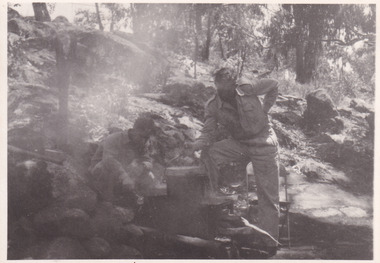
... electronic warfare. They enable commanders to implement highly dynamic battle control against opposing forces by using a number of methods including radio, fibre optic, micro-wave, information systems and satellite links. military album army album military war wwii world war ii army signal detachment unit royal australian corps of signals mt stanley beechworth victoria melbourne sydney Reverse: BMM5095.6 / Our Cookhouse / 32 / Black and white rectangular photograph printed on matte photographic paper. ...Taken in 1944, depicted are two unidentified soldiers presumed to be part of the Army Signal Detachment Unit. They are cooking a meal outdoors around Mt. Stanley. A secret experimental micro-wave radio station was established and tested near this site by the Army Signal Detachment Unit during World War II. It was part of an experimental Ultra High Frequency (UHF) link between Melbourne and Sydney. At the time, it was highly classified. It intended to enquire into the hitherto unexplored transmission of micro-waves; that is, a radio signal which could only be transmitted by line of sight, and thus required hill-top to hill-top location. The photograph is historically significant as it pertains to World War II; the largest global conflict in history. This significance is enhanced by Australia's prominent involvement in campaigns across the Pacific, particularly on land in New Guinea and across the Huon Peninsula. It was also the first time that the Australian mainland came under direct attack by the Axis, with Japanese forces targeting north-west Australia and Sydney Harbour. These battles became Australia's largest and most complex offensives during the war. The record is also historically significant as it relates to the Royal Australian Corps of Signals, or "RA Sigs". This significance is strengthened by Australia's unique distinction of having the first established signal unit under the British Empire. This unit provides electronic warfare. They enable commanders to implement highly dynamic battle control against opposing forces by using a number of methods including radio, fibre optic, micro-wave, information systems and satellite links. Black and white rectangular photograph printed on matte photographic paper. Reverse: BMM5095.6 / Our Cookhouse / 32 / military album, army album, military, war, wwii, world war ii, army signal detachment unit, royal australian corps of signals, mt stanley, beechworth, victoria, melbourne, sydney -
 The Beechworth Burke Museum
Photograph, 1944
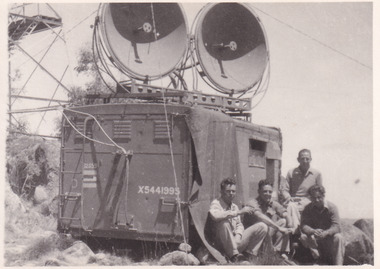
... electronic warfare. They enable commanders to implement highly dynamic battle control against opposing forces by using a number of methods including radio, fibre optic, micro-wave, information systems and satellite links. ...Taken in 1944, the photograph depicts a van with two large, round satellite dishes installed on the roof stationed near Mt. Stanley, Victoria. There is a transmission tower in the background. Four unidentified young men are in the foreground on the right hand side. A secret experimental micro-wave radio station was established and tested at this site by the Army Signal Detachment Unit during World War II. It was part of an experimental Ultra High Frequency (UHF) link between Melbourne and Sydney. At the time, it was highly classified. It intended to enquire into the hitherto unexplored transmission of micro-waves; that is, a radio signal which could only be transmitted by line of sight, and thus required hill-top to hill-top location. The photograph is historically significant as it pertains to World War II; the largest global conflict in history. This significance is enhanced by Australia's prominent involvement in campaigns across the Pacific, particularly on land in New Guinea and across the Huon Peninsula. It was also the first time that the Australian mainland came under direct attack by the Axis, with Japanese forces targeting north-west Australia and Sydney Harbour. These battles became Australia's largest and most complex offensives during the war. The record is also historically significant as it relates to the Royal Australian Corps of Signals, or "RA Sigs". This significance is strengthened by Australia's unique distinction of having the first established signal unit under the British Empire. This unit provides electronic warfare. They enable commanders to implement highly dynamic battle control against opposing forces by using a number of methods including radio, fibre optic, micro-wave, information systems and satellite links. The record has strong research potential. This is due to the ongoing scholarly and public interest in war, military history, the ANZAC legend, and the continuing existence of the RA Sigs. The historic context of this record can provide insight into Australia's history, military, technological innovation and advancements, as well as national economic, defence and foreign policies after 1945. Black and white rectangular photograph printed on matte photographic paper. Reverse: BMM5095.10 / Our station set-up / in operation beside / the old Fire Watchers / Tower / 32 / It was man-handled / the last 50m. to the top / military album, army album, wwii, world war ii, army signal detachment unit, royal australia corps of signals, military, war, australian army, mt. stanley, victoria, beechworth -
 The Beechworth Burke Museum
Photograph, 1944
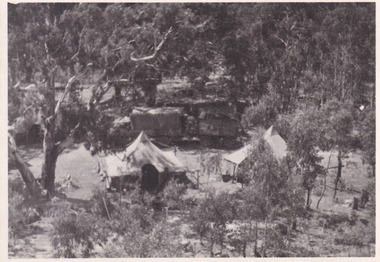
... electronic warfare. They enable commanders to implement highly dynamic battle control against opposing forces by using a number of methods including radio, fibre optic, micro-wave, information systems and satellite links. ...Taken in 1944, depicted is an aerial view of an Australian military camp set up at Mt. Stanley in Victoria. There are two large tents along with a vehicle and trailer surrounded by bushland. A secret experimental micro-wave radio station was established and tested at this site by the Army Signal Detachment Unit during World War II. It was part of an experimental Ultra High Frequency (UHF) link between Melbourne and Sydney. At the time, it was highly classified. It intended to enquire into the hitherto unexplored transmission of micro-waves; that is, a radio signal which could only be transmitted by line of sight, and thus required hill-top to hill-top location. The photograph is historically significant as it pertains to World War II; the largest global conflict in history. This significance is enhanced by Australia's prominent involvement in campaigns across the Pacific, particularly on land in New Guinea and across the Huon Peninsula. It was also the first time that the Australian mainland came under direct attack by the Axis, with Japanese forces targeting north-west Australia and Sydney Harbour. These battles became Australia's largest and most complex offensives during the war. The record is also historically significant as it relates to the Royal Australian Corps of Signals, or "RA Sigs". This significance is strengthened by Australia's unique distinction of having the first established signal unit under the British Empire. This unit provides electronic warfare. They enable commanders to implement highly dynamic battle control against opposing forces by using a number of methods including radio, fibre optic, micro-wave, information systems and satellite links. The record has strong research potential. This is due to the ongoing scholarly and public interest in war, military history, the ANZAC legend, and the continuing existence of the RA Sigs. The historic context of this record can provide insight into Australia's history, military, technological innovation and advancements, as well as national economic, defence and foreign policies after 1945. Black and white rectangular photograph printed on matte photographic paper. Reverse: BMM5095.11 / Our camp / From the top. / (?) (?) / military album, army album, australian royal corps of signals, army signal detachment unit, mt. stanley, victoria, beechworth, wwii, world war ii, melbourne, sydney -
 The Beechworth Burke Museum
Photograph, 1944
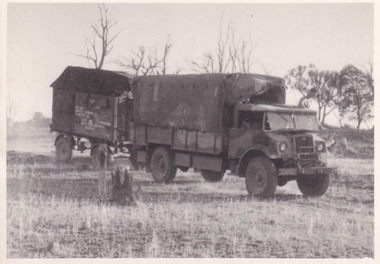
... electronic warfare. They enable commanders to implement highly dynamic battle control against opposing forces by using a number of methods including radio, fibre optic, micro-wave, information systems and satellite links. military album army album wwii world war ii army signal detachment unit royal australian corps of signals ra sigs australian army army truck beechworth stanley victoria melbourne sydney Reverse: BMM5095.9 / Our outfit (fully mobile) / on the move / 32 / Black and white rectangular photograph printed on matte photographic paper. ...Taken in 1944, the photograph depicts an Australian Army vehicle with a trailer driving through bushland in Victoria. A secret experimental micro-wave radio station was established and tested in Stanley, Victoria by the Army Signal Detachment Unit during World War II. It was part of an experimental Ultra High Frequency (UHF) link between Melbourne and Sydney. At the time, it was highly classified. It intended to enquire into the hitherto unexplored transmission of micro-waves; that is, a radio signal which could only be transmitted by line of sight, and thus required hill-top to hill-top location. The photograph is historically significant as it pertains to World War II; the largest global conflict in history. This significance is enhanced by Australia's prominent involvement in campaigns across the Pacific, particularly on land in New Guinea and across the Huon Peninsula. It was also the first time that the Australian mainland came under direct attack by the Axis, with Japanese forces targeting north-west Australia and Sydney Harbour. These battles became Australia's largest and most complex offensives during the war. The record is also historically significant as it relates to the Royal Australian Corps of Signals, or "RA Sigs". This significance is strengthened by Australia's unique distinction of having the first established signal unit under the British Empire. This unit provides electronic warfare. They enable commanders to implement highly dynamic battle control against opposing forces by using a number of methods including radio, fibre optic, micro-wave, information systems and satellite links. Black and white rectangular photograph printed on matte photographic paper. Reverse: BMM5095.9 / Our outfit (fully mobile) / on the move / 32 / military album, army album, wwii, world war ii, army signal detachment unit, royal australian corps of signals, ra sigs, australian army, army truck, beechworth, stanley, victoria, melbourne, sydney -
 The Beechworth Burke Museum
Photograph, 1944
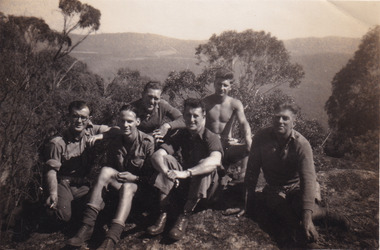
... electronic warfare. They enable commanders to implement highly dynamic battle control against opposing forces by using a number of methods including radio, fibre optic, micro-wave, information systems and satellite links. army album military album wwii world war ii army signal detachment unit royal Australian corps of signals military war mt. stanley victoria beechworth melbourne sydney Reverse: BMM5095.12 / David Pittard / 2nd from left in photo. / The Sig. ...Taken in 1944, depicted is a group of six young men part of the Army Signal Detachment Unit. They are seated on a rock at Mt. Stanley, Victoria. The man second from the left has been identified as David Pittard. A secret experimental micro-wave radio station was established and tested at this site by the Army Signal Detachment Unit during World War II. It was part of an experimental Ultra High Frequency (UHF) link between Melbourne and Sydney. At the time, it was highly classified. It intended to enquire into the hitherto unexplored transmission of micro-waves; that is, a radio signal which could only be transmitted by line of sight, and thus required hill-top to hill-top location. The photograph is historically significant as it pertains to World War II; the largest global conflict in history. This significance is enhanced by Australia's prominent involvement in campaigns across the Pacific, particularly on land in New Guinea and across the Huon Peninsula. It was also the first time that the Australian mainland came under direct attack by the Axis, with Japanese forces targeting north-west Australia and Sydney Harbour. These battles became Australia's largest and most complex offensives during the war. The record is also historically significant as it relates to the Royal Australian Corps of Signals, or "RA Sigs". This significance is strengthened by Australia's unique distinction of having the first established signal unit under the British Empire. This unit provides electronic warfare. They enable commanders to implement highly dynamic battle control against opposing forces by using a number of methods including radio, fibre optic, micro-wave, information systems and satellite links. Black and white rectangular photograph printed on matte photographic paper. Reverse: BMM5095.12 / David Pittard / 2nd from left in photo. / The Sig. Detachment / at Mt Stanley in 1944 / army album, military album, wwii, world war ii, army signal detachment unit, royal australian corps of signals, military, war, mt. stanley, victoria, beechworth, melbourne, sydney -
Moorabbin Air Museum
Book - Avionics, Avionics The Story and technology of aviation electronics
... Avionics Electronics Communications Navigation Radar principles Radar for fighters Radar for attack Tactical devices Reconnaissance systems Electronic warfare Avionics for safety Landing aids Monitoring & recording Displays Flight control Computers Historic & technical overview of avionics circa 1990 Avionics The Story and technology of aviation electronics Book Avionics ...Historic & technical overview of avionics circa 1990non-fiction Historic & technical overview of avionics circa 1990 electronics, communications, navigation, radar principles, radar for fighters, radar for attack, tactical devices, reconnaissance systems, electronic warfare, avionics for safety, landing aids, monitoring & recording, displays, flight control, computers -
 Victorian Railway History Library
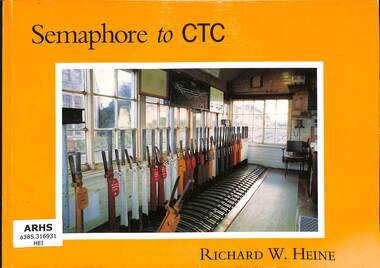
Book, Heine, Richard, Semaphore to CTC: Signalling and Train Working in New Zealand 1863-1993, 2000
... Railroad signalling - New Zealand - history Railroad operations - New Zealand A history of the signalling systems in New Zealand from manually controlled semaphore signals to electronically controlled Centralized Traffic Control 1863-1993. index, ill, p.169. ...A history of the signalling systems in New Zealand from manually controlled semaphore signals to electronically controlled Centralized Traffic Control 1863-1993.index, ill, p.169. non-fiction A history of the signalling systems in New Zealand from manually controlled semaphore signals to electronically controlled Centralized Traffic Control 1863-1993. railroad signalling - new zealand - history, railroad operations - new zealand
