
Showing 11 items matching "emerald museum committee"
-
 Emerald Museum & Nobelius Heritage Park
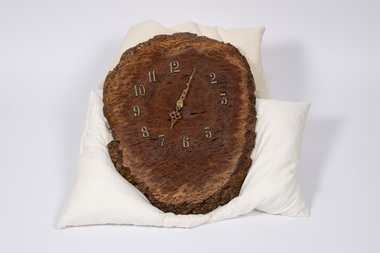
Domestic object - Analogue clock mounted on a piece of Myall burl wood timber, Ted Hogben, 1990s
... ...Emerald Museum Committee...Ted Hogben, the maker of this clock, was a member of the Committee of the Emerald Museum during the 1990s. He was an excellent handyman who did a lot of work around the Museum during his tenure. ...Ted Hogben Emerald Museum Committee Typical analogue clock face. ...Ted Hogben, the maker of this clock, was a member of the Committee of the Emerald Museum during the 1990s. He was an excellent handyman who did a lot of work around the Museum during his tenure. He donated this clock to the Museum when he retired to Berwick in the late 1990s.This attractive clock was handmade by a former Committee member of the Emerald Museum and is usually on display there.Myall Burl wood (timber) clock & Crafter's signTypical analogue clock face. Associated sign 'This clock was crafted & donated to the museum by Ted Hogbented hogben, emerald museum committee -
 Emerald Museum & Nobelius Heritage Park
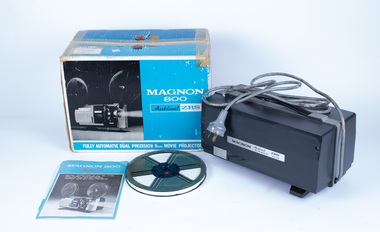
Functional object - Magnon 800 Movie Projector in box, Bell KO-ON Co. Ltd, Early 1970s
... The donor of this Movie Editor, a member of the Emerald Museum Committee for several years, was a keen amateur photographer and donated other items of used photographic equipment to the Museum....The donor of this Movie Editor, a member of the Emerald Museum Committee for several years, was a keen amateur photographer and donated other items of used photographic equipment to the Museum. ...The donor of this Movie Editor, a member of the Emerald Museum Committee for several years, was a keen amateur photographer and donated other items of used photographic equipment to the Museum.This movie editor is part of a collection of photographic equipment which was used and donated by a local person.Movie projector with black plastic carry handle and removable front cover and long power cord. Separate manual. Inside original box with styrofoam packing. Box is of a mainly blue colour with white lettering.On front of projector: 'MAGNON Instdual / 8mm MOVIE PROJECTOR' On back of projector: MAGNON Instdual ZRS / BELL KO-ON CO., LTD. TOKYO JAPAN' On front and back of box: 'MAGNON / 800 / INSTDUAL PRECISION 8mm MOVIE PROJECTOR' On the two sides of the box: 'MAGNON /800 / Instdual / MADE IN JAPAN' On top of box an Inspection Certificate label signed 'T Nishino'magnon 800 movie projector, photography -
 Emerald Museum & Nobelius Heritage Park
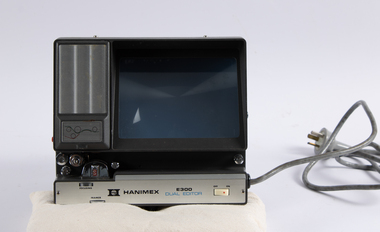
Functional object - Hanimex Movie Editor, Hanimex, 1970s
... The donor, a member of the Emerald Museum Committee for several years, donated other items of used photographic equipment which suggests they were a keen photographer. ...The donor, a member of the Emerald Museum Committee for several years, donated other items of used photographic equipment which suggests they were a keen photographer. ...Hanimex Corporation was an importer and distributor of cameras, lenses, and other photographic equipment in Australia and New Zealand. It was founded in 1947 by German refugee, Jack Hannes, who had fled Germany for Australia in 1939. Hanimex was very significant in the development of the photographic market in Australia. The donor, a member of the Emerald Museum Committee for several years, donated other items of used photographic equipment which suggests they were a keen photographer. This movie editor owned and used by a local person was made by a company which is significant in Australian photographic history.Hanimex Movie Editor inside original box. Cardboard box is a turquoise color with black and white lettering and a red stripe. Foam storage base.On front of box: 'HANIMEX / E300 / DUAL 8 / MOVIE EDITOR' On top of box: 'HANIMEX / MOVIE EDITOR / LAUFBILDETRACHTER'hanimex -
 Emerald Museum & Nobelius Heritage Park
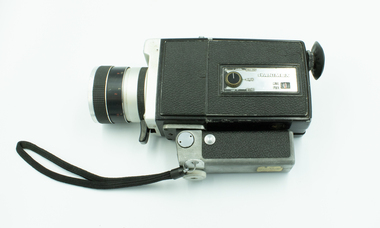
Functional object - Hanimex Loadmatic Camera in case, Hanimex, 1971-1973
... The donor, a member of the Emerald Museum Committee for several years, donated other items of used photographic equipment which suggests they were a keen photographer. ...The donor, a member of the Emerald Museum Committee for several years, donated other items of used photographic equipment which suggests they were a keen photographer. ...Hanimex Corporation was an importer and distributor of cameras, lenses, and other photographic equipment in Australia and New Zealand. It was founded in 1947 by German refugee, Jack Hannes, who had fled Germany for Australia in 1939. Hanimex was very significant in the development of the photographic market in Australia. The Hanimex MPF 830 is a super 8 film camera which is part of the Hanimex Loadmatic series and recognized for its use in 1970's cinema. The donor, a member of the Emerald Museum Committee for several years, donated other items of used photographic equipment which suggests they were a keen photographer. The airways tag shows that the donor took the camera with him when he visited England.This camera owned and used by a local person was made by a company which is significant in Australian photographic history.Black camera case lined with black leather on outside and red felt on inside. Secured with clasp of silver metal. Black leather carry strap. A British Airways baggage tag is tied to the strap, and a completed airways address label is affixed to the front of the case. Camera is a cine (movie) camera - Hanimex Loadmatic MPF 830.On lower right front of case: 'HANIMEX' Inside case is the owner's name and address and telephone number on embossed tape. On side of camera: 'AUTOMATIC / MANUAL / OFF / AUS' and 'HANIMEX / METER / FEET'. On other side of camera: 'LOADMATIC / MPF / 830' On front of camera: HANIMEX'hanimex -
 Flagstaff Hill Maritime Museum and Village
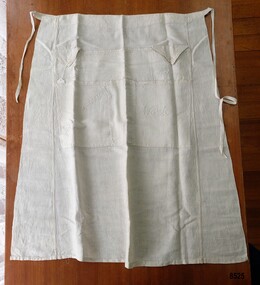
Clothing - Traveller's Apron, Eliza Towns, Circa 1915
... Museum and Village. Eliza was born Eliza Gould in 1857 in South Melbourne (Emerald Hill) and in 1879 married Charles Towns. In the early 1880's they moved to Nhill in western Victoria and remained there for the rest of their married life. Charles was a jeweller and later became an accountant and for many years was involved with the Shire Council, the local show committee...Museum and Village. Eliza was born Eliza Gould in 1857 in South Melbourne (Emerald Hill) and in 1879 married Charles Towns. In the early 1880's they moved to Nhill in western Victoria and remained there for the rest of their married life. Charles was a jeweller and later became an accountant and for many years was involved with the Shire Council, the local show committee ...This apron is one of several linen and clothing items that were made and belonged to Mrs. Eliza Towns and donated to Flagstaff Hill Maritime Museum and Village. Eliza was born Eliza Gould in 1857 in South Melbourne (Emerald Hill) and in 1879 married Charles Towns. In the early 1880's they moved to Nhill in western Victoria and remained there for the rest of their married life. Charles was a jeweller and later became an accountant and for many years was involved with the Shire Council, the local show committee (A & P Society), the Hospital Committee and the Board of the local newspaper (the Nhill Free Press). They had three children and lived a life that would be regarded as comfortably "middle class". Eliza probably had a treadle sewing machine and would have made many of her own clothes - adding her own handmade embroidered or crocheted decorative trim. In March 1915 Eliza travelled to San Francisco to visit her son, James. She went by train to Melbourne ("a pleasant journey on the up express') and the next day caught the express train to Sydney. She noted in her letters home that a " number of young men were going to Sydney to enlist but they had to stop in the corridors most of the way as there was no room for them to sit down". She spent the night on the train and arrived in Sydney the next morning and on the following day she boarded the R.M.S. "Moana" (a steamer which took about twenty-four days to reach San Francisco). She returned from Vancouver about five months later on board the "Manuka". It is very likely Eliza took this "Travelling Apron" with her on her travels. Eliza was travelling by herself and had no one to help her with her dress or her hair. "Travelling Aprons" (also known as Toilet Aprons or Tourist Aprons) were designed with different sized pockets for holding a lady's toiletries - hairbrush, hair pins, comb and sometimes even soap and a powder puff. This allowed the owner, when travelling and getting dressed in small places such as an overnight train compartment or a ship's cabin, to have all her requirements at hand without needing to search for them or have them roll onto the floor. Some of the pockets are finished with buttoned flaps to keep the items in place and when not in use, the apron could be hung up or rolled up and put away. Articles about the "Traveller's Apron" appeared in numerous Women's columns in Australian newspapers in the early 20th century - often with instructions and sometimes a pattern. In the "Age" on Sat 5th October 1907 in a column titled "Feminine Facts and Fancies" the author wrote "No man can appreciate the difficulties of dressing in a "wobbly" train or trying to do one's hair while a ship is weathering a storm". A year earlier (Saturday 24th March 1906) in the same column, the author wrote "... you have to spend nights in a train... forever struggling to dress yourself in a wretched little lavatory. You know how your hairpins and combs jump all over the place ... a train is always at its liveliest when you're trying to do your hair. My travelling apron saved me many a rage."This item is an example of the needlework skills of women in the early 20th century - combining machine stitching with hand embroidery to personalise and embellish a practical domestic object. It is also an excellent (and rare) example of an early 20th century innovation that helped solve the difficulties of privacy and convenience that many women experienced at a time when travel was becoming more accessible to them. A half apron, made of ivory linen with two waist ties and seven pockets. Along the top are two smaller pockets with triangular, buttoned flaps labelled "Hairpins" and "Nailbrush" and one larger unlabelled pocket. Underneath are two larger pockets labelled "Brush & Comb" and "Work" and two unlabelled narrow pockets. The seams are machine stitched and the pockets are outlined with hand embroidered feather stitch. The labels on the pockets are embroidered in stem stitch."Hairpins" / "Nailbrush" / "Brush and Comb" / "Work"flagstaff hill maritime museum and village, nhill, eliza towns, apron, travelling apron, tourist apron, textiles, toilet apron, sewing, embroidery, travel, warrnambool, great ocean road, trains, ships, moana, manuka, feather stitch, stem stitch, fashion, handmade, clothing, charles towns, needlework -
 Flagstaff Hill Maritime Museum and Village
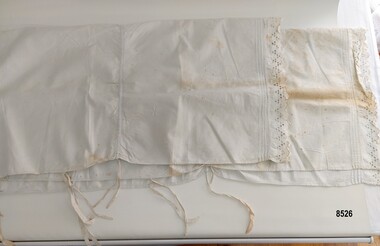
Textile - Bolster Sham, Eliza Towns, Late 19th century to early 20th century
... Museum and Village. Eliza was born Eliza Gould in 1857 in South Melbourne (Emerald Hill) and in 1879 married Charles Towns. In the early 1880's they moved to Nhill in western Victoria and remained there for the rest of their married life. Charles was a jeweller and later became an accountant and for many years was involved with the Shire Council, the local show committee...Museum and Village. Eliza was born Eliza Gould in 1857 in South Melbourne (Emerald Hill) and in 1879 married Charles Towns. In the early 1880's they moved to Nhill in western Victoria and remained there for the rest of their married life. Charles was a jeweller and later became an accountant and for many years was involved with the Shire Council, the local show committee ...This bolster sham is one of several linen and clothing items that were made and belonged to Mrs. Eliza Towns and donated to Flagstaff Hill Maritime Museum and Village. Eliza was born Eliza Gould in 1857 in South Melbourne (Emerald Hill) and in 1879 married Charles Towns. In the early 1880's they moved to Nhill in western Victoria and remained there for the rest of their married life. Charles was a jeweller and later became an accountant and for many years was involved with the Shire Council, the local show committee (A & P Society), the Hospital Committee and the Board of the local newspaper (the Nhill Free Press). They had three children and lived a life that would be regarded as comfortably "middle class". Eliza probably had a treadle sewing machine and would have made many of her own clothes and household linens - adding her own handmade embroidered or crocheted decorative trim. Most beds during the late 19th and early 20th century had a feather, hair or spring mattress covered by a blanket and topped with an under sheet, an upper sheet, several blankets and a bedspread. A flat bolster could be placed either under the pillows or on top of the pillows with a decorative sham. Washing pillows and quilts by hand would have been a very onerous task (involving heating water and handwashing in a tub or using a copper) and so it became the practise of many housewives to cover the pillows and bolsters with an outer slip (or sham) of washable material which could be easily removed and washed when needed. If the bolster was kept under the pillows it wouldn't need to be very decorative but many shams or slips that were "on show" were often highly decorated with embroidery, pintucks, ribbons or lace. This bolster sham is machine made and quite plain with the exception of some pintucking and eyelet lace on each end which suggests that it would mostly be hidden under the top pillows with just the decorative edges on display.This item is an example of the needlework skills of women in the early 20th century - combining machine stitching with hand embroidery to personalise and embellish a practical domestic object. It is also significant as an example of an early 20th century innovation that helped make the working lives of housewives a little bit easier.A long white cotton rectangular bolster sham, machine sewn, with seven ties and two buttons (plus one missing button) to enable it to be folded over lengthwise and closed. It has two pull string ties near each end to enclose a bolster and is finished with a decorative edge of pintucks and handmade eyelet lace and embroidery.flagstaff hill maritime museum and village, eliza towns, sham, bedding, great ocean road, shipwreck coast, warrnambool, household textiles, sewing, bolster sham, housework, pillow sham, charles towns, nhill, haberdashery, needlework, manchester, handmade, household linen -
 Flagstaff Hill Maritime Museum and Village
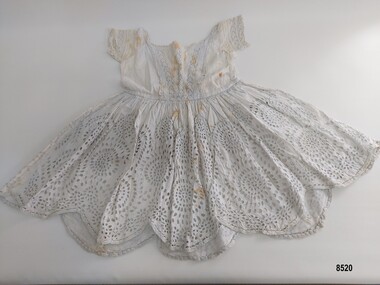
Clothing - Child's dress, Eliza Towns, Late 19th century
... Museum and Village. Eliza was born Eliza Gould in 1857 in South Melbourne (Emerald Hill) and in 1879 married Charles Towns. In the early 1880's they moved to Nhill in western Victoria and remained there for the rest of their married life. Charles was a jeweller and later became an accountant and for many years was involved with the Shire Council, the local show committee...Museum and Village. Eliza was born Eliza Gould in 1857 in South Melbourne (Emerald Hill) and in 1879 married Charles Towns. In the early 1880's they moved to Nhill in western Victoria and remained there for the rest of their married life. Charles was a jeweller and later became an accountant and for many years was involved with the Shire Council, the local show committee ...This child's dress is one of several linen and clothing items that were made and belonged to Mrs. Eliza Towns and donated to Flagstaff Hill Maritime Museum and Village. Eliza was born Eliza Gould in 1857 in South Melbourne (Emerald Hill) and in 1879 married Charles Towns. In the early 1880's they moved to Nhill in western Victoria and remained there for the rest of their married life. Charles was a jeweller and later became an accountant and for many years was involved with the Shire Council, the local show committee (A & P Society), the Hospital Committee and the Board of the local newspaper (the Nhill Free Press). They had three children and lived a life that would be regarded as comfortably "middle class". Eliza probably had a treadle sewing machine and would have made many of her own clothes as well as clothes for her children - adding her own handmade embroidered or crocheted decorative trim. A photograph of their youngest child, Alice, taken in circa 1903 depicts her wearing the dress. The dress would have been only worn on special occasions (such as a formal family photographic portrait) as most young girls in that era would have smocks or pinafores for everyday wear. The age of the dress is in question as it may have been made by Eliza for her eldest daughter, Dorcus, who was born in 1884. This dress has some machine sewing at the neck, waistband and pintucks but much of the dress is handsewn and richly embroidered with Broderie anglaise. Broderie anglaise (also known as eyelet lace) is a form of cutwork embroidery. The foundation fabric is cut to make decorative holes which are sewn with overcast or buttonhole stitches to create a lace like effect. Designs often involve floral motives that are enhanced with simple embroidery stitches such as stem stitch and satin stitch and scalloped edges finished with buttonhole stitches. It was commonly used to trim baby clothes, dresses, nightclothes, underclothes and household linens - particularly in the Victorian and Edwardian eras. This item is an example of the needlework skills of women in the late 19th century - combining machine stitching with hand embroidery to personalise and embellish a child's special dress.Child's white dress made of cotton and lawn, with a skirt of hand embroidered circular cutwork (broderie anglaise), a scalloped hem edged in buttonhole stitch and a gathered waist. The lined bodice has three panels of hand embroidered broderie anglaise (eyelet lace) inserted in a V shape with pintucks and bordered with a broderie anglaise lace frill. The short sleeves also have an inserted broderie anglaise lace strip, three pintucks and a broderie anglaise lace frill. The skirt is semi lined with fine lawn. The dress has a back opening with one button and two ties. The neckline is decorated with two rows of hand embroidered broderie anglaise lace.flagstaff hill, flagstaff hill maritime museum & village, warrnambool, shipwreck coast, great ocean road, nhill, wimmera, eliza towns, dorcus towns, child's dress, machine sewing, hand sewing, broderie anglaise, cutwork, embroidery, eyelet lace, clothing, handmade, charles towns, alice towns -
 Flagstaff Hill Maritime Museum and Village
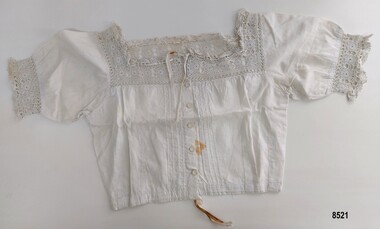
Clothing - Corset cover, Eliza Towns, Mid to late 19th century
... Museum and Village. Eliza was born Eliza Gould in 1857 in South Melbourne (Emerald Hill) and in 1879 married Charles Towns. In the early 1880's they moved to Nhill in western Victoria and remained there for the rest of their married life. Charles was a jeweller and later became an accountant and for many years was involved with the Shire Council, the local show committee...Museum and Village. Eliza was born Eliza Gould in 1857 in South Melbourne (Emerald Hill) and in 1879 married Charles Towns. In the early 1880's they moved to Nhill in western Victoria and remained there for the rest of their married life. Charles was a jeweller and later became an accountant and for many years was involved with the Shire Council, the local show committee ...This corset cover is one of several linen and clothing items that were made and belonged to Mrs. Eliza Towns and donated to Flagstaff Hill Maritime Museum and Village. Eliza was born Eliza Gould in 1857 in South Melbourne (Emerald Hill) and in 1879 married Charles Towns. In the early 1880's they moved to Nhill in western Victoria and remained there for the rest of their married life. Charles was a jeweller and later became an accountant and for many years was involved with the Shire Council, the local show committee (A & P Society), the Hospital Committee and the Board of the local newspaper (the Nhill Free Press). They had three children and lived a life that would be regarded as comfortably "middle class". Eliza probably had a treadle sewing machine and would have made many of her own clothes as well as clothes for her children - adding her own handmade embroidered or crocheted decorative trim. This corset cover is an excellent example of an everyday clothing item with the decorative trim favoured by women in the late Victorian era. Eliza Towns has added pintucks, embroidered feather stitch and a highly decorative hand crocheted lace trim to the neckline, sleeves and front of the bodice. Corset covers (sometimes called camisoles) began to appear in women's fashion around 1840 and continued through the late Victorian decades into the Edwardian era. The long chemise was considered too bulky to cover the corset and so the corset cover was developed to be short and light and was worn over the corset and under the bodice of the outer garment. A woman would dress into her chemise and drawers first, followed by her corset and finally her corset cover as a final layer under her dress. Corset covers served several purposes. They provided protection against sweat (and the need to regularly wash the corset), helped smooth the lines of the corset and increased a woman's modesty.This item is an example of the needlework skills of women in the late 19th century - combining machine stitching with hand embroidery and crochet to embellish an item of personal underclothing. It is also significant as an example of a practical solution to the difficulty of hand washing a corset in the Victorian era.A short (waist length) corset cover of fine cotton. Short sleeves fall from a square neckline and are gathered into a wide crocheted lace trim with a band of embroidered feather stitch. The same crocheted lace design and feather stitching are also on the square neckline which is finished with a drawstring ribbon. The bodice has a front opening with five buttons and is bordered on each side with four pintucks. It has a drawstring ribbon at the waist and an extra layer of fine cotton lining has been added to strengthen the corset cover under the arms. The back has two bands of three pintucks running vertically from the neckline to the waist.flagstaff hill, flagstaff hill maritime museum & village, warrnambool, great ocean road, shipwreck coast, nhill, wimmera, eliza towns, underclothing, corset cover, camisole, machine sewing, hand sewing, crocheted lace, pintucks, feather stitch, embroidery, underwear, victorian era underclothing, victorian era corset cover -
 Flagstaff Hill Maritime Museum and Village
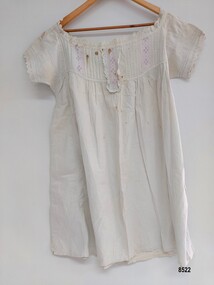
Clothing - Chemise, Eliza Towns, Late Victorian era
... Museum and Village. Eliza was born Eliza Gould in 1857 in South Melbourne (Emerald Hill) and in 1879 married Charles Towns. In the early 1880's they moved to Nhill in western Victoria and remained there for the rest of their married life. Charles was a jeweller and later became an accountant and for many years was involved with the Shire Council, the local show committee...Museum and Village. Eliza was born Eliza Gould in 1857 in South Melbourne (Emerald Hill) and in 1879 married Charles Towns. In the early 1880's they moved to Nhill in western Victoria and remained there for the rest of their married life. Charles was a jeweller and later became an accountant and for many years was involved with the Shire Council, the local show committee ...This chemise is one of several linen and clothing items that were made and belonged to Mrs. Eliza Towns and donated to Flagstaff Hill Maritime Museum and Village. Eliza was born Eliza Gould in 1857 in South Melbourne (Emerald Hill) and in 1879 married Charles Towns. In the early 1880's they moved to Nhill in western Victoria and remained there for the rest of their married life. Charles was a jeweller and later became an accountant and for many years was involved with the Shire Council, the local show committee (A & P Society), the Hospital Committee and the Board of the local newspaper (the Nhill Free Press). They had three children and lived a life that would be regarded as comfortably "middle class". Eliza probably had a treadle sewing machine and would have made many of her own clothes as well as clothes for her children - adding her own handmade embroidered or crocheted decorative trim. This chemise is machine sewn by Eliza Towns and she has added pintucks and broderie anglaise lace as a decorative element. A chemise was usually a sleeveless garment made of linen or cotton (so they could be easily washed) and its shape was much like a modern day nightgown. The name comes from the French word for "shirt" or "shift". Women wore chemises next to the skin (under the corset) to keep stains and odors away from the less washable corset and gown.This item is an example of the needlework skills of women in the mid to late 19th century - combining machine stitching with hand embroidery to personlise and embellish an item of clothing. It is also significant as an example of a practical solution to the difficulties of needing to regularly hand wash a bulky outer garment or gown in the Victorian era.A white cotton, short sleeved, knee length chemise. The fabric at the front is gathered on a yoke which is decorated with bands of five pintucks alternating with broderie anglaise lace and embroidered strips lined with pink ribbon. A different broderie anglaise design decorates the sleeve edges, neckline and center broderie anglaise strip. The back of the chemise is gathered on to the neckline. There are two bands of pintucks on each sleeve. The fabric around each armhole has been strengthened with another layer of cotton and a length of cotton has been added (from the left shoulder to the hem) to increase the width of chemise.flagstaff hill, flagstaff hill maritime museum and village, warrnambool, great ocean road, south west victoria, victorian era, victorian era undergarments, chemise, victorian era chemise, undergarments, pintucks, victorian chemise, eliza towns, nhill, wimmera, home sewing, machine sewn, hand made -
 Flagstaff Hill Maritime Museum and Village
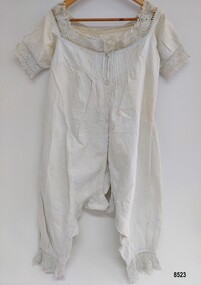
Clothing - Combination Undergarment, Eliza Towns, Late 19th century
... Museum and Village. Eliza was born Eliza Gould in 1857 in South Melbourne (Emerald Hill) and in 1879 married Charles Towns. In the early 1880's they moved to Nhill in western Victoria and remained there for the rest of their married life. Charles was a jeweller and later became an accountant and for many years was involved with the Shire Council, the local show committee...Museum and Village. Eliza was born Eliza Gould in 1857 in South Melbourne (Emerald Hill) and in 1879 married Charles Towns. In the early 1880's they moved to Nhill in western Victoria and remained there for the rest of their married life. Charles was a jeweller and later became an accountant and for many years was involved with the Shire Council, the local show committee ...This item of underclothing, called a "combination" is one of several linen and clothing items that were made and belonged to Mrs. Eliza Towns and donated to Flagstaff Hill Maritime Museum and Village. Eliza was born Eliza Gould in 1857 in South Melbourne (Emerald Hill) and in 1879 married Charles Towns. In the early 1880's they moved to Nhill in western Victoria and remained there for the rest of their married life. Charles was a jeweller and later became an accountant and for many years was involved with the Shire Council, the local show committee (A & P Society), the Hospital Committee and the Board of the local newspaper (the Nhill Free Press). They had three children and lived a life that would be regarded as comfortably "middle class". Eliza probably had a treadle sewing machine and would have made many of her own clothes as well as clothes for her children - adding her own handmade embroidered or crocheted decorative trim. Combination undergarments combined the chemise and drawers into one garment. The combination is divided, or bifurcated, from the waist to the crutch for easier urinating. This one-piece type of underwear was worn by females from the 1860s and into the early 1900s. The 19th Century garments had front button closures like this one, and those made in the 1900s more often had back closures. Combination underwear was popular because the all-in-one design had far fewer gathers and bulk, making the other clothing look much smoother. Their primary use was to protect clothing from perspiration and because they were made with cotton or linen, were easy to wash. Although they were worn under the corset, next to the skin (and therefore not meant to be seen), they were often decorated with lace and embroidery. Although these combinations are made with a plain cotton fabric, Eliza Towns has incorporated pin tucks, hand embroidery and crocheted lace to embellish her garment. The collection of women’s late-19th-century undergarments is an example of clothing that women would include in their wardrobes. The garments add to the study of the evolution of women's fashions and practicality for the early Australian settlers. The careful needlework in these handmade garments and hand-worked lace trims reflect the maker’s dedication to making even serviceable garments beautiful to look at and wear.Women’s white cotton and lace all-In-one combination undergarment. The handmade underwear is a combined chemise and bloomers. It has three buttons in the front and a handmade drawstring cord around the square neckline. It is trimmed with crocheted lace (with a floral design) on the neckline, sleeves and pants. It had pintucks and feather stitching on the bodice and the left and right sides are divided from the waist to the crutch. The back of the garment is plain with a gathered section at the lower back.flagstaff hill maritime museum and village, maritime museum, maritime village, warrnambool, great ocean road, victorian era, combination undergarment, all-in-one underwear, combination, ‘combinations’, one-piece underwear, one-piece undergarment, chemise and bloomers, combination chemise and bloomers, divided, bifurcated, split, chemise and drawers, women’s underwear, ladies’ underwear, undergarment, women’s clothing, women’s fashion, lingerie, 19th-century undergarment, handmade clothing, handmade lace, crocheted lace, towns family, nhill, eliza towns -
 Flagstaff Hill Maritime Museum and Village
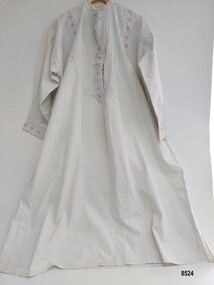
Clothing - Nightgown, Eliza Towns, circa 1890's
... Museum and Village. Eliza was born Eliza Gould in 1857 in South Melbourne (Emerald Hill) and in 1879 married Charles Towns. In the early 1880's they moved to Nhill in western Victoria and remained there for the rest of their married life. Charles was a jeweller and later became an accountant and for many years was involved with the Shire Council, the local show committee...Museum and Village. Eliza was born Eliza Gould in 1857 in South Melbourne (Emerald Hill) and in 1879 married Charles Towns. In the early 1880's they moved to Nhill in western Victoria and remained there for the rest of their married life. Charles was a jeweller and later became an accountant and for many years was involved with the Shire Council, the local show committee ...This nightgown is one of several linen and clothing items that were made and belonged to Mrs. Eliza Towns and donated to Flagstaff Hill Maritime Museum and Village. Eliza was born Eliza Gould in 1857 in South Melbourne (Emerald Hill) and in 1879 married Charles Towns. In the early 1880's they moved to Nhill in western Victoria and remained there for the rest of their married life. Charles was a jeweller and later became an accountant and for many years was involved with the Shire Council, the local show committee (A & P Society), the Hospital Committee and the Board of the local newspaper (the Nhill Free Press). They had three children and lived a life that would be regarded as comfortably "middle class". Eliza probably had a treadle sewing machine and would have made many of her own clothes as well as clothes for her children - adding her own handmade embroidered or crocheted decorative trim. This nightgown is machine sewn by Eliza Towns and she has added a detailed design of pintucks and broderie anglaise lace to the front yoke and cuffs as a decorative element. The 1800's bought a shift in attitude towards modesty as the Victorian era progressed and by the mid to late 1800's it had become more acceptable ladies to wear simple, modest nightgowns. They tended to have a very loose fit and were usually made of linen, cotton or flannel, which had the advantage of providing warmth and also being easy to wash - a necessity for a garment worn next to the skin. Although the basic design of the nightgown was fairly simple, the wearer was free to add various types of trim e.g. lace, crochet, pintucks, embroidery etc.This item is an example of the needlework skills of women in the late 19th century - combining machine stitching with hand embroidery to personalise and embellish a practical item of clothing. It is also significant as an example of a practical solution to the difficulties that women of this era faced with regard to the washing of clothes and household linens.Lady's long, white, cotton nightgown with a V shaped bodice decorated with bands of nine pintucks alternating with strips of broderie anglaise lined with pink ribbon. The opening front placket and neckline are bordered with a simpler broderie anglaise lace. The long sleeves are gathered into cuffs with a matching V shape, pintuck and broderie anglaise design. The front placket fastens with three cream buttons although one is missing. The back of the nightgown has gathered fabric on a plain, narrow V shape yoke. A narrow gusset has been added to the both sides at the bottom of the nightgown.Noneflagstaff hill, flagstaff hill maritime museum and village, warrnambool, great ocean road, shipwreck coast, victorian era clothing, victorian era nightgown, nightgown, nightdress, eliza towns, nhill, wimmera, textiles, clothing, machine sewing, hand sewing, pintucks, broderie anglaise, sewing
