
Showing 16 items matching "emerald post office"
-
 Emerald Museum & Nobelius Heritage Park
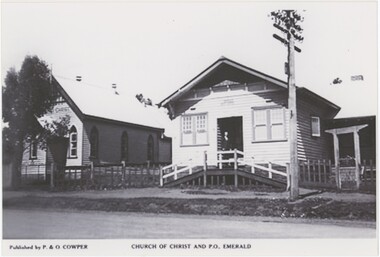
Photograph, P. & O. Cowper, Church of Christ and P.O. Emerald, c. Mid 20th Century
... ...Emerald Post Office...The Emerald Church of Christ operated from 1913 until 1964 on the site (and building) now part of Fernlea Community House. The old post office...Emerald 1940s 1950s Emerald Post Office Emerald Church of Christ Obverse: Left, Typed: "Published by P. & O. ..."P. & O. Cowper" does not appear in internet research as a known publishing company; it is possible either that none of their work has made its way online, or that they were locals publishing on a small scale capacity. If the latter is true, "P. Cowper" could have been Mr. P. Cowper who participated in forming the Emerald Co-operative Society in 1945. The Emerald Church of Christ operated from 1913 until 1964 on the site (and building) now part of Fernlea Community House. The old post office was on that location from the 1910s until after the Church stopped operating, although by the 1960s there were telephone booths in front of the post office. This image could date from 1913 until the 1950s, although it is likely toward the later end of that range in the 1940s or 50s. This copy was produced in 2006 from the original.This photograph captures two long-standing Emerald institutions from the first half of the 20th century, one of which is no longer in operation and the other which has moved and had its place replaced with an unrecognisable new structure.This black and white photograph is printed on glossy modern photo paper. Its lower margin is occupied by printed text explaining the publisher and the subject matter. The photograph itself centres on two buildings, each constructed from wooden planks with sloped, likely tin rooves. A power pole stands to the right in front of the rightmost building. The ege of a road is visible in the foreground, indicating that this picture was taken from on or across the road. The reverse has printed technical information about the photograph, typical of a digital printed photograph.Obverse: Left, Typed: "Published by P. & O. COWPER" Centre, Typed: "CHURCH OF CHRIST AND P.O. EMERALD" Sign in Image, Left: "[obscured] CHRIST" Reverse: "10 27 PCEMER~4.JPG 6 16.12.06 18.12.06"emerald, 1940s, 1950s, emerald post office, emerald church of christ -
 Narre Warren and District Family History Group
Book, Narre Warren & District Family History Group Inc, Casey Cardinia Collection - Gembrook Information File
... The date the articles were published, and title of articles are listed below. 8 Jun 2005 Packer move “to hurt growers” - closure of Moraitis Packers 14 Jun 2006 Bill Parker OAM Reigns Supreme 16 Jan 2013 Firies Mourn Mate - Death of Peter Cramer 21 Oct 2009 Cheese is the Happy Toast - 60th Wedding Anniversary 22 Sep 2021 Unbreakable Bond - Arthur Smith 16 Jun 2021 Veteran Firefighter’s Gong - Brian Petrie 1 Oct 2014 Scouts Just do Their Best 6 Oct 2021 The Last Post - Emerald Post Office 6 Oct 2021 Last Post for the Harrys 30 Jun 2021 Helping Comrades in War - Norm Smith 30 Jun 2021 Memories of Olympics Past - Norm Smith 30 Jun 2021 The Day the Earth Shook - Norm Smith 18 Apr 2018 Bush Beauty Boasts History - Kurth Kiln 24 Nov 2021 A Hall Steeped in History - Gembrook Memorial Hall 1 Dec 2021 Appeal for Old Church 16 Nov 2022 Church Marks Centenary - Sacred Heart Catholic Church 28 Dec 2021 A Lasting Stamp on Town - Gembrook Post Office 31 Oct 2018 Norm’s Our True Legend - Norm Smith 8 Mar 2023 Frank Lee’s Grave LOcated 11 Oct 2023 True Love Over Six Decades - Harold & Kath Ramage 4 Oct 2023 Recording History With Art - Sue Jarvis 4 Oct 2023 Garden Gallery Opens Doors 1 Mar 2023 75th Anniversary of Soldier Settlement 8 May 2024 A Mother’s Endless Love - Kath Ramage 27 Mar 2024 Decades of Work on Show 20 Nov 2024 25 Years of Service - Norm Smith 20 Nov 2024 Looking Back 17 Dec 2025 Milestone for Puffing Billy...The date the articles were published, and title of articles are listed below. 8 Jun 2005 Packer move “to hurt growers” - closure of Moraitis Packers 14 Jun 2006 Bill Parker OAM Reigns Supreme 16 Jan 2013 Firies Mourn Mate - Death of Peter Cramer 21 Oct 2009 Cheese is the Happy Toast - 60th Wedding Anniversary 22 Sep 2021 Unbreakable Bond - Arthur Smith 16 Jun 2021 Veteran Firefighter’s Gong - Brian Petrie 1 Oct 2014 Scouts Just do Their Best 6 Oct 2021 The Last Post - Emerald Post Office 6 Oct 2021 Last Post for the Harrys 30 Jun 2021 Helping Comrades in War - Norm Smith 30 Jun 2021 Memories of Olympics Past - Norm Smith 30 Jun 2021 The Day the Earth Shook - Norm Smith 18 Apr 2018 Bush Beauty Boasts History - Kurth Kiln 24 Nov 2021 A Hall Steeped in History - Gembrook Memorial Hall 1 Dec 2021 Appeal for Old Church 16 Nov 2022 Church Marks Centenary - Sacred Heart Catholic Church 28 Dec 2021 A Lasting Stamp on Town - Gembrook Post Office 31 Oct 2018 Norm’s Our True Legend - Norm Smith 8 Mar 2023 Frank Lee’s Grave LOcated 11 Oct 2023 True Love Over Six Decades - Harold & Kath Ramage 4 Oct 2023 Recording History With Art - Sue Jarvis 4 Oct 2023 Garden Gallery Opens Doors 1 Mar 2023 75th Anniversary of Soldier Settlement 8 May 2024 A Mother’s Endless Love - Kath Ramage 27 Mar 2024 Decades of Work on Show 20 Nov 2024 25 Years of Service - Norm Smith 20 Nov 2024 Looking Back 17 Dec 2025 Milestone for Puffing Billy Casey Cardinia Collection - Gembrook Information File Book Narre Warren & District Family History Group Inc. ...Folder containing a table of contents and various newspaper clippings and other information pertaining to the Gembrook area. The date the articles were published, and title of articles are listed below. 8 Jun 2005 Packer move “to hurt growers” - closure of Moraitis Packers 14 Jun 2006 Bill Parker OAM Reigns Supreme 16 Jan 2013 Firies Mourn Mate - Death of Peter Cramer 21 Oct 2009 Cheese is the Happy Toast - 60th Wedding Anniversary 22 Sep 2021 Unbreakable Bond - Arthur Smith 16 Jun 2021 Veteran Firefighter’s Gong - Brian Petrie 1 Oct 2014 Scouts Just do Their Best 6 Oct 2021 The Last Post - Emerald Post Office 6 Oct 2021 Last Post for the Harrys 30 Jun 2021 Helping Comrades in War - Norm Smith 30 Jun 2021 Memories of Olympics Past - Norm Smith 30 Jun 2021 The Day the Earth Shook - Norm Smith 18 Apr 2018 Bush Beauty Boasts History - Kurth Kiln 24 Nov 2021 A Hall Steeped in History - Gembrook Memorial Hall 1 Dec 2021 Appeal for Old Church 16 Nov 2022 Church Marks Centenary - Sacred Heart Catholic Church 28 Dec 2021 A Lasting Stamp on Town - Gembrook Post Office 31 Oct 2018 Norm’s Our True Legend - Norm Smith 8 Mar 2023 Frank Lee’s Grave LOcated 11 Oct 2023 True Love Over Six Decades - Harold & Kath Ramage 4 Oct 2023 Recording History With Art - Sue Jarvis 4 Oct 2023 Garden Gallery Opens Doors 1 Mar 2023 75th Anniversary of Soldier Settlement 8 May 2024 A Mother’s Endless Love - Kath Ramage 27 Mar 2024 Decades of Work on Show 20 Nov 2024 25 Years of Service - Norm Smith 20 Nov 2024 Looking Back 17 Dec 2025 Milestone for Puffing Billynon-fictiongembrook (vic.), bill parker oam -
 Flagstaff Hill Maritime Museum and Village
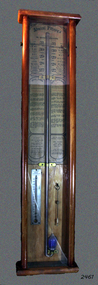
Barometer, 1858-1869
... He made the clock for the Melbourne Post Office lobby, to a design by Government Astronomer Robert Ellery, and won an award at the 1880-81 Melbourne International Exhibition for his turret clock for the Emerald Hill Town Hall. ...He made the clock for the Melbourne Post Office lobby, to a design by Government Astronomer Robert Ellery, and won an award at the 1880-81 Melbourne International Exhibition for his turret clock for the Emerald Hill Town Hall. ...The barometer was either made or sold by T. Gaunt & Co. of Melbourne, a manufacturer, importer and retailer of a wide variety of goods including jewellery, clocks and watches, navigational and measuring instruments, dinnerware, glassware and ornaments. Thomas Gaunt photograph was included in an album of security identity portraits of members of the Victorian Court, Centennial International Exhibition, Melbourne, 1888. (See below for further details.) Admiral Fitzroy Pattern Barometer History: The stick mercury barometer was named after Admiral Robert Fitzroy of the Royal Navy (1805-1865) for his detailed instructions on how to interpret the weather, which were included with the instrument. Fitzroy was the captain of the HMS Beagle, also a weather forecaster to Charles Darwin and the second Governor of New Zealand. He developed many different types of barometers and was the first person to introduce the science of weather forecasting to the British Isles. A local manufacturer of scientific instruments, Thomas Gaunt, produced the barometer that was adapted for the southern hemisphere by Robert Ellery, the State Astronomer based at the Melbourne Observatory. In the original sale catalogue for Gaunt's, the item is described as "Gaunt's Fitzroy Barometers" and it was priced from 25/- to ₤9.9s. History of Thomas Gaunt: Thomas Gaunt established Melbourne's leading watchmaking, optical and jewellery business during the second half of the 19th century. Gaunt arrived in Melbourne in 1852, and by 1858 had established his own business at 14 Little Bourke Street. Around 1869 he moved to new premises in Bourke Street on the corner of Royal Arcade. Gaunt's shop quickly became a Melbourne institution. Gaunt proudly advertised that he was 'The only watch manufacturer in the Australian colonies'. While many watches and clocks may have had Gaunt's name on the dial, few would have been made locally. Gaunt did make some watches for exhibitions, and perhaps a few expensive watches for wealthy individuals. Gaunt's received a telegraph signal from Melbourne Observatory each day to correct his main clock and used this signal to rate and repair ship's chronometers and good quality watches. His main horological manufacturing was directed at turret clocks for town halls, churches and post offices. These tended to be specific commissions requiring individualised design and construction. He made the clock for the Melbourne Post Office lobby, to a design by Government Astronomer Robert Ellery, and won an award at the 1880-81 Melbourne International Exhibition for his turret clock for the Emerald Hill Town Hall. He became well known for his installation of a chronograph at Flemington Racecourse in 1876, which showed the time for the race, accurate to a quarter of a second. The firm also installed the clockwork and figures for Gog and Magog in the Royal Arcade. Thomas Gaunt also developed a department that focused on scientific instrumentation, making thermometers and barometers (from imported glass tubes), telescopes, surveying instruments and microscopes. Another department specialised in electroplating for trophies, awards and silverware, and the firm manufactured large amounts of ecclesiastical gold ware and silverware, for the church including St Patrick's Cathedral. There are no records that disclose the number of employees in the firm, but it was large enough for Gaunt to hold an annual picnic for the watchmakers and apprentices at Mordialloc from 1876; two years previously they had successfully lobbied Gaunt to win the eight hour day. Gaunt's workforce was reportedly very stable, with many workers remaining in the business for 15 to 30 years. Gaunt's wife Jane died on September 1894, aged 64. They had one son and six daughters, but only three daughters survived to adulthood. Two became nuns at the Abbotsford Convent and one daughter, Cecelia Mary Gaunt (died 28 July 1941), married William Stanislaus Spillane on 22 September 1886 and had a large family. Gaunt died at his home in Coburg, Victoria, leaving an estate valued at ₤41,453. The business continued as T. Gaunt & Co. after his death. The barometer is historically significant as an example of the work of Melbourne’s leading scientific instrument maker, Thomas Gaunt. The barometer has social significance as an example of the type of scientific equipment that Thomas Gaunt expanded his horology business into producing. Further social significance lies in the fact that Robert Ellery, the Government Astronomer who designed the local version of the barometer, had a direct connection with the Melbourne Athenaeum founded in 1839 as the Melbourne Mechanics' Institution. Its purpose was "the diffusion of literary, scientific and other useful information". There are also records of a T Gaunt as a subscription and committee member of this the Athenaeum organisation during the 1870s and 1880s which may be Thomas Gaunt, unfortunately still unverified.Stick mercury barometer known as the Admiral Fitzroy Barometer. It comprises an oblong wooden case with glass front panel, ornate pediment, barometer with bulb cistern (empty of fluid), cleaning brush with printed instructions for interpreting information given by the gauge affixed to left and right face of instrument. Includes a thermometer. The barometer appears to be intact. Adapted to the Southern Hemisphere. Special remarks by Admiral Fitzroy. Made by Thomas Gaunt, Melbourne. Manufacturer's details are on back of wooden casing. Rear has upper and lower brass screw plates for securing to vertical surface."Manufactured by Thomas Gaunt, 14 Little Bourke Street, Melbourne. "flagstaff hill, warrnambool, shipwrecked-coast, flagstaff-hill, flagstaff-hill-maritime-museum, maritime-museum, shipwreck-coast, flagstaff-hill-maritime-village, barometer, admiral fitzroy, thomas gaunt, thomas gaunt of melbourne, clockmaker, admiral fitzroy barometer, barometer instructions, gaunt’s fitzroy barometer, gaunt’s of melbourne, gog and magog designer, horological manufacturer, meteorological instrument, melbourne athenaeum, melbourne mechanics' institution, melbourne observatory time signal, robert ellery government astronomer, scientific instrument, stick mercury barometer, thermometer, weather forecast, t gaunt & co -
 Flagstaff Hill Maritime Museum and Village
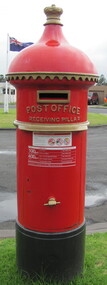
Functional object - Post Office Receiving Pillar, 1885
... Post Office just to post a letter. By 1855 London had installed its first six Pillar Boxes. In 1856 the pillar boxes were first introduced in Sydney. These were circular with a crown on the dome, supported by leaves. Early Victoria Mail was originally collected by ‘letter carriers’, first appointed in Melbourne in 1841, equipped with leather bag and hand bell. He wore a red coat with brass buttons and a black top hat! In 1844 two wooden receiving boxes were erected in Melbourne. The first cast iron boxes were installed in South Melbourne (Emerald...Post Office just to post a letter. By 1855 London had installed its first six Pillar Boxes. In 1856 the pillar boxes were first introduced in Sydney. These were circular with a crown on the dome, supported by leaves. Early Victoria Mail was originally collected by ‘letter carriers’, first appointed in Melbourne in 1841, equipped with leather bag and hand bell. He wore a red coat with brass buttons and a black top hat! In 1844 two wooden receiving boxes were erected in Melbourne. The first cast iron boxes were installed in South Melbourne (Emerald ...This Post Office Receiving Pillar was restored in 1980 and is now a fully operational Australia Post mailbox. In early August 1980 Prime Minister Mr. Fraser posted Warrnambool’s first commemorative envelope into this restored Post Office Receiving Pillar at Flagstaff Hill Maritime Village. The special limited edition envelopes are numbered 1 – 7000. When posted, the envelopes would have the Flagstaff Hill Logo and Flagstaff Hill Maritime Village’s own postmark of a ship’s steering wheel surrounding a lighthouse and a sailing ship, and were dated August 3 on the First Day Cover. Amongst Flagstaff Hill’s collection is that very first letter posted by Prime Minister Fraser. HISTORY OF POST OFFICE RECEIVING PILLARS In 1851 ‘pillar boxes’ were installed at roadside locations in the island of Jersey, England; they had already been successful in several European countries. The use of new prepaid, adhesive postage stamps as well as the roadside pillar boxes meant there was no need for the public to take a trip to the Post Office just to post a letter. By 1855 London had installed its first six Pillar Boxes. In 1856 the pillar boxes were first introduced in Sydney. These were circular with a crown on the dome, supported by leaves. Early Victoria Mail was originally collected by ‘letter carriers’, first appointed in Melbourne in 1841, equipped with leather bag and hand bell. He wore a red coat with brass buttons and a black top hat! In 1844 two wooden receiving boxes were erected in Melbourne. The first cast iron boxes were installed in South Melbourne (Emerald Hill) and were still in service until 1967. They were a fluted circular design and made in England. In the early 1860’s the ‘low door round’ design posting box was introduced, being circular and surrounded by a crown, with two broad embossed bands around its circumference. The clearance door was in front of the box and low down. These were made in Australia. In the early 1870’s square boxes with a tapering top were being used. These too were made in Australia by different manufacturers with slight variations on style such as the orientation and number of slots. Next came the circular boxes again, similar to the ‘low door round’ but with the clearance door extending to just below the posting slot, often referred to as ‘high door round’. These boxes did not have embossed bands. In 1887 small cast iron boxes were introduced, attached to posts and poles and called ‘lamp post receivers’. Around 1930 a ‘London’ model was used in Victoria. It was copied from the flat-domed type in London but made in Tasmania. [References: Flagstaff Hill Maritime Village records, The Warrnambool Standard, August 1st, 1980, “Stamps.Au” http://www.stampsau.com, 4th April 2011 (Extracted from “Australian Street Posting Boxes” by Ken Sparks – out of print)] Post Office Receiving Pillar, or letterbox.1885 “High Door Round” design. Tall cast iron cylinder with decorative dome cap with crown on top. Side has a slot and a hinged door with handle shaped as a fist. Painted red with gold trim. “POST OFFICE / RECEIVING PILLAR” lettering cast into cylinder. Restored in 1980 and once again operating as an Australia Post mailbox. Commemorative plague on pillar.“POST OFFICE / RECEIVING PILLAR” lettering cast into cylinder. Flagstaff Hill Maritime Museum – Port of Warrnambool. This letter receiver was officially commissioned on 3rd August 1980 by the Prime Minister of Australia, the Right Honourable Malcolm Fraser M.P. on completion of 25 years’ service as the Federal Minister for Wannon.”flagstaff hill, warrnambool, shipwrecked coast, flagstaff hill maritime museum, maritime museum, shipwreck coast, flagstaff hill maritime village, great ocean road, post office receiving pillar, letterbox, mailbox, australia post -
 Flagstaff Hill Maritime Museum and Village
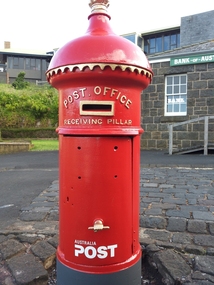
Functional object - Post Office Receiving Pillar, 1885
... Post Office just to post a letter. By 1855 London had installed its first six Pillar Boxes. In 1856 the pillar boxes were first introduced in Sydney. These were circular with a crown on the dome, supported by leaves. Early Victoria Mail was originally collected by ‘letter carriers’, first appointed in Melbourne in 1841, equipped with leather bag and hand bell. He wore a red coat with brass buttons and a black top hat! In 1844 two wooden receiving boxes were erected in Melbourne. The first cast iron boxes were installed in South Melbourne (Emerald...Post Office just to post a letter. By 1855 London had installed its first six Pillar Boxes. In 1856 the pillar boxes were first introduced in Sydney. These were circular with a crown on the dome, supported by leaves. Early Victoria Mail was originally collected by ‘letter carriers’, first appointed in Melbourne in 1841, equipped with leather bag and hand bell. He wore a red coat with brass buttons and a black top hat! In 1844 two wooden receiving boxes were erected in Melbourne. The first cast iron boxes were installed in South Melbourne (Emerald ...Post Office Receiving Pillar was Collected from Warrnambool City Council’s Scott Street Depot and transported to Flagstaff Hill, stored in the Barracks area Friends of Flagstaff Hill began the project of restoring the Post Office Receiving Pillar in early 2011. The replacement dome required a pattern to be made from paper, then timber, then someone to manufacture it. The cast iron body required sand blasting and undercoating. The pillar was installed in Flagstaff Hill Maritime Village in March 2014. A specialist visited the Village and painted the pillar with 7 coats of ‘post office red’ then completed the job with gold paint on the details. In 2015 an information plate of brass was fitted to the Pillar in the position that would have originally announced the clearing times. It was originally manufactured by G Couch, Engineer, Alliance Iron Works, Melbourne. Gordon Couch passed away in June 1896 and his Works were offered for auction in November 1897. HISTORY OF POST OFFICE RECEIVING PILLARS In 1851 ‘pillar boxes’ were installed at roadside locations in the island of Jersey, England; they had already been successful in several European countries. The use of new prepaid, adhesive postage stamps as well as the roadside pillar boxes meant there was no need for the public to take a trip to the Post Office just to post a letter. By 1855 London had installed its first six Pillar Boxes. In 1856 the pillar boxes were first introduced in Sydney. These were circular with a crown on the dome, supported by leaves. Early Victoria Mail was originally collected by ‘letter carriers’, first appointed in Melbourne in 1841, equipped with leather bag and hand bell. He wore a red coat with brass buttons and a black top hat! In 1844 two wooden receiving boxes were erected in Melbourne. The first cast iron boxes were installed in South Melbourne (Emerald Hill) and were still in service until 1967. They were a fluted circular design and made in England. In the early 1860’s the ‘low door round’ design posting box was introduced, being circular and surrounded by a crown, with two broad embossed bands around its circumference. The clearance door was in front of the box and low down. These were made in Australia. In the early 1870’s square boxes with a tapering top were being used. These too were made in Australia by different manufacturers with slight variations on style such as the orientation and number of slots. Next came the circular boxes again, similar to the ‘low door round’ but with the clearance door extending to just below the posting slot, often referred to as ‘high door round’. These boxes did not have embossed bands. In 1887 small cast iron boxes were introduced, attached to posts and poles and called ‘lamp post receivers’. Around 1930 a ‘London’ model was used in Victoria. It was copied from the flat-domed type in London but made in Tasmania. … [References: Flagstaff Hill Maritime Village records, The Argus, 11th April, 1890, The Argus, 2nd July, 1896, The Argus, 30th Nov. 1897, “Stamps.Au” http://www.stampsau.com, 4th April 2011 (Extracted from “Australian Street Posting Boxes” by Ken Sparks – out of print)] Post Office Receiving Pillar, or letterbox.1885 "High Door Round" design, restored 2014 Tall cast iron sylinder with decorative dome cap, slot in side, hinged door with handle shaped as a fist. Painted red with gold trip..Reconditioned barrel, reconstructed dome. Restored by Friends of Flagstaff Hill, 2014. Now a working letterbox. Made in Melbourne.Oval maker's plate “ - G. COUCH - / ENGINEER / ALLIANCE IRON / WORKS / MELBOURNE”flagstaff hill, warrnambool, shipwrecked coast, flagstaff hill maritime museum, maritime museum, shipwreck coast, flagstaff hill maritime village, great ocean road, post office receiving pillar, letterbox, mailbox, australia post -
 Flagstaff Hill Maritime Museum and Village
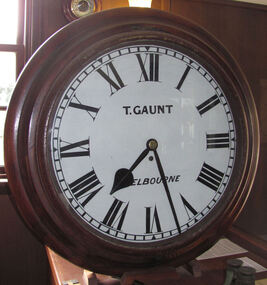
Instrument - Clock, c. 1860s
... He made the clock for the Melbourne Post Office lobby, to a design by Government Astronomer Robert Ellery, and won an award at the 1880-81 Melbourne International Exhibition for his turret clock for the Emerald Hill Town Hall. ...He made the clock for the Melbourne Post Office lobby, to a design by Government Astronomer Robert Ellery, and won an award at the 1880-81 Melbourne International Exhibition for his turret clock for the Emerald Hill Town Hall. ...The clock was either made or sold by T. Gaunt & Co. of Melbourne, a manufacturer, importer and retailer of a wide variety of goods including jewellery, clocks and watches, navigational and measuring instruments, dinnerware, glassware and ornaments. Thomas Gaunt photograph was included in an album of security identity portraits of members of the Victorian Court, Centennial International Exhibition, Melbourne, 1888. Thomas Gaunt History: Thomas Gaunt established Melbourne's leading watchmaking, optical and jewellery business during the second half of the 19th century. Gaunt arrived in Melbourne in 1852, and by 1858 had established his own business at 14 Little Bourke Street. Around 1869 he moved to new premises in Bourke Street on the corner of Royal Arcade, Gaunt's shop quickly became a Melbourne institution. Gaunt proudly advertised that he was 'The only watch manufacturer in the Australian colonies'. While many watches and clocks may have had Gaunt's name on the dial, few would have been made locally. Gaunt did make some watches for exhibitions, and perhaps a few expensive watches for wealthy individuals. Gaunt's received a telegraph signal from Melbourne Observatory each day to correct his main clock and used this signal to rate and repair ship's chronometers and good quality watches. His main horological manufacturing was directed at turret clocks for town halls, churches and post offices. These tended to be specific commissions requiring individualised design and construction. He made the clock for the Melbourne Post Office lobby, to a design by Government Astronomer Robert Ellery, and won an award at the 1880-81 Melbourne International Exhibition for his turret clock for the Emerald Hill Town Hall. He became well known for his installation of a chronograph at Flemington Racecourse in 1876, which showed the time for the race, accurate to a quarter of a second. The firm also installed the clockwork and figures for Gog and Magog in the Royal Arcade. Thomas Gaunt also developed a department that focused on scientific instrumentation, making thermometers and barometers (from imported glass tubes), telescopes, surveying instruments and microscopes. Another department specialised in electroplating for trophies, awards and silverware, and the firm manufactured large amounts of ecclesiastical gold ware and silverware, for the church including St Patrick's Cathedral. There are no records that disclose the number of employees in the firm, but it was large enough for Gaunt to hold an annual picnic for the watchmakers and apprentices at Mordialloc from 1876; two years previously they had successfully lobbied Gaunt to win the eight hour day. Gaunt's workforce was reportedly very stable, with many workers remaining in the business for 15 to 30 years. Gaunt's wife Jane died on September 1894, aged 64. They had one son and six daughters, but only three daughters survived to adulthood. Two became nuns at the Abbotsford Convent and one daughter, Cecelia Mary Gaunt (died 28 July 1941), married William Stanislaus Spillane on 22 September 1886 and had a large family. Gaunt died at his home in Coburg, Victoria, leaving an estate valued at ₤41,453. The business continued as T. Gaunt & Co. after his death. Post Office and Clock History: Warrnambool’s Post Office has been in existence since 1857, when it was originally situated on the corner of Timor and Gilles Street. In March 1864 the Warrnambool Borough Council purchased this clock from Henry Walsh Jnr. for the sum of £25, “to be put up in front of the Post Office”. Henry Walsh Jnr was the eldest son of Melbourne’s Henry Walsh, maker and retailer of clocks, watches, thermometers and jewellery. In 1854 Henry Walsh Jnr. began business in Warrnambool as a watchmaker and jeweller later becoming a Councillor with now a local street named after him. The Post Office was extensively remodelled in 1875-76. Early photographs of this building show that the clock was installed on the northern outside wall, Timor Street, under the arches and between the 2 centre windows, where it could be seen by passers-by. Although spring loaded clocks date back to the 15th century, and fob and pocket watches evolving from these date to the 17th century, personal pocket watches were only affordable to the very fortunate. Public clocks such as this Post Office clock provided opportunity for all to know the time, and for those in possession of a personal watch to check and set their own timepieces to the correct time. During post office reservations during the 1970s the clock was removed and was eventually donated to the Flagstaff Collection. The Clock’s maker Thomas Gaunt, is historically significant and was an established and well renowned scientific instrument and clock maker in Melbourne during the 1860s. He was at that time the only watchmaker in the Australian colonies. In the 1870’s and 1880’s he won many awards for his clocks and was responsible for sending time signals to other clocks in the city and rural areas, enabling many businesses and organisations to accurate set their clocks each day. Warrnambool Borough Council purchased this clock from Henry Walsh Jnr. for the sum of £25 and the clock used to stand in front of the Warrnambool post office to allow ordinary citizens to set their time pieces as they walked by. The item is not only important because it was made by a significant early colonial clock maker and retailed by a locally known clock maker and jeweler but also that it was installed in the Warrnambool Post Office a significantly historical building in it's own right. Built in 1857 and regarded as one of the oldest postal facilities in Australia, with a listing on the National Heritage Database, (ID 15656). This 1864 hall clock originates from the Warrnambool Post Office. The clock glass is hinged to the top of the clock face and has a catch at the bottom. The metal rim of the glass is painted black. The clock face is metal, painted white, with black Roman numerals and markings for minutes and five minutes. The tip of the small hour hand is shaped like a leaf. "T. GAUNT / MELBOURNE" is printed in black on the clock face. The winding key hole is just below the centre of the clock face. The key winds a fusee chain mechanism, attached to the brass mainspring barrel that powers the pendulum with an 8-day movement. The speed of the clock can be adjusted by changing the position of the weight on the pendulum, lengthening or shortening the swing; raising the pendulum shortens its swing and speeds up the clock. The metal fusee mechanism has an inscription on it. The rectangular wooden casing is with a convex curve at the bottom that has a hinged door with a swivel latch. The original stained surface has been painted over with a matte black. There are two other doors that also allow access to the clock’s workings. The case fits over the pendulum and workings at the rear and attaches to the clock by inserting four wooden pegs into holes in the sides of the case then into the back of the clock. A flat metal plate has been secured by five screws onto the top of the case and a hole has been cut into it for the purpose of hanging up the clock. There is a nail inside the case, possibly used for a place to the key."T. GAUNT MELBOURNE" is printed on the clock face. “6 1 3” embossed on the back of the fusee mechanism behind the clock. warrnambool, shipwrecked coast, flagstaff hill, flagstaff hill maritime museum, maritime museum, shipwreck coast, flagstaff hill maritime village, shipwrecked artefact, clock, warrnambool post office, fusee, henry walsh jnr, thomas gaunt, t gaunt & co, post office clock -
 Bendigo Historical Society Inc.
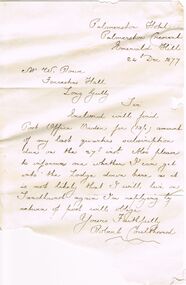
Document - ANCIENT ORDER OF FORESTERS NO. 3770 COLLECTION: CORRESPONDENCE
... He enclosed a Post Office Order for 13/-, the amount of his last quarters subscription due on the 27 inst. He also wanted to know if he could get into the Lodge at Emerald Hill as it was unlikely that he would live on Sandhurst again. ...He enclosed a Post Office Order for 13/-, the amount of his last quarters subscription due on the 27 inst. He also wanted to know if he could get into the Lodge at Emerald Hill as it was unlikely that he would live on Sandhurst again. ...Letter from Robert Coulthard, dated 24 Dec 1877. He enclosed a Post Office Order for 13/-, the amount of his last quarters subscription due on the 27 inst. He also wanted to know if he could get into the Lodge at Emerald Hill as it was unlikely that he would live on Sandhurst again. He asked for a reply. Signed by Robert Coulthatd.societies, aof, correspondence, ancient order of foresters no. 3770 collection - correspondence, palmerston hotel, w rowe, forresters hall, robert coulthard -
 Narre Warren and District Family History Group
Book, Context Pty Ltd, Cardinia Local Heritage Study Review 2007 Stage A. Vol 1 : Key Findings And Recommendations Vol 2 : Heritage Place And Precinct Citations, 2007
... Post Office...Railway Hotel (Bunyip)...Cora Lynn Catholic Parish School...Glen-Keith Farm Complex (Dalmore)...Emerald...Cardinia Shire (Vic.) heritage studies Kenilworth Coach House (Beaconsfield) Wood Street Residential Precinct (Beaconsfield) George Street Residential Precinct (Bunyip) Bunyip Post Office Railway Hotel (Bunyip) Cora Lynn Catholic Parish School Glen-Keith Farm Complex (Dalmore) Emerald Lake Park Emerald Railway Station Emerald Country Club Cambden Woolybutt Ros (Emerald) Oak Lee (Emerald) Sycamore Lodge (Emerald) Cascades Guest house Orchard Packing Shed (Garfield North) Wattle Bank (Gembrook) Coffee Palace (Gembrook) Tehennepe (Iona) Koo Wee Rup Public Hall Dustings Garage (Koo Wee Rup) Wattle Theatre (Koo Wee Rup) Koo Wee Rup Police Lockup Royal Hotel (Koo Wee Rup) Lang Lang Cemetery Misson's Butchers Shop & Residence (Lang Lang) ANZ Bank (Lang Lang) Maryknoll Residential & Civic Precinct Maryknoll Lawn Cemetery Mount Burnett Guesthouse Oakway (Nar Nar Goon) Nar Nar Goon Growers & Packers Shed Jesmond Dene (Officer South) Kings Picture Theatre (Pakenham) Pakenham Post Office I.Y.U. ...The overall objective of the Study was the identification, assessment and documentation of places of post-contact cultural significance for the Cardinia Shire.non-fictionThe overall objective of the Study was the identification, assessment and documentation of places of post-contact cultural significance for the Cardinia Shire.cardinia shire (vic.), heritage studies, kenilworth coach house (beaconsfield), wood street residential precinct (beaconsfield), george street residential precinct (bunyip), bunyip post office, railway hotel (bunyip), cora lynn catholic parish school, glen-keith farm complex (dalmore), emerald lake park, emerald railway station, emerald country club, cambden woolybutt ros (emerald), oak lee (emerald), sycamore lodge (emerald), cascades guest house, orchard packing shed (garfield north), wattle bank (gembrook), coffee palace (gembrook), tehennepe (iona), koo wee rup public hall, dustings garage (koo wee rup), wattle theatre (koo wee rup), koo wee rup police lockup, royal hotel (koo wee rup), lang lang cemetery, misson's butchers shop & residence (lang lang), anz bank (lang lang), maryknoll residential & civic precinct, maryknoll lawn cemetery, mount burnett guesthouse, oakway (nar nar goon), nar nar goon growers & packers shed, jesmond dene (officer south), kings picture theatre (pakenham), pakenham post office, i.y.u. pre-emptive right homestead site (pakenham), valley view orchards manager's house (pakenham upper), ruthdale reserve trees, rutter farm trees (tooradin), eve's house (tynong north), kia ora (upper beaconsfield), the steyne (upper beaconsfield), beaconsfield upper milk bar, staverton garden (upper beaconsfield), great southern railway -
 Vision Australia
Photograph - Image, R.V.I.B. Perpetual Golf trophy, 1988-1993
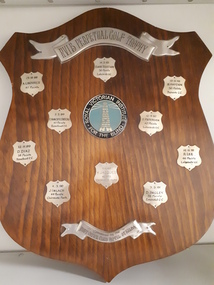
... Post Office Club Hotel St Kilda". In the centre of the shield is a large image of the RVIB lighthouse on a teal background, with gold writing 'Royal Victorian Institute for the Blind' against a black background around the outside. 10 small shields have the name of the winners inscribed: 23.10.88 A. Lindores, 41 points; 5.3.89 E. Van Cuylenberg 41 points Rosebud C.C.; 12.11.99 D. Diaz 38 points Rosebud C.C.; 4.3.90 J. Imlach, 44 points, Chirnside Park; 11-11-90 K. Jacques, 40 pts, Chirnside Park, 3.3.91 D. Ingley, 35 points, Emerald...Post Office Club Hotel St Kilda". In the centre of the shield is a large image of the RVIB lighthouse on a teal background, with gold writing 'Royal Victorian Institute for the Blind' against a black background around the outside. 10 small shields have the name of the winners inscribed: 23.10.88 A. Lindores, 41 points; 5.3.89 E. Van Cuylenberg 41 points Rosebud C.C.; 12.11.99 D. Diaz 38 points Rosebud C.C.; 4.3.90 J. Imlach, 44 points, Chirnside Park; 11-11-90 K. Jacques, 40 pts, Chirnside Park, 3.3.91 D. Ingley, 35 points, Emerald ...A brown wooden award with a inscribed banner at the top which reads "R.V.I.B. Perpetual Golf Trophy" and at the base of the shield "Sponsored by the Post Office Club Hotel St Kilda". In the centre of the shield is a large image of the RVIB lighthouse on a teal background, with gold writing 'Royal Victorian Institute for the Blind' against a black background around the outside. 10 small shields have the name of the winners inscribed: 23.10.88 A. Lindores, 41 points; 5.3.89 E. Van Cuylenberg 41 points Rosebud C.C.; 12.11.99 D. Diaz 38 points Rosebud C.C.; 4.3.90 J. Imlach, 44 points, Chirnside Park; 11-11-90 K. Jacques, 40 pts, Chirnside Park, 3.3.91 D. Ingley, 35 points, Emerald G.C.; 10.11.91 R. Lee, 46 points, Lakeside G.C.; 12-4-92 E. Petersen, 42 points, Lakeside G.C.; 15-11-92 B. Hayden, 36 points, Drouin G.C.; 14.3.93 Claire Tellefson, 36 points, Lakeside G.C.Wooden shield with 10 mini shields, RVIB logo and bannerroyal victorian institute for the blind, awards -
 Tarnagulla History Archive
Telegram, March 1862
... Post and Telegraph Office in the later 20th Century, during building works. Donald Clark Collection. Telegram sent from Sandy Creek Telegraph Office from Thomson & Comrie to Coulter (?) care Reid & ____, Emerald ...A large lot of papers, including this and many other telegrams, were apparently found in the ceiling cavity of the Sandy Creek/Tarnagulla Post and Telegraph Office in the later 20th Century, during building works. Donald Clark Collection. Telegram sent from Sandy Creek Telegraph Office from Thomson & Comrie to Coulter (?) care Reid & ____, Emerald Hill. Text reads 'Wagons scarce at Woodend Cartage, advanced particulars tomorrow'. -
 Emerald Museum & Nobelius Heritage Park
Photograph - Emerald State Bank, c. 1954
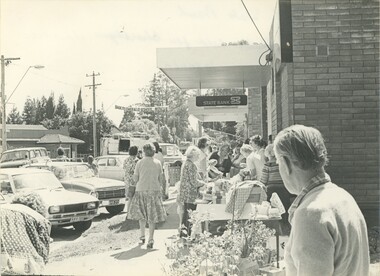
... As the photograph's caption explains, these stalls were held to raise money for certain charities around the local area, often through the organisation of the Emerald Infant Welfare Centre, or the William Angliss Hospital Auxiliary. On the 3rd and 4th of September 1954, a stall was held outside the Post Office (now Melbourne Pathology) aiming to raise £100 for the Emerald pre-school's new building. ...As the photograph's caption explains, these stalls were held to raise money for certain charities around the local area, often through the organisation of the Emerald Infant Welfare Centre, or the William Angliss Hospital Auxiliary. On the 3rd and 4th of September 1954, a stall was held outside the Post Office (now Melbourne Pathology) aiming to raise £100 for the Emerald pre-school's new building. ...This photograph features a busy street market held outside the Emerald State Bank branch on Main Street (now Commonwealth Bank). As the photograph's caption explains, these stalls were held to raise money for certain charities around the local area, often through the organisation of the Emerald Infant Welfare Centre, or the William Angliss Hospital Auxiliary. On the 3rd and 4th of September 1954, a stall was held outside the Post Office (now Melbourne Pathology) aiming to raise £100 for the Emerald pre-school's new building. Over the Friday and Saturday, the stall successfully raised £103 for the new pre-school. In 1955, the facility separated from the Emerald Baby Health Centre and moved to the new building on Kings Road.This photograph demonstrates the willingness of the local community to raise money for a good cause and the nature of local charity markets in the local area.A black and white photograph of a busy street lined with parked cars. On the footpath, dozens of pedestrians examine goods laid out on small tables. The background of the image is filled with trees and vegetation. On the reverse of the image is a handwritten caption.In photograph, on sign hanging from building: "STATE BANK" In photograph, on banner in the background: "BACK TO EMERALD SCHOOL NOV 17 18" On rear, handwritten in ink: "Emerald State Bank / Scene of Stalls held for Charitys / 1950-60" On rear, handwritten in pencil: [line drawn through 'Charitys'] "es charaties"emerald, 1950s, children -
 Emerald Museum & Nobelius Heritage Park
Photograph - Moffat's Store, c. 1920s
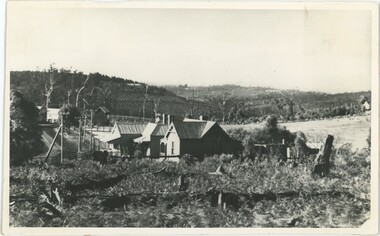
... Reverse, Pen: "Moffats Store Post Office + House / Foreground 1901 House built by R Couper. C Charman / P. Charman + Clem Worrell. / Background Emerald recreation reserve with / grand stand + corner store + bakery on Gembrook road. / Carman + orchard hill of Nobelius back hill / Emerald Mechanics hall in reserve at back corder / Note pine trees at Macclesfield centre background" Pencil: "Different view of Moffat's store"...Emerald 1920s Commerce Reverse, Pen: "Moffats Store Post Office + House / Foreground 1901 House built by R Couper. ...This photograph was taken from nearby what is now the intersection of Emerald-Monbulk Road and Main Street, sometime around the 1920s. It is said to capture a broad array of important institutions including Moffats general store, Madigan's butcher (originally Couper's), the Emerald Recreation Reserve, the corner store and bakery, the Emerald Mechanics Institute, and part of the Nobelius nursery.This photograph is a particularly broad capture of Emerald's landscape and townscape around the 1920s, with extensive detail in its annotation and featuring several important insitutions of early Emerald.A black and white photograph of a rural street, with shrubland in the foreground and a building in the middle of the shot beside the street continuing towards the background. The near-background has several additional buildings, while the further distance shows hills with orchards planted. The photograph is backed by a piece of card backing. The reverse has extensive handwritten annotation in black pen, with some layers of the backing missing in the corners from adhesive. The photograph is peeling from the backing on the right side.Reverse, Pen: "Moffats Store Post Office + House / Foreground 1901 House built by R Couper. C Charman / P. Charman + Clem Worrell. / Background Emerald recreation reserve with / grand stand + corner store + bakery on Gembrook road. / Carman + orchard hill of Nobelius back hill / Emerald Mechanics hall in reserve at back corder / Note pine trees at Macclesfield centre background" Pencil: "Different view of Moffat's store"emerald, 1920s, commerce -
 Emerald Museum & Nobelius Heritage Park
Map - Emerald/Macclesfield Selections Map, Emerald/Macclesfield Selections Map c1930, c1930
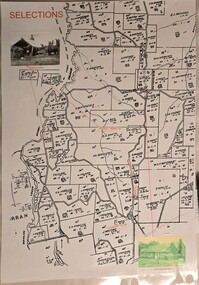
... Selections/Hunt's first Post office/property size, when acquired and by whom Map of property selections in the Emerald/Macclesfield area c1930 Emerald/Macclesfield Selections Map c1930 Map Emerald/Macclesfield Selections Map ...Map of property selections in the Emerald/Macclesfield area c1930Selections/Hunt's first Post office/property size, when acquired and by whom -
 Emerald Museum & Nobelius Heritage Park
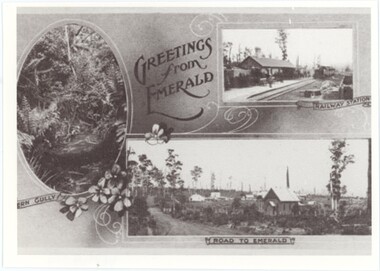
Postcard, Greetings from Emerald, 1913-1920
... The presence of the Church of Christ in 'Road to Emerald' dates this postcard to after 1913, but otherwise sparse Main Street mean it's unlikely to be much later; specifically, the absence of a post office next to the church means this photograph was almost certainly taken in the 1910s. ...The presence of the Church of Christ in 'Road to Emerald' dates this postcard to after 1913, but otherwise sparse Main Street mean it's unlikely to be much later; specifically, the absence of a post office next to the church means this photograph was almost certainly taken in the 1910s. ...We were unable to find any other copies of this postcard, or any information about it, with our surface-level search. The presence of the Church of Christ in 'Road to Emerald' dates this postcard to after 1913, but otherwise sparse Main Street mean it's unlikely to be much later; specifically, the absence of a post office next to the church means this photograph was almost certainly taken in the 1910s. There is another copy of this postcard in our collection: VEMUP1014.1This postcard is an example of tourist advertising in early Emerald, highlighting what was seen as valuable or attractive about the town in the 1910s.This black and white postcard copy centres on a greeting, surrounded by three images framed by decorations including a number of flowers. Each image includes a a caption in a scroll text display. One image (o the left) depicts ferns and other plants around a waterway. The image in the bottom-right shows a road with several buildings along its right side and trees in the background. The image in the top-right depicts a railway station with a steam train arriving.Obverse: Centre: "GREETINGS from EMERALD" Left, cut-off: "ERN GULLY" Top-Right: "RAILWAY STATION" Bottom-Right: "ROAD TO EMERALD"emerald, 1910s -
 Emerald Museum & Nobelius Heritage Park
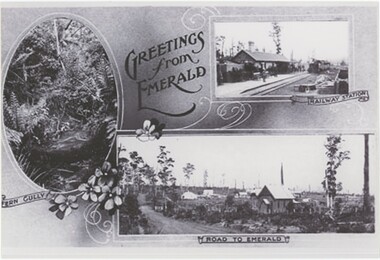
Photograph, Greetings from Emerald, 1913-1920
... The presence of the Church of Christ in 'Road to Emerald' dates this postcard to after 1913, but otherwise sparse Main Street mean it's unlikely to be much later; specifically, the absence of a post office next to the church means this photograph was almost certainly taken in the 1910s. ...The presence of the Church of Christ in 'Road to Emerald' dates this postcard to after 1913, but otherwise sparse Main Street mean it's unlikely to be much later; specifically, the absence of a post office next to the church means this photograph was almost certainly taken in the 1910s. ...We were unable to find any other copies of this postcard, or any information about it, with our surface-level search. The presence of the Church of Christ in 'Road to Emerald' dates this postcard to after 1913, but otherwise sparse Main Street mean it's unlikely to be much later; specifically, the absence of a post office next to the church means this photograph was almost certainly taken in the 1910s. There is another copy of this postcard in our collection: VEMUP1014This postcard is an example of tourist advertising in early Emerald, highlighting what was seen as valuable or attractive about the town in the 1910s.This black and white postcard copy centres on a greeting, surrounded by three images framed by decorations including a number of flowers. Each image includes a a caption in a scroll text display. One image (o the left) depicts ferns and other plants around a waterway. The image in the bottom-right shows a road with several buildings along its right side and trees in the background. The image in the top-right depicts a railway station with a steam train arriving.Obverse: Centre: "GREETINGS from EMERALD" Left: "FERN GULLY" Top-Right: "RAILWAY STATION" Bottom-Right: "ROAD TO EMERALD" Reverse: "10 27 EM8180~1.JPG 9 16.12.06 18.12.06"emerald, 1910s -
 Emerald Museum & Nobelius Heritage Park
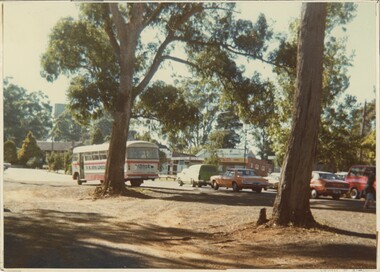
Photograph - Traffic on Main Road Opposite Murphys Way Kilvington Intersection 1979, 1979
... Visible in the background of the photograph are the Emerald Pharmacy (now the Emerald Wellness Pharmacy) and the Post Office (now Melbourne Pathology). ...Visible in the background of the photograph are the Emerald Pharmacy (now the Emerald Wellness Pharmacy) and the Post Office (now Melbourne Pathology). ...This photo was taken facing south-east on the intersection of Main Street, Kilvington Drive, and Ferres Street in Emerald. Visible in the background of the photograph are the Emerald Pharmacy (now the Emerald Wellness Pharmacy) and the Post Office (now Melbourne Pathology). Alongside the traffic on the road in front of the shopfronts, a US Bus Lines coach is parked. US Bus Lines, initially the Belgrave United Motor Service, operated in Melbourne between 1921 and 2009 when it was acquired by Ventura. The likely route it may have been following was the 695 between Belgrave and Gembrook, which continues to operate along Main Street and Belgrave/Gembrook Road.This image demonstrates the degree to which a central road, such as Main Street, can change over a span of fifty years.This colour photograph features a busy street lined with greenery. In the background, a row of shops is obscured by traffic of cars and a waiting bus. In the foreground of the image, slightly obscuring the cars and buildings, stand two tall trees. The tree on the left is slightly shorter and its branches and leaves fill the upper third of the image. On the photograph's reverse are a few handwritten notes.Reverse, handwritten in ink, crossed out: "Outside Ladders / Emerald 1979" Reverse, handwritten in pencil: "OUTSIDE REECE" emerald, 1970s
