
Showing 15 items matching "emperor of the french"
-
 Phillip Island and District Historical Society Inc.
Book, WIKOFF, Henry et al, Biographical sketches of Louis Napoleon Bonaparte, first President of France, including a visit to the Prince at the Castle of Ham / by Henry Wikoff ; to which is added, A brief account of the French Revolution of 1848, and an appendix containing poetical and prose writings of Louis Napoleon / by George Grant, 1849?
... ...emperor of the french...Book from the Cleeland Bequest - a comprehensive collection of books relating to the History of England, Civil & Military, Religious, Intellectual & Social. napoleon iii emperor of the french Cleeland Bequest Cleeland Bequest. ...Book from the Cleeland Bequest - a comprehensive collection of books relating to the History of England, Civil & Military, Religious, Intellectual & Social. Cleeland Bequest. Inscribed: Mrs D..... Richmond .. Sept 16/69 ...... ........napoleon iii, emperor of the french, cleeland bequest -
 Wodonga & District Historical Society Inc
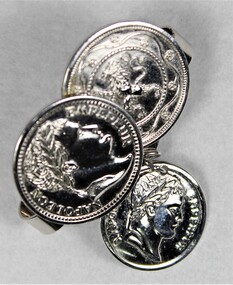
Decorative object - Silver toned Emperor Napoleon Scarf Ring from the Sarah Coventry Jewellery Collection c. 1970s-1980s
... Features depiction of Napoleon III on two of the shiny coins, who was the first President of France from 1848 to 1852 and Emperor of the French from 1852 to 1870. The third pictures a stylised lion. ...Features depiction of Napoleon III on two of the shiny coins, who was the first President of France from 1848 to 1852 and Emperor of the French from 1852 to 1870. The third pictures a stylised lion. ...As part of the Sarah Coventry collection, the scarf ring has local significance with the decentralised commercial development of regional centres such as Wodonga in NE Victoria, as well as national and international significance from the perspective of social and economic developments for women after World War II. The direct selling party-plan business model Sarah Coventry was based on is also considered the first of its kind for jewellery.Silver toned Empereur Napoleon Scarf Ring from the Sarah Coventry Jewellery Collection c. 1970s-1980s. Features depiction of Napoleon III on two of the shiny coins, who was the first President of France from 1848 to 1852 and Emperor of the French from 1852 to 1870. The third pictures a stylised lion. No makers markssarah coventry, jewellery, wodonga, costume jewellery, vintage fashion jewellery, scarf, scarf ring, scarves -
Unions Ballarat
Military Career of Napoleon the Great - An Account of the Remarkable Campaigns of the "Man of Destiny" (Don Woodward Collection), Gibbs, MS, 1909
... He played a significant role in the French Revolution and other warfare. He was Emperor of France in 1804-14 and for a short time in 1815....He played a significant role in the French Revolution and other warfare. He was Emperor of France in 1804-14 and for a short time in 1815. ...Biography of Napoleon Bonaparte's boyhood, military and political career. Napoléon Bonaparte (1769-1821) was a French politician and military leader. He played a significant role in the French Revolution and other warfare. He was Emperor of France in 1804-14 and for a short time in 1815.Politics and military history - France. Biographical interest - Napoleon Bonaparte.Book; 514 pages. Cover: blue background; gold lettering; author's name and title.btlc, ballarat trades hall, ballarat trades and labour council, bonaparte, napoleon, revolutions - french, biography, warfare - waterloo, military, history - france -
 Bendigo Historical Society Inc.
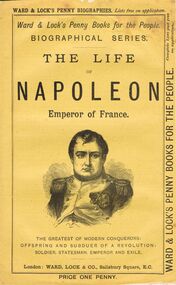
Book - LYDIA CHANCELLOR COLLECTION: THE LIFE OF NAPOLEON
... ...napoleon emperor of france...A book titled 'The Life of Napoleon Emperor of France. The greatest of modern conquerors; offspring and subduer of a revolution; soldier, statesman, emperor and exile.' ...BOOKS Biography napoleon emperor of france Lydia Chancellor collection famous people person individual male France French history history Napoleon The Life of Napoleon war soldier ' Ward & Lock's Penny Biographies Ward & Lock's Penny Books for the People Biographical Series biographies penny books advertisements A book titled 'The Life of Napoleon Emperor of France. ...A book titled 'The Life of Napoleon Emperor of France. The greatest of modern conquerors; offspring and subduer of a revolution; soldier, statesman, emperor and exile.' London : Ward, Lock & Co., Sallisbury Square, E.C. 17 - 32 pgs. This booklet is one of a series of 53 ' Ward & Lock's Penny Books for the People.' 'Biographical Series.' Price one penny. There are also advertisements of note.books, biography, napoleon emperor of france, lydia chancellor, collection, famous people, person, individual, male, france, french history, history, napoleon, the life of napoleon, war, soldier, ' ward & lock's penny biographies, ward & lock's penny books for the people, biographical series, biographies, penny books, advertisements -
 Flagstaff Hill Maritime Museum and Village
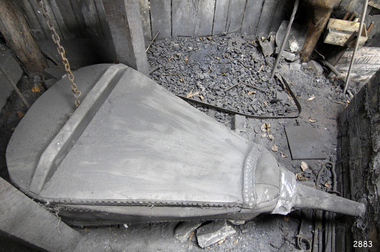
Functional object - Bellows, 1862-1875
... Onions was a “Bellows manufacturer and contractor to Her Majesty’s Honourable Board of Ordinance” and His Imperial Majesty the Emperor of the French [Napoleon Bonaparte]”. The advertisement includes a sketched portrait of the Emperor Napoleon III, and an Imperial Autograph Letter dated May 23, 1854, from Napoleon, Palace of the Tulleries to Mr J C Onions of Bradford Street, Birmingham. ...Onions was a “Bellows manufacturer and contractor to Her Majesty’s Honourable Board of Ordinance” and His Imperial Majesty the Emperor of the French [Napoleon Bonaparte]”. The advertisement includes a sketched portrait of the Emperor Napoleon III, and an Imperial Autograph Letter dated May 23, 1854, from Napoleon, Palace of the Tulleries to Mr J C Onions of Bradford Street, Birmingham. ...This bellows was used at the Warrnambool Racecourse by Master Farrier, Brian Chapman (1931-2017), during the 1970s but its history before then is still being investigated. The bellows have continued to be used from 1978 at Flagstaff Hill's blacksmith's workshop. Even today, in 2021, this same bellows are used by a volunteer blacksmith as he demonstrate the skills and tells of the importance of the blacksmith trade to colonial Australia. This 1860s double-action bellows is a typical form of blacksmith's or shipsmith's bellows. The end is forge-fitted with an iron nozzle or tube, called a tuyere or Tue iron, which concentrates the air to fan the fire or furnace. Tuyeres were traditionally made of cow horn. The double-action design of this bellows efficiently moves air both in and out of the chambers in the one movement of the long handle. The bellows was manufactured by John C. Onions of Birmingham, England, between 1862 and 1875. The stamp with the text, Gold Medal 1862, was also used on the business’ advertising. In 1875 the company was registered and began using the name John C. Onions Limited. JOHN C. ONIONS - John C. (Collingwood) Onions (1841-1904) was the son of a bellows maker of the same name. Onions (born 1841) and his wife Helen married in 1867 and they named one of their children John Collingwood Onions (1868-1913), as was the family tradition. He was well known as a Birmingham manufacturer of patented bellows and other forge-related equipment. He sold to the wholesale and retail markets for both local and overseas customers, including the British colonies. An 1862 advertisement points out that John C. Onions was a “Bellows manufacturer and contractor to Her Majesty’s Honourable Board of Ordinance” and His Imperial Majesty the Emperor of the French [Napoleon Bonaparte]”. The advertisement includes a sketched portrait of the Emperor Napoleon III, and an Imperial Autograph Letter dated May 23, 1854, from Napoleon, Palace of the Tulleries to Mr J C Onions of Bradford Street, Birmingham. In 1863 the company registered a patent on portable forges. In 1871 there were eight employees. John C. Onions Limited became a registered company in 1875. In 1876 an advertisements included that the company were smiths for hearths and tools in general and showed a row of six medallions including one with “Napoleon III, Emperor” and his portrait, and another “ _ _ _ 1862 MEDAL”. Their advertising motto was “For Excellence of Quality”. In 1885 the company merged with William Allday and Sons to become Allday and Onions. This mid-19th century bellows has local historical significance as it were once used by blacksmiths at the Warrnambool Racecourse in the annual racing event that continues today. This bellows is significant as a working example of equipment used in the 1800 and 1900s in the trace of blacksmiths and other metal working smiths. The bellows is technologically significant as it shows the progress from simple bellows to the double-action bellows, a time saving and efficient improvement. The manufacturer John C. Onions is historically significant as a family business that began in the 1600s and continued up until the 1980s.Bellows; large, oval, mechanical double-action smith’s bellows, manually operated, in working condition. The paddles of wood that form the top, middle sections and base of the bellows have flexible leather pieces attached firmly between them, forming airtight double lungs. Cut-outs in the panels allow the bellows to fill with air then force it out. A long handle is connected to pump the bellows and control the quantity and force of the air. The blasts of air are forced through the metal nozzle or tuyere at the end of the bellows and into the forge’s fire. Inscriptions are impressed into the wood on the upper paddle or board of the bellows. There are three circular stamps containing text. Text impressed in the wooden upper paddle of the bellows has been assumed to read “JOHN C. ONIONS, PATENTEES & MANUFACTURERS, BIRMINGHAM””?” “EXTRA” “AWARDED FOR EXCELLENCE OF QUALITY”, made from the following readable text :- “JOHN C ONIONS“ “PATENT - - - & MAN - - - - - - - - -“, “BIR - - - - HAM“, “ _ ERA - - - - “- XTRA-“, “- - - - - - - FOR EXCELL-“ “OF - - - - ITY” Text in the stamp “ - - ECE - - “, “ - - - - - / 1862 / MEDAL”, “- ITY” flagstaff hill, warrnambool, shipwrecked-coast, flagstaff-hill, flagstaff-hill-maritime-museum, maritime-museum, shipwreck-coast, flagstaff-hill-maritime-village, john collingwood onions, john c onions, allday and onions, bellows, smith’s bellows, 19th century bellows, double-action bellows, double-acting bellows, double lung bellows, double chamber bellows, blacksmith tools, blacksmith trade, blacksmith craft, blacksmith equipment, forging equipment, john c onions patented double-action bellows, brian chapman, warrnambool racecourse, blacksmith, shipsmith, iron smith, mechanical bellows -
 Flagstaff Hill Maritime Museum and Village
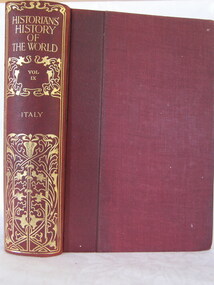
Book - Reference Book/History, Henry Smith Williams, The Historians History of the World Vol 9 set 1 - Edited by Henry Smith Williams L.L.D. Published by “The Times” 1908, 1908
... Emperors and the Popes. A significant portion is dedicated to the rise of Venice, Florence, Genoa, and Milan. It covers the maritime glory of the Venetians and the banking prowess of the Medici. The Renaissance is the "soul" of this volume. It examines the explosion of art, science, and humanism, looking at the era not just as a political history, but as a cultural revolution. It concludes with the 19th-century struggle for Italian unification, featuring figures like Mazzini, Garibaldi, and Cavour. It concentrates on cultural vs political history while other volumes (like those on Prussia or France...Emperors and the Popes. A significant portion is dedicated to the rise of Venice, Florence, Genoa, and Milan. It covers the maritime glory of the Venetians and the banking prowess of the Medici. The Renaissance is the "soul" of this volume. It examines the explosion of art, science, and humanism, looking at the era not just as a political history, but as a cultural revolution. It concludes with the 19th-century struggle for Italian unification, featuring figures like Mazzini, Garibaldi, and Cavour. It concentrates on cultural vs political history while other volumes (like those on Prussia or France ...The 1908 edition of The Historians' History of the World is a monumental work of Edwardian scholarship, representing a specific era of "universal history" where the goal was to synthesise all human knowledge into a single narrative. While previous volumes dealt with the Roman Empire, Volume 9 picks up the story after the "Fall of Rome" and tracks the peninsula’s evolution through the dawn of the 20th century.The Book is part of a 25 volume set with red cloth bindings and gold filigree design to ribnon-fictionThe 1908 edition of The Historians' History of the World is a monumental work of Edwardian scholarship, representing a specific era of "universal history" where the goal was to synthesise all human knowledge into a single narrative. While previous volumes dealt with the Roman Empire, Volume 9 picks up the story after the "Fall of Rome" and tracks the peninsula’s evolution through the dawn of the 20th century. warrnambool, shipwrecked-coast, flagstaff-hill, flagstaff-hill-maritime-museum, maritime-museum, book, the historians history of the world vol 9 set 1, henry smith williams -
 Flagstaff Hill Maritime Museum and Village
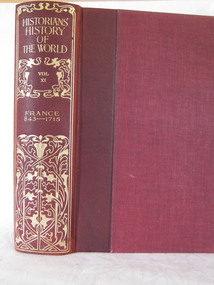
Book - Reference Book/History, Henry Smith Williams, The Historians History of the World Vol 11 set 1 - Edited by Henry Smith Williams L.L.D. Published by “The Times” 1908, 1908
... The French Revolution is covered with a granular look at the fall of the Bastille, the rise of the Jacobins, and the “Reign of Terror” leading to the eventual execution of the monarchy. The volume goes on to narrate the Napoleonic era with the rise of Napoleon Bonaparte, his transformation from a General to an Emperor, his sweeping legal reforms, and his ultimate downfall at Waterloo in 1815. ...The French Revolution is covered with a granular look at the fall of the Bastille, the rise of the Jacobins, and the “Reign of Terror” leading to the eventual execution of the monarchy. The volume goes on to narrate the Napoleonic era with the rise of Napoleon Bonaparte, his transformation from a General to an Emperor, his sweeping legal reforms, and his ultimate downfall at Waterloo in 1815. ...Henry Smith Williams’ “The Historians' History of the World” is a chronological and geographical "tapestry" of human events, these twenty five volumes occupy a very specific and prestigious place in historical research. A warning on Volume 11 if the reader is looking for the history of France (1715–1815) in this specific 1908 edition, ensure you check Volume 12. In some printings of the 1908 set, the numbering of French history was slightly adjusted, and Volume 11 often ends at the death of Louis XIV (1715).The Book is part of a 25 volume set with red cloth bindings and gold filigree design to rib.non-fictionHenry Smith Williams’ “The Historians' History of the World” is a chronological and geographical "tapestry" of human events, these twenty five volumes occupy a very specific and prestigious place in historical research. A warning on Volume 11 if the reader is looking for the history of France (1715–1815) in this specific 1908 edition, ensure you check Volume 12. In some printings of the 1908 set, the numbering of French history was slightly adjusted, and Volume 11 often ends at the death of Louis XIV (1715).flagstaff hill, warrnambool, shipwrecked-coast, flagstaff-hill, flagstaff-hill-maritime-museum, maritime-museum, shipwreck-coast, flagstaff-hill-maritime-village, the historians history of the world vol 11 set 1, book -
 Flagstaff Hill Maritime Museum and Village
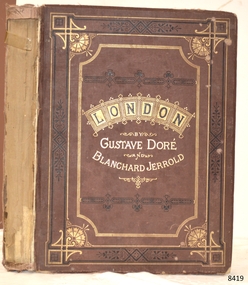
Book - Illustrated Reference Book/Social History, Louis Auguste Gustave Doré et al, London a Pilgrimage, 1872
... French and served as an intellectual bridge between the two capitals. He wrote numerous plays, novels, political pamphlets, and cookbooks under the pseudonym "Fin-Bec," and later penned a definitive, four-volume biography of Emperor Napoleon III. ...French and served as an intellectual bridge between the two capitals. He wrote numerous plays, novels, political pamphlets, and cookbooks under the pseudonym "Fin-Bec," and later penned a definitive, four-volume biography of Emperor Napoleon III. ...London A Pilgrimage (1872) is one of the most celebrated, visually striking, and socially important illustrated books of the 19th century; as such, the work is a highly desirable piece of publishing history. The book offers a comprehensive, episodic portrait of Victorian London at the height of the British Empire. The prominent French artist Gustave Doré and English journalist William Blanchard Jerrold shared a fascination with urban life, combining their talents to create one of the 19th century's greatest collaborative works. They spent days exploring the metropolis together to capture the stark dualities of the city. Rather than focusing solely on the grand landmarks of the wealthy, the book famously juxtaposes the "sunlight and shadows" of London life. When Jerrold suggested a massive, joint exploration of London in 1869, it brought together two perfect skill sets: Jerrold provided the investigative journalistic grit and intimate knowledge of London’s social strata, while Doré provided the haunting, cinematic visual poetry through his illustrations.Hard cover book, London a Pilgrimage Author: William Blanchard Jerrold Publisher: Grant & Co, 74-78 Turnmill St. London. EC. Date: 1872 Morocco Olive hardcover with a damaged spine, lettering in gold with a title in a surrounded with a decorative panel. non-fictionLondon A Pilgrimage (1872) is one of the most celebrated, visually striking, and socially important illustrated books of the 19th century; as such, the work is a highly desirable piece of publishing history. The book offers a comprehensive, episodic portrait of Victorian London at the height of the British Empire. The prominent French artist Gustave Doré and English journalist William Blanchard Jerrold shared a fascination with urban life, combining their talents to create one of the 19th century's greatest collaborative works. They spent days exploring the metropolis together to capture the stark dualities of the city. Rather than focusing solely on the grand landmarks of the wealthy, the book famously juxtaposes the "sunlight and shadows" of London life. When Jerrold suggested a massive, joint exploration of London in 1869, it brought together two perfect skill sets: Jerrold provided the investigative journalistic grit and intimate knowledge of London’s social strata, while Doré provided the haunting, cinematic visual poetry through his illustrations.flagstaff hil, warrnambool, flagstaff hill maritime museum, maritime museum, shipwreck coast, flagstaff hill maritime village, great ocean road, book, pattison collection, warrnambool library, warrnambool mechanics’ institute, ralph eric pattison, corangamite regional library service, warrnambool city librarian, mechanics’ institute library, victorian library board, warrnambool books and records, warrnambool children’s library -
 Orbost & District Historical Society
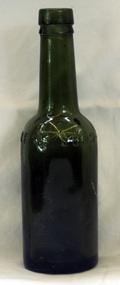
bottle, JGB Siebert & Sons, 1930's
... The young doctor joined the 2nd Regiment of the Prussian army, one among the allies who fought against the French Emperor Napoleon Bonaparte. He saw active service as army surgeon under the command of General von Blücher. . ...The young doctor joined the 2nd Regiment of the Prussian army, one among the allies who fought against the French Emperor Napoleon Bonaparte. He saw active service as army surgeon under the command of General von Blücher. . ...Johann Gottlieb Benjamin Siegert (1796 - 1870) was born at GroB-Walditz in Silesia, Germany. He studied medicine at the University of Berlin, then the capital of Prussia. The young doctor joined the 2nd Regiment of the Prussian army, one among the allies who fought against the French Emperor Napoleon Bonaparte. He saw active service as army surgeon under the command of General von Blücher. . Dr. Siegert relied on the herbs and plants of the region for his cures. In 1824, he began to produce the bitters product which was originally used for medicinal purposes.A dark green bottle with a long neck which possibly had a waxed cork stopper.Around shoulder and on base - JGB Siegert & Sons. DRangostura siegert-jgb bottle bitters -
 Montmorency–Eltham RSL Sub Branch
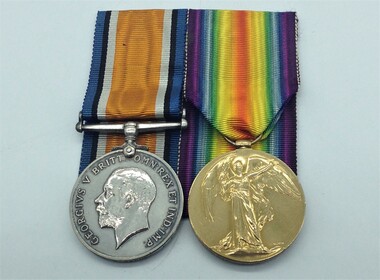
Medal - Medal Group, WW1, 82069 Pte. A. Warner
... He died in action in France on 18 Aug 1918 and is buried in a cemetery near Picardie (see AWM person records) The recipients name, rank, service number and unit are impressed on the bottom edge of the medal - 82069, PTE WARNER R.A.M.C British War Medal - The medal was struck by the Royal Mint, is a silver disc 36mm in diameter with a straight clasp suspended without swivel. The obverse shows Sir Bertram Mackennal's bare headed effigy of King George V facing left with the legend 'GEORGIVS V BRITT:OMN:REX ET IND:IMD - "George V, King of all the British Isles & Emperor ...Pte Albert WARNER (3537) was a driver with 4th Australian Machine Gun Bn. He died in action in France on 18 Aug 1918 and is buried in a cemetery near Picardie (see AWM person records)British War Medal - The medal was struck by the Royal Mint, is a silver disc 36mm in diameter with a straight clasp suspended without swivel. The obverse shows Sir Bertram Mackennal's bare headed effigy of King George V facing left with the legend 'GEORGIVS V BRITT:OMN:REX ET IND:IMD - "George V, King of all the British Isles & Emperor of India". The reverse, designed by William McMillan, shows St George, naked on horseback and armed with a short sword, an allegory of the physical & mental strength which achieved victory of Prussianism. The horse tramples on the Prussian eagle shield and the emblems of death, a skull and cross bones. In the background are ocean waves and just off centre near the right upper time is the risen sun of victory. The years 1914-1918 appear on the perimeter in the left and right fields respectively. The watered silk ribbon is 32mm wide with 3mm wide royal blue band, 2mm wide black band, 3mm wide white band repeated in reverse order and separated by 16mm wide orange band. Victory Medal - The medal is bronze disc 36mm in diameter with a winged figure of Victory on the obverse. The reverse has the words 'THE GREAT WAR FOR CIVILIZATION 1914-1918', all surrounded by a laurel leaf. The watered silk ribbon is 32mm wided has two rainbow design with the violet from each rainbow on the outside edges, moving through to a central red stripe where both rainbows meet.The recipients name, rank, service number and unit are impressed on the bottom edge of the medal - 82069, PTE WARNER R.A.M.C -
 Bendigo Historical Society Inc.
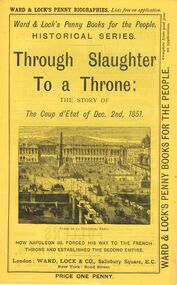
Book - LYDIA CHANCELLOR COLLECTION: THROUGH SLAUGHTER TO A THRONE
... ...napoleon emperor of france...BOOKS Biography napoleon emperor of france Lydia Chancellor collection Ward & Lock's Penny Biographies biographies Ward & Lock's Penny Books for the People Historical Series history France French history Napoleon III Louis Napoleon Bonaparte advertisements male individual person book books penny books A book titled ' Through Slaughter To a Throne: The story of The Coup d'Etat of Dec. 2nd., 1851. ...A book titled ' Through Slaughter To a Throne: The story of The Coup d'Etat of Dec. 2nd., 1851. How Napoleon III forced his way to the French Throne and established the Second Empire. London : Ward, Lock & Co., Salisbury Square, E.C. New York : Bond Street. 97 - 112 pgs (ill.). This book is one of a series of 37 Ward & Lock Penny Books for the People.' ' Historical Series.' Price one penny. There are also advertisements of note.books, biography, napoleon emperor of france, lydia chancellor, collection, ward & lock's penny biographies, biographies, ward & lock's penny books for the people, historical series, history, france, french history, napoleon iii, louis napoleon bonaparte, advertisements, male, individual, person, book, books, penny books -
 National Vietnam Veterans Museum (NVVM)
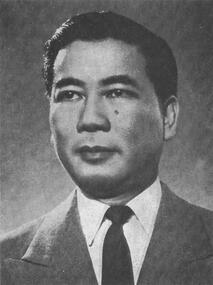
Photograph, First President of Republic of Vietnam
... In 1954, as the defeated French forces left the State of Vietnam, Ngô Đình Diệm, a devout Roman Catholic, became the first prime minister. In 1956, a government-controlled referendum determined that South Vietnam should become a republic rather than stay under the control of Emperor Bảo Đại (who was living in Cannes, on the French Riviera). ...In 1954, as the defeated French forces left the State of Vietnam, Ngô Đình Diệm, a devout Roman Catholic, became the first prime minister. In 1956, a government-controlled referendum determined that South Vietnam should become a republic rather than stay under the control of Emperor Bảo Đại (who was living in Cannes, on the French Riviera). ...In 1954, as the defeated French forces left the State of Vietnam, Ngô Đình Diệm, a devout Roman Catholic, became the first prime minister. In 1956, a government-controlled referendum determined that South Vietnam should become a republic rather than stay under the control of Emperor Bảo Đại (who was living in Cannes, on the French Riviera). Ngô Đình Diệm appointed himself the first President of the Republic of Vietnam (South Vietnam). He then appointed his younger brother, Ngô Đình Nhu, to be his chief advisor and head of both South Vietnam’s secret police and its largest intelligence agency. During 1963, a campaign of civil resistance led by Buddhist monks protested religious discrimination. The government’s brutal treatment of Buddhists convinced many that Ngô Đình Diệm should go. While the United States publicly denied playing any part in the 1963 coup that overthrew Diệm, it was revealed that American officials had met with and encouraged the generals who planned the coup. Both Ngô Đình Diệm and his brother, Ngô Đình Nhu, were executed on 2 November 1963. 1st elected president of South Vietnam, Ngo Dinh Diem. 1st president vietnam, ngo dinh diem, republic of vietnam, south vietnam, assassination, execution, diem, president -
 Alfred Hospital Nurses League - Nursing History Collection
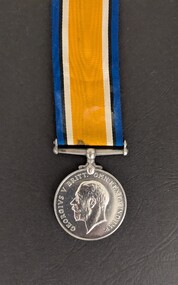
Medal - World War 1 medal, Royal Mint, British War Medal (Leah Rosenthal), 1919
... Leah Rosenthal volunteered with Queen Alexandra's Imperial Nursing Service Reserve, serving in France, and also was awarded the Associate Royal Red Cross Of significance to the AHNL as Leah Rosental was an Alfred nursing graduate World War 1 World War 1914-1918 Leah Rosenthal Queen Alexandra's Imperial Nursing Service Reserve Military Medals British War Medal Round silver medal with a straight clasp suspender without swivel. The front of the medal depicts the bare head effigy of King George V facing left. Around the perimeter "GEORGIVS V BRITT: OMN: REX ET IND: IMP:" (George V, King of all the British Isles and Emperor ...The British War Medal was awarded to British and Imperial forces for service during World War 1.Recipients also received the Military Star( where applicable) and the Victory Medal. Leah Rosenthal volunteered with Queen Alexandra's Imperial Nursing Service Reserve, serving in France, and also was awarded the Associate Royal Red CrossOf significance to the AHNL as Leah Rosental was an Alfred nursing graduateRound silver medal with a straight clasp suspender without swivel. The front of the medal depicts the bare head effigy of King George V facing left. Around the perimeter "GEORGIVS V BRITT: OMN: REX ET IND: IMP:" (George V, King of all the British Isles and Emperor of India). The reverse, designed by William McMillan, shows Saint George naked on horseback and armed with a short sword, an allegory of the physical and mental strength which achieved victory over Prussianism. The horse tramples on the Prussian eagle shield and the emblems of death, a skull and crossbones. In the background are ocean waves and just off-centre near the right upper rim is the risen sun of Victory. The years "1914" and "1918" appear on the perimeter in the left and right fields respectively. The attached ribbon consists of a central broad golden-yellow stripe flanked by white and black stipes with royal blue borders. The medal has been mounted on card along with the 1914-1915 Military Star and The Victory Medalworld war 1, world war 1914-1918, leah rosenthal, queen alexandra's imperial nursing service reserve, military medals, british war medal -
 National Wool Museum
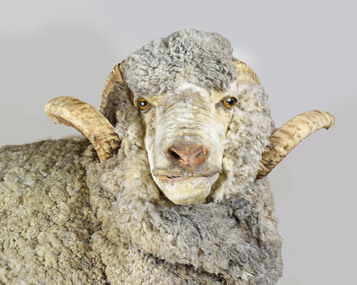
Taxidermy Sheep, Booka, c1980
... The introduction of a single French ‘Rambouillet’ Merino ram, called Emperor, is now widely acknowledged as one of the most important events in the development of the Peppin stud. ...The introduction of a single French ‘Rambouillet’ Merino ram, called Emperor, is now widely acknowledged as one of the most important events in the development of the Peppin stud. ...The ‘Wanganella’ merino sheep stud was established by the Peppin brothers in the Riverina in 1861. The introduction of a single French ‘Rambouillet’ Merino ram, called Emperor, is now widely acknowledged as one of the most important events in the development of the Peppin stud. As many as 70% of today’s Australian Merinos are said to be directly descended from the Peppin-developed sheep. Its heavy fleece falls in the mid-range of Merino wool qualities (20 to 23 microns) and is protected from the excesses of the environment by a comparatively high content of natural wool grease, which can be seen in the creamy colour of Booka’s wool. Fred Peppin said [of the sheep breed] "We were satisfied with the type of wool that the country would grow, instead of endeavouring to produce what the climate and soil continually fight against. Thus we developed all its good natural tendencies and after that the flock had a character of its own.”Peppin merino stud. Has a large body and long legs. Two horns protruding from its skull.sheep, wanganella -
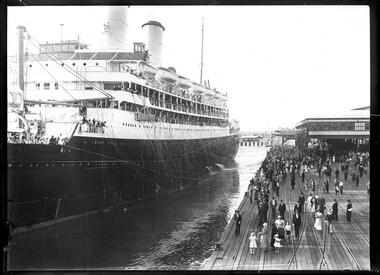 City of Melbourne Libraries
Photograph, Bull, Hugh Jones, 1897-1993, RMS Orford departing from Station Pier, Port Melbourne
... Emperor of Ethiopia, Haile Selassie at Gibraltar on his way to the UK. In 1939, she was requisitioned for Australian government service and on 7/1/1940 she conveyed the first Australian troops to Egypt and was then used to carry French troops from Tamatave, Madagascar to Marseilles. ...Emperor of Ethiopia, Haile Selassie at Gibraltar on his way to the UK. In 1939, she was requisitioned for Australian government service and on 7/1/1940 she conveyed the first Australian troops to Egypt and was then used to carry French troops from Tamatave, Madagascar to Marseilles. ...Published: 21 March 1934 The Age p11 Published title: CROWDED TOURIST SHIP WILL CARRY TEST AND DAVIS CUP TEAMS. Published caption: Carrying an exceptionally large number of tourists, business men and prominent sporting personalities, R.M.S. Orford sailed for London yesterday. Over two hundred passengers embarked at Melbourne, and on leaving the Australian coast there will be two thousand persons on board. The Australian Test team will join the vessel at Fremantle and the remaining two Davis Cup representatives will embark at Adelaide. A picture of the Orford taken just as she moved out from Station Pier, Port Melbourne, under her own steam. Trove article identifier: http://nla.gov.au/nla.news-article203826897 Description: Passenger ship about to depart Station Pier, Port Melbourne. Research by project volunteer, Fiona Collyer: The RMS Orford was built by Vickers-Armstrong Shipyard Barrow-in-Furness, Cumbria, England and launched in 1927 by Lady Ryrie, the wife of Sir Granville Ryrie, the Australian Ambassador to the UK. The Orford was owned by the Orient Steam Navigation Ltd and was designed for the mail and passenger service between England and Australia. She was 20,000 tons, 658 ft long, 75 ft across and 80 ft high from water-line to deck. She had eight decks, a swimming pool and cost more than £1,000,000. She could travel at 20 knots – 480 miles a day, a 5 week voyage between Australia and England. There were enough lifeboats to accommodate every person on board. Promoted as a ship of comfort, luxury, speed and grace with spacious, beautifully decorated lounges, smoking-rooms and writing rooms, the SMH 23/11/1928 review said “sitting-rooms where the furniture recreates the air of quiet, exquisite, safe luxury; suites where you may retire from other people, and on a sea voyage other people, even the most charming other people, often begin to resemble one’s worst enemies towards the end of several weeks sea voyaging together”. “Travel like a human being. This is what the great liners give you today. The Orford dining room is enormous (it seated 350 people) the walls sweep up to a white, cool roof supported on decorative pillars. Panels of grey scagliola and carved designs remove the bleak, comfortless air which used to cling to dining-rooms of ships. Everything about them was so wretchedly temporary that you could not enter them without wishing that you stayed at home. They gave you the creeps and indigestion. This room is gay, bright, sunlit, like a luxurious café overlooking the sea.” “You really feel in here that you are a human being and not a piece of cargo endowed with sensation.” The Orford had the punkah louvre system of ventilation which forced draughts through every part of the ship, ensuring “No Ship Smells!!” and avoiding - “… a mayonnaise of all the unpleasant odours generated under heaven. From the hot oil of the engines, from those overheated, bottomless pits below the water-line, from new paint and food, from people perspiring at work, from rope and tar and grease and fruit and wet clothes and tobacco, rises a deplorable incense that lingers unsettlingly in the nostril long after one has left the ship. Those dreadful odours will never rise to torture the senses of passengers who feel that all is over with them.” The modern electric kitchen had a roll making machine capable of producing 2000 rolls for the table an hour and a bread and butter machine which cut the bread into slices and spread the butter in one operation. (The Week – Brisbane 30/11/1928) On 13/10/1928, the Orford made its first voyage to Australia with 520 first class and 1100 3rd class passengers. The name of the passengers embarking and disembarking and their reason for visiting were published in newspapers and the number of migrants for the New Settlers Scheme and the Dreadnought Boys Co program to promote and assist the migration of British youths willing to become farm workers in Australia 1911-1939 were noted too. On the 19th March 1932, RMS Orford featured in the “Parade of Ships” celebrating the official opening of the Sydney Harbour Bridge. Only country people were allowed to book a ticket as a guest on board. The Post Office issued commemorative postage stamps showing the Orford sailing under the bridge. In March 1934, the Orford sailed from Australia to London, via Colombo, Aden, Port Said, Naples, Villefranche, Toulon, Parma, Gibraltar and Channel Port. Amongst the 2000 passengers on board was the Davis Cup Tennis team, tennis champions Joan Hartigan and Nell Hopman, the Australian Test cricket team and British champion swimmer Joyce Cooper. Every day tennis player Harry Hopman and an Australian Press Association reporter radioed through reports on their activities, which included – - Test cricket batsman Len Darling having spend 4 days in his cabin after straining his groin when he slipped over while playing ball tennis in his slippers. - Batsman Bill Brown dancing the fox-trot, displaying footwork similar to the grace he showed at the wicket. - Alluding to the seasickness of Don Bradman and Stan McCabe and how they were making up for meals lost on the Great (very choppy) Australian Bight. - Miss Joan Hartigan discarding her bright blue shorts for brighter blue bathers and being first into the pool. - Bowler Bill O’Reilly being tripped by a passenger on the deck and spending the voyage with bandaged wrists with daily updates of his progress in the press. - Wicketkeeper Ben Barnett’s conjuring tricks and constant whirring movie camera. - Results of the quoits, ball tennis and bridge tournaments. A fancy dress ball was held one night and the cricketers dressed as sheiks and sang “The Riff Song” from the pre-code 1929 operetta film “The Desert Song” starring John Bates as the Red Shadow and Myrna Lay as a native dancing girl. Alan Kippax’s beard blew overboard! Joan Hartigan dressed as Burlington Bertie from the music hall song and Nell Hopman a doll in a box wearing a crinkled paper dress. On arrival at Southampton, while they waited for the gangway to be lowered, Bradman entertained the team at the piano playing popular tunes while the cricketers sang. . In 1935, RMS Orford’s third class accommodation was converted to tourist class. Her passenger capacity was now 468 First Class, 515 tourist class and 440 crew. First saloon from Sydney fares cost for single £76, £82, £88 and Third Class fares were £21, £23, £25. Less than a penny a mile. . In 1936, the Orford embarked the exiled Emperor of Ethiopia, Haile Selassie at Gibraltar on his way to the UK. In 1939, she was requisitioned for Australian government service and on 7/1/1940 she conveyed the first Australian troops to Egypt and was then used to carry French troops from Tamatave, Madagascar to Marseilles. On 1/6/1940 RMS Orford was bombed and set on fire at Marseilles by German aircraft. 14 crew were killed, 25 wounded. In 1947, the wreck was re-floated and broken up at Savona. . . References: R.M.S. ORFORD. (1928, November 23). The Sydney Morning Herald (NSW : 1842 - 1954), p. 14. Retrieved September 15, 2023, from http://nla.gov.au/nla.news-article16511535 ARRIVAL OF THE ORFORD (1928, November 30). The Week (Brisbane, Qld. : 1876 - 1934), p. 21. Retrieved September 15, 2023, from http://nla.gov.au/nla.news-article181126802 CROWDED TOURIST SHIP WILL CARRY TEST AND DAVIS CUP TEAMS. (1934, March 21). The Age (Melbourne, Vic. : 1854 - 1954), p. 11. Retrieved October 5, 2023, from http://nla.gov.au/nla.news-article203826897 Photographer notations on slide: "B19".tennis, ships
