
Showing 253 items matching "engine types"
-
 Moorabbin Air Museum
Manual (Item) - Ansett Engine Types 1953<>1979
... Ansett Engine Types 1953<>1979...Ansett Engine Types 1953<>1979...Ansett Engine Types 1953<>1979 Manual Ansett Engine Types 1953<>1979 ... -
Moorabbin Air Museum
Book - A 1950's description of all things to do with operation of civilian aircraft and airports, ie such things as navigation, air space control, general air craft engine types, aircraft design. Does not have specific aircraft detail. THE WORLD'S AIRWAYS AND HOW THEY WORK, CAPTAIN J. W. G. JAMES, JOHN STROUD, THE WORLD'S AIRWAYS AND HOW THEY WORK, 1950
... A 1950's description of all things to do with operation of civilian aircraft and airports, ie such things as navigation, air space control, general air craft engine types, aircraft design. Does not have specific aircraft detail. ...A 1950's description of all things to do with operation of civilian aircraft and airports, ie such things as navigation, air space control, general air craft engine types, aircraft design. Does not have specific aircraft detail. ...A 1950's description of all things to do with operation of civilian aircraft and airports, ie such things as navigation, air space control, general air craft engine types, aircraft design. Does not have specific aircraft detail. ...A 1950's description of all things to do with operation of civilian aircraft and airports, ie such things as navigation, air space control, general air craft engine types, aircraft design. Does not have specific aircraft detail. THE WORLD'S AIRWAYS AND HOW THEY WORKCover jacket showing black and white sketch of 1950's four radial engine passenger aircraft in flight, between orange coloured band top and bottom of cover.non-fictionA 1950's description of all things to do with operation of civilian aircraft and airports, ie such things as navigation, air space control, general air craft engine types, aircraft design. Does not have specific aircraft detail. THE WORLD'S AIRWAYS AND HOW THEY WORK -
Moorabbin Air Museum
Book - Aviation basics, The ABC of Aviation
... ...Engine types...Aviation basics Aircraft & industry Lighter than air & heavier than air aircraft Autogiros Airplane construction Structures and design Engine types Propeller types Control methods Aircraft instruments Introduction to the study of aviation, circa 1939 The ABC of Aviation Book Aviation basics ...Introduction to the study of aviation, circa 1939non-fictionIntroduction to the study of aviation, circa 1939aircraft & industry, lighter than air & heavier than air aircraft, autogiros, airplane construction, structures and design, engine types, propeller types, control methods, aircraft instruments -
 Puffing Billy Railway
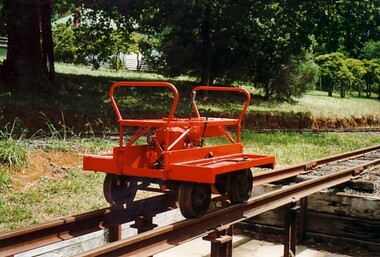
NKs 5 - Victorian Railways 2'6" gauge trolly
... trolley made of wood and steel Engine Type: 1 Cylinder. reversible Fuel: 2 stroke Transmission: Belt drive...KS is lighter car capable of carrying 4 men or sevenhundredweight Historic - Victorian Railways Narrow Gauge trolley nks5 puffing billy victorian railways narrow gauge 2'6" gauge NKS 5 trolley made of wood and steel Engine Type: 1 Cylinder. reversible Fuel: 2 stroke Transmission: Belt drive NKs 5 - Victorian Railways 2'6" gauge trolly Victorian Railways - Spotswood Workshops ...NKS 5 - NKS Type Gangers Trolly - Victorian Railways 2'6" gauge trolly - a KS series Section Car often called the Kasey Jones The narrow gauge version of the broad gauge KS series cars. They were classed NKS with two stroke motors. These cars were built by the Spotswood Workshops, with castings coming from the Newport Workshops. KS is lighter car capable of carrying 4 men or sevenhundredweight Historic - Victorian Railways Narrow Gauge trolley made of wood and steel Engine Type: 1 Cylinder. reversible Fuel: 2 stroke Transmission: Belt driveNKS 5trolley, nks5, puffing billy, victorian railways, narrow gauge, 2'6" gauge -
 Puffing Billy Railway
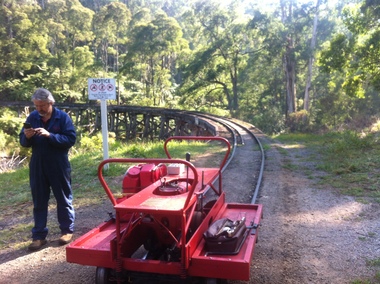
NKS Type Trolly - Victorian Railways 2'6" gauge trolly, NKS 8
... Motorised small rectangular trolly made of wood and wrought iron Engine Type: 1 Cyl. reversible Fuel: 2 stroke Transmission: Belt drive...KS is lighter car capable of carrying 4 men or sevenhundredweight Historic - Victorian Railways Narrow Gauge - Track Patrol Vehicle used by Puffing Billy Preservation Society puffing billy victorian railways trolley narrow gauge 2'6" gauge kasey trolly NKS 8 Motorised small rectangular trolly made of wood and wrought iron Engine Type: 1 Cyl. reversible Fuel: 2 stroke Transmission: Belt drive NKS 8 NKS Type Trolly - Victorian Railways 2'6" gauge trolly Victorian Railways - Spotswood Workshops ...NKS Type Gangers Trolly - Victorian Railways 2'6" gauge trolly - a KS series Section Car oftern called the Kasey Jones The narrow gauge version of the broad gauge KS series cars. They were classed NKS with two stroke motors. These cars were built by the Spotswood Workshops, with castings coming from the Newport Workshops. KS is lighter car capable of carrying 4 men or sevenhundredweight Historic - Victorian Railways Narrow Gauge - Track Patrol Vehicle used by Puffing Billy Preservation SocietyMotorised small rectangular trolly made of wood and wrought iron Engine Type: 1 Cyl. reversible Fuel: 2 stroke Transmission: Belt driveNKS 8puffing billy, victorian railways, trolley, narrow gauge, 2'6" gauge, kasey, trolly -
Bendigo Historical Society Inc.
Document - DRIVERS LUBRICATION CHART
... Chassis with pressed steel frame and Taylor Engine Type YB /YC. Produced by Associated Equipment Co. ...Chassis with pressed steel frame and Taylor Engine Type YB /YC. Produced by Associated Equipment Co. ...BHS CollectionDrivers Lubrication Chart; General Arrangement of A.E.C. Chassis with pressed steel frame and Taylor Engine Type YB /YC. Produced by Associated Equipment Co. London.machinery, engines - internal combustion, chassis lubrication -
 Puffing Billy Railway
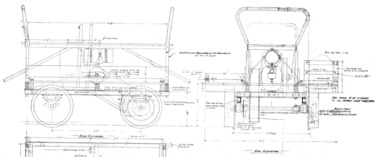
NKS 9, Victorian Railways 2'6" gauge trolly
... Motorised small rectangular trolly made of wood and wrought iron - currently stored dismantled Engine Type: 1 Cyl. reversible Fuel: 2 stroke Transmission: Belt drive...And then at Walhalla Railway where it was regauged to 2 foot 6 inch puffing billy puffing billy museum trolley narrow gauge 2'6" gauge victorian railways state electricity commission of victoria - yallourn. trolly NKS 9 Motorised small rectangular trolly made of wood and wrought iron - currently stored dismantled Engine Type: 1 Cyl. reversible Fuel: 2 stroke Transmission: Belt drive Victorian Railways 2'6" gauge trolly NKS 9 Victorian Railways - Spotswood Workshops ...NKS Type Gangers Trolly - Victorian Railways 2'6" gauge trolley - a KS series Section Car oftern called the Kasey Jones The narrow gauge version of the broad gauge KS series cars. They were classed NKS with two stroke motors. These cars were built by the Spotswood Workshops, with castings coming from the Newport Workshops. KS is lighter car capable of carrying 4 men or sevenhundredweight Trolly 9 was built for the State Electricity Commission of Victoria for use on their metre gauge railway of Yallourn. It was sold to a preservation group at Walhalla and regauged to 2 foot 6 inch. It came to the Puffing Billy Railway in the early 1980s.Historic - Victorian Railways Narrow Gauge - Track Patrol Vehicle used by the State Electricity Commission of Victoria for use on their 900mm gauge railway of Yallourn. And then at Walhalla Railway where it was regauged to 2 foot 6 inchMotorised small rectangular trolly made of wood and wrought iron - currently stored dismantled Engine Type: 1 Cyl. reversible Fuel: 2 stroke Transmission: Belt driveNKS 9puffing billy, puffing billy museum, trolley, narrow gauge, 2'6" gauge, victorian railways, state electricity commission of victoria - yallourn., trolly -
 Maldon Vintage Machinery Museum Inc
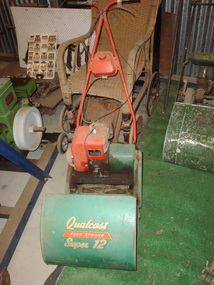
Motor Mower
... Sticker on engine "Stowmarket, SIP (in a red diamond background) Suffolk / Engine type 75G14 Model No. 25A / Made in Englsnd / Recommended Lubricants" followed by a table of lubricant makers and oil specification....Sticker on engine "Stowmarket, SIP (in a red diamond background) Suffolk / Engine type 75G14 Model No. 25A / Made in Englsnd / Recommended Lubricants" followed by a table of lubricant makers and oil specification. ...Cylindrical lawn mower with grass catcher. Green painted catcher and engine cover, orange petrol tank and handles. Pull start with engine control on RHS handle. Name prominantly printed on front of catcher "Qualcast / four stroke / Super 12". Sticker on engine "Stowmarket, SIP (in a red diamond background) Suffolk / Engine type 75G14 Model No. 25A / Made in Englsnd / Recommended Lubricants" followed by a table of lubricant makers and oil specification.machinery, lawn mowing -
 Bendigo Historical Society Inc.
Document - MINING REPORTS - BENDIGO MINING REPORTS
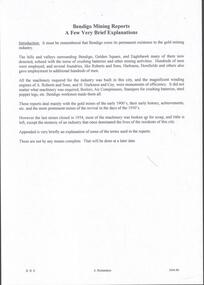
... Notes, written by Albert Richardson, include an introduction which mentions the noise of the mining activities, all the machinery being made in Bendigo by the local foundries and the end of the mining.There are explanations of poppet legs or heads, landing brace, intermediate brace, safety brace, pulley wheels, boilers, winding engine, types of engines and air compressors....Notes, written by Albert Richardson, include an introduction which mentions the noise of the mining activities, all the machinery being made in Bendigo by the local foundries and the end of the mining.There are explanations of poppet legs or heads, landing brace, intermediate brace, safety brace, pulley wheels, boilers, winding engine, types of engines and air compressors. Document MINING REPORTS - BENDIGO MINING REPORTS ...Albert Richardson had a life long interest in Bendigo's mining. He wrote broadly about the practical aspects of mining and the history of many of the mining companies. One handwritten and typed copies (3 of page 1, 3 of page 2, 2 of page 3 and 2 of page 4). Notes, written by Albert Richardson, include an introduction which mentions the noise of the mining activities, all the machinery being made in Bendigo by the local foundries and the end of the mining.There are explanations of poppet legs or heads, landing brace, intermediate brace, safety brace, pulley wheels, boilers, winding engine, types of engines and air compressors.document, gold, mining reports, mining reports, bendigo mining reports, a. roberts & sons, h.harkness and coy, horsfield's, south new moon, central deborah, great extended hustlers, wattle gully mine chewton, big deborah mine, royal hustlers reserve no 2 shaft, the city, johnsons reef no 2, lansell's comet, south devonshire, great southern, victoria quartz, lansell's big '180', little '180', new moon, big blue, central blue, central nell gwynne, lansell's sandhurst or 'needle' mine, eureka extended -
Moorabbin Air Museum
Functional Object - Sopwith Pup Propellor
... Description: marked as a 100HP Le Rhone Engine English type boss, this wooden propellor is believed to be from a WW1 Sopwith Pup aircraft. ...Description: marked as a 100HP Le Rhone Engine English type boss, this wooden propellor is believed to be from a WW1 Sopwith Pup aircraft. ...Historical Details: . Description: marked as a 100HP Le Rhone Engine English type boss, this wooden propellor is believed to be from a WW1 Sopwith Pup aircraft. Level of Importance: s/n 5577 -
 Nhill Aviation Heritage Centre
Memorabilia - Log Book, Aero Engine Log Book, 1942
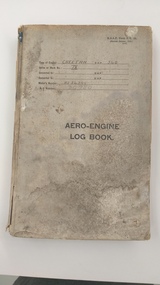
... Aero Engine Log Book, Type of engine-Cheetah BHP. 340. Series or Mk No. ...These log books would have been kept for each aircraft at the air station log book aero engine log repair log anson cheetah Aero Engine Log Book, Type of engine-Cheetah BHP. 340. Series or Mk No. ...These log books would have been kept for each aircraft at the air stationHard back bound book 305 pages with columns. sections titled Chronological Log, Repair Log, Modification LogAero Engine Log Book, Type of engine-Cheetah BHP. 340. Series or Mk No. IX Makers number AS34299, A Number DG750, A 143950log book, aero engine log, repair log, anson, cheetah -
 Bendigo Military Museum
Accessory - CASING, est 1979
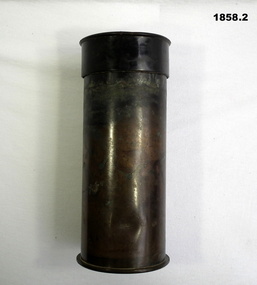
... .1 Rimmed brass case for "shotgun" type aircraft engine starting system. .2 Plastic end cap....machinery-engines military history-raaf .1 Base has "Cart Elec Eng Start MF 79/3 84 ME 7-79" .2 "Remove cap before loading EFM 79" .1 Rimmed brass case for "shotgun" type aircraft engine starting system. .2 Plastic end cap. ....1 Rimmed brass case for "shotgun" type aircraft engine starting system. .2 Plastic end cap..1 Base has "Cart Elec Eng Start MF 79/3 84 ME 7-79" .2 "Remove cap before loading EFM 79"machinery-engines, military history-raaf -
Moorabbin Air Museum
Manual (Item) - JAC Syllabus - Point Cook OTS Junior Officer Training
... Instruction Manual for Wolseley Aero Engines (Wolseley-Renault Types) Level of Importance: World. ...Instruction Manual for Wolseley Aero Engines (Wolseley-Renault Types) Level of Importance: World. ...Description: 78 pages. Published by Wolseley Motors Ltd. Published on unknown date. No. 552. Instruction Manual for Wolseley Aero Engines (Wolseley-Renault Types) Level of Importance: World. -
 Seaworks Maritime Museum
Shipbuilders model, MV Binsnes
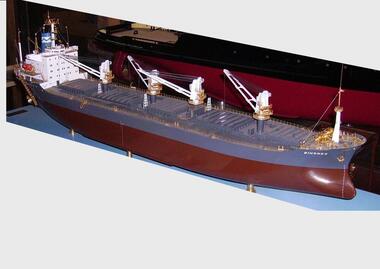
... Post 1997: 20,589g. 11,810n. 34,545d. 7-cyl. 2 S.C.S.A. (760 x 1,550mm) Sulzer 7RND76 type motor engine, manufactured by the shipbuilder at Tamashima, geared to a shaft with a controllable pitch propeller. 14,000bhp, 15½kts. ...Plaque at base: " M.V BISNES/ PRINCIPAL PARTICULARS OF 33,750 LTDW/ DIESAL BULK BARRIERS/ Length (overall) abt. 180.00 M/ length (between perpendiculars) 170.00 m, breadth (moulded) 28.40 M, Depth (moulded) 15.00 M/ Draft (designed loaded, moulded) 10.84 M/ Deadweight abt. 33.750 LT/ Gross Tonnage abt. 18,800 T/ Cargo Hold Capacity abt. 42,500 M/ Main Engine/ Type Sumitomo - Sulzer 7RND68 type main diesel engine/ Max Continuous Output BHP 14, 00 PSat 122 rpm/ Service speed at designed draft abt. 15.7 knots/ classification Lloyd's register of Shipping/ Keel -- Laying September 1976/ Launching December 1976/ Delivery April 1977/ Owner : Dillingham Jebsen Shipping Corporation, Liberia/ Builder: Sumitome Heavy Industries Ltd., Japan" second plaque: "MANUFACTURED BY/ FUJI BIJUTSU MOKEI CO., LTD/ TOKYO JAPAN" On model "Binsnes Monrovia"...Post 1997: 20,589g. 11,810n. 34,545d. 7-cyl. 2 S.C.S.A. (760 x 1,550mm) Sulzer 7RND76 type motor engine, manufactured by the shipbuilder at Tamashima, geared to a shaft with a controllable pitch propeller. 14,000bhp, 15½kts. ...BINSNES (3) 1974: Ordered by Dillingham, Jebsen Shipping Corp, Liberia, from Sumitomo Heavy Industries Ltd., Uraga (Yard No. 986). 3.12.1976: Launched. 27.4.1977: Completed. (O.N. 6815). As built: 19,196g. 12,572n. 34,544d. 180.02(BB) x 28.45 x 10.891 metres oa. Post 1997: 20,589g. 11,810n. 34,545d. 7-cyl. 2 S.C.S.A. (760 x 1,550mm) Sulzer 7RND76 type motor engine, manufactured by the shipbuilder at Tamashima, geared to a shaft with a controllable pitch propeller. 14,000bhp, 15½kts. Bulk carrier with four 15-ton cranes capable of operating grabs carried aboard. Leased to the British Phosphate Commission. 1981: Transferred to Pacnorse Shipping International Ltd. 1982: Transferred to Sanders Shipping Ltd., (AS Kristian Jebsens Rederi, managers), Philippines, and renamed GENERAL ROXAS. 1986: Transferred to Pacnorse Shipping Nine Ltd., (same managers). 1986: Sold to the USSR-Black Sea Shipping Company, Russia, and renamed VASILIJ (VASILIV?) AZHAYEV. 1997: Hero Maritime Ltd., (Ocean Agencies Ltd., managers), St. Vincent and The Grenadines, and renamed KARAGOL. 1999: Sold to Flagship Company Ltd., (Barclay Shipping Ltd., managers), Malta, and renamed MILTIADIS M. Sold to Shandong Province Marine Shipping, named Shun Ying or Shunying (Apr 2008?). Ship builder's model of bulk carrier M.V. Binsnes IMO 7426203 built in Japan 1976, 19,196 gross tonnes. Model - Hull painted in burgundy and grey, with four cranes and detailed deck fittings with white and gold highlights, a Liberian flag flying from the stern, raised on a laminated wooden base (lacking perspex cover). Original ship 590.66' x 93.34' x 35.73' (180.02 x 28.45 x 10.89m). Original ship was built by Sumimoto Heavy Industries and leased to the British Phosphate CommissionPlaque at base: " M.V BISNES/ PRINCIPAL PARTICULARS OF 33,750 LTDW/ DIESAL BULK BARRIERS/ Length (overall) abt. 180.00 M/ length (between perpendiculars) 170.00 m, breadth (moulded) 28.40 M, Depth (moulded) 15.00 M/ Draft (designed loaded, moulded) 10.84 M/ Deadweight abt. 33.750 LT/ Gross Tonnage abt. 18,800 T/ Cargo Hold Capacity abt. 42,500 M/ Main Engine/ Type Sumitomo - Sulzer 7RND68 type main diesel engine/ Max Continuous Output BHP 14, 00 PSat 122 rpm/ Service speed at designed draft abt. 15.7 knots/ classification Lloyd's register of Shipping/ Keel -- Laying September 1976/ Launching December 1976/ Delivery April 1977/ Owner : Dillingham Jebsen Shipping Corporation, Liberia/ Builder: Sumitome Heavy Industries Ltd., Japan" second plaque: "MANUFACTURED BY/ FUJI BIJUTSU MOKEI CO., LTD/ TOKYO JAPAN" On model "Binsnes Monrovia" -
 Bendigo Historical Society Inc.
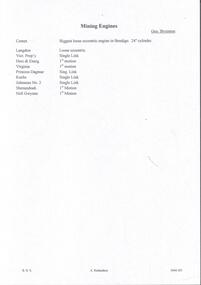
Document - MINING REPORTS - MINING ENGINES
... Handwritten notes mentioning the type of engine in the Comet, Langdon, Victoria Proprietory, Hercules & Energetic, Virginia, Princess Dagmar, Kochs, Johnsons No 2, Shenandoah and the Nell Gwynne Mines....DOCUMENT Mining Reports Mining Engines Comet Langdon Victoria Proprietory Hercules & Energetic Virginia Princess Dagmar Kochs Johnsons No 2 Shenandoah Nell Gwynne Geo Bryenton Handwritten notes mentioning the type of engine in the Comet, Langdon, Victoria Proprietory, Hercules & Energetic, Virginia, Princess Dagmar, Kochs, Johnsons No 2, Shenandoah and the Nell Gwynne Mines. ...Handwritten notes mentioning the type of engine in the Comet, Langdon, Victoria Proprietory, Hercules & Energetic, Virginia, Princess Dagmar, Kochs, Johnsons No 2, Shenandoah and the Nell Gwynne Mines.document, mining reports, mining engines, comet, langdon, victoria proprietory, hercules & energetic, virginia, princess dagmar, kochs, johnsons no 2, shenandoah, nell gwynne, geo bryenton -
 Australian Gliding Museum
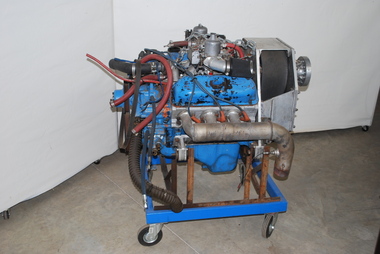
Machine - Auto-Tug Engine, 1983 or prior
... The use of the 1982 Ford V6 engine type for Pawnee tug conversions was discontinued when the General Motors LS1 5.7 litre V8 became available. ...The use of the 1982 Ford V6 engine type for Pawnee tug conversions was discontinued when the General Motors LS1 5.7 litre V8 became available. ...The 1982 Ford V6 engine, built at the Ford Essex Engine Plant at Windsor in Ontario Canada, was released by Ford for installation in a number of car and light truck models manufactured in Canada, United States, Mexico and Venezula. Production probably exceeded 7 million items. The Australian Gliding Museum’s exhibit was an engine converted for aircraft use that was bought for the Gliding Federation of Australia “Auto-Tug” program from Javelin Aircraft Company in Wichita in USA. “Auto-Tug” was an experimental program sponsored by the Gliding Federation of Australia to equip a glider – sailplane Piper Pawnee PA-25-150 tug with a water-cooled engine to alleviate the costs of running and maintaining the Lycoming engines fitted to Pawnee tugs in Australia. The program began in 1988 and was aimed at obtaining limited certification for converting dedicated glider – sailplane tow planes. The engine equipped with modified intake manifolds produced 198 hp for flight with the same propeller RPM for take-off as the original Lycoming 0-540 engine. However, fuel consumption was halved as the water cooling of the Ford engine enabled quicker descents with throttle closed following the release of the sailplane. Based on the results of GFA’s program, CASA concluded that engine was quite suitable for an aircraft installation and rated it more reliable than the equivalent Lycoming and Continental aircraft engine. The use of the 1982 Ford V6 engine type for Pawnee tug conversions was discontinued when the General Motors LS1 5.7 litre V8 became available. It is understood that a small number of conversions have been done using the LS1 engine. This brief history is based on information obtained from Mike Burns and David Sharples who were involved in the Auto-Tug program from 1988 to 1992. Technical information relating to the 1982 Ford V6 automotive engine is contained in a paper by D.L. Armstrong and G.F. Stirrat of the Engine Engineering Office at Ford. Indicative of technological experimentation in the sport of glidingFord auto engine mounted on mobile standaustralian gliding, glider, sailplane, auto-tug, pawnee, tug, auto, engine, motor, ford, gliding federation of australia, burns, sharples. -
 Melbourne Tram Museum
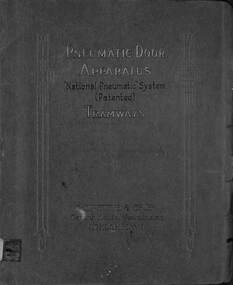
Manual, G D Peters & Co, "Pneumatic Door Apparatus", c1930
... Provides an introduction, system types, door engines, folding door and step equipment, treadle plates, electrical and pneumatic fittings and location advice. ...Provides an introduction, system types, door engines, folding door and step equipment, treadle plates, electrical and pneumatic fittings and location advice. ...Book published by G D Peters & Co. of Caxton House Westminster London detailing the National Pneumatic door control systems. Provides an introduction, system types, door engines, folding door and step equipment, treadle plates, electrical and pneumatic fittings and location advice. This type of equipment was used on Melbourne tram and buses. Has the stamp of the Melbourne agents - Railways & Rolling Stock Equipment Ltd. throughout.Yields information about the pneumatic door control systems of G D Peters.Book - green paper covers containing approx 90 pages detailing the equipment offered with some coloured diagrams. Pages secured by two metal clips.tramways, tramcars, g d peters, electro pneumatic, door controls, buses -
 Flagstaff Hill Maritime Museum and Village
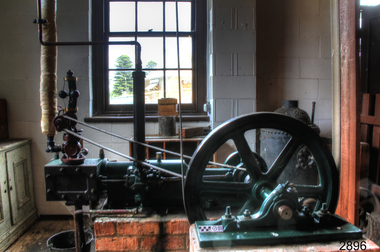
Machine - Steam Engine, Tangyes engineering, Mid-1880s
... engine...manufacturing...farming...pumps...lifting equipment...engines...machine tools...hydraulic rams...hydraulic pumps...steam pumps...differential pulleys...Mill type...When connected and powered up, the engine could drive an overhead line shaft via a flat belt off its flywheel. The line shaft would then drive the machinery via flat belts. It could drive virtually any type...Steam engine: stationary Tangye Size B, single-cylinder, horizontal Mill type steam engine. ...Steam engine: stationary Tangye Size B, single-cylinder, horizontal Mill type steam engine. ...This Tangye B-size, single-cylinder, horizontal steam engine was likely manufactured in England around the mid-1880s. It was distributed by Melbourne machinery merchants Cameron & Sutherland, which also operated in Bendigo and Ballarat. A local cheese maker once used the engine to drive factory equipment. It was later donated to the Warrnambool Technical School, which then donated it to Flagstaff Hill to add to its historical steam engine collection. Between its manufacture and its donation to Flagstaff Hill, the governor had been replaced by the current Pickering governor. This engine design was very popular in the late 19th and early 20th centuries. When connected and powered up, the engine could drive an overhead line shaft via a flat belt off its flywheel. The line shaft would then drive the machinery via flat belts. It could drive virtually any type of machinery, such as water and sewerage pumps, mine elevators, winches, cranes, metal forges, air blowers, and marine machinery. This engine features a mechanical governor, which controls the speed of the engine regardless of whether it is under load. It also has a water pump built into the valve rod, which is used to supply the boiler with water. Steam enters the cylinder via a slide valve and applies pressure to the piston; it is like a modern internal combustion engine, but in the case of the steam engine, the pressure is exerted in turn on either side of the piston. In other words, the connecting rod is pushed by steam via the piston and piston rod and then pulled back again by steam pushing on the opposite side of the piston. Thus, power is exerted almost continuously, except at the end of each piston stroke, when it reverses direction. In the 1880s, many local butter and cheese manufacturers installed Tangye steam engines to power their machinery. A comprehensive article in the Gippsland Mercury in September 1889 extolled the magnificence of the Farnham Butter Factory in Dennington, Warrnambool, and described how one Tangye engine was used to drive several machines in the cheese- and butter-making processes. A report in the Warragul Guardian in December 1890 notes that the newly opened Warrnambool Butter Factory used a Tangye steam engine to pump water from a 60-foot well. Tangye: Richard Tangye (1833–1906) and four of his brothers—James, Joseph, Edward, and George—were the sons of Joseph Tangye, a Quaker Cornish miner. In 1857, they founded the engineering firm Richard Tangye & Brothers in Birmingham, UK. In 1860, the firm became Tangye Brothers and moved to Cornwall Works in Birmingham. The business encouraged inventors to join the company and develop their patents there, as happened with Weston’s differential pulley block, invented by the Englishman Thomas Aldridge Weston in 1854. Tangye bought the patent in 1858, giving the firm the sole right to manufacture it. The design received a medal for “original application, practical utility and success” at the 1862 International Exhibition in London. Also in 1858, the Tangye firm was commissioned by Brunel’s shipping company to manufacture hydraulic lifting jacks, or rams, to launch the steamship SS Great Eastern. The success of this project brought favourable attention to the firm, and it became involved in other notable projects, including the erection of Cleopatra’s Needle in London in 1878 and work on the Forth Road Bridge in Scotland. The firm underwent several name changes over the years, including James Tangye and Brothers (1857), Tangye Brothers and Price (1859), Tangye Brothers (1860), Tangye Brothers & Holman (1876), Tangye Brothers (by 1878), Tangye Ltd. (1881), and then simply Tangye. Its machinery and equipment were exported worldwide. In 1884, a branch with showrooms, offices, and a warehouse was opened in Melbourne at Cornwall House, Collins Street West. The firm was well known for producing high-quality machinery for agriculture and industry. Even today, new Tangye machinery is available for a subsidiary of Allspeeds. An extensive account of the firm’s history, names, inventions, and further references is available in Grace’s Guide, which also includes references to and diagrams of the Tangye horizontal steam engine. The horizontal steam engine was made by the well-known engineering firm Tangye, known for its high quality of manufacture. It was an important development in machinery because it helped improve productivity. Engines of this type are still used in some parts of the world today. This engine is a good example of a late 19th-century steam engine used in industry and agriculture and adapted for many different purposes. It is also important locally because it was connected to a local cheese making business and part of the thriving western district dairy industry. It may have been one of the Tangyes engines used at the Farnham butter factory or the Warrnambool Butter Factory, which was reported to be one of the most important in the Colony. It is also connected to the Warrnambool Technical School, established in 1968. Steam engine: stationary Tangye Size B, single-cylinder, horizontal Mill type steam engine. It has a 4-inch diameter cylinder with an 8-inch stroke. The body is painted green, and the Pickering governor is red. It was manufactured in Birmingham, England, in accordance with Tangye's Patent 238930, and distributed by Cameron and Sunderland, Melbourne, in the mid-1880s. TANGEYS PATENT BIRMINGHAM B SIZE 238930 CAMERON & SUTHERLAND MELBOURNE THE PICKERING PORTLAND . GOVERNOR . CONN. U.S.A.flagstaff hill, warrnambool, maritime village, maritime museum, flagstaff hill maritime museum and village, shipwreck coast, great ocean road, machine, invention, engine, steam, steam engine, horizontal steam engine, tangyes horizontal steam engine, stationary steam engine, single cylinder steam engine, manufacturing, farming, pumps, lifting equipment, engines, machine tools, hydraulic rams, hydraulic pumps, steam pumps, differential pulleys, mill type steam engine, 4 inch cylinder, weston’s differential pulley, thomas aldridge weston, 1862 international exhibition in london, brunel, ss great eastern, cleopatra’s needle, forth road bridge, cornwall house, collins street melbourne, agricultural machinery, industrial machinery, allspeeds, dairy, pump, richard tangye & brothers, james tangye and brothers, tangye brothers and price, tangye brothers, tangye brothers & holman, tangyes ltd., tangye, richard tangye, james tangye, joseph tangye, edward tangye, george tangye, cornwall works, birmingham, pickering governor, pickering portland connecticut usa, 19th century, dairy plant, steam power, tangye's patent 238930, tangye b size engine, cameron & sutherland, machine merchants, 1880s, mid-1880s, cheese manufacturer, butter manufacturer, diary industry, warrnambool technical school, belt driven machinery, agriculture, mechanical governor, farnham butter factory, warrnambool butter factory -
 Ballarat Tramway Museum
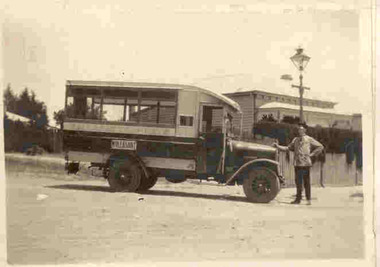
Photograph - ESCo or Ballarat Tramways motor bus, late 1920's
... The bus petrol engine International type was formerly in the possession of, one, Cruickshanks, an independent driver with a permit from the council to run between The Point of Pictures?...The bus petrol engine International type was formerly in the possession of, one, Cruickshanks, an independent driver with a permit from the council to run between The Point of Pictures? ...Photograph of ESCo or Ballarat Tramways motor bus, with the destination of Mt. Pleasant on the side. Driver W. Irwin? Handwritten caption by H.P. James. Note Item Not formally Numbered. Image btm2507i2 shows position on page relative to items 2507 to 2512. For a copy photograph of this image, see Reg Item 3813. High Res Images added 15/3/2011. Digital scan of a negative in the Wal Jack Collection added 21/4/2019 as image btm2510i4 Yields information about a vehicle the Electric Supply Co of Victoria used to provide additional services in Ballarat in the face of bus competition. See page 59 of Golden City and its Tramways for further information.Black and white photograph contained within Reg. Item 2488, page 55.Handwritten in Pencil under the photograph is "Here is an interesting picture. Note the driver he is W. Irwin who gave me these pictures for which I am very grateful. The bus petrol engine International type was formerly in the possession of, one, Cruickshanks, an independent driver with a permit from the council to run between The Point of Pictures?, Ness St, Mt Pleasant via Bond St, Peel St. to City but the Electric Supply Coy purchased the vehicle and ran it from 1927 to 1929 (unpayable). The most use it was put to was on Mt Pleasant, but it ran also to High School as replacement for trams on Sebas if an electric tram was derailed. Perhaps the most unique trips it ever made was between Forest St. Wendouree to the Aerodrome, 1929, on the occasions of any ?? flight. Again Mr Irwin was the driver (& made two trips)"tramways, trams, esco, motor buses, mt pleasant, cruickshanks -
 Bendigo Historical Society Inc.
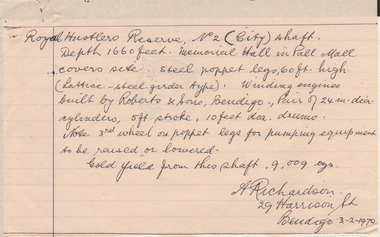
Document - ALBERT RICHARDSON COLLECTION: HANDWRITTEN report ROYAL HUSTLERS RESERVE
... Steel poppet legs, 60 ft high (lattice-steel garden type). Winding engines built by Roberts and Sons, Bendigo. ...Steel poppet legs, 60 ft high (lattice-steel garden type). Winding engines built by Roberts and Sons, Bendigo. ...Hand written letter signed by A. Richardson, 29 Harrison Street, Bendigo - 03/02/1970. Royal Hustler Reserve No. 2 (lift) shaft. Depth 1660 feet. Memorial Hall in Pall Mall covers site. Steel poppet legs, 60 ft high (lattice-steel garden type). Winding engines built by Roberts and Sons, Bendigo. Pair of 24 in. clear cylinders, 5ft stroke, 10ft ? drums. Note 3rd wheel on poppet legs for pumping equipment to be raised or lowered. Gold yield from this shaft 9,009 ounces.person, mining, albert richardson -
 Puffing Billy Railway
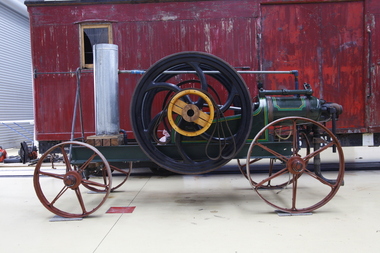
Blackstone Oil Engine, 6 November 1908
... The Lamp or hot-bulb engine (also hotbulb or heavy-oil engine) is a type of internal combustion engine. ...The Lamp or hot-bulb engine (also hotbulb or heavy-oil engine) is a type of internal combustion engine. ...8HP Blackstone Lamps Start Oil Engine engine number 71076 Engine Details Maximum operating RPM of 240. Fitted with a 3'9" Flywheel Tested on the 6th of November 1908. Shipped to Cluter buck South Australia for installation on concrete base. Recovered and restored during the 80's in South Australia Purchased privately in 2013 in Tailem Bend South Australia and transported to Victoria. Currently on loan to the Puffing Billy Museum at Menzies Creek as an operating exhibit. Blackstone & Co. was a farm implement maker at Stamford, Lincolnshire, United Kingdom. In 1896 they built lamp start oil engines. The Lamp or hot-bulb engine (also hotbulb or heavy-oil engine) is a type of internal combustion engine. It is an engine in which fuel is ignited by being brought into contact with a red-hot metal surface inside a bulb, followed by the introduction of air (oxygen) compressed into the hot-bulb chamber by the rising piston. There is some ignition when the fuel is introduced, but it quickly uses up the available oxygen in the bulb. Vigorous ignition takes place only when sufficient oxygen is supplied to the hot-bulb chamber on the compression stroke of the engine. Most hot-bulb engines were produced as one-cylinder, low-speed two-stroke crankcase scavenged units Historic - Industrial - single cylinder, horizontal, 4 stroke, hot-bulb ignition oil engine Blackstone 8HP Oil Engine made from steel, wrought iron and brassOval Plate with Black Stones and Clutter Buck Brass Plaque engine number 71076blackstone, oil engine, clutter buck, black stone, puffing billy, hit and miss, engine, blackstone & co -
 Puffing Billy Railway
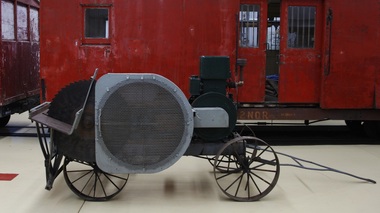
New Record Saw Bench, circa 1930's
... With hopper cooling and a fuel tank between the skids, and weighing only 240 pounds (109 kg), it was easy to mount on wheeled transport, making the Champion a self-contained mobile source of power. Engines of this type were used in rural areas for driving chaff cutters, small saw benches, pumps and orchard sprayers. ...With hopper cooling and a fuel tank between the skids, and weighing only 240 pounds (109 kg), it was easy to mount on wheeled transport, making the Champion a self-contained mobile source of power. Engines of this type were used in rural areas for driving chaff cutters, small saw benches, pumps and orchard sprayers. ...Saw Bench - New Record Saw Bench Timber framed with steel wheels, belt driven saw blade powered by a Rosbery internal combustion engine. The Rosebery Engine No C28437 R.P.M 800 H.P. 6 Manufactured By Westinghouse Rosebery Pty.Ltd. Sydney Rosebery Engine Works Ltd began as the engine and pump manufacturing division of Buzacott & Company, and in 1923 became an incorporated company. In 1935, Westinghouse gave Rosebery Engine Works the right to manufacture and sell nearly all Westinghouse products. The name of the company then changed to Westinghouse Rosebery Ltd From the late nineteenth century, petrol engines gradually supplanted steam engines for running a wide range of machines, and in turn petrol engines were largely supplanted by electric motors. The Champion was a successful small petrol engine made by the large Sydney company, Westinghouse Rosebery, based on the American-designed Fuller and Johnson engine. With hopper cooling and a fuel tank between the skids, and weighing only 240 pounds (109 kg), it was easy to mount on wheeled transport, making the Champion a self-contained mobile source of power. Engines of this type were used in rural areas for driving chaff cutters, small saw benches, pumps and orchard sprayers. These engines were also commonly used in both rural and urban areas for powering concrete mixers. Both Westinghouse Rosebery in NSW and Toowoomba Foundry in Queensland made these engines in large quantities, beginning in the 1920s when tariff protection made local manufacturing viable. The production of small petrol engines continued in Australia until the 1970s, when reduced tariff protection led to increased competition from cheaper imported engines. Historic - Industrial Timber working - belt driven saw blade powered by a Rosbery internal combustion engine. Timber framed with steel wheels, belt driven saw blade powered by a Rosbery internal combustion engine. The Rosebery Engine No c28437 R.P.M 800 H.P. 6 Manufactured By Westinghouse Rosebery Pty.ltd. Sydneysaw bench, puffing billy, new record, internal combustioin, westinghouse rosebery pty.ltd., rosebery pty, internal combustion engine. -
 Seaworks Maritime Museum
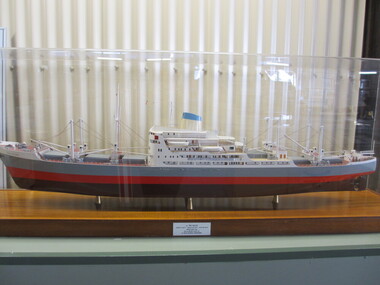
Shipbuilders model, Tri Ellis
... This engine was based no a Burmeister and Wain design but H & W gave these engines their own type designation. Sailed on board its maiden voyage to Australia via Casablanca Morocco where she collected her first load of phosphate. ...This engine was based no a Burmeister and Wain design but H & W gave these engines their own type designation. Sailed on board its maiden voyage to Australia via Casablanca Morocco where she collected her first load of phosphate. ...Model ship was presented to the Melbourne Maritime Museum by the British Phosphate Commissioners. Built as Tri-Ellis (1958-74), Tryphena (1974-78), Man Tat (1978-80), 1980 broken up. DWT 13,756 SPEED 14 KNOTS.AT 112RPM. BOILERS LARKSON TRIMBLETUBE. FUEL CONSUMPTION 7 TPD. GENERATORS W.H.ALLEN - 4CYL.2SA290/470. 480B.H.P.320L.W.-220V 333RPM DAILY CONS - 1.5 TONS. EMERGENCY GEN R & H. 40 K.N. -220V. REFRIGERATING MACH: J & G HALL LTD. SUPERSTRUCTURE: FORECASTLE 62'..2 DECKS RIVETED AND WELDED. CARGO BATTONS NOT FITTED. 9 BULKHEADS. RISE OF FLOOR 6".WATER BALLAST 3,296 TONS INCLUDING TUNNEL TANKS 1,341 TONS. 'TWEEN- DECKS FORWARD 274 TONS. REFRIGERATED CARGO INSTALLATION - 6 HOLDS - 55.2',52',54',59.5',43' ,53'. GRAIN CAPACITY :621,640 CU. FT. BALE CAPACITY : 573,810 CU. FT. INSULATED CAPACITY : 5,050 CU.FT. 6 STEEL HATCHWAYS (27',30',30'* 30') (30'* 27.75') (27', 24' * 28' ). 12 WINCHES...DERRICKS 1 (25), 2 (10), 10 (5). MACHINERY: OIL 2SA 7CY.C20 * 1400MM EXHAUST 470MM. 6500 BHP. FUEL BUNKERS: 2135 TONS HIGH VISCOCITY FUEL. The main engine was an opposed piston type Harland & Wolff 6-620/ 1870 6 for the number of cylinders.. 620 for the cylinder bore and 1870 for the combined strokes of the main exhaust pistons in each cylinder. This engine was based no a Burmeister and Wain design but H & W gave these engines their own type designation. Sailed on board its maiden voyage to Australia via Casablanca Morocco where she collected her first load of phosphate. We sailed to Geelong via the Suez canal and the Port of Aden (Yemen) and Freemantle. The first load of phosphate was unloaded at Corio Bay (geelong) Formerly part of the collection of Melbourne shipping company, Howard Smith Ltd. Ship builder's model of the cargo ship Tri-Ellis IMO 5368196 - Body of moulded polyurethane painted in red, black and grey, the deck painted in red, with detailed fittings, machinery, rigging and superstructure, raised on a wooden base. Original ship built Clyde 1958, 11,761 gross tonnes, 531.5' x 68' x 31' (162.0 x 20.73 x 9.45m)plaque at foot of model "MV TRI ELLIS/ LENGTH B.P. 486'-3"- BREADTH MLD 68'0" - DEPTH MLD 40'6"/ TONNAGE GROSS 11,760/ Built by HARLAND & WOLFF LTD/ For BRITISH PHOSPHATE COMMISSIONERS" On model "TRI-ELLIS" painted black -
 Flagstaff Hill Maritime Museum and Village
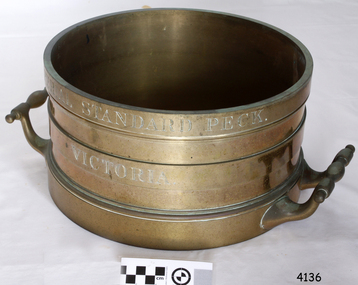
Functional object - Standard Measure, James McEwan & Co, 1860s-1900s
... This company provided and sold a large and varied amount of imported goods into the colony; agricultural equipment, building materials, mining items, steam engines, tools of all types and marble fireplaces. The company grew to employ over 150 people in Melbourne and opened offices at 27 Lombard St, London, as well as in New Zealand and Fiji. ...This company provided and sold a large and varied amount of imported goods into the colony; agricultural equipment, building materials, mining items, steam engines, tools of all types and marble fireplaces. The company grew to employ over 150 people in Melbourne and opened offices at 27 Lombard St, London, as well as in New Zealand and Fiji. ...This container is a pre-Decimal, Imperial Standard Peck, part of a three-piece set of Standard measures used in Victoria from around 1900 to 1940. The measures were made in Melbourne by J. McEwan & Co. These three measures were likely used by the local Melbourne authority that monitored weights and measures in the mid to late 19th century. . An Imperial Bushel was equal to 8 gallons, or 36.36872 litres . An Imperial Peck equals a quarter of a Bushel, or 9.09 litres Standards for weights and measures began in Victoria when the Melbourne Observatory received primary sets of Imperial Standard Weights and Measures from Britain. These were tested against the then British Imperial Standards to measure length, weight and currency. Administrative bodies in the Colony of Australia could then compare their weights and measures against these British Primary Standards and adjust their Measures accordingly, to maintain the Standards. The Weights and Measures Act of 1862 was passed in Victoria, and local inspectors were established throughout the colony. By the 1870s, local councils and shires in Victoria held a set of Standards used to test scales, weights, and measures used by manufacturers, wholesalers, and retailers. Every ten years, the councils’ Standards needed to be rechecked against the Victorian Standards. In the 19th Century, the Victorian Customs Department inspected and maintained the Standards. In 1901, the Customs Department was transferred to the Federal Government, but the Weights and Measures authority remained with the Victorian Government and relocated to the Melbourne Observatory. In 1904, the Standard weights and measures, and testing equipment, were installed in the room of a new building erected at the south end of the Great Melbourne Telescope House. The room became known as the Whirling Room, due to its large whirling apparatus that tested air meters. When the Melbourne Observatory closed in 1944, the Weights and Measures Branch was formed to continue maintaining the Standards. On February 14th, 1966, Australia began its conversion to metric measures and currency, and a new set of Standard Measures was introduced; the conversion took place in stages. The Weights and Measures Branch remained at the Observatory site until 1995. James McEwan & Co.: - The maker of this set of Standard Measures was James McEwan. His Melbourne business was established in 1852 and sold retail furniture and wholesale ironmongery. The firm’s warehouses were situated at the intersection of 81-83 Elizabeth and Little Collins Streets. Shortly afterwards, the firm partnered with William Kerr Thomson and Samuel Renwick. When McEwan died in 1868, his partners carried on and expanded the business under his name, J McEwan. The business was expanded to provide a retail shop, counting-house and private offices. Wholesale warehouses adjoined these premises at 4, 6 and 10 Little Collins Street, West. This company provided and sold a large and varied amount of imported goods into the colony; agricultural equipment, building materials, mining items, steam engines, tools of all types and marble fireplaces. The company grew to employ over 150 people in Melbourne and opened offices at 27 Lombard St, London, as well as in New Zealand and Fiji. It also serviced the Mauritius islands and the Pacific area with its steamship, the Suva, and a brig, the Shannon. The set of Imperial Standard Measures is an example of a bronze measure container made specifically for J. McEwan & Co. Today, it helps us to understand how imperial weights and measures were used, and how a standard of measurement for merchants was developed in the Australian colonies based on the Imperial British measurement system. The container has social significance as an item retailed by J McEwan, and used by Victoria’s authorities legally responsible for ensuring that dry goods sold in Victoria by wholesalers and retailers are correct. Imperial Standard Measure: a container to measure the volume of a Peck. It is part of a set of three precision measures - a Peck, a Half Bushel and a Bushel – used by government authorities in Victoria. The cast brass cylinder has straight sides and a flat base, and two handles are attached near the base by two posts on each handle. The wall inside is straight, and outside has grooves and horizontal bands. Inscriptions are engraved on the outside. The Measures were made for the retailer, J. McEwan & Co., London and Melbourne. Engraved on side: "IMPERIAL STANDARD PECK. / VICTORIA."flagstaff hill, flagstaff hill maritime museum and village, warrnambool, maritime museum, maritime village, great ocean road, shipwreck coast, weights and measurements, science, james mcewan & co., precision instrument, technology, melbourne observatory, british imperial standards, standard weights & measures, volume measure, dry measure, customs, commerce, victorian standard measure, pre-decimal measure, imperial standard, imperial bushel, imperial half bushel, imperial peck, peck measure, bronze container, brass container, cast container -
 Flagstaff Hill Maritime Museum and Village
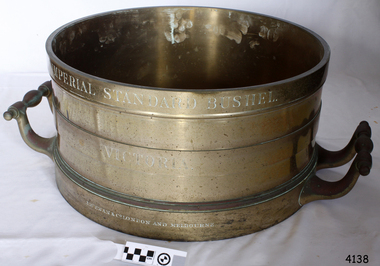
Functional object - Standard Measure, James McEwan & Co, 1860s-1900s
... This company provided and sold a large and varied amount of imported goods into the colony; agricultural equipment, building materials, mining items, steam engines, tools of all types and marble fireplaces. The company grew to employ over 150 people in Melbourne and opened offices at 27 Lombard St, London, as well as in New Zealand and Fiji. ...This company provided and sold a large and varied amount of imported goods into the colony; agricultural equipment, building materials, mining items, steam engines, tools of all types and marble fireplaces. The company grew to employ over 150 people in Melbourne and opened offices at 27 Lombard St, London, as well as in New Zealand and Fiji. ...This container is a pre-Decimal, Imperial Standard Bushel, part of a three-piece set of Standard measures used in Victoria from around 1900 to 1940. The measures were made in Melbourne by J. McEwan & Co. These three measures were likely used by the local Melbourne authority that monitored weights and measures in the mid to late 19th century. . An Imperial Bushel was equal to 8 gallons, or 36.36872 litres . An Imperial Peck equals a quarter of a Bushel, or 9.09 litres Standards for weights and measures began in Victoria when the Melbourne Observatory received primary sets of Imperial Standard Weights and Measures from Britain. These were tested against the then British Imperial Standards to measure length, weight and currency. Administrative bodies in the Colony of Australia could then compare their weights and measures against these British Primary Standards and adjust their Measures accordingly, to maintain the Standards. The Weights and Measures Act of 1862 was passed in Victoria, and local inspectors were established throughout the colony. By the 1870s, local councils and shires in Victoria held a set of Standards used to test scales, weights, and measures used by manufacturers, wholesalers, and retailers. Every ten years, the councils’ Standards needed to be rechecked against the Victorian Standards. In the 19th Century, the Victorian Customs Department inspected and maintained the Standards. In 1901, the Customs Department was transferred to the Federal Government, but the Weights and Measures authority remained with the Victorian Government and relocated to the Melbourne Observatory. In 1904, the Standard weights and measures, and testing equipment, were installed in the room of a new building erected at the south end of the Great Melbourne Telescope House. The room became known as the Whirling Room, due to its large whirling apparatus that tested air meters. When the Melbourne Observatory closed in 1944, the Weights and Measures Branch was formed to continue maintaining the Standards. On February 14th, 1966, Australia began its conversion to metric measures and currency, and a new set of Standard Measures was introduced; the conversion took place in stages. The Weights and Measures Branch remained at the Observatory site until 1995. James McEwan & Co.: - The maker of this set of Standard Measures was James McEwan. His Melbourne business was established in 1852 and sold retail furniture and wholesale ironmongery. The firm’s warehouses were situated at the intersection of 81-83 Elizabeth and Little Collins Streets. Shortly afterwards, the firm partnered with William Kerr Thomson and Samuel Renwick. When McEwan died in 1868, his partners carried on and expanded the business under his name, J McEwan. The business was expanded to provide a retail shop, counting-house and private offices. Wholesale warehouses adjoined these premises at 4, 6 and 10 Little Collins Street, West. This company provided and sold a large and varied amount of imported goods into the colony; agricultural equipment, building materials, mining items, steam engines, tools of all types and marble fireplaces. The company grew to employ over 150 people in Melbourne and opened offices at 27 Lombard St, London, as well as in New Zealand and Fiji. It also serviced the Mauritius islands and the Pacific area with its steamship, the Suva, and a brig, the ShannonThe set of Imperial Standard Measures is an example of a bronze measure container made specifically for J. McEwan & Co. Today, it helps us to understand how imperial weights and measures were used, and how a standard of measurement for merchants was developed in the Australian colonies based on the Imperial British measurement system. The container has social significance as an item retailed by J McEwan, and used by Victoria’s authorities legally responsible for ensuring that dry goods sold in Victoria by wholesalers and retailers are correct.Imperial Standard Measure: a container to measure the volume of a Busel. It is part of a set of three precision measures - a Peck, a Half Bushel and a Bushel – used by government authorities in Victoria. The cast brass cylinder has straight sides and a flat base, and two handles are attached near the base by two posts on each handle. The wall inside is straight, and outside has grooves and horizontal bands. Inscriptions are engraved on the outside. The Measures were made for the retailer, J. McEwan & Co., London and Melbourne.Engraved on side: "IMPERIAL STANDARD BUSHEL. / VICTORIA ./ J. MCEWAN & CO. LONDON AND MELBOURNE."flagstaff hill, flagstaff hill maritime museum and village, warrnambool, maritime museum, maritime village, great ocean road, shipwreck coast, weights and measurements, science, james mcewan & co., precision instrument, technology, melbourne observatory, british imperial standards, standard weights & measures, volume measure, dry measure, customs, commerce, victorian standard measure, pre-decimal measure, imperial standard, imperial bushel, peck measure, bronze container, brass container, cast container -
 Flagstaff Hill Maritime Museum and Village
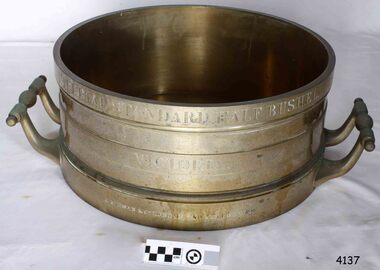
Equipment - Standard Measure, James McEwan & Co, 1860s-1900s
... This company provided and sold a large and varied amount of imported goods into the colony; agricultural equipment, building materials, mining items, steam engines, tools of all types and marble fireplaces. The company grew to employ over 150 people in Melbourne and opened offices at 27 Lombard St, London, as well as in New Zealand and Fiji. ...This company provided and sold a large and varied amount of imported goods into the colony; agricultural equipment, building materials, mining items, steam engines, tools of all types and marble fireplaces. The company grew to employ over 150 people in Melbourne and opened offices at 27 Lombard St, London, as well as in New Zealand and Fiji. ...This container is a pre-Decimal, Imperial Standard Half Bushel, part of a three-piece set of Standard measures used in Victoria from around 1900 to 1940. The measures were made in Melbourne by J. McEwan & Co. These three measures were likely used by the local Melbourne authority that monitored weights and measures in the mid to late 19th century. . An Imperial Bushel was equal to 8 gallons, or 36.36872 litres . An Imperial Peck equals a quarter of a Bushel, or 9.09 litres Standards for weights and measures began in Victoria when the Melbourne Observatory received primary sets of Imperial Standard Weights and Measures from Britain. These were tested against the then British Imperial Standards to measure length, weight and currency. Administrative bodies in the Colony of Australia could then compare their weights and measures against these British Primary Standards and adjust their Measures accordingly, to maintain the Standards. The Weights and Measures Act of 1862 was passed in Victoria, and local inspectors were established throughout the colony. By the 1870s, local councils and shires in Victoria held a set of Standards used to test scales, weights, and measures used by manufacturers, wholesalers, and retailers. Every ten years, the councils’ Standards needed to be rechecked against the Victorian Standards. In the 19th Century, the Victorian Customs Department inspected and maintained the Standards. In 1901, the Customs Department was transferred to the Federal Government, but the Weights and Measures authority remained with the Victorian Government and relocated to the Melbourne Observatory. In 1904, the Standard weights and measures, and testing equipment, were installed in the room of a new building erected at the south end of the Great Melbourne Telescope House. The room became known as the Whirling Room, due to its large whirling apparatus that tested air meters. When the Melbourne Observatory closed in 1944, the Weights and Measures Branch was formed to continue maintaining the Standards. On February 14th, 1966, Australia began its conversion to metric measures and currency, and a new set of Standard Measures was introduced; the conversion took place in stages. The Weights and Measures Branch remained at the Observatory site until 1995. James McEwan & Co.: - The maker of this set of Standard Measures was James McEwan. His Melbourne business was established in 1852 and sold retail furniture and wholesale ironmongery. The firm’s warehouses were situated at the intersection of 81-83 Elizabeth and Little Collins Streets. Shortly afterwards, the firm partnered with William Kerr Thomson and Samuel Renwick. When McEwan died in 1868, his partners carried on and expanded the business under his name, J McEwan. The business was expanded to provide a retail shop, counting-house and private offices. Wholesale warehouses adjoined these premises at 4, 6 and 10 Little Collins Street, West. This company provided and sold a large and varied amount of imported goods into the colony; agricultural equipment, building materials, mining items, steam engines, tools of all types and marble fireplaces. The company grew to employ over 150 people in Melbourne and opened offices at 27 Lombard St, London, as well as in New Zealand and Fiji. It also serviced the Mauritius islands and the Pacific area with its steamship, the Suva, and a brig, the Shannon.The set of Imperial Standard Measures is an example of a bronze measure container made specifically for J. McEwan & Co. Today, it helps us to understand how imperial weights and measures were used, and how a standard of measurement for merchants was developed in the Australian colonies based on the Imperial British measurement system. The container has social significance as an item retailed by J McEwan, and used by Victoria’s authorities legally responsible for ensuring that dry goods sold in Victoria by wholesalers and retailers are correct.Imperial Standard Measure: a container to measure the volume of a Half Bushel. It is part of a set of three precision measures - a Peck, a Half Bushel and a Bushel – used by government authorities in Victoria. The cast brass cylinder has straight sides and a flat base, and two handles are attached near the base by two posts on each handle. The wall inside is straight, and outside has grooves and horizontal bands. Inscriptions are engraved on the outside. The Measures were made for the retailer, J. McEwan & Co., London and Melbourne. Engraved test: "IMPERIAL STANDARD HALF BUSHEL. / VICTORIA / J. MCEWAN & O. LONDON AND MELBOURNE."flagstaff hill, flagstaff hill maritime museum and village, warrnambool, maritime museum, maritime village, great ocean road, shipwreck coast, weights and measurements, science, james mcewan & co., precision instrument, technology, melbourne observatory, british imperial standards, standard weights & measures, volume measure, dry measure, customs, commerce, victorian standard measure, pre-decimal measure, imperial standard, imperial half bushel, bronze container, brass container, cast container -
 Flagstaff Hill Maritime Museum and Village
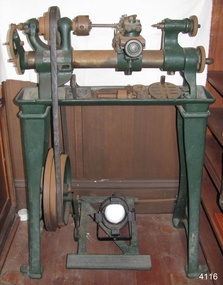
Machine - Treadle Lathe, 1920-1923
... type to be built in England. It was followed (1928) by an hydraulic version for turning gear blanks, and similar work. Further developments provided machines which, during the Second World War, turned all the crankshafts and propeller shafts for Bristol engines. ...type to be built in England. It was followed (1928) by an hydraulic version for turning gear blanks, and similar work. Further developments provided machines which, during the Second World War, turned all the crankshafts and propeller shafts for Bristol engines. ...The lathe-making business incorporated in 1902 as Drummond Bros Ltd originated in the fertile mind of Mr Arthur Drummond, said to have been living at that time at Pinks Hill, on the southern edge of Broad Street Common, west of Guildford. Mr Drummond, whose accomplishments included several pictures hung in the Royal Academy, was unable to find a lathe suitable for use in model engineering. In 1896 he designed for himself a ‘small centre lathe … which had a compound slide rest with feed-screws and adjustable slides’. He also designed and built ‘lathes of 4.5 inch and 5 inch centre height, which had beds of a special form whereby the use of a gap piece was eliminated but the advantages of a gap-bed lathe were retained’. Assisted by his brother, Mr Frank Drummond, who had served an apprenticeship to an engineering firm at Tunbridge Wells, the first lathes were made in a workshop adjoining Arthur Drummond’s house. The demand that speedily built up led to the decision to form a company and manufacture the lathes for sale commercially. Land was acquired nearby, at Rydes Hill, and the first factory built. The enterprise was a success, and the company quickly established ‘a high reputation in this country and abroad for multi-tool and copying lathes, and gear-cutting machines’. Other lathes were added to the range, including the first of the ’round bed’ machines for which the firm became widely known. A Drummond 3.5 inch lathe was among the equipment of Captain Scott’s 1912 expedition to the South Pole, and large numbers of 3.5 inch and 4 inch designs were exported to Australia, Canada and India. By the outbreak of war in 1914, 5 inch, 6 inch and 7 inch screw cutting lathes, arranged for power drive, were on sale. Large orders were received from the government for 3.5 inch lathes, for use in destroyers and submarines, and 5 inch lathes for the mechanised section of the Army Service Corps. The latter were used in mobile workshops. The factory worked night and day to supply the forces’ needs, until production was disrupted by a fire which destroyed a large part of the works in May 1915. As soon as rebuilding was complete work restarted. At the end of the war the entire production was being taken by the Government departments, a special feature being a precision screw lathe, bought by the Ministry of Munitions in 1918. Between the wars Drummond Bros Ltd introduced new machines for the motor vehicle, and later the aircraft industry, and the works were extended on many occasions to fulfill the increasing orders. The Maxicut multi-tool lathe (1925), designed for high-production turning operations, was one of the first machines of this type to be built in England. It was followed (1928) by an hydraulic version for turning gear blanks, and similar work. Further developments provided machines which, during the Second World War, turned all the crankshafts and propeller shafts for Bristol engines. Others, ordered by the Ministry of Supply were employed in turning shells, and many other specific needs of vehicle and aircraft manufacture were catered for by new types of Drummond lathes. Production of the small centre lathes ceased during the war when the company needed to concentrate on building multi-tool lathes and gear shapers. After the war a completely new Maxicut range was introduced, replacing the older versions, and fully automatic. The types were continually developed, and new versions manufactured until the end of the company’s life in 1980. The disappearance from the scene of Mr Arthur Drummond in 1946, and the end of the company’s autonomous existence in 1953 when the company was acquired by William Asquith Ltd, which was in turn bought by Staveley in 1966, meant that the factory at Rydes Hill became one – albeit very effective – part of a large national engineering company. Achievements at the Guildford works during its last years included the development of automated Maxicut gear-shapers in what was ‘probably the most fully automated gear shop in the country’, while a machine from Guildford was sent to the Osaka Fair in 1962. In 1963 an agreement was signed with Hindustan Machine Tools for the manufacture of Maxicut gear-shapers in state owned factories in Bangalore and Chandigarh. During 1963 the two largest multi-tool lathes ever made in the UK were installed in Ambrose Shardlow’s works in Sheffield for handling cranks up to 14 foot long. In 1976 Drummond lathes were included in Staveley’s £14,000,000 installation in Moscow of an automated production line for Zil motor cars. Up to the end invention continued at Guildford: a new Drummond Multi-turn memory-controlled machine was shown at the International Machine Tool Exhibition in 1977. This could not save the works from the pressures of the late 1970s, and Staveley Industries closed its Guildford site in 1980.An early example of a lathe that was designed primarily for the hobbyist model maker. It is in good condition and sought today by collectors as many of it's attributes were innovative at the time and lead to further development and incorporation of some of its features into more industrial models of production machinery. Lathe, round bed, treadle powered lathe, Drummond Type A, Serial number and maker's inscription. 1920-1923, Made by Drummond Brothers in Guildford, Surrey, England. Lathe is complete with Chuck, Tool post and Tail Stock in situ (30 extra parts)"MADE BY DRUMMOND BROTHERS LIMITED - PATENT TEES - RYDE'S HILL n GUILDFORD SURREY", "Serial Number 01470," "L44" or "L45 " flagstaff hill, warrnambool, shipwrecked coast, flagstaff hill maritime museum, maritime museum, shipwreck coast, flagstaff hill maritime village, great ocean road, lathe 1920-1923, round bed lathe, treadle lathe, drummond type a, guildford surrey, drummond brothers guildford surrey england, tread'e -
 Flagstaff Hill Maritime Museum and Village
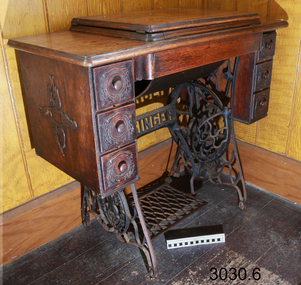
Domestic object - Sewing Machine, Singer Sewing Machine Company, 1907 -1920 (see note section this document for further information regards model identification)
... Industrial sewing machines, in combination with the cotton gin, the spinning jenny, and the steam engine, made clothing production much easier and much cheaper. warrnambool shipwrecked-coast flagstaff-hill flagstaff-hill-maritime-museum shipwreck-coast flagstaff-hill-maritime-village sewing-machine clothes repair singer sewing machine Lotus decoration to machine Singer sewing machine treadle type wooden stand with six drawers plus instruction manual Domestic object Sewing Machine Singer Sewing Machine Company ...In 1867 the Singer Company decided that the demand for their sewing machines in the UK was sufficiently high to open a local factory. Glasgow was selected for its iron-making industries, cheap labour, and possibly because at the time the General Manager of the US Singer Sewing Machine Company was George McKenzie, who was of Scottish descent. The company obtained a lease on land near Queen Street Station and machinery and machine parts were shipped over from the US. Demand for sewing machines outstripped production at the new plant and by 1873 a new larger factory was completed near Bridgeton Cross. By now Singer employed over 2,000 people in Scotland but still, they could not produce enough machines. In 1882 George McKenzie, the soon to become President of the Singer Sewing Machine Company undertook the ground breaking ceremony on 46 acres of farmland at Kilbowie, Clydebank and the largest Singer factory in the world started to be built. Originally two main buildings were constructed. Built above the middle wing of the factory was a huge clock tower with the 'Singer' name displayed for all to see from miles around. Many miles of railway lines were laid throughout the factory to connect the different departments and to aid in the shipping of their goods. Railway lines from the factory connected Glasgow, Dumbarton, and Helensburgh stations. The factory was regarded as the most modern facility in Europe at that time. As different departments in the factory were completed, the workers moved from the old sites to the new one at Kilbowie and the factory was finally finished in 1885. With nearly a million square feet of space and almost 7,000 employees producing on average 13,000 machines a week, making it the largest sewing machine factory in the world. The Clydebank factory was so productive that in 1905 the US Singer Company set up the Singer Manufacturing Company Ltd. as a UK registered company. The invention of the sewing machine had several very significant impacts on the lives of many people. It changed the domestic life of many women as more households began to own sewing machines, women as the ones who traditionally stayed home to do chores including making and repairing clothing, found themselves with more free time. Previously several days a week would be dedicated to sewing clothing for herself and her family, a housewife could now complete her sewing in merely several hours, allowing for more free time to pursue hobbies and attain new skills. Sewing and clothing production, in general, became more industrialized activities, taking place less in the home and more in large factories. Industrial sewing machines, in combination with the cotton gin, the spinning jenny, and the steam engine, made clothing production much easier and much cheaper. Singer sewing machine treadle type wooden stand with six drawers plus instruction manual Lotus decoration to machinewarrnambool, shipwrecked-coast, flagstaff-hill, flagstaff-hill-maritime-museum, shipwreck-coast, flagstaff-hill-maritime-village, sewing-machine, clothes repair, singer sewing machine -
 Flagstaff Hill Maritime Museum and Village
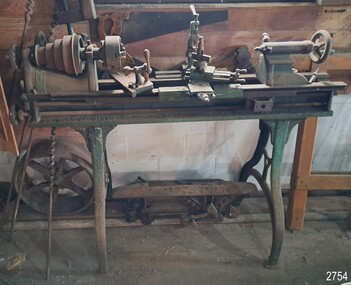
Machine - Lathe, W F & John Barnes, early 1900s
... type, steam-powered woodworking machine. Its bench is supported by decorative posts at each end, with each post dividing into arched legs. The lathe is mechanically connected to both a pulley and a flywheel, designed to be operated in conjunction with a steam engine. ...type, steam-powered woodworking machine. Its bench is supported by decorative posts at each end, with each post dividing into arched legs. The lathe is mechanically connected to both a pulley and a flywheel, designed to be operated in conjunction with a steam engine. ...This woodworking lathe, connected to both a pulley and a flywheel, demonstrates its historical operation with a steam engine. Such a configuration reflects manufacturing practices from the late 1800s and early 1900s, when steam power was the predominant source for driving workshop and factory machinery. Large machine shops often utilised a single power source, distributing power via roof-mounted belts and pulleys to operate several machines simultaneously. Over time, petrol-driven motors were introduced, and eventually, electricity became the standard power source. Conversion kits were made available in the late 19th and early 20th centuries to adapt older lathes to these newer, cleaner fuels. Manufacturer's History: W.F. & J. Barnes was a renowned maker of hand- and foot-powered treadle woodworking and metalworking machinery, established in 1869. The partnership between William F. Barnes and John Barnes was formalised in 1872, and the firm was incorporated in 1884. Their machines were used for both ‘farm’ applications and professional engineering. By 1881, the company began producing electrically powered machinery. By 1937, W.F. & J. Barnes expanded into manufacturing machinery for automotive assembly. The business closed in 1983, and in 1998, LeBlond Ltd. of Ohio acquired the firm. The lathe was donated by Briggs Marine, Melbourne: In Flagstaff Hill’s formative years, 1972-1975, Briggs Marine, Melbourne (Briggs Brass Foundry), donated equipment and objects used or made at their premises. The foundry was established in 1912 by Herbert Harrison Briggs. In 1965, the firm was owned by partners Cyril Briggs and Frank Lee: Cyril died in 1967, and Frank died in 1971, so the foundry was then run by his son and daughter-in-law, Les and Eva Lee. Briggs Marine’s Warrnambool Branch closed in 1972 after the death of Frank Lee in 1971. Flagstaff Hill’s founding director, John Lindsay, recalled that Briggs Marine’s family members gave personal assistance in setting up the displays in the original village shops, particularly the ‘Brass Foundry’ building, around the time the Maritime Museum opened in 1975. Briggs Marine still exists today, but the Briggs family is no longer involved. This early 1900s lathe marks a significant stage in the evolution of machinery, positioned between the era of hand-operated machines and the advent of electrically powered equipment. Its presence exemplifies the progression of industrial technology and craftsmanship during this period. The lathe is particularly notable for its association with the Briggs Brass Foundry. The foundry was known for developing a specialised brass alloy composed of non-ferrous metals, a formulation that resulted in durable products built to withstand the demanding conditions of marine environments. This focus on resilience and longevity made Briggs Brass Foundry’s goods highly sought after within the maritime sector. Briggs Maine, a long-established business, utilised the foundry’s capabilities to create cast goods tailored to the needs of the marine industry. The facility was equipped to deliver both custom-designed and mass-produced items, ensuring versatility in meeting various requirements. Many of Briggs Foundry’s products found their place on sailing and steam vessels throughout Victoria’s coastline, including in the port town of Warrnambool, where there was once a brancy of Briggs Marine. In addition to general marine fittings, Briggs Marine earned recognition for its expertise in bell-founding. The foundry’s reputation is closely linked to the restoration of the Schomberg Bell at Flagstaff Hill, a small but historically significant bell from a luxury migrant vessel dating back to the mid-19th century. The successful restoration of the Schomberg Bell demonstrates Briggs Brass Foundry’s commitment to preserving craftsmanship and maritime heritage.The lathe is a green, bench-type, steam-powered woodworking machine. Its bench is supported by decorative posts at each end, with each post dividing into arched legs. The lathe is mechanically connected to both a pulley and a flywheel, designed to be operated in conjunction with a steam engine. Included with the lathe is a range of accessories. Across the front of the machine, an inscription is cast, and a stamped, metal lathe pulley guide is attached to the drive mechanism. The lathe was manufactured by W. F. and J. Barnes, Rockford, Illinois, USA, during the 1900s.“W F and J Barnes, Rockford, USA” "1820" "1887"flagstaff hill, flagstaff hill maritime museum and village, warrnambool, maritime museum, maritime village, great ocean road, shipwreck coast, lathe, steam-operated lathe, steam-operated pulley, steam power, steam engine, machine, steam operated machine, metal work, foundry work, metal working trade, tool, pulley driven, metalworking, woodworking, barnes lathe, briggs marine, belt driven, wordworking lathe, free standing lathe, bench lathe, steam powered, vintage lathe, woodturning lathe, w. f. and j. barnes, illanois, early 20th century, briggs, briggs brass foundry, briggs marine foundry, briggs marine products, herbert harrison briggs, george edward briggs, cyril falkiner mckinnon briggs, collingwood, moorabbin, frank lee, les lee, eva lee, briggs marine warrnambool, non-ferrous founders, bell specialists, ship bell specialists, sand cast, marine equipment, marine fittings, foundry, brass foundry, founders -
 Federation University Historical Collection
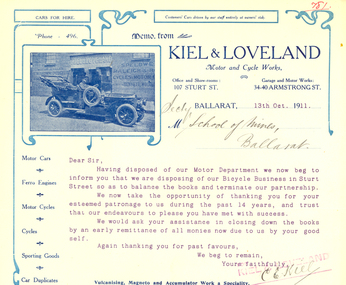
Letter - Document, C.E. Kiel, Kiel and Loveland Motor and Cycle works Letterhead, 1911, 13/10/1911
... bicycle cycle kiel and loveland kiel loveland vulcanising magneto accumulator motor cars ferro engines motor cycles sporting goods car duplicates art nouveau letterhead Typed onto the letterhead: 'Dear Sir, Having disposed of our Motor Department we now beg to inform you that we are disposing of our Bicycle Business in Sturt Street so as to balance the books and terminate our partnership. ...Typed letter on Kiel and Loveland letterhead (features a photograph of a driver in a car and Art Nouveau design). The letter relates to the closure of the bicycle business in Sturt Street, Ballarat and is signed by C.E. Kiel.Typed onto the letterhead: 'Dear Sir, Having disposed of our Motor Department we now beg to inform you that we are disposing of our Bicycle Business in Sturt Street so as to balance the books and terminate our partnership. We now take the opportunity of thanking you for your esteemed patronage to us during the past 14 years, and trust that our endeavours to please you have met with success. We would ask your assistance in clising down the books by an early remittance of all monies now due to us by your good self. again thanking you for past favours, We beg to remain, Yours faithfully, C.E. Kiel (overstamped 'Kiel and Loveland)bicycle, cycle, kiel and loveland, kiel, loveland, vulcanising, magneto, accumulator, motor cars, ferro engines, motor cycles, sporting goods, car duplicates, art nouveau, letterhead
