
Showing 17 items matching "enter the raaf"
-
 Moorabbin Air Museum
Book - RAAF air bases, Air Base Richmond The Story of the RAAF base on the Hawkesbury
... ...Enter the RAAF...RAAF bases Early days Enter the RAAF The squadrons arrive Early thirties Expansion War declared The early war years The WAAAF The paratroopers The war continues Aftermath of war On to the nineties Bicentennial air show Historical overview of RAAF base Richmond, circa 1991 Air Base Richmond The Story of the RAAF base on the Hawkesbury Book RAAF air bases ...Historical overview of RAAF base Richmond, circa 1991non-fictionHistorical overview of RAAF base Richmond, circa 1991early days, enter the raaf, the squadrons arrive, early thirties, expansion, war declared, the early war years, the waaaf, the paratroopers, the war continues, aftermath of war, on to the nineties, bicentennial air show -
Tatura Irrigation & Wartime Camps Museum
Photograph, 2001
... His father was on the P.M.G. line staff at Tatura c.1939-41. Jack entered the RAAF through the Air Training Corps. ...His father was on the P.M.G. line staff at Tatura c.1939-41. Jack entered the RAAF through the Air Training Corps. ...Jack Sharpley lived in Erica Av. Tatura. His father was a P.M.G. Linesman c.1939. Jack attended Tatura Convent & Shepparton High School. Joined staff of State Savings Bank, and attended Melbourne University. Entered Air Force in Air Training Corps 1941. Trained in Canada as a Flight Observer. Posted to a Sunderland Flying Boat Squadron in England. Killed 04.02.1943 in a flying accident off the coast of Wales. A brillian pupil and an outstanding athlete.Photograph of Jack Sharpley who lived in Erica Av. Tatura. His father was on the P.M.G. line staff at Tatura c.1939-41. Jack entered the RAAF through the Air Training Corps. Trained in Canada, flew in Sunderland Flying Boats. Died in crash on duty off the coast of Wales.sharpley, jack, raaf, photograph, people -
 Lara RSL Sub Branch
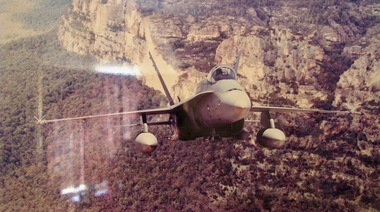
FA/-18 Hornet Jet Fighter
... The Australian Government purchased 75 "A" and "B" variants of the F/A-18 in 1981 to replace the RAAF's Dassault Mirage III fighters. The Hornets entered service with the RAAF between 1984 and 1990, and 71 remain in operation as of 2017. ...The Australian Government purchased 75 "A" and "B" variants of the F/A-18 in 1981 to replace the RAAF's Dassault Mirage III fighters. The Hornets entered service with the RAAF between 1984 and 1990, and 71 remain in operation as of 2017. ...The Royal Australian Air Force (RAAF) has operated McDonnell Douglas F/A-18 Hornet fighter aircraft since 1984. The Australian Government purchased 75 "A" and "B" variants of the F/A-18 in 1981 to replace the RAAF's Dassault Mirage III fighters. The Hornets entered service with the RAAF between 1984 and 1990, and 71 remain in operation as of 2017. The other four Hornets were destroyed in flying accidents during the late 1980s and early 1990s.F/A-18 Hornet Jet Fighter replaced the Mirage Jet Fighter. Still in service in 2018.Framed PictureNILf/a-18 hornet jet fighter raaf -
 Ballarat Clarendon College
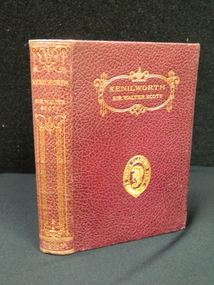
Book, Kenilworth
... entered Ballarat College 1932. Raymond was born 24 June 1917 at Ballarat, the son of Percy Alfred and Ruby Evelyn (Davies) Oxlade. He enlisted in the Australian Armed Forces in 1940. He transferred to the RAAF...entered Ballarat College 1932. Raymond was born 24 June 1917 at Ballarat, the son of Percy Alfred and Ruby Evelyn (Davies) Oxlade. He enlisted in the Australian Armed Forces in 1940. He transferred to the RAAF ...Prize awarded to Raymond Percival Thomas Oxlade, Dux of Remove Upper 1932. Raymond entered Ballarat College 1932. Raymond was born 24 June 1917 at Ballarat, the son of Percy Alfred and Ruby Evelyn (Davies) Oxlade. He enlisted in the Australian Armed Forces in 1940. He transferred to the RAAF in 1942 and was discharged 1946. Raymond's grand-daughter Jessica Oxlade entered the school in 2007, achieving Dux of the school in 2010.Maroon calf binding with decorative gold embossing on cover and spine; gilt title and publisher statements on spine and school crest on front cover; book plate on front cover verso; marbled endpapers; pages gilt-edged and sight foxing; black and white frontispiece;Book plate: school crest / Ballarat College / Remove (Upper) Form / Dux Prize / Awarded to / R P T Oxlade / A Richardson / December 1932 / Principalraymond-percival-thomas-oxlade, 1932, ballarat-college, book, prize, a- richardson, jessica-oxlade, dux -
 Ballarat Clarendon College
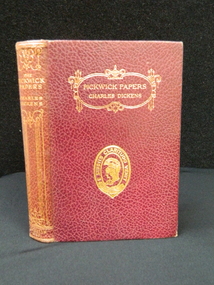
Book, Pickwick papers
... entered Ballarat College 1932. Raymond was born 24 June 1917 at Ballarat, the son of Percy Alfred and Ruby Evelyn (Davies) Oxlade. He enlisted in the Australian Armed Forces in 1940. He transferred to the RAAF...entered Ballarat College 1932. Raymond was born 24 June 1917 at Ballarat, the son of Percy Alfred and Ruby Evelyn (Davies) Oxlade. He enlisted in the Australian Armed Forces in 1940. He transferred to the RAAF ...Prize awarded to Raymond Percival Thomas Oxlade, Dux of Fifth A (Upper) 1934. Raymond entered Ballarat College 1932. Raymond was born 24 June 1917 at Ballarat, the son of Percy Alfred and Ruby Evelyn (Davies) Oxlade. He enlisted in the Australian Armed Forces in 1940. He transferred to the RAAF in 1942 and was discharged 1946. Raymond's grand-daughter Jessica Oxlade entered the school in 2007, achieving Dux of the school in 2010. Maroon calf binding with decorative gold embossing on cover and spine; gilt title and publisher statements on spine and school crest on front cover; book plate on front cover verso; marbled endpapers; pages gilt-edged and slight foxing; black and white frontispiece;Book plate: school crest / Ballarat College / Fifth A (Upper) Form / Dux Prize / Awarded to / R P J Oxlade / R E Thwaites / December 1934 / Principalraymond-percival-thomas-oxlade, ballarat-college, 1934, dux, r-e-thwaites, jessica-oxlade -
 Ballarat Clarendon College
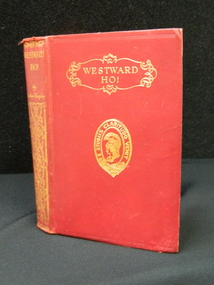
Book, Westward Ho!, 1926
... entered Ballarat College 1932. Raymond was born 24 June 1917 at Ballarat, the son of Percy Alfred and Ruby Evelyn (Davies) Oxlade. He enlisted in the Australian Armed Forces in 1940. He transferred to the RAAF...entered Ballarat College 1932. Raymond was born 24 June 1917 at Ballarat, the son of Percy Alfred and Ruby Evelyn (Davies) Oxlade. He enlisted in the Australian Armed Forces in 1940. He transferred to the RAAF ...Prize awarded to Raymond Percival Thomas Oxlade, Dux of Fifth A (Upper) 1934. Raymond entered Ballarat College 1932. Raymond was born 24 June 1917 at Ballarat, the son of Percy Alfred and Ruby Evelyn (Davies) Oxlade. He enlisted in the Australian Armed Forces in 1940. He transferred to the RAAF in 1942 and was discharged 1946. Raymond's grand-daughter Jessica Oxlade entered the school in 2007, achieving Dux of the school in 2010. Red calf binding with decorative gold embossing on cover and spine; gilt title and publisher statements on spine and school crest on front cover; book plate on front cover verso; marbled endpapers; pages gilt-edged and sight foxing; black and white frontispiece;Book plate: school crest / Ballarat College / Remove (Upper) Form / Dux Prize / Awarded to / R P J Oxlade / R E Thwaites / December 1932 / Principalraymond-percival-thomas-oxlade, ballarat-college, dux, 1934, jessica-oxlade -
 Bendigo Military Museum
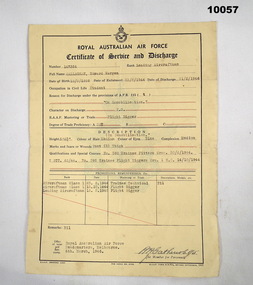
Administrative record - CERTIFICATE OF SERVICE, RAAF, Royal Australian Air Force, 6 March 1946
... RAAF Insignia at top of page. Personal details entered in black type. ...RAAF Insignia at top of page. Personal details entered in black type. ..."Edward Warren Callaghan". Edward enlisted (No.147354) in the RAAF on 23/2/1944, aged 18 years, 5 months. His service was as follows; 1RD Shepparton 23/2/1944, 1 SD Fisherman's Bend 23/3/1944, 7 STT Geelong 3/4/1944, 1ES Ascot Vale 30/6/1944, Graded Fit Rigger 15/10/1944 67 Sqd Laverton 19/10/1944, Edward flew on Coastal Reconnaissance missions from here. Due to colour blindness he was unable to fly combat missions. 7 AD Tocumwal 26/2/1945, 1 PD Royal Park 5/2/1946, 1 PD Royal Park 21/2/1946, Discharged from the RAAF with the rank of LAC. Cream coloured certificate with pro-form text in blue coloured print. RAAF Insignia at top of page. Personal details entered in black type. Text on back in blue coloured printing. Blank spaces on proforma filled with a red coloured line. Blue coloured line border around edge of certificate. Handwritten signature in black ink on bottom RHC. Watermark featuring RAAF logo in light blue in central section of certificate.Handwritten signature in black ink on bottom RHC.edward warren callaghan, raaf, discharge of discharge. -
 Bendigo Military Museum
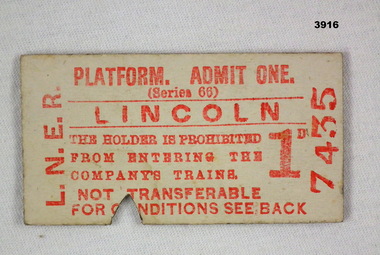
Accessory - TICKET
... Holder was entitled to enter the platform but not board a train at Lincoln (UK) station. Cost of the ticket was 1d (1 penny). Item re Frederick Gardner DAVEY DFC No 410533 RAAF. ...Holder was entitled to enter the platform but not board a train at Lincoln (UK) station. Cost of the ticket was 1d (1 penny). Item re Frederick Gardner DAVEY DFC No 410533 RAAF. ...Holder was entitled to enter the platform but not board a train at Lincoln (UK) station. Cost of the ticket was 1d (1 penny). Item re Frederick Gardner DAVEY DFC No 410533 RAAF. Refer Reg No 3536P for his service details.Cream, cardboard railway platform ticket with red printing front / back. One edge has been clipped.railways, platform, england -
 Bendigo Military Museum
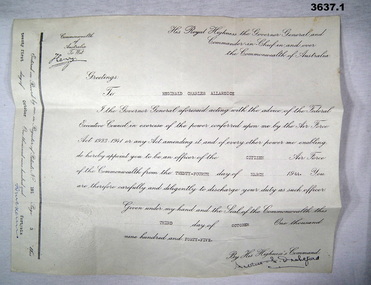
Administrative record - OFFICER AND STATEMENT OF SERVICE CERTIFICATES, (.1) 21.10.1946, (.2) Post 1946
... (.1) Certificate on parchment paper re R C Allardice’s appointment as an Officer of the RAAF on 23.3.1944 and signed on 3 .10.1945. Document entered on the Register 21.10.1946. (.2) Statement of service re R C Allardice as an Officer of the RAAF form (P/P118) Details re his appointments and awards....Refer Cat No 3627.5 for his service history. appointment of an officer service of and officer (.1) Certificate on parchment paper re R C Allardice’s appointment as an Officer of the RAAF on 23.3.1944 and signed on 3 .10.1945. Document entered on the Register 21.10.1946. (.2) Statement of service re R C Allardice as an Officer of the RAAF form (P/P118) Details re his appointments and awards. ...Items relate to Reginald Charles ALLARDICE No 418577 RAAF. Refer Cat No 3627.5 for his service history.(.1) Certificate on parchment paper re R C Allardice’s appointment as an Officer of the RAAF on 23.3.1944 and signed on 3 .10.1945. Document entered on the Register 21.10.1946. (.2) Statement of service re R C Allardice as an Officer of the RAAF form (P/P118) Details re his appointments and awards.appointment of an officer, service of and officer -
 Waverley RSL Sub Branch
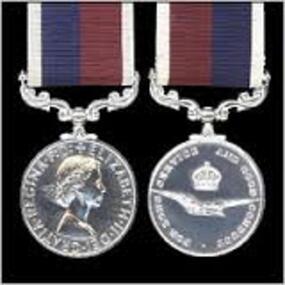
R.A.A.F. Long Service Medal
... RAAF Dental Officers were posted to the large dental centres at Ascot Vale (Vic) and Bradfield Park (NSW) when first appointed, where they received military and clinical training, before being deployed to their needed location. Mobile Dental Units When Japan entered ...Awarded to Alan Bowers (A236814) who was a R.A.A.F. dental mechanic who serverd during WWII including service in Darwin, and then continued in the R.A.A.F. for some years after the end of WWII The Royal Australian Air Force (and all Commonwealth Air Forces) Long Service and Good Conduct Medal: Awarded to NCOs and ORs of the RAAF (RAF, RCAF etc) for 15 years service. A cupro-nickel plated medal, the obverse features the sovereign's head, the reverse features the crown and eagle emblem of the RAAF (and RAF). Officers are eligible for the award provided they have served a minimum 12 years in the ranks. The riband is dark blue and maroon with white edges. This medal ceased to be awarded in Australia in 1975 when it was replaced by the National Medal (and sbsequently the DFSM and DLSM) in the Australian system of honours and awards. http://www.heritagemedals.com.au/medals-1/service-long-service/air-force-long-service-and-good-conduct-medal.html History of the RAAF Dental Branch It took six years following the formation of the RAAF in 1921 for the first Dental Clinic to be established at Point Cook, Victoria. On 10th June 1927 Flying Officer James Carl Rosenbrock commenced work as an RAAF Dental Officer for the FlyingTraining School at Point Cook. As personnel numbers were still relatively small, Rosenbrock was also responsible for the dental care of all Victorian RAAF units, which involved treating members at 1AD Laverton, as well as Air Force Headquarters at Victoria Barracks in Melbourne. As Army Dental Officers were currently caring for RAAF personnel at Richmond, NSW, the Senior Dental Officer of the 3rd Military District in Victoria (SDO 3MD) requested through the military board that a similar arrangement be established, where that the newly appointed RAAF Dentist provide part time dental services to the Army units stationed at Queenscliff. This was seen as an effective reciprocal arrangement, with both units having a Dental Officer in attendance for, in total, around 3-4 weeks a year. Rosenbrock continued to serve as the sole RAAF Dental Officer until the middle of 1933, when the Air Board asked for his service to be terminated following ‘behaviour unbecoming of a RAAF officer'. He had borrowed several sums of money, of around 40 Pounds or so, from junior ranks on base (as well as from the Regimental Sergeant Major) and had failed to pay the money back. He was replaced by a fellow Victorian, FLGOFF Norman Henry Andrews, on the 18th Sep 1933, who went on to become our first Director of Dental Services, and was instrumental in establishing the organisations and conditions of the Branch that are still present today. Through a fair amount of persistence and hard work on the part of Norman Andrews, the RAAF Dental Branch began to expand from 1937, with the introduction of 2 additional positions, at RAAF station Richmond, and at the FlyingTraining School at Point Cook. This gave the RAAF 3 uniformed Dental Officers, which was expanded to 5 in the months leading up to WW2. 4 of these Dental Officers were based in Victoria and 1 at Richmond, with the other two RAAF units being cared for by the Army (as in the case of Pearce in WA) or by civilians (as in Darwin). With the sudden increase in RAAF personnel required at the outbreak of WW2, the number of RAAF Dental Officers increased dramatically, from 5 in 1939, 28 in 1940, 64 in 1941, 147 in 1942, 193 in 1943, 219 in 1944, and peaking at 227 in 1945. RAAF Dental Officers were required to work in a variety of locations, both in and out of Australia. Between 1940 and 1942 a massive construction programme occurred, with new dental clinics being established around Australia. Priority was given to aircrew training units in order to get these personnel dentally fit for operational deployment, but Dental Officers could equally find themselves posted to recruit depots, fixed stations, medical clearance stations, mobile dental sections, and RAAF and civilian hospitals. RAAF Dental Officers were posted to the large dental centres at Ascot Vale (Vic) and Bradfield Park (NSW) when first appointed, where they received military and clinical training, before being deployed to their needed location. Mobile Dental Units When Japan entered the war in 1941, the rapid deployment of troops to northern operational areas with less than ideal dental fitness was extremely high. As a result, the RAAF deployed a range of mobile dental units, either alone or with medical sections, to support the increasing number of isolated deployed personnel within Australia and overseas. There were three types of mobile unit used: a. Mobile Dental Unit – relied on using either a semi-trailer to get around or by building a surgery directly on to the truck chassis, and installing hydraulic chairs, units, x-rays, and laboratory equipment. They were able to move around between small units, such as RAAF radar stations, where they could plug into the local power supply and work immediately. b. Transportable Dental Units – used for stops of longer duration, where field equipment was carried in panniers from one unit to another by road or rail and housed in whatever accommodation was available at the destination. They were often carried within Australia on Tiger Moths and Dakota aircraft. c. Itinerant Dental Units – in some areas, the dental equipment was installed at the RAAF unit and the Dental Officer and their staff would travel from unit to unit, using the equipment available at each location. RAAF Dental BadgeAs the war developed in Europe, it soon became obvious that the RAF Dental support was not capable of supporting the increasing numbers of RAAF aircrew that were being sent for service with the RAF, with only enough Dental Officers available to provide one to every 2000 men ( instead of the preferred 1 to 600). As a result, the RAAF provided a mobile dental unit, fitted out in a caravan and pulled by a Ford V8 Coupe, to travel around England in support of RAAF personnel at various squadrons. Some degree of tact was needed to ensure that the RAF did not take this as a comment on the treatment they were providing, but it proved successful in maintaining a satisfactory state of dental fitness in RAAF personnel, and a second mobile unit was soon dispatched. They were also set up with a laboratory on board as well as the surgery, which was a major difference between the RAF and RAAF, as the RAF did not provide dentures for their troops (the RAAF would, providing they had served for 6 years). In 1943 the RAF was no longer able to provide Dental support to Australian troops in the Middle East, which resulted in the need for a transportable dental unit to be deployed from Australia. It functioned in a similar manner to the RAF, by moving from one squadron to another. It served in the Middle East and Africa, from Cairo across North Africa, to Italy, and eventually back to England to treat returned prisoners of war. GPCAPT Norman Andrews The growth and development of the RAAF Dental Branch owes a debt to one man in particular, GPCAPT Norman Andrews. As the second RAAF Dental Officer to enlist on 18 Sep 1933, Andrews became the principal architect of the structure and organisation of the RAAF Dental Branch leading up to and during WW2. Until early 1940, the RAAF Dental Branch was administered by the Director of Medical Services (Air), which placed it under the control of the Army Medical staff. The Army would provide their Inspector of Dental Services for advice whenever needed. In April 1940, the RAAF Medical service separated from the Army, resulting in the control of the RAAF Dental Branch shifting back to the RAAF. Andrews became the first Director of Dental Services, when the position was created in 1943 as recognition of the higher profile the Dental Branch was now playing in the RAAF Medical service. Until this time, Andrews's title had been as the Dental Staff Officer to the RAAF Medical Service. Andrews was responsible for the establishment of the war-time structure of the Dental service, establishing new dental centres at all major bases, creating mobile and transportable dental units, ensuring the continual growth of the Branch, maintaining professional development of staff through the establishment of a professional journal, and by organising renowned lecturers to speak at RAAF bases. He also believed in visiting as many dental units as possible to see for himself what conditions were like and to talk first-hand to staff in remote units. His itinerary during the war years, both in and out of Australia, shows a large number of trips in a variety of modes of transport in order to reach remote areas where units were serving. He was promoted to GPCAPT in July 1944, as the numbers of Dental Officers soon peaked at 227 towards the end of the war (1 GPCAPT, 9 WGCDRs, 60 SQNLDRs, and 157 FLTLTs). After the war, with the reduction in RAAF personnel required in uniform, the Dental Branch also reduced its numbers significantly. By 1947 there were only 18 Dental Officers serving (many part-time), with 1 GPCAPT, 1 WGCDR, 10 SQNLDRs, and 6 FLTLTs, and only 13 by 1950. With the decrease in Branch personnel numbers, the ‘powers to be' saw fit to reduce the Director of Dental Service rank to WGCDR, and as a result Norman Andrews found that in order to continue serving in the RAAF he would have to wear a reduced rank. This appears to have been a contributing factor in his decision to discharge at the relatively early age of 43 and accept an administrative job as Director of the Victorian Government's School Dental Service. Norman Andrews holds the proud honour of being the founder of the RAAF Dental Branch, which during the war was instrumental in educating servicemen of the importance of dental health and maintaining the dental fitness of troops in a variety of areas. Dental Orderlies (Assistants) The dental orderly mustering was first introduced in 1937. Until that time, medical orderlies were assigned to assist the Dental officer with their duties. As early as 1931 it had been noted by both RAAF and Army Dental Officers working in Victoria and Richmond that a lot of the troubles they were having would be solved by appointing a permanent Dental Orderly. Often they would find that the medical orderly they were assigned was a different one each day, and as a result the administration and work in general was very inefficient. By 1937, with the increase in Dental Officers to 3, it was realised that a Dental Orderly mustering needed to be created. Dental Mechanics/Technicians Before WW2, dental laboratory work was provided by civilian laboratories, as most RAAF units were stationed around metropolitan areas. At this time, service personnel were still required to pay for their own dentures, unless they had served for six years or had their dentures damaged during performance of their duties. In July 1940, mainly in response to the development of more remote RAAF dental units and the increasing demand for dental prostheses, the Dental Mechanic mustering was established. Unfortunately there was a very limited pool of civilian dental mechanics to recruit from, and as a result the RAAF set up a training school at Laverton (which was later moved to Ascot Vale) in June 1941 which conducted an intensive 6 month course in Dental mechanics. Dental mechanics were quickly in demand. In all fixed and mobile dental units at least 1 Mechanic was supplied for each Dental Officer, and indeed the RAAF supplied Dental Mechanics throughout all its deployments, something the RAF were unwilling, or unable, to do. Two grades of dental mechanic existed: the Senior Mechanic (with the rank of NCO), who was competent in all phases of laboratory work; and the Junior Mechanic, who could only handle routine work and not more advanced denture work. The progression to Senior required a further trade test in techniques including setting up, clasp-forming, casting and backing teeth. During the course of the War, two special courses were held for Mechanics. The first, directed at senior mechanics so that they could instruct others, was in 1942 when Acrylic Resin was first introduced as a denture base material, as an alternative to the current option of vulcanite. Later, towards the end of the War, a ‘refresher' course was provided for those that had served for the greatest period of time in order to allow them retraining in techniques that they had not practised during their service and which were common in civilian life. This included cast base dentures, crowns and bridges, partial dentures, and retainers. Towards the end of the War, a course was held with WAAAF trainees to train them as Mechanics. However, as the War was soon to end they never had the opportunity to progress within the mustering to become Senior Mechanics. The RAAF Dental Branch has survived 75 years of turbulence, with reviews of its viability occurring regularly every few years from as early as 1937. The Branch continues to provide excellent service to the ADF community and, despite reduced manpower, will continue to play an important role in Air Force Health operations. http://www.defence.gov.au/health/about/docs/RAAFDental.pdf40cm cupro-nickel plated medal, the obverse features the sovereign's head, the reverse features the crown and eagle emblem of the RAAF (and RAF). A23814 BOWERS.A. A. F.r.a.a.f long service medal, r.a.a.f good conduct, r.a.a.f. dental service medal -
 Bendigo Military Museum
Certificate - CERTIFICATE, APPOINTMENT of an OFFICER
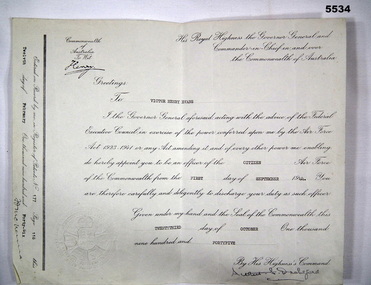
... Promotion Officer RAAF WW2 Note on side stating record entered in Register of Patents No.177 P.118 on 12th Feb 1946. ...Formal certificate outlining Promotion of V.H. Evans, No 418655 RAAF to Officer Rank. Signed on 23 Oct 1945 but backdated to 1st Sept 1944. From the Governor General and signed on his behalf.Heavy white paper. Fold mark in middle and stamp imprint on bottom left corner. A little dirty around edges. Style of writing, form with gaps left for unique date (name & dates) to be filled in. Blank on other side.Note on side stating record entered in Register of Patents No.177 P.118 on 12th Feb 1946. Form has imprint of Official Commonwealth of Australia stamp in bottom left corner. Signature at bottom of form. An address noted in pencil on back.promotion, officer, raaf, ww2 -
 Bendigo Military Museum
Book - BOOK, RAAF, RAAF, RAAF Flying Log Book, 4.1937
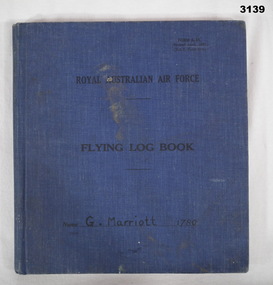
... Log books Raaf Handwritten front cover: “G MARRIOTT 1780” Entered inside: 1st entry: “Sep 14 1938; Aircraft: Demon AI-38; Hours: 15” Last entry: “Mar 1 1939; Aircraft: Anson L9161; Kalgoorlie to Pearce, WA, Hours: 2.45” Blue buckram hard cover with black printing. ...Blue buckram hard cover with black printing. Inside a large quantity of mostly empty ruled pages with columns eg year, aircraft, number, pilot, hours flown. Handwritten front cover: “G MARRIOTT 1780” Entered inside: 1st entry: “Sep 14 1938; Aircraft: Demon AI-38; Hours: 15” Last entry: “Mar 1 1939; Aircraft: Anson L9161; Kalgoorlie to Pearce, WA, Hours: 2.45”log books, raaf -
 Monbulk RSL Sub Branch
Book, Allen & Unwin, The forgotten few : 77 RAAF Squadron in Korea, 2008
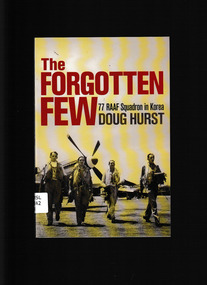
... RAAF was in Japan and packing up to go home when North Korea invaded South Korea. Instead of going home to Australia, they found themselves with their mustang fighters in Korea as part of the UN forces opposing the rampaging North Koreans who occupied almost the whole peninsular within 8 weeks of the start of the invasion. The squadron played a major role in halting the invasion and driving the Koreans back almost to the Chinese border. Then the Chinese, equipped with their MIG 21 jet fighters, entered ...In June 1950, No 77 squadron RAAF was in Japan and packing up to go home when North Korea invaded South Korea. Instead of going home to Australia, they found themselves with their mustang fighters in Korea as part of the UN forces opposing the rampaging North Koreans who occupied almost the whole peninsular within 8 weeks of the start of the invasion. The squadron played a major role in halting the invasion and driving the Koreans back almost to the Chinese border. Then the Chinese, equipped with their MIG 21 jet fighters, entered the war. The hopelessly outclassed mustangs were quickly replaced by meteor jet fighters to again play a major role in resisting the invasion forces. The squadron lost over 20 pilots over the course of the war, but succeeded in shooting down a number of MIG fighters and offering ground support to the UN forces. This is an action packed account of the men of that squadron.Index, bib, ill, map, p.234.non-fictionIn June 1950, No 77 squadron RAAF was in Japan and packing up to go home when North Korea invaded South Korea. Instead of going home to Australia, they found themselves with their mustang fighters in Korea as part of the UN forces opposing the rampaging North Koreans who occupied almost the whole peninsular within 8 weeks of the start of the invasion. The squadron played a major role in halting the invasion and driving the Koreans back almost to the Chinese border. Then the Chinese, equipped with their MIG 21 jet fighters, entered the war. The hopelessly outclassed mustangs were quickly replaced by meteor jet fighters to again play a major role in resisting the invasion forces. The squadron lost over 20 pilots over the course of the war, but succeeded in shooting down a number of MIG fighters and offering ground support to the UN forces. This is an action packed account of the men of that squadron.korean war - aerial combat, korean war 1950-1953 - australian involvement -
 Melton City Libraries
Photograph, Edna Barrie and Hubert Opperman, 1994
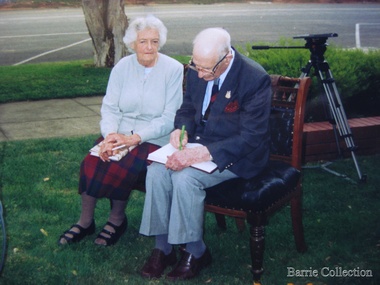
... After war service with the RAAF he entered Federal politics holding the Victoria seat of Corio for the Liberal Party from 1949 until 1967. ...After war service with the RAAF he entered Federal politics holding the Victoria seat of Corio for the Liberal Party from 1949 until 1967. ...The plaque of Oppy reads: Hubert Opperman was born in Rochester, his early job as a Telegraph Boy encouraged his love of cycling. Throughout the 1920’s and 1930’s “Oppy” was the dominant figure in Australian cycling. He first won the Australian Road Cycling Championship in 1924. He won it again in 1926, 1927 and 1929. At the same time he was becoming and international star. This statue is modelled on his on his stunning victory at the Bol D’Or in Paris in the same year that he was highly placed in the prestigious Tour de France. His first place in the 1265 kms Paris - Brest- Paris road race was the highlight of his sporting career. That year he was voted Sportsman of the Year by a French newspaper. In 1991 Sir Hubert attended the Centenary Celebrations of the race and was honoured with Gold Medal of the City of Paris “Oppy” retired from cycling in 1940. Typically he celebrated his retirement with a 24 hour marathon at the Sydney Velodrome breaking one hundred and one records in the process. After war service with the RAAF he entered Federal politics holding the Victoria seat of Corio for the Liberal Party from 1949 until 1967. During this period he served as Minister for Shipping and Transport and Minister for Immigration. In 1967 he was appointed Australian High Commissioner for Malta, receiving the OBE in 1952 and was knighted in 1968. This Statue was officially unveiled by SIR HUBERT OPPERMAN On his 90th birthday, 29th May 1994Oppy signing Edna Barrie's leatherbound copy of 'Melton-Plains of Promise'. . The Inscription reads - To Edna with my Melton remembrances as the place I first rode a bicycle Hubert Opperman ‘Oppy’ [ 29/5/1904 – April 1996]. Edna Barrie contacted and organised for Hubert Opperman to launch the book. (She was also present at his last bike ride at Rochester in 1995.)local identities, local significant events -
 8th/13th Victorian Mounted Rifles Regimental Collection
Uniform - Honorary Colonel Fairbairn, 1980 circa
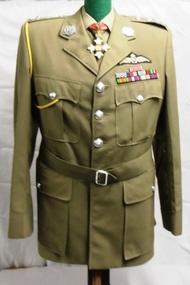
... entered politics, holding the federal seat of Farrer from 1949-1975. He was Minister for Defence 1971-73. Sir David was Australian Ambassador to the Netherlands 1977-1980. This object is well provenanced, complete and representative uniform worn by an honorary colonel of the 8th/13th Victorian Mounted Rifles Regiment, a man who gave exemplary service as a serviceman, politician and diplomat. uniform fairbairn vmr raaf honorary ambassador wwii spitfire world war two parliament Service dress tunic, polyester summer, with yellow cord lanyard, officer badges of rank, 8/13 Victorian Mounted Rifles collar badges, silver Royal Australian Armoured Corps (RAAC) buttons, and pilot qualification badge (wings). ...This tunic was worn by Sir David Fairbairn KBE DFC when Honorary Colonel of 8th/13th Victorian Mounted Rifles Regiment 1981-83. Sir David served with 21st Light Horse prior to World War Two. During WWII he served with the Royal Australian Air Force flying Spitfires in Britain and Europe and later in the war, in the Pacific theatre. Following the war, he entered politics, holding the federal seat of Farrer from 1949-1975. He was Minister for Defence 1971-73. Sir David was Australian Ambassador to the Netherlands 1977-1980.This object is well provenanced, complete and representative uniform worn by an honorary colonel of the 8th/13th Victorian Mounted Rifles Regiment, a man who gave exemplary service as a serviceman, politician and diplomat.Service dress tunic, polyester summer, with yellow cord lanyard, officer badges of rank, 8/13 Victorian Mounted Rifles collar badges, silver Royal Australian Armoured Corps (RAAC) buttons, and pilot qualification badge (wings). Neck decoration Knight Commander of British Empire (KBE) (Civilian list) (replica); ribbon bar denoting: Order of the British Empire (Civil), Distinguished Flying Cross (DFC), 39-45 Star, Europe and Germany Star, Pacific Star, Defence Medal 1939-45, British War Medal 1939-45, Australian Service Medal 1939-45, Queen Elizabeth II Coronation Medal. uniform, fairbairn, vmr, raaf, honorary, ambassador, wwii, spitfire, world war two, parliament -
 Wodonga & District Historical Society Inc
Certificate - Recognition of Service World War II - James S. N. Harris
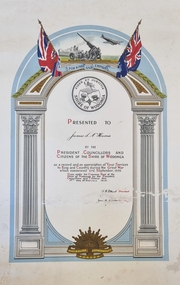
... entered politics and was knighted for his services in May 1937. After finishing his secondary schooling James (Stewart) Harris moved to Melbourne to study law, becoming a resident of Trinity College in 1925 and rising to become Senior Student in his final year, 1928-29. He enlisted in the Air Force Cadets at Point Cook in 1925 and transferred to the Air Force Reserve in 1930. On 7th October 1940 James transferred to active service as a Flight Officer. He worked his way up the ranks, being appointed Wing Commander in 1944. He also served as Chief Instructor of the RAAF...entered politics and was knighted for his services in May 1937. After finishing his secondary schooling James (Stewart) Harris moved to Melbourne to study law, becoming a resident of Trinity College in 1925 and rising to become Senior Student in his final year, 1928-29. He enlisted in the Air Force Cadets at Point Cook in 1925 and transferred to the Air Force Reserve in 1930. On 7th October 1940 James transferred to active service as a Flight Officer. He worked his way up the ranks, being appointed Wing Commander in 1944. He also served as Chief Instructor of the RAAF ...James Stewart Noel Harris was born in Rutherglen on 21 March 1905 to John Richards Harris and Jessie Lily nee Prentice. His father was a doctor in Rutherglen. John later entered politics and was knighted for his services in May 1937. After finishing his secondary schooling James (Stewart) Harris moved to Melbourne to study law, becoming a resident of Trinity College in 1925 and rising to become Senior Student in his final year, 1928-29. He enlisted in the Air Force Cadets at Point Cook in 1925 and transferred to the Air Force Reserve in 1930. On 7th October 1940 James transferred to active service as a Flight Officer. He worked his way up the ranks, being appointed Wing Commander in 1944. He also served as Chief Instructor of the RAAF School of Administration, receiving the RAAF Long Service Commendation. The RAAF School of Administration and Special Duties had moved from Ascot Vale to Trinity College in 1942 meaning that James Harris' service career had returned to the place it began in 1925. In 1945 he requested to be transferred back to the Reserve so that he could resume his civilian life. On discharge, James returned to Wodonga and resumed his legal career. In the early 1930s he had joined the legal practice of Mr. Edmondstone which had opened for business in High Street, Wodonga in 1886. The practice continued to develop and in 1966 was joined by Lou Lieberman, becoming known as “Harris Lieberman & Co”. Harris Lieberman still operates in Wodonga and Albury. James Stewart Noel Harris died in Wodonga on 30th November 1978.This item is significant because it recognises the War Service of a prominent citizen of Wodonga.A colour printed certificate presented to James S. N, Harris in appreciation for his service for "King and Empire" during World War II. The text is surrounded by columns and an arch. The Australian and British flags are at the top as well as representations of the Navy, Army and Air Force. It also features the logo of the Shire of Wodonga above the text. The badge of the Commonwealth Armed Forces is at the centre bottom of the certificate. This small collection also includes black and white photographs of James Samuel Noel Harris in uniform and also saluting on presentation of an award recognising his service in 1942.On Certificate: PRESENTED TO James S. N. Harris BY THE PRESIDENT, COUNCILLORS AND CITIZENS OF THE SHIRE OF WODONGA as a record and an appreciation of Your Services to King and Country during the Great War which commenced 3rd September, 1939. Given under the Common Seal of the Shire of Wodonga by the President, Citizens this Councillors and Citizens this 25th day of February 1946 C F Pollard, Presidentjames stewart noel harris, servicemen wodonga wwii, harris lieberman -
 Hymettus Cottage & Garden Ballarat
Work on paper - pamphlet, Beaufort Homes
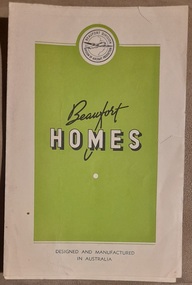
... RAAF base at Ballarat Airport. When Michael & Marie Taffe of Hymettus were married in 1971 one of these homes at Ballarat Airport was their first home. In 1946 the prefabricated Beaufort Homes was the first time the Australian Government entered into the building of homes in Australia. ...A pamphlet promoting Beaufort Homes created by the Beaufort Division of the Department of Aircraft Production together with the Victorian Housing Commission and the Commonwealth Department of Works and Housing.non-fictionA pamphlet promoting Beaufort Homes created by the Beaufort Division of the Department of Aircraft Production together with the Victorian Housing Commission and the Commonwealth Department of Works and Housing.building, australia, home manufacture, commonwealth of australlia, taffe, aircraft production, architecture, prefabrication
