
Showing 75 items matching "entrance driveway"
-
 University of Melbourne, Burnley Campus Archives
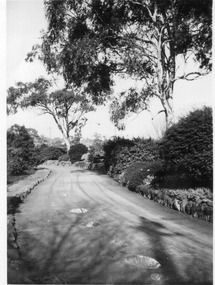
Photograph - Black and white print, Main Entrance Driveway, July 1947
... Main Entrance Driveway......swan street entrance...driveway...entrance e. m. gibson collection swan street entrance driveway 5/3 331 "July 1947." E M Gibson. ..."July 1947." E M Gibson. Entrance from Swan Street.5/3 331entrance, e. m. gibson collection, swan street entrance, driveway -
 Marysville & District Historical Society
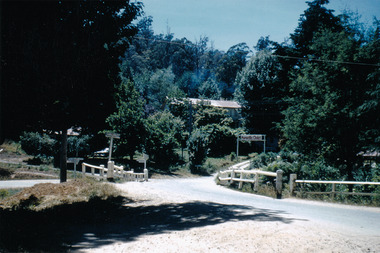
Photograph (Item) - Colour photograph, 1957
... A colour photograph of the entrance driveway to the Marysville Chalet that was taken in 1957....A colour photograph of the entrance driveway to the Marysville Chalet that was taken in 1957....A colour photograph of the entrance driveway to the Marysville Chalet that was taken in 1957. ...A colour photograph of the entrance driveway to the Marysville Chalet that was taken in 1957.A colour photograph of the entrance driveway to the Marysville Chalet that was taken in 1957.marysville, victoria, australia, the marysville chalet, guest house, poontawan, steavenson hotel, albert harrison, margaret harrison, elise ackerman, ralph ackerman, john van ranglerooy, joe keithard, kathy keithard, louisa goding, accommodation, photograph -
 Marysville & District Historical Society
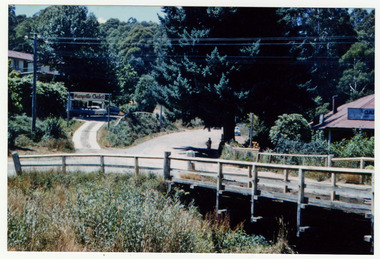
Photograph (Item) - Colour photograph, January 1959
... A colour photograph of the entrance driveway to the Marysville Chalet that was taken in January 1959....A colour photograph of the entrance driveway to the Marysville Chalet that was taken in January 1959....A colour photograph of the entrance driveway to the Marysville Chalet that was taken in January 1959. ...A colour photograph of the entrance driveway to the Marysville Chalet that was taken in January 1959.A colour photograph of the entrance driveway to the Marysville Chalet that was taken in January 1959.marysville, victoria, australia, the marysville chalet, guest house, poontawan, steavenson hotel, albert harrison, margaret harrison, elise ackerman, ralph ackerman, john van ranglerooy, joe keithard, kathy keithard, louisa goding, accommodation, photograph -
 Stawell Historical Society Inc
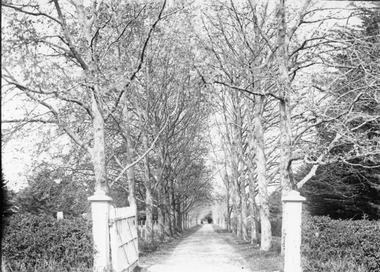
Photograph, “The Sycamores” Driveway entrance Gates
... “The Sycamores” Driveway entrance Gates...Entrance gates to “The Sycamores” Driveway. A show place on Concongella from mid 1860's. ..."The Sycamores" has been owned by the West family since c 1920. concongella Black & white photograph (2 copies) of an entrance gateway with an avenue of deciduous trees. “The Sycamores” Driveway entrance Gates Photograph ...Entrance gates to “The Sycamores” Driveway. A show place on Concongella from mid 1860's. "The Sychmores" where William Osmand lived. Osmand's "Sycamores" was in a secluded block of the eastern side of the creek along which was planted pine and cypress trees. He built a comfortable house and line the carriage way with Sycamores. Osmand was on the of the men who made money in the Stawell reefs mines. "The Sycamores" has been owned by the West family since c 1920. Black & white photograph (2 copies) of an entrance gateway with an avenue of deciduous trees.concongella -
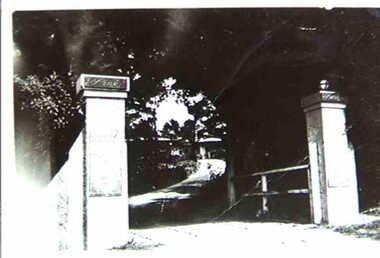 Inverloch Historical Society
000850 - Photograph - Inverloch - Pine Lodge entrance gateway and driveway - from H Swift (Hazel)
... 000850 - Photograph - Inverloch - Pine Lodge entrance gateway and driveway - from H Swift (Hazel)...000850 - Photograph - Inverloch - Pine Lodge entrance gateway and driveway - from H Swift (Hazel) ... -
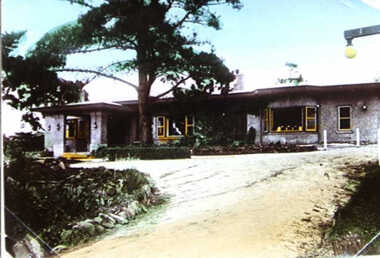 Inverloch Historical Society
000469 - Photograph - Pine Lodge driveway & entrance - from Betty Pink
... 000469 - Photograph - Pine Lodge driveway & entrance - from Betty Pink...The photo in this record is from a scan in October 2001. 000469 - Photograph - Pine Lodge driveway & entrance - from Betty Pink ...Photograph missing from folder at time of scanning 26 October 2017. The photo in this record is from a scan in October 2001. -
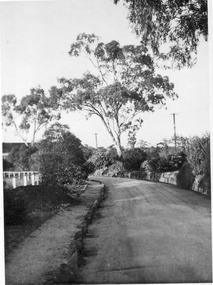 University of Melbourne, Burnley Campus Archives
Photograph - Black and white print, E.M. Gibson, Entrance Roadway, Autumn 1947
... ...entrance driveway...road swan street e. m. gibson collection entrance entrance driveway "Autumn 1947." 903 2/3 Black and white photograph of the entry driveway from Swan Street. lagoon Paddock on the left and Plant Reaearch Institute on the right. ...Black and white photograph of the entry driveway from Swan Street. lagoon Paddock on the left and Plant Reaearch Institute on the right. "Autumn 1947." 903 2/3road, swan street, e. m. gibson collection, entrance, entrance driveway -
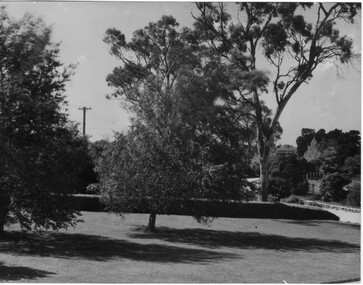 University of Melbourne, Burnley Campus Archives
Photograph - Black and white print, A.W. Jessep, View Towards Swan Street, 1941
... ...swan street entrance...driveway...plant research laboratory 1941 a.w. jessep plant research institute swan street entrance driveway On reverse, "Plant Research Laboratory Oct.1941. ...Black and white photograph. View towards Swan Street entrance from the front door of the Plant Research Laboratory/InstituteOn reverse, "Plant Research Laboratory Oct.1941. Taken from front door looking north. (A.W. Jessep).plant research laboratory, 1941, a.w. jessep, plant research institute, swan street entrance, driveway -
 Kew Historical Society Inc
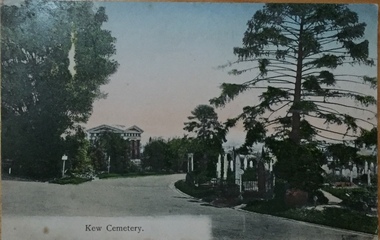
Postcard, Unknown, Kew Cemetery, 1905
... Panoramic view of the entrance driveway in Boroondara General (Kew) Cemetery. ...Panoramic view of the entrance driveway in Boroondara General (Kew) Cemetery. ...This view of the Boroondara General (Kew) Cemetery is dated to 1905 by the inscription and postmark on the reverse. It provides an important visual record of this part of the Cemetery. The postcard can be used to identify the original configuration of the roads and vegetation, some of which was subsequently removed (eg the bunya pine at right). On the Victorian Heritage Database, the construction period given for the Springthorpe Memorial is given as 1897-1907, yet this view of the Memorial in 1905 would suggest that it was virtually completed at an earlier date. (It should be noted that additions such as the wheel of life sculpture were not completed until 1910).This dated photograph is historically important as its inscription confirms it to be one of the earliest postcard representations of the Boroondara General (Kew) Cemetery. It also provides visual evidence of the size and extent of the landscaping by 1905, particularly the layout of the roads (now altered), plantings of the period, and the extent of the land occupied by the Springthorpe Memorial and its gardens, which was subsequently reduced by the trustees of the cemetery in the 1930s. Panoramic view of the entrance driveway in Boroondara General (Kew) Cemetery. At left can be seen the Springthorpe Memorial, and further down on the left the entrance gate, or one of the gates, to the Memorial. Inscribed on reverse: "Miss Brown / Shuan [sic] / Grosvenor Street / M. Brighton. Love from Mother Oct 28th 1905" Postmark: "Melbourne 8 / 2 PM, 28/10/05".springthorpe memorial, boroondara general (kew) cemetery, postcards -- cemeteries -
 Buninyong & District Historical Society
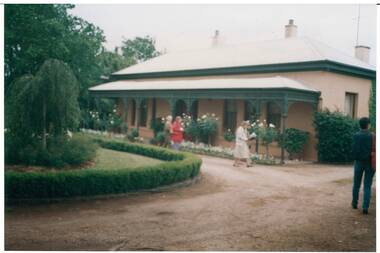
Photograph - Colour photograph, Brim Brim front entrance, November 1990
... Brim Brim front entrance from driveway, part of garden visible...Brim Brim was built by Judge Warrington Rogers in 1859 An early property built by a notable resident in 1859, Brim Brim has served many roles as a residence, a home for the elderly and as various B & B and function businesses Building Brim Brim Judge Warrington Rogers Brim Brim front entrance from driveway, part of garden visible Brim Brim front entrance Photograph Colour photograph ...Brim Brim was built by Judge Warrington Rogers in 1859An early property built by a notable resident in 1859, Brim Brim has served many roles as a residence, a home for the elderly and as various B & B and function businessesBrim Brim front entrance from driveway, part of garden visiblebuilding, brim brim, judge warrington rogers -
 Marysville & District Historical Society
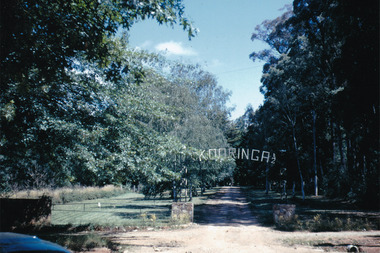
Photograph (item) - Colour photograph, Original photograph-1960
... A digital copy of a colour photograph of the front entrance gate and the driveway of Kooringa Guest House in Marysville. ...A digital copy of a colour photograph of the front entrance gate and the driveway of Kooringa Guest House in Marysville. ...A digital copy of a colour photograph of the front entrance gate and the driveway of Kooringa Guest House in Marysville. ...A digital copy of a colour photograph of the front entrance gate and the driveway of Kooringa Guest House in Marysville. The original photograph was taken in 1960.A digital copy of a colour photograph of the front entrance gate and the driveway of Kooringa Guest House in Marysville.marysville, victoria, australia, kooringa, frederick webb, cuzens brothers, betha wilhelmina christina unmack, minnie webb, t.e. foster, edgar charles webb, clarence thomas pitman, jacob pitman, sir isaac pitman, caroline anna blood newenham, henry newenham pitman, carrie rosalind persse pitman, reginald william stringer, alice burton pitman, clarence edward pitman, newenham mueller pitman, olive birch, constance may pitman, olive dora blakeney pitman, gwendoline de burch pitman, kooringa guesthouse, lilian may shelton, thomas henry branchflower, wilbur anderson, peter mackey, caroline anna pitman, joyce anderson, photograph -
 Whitehorse Historical Society Inc.
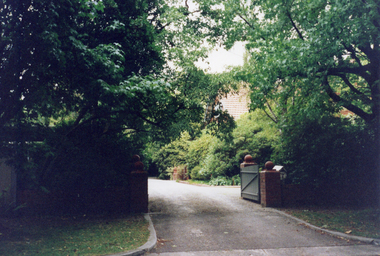
Photograph, 8 Meerut Street, Mitcham, Taken 1998
... Coloured photograph of the driveway entrance to the home of Edgar Edwards Walker, owner of Australian Tesselated Tiles - 8 Meerut Street, Mitcham...meerut street mitcham no 8 walker edgar Coloured photograph of the driveway entrance to the home of Edgar Edwards Walker, owner of Australian Tesselated Tiles - 8 Meerut Street, Mitcham 8 Meerut Street, Mitcham Photograph Photograph ...Coloured photograph of the driveway entrance to the home of Edgar Edwards Walker, owner of Australian Tesselated Tiles - 8 Meerut Street, Mitchammeerut street, mitcham no 8, walker, edgar -
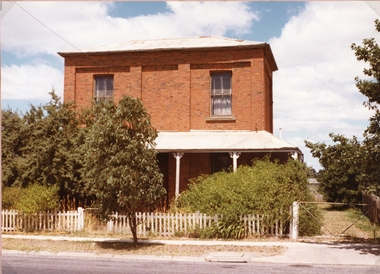 Stawell Historical Society Inc
Photograph, Literary Institute in Longfield Street -- Coloured
... Trees out the front of the building and a picket fence with entrance gate and driveway gate. ...Trees out the front of the building and a picket fence with entrance gate and driveway gate. Literary Institute in Longfield Street -- Coloured Photograph ...Literary Institute Stawell converted into a private residence later for Mr. & Mrs. Bert Fielding.Coloured photograph of red brick two storey building with veranda. Trees out the front of the building and a picket fence with entrance gate and driveway gate. stawell -
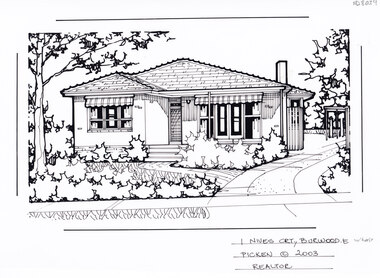 Whitehorse Historical Society Inc.
Artwork, other - Ink Line Drawing, 1 Nives Crt., Burwood.E, 2003
... A black ink line drawing on drafters film by Margaret Picken, of 1 Nives Crt., Burwood East A one story brick house with covered porch in the background, and front lawn with a path leading from the driveway on the left to the to the entrance. The driveway leads to a picket back fence and gate....Whitehorse Historical Society Schwerkolt Cottage Housing Architecture Margaret Picken Burwood House Garden Burwood East 1 Nives Crt., Burwood.E Picken © 2003 Realtor A black ink line drawing on drafters film by Margaret Picken, of 1 Nives Crt., Burwood East A one story brick house with covered porch in the background, and front lawn with a path leading from the driveway on the left to the to the entrance. The driveway leads to a picket back fence and gate. 1 Nives Crt., Burwood.E Artwork, other Ink Line Drawing Margaret Picken ...A property illustration by Margaret Picken Commissioned by a real estate agency for the purpose of advertising 1 Nives Crt., Burwood East. This property is listed as having sold for $315,000 in 2003 Made by using Rotring ‘Rapidigraph’ drafting pens with Rotring ink on Rapidigraph polyester drafting film, double matte. Trained as a cartographic draftsman within the mining industry, Margaret Picken is an artist who worked producing property illustrations for real estate agencies in eastern suburbs of Victoria from 1983-2005. Retiring from the industry as technological changes favored coloured photography over illustrations, and commissioning companies over sole contractors.This artwork is of Historical Significance as a record of local domestic architecture.A black ink line drawing on drafters film by Margaret Picken, of 1 Nives Crt., Burwood East A one story brick house with covered porch in the background, and front lawn with a path leading from the driveway on the left to the to the entrance. The driveway leads to a picket back fence and gate.1 Nives Crt., Burwood.E Picken © 2003 Realtorwhitehorse historical society, schwerkolt cottage, housing, architecture, margaret picken, burwood, house, garden, burwood east -
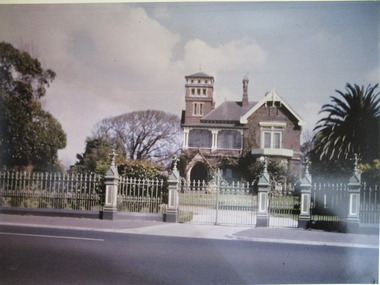 Williamstown Historical Society Inc
Photograph - Maritimo, The Strand, Williamstown
... Wrought iron fence with entrance gates to driveway and five pillars. ...Wrought iron fence with entrance gates to driveway and five pillars. Photograph Maritimo, The Strand, Williamstown ...Maritimo was built by William H Croker, a local Williamstown solicitor in 1885, and was demolished in 1993, the original wrought iron fence remainsMaritimo was an important local building and landmark, sent in extensive grounds, which was demolished despite local efforts to stop its destructionColour photograph of Maritimo on The Strand, Williamstown. Ornate two storey red brick mansion with square tower on left and tall central chimney. Wrought iron fence with entrance gates to driveway and five pillars. -
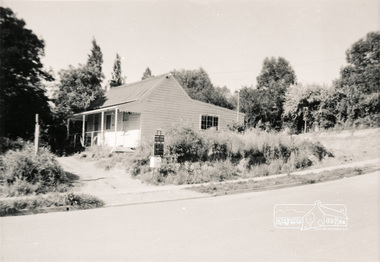 Eltham District Historical Society Inc
Photograph, Grant's Cottage, cnr. Main Road and Dalton Street, Eltham, 1970s
... This photo shows Eltham Clinic in its early days,(sign at driveway entrance), circa 19070s. The clinic started off in Grant's house which was built before 1918. ...This photo shows Eltham Clinic in its early days,(sign at driveway entrance), circa 19070s. The clinic started off in Grant's house which was built before 1918. ...This photo shows Eltham Clinic in its early days,(sign at driveway entrance), circa 19070s. The clinic started off in Grant's house which was built before 1918. Showing front and side views of former cottage (Grant's house) on cnr Main Road and Dalton Street, Eltham now the site of present-day Eltham Clinic at 700 Main RoadTwo black and white photographshouses, main road, dalton street, grant house, eltham clinic -
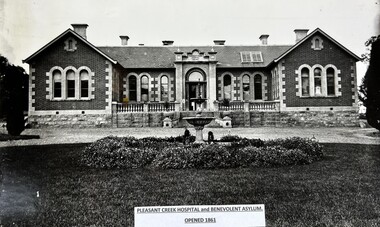 Stawell Historical Society Inc
Photograph, Pleasant Creek Hospital built 1861
... Central steps to entrance and a gravel driveway. In the foreground a fountain surrounded by a garden bed and lawn....Central steps to entrance and a gravel driveway. In the foreground a fountain surrounded by a garden bed and lawn. ...Pleasant Creek Hospital with garden and fountain at front. Built 1861Black and white enlarged photograph of a large brick building with stone foundations slate roof patio with balustrade. Central steps to entrance and a gravel driveway. In the foreground a fountain surrounded by a garden bed and lawn.Pleasant Creek Hospital and Benevolent Asylum opened 1861.stawell -
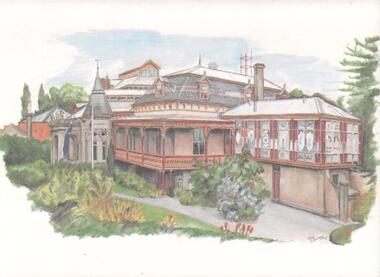 Bendigo Historical Society Inc.
Card - FORTUNA COLLECTION: CARD
... Christmas Card - colour printed sketch of fortuna Villa showing partial view of driveway, portico entrance on left, turret tower, ironwork balcony and conservatory on right. ...Fortuna Villa Army Survey Regiment Christmas Card - colour printed sketch of fortuna Villa showing partial view of driveway, portico entrance on left, turret tower, ironwork balcony and conservatory on right. ...Christmas Card - colour printed sketch of fortuna Villa showing partial view of driveway, portico entrance on left, turret tower, ironwork balcony and conservatory on right. Wording inside card reads ' Seasons Greetings from Army Survey Regiment Fortuna'. On rear of card is a 'Royal Australian Survey Corps insignia.fortuna villa, army survey regiment -
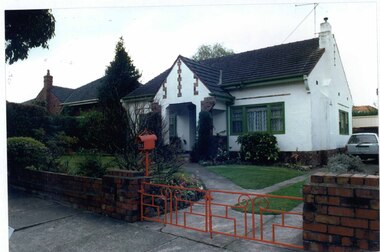 Glen Eira Historical Society
Photograph, Beauville Avenue, 35, Murrumbeena, 2001
... There are low, red, wrought iron gates across the driveway entrance. Garage has a matching brown brick feature wall....There are low, red, wrought iron gates across the driveway entrance. Garage has a matching brown brick feature wall. ...Originally labelled "Beauville Estate, Established 1936, Still Thriving 65 years on, 10th March 2001", the Beauville Estate Album contains colour photographs of houses in the Estate. They were taken around the time of the Beauville Estate’s 65th Heritage Celebration held on 10/03/2001 and donated to the Caulfield Historical Society shortly afterwards. Photographer unknown. Windows frames, gutters and drain pipe all painted green but this is same property as 2104A-38 where they are painted black.City of Glen Eira’s Heritage Management Plan Vol 2 p79 (this is p84 of the pdf version) – HO12 Beauville Estate and environs, Murrumbeena: The Beauville Historic Area is important at the State level as the first large housing estate undertaken by the AV Jennings Construction Co, later Jennings Group Limited, Victoria’s largest home builder. It is important also as a very early estate development incorporating a range of features other than houses and including made roads, shops and recreation facilities. In this respect it was the forerunner of the comprehensively planned housing estate of the post war era. The estate is distinguished by its aesthetic values, as is the earlier and comparable Hillcrest Estate, which are formed by a combination of restrained diversity in house styles, with the exception of no. 30 in the emerging International style, and by a landscaped garden environment. Colour photograph of white rendered house with unpainted variegated brown brick features including a geometric pattern of 3 vertical shapes on the gable over the porch. Other features include a wide arched porch, tiled roof and low unpainted reddish brown brick fence in the foreground with "35" on the reddish brown metal letterbox on top of the brick pillar beside the driveway. There are low, red, wrought iron gates across the driveway entrance. Garage has a matching brown brick feature wall.murrumbeena, houses, beauville avenue, architectural styles, 1930's, inter war style, a.v. jennings, av jennings, jennings, brick houses, beauville estate, porches, letterboxes, sir albert victor jennings, a v jennings construction co, beauville estate heritage area, glen eira city council, architectural features, jennings group limited, land subdivision, gardens, beauville historic area, rendered houses, brick features, arches, brick fences, garages (private), gables -
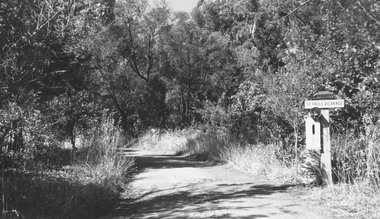 Ringwood and District Historical Society
Photograph, Church of England, Ringwood- entrance to Vicarage, Warrandyte Road. 1965
... Black and white photograph of dirt driveway through a bushy area. Church of England, Ringwood- entrance to Vicarage, Warrandyte Road. 1965. ...Black and white photograph of dirt driveway through a bushy area. -
 Glenelg Shire Council Cultural Collection
Photograph, Arial view of CSR Softwoods, Dartmoor, n.d
... At front is a recessed entrance and an open internal area. A driveway and road are at front. ...At front is a recessed entrance and an open internal area. A driveway and road are at front. ...Port of Portland Authority archives.Front: (no inscriptions) Back: (no inscriptions)port of portland -
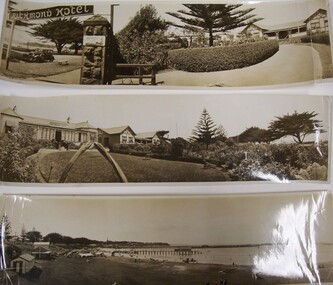 Glenelg Shire Council Cultural Collection
Photograph - Photograph - Entrance to Richmond Hotel Centenary Celebrations Portland 1934, 1934
... driveway leading to two light-coloured houses. Donated by Ms Mary Robinson, acting on behalf of Mrs W. G. Hutchinson "Tellong" Blackwood River Drive Balingup W A 6253 Photograph Photograph - Entrance to Richmond Hotel Centenary Celebrations Portland 1934 Unknown ...Photographs taken by Esther Winifred Hall (nee Smallpage) - great grand-daughter of Stephen George Henty. Taken in 1934 Centenary Celebrations in Portland.Back: "Original Home of Stephen George Henty. To E.... Hall from Marg...."centenary celebrations portland 1934 -
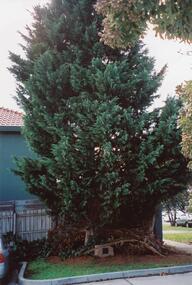 Phillip Island and District Historical Society Inc.
Photographs, 30/11/2009
... Colour Photograph 5 Warley Hospital driveway alongside front entrance. Colour Photograph 6 Warley Hospital with "Expressions of Interest" Sign in foreground with SOLD across the sign. ...Colour Photograph 5 Warley Hospital driveway alongside front entrance. Colour Photograph 6 Warley Hospital with "Expressions of Interest" Sign in foreground with SOLD across the sign. ...This is a collection of 12 coloured photographs of the Warley Hospital and Nursing home donated by Meg Davis. In 1923 the Warley Hospital was established in a house purchased by Mr Thompson. The new hospital was built in 1962 and the Nursing Home Annex was added in the mid 1970's. The Hospital was closed January 31st 2008.Colour Photograph 1 Cyprus Tree in grounds of the Warley Hospital with Plaque mounted on Granite plinth at base. Colour Photograph 2 Warley Avenue Cowes, Phillip Island with trees lining the street. Colour Photograph 3 Plaque mounted on Granite plinth stating "This tree was planted at the Diamond Jubilee Celebration 4-12-1983 by Mr Peter J Berwick, President Victorian Bush Nursing Association" Colour Photograph 4 Warley Avenue Street Sign mounted on concrete pole. Colour Photograph 5 Warley Hospital driveway alongside front entrance. Colour Photograph 6 Warley Hospital with "Expressions of Interest" Sign in foreground with SOLD across the sign. Colour Photograph 7 Warley Hospital Nursing Home. Colour Photograph 8 Warley Hospital front view with garage underneath. Colour Photograph 9 Warley Hospital Nursing Home. Colour Photograph 10 Warley Hospital front close up view of garage entrance and Nursing home to the right in the background. Colour Photograph 11 Warley Hospital Main Entrance. Colour Photograph 12 Warley Hospital original Medical Centre - now Consulting Rooms. warley hospital cowes phillip island, hospitals, warley nursing home cowes phillip island, warley avenue cowes phillip island, meg davis -
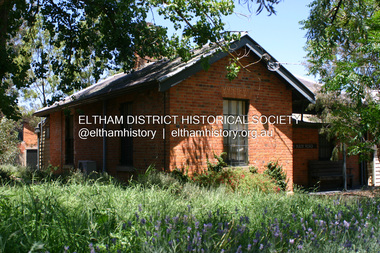 Eltham District Historical Society Inc
Photograph - Digital Photograph, Alan King, Former Police Residence, 728 Main Road, Eltham, 28 December 2007
... Council improved the driveway but later added a second rear access from Brougham Street due to the dangerous nature of the Main Road entrance. ...Council improved the driveway but later added a second rear access from Brougham Street due to the dangerous nature of the Main Road entrance. ...The institutions of law and order in Colonial Victoria included the police, courts and prisons. The 1852 report of the Snodgrass Select Committee appointed to "identify the policing needs of the colony” noted there existed seven independent police forces that did not co-operate or regularly communicate. Following the committee's report all these police entities were merged into the Victoria Police, founded on 8 January 1853, to implement law and order responsibilities throughout the Colony of Victoria. The Eltham Courthouse (1860) and adjacent Police Residence (1859) formed a justice precinct established in the immediate aftermath of the 1852 police inquiry and the effects of the gold rush. The physical presence of these buildings, in the centre of the early Eltham township, defined centralised control over law and order. In the early days the Police Constable in charge would conduct his duties travelling around the district by horse; a stable was located at the rear of the residence. At times the horse would be grazed on the paddocks across the road. Horseshoes were forged by the blacksmith beside the Courthouse on the high side of “Policeman’s Hill”. Along with the stable, there was a two-cell bluestone lockup where prisoners were held awaiting trial in the adjacent Courthouse. Their meals were usually provided by the policeman’s wife or from the hotel just up the road. With the arrival of the railway in 1902 the town centre gradually shifted towards the railway station. The Police Station and operations were moved into the town centre in 1961 to a renovated house in Pryor Street, which was later replaced by the current Police Station. From 1961-1981 the residence was occupied by the Vermin and Noxious Weeds Destruction Section of the Department of Crown Lands and Survey. Prior to August 1967 the former Police Station was dragged to the rear of Police Residence to make way for the construction of a driveway and access from Main Road. The building was placed on the site of a former Scullery and modified for Lands Department use. In 1981 the Shire of Eltham took over management of the former Police Residence in Eltham. It remained unoccupied for a period whilst its future was discussed in Council. It was then used for a community job creation scheme until 1985. In 1985 the Shire of Eltham Parks and Environment occupied the residence. Council improved the driveway but later added a second rear access from Brougham Street due to the dangerous nature of the Main Road entrance. Additionally, a rear toilet facility between the Police Residence and the relocated former Police Station, which was doubling up as a lunchroom. Council also commenced discussions to re-establish a replica Police Station. Around November 1986 the former Police Station was demolished; believed to have been suffering termite damage. About 1989, after some years of discussion, a replica Police Station was built, based on photographs, to act as a lunchroom and meeting room for the Parks and Environment staff and volunteers doing community service. In 1996 Eltham District Historical Society held discussions with Nillumbik Shire Council commissioners throughout the year regarding a home for the Society. A proposal was put forward by the Society in October to occupy the former Police Residence. In March 1997 Eltham District Historical Society gained access to former Police Residence and on July 12, 1998, moved into its Local History Centre. In July 2018, Eltham District Historical Society gained access to the replica Police Station (which had been used as a music library and storage for the Eltham Concert Band) for use as part of regular heritage tours for schools and community-based groups. Covered under Heritage Overlay, Nillumbik Planning Scheme. Published: Nillumbik Now and Then / Marguerite Marshall 2008; photographs Alan King with Marguerite Marshall.; p65This collection of almost 130 photos about places and people within the Shire of Nillumbik, an urban and rural municipality in Melbourne's north, contributes to an understanding of the history of the Shire. Published in 2008 immediately prior to the Black Saturday bushfires of February 7, 2009, it documents sites that were impacted, and in some cases destroyed by the fires. It includes photographs taken especially for the publication, creating a unique time capsule representing the Shire in the early 21st century. It remains the most recent comprehenesive publication devoted to the Shire's history connecting local residents to the past. nillumbik now and then (marshall-king) collection, eltham, main road, eltham district historical society, eltham justice precinct, little eltham, local history centre, police residence, police station -
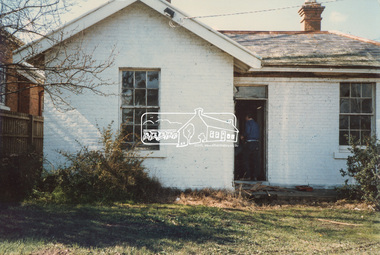 Eltham District Historical Society Inc
Photograph, Former Eltham Police Residence, 728 Main Road, Eltham, c.1985, 1985c
... Council improve the driveway but later add a second rear access from Brougham Street due to the dangerous nature of the Main Road entrance. ...Council improve the driveway but later add a second rear access from Brougham Street due to the dangerous nature of the Main Road entrance. ...This photo is believed to have been taken circa 1985 when the Shire of Eltham Parks and Environment occupied the site. This photo was originally mounted on 3mm MDF fibre board with notes and stickers applied as part of a display on the former Police Residence and now present day Local History Centre, home to Eltham District Historical Society; possibly put together by Harry Gilham during his time as president of the society. Eltham Police Station and Residence: A brief history 1860 Eltham Courthouse built in Main Road, together with an adjoining police residence, office, lock–up and stables. 1959 Police Department purchases a house in Pryor Street to be refurbished as Eltham Police Station 1961 Police in Eltham move into Pryor Street refurbished buildings and office. c.1961-1981 Occupied by Vermin and Noxious Weeds Destruction Section of the Department of Crown Lands and Survey. Former Police Station dragged around to rear of Police Residence (prior to August 1967) to make way for the construction of a driveway and access from Main Road. The building was placed on the site of a former Scullery and modified for Lands Department use. 1981 Shire of Eltham take over management of old Police Residence in Eltham. It remains unoccupied for a period of time whilst its future is discussed in Council. 1981-1985 Used for community job creation scheme 1985 Shire of Eltham Parks and Environment occupy the residence. Council improve the driveway but later add a second rear access from Brougham Street due to the dangerous nature of the Main Road entrance. Also add a rear toilet facility between the Police Residence and former Police Station, which was doubling up as a lunch room. Council also commence discussions to re-establish a replica Police Station. c.1986 November. Former Police Station demolished; believed to have been suffering termite damage. c.1989 After some years of discussion a replica Police Station is built, based on photographs, to act as a lunch room and meeting room for Parks and Environment staff and volunteers doing community service. 1996 Eltham District Historical Society in discussions with Nillumbik Shire Council commisioners throughout the year regarding a home for the Society. A proposal put forward by the Society in October to occupy the former Police Residence. 1997 March. Eltham District Historical Society gains access to former Police Residence. 1998 July 12th. Eltham District Historical Society Inc moves into its Local History Centre, 728 Main Road Eltham (the former Police Residnce built in 1860). 2018 July. Eltham District Historical Society gains access to the replica Police Station for use as part of regular heritage tours for schools and community based groups.Colour printHandwritten in faded blue felt pen ink "No. 3 - Front of 728 Police Residence. 1860 Court House over the paling fence. Verandah missing from earlier photographs"728 main road, eltham, local history centre, parks and environment, police residence, police station, shire of eltham -
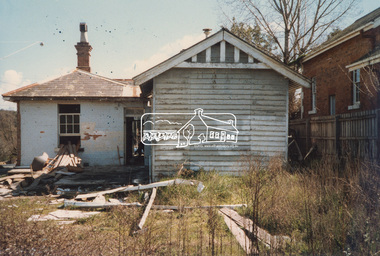 Eltham District Historical Society Inc
Photograph, Former Eltham Police Residence, 728 Main Road, Eltham, c.1985, 1985c
... Council improve the driveway but later add a second rear access from Brougham Street due to the dangerous nature of the Main Road entrance. ...Council improve the driveway but later add a second rear access from Brougham Street due to the dangerous nature of the Main Road entrance. ...This photo is believed to have been taken circa 1985 when the Shire of Eltham Parks and Environment occupied the site. This photo was originally mounted on 3mm MDF fibre board with notes and stickers applied as part of a display on the former Police Residence and now present day Local History Centre, home to Eltham District Historical Society; possibly put together by Harry Gilham during his time as president of the society. Eltham Police Station and Residence: A brief history 1860 Eltham Courthouse built in Main Road, together with an adjoining police residence, office, lock–up and stables. 1959 Police Department purchases a house in Pryor Street to be refurbished as Eltham Police Station 1961 Police in Eltham move into Pryor Street refurbished buildings and office. c.1961-1981 Occupied by Vermin and Noxious Weeds Destruction Section of the Department of Crown Lands and Survey. Former Police Station dragged around to rear of Police Residence (prior to August 1967) to make way for the construction of a driveway and access from Main Road. The building was placed on the site of a former Scullery and modified for Lands Department use. 1981 Shire of Eltham take over management of old Police Residence in Eltham. It remains unoccupied for a period of time whilst its future is discussed in Council. 1981-1985 Used for community job creation scheme 1985 Shire of Eltham Parks and Environment occupy the residence. Council improve the driveway but later add a second rear access from Brougham Street due to the dangerous nature of the Main Road entrance. Also add a rear toilet facility between the Police Residence and former Police Station, which was doubling up as a lunch room. Council also commence discussions to re-establish a replica Police Station. c.1986 November. Former Police Station demolished; believed to have been suffering termite damage. c.1989 After some years of discussion a replica Police Station is built, based on photographs, to act as a lunch room and meeting room for Parks and Environment staff and volunteers doing community service. 1996 Eltham District Historical Society in discussions with Nillumbik Shire Council commisioners throughout the year regarding a home for the Society. A proposal put forward by the Society in October to occupy the former Police Residence. 1997 March. Eltham District Historical Society gains access to former Police Residence. 1998 July 12th. Eltham District Historical Society Inc moves into its Local History Centre, 728 Main Road Eltham (the former Police Residnce built in 1860). 2018 July. Eltham District Historical Society gains access to the replica Police Station for use as part of regular heritage tours for schools and community based groups.Colour printHandwritten in faded blue felt pen ink "No. 2 - Backyard of 728 #5 Weatherboard 'Office'. Note 1860 Court House over the fence."728 main road, eltham, local history centre, parks and environment, police residence, police station, shire of eltham -
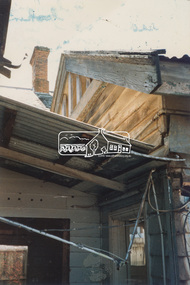 Eltham District Historical Society Inc
Photograph, Former Eltham Police Residence, 728 Main Road, Eltham, c.1985, 1985c
... Council improve the driveway but later add a second rear access from Brougham Street due to the dangerous nature of the Main Road entrance. ...Council improve the driveway but later add a second rear access from Brougham Street due to the dangerous nature of the Main Road entrance. ...This photo is believed to have been taken circa 1985 when the Shire of Eltham Parks and Environment occupied the site. This photo was originally mounted on 3mm MDF fibre board with notes and stickers applied as part of a display on the former Police Residence and now present day Local History Centre, home to Eltham District Historical Society; possibly put together by Harry Gilham during his time as president of the society. Eltham Police Station and Residence: A brief history 1860 Eltham Courthouse built in Main Road, together with an adjoining police residence, office, lock–up and stables. 1959 Police Department purchases a house in Pryor Street to be refurbished as Eltham Police Station 1961 Police in Eltham move into Pryor Street refurbished buildings and office. c.1961-1981 Occupied by Vermin and Noxious Weeds Destruction Section of the Department of Crown Lands and Survey. Former Police Station dragged around to rear of Police Residence (prior to August 1967) to make way for the construction of a driveway and access from Main Road. The building was placed on the site of a former Scullery and modified for Lands Department use. 1981 Shire of Eltham take over management of old Police Residence in Eltham. It remains unoccupied for a period of time whilst its future is discussed in Council. 1981-1985 Used for community job creation scheme 1985 Shire of Eltham Parks and Environment occupy the residence. Council improve the driveway but later add a second rear access from Brougham Street due to the dangerous nature of the Main Road entrance. Also add a rear toilet facility between the Police Residence and former Police Station, which was doubling up as a lunch room. Council also commence discussions to re-establish a replica Police Station. c.1986 November. Former Police Station demolished; believed to have been suffering termite damage. c.1989 After some years of discussion a replica Police Station is built, based on photographs, to act as a lunch room and meeting room for Parks and Environment staff and volunteers doing community service. 1996 Eltham District Historical Society in discussions with Nillumbik Shire Council commisioners throughout the year regarding a home for the Society. A proposal put forward by the Society in October to occupy the former Police Residence. 1997 March. Eltham District Historical Society gains access to former Police Residence. 1998 July 12th. Eltham District Historical Society Inc moves into its Local History Centre, 728 Main Road Eltham (the former Police Residnce built in 1860). 2018 July. Eltham District Historical Society gains access to the replica Police Station for use as part of regular heritage tours for schools and community based groups.Colour printHandwritten in faded blue felt pen ink "Roof of room 5 (weatherboard office) and W.C. See No. 2 for another view"728 main road, eltham, local history centre, parks and environment, police residence, police station, shire of eltham -
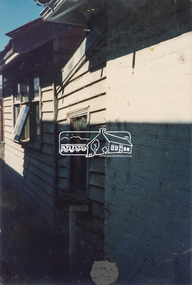 Eltham District Historical Society Inc
Photograph, Former Eltham Police Residence, 728 Main Road, Eltham, c.1985, 1985c
... Council improve the driveway but later add a second rear access from Brougham Street due to the dangerous nature of the Main Road entrance. ...Council improve the driveway but later add a second rear access from Brougham Street due to the dangerous nature of the Main Road entrance. ...This photo is believed to have been taken circa 1985 when the Shire of Eltham Parks and Environment occupied the site. This photo was originally mounted on 3mm MDF fibre board with notes and stickers applied as part of a display on the former Police Residence and now present day Local History Centre, home to Eltham District Historical Society; possibly put together by Harry Gilham during his time as president of the society. Eltham Police Station and Residence: A brief history 1860 Eltham Courthouse built in Main Road, together with an adjoining police residence, office, lock–up and stables. 1959 Police Department purchases a house in Pryor Street to be refurbished as Eltham Police Station 1961 Police in Eltham move into Pryor Street refurbished buildings and office. c.1961-1981 Occupied by Vermin and Noxious Weeds Destruction Section of the Department of Crown Lands and Survey. Former Police Station dragged around to rear of Police Residence (prior to August 1967) to make way for the construction of a driveway and access from Main Road. The building was placed on the site of a former Scullery and modified for Lands Department use. 1981 Shire of Eltham take over management of old Police Residence in Eltham. It remains unoccupied for a period of time whilst its future is discussed in Council. 1981-1985 Used for community job creation scheme 1985 Shire of Eltham Parks and Environment occupy the residence. Council improve the driveway but later add a second rear access from Brougham Street due to the dangerous nature of the Main Road entrance. Also add a rear toilet facility between the Police Residence and former Police Station, which was doubling up as a lunch room. Council also commence discussions to re-establish a replica Police Station. c.1986 November. Former Police Station demolished; believed to have been suffering termite damage. c.1989 After some years of discussion a replica Police Station is built, based on photographs, to act as a lunch room and meeting room for Parks and Environment staff and volunteers doing community service. 1996 Eltham District Historical Society in discussions with Nillumbik Shire Council commisioners throughout the year regarding a home for the Society. A proposal put forward by the Society in October to occupy the former Police Residence. 1997 March. Eltham District Historical Society gains access to former Police Residence. 1998 July 12th. Eltham District Historical Society Inc moves into its Local History Centre, 728 Main Road Eltham (the former Police Residnce built in 1860). 2018 July. Eltham District Historical Society gains access to the replica Police Station for use as part of regular heritage tours for schools and community based groups.Colour printHandwritten in faded blue felt pen ink "Another view of north wall 728 No. 4. Taken from west end towards back yard"728 main road, eltham, local history centre, parks and environment, police residence, police station, shire of eltham -
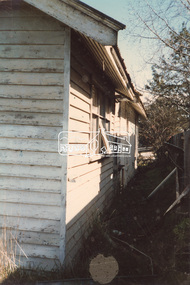 Eltham District Historical Society Inc
Photograph, Former Eltham Police Residence, 728 Main Road, Eltham, c.1985, 1985c
... Council improve the driveway but later add a second rear access from Brougham Street due to the dangerous nature of the Main Road entrance. ...Council improve the driveway but later add a second rear access from Brougham Street due to the dangerous nature of the Main Road entrance. ...This photo is believed to have been taken circa 1985 when the Shire of Eltham Parks and Environment occupied the site. This photo was originally mounted on 3mm MDF fibre board with notes and stickers applied as part of a display on the former Police Residence and now present day Local History Centre, home to Eltham District Historical Society; possibly put together by Harry Gilham during his time as president of the society. Eltham Police Station and Residence: A brief history 1860 Eltham Courthouse built in Main Road, together with an adjoining police residence, office, lock–up and stables. 1959 Police Department purchases a house in Pryor Street to be refurbished as Eltham Police Station 1961 Police in Eltham move into Pryor Street refurbished buildings and office. c.1961-1981 Occupied by Vermin and Noxious Weeds Destruction Section of the Department of Crown Lands and Survey. Former Police Station dragged around to rear of Police Residence (prior to August 1967) to make way for the construction of a driveway and access from Main Road. The building was placed on the site of a former Scullery and modified for Lands Department use. 1981 Shire of Eltham take over management of old Police Residence in Eltham. It remains unoccupied for a period of time whilst its future is discussed in Council. 1981-1985 Used for community job creation scheme 1985 Shire of Eltham Parks and Environment occupy the residence. Council improve the driveway but later add a second rear access from Brougham Street due to the dangerous nature of the Main Road entrance. Also add a rear toilet facility between the Police Residence and former Police Station, which was doubling up as a lunch room. Council also commence discussions to re-establish a replica Police Station. c.1986 November. Former Police Station demolished; believed to have been suffering termite damage. c.1989 After some years of discussion a replica Police Station is built, based on photographs, to act as a lunch room and meeting room for Parks and Environment staff and volunteers doing community service. 1996 Eltham District Historical Society in discussions with Nillumbik Shire Council commisioners throughout the year regarding a home for the Society. A proposal put forward by the Society in October to occupy the former Police Residence. 1997 March. Eltham District Historical Society gains access to former Police Residence. 1998 July 12th. Eltham District Historical Society Inc moves into its Local History Centre, 728 Main Road Eltham (the former Police Residnce built in 1860). 2018 July. Eltham District Historical Society gains access to the replica Police Station for use as part of regular heritage tours for schools and community based groups.Colour printHandwritten in faded blue felt pen ink "Repeat view of No. 4 from external corner of weatherboard extn. Room 5"728 main road, eltham, local history centre, parks and environment, police residence, police station, shire of eltham -
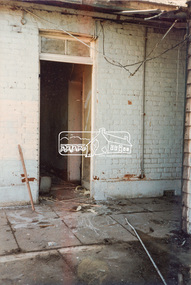 Eltham District Historical Society Inc
Photograph, Former Eltham Police Residence, 728 Main Road, Eltham, c.1985, 1985c
... Council improve the driveway but later add a second rear access from Brougham Street due to the dangerous nature of the Main Road entrance. ...Council improve the driveway but later add a second rear access from Brougham Street due to the dangerous nature of the Main Road entrance. ...This photo is believed to have been taken circa 1985 when the Shire of Eltham Parks and Environment occupied the site. This photo was originally mounted on 3mm MDF fibre board with notes and stickers applied as part of a display on the former Police Residence and now present day Local History Centre, home to Eltham District Historical Society; possibly put together by Harry Gilham during his time as president of the society. Eltham Police Station and Residence: A brief history 1860 Eltham Courthouse built in Main Road, together with an adjoining police residence, office, lock–up and stables. 1959 Police Department purchases a house in Pryor Street to be refurbished as Eltham Police Station 1961 Police in Eltham move into Pryor Street refurbished buildings and office. c.1961-1981 Occupied by Vermin and Noxious Weeds Destruction Section of the Department of Crown Lands and Survey. Former Police Station dragged around to rear of Police Residence (prior to August 1967) to make way for the construction of a driveway and access from Main Road. The building was placed on the site of a former Scullery and modified for Lands Department use. 1981 Shire of Eltham take over management of old Police Residence in Eltham. It remains unoccupied for a period of time whilst its future is discussed in Council. 1981-1985 Used for community job creation scheme 1985 Shire of Eltham Parks and Environment occupy the residence. Council improve the driveway but later add a second rear access from Brougham Street due to the dangerous nature of the Main Road entrance. Also add a rear toilet facility between the Police Residence and former Police Station, which was doubling up as a lunch room. Council also commence discussions to re-establish a replica Police Station. c.1986 November. Former Police Station demolished; believed to have been suffering termite damage. c.1989 After some years of discussion a replica Police Station is built, based on photographs, to act as a lunch room and meeting room for Parks and Environment staff and volunteers doing community service. 1996 Eltham District Historical Society in discussions with Nillumbik Shire Council commisioners throughout the year regarding a home for the Society. A proposal put forward by the Society in October to occupy the former Police Residence. 1997 March. Eltham District Historical Society gains access to former Police Residence. 1998 July 12th. Eltham District Historical Society Inc moves into its Local History Centre, 728 Main Road Eltham (the former Police Residnce built in 1860). 2018 July. Eltham District Historical Society gains access to the replica Police Station for use as part of regular heritage tours for schools and community based groups.Colour printHandwritten in faded blue felt pen ink "Backdoor to residence. White paint still visible 2010 on brickwork"728 main road, eltham, local history centre, parks and environment, police residence, police station, shire of eltham
