
Showing 18 items matching "epworth hospital"
-
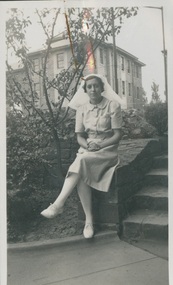 Uniting Church Archives - Synod of Victoria
Photograph, Undated c.1940s
... Phyllis Lorraine Davis, nurse, Epworth Hospital, methodist...Informal B & W photograph of Phyllis Lorraine Davis dressed in nurses uniform, sitting in the grounds of the Epworth Hospital, Richmond....Phyllis Lorraine Davis, nurse, Epworth Hospital, methodist Informal B & W photograph of Phyllis Lorraine Davis dressed in nurses uniform, sitting in the grounds of the Epworth Hospital, Richmond. ...Informal B & W photograph of Phyllis Lorraine Davis dressed in nurses uniform, sitting in the grounds of the Epworth Hospital, Richmond.phyllis lorraine davis, nurse, epworth hospital, methodist -
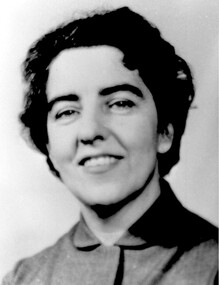 Surrey Hills Historical Society Collection
Photograph, Matron Joan Bray of Barton Street, Surrey Hills
... ...epworth hospital...She trained as a nurse at Epworth Hospital and in 1941 served with the army at Gaza Hospital in the Middle East, then in New Guinea. ...She trained as a nurse at Epworth Hospital and in 1941 served with the army at Gaza Hospital in the Middle East, then in New Guinea. ...Joan Mary Bray was born 6/9/1915 in Brisbane, the daughter of Herbert Edward Bray and his wife Grace (nee Shepherd) who married in Wisbech, Cambridge in 1892. The family lived at 5 Barton Street from the late 1920s. She completed her primary schooling at Auburn Primary by travelling there by the little black bus along Canterbury Road. She then went on to Mont Albert Central School and Melbourne Girls High. Locally she belonged to the 1st Surrey Hills Girl Guide Company at Holy Trinity Church. She trained as a nurse at Epworth Hospital and in 1941 served with the army at Gaza Hospital in the Middle East, then in New Guinea. From 1944 until the end of the war she was in Bougainville. Her mother died in Surrey Hills 29/9/1945 and her father moved to Hawthorn; he died in 1955. She had 3 older sisters: Eveline Grace (1893-1978) m Eric Benson; Violet Constance (1894-1983 - ? Sister Constance in mother’s death notice); Dorothy Maud (1896 - ? Sister Ursula in mother’s death notice). After the war she was a RSSL nurse, Matron of St Gabriel’s Baby Home in Balwyn, then Director of Nursing at the Royal Eye and Ear Hospital, East Melbourne. She resigned to be married. [No success in locating her marriage, presumed to be to UNKNOWN Wicks.]Black and white head and shoulders portrait of Joan Bray. She is wearing a plain shirt or jacket.barton street, mont albert central school, auburn primary school, melbourne girls high school, girl guides, 1st surrey hills girl guide company, nurses, nursing, hospitals, health services, australian army nursing service, world wars, 1939-1945, epworth hospital, st gabriel's baby home, eye and ear hospital, (miss) joan mary bray, matron joan bray, (mrs) joan wicks -
 Marysville & District Historical Society
THE TRIANGLE NEWS-VOL 41 NO 29-AUGUST 1 2014
... local oncologist raising funds for epworth hospital...marysville victoria australia local oncologist raising funds for epworth hospital what's on when in august 2014 sesonal influenza vaccine the committee of management of the gallipoli park precinct marysville community market creative triangle adventurous cooks triangle community dinner church notices marysville golf report marysville triangle business and tourism agm mayor's chair by councillor margaret rae councillor comment by john walsh koriella ward residential and rural real estate marysville & triangle men's shed advertisements notice of agm of marysville & triangle youth group marysville triangle real estate lions community service awards victims assistance program el kanah eat in eat out menu buxton hotel roast night notice of special meeting of council buxton primary school open day marysville preschool centre long day care & kindergarten retail opportunities new home for local talent & produce made in marysville & surronds cafe gallery & providore mim marysville villains best & fairest dinner the bunker restaurant grand opening marysville golf & bowls club marysville patisserie casual position the country touch bus yea shire hall opera event gilbert & sullivan taggerty community progress group & hall committee taggerty rocks supper dance THE TRIANGLE NEWS-VOL 41 NO 29-AUGUST 1 2014 ...marysville, victoria, australia, local oncologist raising funds for epworth hospital, what's on when in august, 2014 sesonal influenza vaccine, the committee of management of the gallipoli park precinct, marysville community market, creative triangle, adventurous cooks, triangle community dinner, church notices, marysville golf report, marysville triangle business and tourism agm, mayor's chair by councillor margaret rae, councillor comment by john walsh koriella ward, residential and rural real estate, marysville & triangle men's shed, advertisements, notice of agm of marysville & triangle youth group, marysville triangle real estate, lions community service awards, victims assistance program, el kanah eat in eat out menu, buxton hotel roast night, notice of special meeting of council, buxton primary school open day, marysville preschool centre, long day care & kindergarten, retail opportunities, new home for local talent & produce, made in marysville & surronds cafe gallery & providore, mim, marysville villains best & fairest dinner, the bunker restaurant grand opening, marysville golf & bowls club, marysville patisserie casual position, the country touch bus, yea shire hall, opera event gilbert & sullivan, taggerty community progress group & hall committee, taggerty rocks supper dance -
Eltham District Historical Society Inc
Document - Folder, Spence, Nell
... ...Epworth Hospital...Nell Spence Old Colonists' Homes Eltham Archie Spence Royal Melbourne Hospital Epworth Hospital Newspaper clippings, A4 photocopies, etc Spence, Nell Document Folder ...After a hard childhood, Nell Spence trained as a nurse at the Melbourne Hospital (later Royal Melbourne Hospital), nursed at other hospitals and for family members. Contents Newspaper article: "A lifetime of loyal service", Diamond Valley News, 14 November 1989. Nell Spence was about to celebrate her 100th birthday. Newspaper clippings, A4 photocopies, etcnell spence, old colonists' homes eltham, archie spence, royal melbourne hospital, epworth hospital -
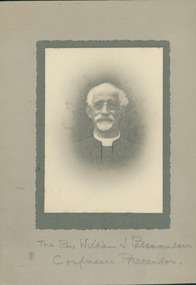 Uniting Church Archives - Synod of Victoria
Print, C1910
... Pallie, worked to raise the funds to establish the Epworth Hospital and was Chaplain there at his death....Pallie, worked to raise the funds to establish the Epworth Hospital and was Chaplain there at his death. ...Rev. William J. Palamountain (1863-1935), known as Rev. Pallie, worked to raise the funds to establish the Epworth Hospital and was Chaplain there at his death.Matte, black and white, head and shoulders portrait of Rev. William J. Palamountain on card.palamountain, wj -
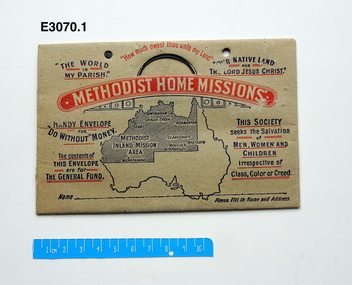 Uniting Church Archives - Synod of Victoria
Offering envelope, Methodist Home Missions
... The Methodist Home Missions was the department running the work of smaller churches and charitable institutions such as babies' homes, the Epworth Hospital, chaplaincies to hospitals and prisons, aged care homes, alcohol rehabilitation, local missions to depressed areas and the like. ...The Methodist Home Missions was the department running the work of smaller churches and charitable institutions such as babies' homes, the Epworth Hospital, chaplaincies to hospitals and prisons, aged care homes, alcohol rehabilitation, local missions to depressed areas and the like. ...The Methodist Home Missions was the department running the work of smaller churches and charitable institutions such as babies' homes, the Epworth Hospital, chaplaincies to hospitals and prisons, aged care homes, alcohol rehabilitation, local missions to depressed areas and the like. A minister was appointed each year by Conference, on deputation, to travel around Victoria to explain and encourage local congregations to support the work of the missions.Methodist Home Missions cardboard envelope with a blue map of Australia and blue and red text. The is a curved slot at the top of the envelope for inserting coins and squares on the back to mark off weekly giving. methodist home missions, methodist inland mission -
 Uniting Church Archives - Synod of Victoria
Brochure, Northcote Methodist Circuit
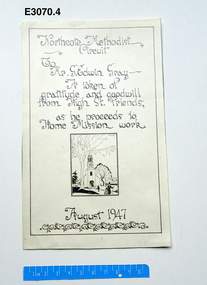
... The Methodist Home Missions was the department running the work of smaller churches and charitable institutions such as babies' homes, the Epworth Hospital, chaplaincies to hospitals and prisons, aged care homes, alcohol rehabilitation, local missions to depressed areas and the like. ...The Methodist Home Missions was the department running the work of smaller churches and charitable institutions such as babies' homes, the Epworth Hospital, chaplaincies to hospitals and prisons, aged care homes, alcohol rehabilitation, local missions to depressed areas and the like. ...The Methodist Home Missions was the department running the work of smaller churches and charitable institutions such as babies' homes, the Epworth Hospital, chaplaincies to hospitals and prisons, aged care homes, alcohol rehabilitation, local missions to depressed areas and the like. A minister was appointed each year by Conference, on deputation, to travel around Victoria to explain and encourage local congregations to support the work of the missions.Northcote Methodist Circuit: To Mr G Edwin Gray - A token of gratitude and goodwill from High St friends as he proceeds to Home Mission Work. August 1947. The paper has a small drawing of a church embedded in the hand written text.northcote methodist circuit, g edwin gray, methodist home mission -
 Uniting Church Archives - Synod of Victoria
Photograph, Rev. GA Judkins President of the Conference 1937, 1937
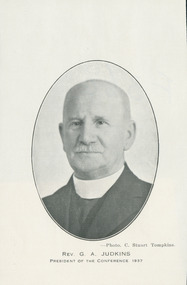
... He was chaplain at Epworth Hospital from 1940 to 1949....He was chaplain at Epworth Hospital from 1940 to 1949. B&W head and shoulders photograph. ...Reverend George Alfred Judkins was born in 1871 and died at Springvale in 1958. He commenced his ministry in 1897. He was stationed at Mt Lyell 1897, Melbourne Richmond 1899, Yarram Yarram 1891, Bendigo 1904, Echuca 1908, Horsham 1911, Ballarat Barkly Street 1914, Malvern 1918, Canterbury 1922, Social Service Department Director 1925-1938, Box Hill 1939. He was Secretary-General of Conference in 1936 and President 1937. He was chaplain at Epworth Hospital from 1940 to 1949.B&W head and shoulders photograph. -
 Uniting Church Archives - Synod of Victoria
Pamphlet, Methodist Home Missions
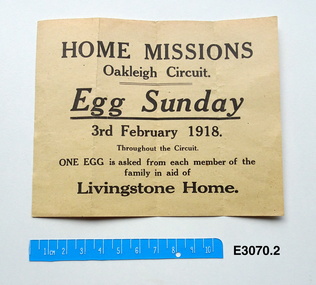
... The Methodist Home Missions was the department running the work of smaller churches and charitable institutions such as babies' homes, the Epworth Hospital, chaplaincies to hospitals and prisons, aged care homes, alcohol rehabilitation, local missions to depressed areas and the like. ...The Methodist Home Missions was the department running the work of smaller churches and charitable institutions such as babies' homes, the Epworth Hospital, chaplaincies to hospitals and prisons, aged care homes, alcohol rehabilitation, local missions to depressed areas and the like. ...The Methodist Home Missions was the department running the work of smaller churches and charitable institutions such as babies' homes, the Epworth Hospital, chaplaincies to hospitals and prisons, aged care homes, alcohol rehabilitation, local missions to depressed areas and the like. A minister was appointed each year by Conference, on deputation, to travel around Victoria to explain and encourage local congregations to support the work of the missions. Livingstone House was established in Carlton in 1888, and was first known as the Temporary Home for Destitute Children. It was run by the Central Dorcas Society, and led by its Senior Biblewoman, Mrs Varcoe. Many children in Livingstone were placed in foster care. In 1891, it relocated to a new property in Cheltenham and later became the Methodist Homes for Children. [https://www.findandconnect.gov.au/guide/vic/E000067]Methodist Home Missions Oakleigh Circuit Egg Sunday promotional pamphlet, 3rd February 1918. methodist home missions, livingstone home -
 Returned Nurses RSL Sub-branch
Newspaper - Newspaper clipping, Marie McNamara, Serving the cause, [1981]
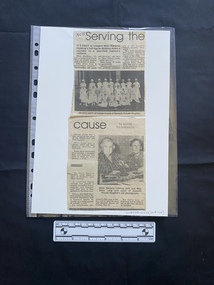
... Epworth Private Hospital, Richmond is celebrating it's nursing school's 60th year [opened in 1921 - Wikipedia]. ...Epworth Private Hospital, Richmond is celebrating it's nursing school's 60th year [opened in 1921 - Wikipedia]. ...Epworth Private Hospital, Richmond is celebrating it's nursing school's 60th year [opened in 1921 - Wikipedia]. Miss Marjorie Holding and Miss Ellice Lang, now retired, reminisce on their time nursing there. Both women were among the the first nurses trained at the school, with Marjorie going on to serve in WW2 before returning to serve as matron from 1948 to 1973.Two newspaper clippings, both with three columns of text and a black and white photo each. The photo on the first clipping show a large group of nurses in 1920's uniforms. The photo on the second clipping show two older women looking at photo albums.'NC15']blue ink, top left of first clipping]army, world war 2, world war two, wwii, middle east, new guinea -
 Wangaratta RSL Sub Branch
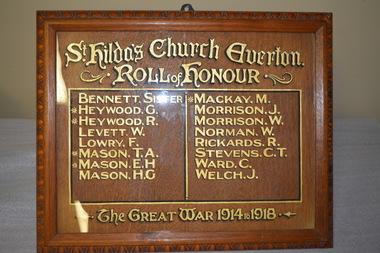
Honour Board - Framed Roll of Honour, St. Hilda's Church, Everton
... BENNETT returned to Victoria and was invited to join the nursing staff at Melbourne's Epworth Hospital with prospects of becoming Matron. ...BENNETT returned to Victoria and was invited to join the nursing staff at Melbourne's Epworth Hospital with prospects of becoming Matron. ...St Hilda's Church Everton, WW1 Roll of Honour - contains 16 names of members of the Everton Community in Victoria who served during the First World War including Nursing Sister Alma Louisa BENNETT (1890-1922) who trained at Melbourne General Hospital. She moved to Western Australia and continued nursing until the advent of World War 1. She immediately sought to enlist but was not granted her request until 1916 and was eventually sent for nursing duties in India. Her arrival coincided with the first convey of wounded after the fall of Kut in Mesopotamia. She was immediately given charge of a ward at Victoria Hospital. The following year she was appointed Matron of the hospital ship "Herefordshire" which transported sick and wounded soldiers from the mouth of the Tigris River to Bombay. Her next appointment was to the 34th Welsh Hospital at Deolali 150 miles from Bombay. The hospital was huge and she took charge as Matron. After 17 months at Deolali BENNETT was awarded the Royal Red Cross Medal First Class one of the highest distinctions in the British Nursing Service. When peace was declared she travelled to England where she continued to nurse in an Army Hospital. During her stay she was invited to Buckingham Palace where she was presented with Red Cross Medal by King George V. BENNETT returned to Victoria and was invited to join the nursing staff at Melbourne's Epworth Hospital with prospects of becoming Matron. Ill health intervened and she died in September 1922. Item said to be made by the family of Gilbert and Richard Heywood both KIA and listed on honour roll.St Hilda's Church Everton Honour Roll contains 16 names of members including Nurse BENNETT, from the Everton Community in Victoria who served in WW1 Carved timber frame and mounting with 16 names in gold coloured paint listed in two columns."St Hilda's Church Everton' "Roll of Honour" "The Great War 1914 to 1918" Sister Bennett/Heywood G/Heywood R/Levett W/Lowry F/Mason T.A/Mason E.H/Mason H.G/MacKay M/Morrison J/Morrison W/Norman W/Rickards R/Steens C.T/Ward C/Welch J.everton, 1914-1918, roll of honour -
 Surrey Hills Historical Society Collection
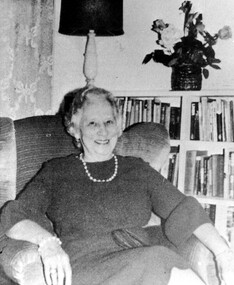
photograph, Dr Una Porter
... Cato Charitable and Benevolent Trust and later the James and Una Porter Trust Fund, she made substantial personal donations to hospitals, universities and community organisations including the University of Melbourne, Monash University, Epworth Hospital, Methodist Ladies College, Cato College, Queen Victoria Hospital and the YWCA. ...Cato Charitable and Benevolent Trust and later the James and Una Porter Trust Fund, she made substantial personal donations to hospitals, universities and community organisations including the University of Melbourne, Monash University, Epworth Hospital, Methodist Ladies College, Cato College, Queen Victoria Hospital and the YWCA. ...Dr Unice (Una) Beatrice Porter, OBE, CBE (1900 - 1996) Una Porter was the youngest daughter of Frederick John Cato and his wife Fanny (née Bethune). She had 3 sisters and 4 brothers. Her father was of course the prominent businessman and co-founder of the Moran & Cato grocery company who was known for his generosity and commitment to the Methodist Church. Given this background it is not surprising that Una inherited a deep and lasting Christian faith that would become the driving force behind her own career and philanthropic activities. Una was educated at Methodist Ladies College and the English boarding school "Farringtons" however her formal education ended at the age of 14 due to ill health. By the outbreak of the First World War her sisters were married and her brothers enlisted. Una became very close to her father and assisted him in establishing hospitals and missions in Arnhem Land, Fiji and India. Una returned to formal study and matriculated at the age of 30. A niece with diabetes was the catalyst which led Una to study medicine. She enrolled at the University of Melbourne in 1933 and subsequently specialised in psychiatry with training at Prince Henry's Hospital, the Royal Park Mental Hospital and the Children's Hospital. In 1946 she took a post at the Ballarat Mental Hospital. Here she was the first female member of staff, overseeing 512 female patients. She later worked in private practice and was instrumental in the establishment of a psychiatric clinic at the Queen Victoria Hospital. Throughout her life, Una maintained a strong link with the Young Women's Christian Association (YWCA) and in 1963 was elected as the World President of this organisation and in 1964 she was elected Woman of the Year. Una's philanthropic work was extensive. In addition to administering the F.J. Cato Charitable and Benevolent Trust and later the James and Una Porter Trust Fund, she made substantial personal donations to hospitals, universities and community organisations including the University of Melbourne, Monash University, Epworth Hospital, Methodist Ladies College, Cato College, Queen Victoria Hospital and the YWCA. It is estimated that she gave over $1 million to various hospitals and institutions. Some of her projects included establishing a scholarship for rural female students to attend university, a Chair in Psychiatry, and extensive research into early childhood development. Una B. Porter was appointed O.B.E. (1961) and C.B.E. (1968) in recognition of her services to the community. At the age of 46 Una married James Roland Porter, an ex-RAAF squadron leader and a lifelong friend. Until this time, Dr Porter had lived at the Cato family home, ‘Kawarau’ at 192-198 Tooronga Road, Hawthorn (later Stephanie’s restaurant). In spite of having qualified as a doctor and with all her philanthropic activities, at age 43 the electoral rolls give her status as ‘home duties’! Dr Porter’s connection with Surrey Hills came after her marriage. In 1948 she and her husband bought 8 Kent Road. A black and white photograph of a screened image of a lady sitting in a winged-back chair. She is wearing a knee length dress with three-quarter length sleeves, and beads around her neck and wrist.psychiatrist, philanthropist, queen victoria hospital, mont albert, surrey hills, 8 kent road, dr una porter, mr james porter, dr unice beatrice porter, mr frederick cato, miss unice beatrice cato, mrs fanny cato, miss fanny bethune, young women's christian association, fj cato charitable and benevolent trust, james and una porter trust fund, methodist ladies college -
 City of Melbourne Libraries
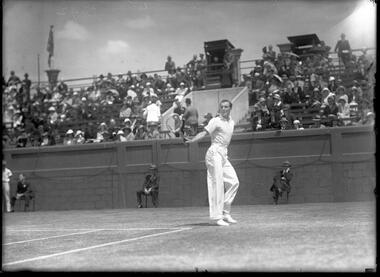
Photograph, Bull, Hugh Jones, 1897-1993, Tennis player Fred Perry, Kooyong
... Fred died in the Epworth Hospital, Richmond, Melbourne after falling in his hotel bathroom while visiting for the Australian Open. ...Fred died in the Epworth Hospital, Richmond, Melbourne after falling in his hotel bathroom while visiting for the Australian Open. ...Tennis champion Fred Perry backhands the ball at Kooyong, 1934 “I didn’t aspire to be a good sport, “champion” was good enough for me.” Fred Perry (1909-1995) was an English tennis champion who won eight Grand Slam titles including Wimbledon in 1934, 1935, 1936 and the Australian Open in 1934. Australian sports journalist Alan Trengove remarked, “When Perry walked out to play in his crisp white flannels and matching white blazer, thousands of female hearts missed a beat!” In 1935, Fred and Dorothy defeated Harry and Nell Hopman in the Wimbledon mixed doubles, and in 1936 they won against America. Fred started a successful sportswear brand in 1952, which continues today. Fred initially wanted a smoking pipe as the emblem as he was an enthusiastic smoker, but was talked out of it because it wouldn’t appeal to women. The familiar laurel was used instead. Featured in "Newsworthy: Melbourne in photographs 1933-1936" exhibition at East Melbourne Library, October to December 2023. Exhibition caption by project volunteer Fiona Collyer. Photographer notations on slide: "F. Perry 1934 Action B42" Photograph taken at Kooyong, Melbourne, but used in article about Wimbledon 1934. Published: The Age 7 July 1934 p 13 Published title: "THE FINAL STAGE." Published caption: F. J. Perry (England) Trove article identifier: http://nla.gov.au/nla.news-article205525840 Research by project volunteer Fiona Collyer: Frederick John Perry, 18 May 1909 to 2 Feb 1995 Fred Perry was an English tennis and table-tennis champion. He won eight Grand Slam titles – Wimbledon Gentlemen’s Singles, US Open three times, Australian Open and French Open once each. Fred had natural hand-to eye co-ordination, solid strokes and a devastating forehand that he used soon after the ball bounced. His fierce competitiveness and unabashed confidence gave him the winning edge. Fred was born in Stockport, Cheshire in 1909. His father, Samuel, a committed socialist, was a cotton spinner who became Secretary of the Co-Operative Party and later a Labour and Co-Operative Party M.P. When Fred was nine years old the family moved to Ealing, London. In 1929, at the age of 19, Fred became the World Champion at table-tennis – a new international sport at the time. He then decided to switch from table-tennis to tennis after his father told him to stop spending so much time in the smoke-filled halls that held table-tennis events. “You look like death warmed up.” he said. In the tennis world, Fred was regarded as an upstart intruder, and was the victim of snobbery and prejudice for his working class background. Fred trained with Arsenal Football Club in defiance of the LTA (Lawn Tennis Association) which had a dim view of extra-curricular exercise. His sarcastic toff-baiting call of “very clevah” when an opponent played a good shot and his habit of vaulting over the net whenever he won a match made Fred compelling to watch. Fred’s prize for winning Wimbledon was a £25 shopping voucher and a replica trophy. There was no on-court presentation; instead it was the custom to offer congratulations in the dressing rooms. One of the defining moments of Fred’s career came on the day he won Wimbledon for the first time in 1934. He was in the bathtub after the match when he over-heard former tennis player Brame Hillyard, a committee member of the All-England Club talking to Australian runner-up Jack Crawford. “This was the one day when the best man didn’t win.” Hillyard had brought a bottle of champagne and an All-England neck-tie, which was official recognition of Fred now being a member of one of the sporting world’s most elite clubs. Instead of a formal presentation to Fred, Hillyard draped the tie unceremoniously over his seat in the dressing room, handed Jack the bottle of champagne, and left. “Instead of Fred Perry the Champ, I felt like J. Fred Muggs the Chimp!” he said. When Fred finally went professional, an official at LTA told him he would never wear the club sweater again. Fred said “I made sure he wouldn’t have to worry about that, I sent a sleeve to him as a present!” In 1935, RKO offered Fred a contract for two movies at $50,000 each, but he had to turn down the offer as it would be in breach of LTA rules and he would lose his amateur status. In 1935, Fred married American film actress Helen Vinson in Harrison, New York, waking up a registrar at five minutes to midnight to avoid being married on Friday the thirteenth – “To be on the safe side” they said. In 1936, having been world number one tennis player for three years, Fred quit amateur tennis and moved to America. He joined tennis players Ellsworth Vines and Don Budge on a professional tennis circuit, travelling around US cities and receiving a share of the gate receipts. The All-England Club removed his honorary membership and the tie that went with it – “After all the trouble they’d gone to presenting it to me.” he quipped acidly. Despite being a three-time Wimbledon champion, Fred was barred from playing on LTA affiliated courts, so when he held his pro-tour through the UK in 1937, the matches had to be played on a portable wooden court, transported around by truck to football grounds. Fred was co-owner of the Beverley Hills Tennis Club. The exclusive membership consisted of Hollywood actors, directors, writers and studio heads. At the launch of the re-branded club in 1937, Fred played a doubles match with Charlie Chaplin, Groucho Marx and Ellsworth Vines, which he won with Charlie. Watching on was a Who’s Who of Hollywood actors including Barbara Stanwyck, Joan Crawford, the Marx Brothers, Errol Flynn, and Ronald Coleman to name a few. Fred was romantically linked to Hollywood actresses Marlene Dietrich, Jean Harlow, and Bette Davis, and was engaged to British actress Mary Lawson. In 1939, he became a US citizen and in 1942 enlisted in the US Air Force. Fred wore medical gauze around his right wrist while playing to stop sweat from flowing onto the handle of his racket and to wipe sweat from his brow. He paired up with former footballer Austrian Tibby Wegner to develop an anti-perspirant device. The prototype towelling sweatbands were given free to players at tournaments and proved popular. In 1952, Fred Perry Sportswear began and the trademark slimfit white polo shirt with embroidered laurel wreath on the left breast was born. The laurel wreath was inspired by Wimbledon’s original emblem and is the ancient symbol for triumph and victory. Fred was an enthusiastic pipe smoker and wanted a pipe to be the logo, however he was persuaded that it wouldn’t appeal to women. Years after the brand started, French tennis champion and sportswear designer Rene Lacoste and Fred were interviewed together for TV. Lacoste said ”I made the shirt and you made me a great compliment doing the same thing.” Fred responded “You made the back of it longer than the front – so between us we revolutionised it, didn’t we?” After Fred retired from competition tennis in 1956, he worked as a BBC tennis commentator for TV and radio and wrote columns for British newspapers. He also coached at Beca Raton Club in Florida and was director of golf at Runaway Bay in Jamaica. In 1984, 50 years after his first title, Wimbledon erected a statue of Fred. “I never thought I’d live to see the day when a statue was put up to the son of a Labour M.P. inside the manicured grounds of Wimbledon,” he said. Fred married four times, firstly to Texan actress Helen Vinson. His final marriage to Barbara Riese in 1952 lasted until his death. They had two children, Penny and David. Fred died in the Epworth Hospital, Richmond, Melbourne after falling in his hotel bathroom while visiting for the Australian Open. His ashes are in an urn near his statue at Wimbledon. - In 1975, Fred was inducted into the International Tennis Hall of Fame. - In 2002, the Fred Perry 23 km walking route was opened in Stockport. - An English Heritage blue plaque was attached to his Ealing house where he lived in from 1919-1935. A letter to The Times… In 1932, Dr Daniel Prenn and Gottfried Von Cramm of Germany beat the formally dominant Great Britain team of Fred Perry and Bunny Austin in the Davis Cup. Prenn was not selected for the 1933 Davis Cup Team after Chancellor Adolf Hitler announced his “Aryan only” agenda for Germany’s sporting bodies. Dr Prenn, a Jew, was born in Vilnius (then part of Russia), and in 1920 his family fled to Berlin as refugees after the pogroms. On 15 April 1933, Fred Perry and Bunny Austin (a member at the Oxford Group, a Christian anti-war movement), wrote a letter of protest to the London Times: "Sir, We have read with considerable dismay the official statement which has appeared in the Press that Dr D.D. Prenn is not to represent Germany in the Davis Cup on the grounds that he is of Jewish origin. We cannot but recall the scene when, less than twelve months ago, Dr Prenn before a large crowd at Berlin won for Germany against Great Britain the semi-final round of the European Zone of the Davis Cup, and was carried from the arena amidst spontaneous and tremendous enthusiasm. We have always valued our participation in international sport, because we believed it to be a great opportunity for the promotion of better international understanding and because it was a human activity that countenanced no distinction of race, class or creed. For this reason, if for none other, we view with great misgivings any action which may well undermine all that is most valuable in international competitions. Yours faithfully, H.W. Austin, Fred Perry.” Daniel Prenn emigrated to Britain in 1935. References: Fred Perry: British tennis legend, Kevin Jefferys, Pitch Publishing, 2017 'Fred Perry: The hero from the wrong side of the tramlines', Paul Newman, tennis correspondent, The Independent, 21 November 2015 https://www.independent.co.uk/sport/tennis/fred-perry-the-hero-from-the-wrong-side-of-the-tramlines-a6743721.html. 'Fred Perry: the radical of Wimbledon', Bob Holman, Socialist Worker, 26 June 2009 https://socialistworker.co.uk/comment/fred-perry-the-radical-of-wimbledon/ 'Daniel Prenn (1904-1991) – A little-known Jewish German tennis player', newmark401, Tennis Warehouse forums, 12 May 2011 http://tt.tennis-warehouse.com/index.php?threads/daniel-prenn-1904-1991-–-a-little-known-jewish-german-tennis-player.379780/Photographer notations on slide: "F. Perry 1934 Action B42".tennis, 1930-1939 -
 Alfred Hospital Nurses League - Nursing History Collection
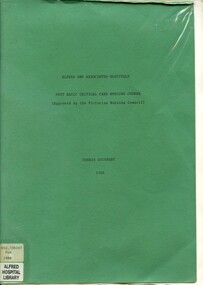
Document - Post Basic Nursing Course Document, Paul Crockford et al, Alfred and Associated Hospitals post basic critical care nursing course (approved by the Victorian nursing Council) Course Document,1988, 1988
... In 1984 the Critical Care Nursing Course was developed and commenced in 1985 (replacing the intensive care and cardiac nursing courses) The new course consisted of both a core component and majors in intensive care and cardiac nursing Of significance to AHNL as it was a post-basic nursing course undertaken at the Alfred Hospital Alfred Hospital Nursing Critical Care Nursing Intensive Care Nursing ALFRED HOSPITAL SCHOOL OF NURSING Course doucument for post basic critical care nursing course at the Alfre, Epworth and BoxHill Hospitals At lower left of front cover are two small white stickers. one with library ID, the other printed 'Alfred Hospital Library' Hand written in ink top right of title page is the previous catalogue number, at top left of this page is a printed library bar code. ...The first post basic critical care nursing courses commenced at the Alfred in 1969, (Renal Intensive Care, Respiratory Intensive Care And Cardiac Nusring course) eah of 8 monts duration. In 1977 the renal and respiratory courses were combined into the Renal-Respiratory course of 52 weeks duration. The cardiac nursing course was also extended to 52 weeks. In 1984 the Critical Care Nursing Course was developed and commenced in 1985 (replacing the intensive care and cardiac nursing courses) The new course consisted of both a core component and majors in intensive care and cardiac nursingOf significance to AHNL as it was a post-basic nursing course undertaken at the Alfred HospitalBooklet with green cover. Title on frontnon-fictionAt lower left of front cover are two small white stickers. one with library ID, the other printed 'Alfred Hospital Library' Hand written in ink top right of title page is the previous catalogue number, at top left of this page is a printed library bar code. At bottom right of this page is an Alfred Hospital - Health Sciences library stamp detailing author, title Call no. Accession No, This has been overstamped 'cancelled' in redalfred hospital, nursing, critical care nursing, intensive care nursing, alfred hospital school of nursing -
 Alfred Hospital Nurses League - Nursing History Collection
Document - Post Basic Nursing Course Document, Paul Crockford et al, Alfred and Associated Hospitals post basic critical care nursing course (approved by the Victorian nursing Council) Course Document, 1988, 1988
... In 1984 the Critical Care Nursing Course was developed and commenced in 1985 (replacing the intensive care and cardiac nursing courses) The new course consisted of both a core component and majors in intensive care and cardiac nursing Of significance to AHNL as it was a post-basic nursing course undertaken at the Alfred Hospital Alfred Hospital Nursing Critical Care Nursing Intensive Care Nursing ALFRED HOSPITAL SCHOOL OF NURSING Course doucument for post basic critical care nursing course at the Alfre, Epworth and BoxHill Hospitals At top right of the front cover is a small rectangular white sticker on which the previous catalogue number is written [black ink] Glue bound booklet with green cover. ...The first post basic critical care nursing courses commenced at the Alfred in 1969, (Renal Intensive Care, Respiratory Intensive Care And Cardiac Nusring course) eah of 8 monts duration. In 1977 the renal and respiratory courses were combined into the Renal-Respiratory course of 52 weeks duration. The cardiac nursing course was also extended to 52 weeks. In 1984 the Critical Care Nursing Course was developed and commenced in 1985 (replacing the intensive care and cardiac nursing courses) The new course consisted of both a core component and majors in intensive care and cardiac nursingOf significance to AHNL as it was a post-basic nursing course undertaken at the Alfred HospitalGlue bound booklet with green cover. Title printed on front cover [black ink]non-fictionAt top right of the front cover is a small rectangular white sticker on which the previous catalogue number is written [black ink]alfred hospital, nursing, critical care nursing, intensive care nursing, alfred hospital school of nursing -
 Alfred Hospital Nurses League - Nursing History Collection
Document - Post Basic Nursing Course Document, Paul Crockford et al, Alfred and Associated Hospitals post basic critical care nursing course (approved by the Victorian nursing Council) Course Document,1986, 1986
... In 1984 the Critical Care Nursing Course was developed and commenced in 1985 (replacing the intensive care and cardiac nursing courses) The new course consisted of both a core component and majors in intensive care and cardiac nursing Of significance to AHNL as it was a post-basic nursing course undertaken at the Alfred Hospital Alfred Hospital Nursing Critical Care Nursing Intensive Care Nursing ALFRED HOSPITAL SCHOOL OF NURSING Course doucument for post basic critical care nursing course at the Alfre, Epworth and BoxHill Hospitals At top right of the front cover is a small rectangular white sticker on which the previous catalogue number is written [black ink] Glue bound booklet with light brown cover. ...The first post basic critical care nursing courses commenced at the Alfred in 1969, (Renal Intensive Care, Respiratory Intensive Care And Cardiac Nusring course) eah of 8 monts duration. In 1977 the renal and respiratory courses were combined into the Renal-Respiratory course of 52 weeks duration. The cardiac nursing course was also extended to 52 weeks. In 1984 the Critical Care Nursing Course was developed and commenced in 1985 (replacing the intensive care and cardiac nursing courses) The new course consisted of both a core component and majors in intensive care and cardiac nursingOf significance to AHNL as it was a post-basic nursing course undertaken at the Alfred HospitalGlue bound booklet with light brown cover. Title printed on front cover [black ink]non-fictionAt top right of the front cover is a small rectangular white sticker on which the previous catalogue number is written [black ink]alfred hospital, nursing, critical care nursing, intensive care nursing, alfred hospital school of nursing -
 Alfred Hospital Nurses League - Nursing History Collection
Document - Post Basic Nursing Course Document, Paul Crockford et al, Alfred and Associated Hospitals post basic critical care nursing course (approved by the Victorian nursing Council) Course Document,1987, 1987
... In 1984 the Critical Care Nursing Course was developed and commenced in 1985 (replacing the intensive care and cardiac nursing courses) The new course consisted of both a core component and majors in intensive care and cardiac nursing Of significance to AHNL as it was a post-basic nursing course undertaken at the Alfred Hospital Alfred Hospital Nursing Critical Care Nursing Intensive Care Nursing ALFRED HOSPITAL SCHOOL OF NURSING Course doucument for post basic critical care nursing course at the Alfre, Epworth and BoxHill Hospitals At top right of the front cover is a small rectangular white sticker on which the previous catalogue number is written [black ink] At bottom right of back cover there is a rectangular white sticker with 'ALFRED NURSES ARCHIVES' [stamped in black ink] and previous catalogue number and 'Box 20 NURSING EDUCATION' [handwritten in black ink] Glue bound booklet with yellow cover. ...The first post basic critical care nursing courses commenced at the Alfred in 1969, (Renal Intensive Care, Respiratory Intensive Care And Cardiac Nusring course) eah of 8 monts duration. In 1977 the renal and respiratory courses were combined into the Renal-Respiratory course of 52 weeks duration. The cardiac nursing course was also extended to 52 weeks. In 1984 the Critical Care Nursing Course was developed and commenced in 1985 (replacing the intensive care and cardiac nursing courses) The new course consisted of both a core component and majors in intensive care and cardiac nursingOf significance to AHNL as it was a post-basic nursing course undertaken at the Alfred HospitalGlue bound booklet with yellow cover. Title printed on front cover [black ink]non-fictionAt top right of the front cover is a small rectangular white sticker on which the previous catalogue number is written [black ink] At bottom right of back cover there is a rectangular white sticker with 'ALFRED NURSES ARCHIVES' [stamped in black ink] and previous catalogue number and 'Box 20 NURSING EDUCATION' [handwritten in black ink]alfred hospital, nursing, critical care nursing, intensive care nursing, alfred hospital school of nursing -
 Alfred Hospital Nurses League - Nursing History Collection
Document - Post Basic Nursing Course Document, Alfred Hospital, Alfred Hospital critical care nursing course 1991, 1991
... In this edition the course was reviewed in collaboration with the higher education sector Of significance to AHNL as it was a post-basic nursing course undertaken at the Alfred Hospital Alfred Hospital Nursing Critical Care Nursing Intensive Care Nursing ALFRED HOSPITAL SCHOOL OF NURSING Course doucument for post basic critical care nursing course at the Alfre, Epworth and BoxHill Hospitals At top right of the front cover is a small rectangular white sticker on which the previous catalogue number is written [black ink] Glue bound booklet with light blue cover. ...The first post basic critical care nursing courses commenced at the Alfred in 1969, (Renal Intensive Care, Respiratory Intensive Care And Cardiac Nusring course) eah of 8 monts duration. In 1977 the renal and respiratory courses were combined into the Renal-Respiratory course of 52 weeks duration. The cardiac nursing course was also extended to 52 weeks. In 1984 the Critical Care Nursing Course was developed and commenced in 1985 (replacing the intensive care and cardiac nursing courses) The new course consisted of both a core component and majors in intensive care and cardiac nursing. In this edition the course was reviewed in collaboration with the higher education sectorOf significance to AHNL as it was a post-basic nursing course undertaken at the Alfred HospitalGlue bound booklet with light blue cover. Title printed on front cover [black ink]non-fictionAt top right of the front cover is a small rectangular white sticker on which the previous catalogue number is written [black ink]alfred hospital, nursing, critical care nursing, intensive care nursing, alfred hospital school of nursing
