
Showing 11 items matching "ethel ogilvy (nee stoddart)"
-
 Emerald Museum & Nobelius Heritage Park
Memorabilia - Badges and pin, Item 1. 1954, Item 2. 1914-1918
... ...Ethel Ogilvy (nee Stoddart)...Emerald Victoria Australia World War One Volunteers personal effects medical services First aid clubs associations societies Armed forces Arthur James Ogilvy (Maj) Jean Ogilvy Ethel Ogilvy (nee Stoddart) See detailed history Three items. 1. ...Item 1. 1954 Royal Visit Pin (brass). Item 2. VAD Red Cross badge - Victoria Division (brass). Blue enamelled bar attached to pin from which hangs a round disc with Red Cross symbol in middle and the words "Aust. Red Cross Victorian Division" around outside of disc, on red enamel. Item 3. Small, round, "button" pin made of brass with Red Cross symbol in middle of badge, on silverplate. Inscription around edge reads: "Victoria Junior Section. Australian Red Cross Society (BRCS)" Symbol of Royal crown at top centre of button. Comes in small round tin for safekeeping. Tin is discoloured. Possibly English/Royal emblem embossed in middle of lid. Surrounded by the words "J.R. Gaunt & Son Ltd. London Medalists to H.M. The King".Three items. 1. Royal Visit pin 1954 2. VAD Red Cross badge 3. Junior Section Red Cross badgeSee detailed historyemerald, victoria, australia, world war one, volunteers, personal effects, medical services, first aid, clubs, associations, societies, armed forces, arthur james ogilvy (maj), jean ogilvy, ethel ogilvy (nee stoddart) -
Emerald Museum & Nobelius Heritage Park
Photograph - Ogilvy/Frank family
... ...Ethel Ogilvy (nee Stoddart)...Ogilvy and Ethel Stoddart. Arthur Ogilvy (1874-1969) was a veteran of the Boer War and an original ANZAC. He was an active member in the first scout movement in Emerald and a life member of the Emerald RSL, an active churchman and an elder of the Church of England. Ogilvy Road in Clematis is named after Arthur Ogilvy. He was a keen gardener and planted many trees on his 3-acre property at 16 Edenmont Road, Clematis. Jean Frank Arthur Ogilvy Ethel Ogilvy (nee ...His daughter Jean, who continued to live on the property, also had a love of plants and trees. There was a beautiful 100-year-old copper beech which was still extant in 2020.Mrs Jean Frank (1920-1919) was the daughter of Major Arthur Ogilvy and Ethel Stoddart. Arthur Ogilvy (1874-1969) was a veteran of the Boer War and an original ANZAC. He was an active member in the first scout movement in Emerald and a life member of the Emerald RSL, an active churchman and an elder of the Church of England. Ogilvy Road in Clematis is named after Arthur Ogilvy. He was a keen gardener and planted many trees on his 3-acre property at 16 Edenmont Road, Clematis.Photographs (7) donated from the estate of Jean Frank nee Ogilvy. These comprise three studio photos of Jean Frank as a toddler circa 1921 - two of these photos have been hand-coloured; two black and white studio photos of young women. (One is described as being of Jean and the other as being Jean and her sister. However, as these photos appear to be circa 1900, this cannot be correct.) Two black and white photos of Arthur Ogilvy.jean frank, arthur ogilvy, ethel ogilvy (nee stoddart), anzac, clematis victoria australia -
Emerald Museum & Nobelius Heritage Park
Leisure object - Teddy bear, Early 1900s
... Teddy Bear belonged to mother of Jean Frank, Ethel Ogilvy (nee Stoddart) 1886-1961. Jean's father, Major Ogilvy had an active interest in scouting which he continued when he came to live in Emerald after 1936. ...Teddy Bear belonged to mother of Jean Frank, Ethel Ogilvy (nee Stoddart) 1886-1961. Jean's father, Major Ogilvy had an active interest in scouting which he continued when he came to live in Emerald after 1936. ...Teddy Bear belonged to mother of Jean Frank, Ethel Ogilvy (nee Stoddart) 1886-1961. Jean's father, Major Ogilvy had an active interest in scouting which he continued when he came to live in Emerald after 1936. He also had a nursery at Edenmont Rd, Clematis, was an elder at St Marks Church of England and belonged to the local Fire Brigade. Ogilvy Road is named after him. Teddy's clothes are not original - they were made by Jean.Child's Teddy Bear stuffed with straw - poor condition. Clothed (green corduroy vest & trousers; grey shirt; 3 buttons; peach cravat)Calico stuffed with straw. Clothes: corduroy vest and trousers; grey cotton shirt; peach cravat; 3 buttons)teddy bear, ethel ogilvy, major ogilvy, jean frank -
 Emerald Museum & Nobelius Heritage Park
Uniform - Nurse Apron, 1900s
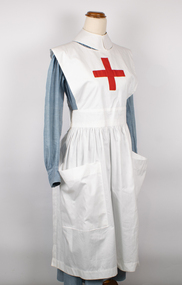
... Ethel May Ogilvy (nee Stoddart) became a Red Cross Nurse during World War I after completing a course in Nursing and Hygiene conducted by the St John Ambulance Association in November 1914. ...Ethel May Ogilvy (nee Stoddart) became a Red Cross Nurse during World War I after completing a course in Nursing and Hygiene conducted by the St John Ambulance Association in November 1914. ...Ethel May Ogilvy (nee Stoddart) became a Red Cross Nurse during World War I after completing a course in Nursing and Hygiene conducted by the St John Ambulance Association in November 1914. The Red Cross was ostensibly non-military in line with its principles of neutrality and independence. While a group of 20 nurses were sent to Europe by the NSW Division of the Red Cross, most Red Cross nurses, like Ethel, contributed to the war effort at home. They filled a need created by the exit of a large number of Australian nurses to the front and by the influx of seriously injured personnel who were brought back home. In 1919, Ethel Stoddart married Arthur James Ogilvy, a veteran of the Boer War and World War I. The couple moved to Emerald in 1936 where they lived the remainder of their lives. This apron is part of a complete World War I Red Cross nurse uniform held by the Museum which was worn by a young woman who later moved to Emerald. The uniform is emblematic of the variety of ways in which women contributed to the war effort.White cotton apron consisting of a gathered skirt with two capacious pockets and a bib and waistband with a Red Cross symbol stitched in the centre of the bib. Two straps - each with one buttonhole - extend from the bib to be buttoned into the waistband at the back. The apron waistband has two buttons on one side and one button and one buttonhole on the other side. Separately there are two long narrow cotton strips which may have been suitable for bandages. red cross, world war 1, nurse uniform -
 Emerald Museum & Nobelius Heritage Park
Uniform - Nurse Dress, 1900s
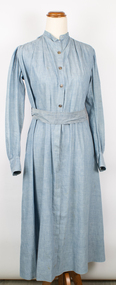
... Ethel May Ogilvy (nee Stoddart) became a Red Cross Nurse during World War I after completing a course in Nursing and Hygiene conducted by the St John Ambulance Association in November 1914. ...Ethel May Ogilvy (nee Stoddart) became a Red Cross Nurse during World War I after completing a course in Nursing and Hygiene conducted by the St John Ambulance Association in November 1914. ...Ethel May Ogilvy (nee Stoddart) became a Red Cross Nurse during World War I after completing a course in Nursing and Hygiene conducted by the St John Ambulance Association in November 1914. The Red Cross was ostensibly non-military in line with its principles of neutrality and independence. While a group of 20 nurses were sent to Europe by the NSW Division of the Red Cross, most Red Cross nurses, like Ethel, contributed to the war effort at home. They filled a need created by the exit of a large number of Australian nurses to the front and by the influx of seriously injured personnel who were brought back home. In 1919, Ethel Stoddart married Arthur James Ogilvy, a veteran of the Boer War and World War I. The couple moved to Emerald in 1936 where they lived the remainder of their lives. This dress is part of a complete World War I Red Cross nurse uniform held by the Museum which was worn by a young woman who later moved to Emerald. The uniform is emblematic of the variety of ways in which women contributed to the war effort.Long blue cotton dress with long sleeves - at the end of each sleeve are two mother of pearl buttons and buttonholes. The dress has four mother of pearl buttons and buttonholes down the front and two buttonholes at the neck. There are three loops at the waist at the back for a belt to be threaded through. Separate long narrow sash-like belt of the same material. (The belt may have originally had a buckle.)red cross, world war 1, nurse uniform -
 Emerald Museum & Nobelius Heritage Park
Photograph - Photographic portrait of a nurse, Gainsborough, c.1914
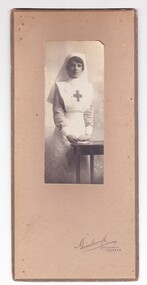
... Ethel May Ogilvy (nee Stoddart) became a Red Cross Nurse during World War I after completing a course in Nursing and Hygiene conducted by the St John Ambulance Association in November 1914. ...Ethel May Ogilvy (nee Stoddart) became a Red Cross Nurse during World War I after completing a course in Nursing and Hygiene conducted by the St John Ambulance Association in November 1914. ...Ethel May Ogilvy (nee Stoddart) became a Red Cross Nurse during World War I after completing a course in Nursing and Hygiene conducted by the St John Ambulance Association in November 1914. This portrait was presumably taken after Ethel had completed this course. Ethel's daughter later donated her mother's uniform - which is held by the Museum. Most Australian Red Cross nurses, like Ethel, contributed to the war effort at home. They filled a need created by the exit of a large number of Australian nurses to the front and by the influx of seriously injured personnel who were brought back home. In 1919, Ethel Stoddart married Arthur James Ogilvy, a veteran of the Boer War and World War I. The couple moved to Emerald in 1936 where they lived the remainder of their lives. This photograph is emblematic of the variety of ways in which Australian women contributed to the war effort during World War 1.Black and white photographic portrait of Nurse Ethel Stoddart mounted in a sepia-coloured cardboard frame. Signature of photography studio in bottom right of frame.In bottom right of frame: 'Gainsborough / 213 CHAPEL ST / PRAHRAN'red cross, world war 1 -
 Emerald Museum & Nobelius Heritage Park
Uniform - Nurse Collar, 1900s
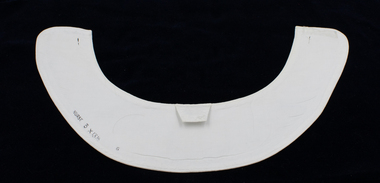
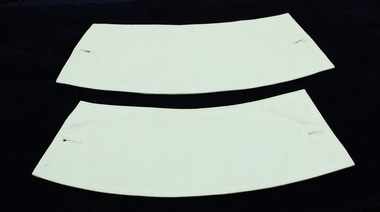
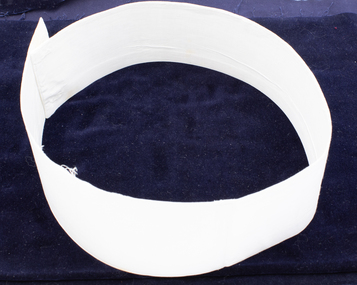
... Nurse collars were detachable to allow for quick laundering. Ethel May Ogilvy (nee Stoddart) became a Red Cross Nurse during World War I after completing a course in Nursing and Hygiene conducted by the St John Ambulance Association in November 1914. ...Nurse collars were detachable to allow for quick laundering. Ethel May Ogilvy (nee Stoddart) became a Red Cross Nurse during World War I after completing a course in Nursing and Hygiene conducted by the St John Ambulance Association in November 1914. ...Nurse collars were detachable to allow for quick laundering. Ethel May Ogilvy (nee Stoddart) became a Red Cross Nurse during World War I after completing a course in Nursing and Hygiene conducted by the St John Ambulance Association in November 1914. The Red Cross was ostensibly non-military in line with its principles of neutrality and independence. While a group of 20 nurses were sent to Europe by the NSW Division of the Red Cross, most Red Cross nurses, like Ethel, contributed to the war effort at home. They filled a need created by the exit of a large number of Australian nurses to the front and by the influx of seriously injured personnel who were brought back home. In 1919, Ethel Stoddart married Arthur James Ogilvy, a veteran of the Boer War and World War I. The couple moved to Emerald in 1936 where they lived the remainder of their lives. These collars are part of a complete World War I Red Cross nurse uniform held by the Museum which was worn by a young woman who later moved to Emerald. The uniform is emblematic of the variety of ways in which women contributed to the war effort.Two almost identical white starched collars. Each collar has a buttonhole at each end which might have enabled the collar to be fastened at the front with cufflink-like buttons.On back of collar 1/2: 'NURSE 3 x 13 1/2 G' On back of collar 2/2: 'NURSE 8432 /13 1/2 P' - also '?Stoddart' very faint.red cross, world war 1, nurse uniform -
 Emerald Museum & Nobelius Heritage Park
Uniform - Nurse Cuffs, 1900s
... Cuffs on nurse uniforms were made to be detachable for ease of laundering. Ethel May Ogilvy (nee Stoddart) became a Red Cross Nurse during World War I after completing a course in Nursing and Hygiene conducted by the St John Ambulance Association in November 1914. ...Cuffs on nurse uniforms were made to be detachable for ease of laundering. Ethel May Ogilvy (nee Stoddart) became a Red Cross Nurse during World War I after completing a course in Nursing and Hygiene conducted by the St John Ambulance Association in November 1914. ...Cuffs on nurse uniforms were made to be detachable for ease of laundering. Ethel May Ogilvy (nee Stoddart) became a Red Cross Nurse during World War I after completing a course in Nursing and Hygiene conducted by the St John Ambulance Association in November 1914. The Red Cross was ostensibly non-military in line with its principles of neutrality and independence. While a group of 20 nurses were sent to Europe by the NSW Division of the Red Cross, most Red Cross nurses, like Ethel, contributed to the war effort at home. They filled a need created by the exit of a large number of Australian nurses to the front and by the influx of seriously injured personnel who were brought back home. In 1919, Ethel Stoddart married Arthur James Ogilvy, a veteran of the Boer War and World War I. The couple moved to Emerald in 1936 where they lived the remainder of their lives. These cuffs are part of a complete World War I Red Cross nurse uniform held by the Museum which was worn by a young woman who later moved to Emerald. The uniform is emblematic of the variety of ways in which women contributed to the war effort.Two pairs of white starched cuffs for a nurse uniform. Each cuff has a buttonhole at each end which would enable the cuff to be joined by cufflink-like buttons.On each cuff, printed: 'NURSE 8 G' On each cuff handwritten: 'Stoddart'red cross, world war 1, nurse uniform -
 Emerald Museum & Nobelius Heritage Park
Uniform - Nurse Belts, 1900s
... Belts on nurse uniforms were made to be detachable for ease of laundering. Ethel May Ogilvy (nee Stoddart) became a Red Cross Nurse during World War I after completing a course in Nursing and Hygiene conducted by the St John Ambulance Association in November 1914. ...Belts on nurse uniforms were made to be detachable for ease of laundering. Ethel May Ogilvy (nee Stoddart) became a Red Cross Nurse during World War I after completing a course in Nursing and Hygiene conducted by the St John Ambulance Association in November 1914. ...Belts on nurse uniforms were made to be detachable for ease of laundering. Ethel May Ogilvy (nee Stoddart) became a Red Cross Nurse during World War I after completing a course in Nursing and Hygiene conducted by the St John Ambulance Association in November 1914. The Red Cross was ostensibly non-military in line with its principles of neutrality and independence. While a group of 20 nurses were sent to Europe by the NSW Division of the Red Cross, most Red Cross nurses, like Ethel, contributed to the war effort at home. They filled a need created by the exit of a large number of Australian nurses to the front and by the influx of seriously injured personnel who were brought back home. In 1919, Ethel Stoddart married Arthur James Ogilvy, a veteran of the Boer War and World War I. The couple moved to Emerald in 1936 where they lived the remainder of their lives. These belts are part of a complete World War I Red Cross nurse uniform held by the Museum which was worn by a young woman who later moved to Emerald. The uniform is emblematic of the variety of ways in which women contributed to the war effort.Three pairs of white starched belts for a nurse uniform. One belt (1/3) has a long narrow rectangular shape with two buttonholes at each end. The other belt (2/3) has a triangular shape at one end with two press studs (rings) at this end. There may have been two posts at the other end at one time. The third (3/3) has three buttonholes at each end.At one end of belt 1/3 hand printed: 'E. M. Stoddart' At one end of belt 3/3 hand-written: 'Stoddart' and underneath printed '?8412'red cross, world war 1, nurse uniform -
 Emerald Museum & Nobelius Heritage Park
Uniform - Nurse Veil, 1900s
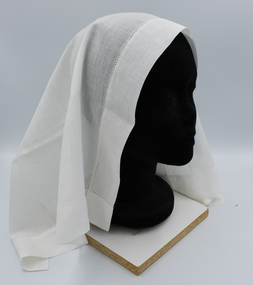
... Veils were worn to cover a nurse's hair and were usually square in shape. Ethel May Ogilvy (nee Stoddart) became a Red Cross Nurse during World War I after completing a course in Nursing and Hygiene conducted by the St John Ambulance Association in November 1914. ...Veils were worn to cover a nurse's hair and were usually square in shape. Ethel May Ogilvy (nee Stoddart) became a Red Cross Nurse during World War I after completing a course in Nursing and Hygiene conducted by the St John Ambulance Association in November 1914. ...Veils were worn to cover a nurse's hair and were usually square in shape. Ethel May Ogilvy (nee Stoddart) became a Red Cross Nurse during World War I after completing a course in Nursing and Hygiene conducted by the St John Ambulance Association in November 1914. The Red Cross was ostensibly non-military in line with its principles of neutrality and independence. While a group of 20 nurses were sent to Europe by the NSW Division of the Red Cross, most Red Cross nurses, like Ethel, contributed to the war effort at home. They filled a need created by the exit of a large number of Australian nurses to the front and by the influx of seriously injured personnel who were brought back home. In 1919, Ethel Stoddart married Arthur James Ogilvy, a veteran of the Boer War and World War I. The couple moved to Emerald in 1936 where they lived the remainder of their lives. This veil is part of a complete World War I Red Cross nurse uniform held by the Museum which was worn by a young woman who later moved to Emerald. The uniform is emblematic of the variety of ways in which women contributed to the war effort.One piece of square white lawn material used as a nurse veil.red cross, world war 1, nurse uniform -
 Emerald Museum & Nobelius Heritage Park
Uniform - Nurse Veil, 1900s
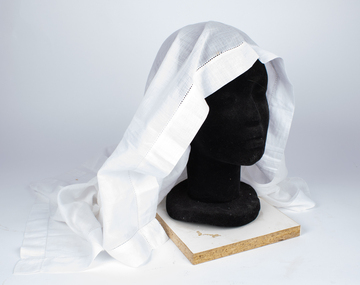
... Veils were worn to cover a nurse's hair and were usually square in shape. Ethel May Ogilvy (nee Stoddart) became a Red Cross Nurse during World War I after completing a course in Nursing and Hygiene conducted by the St John Ambulance Association in November 1914. ...Veils were worn to cover a nurse's hair and were usually square in shape. Ethel May Ogilvy (nee Stoddart) became a Red Cross Nurse during World War I after completing a course in Nursing and Hygiene conducted by the St John Ambulance Association in November 1914. ...Veils were worn to cover a nurse's hair and were usually square in shape. Ethel May Ogilvy (nee Stoddart) became a Red Cross Nurse during World War I after completing a course in Nursing and Hygiene conducted by the St John Ambulance Association in November 1914. The Red Cross was ostensibly non-military in line with its principles of neutrality and independence. While a group of 20 nurses were sent to Europe by the NSW Division of the Red Cross, most Red Cross nurses, like Ethel, contributed to the war effort at home. They filled a need created by the exit of a large number of Australian nurses to the front and by the influx of seriously injured personnel who were brought back home. In 1919, Ethel Stoddart married Arthur James Ogilvy, a veteran of the Boer War and World War I. The couple moved to Emerald in 1936 where they lived the remainder of their lives. This veil is part of a complete World War I Red Cross nurse uniform held by the Museum which was worn by a young woman who later moved to Emerald. The uniform is emblematic of the variety of ways in which women contributed to the war effort.One piece of square white lawn material used as a nurse veil.red cross, world war 1, nurse uniform
