
Showing 5 items matching "eurasian"
-
 The Beechworth Burke Museum
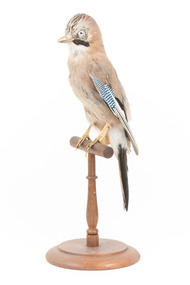
Animal specimen - Eurasian Jay, Trustees of the Australian Museum, 1860-1880
... The Eurasian Jay is a small passerine bird occurring in Europe, northern Africa, and Asia. ...The Eurasian Jay, as depicted in this specimen, has distinctive blue, white and dark brown stipes at the top of the wing. ...The Beechworth Burke Museum Loch Street Beechworth high-country The Eurasian Jay is a small passerine bird occurring in Europe, northern Africa, and Asia. ...The Eurasian Jay is a small passerine bird occurring in Europe, northern Africa, and Asia. There are very distinct variations between the species of the Jay which assists in their identification. These birds inhabit mixed woodland, parks, orchards, and large gardens. They are generally solitary but can gather in large communal roosts during periods of cold weather. Eurasian Jays are known for their mimicry. They can often sound like a different species and during the day may mimic the birds they are attacking in order to confuse their opposition. This particular specimen has been mounted in an accurate but stylised fashion. This specimen is part of a collection of almost 200 animal specimens that were originally acquired as skins from various institutions across Australia, including the Australian Museum in Sydney and the National Museum of Victoria (known as Museums Victoria since 1983), as well as individuals such as amateur anthropologist Reynell Eveleigh Johns between 1860-1880. These skins were then mounted by members of the Burke Museum Committee and put-on display in the formal space of the Museum’s original exhibition hall where they continue to be on display. This display of taxidermy mounts initially served to instruct visitors to the Burke Museum of the natural world around them, today it serves as an insight into the collecting habits of the 19th century.This specimen is part of a significant and rare taxidermy mount collection in the Burke Museum. This collection is scientifically and culturally important for reminding us of how science continues to shape our understanding of the modern world. They demonstrate a capacity to hold evidence of how Australia’s fauna history existed in the past and are potentially important for future environmental research. This collection continues to be on display in the Museum and has become a key part to interpreting the collecting habits of the 19th century.The Eurasian Jay, as depicted in this specimen, has distinctive blue, white and dark brown stipes at the top of the wing. The body and head are light brown with a reddish undertone and there are streaks of dark brown at top the head. The tail, bottom of the wings and underneath the eyes are dark brown. This particular specimen stands upon a wooden mount and has an identification tag tied around its leg. It has pale coloured glass eyes which are accurate for this species.Swing Tag: [illegible] / to Sydney - N =99taxidermy mount, taxidermy, animalia, burke museum, beechworth, australian museum, skin, bird, jay, eurasian jay, europe, european birds, blue stripes -
 The Beechworth Burke Museum
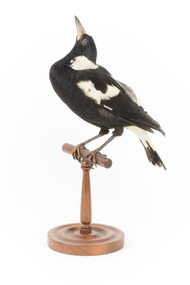
Animal specimen - Australian Magpie, Trustees of the Australian Museum, 1860-1880
... Belonging to the family Artamidae, the Australian magpie is the sole member of the genus Gymnorhina and shares its closest relation with the black butcherbird (Melloria quoyi). Unlike the Eurasian magpie, it is not part of the Corvidae family. ...Belonging to the family Artamidae, the Australian magpie is the sole member of the genus Gymnorhina and shares its closest relation with the black butcherbird (Melloria quoyi). Unlike the Eurasian magpie, it is not part of the Corvidae family. ...The Australian magpie is a passerine native to Australia and southern New Guinea. Renowned for its black and white plumage and distinctive song, the Australian magpie has also established populations in New Zealand and on the Fijian island of Taveuni, where it was introduced during the 19th century. Previously classified as three distinct species, it is now recognized as a single species comprising nine subspecies. Belonging to the family Artamidae, the Australian magpie is the sole member of the genus Gymnorhina and shares its closest relation with the black butcherbird (Melloria quoyi). Unlike the Eurasian magpie, it is not part of the Corvidae family. This specimen was originally misidentified as a white winged chough and is part of a collection of almost 200 animal specimens that were originally acquired as skins from various institutions across Australia, including the Australian Museum in Sydney and the National Museum of Victoria (known as Museums Victoria since 1983), as well as individuals such as amateur anthropologist Reynell Eveleigh Johns between 1860-1880. These skins were then mounted by members of the Burke Museum Committee and put-on display in the formal space of the Museum’s original exhibition hall where they continue to be on display. This display of taxidermy mounts initially served to instruct visitors to the Burke Museum of the natural world around them, today it serves as an insight into the collecting habits of the 19th century. This specimen is part of a significant and rare taxidermy mount collection in the Burke Museum. This collection is scientifically and culturally important for reminding us of how science continues to shape our understanding of the modern world. They demonstrate a capacity to hold evidence of how Australia’s fauna history existed in the past and are potentially important for future environmental research. This collection continues to be on display in the Museum and has become a key part to interpreting the collecting habits of the 19th century.This specimen an Australian Magpie with black and white plumage over the body, mounted on a cedar stand. The specimen has a large straight beak and is in an unusual pose for a magpie, compressing the white patch on the back of the neck. The beak has turned yellow where originally grey, potentially leading to a previous misidentification as a white-winged chough.taxidermy mount, taxidermy, animalia, burke museum, beechworth, australian museum, skin, reynell eveleigh johns, bird, australian magpie, ornithological, ornithology, white winged chough -
 Returned Nurses RSL Sub-branch
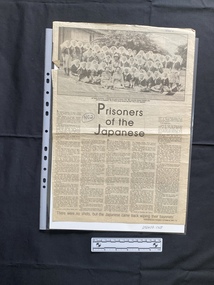
Newspaper - Newspaper clipping, The Border Mail, Prisoners of the Japanese, October 28 1989
... ...Eurasian...World War 1939-1945 Thelma McEachern 10th Australian General Hospital AGH Radji Beach Sumatra Banka Strait 2/22nd Battalion Tootie McPherson Mavis Cullen Naruto Maru Dutch Eurasian Iole Harper Nesta James Waltzing Matilda Margaret Dryburgh Marjory Jennings Norah Chambers New Guinea Yokohama Yacht Club Yokohama Mount Fuji Kay Parker Eileen Callaghan Banks Island Betty Jeffrey Flo Trotter Blanche Hempsted Perth Melbourne Melbourne Cup Micky Syer 'NC2' [circled, blue ink, middle left of page] Large newspaper page with a full page story consisting of five columns of text and a large, bold title beneath a large black and white group photo of forty six people, most in nurses uniforms Prisoners of the Japanese Newspaper Newspaper clipping The Border Mail ...The newspaper article gives a basic overview of two groups of POW nurses during World War 2. Twenty two of the nurses trying to escape from the Japanese in Singapore, February 1942, on the Vyner Brooke came ashore on Banka Island. A few days afterwards they were all machine gunned by the Japanese, with only one survivor, Vivian Bullwinkel. She managed to get herself and a wounded British soldier to Muntok, where they both became POWs (prisoners of war). Of the sixty nurses on the Vyner Brooke, twelve had drowned, twenty one had been murdered and thirty two had gone into prison. Those that would survive the war made it through on a terrible diet consisting mostly of rice, attempts of the Japanese to use them for 'entertainment', making their own entertainment in celebrating birthdays and holidays, having music concerts and terrible sicknesses including cerebral malaria. Finally after the Japanese surrendered they were met at an airstrip by the Matron in Chief, A.M. Sage. She was hoping for the full sixty five from the Vyner Brooke. There were twenty four left. Another group of nurses were captured by the Japanese in Rabaul, January 1942, where twenty of their patients were taken, killed and buried in a mass grave. The nurses were put in a prison camp with civilian women where they too were treated terribly. They would be knocked down and kicked if they didn't bow deep enough, or would have their captors trying to urinate on them while laughing. After being moved to Japan they continued to try to survive by eating glue they were using to make envelopes for the Japanese. Large newspaper page with a full page story consisting of five columns of text and a large, bold title beneath a large black and white group photo of forty six people, most in nurses uniforms'NC2' [circled, blue ink, middle left of page]world war 1939-1945, thelma mceachern, 10th australian general hospital, agh, radji beach, sumatra, banka strait, 2/22nd battalion, tootie mcpherson, mavis cullen, naruto maru, dutch, eurasian, iole harper, nesta james, waltzing matilda, margaret dryburgh, marjory jennings, norah chambers, new guinea, yokohama yacht club, yokohama, mount fuji, kay parker, eileen callaghan, banks island, betty jeffrey, flo trotter, blanche hempsted, perth, melbourne, melbourne cup, micky syer -
 The Beechworth Burke Museum
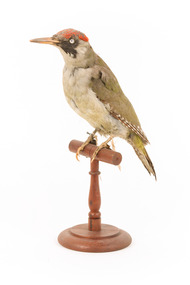
Animal specimen - Green Woodpecker, Trustees of the Australian Museum, 1860-1880
... This collection continues to be on display in the Museum and has become a key part to interpreting the collecting habits of the 19th century. taxidermy mount taxidermy burke museum beechworth australian museum reynell eveleigh johns bird woodpecker green woodpecker eurasian green woodpecker Swing tag: 1e. / Green Woodpecker / Catalogue page 66 / Metal tag: 4308 / This Green Woodpecker has a distinctive red crown on its head that appears patchy. ...This fairly large woodpecker of the Picadae family is widely distributed across most parts of Europe and the UK, with some occurrence in Western Asia. Preferring semi-open habitats such as woodlands, heathlands and gardens, the species is unique amongst woodpeckers as it prefers to hunt and feed on the ground for its ant prey. This species has a distinctive bright red crown, black moustasche-like stripes, mostly green back plumage and a paler green to yellow breast. This is a female of the species as the male has a red centre to the moustache stripe at the side of the beak. This specimen is a fairly accurate depiction of a Green Woodpecker. This specimen is part of a collection of almost 200 animal specimens that were originally acquired as skins from various institutions across Australia, including the Australian Museum in Sydney and the National Museum of Victoria (known as Museums Victoria since 1983), as well as individuals such as amateur anthropologist Reynell Eveleigh Johns between 1860-1880. These skins were then mounted by members of the Burke Museum Committee and put-on display in the formal space of the Museum’s original exhibition hall where they continue to be on display. This display of taxidermy mounts initially served to instruct visitors to the Burke Museum of the natural world around them, today it serves as an insight into the collecting habits of the 19th century.This specimen is part of a significant and rare taxidermy mount collection in the Burke Museum. This collection is scientifically and culturally important for reminding us of how science continues to shape our understanding of the modern world. They demonstrate a capacity to hold evidence of how Australia’s fauna history existed in the past and are potentially important for future environmental research. This collection continues to be on display in the Museum and has become a key part to interpreting the collecting habits of the 19th century.This Green Woodpecker has a distinctive red crown on its head that appears patchy. It has a black face, a black moustache-like stripe on each side of the beak, pale eyes and long light yellow-orange beak. The back of the bird is green, and its flank and breast is a pale cream-yellow colour. It has slightly visible distinct white-dotted brown feathers folded into its wings. The specimen is mounted on a wooden perch, with a metal tag tied around its right leg and a paper tag around each leg.Swing tag: 1e. / Green Woodpecker / Catalogue page 66 / Metal tag: 4308 /taxidermy mount, taxidermy, burke museum, beechworth, australian museum, reynell eveleigh johns, bird, woodpecker, green woodpecker, eurasian green woodpecker -
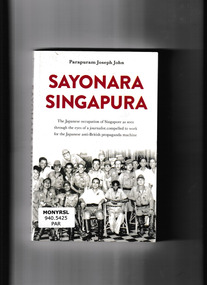 Monbulk RSL Sub Branch
Book, Joseph John Parapuram, Sayonara Singapura, 2016
... Limbs of every description - European, Indian, Chinese, Malay and Eurasian - were everywhere. Parapuram Joseph John - 'John' to all - is given an ultimatum by the Japanese invaders: work for us or face the consequences. ...I was editor of The Malaya Tribune, a daily newspaper in Singapore, sleepily okaying Page One when 17 Japanese Zero bombers shattered the night. It was December 8, 1941. Having been fed daily stories full of optimism from London, we in Singapore hadn't an inkling that war with Japan was imminent … I sneaked out when there was a pause in the bombing. Limbs of every description - European, Indian, Chinese, Malay and Eurasian - were everywhere. Parapuram Joseph John - 'John' to all - is given an ultimatum by the Japanese invaders: work for us or face the consequences. He becomes No.2 at the Domei.Ill, p.220.non-fictionI was editor of The Malaya Tribune, a daily newspaper in Singapore, sleepily okaying Page One when 17 Japanese Zero bombers shattered the night. It was December 8, 1941. Having been fed daily stories full of optimism from London, we in Singapore hadn't an inkling that war with Japan was imminent … I sneaked out when there was a pause in the bombing. Limbs of every description - European, Indian, Chinese, Malay and Eurasian - were everywhere. Parapuram Joseph John - 'John' to all - is given an ultimatum by the Japanese invaders: work for us or face the consequences. He becomes No.2 at the Domei. world war 1939-1945 - campaigns - singapore, personal recollections - joseph john parapuram
