
Showing 102 items matching "european painting"
-
 Robin Boyd Foundation
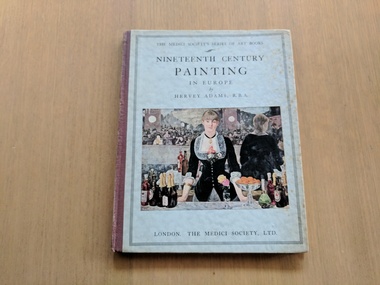
Book, Hervey Adams, Nineteenth Century Painting in Europe
... Nineteenth Century Painting in Europe...european painting...european painting european art Walsh St library Hardcover Nineteenth Century Painting in Europe Book Hervey Adams The Medici Society, Ltd. ...Hardcovereuropean painting, european art, walsh st library -
 Robin Boyd Foundation
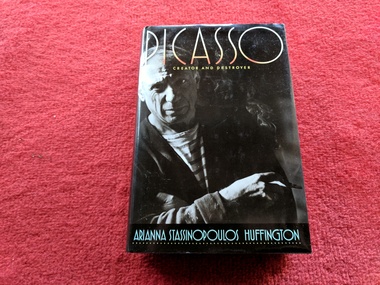
Book, Arianna Huffington, Picasso: Creator and Destroyer, 1988
... ... european painting...picasso european painting european artist Walsh St library "Itinerary, Patrick Summers 1995-1996" A4 Sheet inserted inside front cover Hardcover w/ Dust Jacket Picasso: Creator and Destroyer Book Arianna Huffington Simon and Schuster ...Hardcover w/ Dust Jacket"Itinerary, Patrick Summers 1995-1996" A4 Sheet inserted inside front coverpicasso, european painting, european artist, walsh st library -
 Glenelg Shire Council Cultural Collection
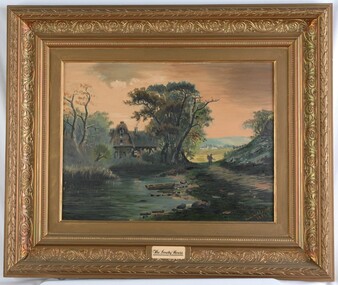
Painting, Jessie Shevill, The Lonely House, 1894
... European Painting...CEMA Art Collection Previously located in History House European Painting 1800s Country Front: Jessie Shevill 1894 Plaque attached to frame: The Lonely House Back: (no inscriptions) A house set amongst trees with a small body of water in front. ...CEMA Art Collection Previously located in History HouseA house set amongst trees with a small body of water in front. The house has smoke rising from the chimney. Pinkish sky. On the water is a small wooden boat, and to the right of the house stands a person. In the background is a green hill with buildings set in the foothills. The hill and trees of the foreground are set against an orange/pink sky. The work has a gilded ornate frame with no mounts and exposed canvas. Signed front of painting bottom rightFront: Jessie Shevill 1894 Plaque attached to frame: The Lonely House Back: (no inscriptions)european painting, 1800s, country -
 Eltham District Historical Society Inc
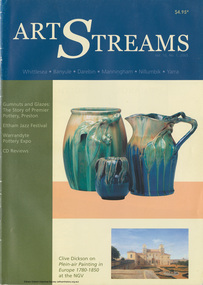
Journal, Peter Doughtery, ArtStreams: Vol. 10, No. 1, 2005
... Vol. 10, No. 1, Mar-Apr 2005 CONTENTS Comment 2 Clive Dickson 'Plein-air Painting in Europe 1780-1850' 3 Premier Pottery, Preston 1929-1956 7 Tom Dell'Anno at the Eltham Library Gallery 13 CD Reviews 14 Eltham Jazz and Blues Heritage Festival 16 Silent Voices 18 The Warrandyte Pottery Expo 19 Book reviews 21 Poetry 24 Artin' About 28 Wining & dining 30 Listings 32...Vol. 10, No. 1, Mar-Apr 2005 CONTENTS Comment 2 Clive Dickson 'Plein-air Painting in Europe 1780-1850' 3 Premier Pottery, Preston 1929-1956 7 Tom Dell'Anno at the Eltham Library Gallery 13 CD Reviews 14 Eltham Jazz and Blues Heritage Festival 16 Silent Voices 18 The Warrandyte Pottery Expo 19 Book reviews 21 Poetry 24 Artin' About 28 Wining & dining 30 Listings 32 "Peter Dougherty has been involved in the local art scene for many years. ...Vol. 10, No. 1, Mar-Apr 2005 CONTENTS Comment 2 Clive Dickson 'Plein-air Painting in Europe 1780-1850' 3 Premier Pottery, Preston 1929-1956 7 Tom Dell'Anno at the Eltham Library Gallery 13 CD Reviews 14 Eltham Jazz and Blues Heritage Festival 16 Silent Voices 18 The Warrandyte Pottery Expo 19 Book reviews 21 Poetry 24 Artin' About 28 Wining & dining 30 Listings 32"Peter Dougherty has been involved in the local art scene for many years. As publisher and editor of the arts magazine Artstreams, his comments on the various branches of the arts are widely respected. His "The Arts" column in the Diamond Valley Leader presents a brief summary for a much wider cross section of the local community. Peter also operates his own gallery and the Artstreams Cafe at the St Andrews market. Peter has a wealth of knowledge about present day and historical aspects of local art and artists." - Eltham District Historical Society Newsletter No. 161, March 2005Colour front and back cover with feature articles and literary pieces with photographs and advertisements printed in black and white. 32 pages, 30 cm. Vol. 1, no. 1 (Nov. 1996) - Vol. 10, no. 5 (summer ed. 2005/06) art streams, art streams magazine, tom dell'anno, clive dickson, plein-air painting, david dee, reg hawkins, walter dee, alan james, margaret kerr, eltham library, community gallery, eltham town jazz and blues heritage festival, joe malatji, sutueal bekele althe, warrandyte pottery expo, robyn rowland, peter brocklehurst, margaret orr, brian mooney, jeanie james -
 Marysville & District Historical Society
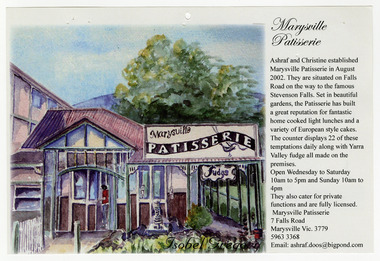
Ephemera (Item) - Calendar page, Isobel Gregory, Marysville Patisserie, Unknown
... European-style cakes, and Yarra Valley fudge, all of which were made on the premises. The Patisserie, along with most of the businesses in Marysville, was destroyed in the 2009 Black Saturday bushfires. marysville patisserie marysville victoria isobel gregory 2009 black saturday bushfires A page from a calendar showing the Marysville Patisserie in Marysville in Victoria. Shows a painting ...A page from a calendar showing the Marysville Patisserie in Marysville in Victoria.A page from a calendar showing the Marysville Patisserie in Marysville in Victoria. The Marysville Patisserie was established in Falls Road in 2002. The Patisserie was known for its delicious light lunches, European-style cakes, and Yarra Valley fudge, all of which were made on the premises. The Patisserie, along with most of the businesses in Marysville, was destroyed in the 2009 Black Saturday bushfires.marysville patisserie, marysville, victoria, isobel gregory, 2009 black saturday bushfires -
 Nhill Aviation Heritage Centre
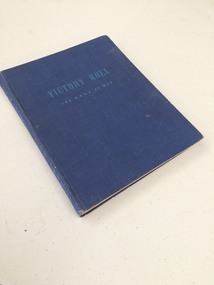
Book - RAAF at War, Victory Roll, 1945
... europe and the pacific. Victory Roll, The Royal Australian Air Force in it's sixth year of war Hard back 200 pages with colour paintings and sketches, black and white photographs. ...Hard back 200 pages with colour paintings and sketches, black and white photographs.raaf pilot experiences flying out of operational bases of europe and the pacific. -
 Federation University Historical Collection
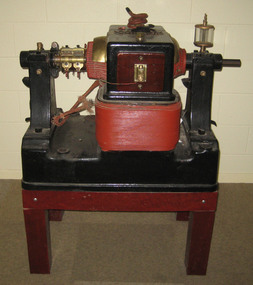
Equipment, Elwell-Powell, Elwell-Parker AC Generator
... Europe. During one of my visits I took with me an artist, who is painting for me a portrait, 6 feet by 5 feet, of Mr. ...Europe. During one of my visits I took with me an artist, who is painting for me a portrait, 6 feet by 5 feet, of Mr. ...This AC generator operated for the State Electricity Commission in the Ballarat North Power Station prior to World War Two. James Oddie of Ballarat has an association with Thomas Parker of Elswell-Parker. In early 1887 Oddie arrived in England seeking information on electrical knowledge and its developments. At this time Henry Sutton was teaching Electricity and Magnetism at the Ballarat School of Mines. Oddie stayed in the United Kingdom for around three years and during that time became a close friend of Thomas Parker and his family. The two first met at the first official running of the Blackpool tram, and Oddie was invited to visit Parker at Wolverhampton. Over the years Thomas Parker kept newspaper cuttings (mainly Australian) relating to James Oddie and his work. The following article is a description of the Wolverhampton works by James Oddie, and was collected by Thomas Parker. After the dinner at Blackpool, Mr. Parker visited me, and cordially invited me to see his extensive works at Wolverhampton, an invitation I was not slow to avail myself of. This was the keynote of the best friendship I made in England. I went shortly afterwards and stayed several days, visiting the works daily, as Mr. Parker gave me the run of the whole works. There I ordered the installation of a 60 light dynamo, with a 28 cell storage battery and paraphernalia, now doing duty at the Observatory. I subsequently visited the works frequently, sometimes for a week at a time, and I regard it as the brightest spot in my English constellation. Mr. Parker started his works in 1880, with one man beside himself. He never had a single day’s instruction in electricity in his life; now he daily instructs between 300 and 400 employees, who worship him as a father. He is said to be now the most practical electrical engineer and mechanist in Europe. During one of my visits I took with me an artist, who is painting for me a portrait, 6 feet by 5 feet, of Mr. Parker, surrounded by dynamos, secondary batteries, measuring instruments etc. Electric tram cars are going to be a big thing in England. Parker’s Company Limited, is now, with three other companies, in the hands of the Electric Construction Company, with Mr. Parker as manager of the lot. The whole of the works will be taken to Wolverhampton. Before I left, a tender for £50,000 was accepted for the construction of new works.AC Generator painted read and black on a stand. This AC generator operated for the State Electricity Commission in the Ballarat North Power Station prior to World War Twogenerator, ac generator, elwell-parker ltd, state electricity commission, sec, ballarat north power station, james oddie, wolverhampton -
 Federation University Historical Collection
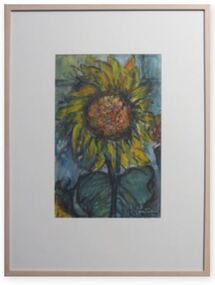
Article - Article - Women, Ballarat School of Mines: Women of Note; Isabel Huntington, Artist, Teacher, (1905 - 1971), 13/07/2023
... Ursula Hoff (from the National Gallery Victoria) judged the 1965 Albury awards for watercolour, and religious paintings in oils, awarding the prize to Isabel Huntington. In the same year Isabel Huntington travelled to Europe. ...Ursula Hoff (from the National Gallery Victoria) judged the 1965 Albury awards for watercolour, and religious paintings in oils, awarding the prize to Isabel Huntington. In the same year Isabel Huntington travelled to Europe. ...Isabel Huntington was a painter, craft officer and craft worker. She studied at Ballarat High School, Ballarat Technical Art School (a division of the School of Mines) and RMIT, and was a member of the Victorian Artists' Society and the Contemporary Art Society. In 1945 she was appointed Director of Handcrafts for the Victorian Division of the Red Cross Society. Isabel Huntington had previously held the position of Supervisor of Handcrafts at Heidelberg Military Hospital for three and a half years. She was a member of the Arts and Crafts Society. Isabel Huntington had five 'one-man" shows, three in Melbourne, one in Ballarat and one in Hamilton, Victoria. Ursula Hoff (from the National Gallery Victoria) judged the 1965 Albury awards for watercolour, and religious paintings in oils, awarding the prize to Isabel Huntington. In the same year Isabel Huntington travelled to Europe. After returning from overseas she taught at Rosanna High School, Victoria. Isabel Huntington lived at Montmorency, Victoria, and was there at the time of her death. Born Isabel McCausland, she married Robert Huntington in 1931. women of note, isabel huntington, ballarat school of mines, ballarat high school, ballarat technical art school, royal melbourne institute of technology, rmit, victorian division of red cross, director of handcrafts, rosanna high school, montmorency, heidelberg military hospital, supervisor of handcrafts, art shows, melbourne, ballarat, hamilton, mccausland, robert huntington -
 Flagstaff Hill Maritime Museum and Village
Painting - Watercolour Painting, Beni Carr Glyn Burnett, The Winterhude, 1933
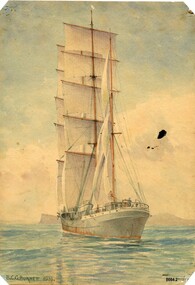
... It was photographed in Sydney by William James Hall in1931 on its way to Port Lincoln, South Australia to load wheat for Europe. This painting (one of a set of three small artworks) is significant as an example of shipping (particularly the use of sailing ships) that were still being used as late as the 1930's in Australia. ...Beni Carr Glyn Burnett (also known as B. C. G. Burnett or Beni Burnett) was born in 1889 to missionary parents in Mongolia. When he was 15 years old he began training as an architect with a firm in Shanghai. He worked in Singapore, Japan and China before moving to Australia around 1933. In 1937 he was appointed as the Commonwealth principal architect in the Northern Territory. He went on to design a series of houses for senior public servants and military personnel which became very popular as they were specifically designed for the tropics - incorporating louvres, high ceilings and good ventilation. When Darwin was bombed in February 1942, he was evacuated to Alice Springs where he continued to work as an architect. He also became a Magistrate and Coroner in Alice Springs. In later life he was well known for sketching clientele in public bars. He died in 1955. Beni Burnett was living in Sydney in 1933 when he produced these three artworks. There were several photography firms operating in Sydney at this time who specialised in photographing ships and the shipping trade (e.g. Samuel J. Hood and William James Hall) and whose photographs were used by artists to produce ship portraits. Both of these photographers took photographs of the two ships in B. C. G. Burnett's watercolours. The "Winterhude" (originally called "Mabel Rickmers) was a three masted Finnish barque built in 1898 by Rickers - Werft Bremerhaven for use on the East India rice trade and later the South American nitrate trade. After WW1 it came under French control as war compensation. It was also sold several times and at one stage was called "Selma Hemsoth" but in 1925 it was bought by Gustaf Erikson who restored the name "Winterhude" and the vessel became a regular transport in the Australian wheat trade. In 1944 it was sold to the German navy before being taken over by the British at the end of WW2. It was photographed in Sydney by William James Hall in1931 on its way to Port Lincoln, South Australia to load wheat for Europe.This painting (one of a set of three small artworks) is significant as an example of shipping (particularly the use of sailing ships) that were still being used as late as the 1930's in Australia. It is also important because its creator (B. C. G. Burnett) went on to become a well-known public figure in the Northern Territory in the late 1930's due to his innovative approach to designing homes for the tropical climate.A watercolour painting of a sailing ship called "Winterhude". It shows a 3 masted barque with a blue and red steel hull in full sail heading away from the viewer. A small figure can be seen at the wheel at the rear of the ship. The painter's name (B. C. G. Burnett) and date (1933) are written on the bottom left-hand corner of the painting. The name of the ship is written in faded pencil on the back of the painting.front - "B. C. G. BURNETT. 1933" back - in faded pencil - "the Winterhude"flagstaff hill maritime museum and village, warrnambool, great ocean road, sailing ships, ships, barque, winterhude, beni carr glyn burnett, b. c. g. burnett, beni burnett, painting, watercolour painting, sketch, ink sketch, sydney harbour, architect, darwin, burnett house, photography, samuel j. hood, william james hall, mabel rickmers -
 City of Moorabbin Historical Society (Operating the Box Cottage Museum)
Book, Globe Press Pty. Ltd, Buckley's hope : the story of Australia's wild white man, 1981
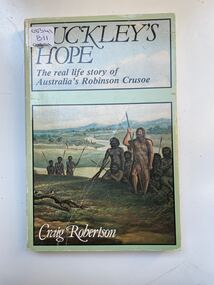
... A small soft cover book with a blue/green cover,on the front cover is a painting of early Australia with Indigenous Australians hunting with spears alongside them is a European with long unkept hair and a beard dressed in animal skins,on the back cover is text by the author giving a brief outline of the book....A small soft cover book with a blue/green cover,on the front cover is a painting of early Australia with Indigenous Australians hunting with spears alongside them is a European with long unkept hair and a beard dressed in animal skins,on the back cover is text by the author giving a brief outline of the book. ...A small soft cover book with a blue/green cover,on the front cover is a painting of early Australia with Indigenous Australians hunting with spears alongside them is a European with long unkept hair and a beard dressed in animal skins,on the back cover is text by the author giving a brief outline of the book.buckley, sorrento, robinson crusoe, port phillip, van diemen's land, colonialism, 1840, convicts, indigenous tribes. -
 Glenelg Shire Council Cultural Collection
Painting, Jennifer McCarthy, Edward Henty Arrival, 2009
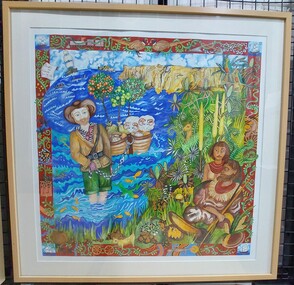
... European clothing - green trousers and a striped top. He is ankle deep in the water. Behind him are two baskets which he holds with a chain. Behind that are two sheep. Top left is a parchment which says, Thistle the Pioneer, Nov 19th 1834. Edward Henty Arrival Painting ...Winner of the 175th Anniversary of Edward Henty landing at Portland, Acquisitive Art Prize.Gouache on paper depiction of Edward Henty's arrival at Portland Bay. Cream coloured mat board. Light coloured wooden frame. Wire hanging cord. A colourful border depicting native animals as well as other items such as a steam train, shovel, cartwheels surrounds an image of the coastline. Each corner of the border shows a sailing ship. In the foreground are two Indigenous Australians seated on the floor surrounded by bushland. To the left stands a man in European clothing - green trousers and a striped top. He is ankle deep in the water. Behind him are two baskets which he holds with a chain. Behind that are two sheep. Top left is a parchment which says, Thistle the Pioneer, Nov 19th 1834.Front: Back - 'Jennifer McCarthy Edward Henty - Arrival 2009' - Brown texta Also framers sticker1834, the thistle, henty, colonial, portland bay -
 Orbost & District Historical Society
photograph, H.M.S. Rattlesnake, leaving Port Essington 1846-1849 BY STANLEY, OWEN
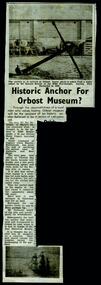
... After the passage out, Stanley brought aboard Oswald Brierly, later to be the marine painter to Queen Victoria, and together these men made two voyages through the Great Barrier Reef, painting and sketching all the while. They produced a visual record of 19th century contact between Europeans and the indigenous people of Northern Australia and New Guinea in an album which contains the original of this copy. ...After the passage out, Stanley brought aboard Oswald Brierly, later to be the marine painter to Queen Victoria, and together these men made two voyages through the Great Barrier Reef, painting and sketching all the while. They produced a visual record of 19th century contact between Europeans and the indigenous people of Northern Australia and New Guinea in an album which contains the original of this copy. ..."The marine Hydrographers of the British Admiralty wanted desperately to chart a safe passage through the Great Barrier Reef and the gap between the northern tip of Australia and Papua New Guinea, which would open up the new colony to the East Indies trade. They commissioned the Rattlesnake, a 28 gun frigate of the Royal Navy, whose captain was a keen amateur artist and whose name, Owen Stanley, was given to the mountain ranges of PNG. After the passage out, Stanley brought aboard Oswald Brierly, later to be the marine painter to Queen Victoria, and together these men made two voyages through the Great Barrier Reef, painting and sketching all the while. They produced a visual record of 19th century contact between Europeans and the indigenous people of Northern Australia and New Guinea in an album which contains the original of this copy. It is held in the Mitchell Library in Sydney." (ref. State Library New South Wales) Sir Oswald Brierly, a young marine artist, arrived in Sydney in 1842 on the yacht Wanderer. Settling at the whaling station of Boyd Town in Twofold Bay, he painted extensively and left a vivid account of the whaling life during the five years he spent there. However it was the open sea and adventure that lead Brierly to accept a position on the HMS Rattlesnake as shipboard artist. This item is associated with the anchor of the The Rattlesnake. This anchor is in the main street of Orbost in front of what was once the museum.This is a copy of a picture of the H.M.S. Rattlesnake at sea with a canoe of Aborigines rowing towards it.h.m.s.-rattlesnake brierly-oswald stanley-owen -
 Glenelg Shire Council Cultural Collection
Booklet, A Homely Chat About Dairying, 09/1888
... European settlement in Australia. The Exhibition Building, constructed in 1880 for the Melbourne International Exhibition, was extended and reused. The Centennial Exhibition focused on Australia itself, and emphasised music and painting that attracted many visitors....European settlement in Australia. The Exhibition Building, constructed in 1880 for the Melbourne International Exhibition, was extended and reused. The Centennial Exhibition focused on Australia itself, and emphasised music and painting that attracted many visitors. centennial exhibition Melbourne Exhibition Building 1888 dairy rural industry A booklet, containing a lecture on model dairies, 'A Homely Chat About Dairying'; delivered by Mr. ...A booklet, containing a lecture on model dairies, 'A Homely Chat About Dairying'; delivered by Mr. D. Wilson, at the Centennial International Exhibition, 8th September 1888.centennial exhibition, melbourne exhibition building, 1888, dairy, rural industry -
 Mission to Seafarers Victoria
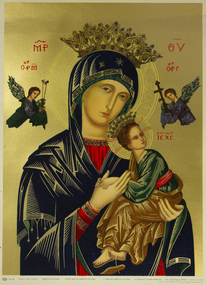
Print - Reproduction of a painting, Perpetual Succour
... Probably a gift from an Eastern European crew member visiting the Mission TBC. orthodox church nativity mary jesus crown angel artwork-paintings printed inscription lower edge of image Print of Eastern Orthodox style painting of Madonna and child on gold ground Perpetual Succour Print Reproduction of a painting ...Discovered in the Chapel of St Peter when packing up for renovations. Probably a gift from an Eastern European crew member visiting the Mission TBC.Print of Eastern Orthodox style painting of Madonna and child on gold ground printed inscription lower edge of imageorthodox church, nativity, mary, jesus, crown, angel, artwork-paintings -
 Mortlake and District Historical Society
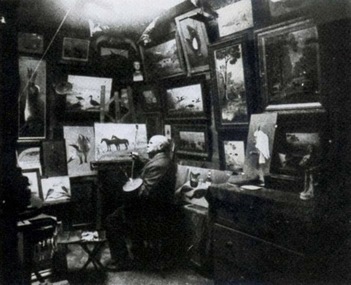
Painting, William Alen, The Old Windmill, 1916
... Europe and Britain. The Mill has been a prominent landmark in Mortlake for over 150 years. It was converted to steam after it was sold in 1857 to Hamilton, Aikman and Geddes. Its use declined after the Ararat goldfields petered out, the diggers moved on and local soils proved unsuited to the sustained cultivation of wheat. The existing Mill Chimney is Heritage listed and is part of the National Estate. mill windmill mortlake national estate hamilton bostock aikman geddes Signed W.Alen 1 painting ...The Old Wind Mill in Mill Street Mortlake was constructed in 1856 by Thos. Bostock. It was erected to process locally-grown grain to supply the increased population of the Ararat goldfields with flour. It was painted in 1916 by W.Alen a local artist, who did not have first-hand knowledge of the old Mill, but would have relied on descriptions from those living in the district who did, as well as possibly recollections of windmills in Europe and Britain. The Mill has been a prominent landmark in Mortlake for over 150 years. It was converted to steam after it was sold in 1857 to Hamilton, Aikman and Geddes. Its use declined after the Ararat goldfields petered out, the diggers moved on and local soils proved unsuited to the sustained cultivation of wheat. The existing Mill Chimney is Heritage listed and is part of the National Estate.1 paintingSigned W.Alenmill windmill mortlake national estate hamilton bostock aikman geddes -
 Orbost & District Historical Society
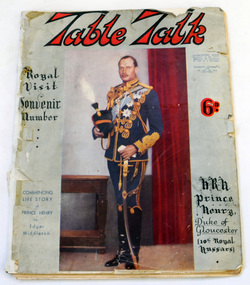
magazine, Table Talk, August 1 1934
... This magazine was published as a souvenir to commemorate the centenary of European settlement in Victoria, 1934 tourism recreation history Melbourne magazine Table-Talk A 104 page soft covered magazine relating to Melbourne's first 100 years. It contains stories about the settlement of early Melbourne, businesses, land purchases and advertisements. The front cover has a brown background and a colour reproduction of a painting ...This magazine was published as a souvenir to commemorate the centenary of European settlement in Victoria, 1934A 104 page soft covered magazine relating to Melbourne's first 100 years. It contains stories about the settlement of early Melbourne, businesses, land purchases and advertisements. The front cover has a brown background and a colour reproduction of a painting titled Pioneers by W. B. McInnes.tourism recreation history melbourne magazine table-talk -
 Bendigo Military Museum
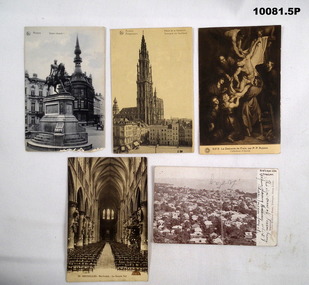
Photograph - PHOTOGRAPHIC POSTCARDS, c.1918
... Europe 1. On back written "Statue of First King of Belgium, Antwerp". 2. Detailed description of what is in the Cathedral on back. 3. On back detailed description and comments on Rubens paintings. 4. ...Various postcards from Europe and Africa during WW1. Part of the collection of V E Giudice, No. 53730, Refer Cat No. 10031P for service details. Part of the overall collection of William (Bill) Thomason, Refer Cat No.4136P, Various postcards collected all in black and white. 1. Statue of King Leopold, First King of Belgium, in a square, in the City of Antwerp. 2. Picture of Pieche De La Cathedrale located in Antwerp. 3. Picture of a Rubens painting located within the Cathedrale De Anvers. 4. Picture of Nave of Cathedrale of St Michael & St. Gudula in Brussels. 5. Picture of Sierra Leone Harbour, Port of Freetown. 1. On back written "Statue of First King of Belgium, Antwerp". 2. Detailed description of what is in the Cathedral on back. 3. On back detailed description and comments on Rubens paintings. 4. On back, comments on aspects of the Cathedrale. 5. On front written "This is a picture of Sierra Leone Africa” of the Harbour.v e giudice, collection of william (bill) thomason, photographic postcards, ww1, europe -
 Eltham District Historical Society Inc
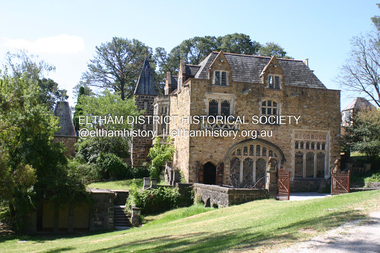
Photograph - Digital Photograph, Alan King, Great Hall, Montsalvat, 8 January 2008
... He later studied painting at the National Gallery School under artist, Frederick McCubbin, then joined the studio of artist Max Meldrum. In 1924, Jörgensen married medical student Lillian Smith, and with artist friends they travelled to Europe to study the great masters. ...He later studied painting at the National Gallery School under artist, Frederick McCubbin, then joined the studio of artist Max Meldrum. In 1924, Jörgensen married medical student Lillian Smith, and with artist friends they travelled to Europe to study the great masters. ...Great Hall at Montsalvat built 1938-52, designed by Justus Jorgensen Covered under National Estate, National Trust of Australia (Victoria) State Significance, Victorian Heritage and Heritage Overlay, Nillumbik Planning Scheme. Published: Nillumbik Now and Then / Marguerite Marshall 2008; photographs Alan King with Marguerite Marshall.; p129 At first glance, Montsalvat, the artists’ community at Hillcrest Avenue, Eltham, could belong to another time and place. The French provincial Gothic-style buildings blend picturesquely with the introduced and native trees and farm animals on the five hectare property. But Montsalvat belongs very much to today’s Eltham, having inspired much of its creative activity and style. The use of mud-brick and recycled building materials, for which Eltham is so well-known, was largely popularised by Montsalvat. Montsalvat – unique in Victoria and probably in Australia – is registered by the National Trust and National Estate.1 Montsalvat, named after the castle of the Knights of the Holy Grail, has attracted artists and intellectuals since it was founded in 1934. For years at weekends, artists, lawyers, philosophers, politicians and others, who shared a love for what Montsalvat stood for, gathered for a meal and stimulating discussion. The focus for this gathering of talent was Justus Jörgensen, an eccentric man with vision and charisma. It was Jörgensen’s foresight that saw the creation of Montsalvat, which in 1975 was formed into a trust to benefit the Victorian people. The property was then valued at about three million dollars. It is now visited by thousands of people annually. Born in 1894 and brought up a Catholic, Jörgensen had trained as an architect. He later studied painting at the National Gallery School under artist, Frederick McCubbin, then joined the studio of artist Max Meldrum. In 1924, Jörgensen married medical student Lillian Smith, and with artist friends they travelled to Europe to study the great masters. In London Jörgensen exhibited in several major galleries. One of his still life paintings was included in the book The Art of Still Life by Herbert Furst, which featured 100 of the greatest ever still life paintings.2 In 1929, Jörgensen returned to Melbourne where Lil, now qualified, worked as an anaesthetist at St Vincent’s Hospital. They bought a small house in Brighton and Jörgensen rented a large building in Queen Street for his studio until the Royal Automobile Club of Victoria bought it in 1955. While designing and overseeing the building of a studio for his friend the famous cartoonist Percy Leason, in Lavender Park Road, Jörgensen decided to buy land for a country retreat in Eltham. So the building of Montsalvat began. Jörgensen gathered around a dozen of his friends and students from his Queen Street studio. They set to work, first at weekends then some decided to live permanently on the site. Jörgensen had seen mud-brick buildings in Spain and recognised that Eltham’s clay soil was ideal for mud-bricks and although labour intensive, it was a very cheap way of building. Jörgensen’s students and friends worked under his direction with the help of local tradesmen, including carpenter, Len Jarrold and later stone mason, Horrie Judd. In return Jörgensen would give the students a painting lesson or two. It was the Great Depression when many were out of work. Jörgensen also inspired people to give generously of money and materials. With their help Jörgensen found second-hand materials for building. Friends donated slate for roofing, discarded firebricks were used for flooring and windows and doors and a cast-iron circular staircase came from a wrecker. The students’ day started at 7am with building and domestic chores, shared equally between the sexes. The first building was used by his friends at weekends and then became a home for his wife Lil. It consisted of three rooms and an attic under a high-pitched roof. Jörgensen then built a similar structure with the same high-pitched roof as a more permanent home for his students. The two buildings were joined together with a tower and a studio for Jörgensen. While excavating for the studio a reef of yellow mud-stone was found and then used in construction. The next building was the Great Hall, to be used for dining, exhibitions and meetings and completed in 1958, after a halt during the war. Whelan the Wrecker donated the stone-framed windows from the building that housed the Victorian Insurance Co. in Collins Street, which had been demolished in the 1930s. The swimming pool was donated and cubicles were built for the students with their initials marked in tiles on each doorstep.1 One of Jörgensen’s great abilities was to recognise how to use material which harmonised. He would comb through wreckers’ yards for what he needed. Regarding his buildings as sculptural pieces, his first consideration was for the aesthetic quality of a building and only then for its functionality.2 At Montsalvat, Jörgensen found he was able to put his ideas into practice without compromise and those who worked with him had to conform to his ideas. With the Jörgensens, the colony’s original nucleus consisted of the Skipper family – Mervyn and wife Lena, daughters Helen and Sonia and son Matcham,who was to become an eminent jeweller and sculptor represented in National Gallery collections throughout Australia and in European museums.3 Other members were Arthur Munday, Lesley Sinclair, Helen Lempriere, Ian Robertson, John Smith, George Chalmers, John Busst and Sue Van der Kellan; also Jörgensen’s three sons – Max, Sebastian and Sigmund – and Saskia, Sonia Skipper and Arthur Munday’s daughter. Montsalvat went through some hard times when local gossips spread rumours of sexual shenanigans at Montsalvat. However Montsalvat also had many local supporters – especially amongst the local tradespeople. The colony was certainly unconventional – with Jörgensen’s wife Lil (and son Max) and life-time partner Helen Skipper, (mother of Sebastian and Sigmund) living at Montsalvat. Sonia Skipper says in her biography that the group were ‘very conscious of their responsibilities to each other and a desire to make their relationships work’.4 By World War Two many buildings around the Great Hall were completed. Jörgensen was a pacifist, as were most of his students. Some of the Montsalvat community enlisted while others engaged in essential services like dairy farming and market gardening for the war effort. It was then that Jörgensen constructed farm buildings. After the war many well-known personalities such as Clifton Pugh, landscape gardener Gordon Ford, and builder Alistair Knox, were drawn to Montsalvat. They learnt that building was not a ‘sacred cow’ only for professionals, but that anyone who was willing to get their hands dirty could do it. The post-war shortage of materials also encouraged builders to follow Montsalvat’s lead in reusing materials. When Jörgensen died in 1975, his influence did not – thanks largely to the vigilance of his son, Sigmund, who became its administrator. The weekend dinners have gone, but in 2008 about 14 artists still work at Montsalvat – some living there – including a couple who have been there since its early days. Under Sigmund’s direction Montsalvat further expanded its activities which included festivals, art exhibitions, concerts and weddings. Sigmund completed the Chapel, then the Long Gallery next to the pool, After the barn burnt down, he replaced it in 1999 (the builder was Hamish Knox, Alistair’s son) with a new gallery and entrance and added a restaurant. Sigmund has been careful that any new building blends in with the character of Montsalvat. In 2006 Montsalvat was restructured for its continued financial viability and with the help of Arts Victoria a new executive officer was appointed. A representative board from the wider community was established, which includes members from the former Montsalvat Trust including Sigmund Jörgensen – who is now the heritage and arts adviser to the new company Montsalvat Ltd.5 Today, visiting Montsalvat one still sees artists, students and visitors enjoying the unique and beautiful surroundings.This collection of almost 130 photos about places and people within the Shire of Nillumbik, an urban and rural municipality in Melbourne's north, contributes to an understanding of the history of the Shire. Published in 2008 immediately prior to the Black Saturday bushfires of February 7, 2009, it documents sites that were impacted, and in some cases destroyed by the fires. It includes photographs taken especially for the publication, creating a unique time capsule representing the Shire in the early 21st century. It remains the most recent comprehenesive publication devoted to the Shire's history connecting local residents to the past. nillumbik now and then (marshall-king) collection, eltham, great hall, montsalvat -
 Eltham District Historical Society Inc
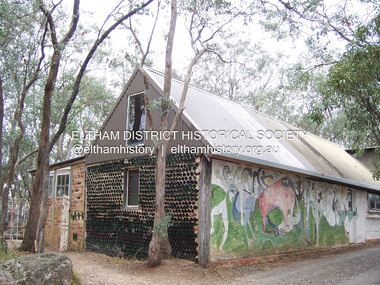
Photograph - Digital Photograph, Marguerite Marshall, Art Gallery at Clifton Pugh's Artists' Colony, Dunmoochin, Barreenong Road, Cottles Bridge, 5 February 2008
... Dunmoochin inspired Pugh for such paintings as in a book on orchids and the Death of a Wombat series.1 But his love for the bush was accompanied by the fear that Europeans were destroying it and much of his painting illustrated this fear and his plea for its conservation.2 However it was his house rather than the surrounding bush that was to be destroyed. ...Dunmoochin inspired Pugh for such paintings as in a book on orchids and the Death of a Wombat series.1 But his love for the bush was accompanied by the fear that Europeans were destroying it and much of his painting illustrated this fear and his plea for its conservation.2 However it was his house rather than the surrounding bush that was to be destroyed. ...Art Gallery with mural painted by Clifton Pugh (1924-1990) at his Artists' Colony, Dunmoochin, Barreenong Road, Cottles Bridge. Following military service in the second world war, Clifton Pugh studied under artist Sir William Dargie at the National Gallery School in Melbourne as well as Justus Jorgensen, founder of Montsalvat. For a while he lived on the dole but also worked packing eggs for the Belot family saving sufficient to purchase six acres (2.4 ha) of land at Barreenong Road, Cottles Bridge. He accumulated more land and persuaded several other artists and friends to buy land nearby, resulting in a property of approximately 200 acres, stablishing it as one of the first artistic communes in Australia alongside Montsalvat in Eltham. It was around 1951 that Pugh felt he had '"done moochin' around" and so the name of the property evolved. He bought timber from Alistair Knox to build his house on the crest of a hill. Inspired by local goldminer's huts, it was a one room wattle-and-daub structure with dirt floor. Over the years it expanded with thick adobe walls made from local clay, high ceilings and stone floors. All materials other than the local earth were sourced from second hand materials, most found at wreckers' yards. Artists from across the nation were drawn to Dunmoochin, with several setting up houses and shacks on the property, maintaining their independence but sharing their artistic zeal. Artists who worked or resided at Dunmoochin included Mirka Mora, John Perceval, Albert Tucker, Fred Williams, Charles Blackman, Arthur Boyd and John Olsen. In 2002, Pugh's house along with its treasure trove of art and a library of some 20,000 books was destroyed by fire. Traces of Pugh's home remain with the presence of the Victorian doorframe archway with leadlight of intricate design, procured from a demolished Melbourne mansion; and two bronze life-sized female statues created by Pugh and cast by Matcham Skipper. In place of Pugh's house rose two double-storey mud-brick artists' studios topped with corrugated iron rooves curved like the wings of a bird with accommodation for seven. The original studios, gallery and other buildings survived the fire. Covered under Heritage Overlay, Nillumbik Planning Scheme. Published: Nillumbik Now and Then / Marguerite Marshall 2008; photographs Alan King with Marguerite Marshall.; p153 It’s not surprising that artist Clifton Pugh was drawn to Cottles Bridge to establish his artists’ colony Dunmoochin. Undisturbed by the clamour of modern life at Barreenong Road, Pugh was surrounded by the Australian bush he loved, and where his ashes were later scattered. The 200 acres (81ha) of bushland, broken by glimpses of rolling hills, has more than 50 species of orchids and Pugh shared his property with native animals including kangaroos, emus, phascogales, wombats, and diverse bird life. Pugh encouraged these creatures to join him in the bush by creating, with Monash University, a holding station where the animals were raised. Dunmoochin inspired Pugh for such paintings as in a book on orchids and the Death of a Wombat series.1 But his love for the bush was accompanied by the fear that Europeans were destroying it and much of his painting illustrated this fear and his plea for its conservation.2 However it was his house rather than the surrounding bush that was to be destroyed. Tragically in 2002 Pugh’s house, with its treasure of art and library of 20,000 art books, was destroyed by fire. Traces of the beauty of Pugh’s home still remain, however, in the magnificent Victorian doorframe archway with leadlight of intricate design procured from a demolished Melbourne mansion; and two bronze life-sized female statues created by Pugh and cast by Matcham Skipper. Now in place of Pugh’s house, are two double-storey mud-brick artists’ studios topped with corrugated roofs curved like birds’ wings, with accommodation for seven. The original studios, gallery and other buildings remain.3 Pugh grew up on his parents’ hobby farm at Briar Hill and attended the Briar Hill Primary School, then Eltham High School and later Ivanhoe Grammar. At 15 he became a copy boy for the Radio Times newspaper, then worked as a junior in a drafting office. Pugh was to have three wives and two sons. After serving in World War Two in New Guinea and Japan, Pugh studied under artist Sir William Dargie, at the National Gallery School in Melbourne.4 Another of his teachers was Justus Jörgensen, founder of Montsalvat the Eltham Artists’ Colony. Pugh lived on the dole for a while and paid for his first six acres (2.4ha) at Barreenong Road by working as an egg packer for the Belot family. Pugh accumulated more land and persuaded several other artists and friends to buy land nearby, resulting in the 200 acre property. They, too, purchased their land from the Belot family by working with their chickens. Around 1951 Pugh felt he had ‘Done moochin’ around’ and so the name of his property was born. Pugh bought some used timber from architect Alistair Knox to build his house on the crest of a hill. Inspired by local goldminers’ huts it was a one-room wattle-and-daub structure with a dirt floor. It was so small that the only room he could find for his telephone was on the fork of a tree nearby.5 Over the years the mud-brick house grew to 120 squares in the style now synonymous with Eltham. It had thick adobe walls (sun-dried bricks) made from local clay, high ceilings and stone floors with the entire structure made of second-hand materials – most found at wreckers’ yards. Pugh’s first major show in Melbourne in 1957, established him as a distinctive new painter, breaking away from the European tradition ‘yet not closely allied to any particular school of Australian painting’.6 Pugh became internationally known and was awarded the Order of Australia. He won the Archibald Prize for portraiture three times, although he preferred painting the bush and native animals. In 1990 not long before he died, Pugh was named the Australian War Memorial’s official artist at the 75th anniversary of the landing at Gallipoli. Today one of Pugh’s legacies is the Dunmoochin Foundation, which gives seven individual artists or couples and environmental researchers the chance to work in beautiful and peaceful surroundings, usually for a year. By November 2007, more than 80 people had taken part, and the first disabled artist had been chosen to reside in a new studio with disabled access.1 In 1989, not long before Pugh died in 1990 of a heart attack at age 65, he established the Foundation with La Trobe University and the Victorian Conservation Trust now the Trust for Nature. Pugh’s gift to the Australian people – of around 14 hectares of bushland and buildings and about 550 art works – is run by a voluntary board of directors, headed by one of his sons, Shane Pugh. La Trobe University in Victoria stores and curates the art collection and organises its exhibition around Australia.2 The Foundation aims to protect and foster the natural environment and to provide residences, studios and community art facilities at a minimal cost for artists and environmental researchers. They reside at the non-profit organisation for a year at minimal cost. The buildings, some decorated with murals painted by Pugh and including a gallery, were constructed by Pugh, family and friends, with recycled as well as new materials and mud-bricks. The Foundation is inspired by the tradition begun by the Dunmoochin Artists’ Cooperative which formed in the late 1950s as one of the first artistic communes in Australia. Members bought the land collaboratively and built the seven dwellings so that none could overlook another. But, in the late 1960s, the land was split into private land holdings, which ended the cooperative. Dunmoochin attracted visits from the famous artists of the day including guitarists John Williams and Segovia; singer and comedian Rolf Harris; comedian Barry Humphries; and artists Charles Blackman, Arthur Boyd and Mirka Mora. A potters’ community, started by Peter and Helen Laycock with Alma Shanahan, held monthly exhibitions in the 1960s, attracting local, interstate and international visitors – with up to 500 attending at a time.3 Most artists sold their properties and moved away. But two of the original artists remained into the new millennium as did relative newcomer Heja Chong who built on Pugh’s property (now owned by the Dunmoochin Foundation). In 1984 Chong brought the 1000-year-old Japanese Bizan pottery method to Dunmoochin. She helped build (with potters from all over Australia) the distinctive Bizan-style kiln, which fires pottery from eight to 14 days in pine timber, to produce the Bizan unglazed and simple subdued style. The kiln, which is rare in Australia, is very large with adjoining interconnected ovens of different sizes, providing different temperatures and firing conditions. Frank Werther, who befriended Pugh as a fellow student at the National Gallery Art School in Melbourne, built his house off Barreenong Road in 1954. Werther is a painter of the abstract and colourist style and taught art for about 30 years. Like so many in the post-war years in Eltham Shire, as it was called then, Werther built his home in stages using mud-brick and second-hand materials. The L-shaped house is single-storey but two-storey in parts with a corrugated-iron pitched roof. The waterhole used by the Werthers for their water supply is thought to be a former goldmining shaft.4 Alma Shanahan at Barreenong Road was the first to join Pugh around 1953. They also met at the National Gallery Art School and Shanahan at first visited each weekend to work, mainly making mud-bricks. She shared Pugh’s love for the bush, but when their love affair ended, she designed and built her own house a few hundred yards (metres) away. The mud-brick and timber residence, made in stages with local materials, is rectangular, single-storey with a corrugated-iron roof. As a potter, Shanahan did not originally qualify as an official Cooperative member.This collection of almost 130 photos about places and people within the Shire of Nillumbik, an urban and rural municipality in Melbourne's north, contributes to an understanding of the history of the Shire. Published in 2008 immediately prior to the Black Saturday bushfires of February 7, 2009, it documents sites that were impacted, and in some cases destroyed by the fires. It includes photographs taken especially for the publication, creating a unique time capsule representing the Shire in the early 21st century. It remains the most recent comprehenesive publication devoted to the Shire's history connecting local residents to the past. nillumbik now and then (marshall-king) collection, art gallery, clifton pugh, dunmoochin, cottlesbridge, cottles bridge, barreenong road -
 Eltham District Historical Society Inc
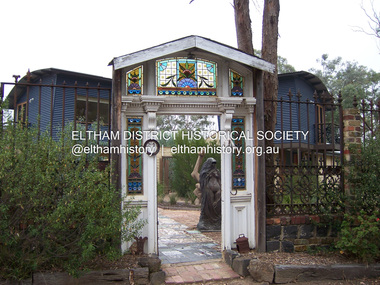
Photograph - Digital Photograph, Marguerite Marshall, Doorway of Clifton Pugh's former house at Dunmoochin, Barreenong Road, Cottles Bridge, 5 February 2008
... Dunmoochin inspired Pugh for such paintings as in a book on orchids and the Death of a Wombat series.1 But his love for the bush was accompanied by the fear that Europeans were destroying it and much of his painting illustrated this fear and his plea for its conservation.2 However it was his house rather than the surrounding bush that was to be destroyed. ...Dunmoochin inspired Pugh for such paintings as in a book on orchids and the Death of a Wombat series.1 But his love for the bush was accompanied by the fear that Europeans were destroying it and much of his painting illustrated this fear and his plea for its conservation.2 However it was his house rather than the surrounding bush that was to be destroyed. ...Following military service in the second world war, Clifton Pugh studied under artist Sir William Dargie at the National Gallery School in Melbourne as well as Justus Jorgensen, founder of Montsalvat. For a while he lived on the dole but also worked packing eggs for the Belot family saving sufficient to purchase six acres (2.4 ha) of land at Barreenong Road, Cottles Bridge. He accumulated more land and persuaded several other artists and friends to buy land nearby, resulting in a property of approximately 200 acres, stablishing it as one of the first artistic communes in Australia alongside Montsalvat in Eltham. It was around 1951 that Pugh felt he had '"done moochin' around" and so the name of the property evolved. He bought timber from Alistair Knox to build his house on the crest of a hill. Inspired by local goldminer's huts, it was a one room wattle-and-daub structure with dirt floor. Over the years it expanded with thick adobe walls made from local clay, high ceilings and stone floors. All materials other than the local earth were sourced from second hand materials, most found at wreckers' yards. Artists from across the nation were drawn to Dunmoochin, with several setting up houses and shacks on the property, maintaining their independence but sharing their artistic zeal. Artists who worked or resided at Dunmoochin included Mirka Mora, John Perceval, Albert Tucker, Fred Williams, Charles Blackman, Arthur Boyd and John Olsen. In 2002, Pugh's house along with its treasure trove of art and a library of some 20,000 books was destroyed by fire. Traces of Pugh's home remain with the presence of the Victorian doorframe archway with leadlight of intricate design, procured from a demolished Melbourne mansion; and two bronze life-sized female statues created by Pugh and cast by Matcham Skipper. In place of Pugh's house rose two double-storey mud-brick artists' studios topped with corrugated iron rooves curved like the wings of a bird with accommodation for seven. The original studios, gallery and other buildings survived the fire. Covered under Heritage Overlay, Nillumbik Planning Scheme. Published: Nillumbik Now and Then / Marguerite Marshall 2008; photographs Alan King with Marguerite Marshall.; p155 It’s not surprising that artist Clifton Pugh was drawn to Cottles Bridge to establish his artists’ colony Dunmoochin. Undisturbed by the clamour of modern life at Barreenong Road, Pugh was surrounded by the Australian bush he loved, and where his ashes were later scattered. The 200 acres (81ha) of bushland, broken by glimpses of rolling hills, has more than 50 species of orchids and Pugh shared his property with native animals including kangaroos, emus, phascogales, wombats, and diverse bird life. Pugh encouraged these creatures to join him in the bush by creating, with Monash University, a holding station where the animals were raised. Dunmoochin inspired Pugh for such paintings as in a book on orchids and the Death of a Wombat series.1 But his love for the bush was accompanied by the fear that Europeans were destroying it and much of his painting illustrated this fear and his plea for its conservation.2 However it was his house rather than the surrounding bush that was to be destroyed. Tragically in 2002 Pugh’s house, with its treasure of art and library of 20,000 art books, was destroyed by fire. Traces of the beauty of Pugh’s home still remain, however, in the magnificent Victorian doorframe archway with leadlight of intricate design procured from a demolished Melbourne mansion; and two bronze life-sized female statues created by Pugh and cast by Matcham Skipper. Now in place of Pugh’s house, are two double-storey mud-brick artists’ studios topped with corrugated roofs curved like birds’ wings, with accommodation for seven. The original studios, gallery and other buildings remain.3 Pugh grew up on his parents’ hobby farm at Briar Hill and attended the Briar Hill Primary School, then Eltham High School and later Ivanhoe Grammar. At 15 he became a copy boy for the Radio Times newspaper, then worked as a junior in a drafting office. Pugh was to have three wives and two sons. After serving in World War Two in New Guinea and Japan, Pugh studied under artist Sir William Dargie, at the National Gallery School in Melbourne.4 Another of his teachers was Justus Jörgensen, founder of Montsalvat the Eltham Artists’ Colony. Pugh lived on the dole for a while and paid for his first six acres (2.4ha) at Barreenong Road by working as an egg packer for the Belot family. Pugh accumulated more land and persuaded several other artists and friends to buy land nearby, resulting in the 200 acre property. They, too, purchased their land from the Belot family by working with their chickens. Around 1951 Pugh felt he had ‘Done moochin’ around’ and so the name of his property was born. Pugh bought some used timber from architect Alistair Knox to build his house on the crest of a hill. Inspired by local goldminers’ huts it was a one-room wattle-and-daub structure with a dirt floor. It was so small that the only room he could find for his telephone was on the fork of a tree nearby.5 Over the years the mud-brick house grew to 120 squares in the style now synonymous with Eltham. It had thick adobe walls (sun-dried bricks) made from local clay, high ceilings and stone floors with the entire structure made of second-hand materials – most found at wreckers’ yards. Pugh’s first major show in Melbourne in 1957, established him as a distinctive new painter, breaking away from the European tradition ‘yet not closely allied to any particular school of Australian painting’.6 Pugh became internationally known and was awarded the Order of Australia. He won the Archibald Prize for portraiture three times, although he preferred painting the bush and native animals. In 1990 not long before he died, Pugh was named the Australian War Memorial’s official artist at the 75th anniversary of the landing at Gallipoli. Today one of Pugh’s legacies is the Dunmoochin Foundation, which gives seven individual artists or couples and environmental researchers the chance to work in beautiful and peaceful surroundings, usually for a year. By November 2007, more than 80 people had taken part, and the first disabled artist had been chosen to reside in a new studio with disabled access.1 In 1989, not long before Pugh died in 1990 of a heart attack at age 65, he established the Foundation with La Trobe University and the Victorian Conservation Trust now the Trust for Nature. Pugh’s gift to the Australian people – of around 14 hectares of bushland and buildings and about 550 art works – is run by a voluntary board of directors, headed by one of his sons, Shane Pugh. La Trobe University in Victoria stores and curates the art collection and organises its exhibition around Australia.2 The Foundation aims to protect and foster the natural environment and to provide residences, studios and community art facilities at a minimal cost for artists and environmental researchers. They reside at the non-profit organisation for a year at minimal cost. The buildings, some decorated with murals painted by Pugh and including a gallery, were constructed by Pugh, family and friends, with recycled as well as new materials and mud-bricks. The Foundation is inspired by the tradition begun by the Dunmoochin Artists’ Cooperative which formed in the late 1950s as one of the first artistic communes in Australia. Members bought the land collaboratively and built the seven dwellings so that none could overlook another. But, in the late 1960s, the land was split into private land holdings, which ended the cooperative. Dunmoochin attracted visits from the famous artists of the day including guitarists John Williams and Segovia; singer and comedian Rolf Harris; comedian Barry Humphries; and artists Charles Blackman, Arthur Boyd and Mirka Mora. A potters’ community, started by Peter and Helen Laycock with Alma Shanahan, held monthly exhibitions in the 1960s, attracting local, interstate and international visitors – with up to 500 attending at a time.3 Most artists sold their properties and moved away. But two of the original artists remained into the new millennium as did relative newcomer Heja Chong who built on Pugh’s property (now owned by the Dunmoochin Foundation). In 1984 Chong brought the 1000-year-old Japanese Bizan pottery method to Dunmoochin. She helped build (with potters from all over Australia) the distinctive Bizan-style kiln, which fires pottery from eight to 14 days in pine timber, to produce the Bizan unglazed and simple subdued style. The kiln, which is rare in Australia, is very large with adjoining interconnected ovens of different sizes, providing different temperatures and firing conditions. Frank Werther, who befriended Pugh as a fellow student at the National Gallery Art School in Melbourne, built his house off Barreenong Road in 1954. Werther is a painter of the abstract and colourist style and taught art for about 30 years. Like so many in the post-war years in Eltham Shire, as it was called then, Werther built his home in stages using mud-brick and second-hand materials. The L-shaped house is single-storey but two-storey in parts with a corrugated-iron pitched roof. The waterhole used by the Werthers for their water supply is thought to be a former goldmining shaft.4 Alma Shanahan at Barreenong Road was the first to join Pugh around 1953. They also met at the National Gallery Art School and Shanahan at first visited each weekend to work, mainly making mud-bricks. She shared Pugh’s love for the bush, but when their love affair ended, she designed and built her own house a few hundred yards (metres) away. The mud-brick and timber residence, made in stages with local materials, is rectangular, single-storey with a corrugated-iron roof. As a potter, Shanahan did not originally qualify as an official Cooperative member.This collection of almost 130 photos about places and people within the Shire of Nillumbik, an urban and rural municipality in Melbourne's north, contributes to an understanding of the history of the Shire. Published in 2008 immediately prior to the Black Saturday bushfires of February 7, 2009, it documents sites that were impacted, and in some cases destroyed by the fires. It includes photographs taken especially for the publication, creating a unique time capsule representing the Shire in the early 21st century. It remains the most recent comprehenesive publication devoted to the Shire's history connecting local residents to the past. nillumbik now and then (marshall-king) collection, art gallery, clifton pugh, dunmoochin, cottlesbridge, cottles bridge, barreenong road -
 Queenscliffe Maritime Museum
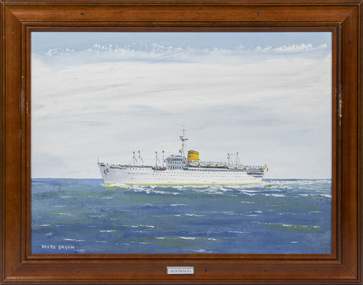
Painting - Framed oil painting of 'MV Australia', Dacre Smyth, 'Australia'
... Operated as a migrant ship from Europe to Australia in the 50s and 60s. MV Australia Migrant Ships Australia A framed oil painting of the migrant ship 'MV Australia' 'Australia' Painting Framed oil painting of 'MV Australia' Dacre Smyth ...After World War II Lloyd Triestino re-established its Australian service with existing ships and began a rebuilding programme ordering seven new liners. Of these new liners three were for the Australian service, launched in 1950 these three ships became known as the Triestino Trio. The first to be built was the Australia launched on 21 May 1950, departing Trieste on 19 April 1951 and arriving in Melbourne on 17 May. The second ship Oceania launched on 30 July 1950, departed Genoa for its maiden voyage on 18 August 1951.The third, Neptunia, launched on 1 October 1950, departing on its maiden voyage on 14 September 1951 and arriving in Brisbane on 18 October.A framed oil painting of the migrant ship 'MV Australia'Australiamv australia, migrant ships -
 Queenscliffe Maritime Museum
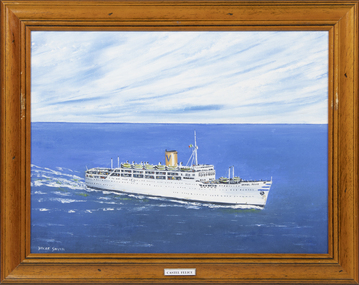
Painting - MV Castel Felice, Dacre Smyth, Castel Felice
... Used post Second World War to bring migrants from Europe to Australia in the 60s and 70s prior to air travel. MV Castel Felice Migrant Ships Castel Felice A framed oil painting of the migrant ship 'MV Castel Felice' Castel Felice Painting MV Castel Felice Dacre Smyth ...Owned by the Sitmar Line, the 'Castel Felice' operated on the Australia migrgant route from the 60s to the 70s prioir to air travel in the mid 70s. Mrs B SmythA framed oil painting of the migrant ship 'MV Castel Felice'Castel Felicemv castel felice, migrant ships -
 Queenscliffe Maritime Museum
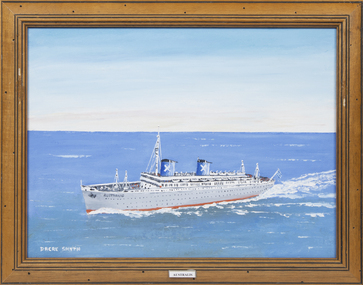
Painting - SS Australis, Dacre Smyth, Australis
... After many name and ownership change, the Chandris Line Australis served as a migrant ship on the Europe - Australia route from 1964 to 1978. SS Australis Migrant ships Australis A framed oil painting of the migrant ship SS Australis Australis Painting SS Australis Dacre Smyth ...The Australis retains a significant place in Australian immigration history as the last ship to carry government assisted immigrants to Australian shores in 1977. She had the largest passenger capacity of any post World War II immigrant ship to regularly visit Australia and many passengers fondly remember her grandeur and remnants of Art Deco style.Mrs B SmythA framed oil painting of the migrant ship SS AustralisAustralisss australis, migrant ships -
 Eltham District Historical Society Inc
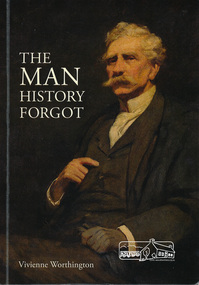
Book, The Man history forgot by Vivienne Worthington, 2018
... painting "J.A. Panton, Esq., PM" 1904 is by Frederick McCubbin. Sections in the book refer to : J. A. Panton CMG, Discovery of gold, 1854 Year of Exhibitions, Mining commission, Europe, Bohemia, art and marriage, artist in the western district, patron of Victorian Academy of Art, First Police Magistrate of city court, pioneer pastoralist, aboard the yacht "Cushie Doo", fellow of Royal Geographical Society, London, Inaugural President of Victorian Artists Society, Later Life of Joseph Panton....painting "J.A. Panton, Esq., PM" 1904 is by Frederick McCubbin. Sections in the book refer to : J. A. Panton CMG, Discovery of gold, 1854 Year of Exhibitions, Mining commission, Europe, Bohemia, art and marriage, artist in the western district, patron of Victorian Academy of Art, First Police Magistrate of city court, pioneer pastoralist, aboard the yacht "Cushie Doo", fellow of Royal Geographical Society, London, Inaugural President of Victorian Artists Society, Later Life of Joseph Panton. jospeh anderson panton biography frederick mccubbin cushie doo (ship) gold discovery police magistrate victorian artists society Softcover book The Man history forgot by Vivienne Worthington Book Publishing Productions ...Biography of Goldfields Commissioner Joseph Anderson Panton for whom Panton Hill was named for. The cover painting "J.A. Panton, Esq., PM" 1904 is by Frederick McCubbin. Sections in the book refer to : J. A. Panton CMG, Discovery of gold, 1854 Year of Exhibitions, Mining commission, Europe, Bohemia, art and marriage, artist in the western district, patron of Victorian Academy of Art, First Police Magistrate of city court, pioneer pastoralist, aboard the yacht "Cushie Doo", fellow of Royal Geographical Society, London, Inaugural President of Victorian Artists Society, Later Life of Joseph Panton.Softcover bookjospeh anderson panton, biography, frederick mccubbin, cushie doo (ship), gold discovery, police magistrate, victorian artists society -
 Women's Art Register
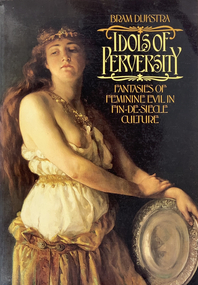
Book, Oxford University Press, Idols of perversity. Fantasies of Feminine evil in Fin-de-Siecle Culture, 1989
... Provides a feminist reading on many familiar literary and art works, and theoretical frameworks from the time. painting feminism sexuality violence symbolism mythology motherhood Darwinism Pre-Raphaelites Analysis of late 19th century American and European writing, art, science and philosophy exploring cultural misogyny. ...Analysis of late 19th century American and European writing, art, science and philosophy exploring cultural misogyny. Discusses the attitude to women as having only sexual and reproductive roles and being depicted as symbols of evil, passivity and sensuality, and ever dependent, while men were free to follow financially independent public and intellectual lives.Booknon-fictionAnalysis of late 19th century American and European writing, art, science and philosophy exploring cultural misogyny. Discusses the attitude to women as having only sexual and reproductive roles and being depicted as symbols of evil, passivity and sensuality, and ever dependent, while men were free to follow financially independent public and intellectual lives. painting, feminism, sexuality, violence, symbolism, mythology, motherhood, darwinism, pre-raphaelites -
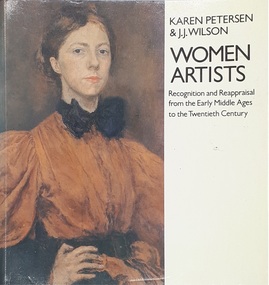 Women's Art Register
Book, The Women's Press Limited, Women Artists: Recognition and Reappraisal from the Early Middle Ages to the Twentieth Century, 1978
... Complements many texts, catalogues, monographs and histories on these artists held the Women's Art Register. painting portraiture sculpture textiles photography Illustrated overview of women artists from 5th - 20th century including European, British and American artists. ...Illustrated overview of women artists from 5th - 20th century including European, British and American artists. A chapter on Chinese artists states that Chinese women's contribution to the arts ' beginning around 3000 BC.'Booknon-fictionIllustrated overview of women artists from 5th - 20th century including European, British and American artists. A chapter on Chinese artists states that Chinese women's contribution to the arts ' beginning around 3000 BC.'painting, portraiture, sculpture, textiles, photography -
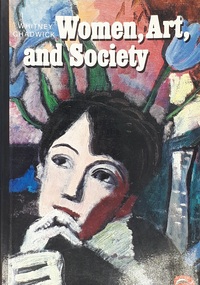 Women's Art Register
Book, Whitney Chadwick, Women, Art and Society, 1990
... (From the author's Preface) Complements many texts, catalogues, monographs and histories held by the Women's Art Register. painting sculpture performance feminism collage Illustrated feminist overview of women artists from the Middle Ages to the late 20th century, practising predominantly in Europe, United Kingdom and the United States. ...Illustrated feminist overview of women artists from the Middle Ages to the late 20th century, practising predominantly in Europe, United Kingdom and the United States.Booknon-fictionIllustrated feminist overview of women artists from the Middle Ages to the late 20th century, practising predominantly in Europe, United Kingdom and the United States.painting, sculpture, performance, feminism, collage -
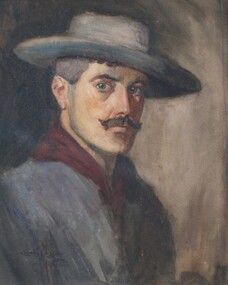 Creswick Museum
watercolour painting, Self Portrait (Lionel Lindsay)
... Lionel became a famous artist in Australia and Europe, especially noted for his Spanish etchings. lionel lindsay creswick etching watercolour Spain norman lindsay Signed "Lionel Lindsay 1899" Watercolour painting on paper of self portrait by Lionel Lindsay. ...Early self portrait of famous painter Lionel Lindsay. Lionel was one of the famous family of artists, which included Norman Lindsay, Percy Lindsay, Daryl Lindsay and Ruby Lindsay.A rare early self portrait by Lionel Lindsay, showing himself in a "Spanish style", before he followed his dream and went to Spain. Lionel became a famous artist in Australia and Europe, especially noted for his Spanish etchings.Watercolour painting on paper of self portrait by Lionel Lindsay.Signed "Lionel Lindsay 1899"lionel lindsay, creswick, etching, watercolour, spain, norman lindsay -
 Bendigo Historical Society Inc.
Document - INEZ ABBOTT, 1983
... European scenes. She returned briefly to Bendigo in the 1920ss before returning to live in London. Inez Abbott Bendigo Art Gallery art artwork Bendigo artist painter watercolourist Australian art painting catalogue A blue leaflet titled ' Inez Abbott 1896 - 1957.' ...Inez Abbott (1896-1957) was an art student of Arthur T Woodward. In 1922 she went to France and produced mostly European scenes. She returned briefly to Bendigo in the 1920ss before returning to live in London.A blue leaflet titled ' Inez Abbott 1896 - 1957.' A catalogue of her work exhibited at the Bendigo Art Gallery June/July 1983. Bottom left corner of front cover has a number sticker 0138 ART.inez abbott, bendigo art gallery, art, artwork, bendigo artist, painter, watercolourist, australian art, painting, catalogue -
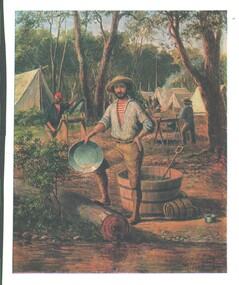 Bendigo Historical Society Inc.
Print - WES HARRY COLLECTION: 'I HAVE GOT IT ', 1854
... Painting, National Gallery of Victoria. He retired from this position at the end of 1881, and in 1882 departed for Europe. ...Painting, National Gallery of Victoria. He retired from this position at the end of 1881, and in 1882 departed for Europe. ..."I have got it" is the title of this painting created on the goldfienlds in Ballarat in 1854. Eugene von Guérard, painter and teacher, was born in November 1811 in Vienna. From 1826, he toured Italy with his artist father and between 1830 and 1832 resided in Rome. From around 1839 to 1844, he studied landscape painting at the Dusseldorf Academy, and travelled widely. In 1852, he moved to London, and in August that year decided to travel to Victoria, Australia to try his luck on the goldfields. He arrived at Geelong on 24 December 1852, and made many sketches of the mining districts around Ballarat until 1854. He moved to Melbourne, and in 1870 was appointed the first Master of the School of Painting, National Gallery of Victoria. He retired from this position at the end of 1881, and in 1882 departed for Europe. In 1891, he moved to London, and died in London on 17 April 1901. He is buried in Brompton Cemetery, Chelsea, England.Print of an oil painting by Eugene von Guerard called 'I have got it ', painted in 1854. It depicts a mining camp in the bush, there are several tents in the background and two men using windlasses, in front of these there is a digger posing with a gold dish with gold visible at the base of the dish. Behind him there is a wooden tub and bucket, with a spade resting in the tub. This painting is from a collection at the State Library of Victoria.Eugene von Guerardmining, i have got it, eugene von guerard
