
Showing 17 items matching "evangelism"
-
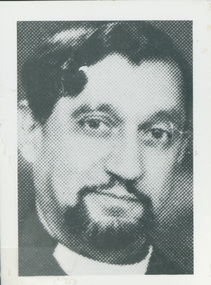 Uniting Church Archives - Synod of Victoria
BW photo, Undated
... Abel Hendriks, World Evangelism Centre, Wingello House, 1 Angel Place, Sydney 2000...Abel Hendriks, World Evangelism Centre, Wingello House, 1 Angel Place, Sydney 2000...Abel Hendriks; World Evangelism Rev. Abel Hendriks, World Evangelism Centre, Wingello House, 1 Angel Place, Sydney 2000 Full face photograph of Rev. ...Rev. Abel Hendriks, World Evangelism Centre, Wingello House, 1 Angel Place, Sydney 2000Full face photograph of Rev. Abel Hendriks, who is bearded.Rev. Abel Hendriks, World Evangelism Centre, Wingello House, 1 Angel Place, Sydney 2000rev. abel hendriks; world evangelism -
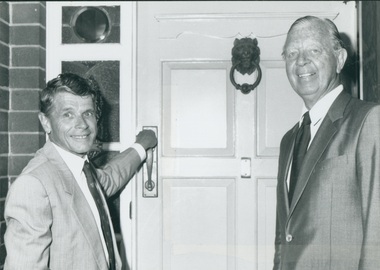 Uniting Church Archives - Synod of Victoria
Photograph
... Sir Ronald Wilson, President of the Uniting Church in Australia and Rev Sir Alan Walker at the official opening by Sir Ronald of the Pacific College for Evangelism in Sydney on 4 March 1989....Sir Ronald Wilson, President of the Uniting Church in Australia and Rev Sir Alan Walker at the official opening by Sir Ronald of the Pacific College for Evangelism in Sydney on 4 March 1989. Sir Ronald Wilson and Rev Sir Alan Walker Photograph ...Sir Ronald Wilson and Rev Sir Alan WalkerSir Ronald Wilson, President of the Uniting Church in Australia and Rev Sir Alan Walker at the official opening by Sir Ronald of the Pacific College for Evangelism in Sydney on 4 March 1989. -
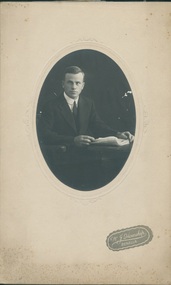 Uniting Church Archives - Synod of Victoria
Photograph, 1925
... ...Evangelism...Gibbs, H.J. Benalla Evangelism Methodist Matte, black and white, oval, studio portrait of Mr. ...Mr. Harry J. Gibbs was an evangelist.Matte, black and white, oval, studio portrait of Mr. Harry J. Gibbs on card.gibbs, h.j., benalla, evangelism, methodist -
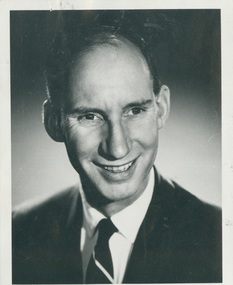 Uniting Church Archives - Synod of Victoria
BW photo, c.1975
... Reverend Norman Pell general secretary of the Victorian Baptist Union and known in CE and evangelical circles accepted an appointment as Director of in-depth evangelism with the Billy Graham Crusade....Reverend Norman Pell general secretary of the Victorian Baptist Union and known in CE and evangelical circles accepted an appointment as Director of in-depth evangelism with the Billy Graham Crusade. Rev. ...Reverend Norman Pell general secretary of the Victorian Baptist Union and known in CE and evangelical circles accepted an appointment as Director of in-depth evangelism with the Billy Graham Crusade.Head and shoulders portrait of Rev. Norman Pell wearing suit jacket and tie.Rev. Norman Pell, National Christian Endeavour Presidentrev. norman pell; victorian baptist union; billy graham crusade -
 Mission to Seafarers Victoria
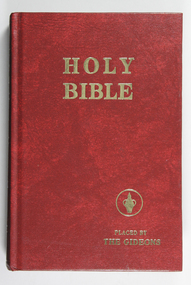
Book - Bible, Holy Bible - Placed by the Gideons
... The Gideons' primary activity is distributing copies of the Bible free of charge, to unite traveling salesmen for evangelism. The symbol of the Gideons is a two-handled pitcher and torch recalling Gideon's victory over the Midianites....The Gideons' primary activity is distributing copies of the Bible free of charge, to unite traveling salesmen for evangelism. The symbol of the Gideons is a two-handled pitcher and torch recalling Gideon's victory over the Midianites. bible, gideons Red hardcover book, gold embossed lettering Holy Bible - Placed by the Gideons Book Bible ...Red hardcover book, gold embossed letteringbible, gideons -
 Mission to Seafarers Victoria
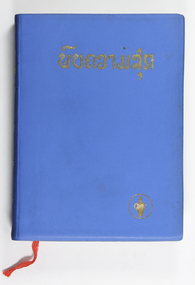
Book - Bible, Bible in Laotian
... The Gideons' primary activity is distributing copies of the Bible free of charge, to unite traveling salesmen for evangelism. The symbol of the Gideons is a two-handled pitcher and torch recalling Gideon's victory over the Midianites....The Gideons' primary activity is distributing copies of the Bible free of charge, to unite traveling salesmen for evangelism. The symbol of the Gideons is a two-handled pitcher and torch recalling Gideon's victory over the Midianites. bible prayers church Blue softcover book with fixed thin vinyl sleeve and gold text Bible in Laotian Book Bible ...Blue softcover book with fixed thin vinyl sleeve and gold textfictionbible, prayers, church -
 Mission to Seafarers Victoria
Booklet, Bible
... The Gideons' primary activity is distributing copies of the Bible free of charge, to unite traveling salesmen for evangelism. The symbol of the Gideons is a two-handled pitcher and torch recalling Gideon's victory over the Midianites....The Gideons' primary activity is distributing copies of the Bible free of charge, to unite traveling salesmen for evangelism. The symbol of the Gideons is a two-handled pitcher and torch recalling Gideon's victory over the Midianites. bible chinese mandarin welfare mission to seafarers seamen's mission Small blue paperback bible, blue card cover with gold text Bible Booklet ...Gideons International is an evangelical Christian association founded in 1899 in Wisconsin. The Gideons' primary activity is distributing copies of the Bible free of charge, to unite traveling salesmen for evangelism. The symbol of the Gideons is a two-handled pitcher and torch recalling Gideon's victory over the Midianites.Small blue paperback bible, blue card cover with gold text bible, chinese, mandarin, welfare, mission to seafarers, seamen's mission -
 Mission to Seafarers Victoria
Booklet - Pocket Size
... The Gideons' primary activity is distributing copies of the Bible free of charge, to unite traveling salesmen for evangelism. The symbol of the Gideons is a two-handled pitcher and torch recalling Gideon's victory over the Midianites....The Gideons' primary activity is distributing copies of the Bible free of charge, to unite traveling salesmen for evangelism. The symbol of the Gideons is a two-handled pitcher and torch recalling Gideon's victory over the Midianites. bible greek pocket size Small blue paperback bible, sheathed in a fixed thin vinyl sleeve Booklet Pocket Size ...Gideons International is an evangelical Christian association founded in 1899 in Wisconsin. The Gideons' primary activity is distributing copies of the Bible free of charge, to unite traveling salesmen for evangelism. The symbol of the Gideons is a two-handled pitcher and torch recalling Gideon's victory over the Midianites.Small blue paperback bible, sheathed in a fixed thin vinyl sleevebible, greek, pocket size -
 Uniting Church Archives - Synod of Victoria
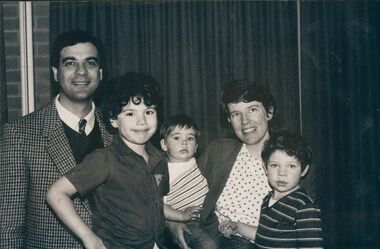
Photograph, Rev. John Canaris, 02/1988
... Originally from Qld, C&N records that he had been in Horsham for the past six years, and that he had had an "extensive ministry in mass evangelism". He later returned to Brisbane, Qld....Originally from Qld, C&N records that he had been in Horsham for the past six years, and that he had had an "extensive ministry in mass evangelism". He later returned to Brisbane, Qld. karen canaris, whittlesea John Canaris "John, Karen and the boys" B & W photograph of Rev. ...Rev. John Canaris is listed at appointed to Whittlesea in January 1988, but is not listed in the 2000 Assembly Directory. He was 37 when ordained in December 18 1987. Originally from Qld, C&N records that he had been in Horsham for the past six years, and that he had had an "extensive ministry in mass evangelism". He later returned to Brisbane, Qld.B & W photograph of Rev. John Canaris with his wife Karen and three sons."John, Karen and the boys"karen canaris, whittlesea, john canaris -
 Uniting Church Archives - Synod of Victoria
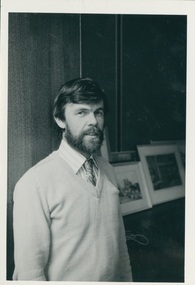
Photograph, c. 1977
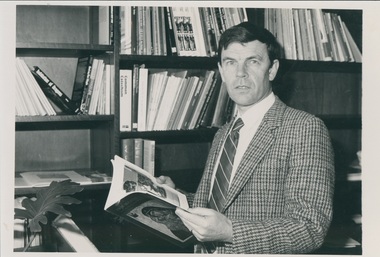
... B 1936 Glasgow arr in Australia 1950 Ordained 1963 First appointment Corryong 1963-1967; then went to New Town Tas 1967-1970; East Kew 1970-1976; Stated Clerk Presbyterian Assembly Of Victoria 1976-1977;Assoc Sec Synod of Victoria 1977-1980; Evangelism Officer Div Field services Synod of Vic 1981-02/87; Interim Exec Sec Field services 03/87-01/89; Presbytery Officer Western Port Presbytery 02/89- 06/95, Executive Secretary VCC 07/95...B 1936 Glasgow arr in Australia 1950 Ordained 1963 First appointment Corryong 1963-1967; then went to New Town Tas 1967-1970; East Kew 1970-1976; Stated Clerk Presbyterian Assembly Of Victoria 1976-1977;Assoc Sec Synod of Victoria 1977-1980; Evangelism Officer Div Field services Synod of Vic 1981-02/87; Interim Exec Sec Field services 03/87-01/89; Presbytery Officer Western Port Presbytery 02/89- 06/95, Executive Secretary VCC 07/95 christie-johnston, hamish; synod of victoria; western port presbytery; presbyterian minister; uniting church minister; east kew presbyterian/uniting church; stated clerk presbyterian assembly victoria B&W gloss waist length photograph of the Rev. ...B 1936 Glasgow arr in Australia 1950 Ordained 1963 First appointment Corryong 1963-1967; then went to New Town Tas 1967-1970; East Kew 1970-1976; Stated Clerk Presbyterian Assembly Of Victoria 1976-1977;Assoc Sec Synod of Victoria 1977-1980; Evangelism Officer Div Field services Synod of Vic 1981-02/87; Interim Exec Sec Field services 03/87-01/89; Presbytery Officer Western Port Presbytery 02/89- 06/95, Executive Secretary VCC 07/95B&W gloss waist length photograph of the Rev. Hamish Christie-Johnston, wearing a jumper and tie. christie-johnston, hamish; synod of victoria; western port presbytery; presbyterian minister; uniting church minister; east kew presbyterian/uniting church; stated clerk presbyterian assembly victoria -
 Uniting Church Archives - Synod of Victoria
Photograph, c. 1970s
... B 1936 Glasgow arr in Australia 1950 Ordained 1963 First appointment Corryong 1963-1967; then went to New Town Tas 1967-1970; East Kew 1970-1976; Stated Clerk Presbyterian Assembly Of Victoria 1976-1977;Assoc Sec Synod of Victoria 1977-1980; Evangelism Officer Div Field services Synod of Vic 1981-02/87; Interim Exec Sec Field services 03/87-01/89; Presbytery Officer Western Port Presbytery 02/89- 06/95, Executive Secretary VCC 07/95...B 1936 Glasgow arr in Australia 1950 Ordained 1963 First appointment Corryong 1963-1967; then went to New Town Tas 1967-1970; East Kew 1970-1976; Stated Clerk Presbyterian Assembly Of Victoria 1976-1977;Assoc Sec Synod of Victoria 1977-1980; Evangelism Officer Div Field services Synod of Vic 1981-02/87; Interim Exec Sec Field services 03/87-01/89; Presbytery Officer Western Port Presbytery 02/89- 06/95, Executive Secretary VCC 07/95 christie-johnston, hamish; synod of victoria; western port presbytery; presbyterian minister; uniting church minister; east kew presbyterian/uniting church; stated clerk presbyterian assembly victoria B & W waist length photograph of Rev. ...B 1936 Glasgow arr in Australia 1950 Ordained 1963 First appointment Corryong 1963-1967; then went to New Town Tas 1967-1970; East Kew 1970-1976; Stated Clerk Presbyterian Assembly Of Victoria 1976-1977;Assoc Sec Synod of Victoria 1977-1980; Evangelism Officer Div Field services Synod of Vic 1981-02/87; Interim Exec Sec Field services 03/87-01/89; Presbytery Officer Western Port Presbytery 02/89- 06/95, Executive Secretary VCC 07/95B & W waist length photograph of Rev. Hamish Christie-Johnston seated at a desk, holding an open book. christie-johnston, hamish; synod of victoria; western port presbytery; presbyterian minister; uniting church minister; east kew presbyterian/uniting church; stated clerk presbyterian assembly victoria -
 City of Moorabbin Historical Society (Operating the Box Cottage Museum)
Badge - Jubilee of the Wesleyan Methodist Church Medal, 1886
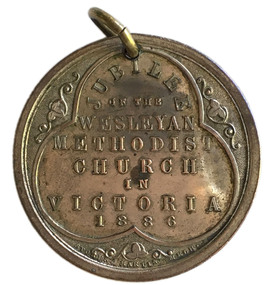
... Methodism stressed evangelism and a closer association with God. ...Methodism stressed evangelism and a closer association with God. ...In 1886 the Wesleyan Methodist Church celebrated the fiftieth jubilee of the establishment of the Wesleyan Methodist Association in Britain. The Association was one of several off-shoots of the Methodist Church, which had been established by John Wesley from the 1730s. Methodism stressed evangelism and a closer association with God. The focus on fiftieth anniversaries by the church originated in Leviticus 25:10: ‘And ye shall hallow the fiftieth year, and proclaim liberty throughout all the land unto all the inhabitants thereof: it shall be a jubilee unto you...’. In 1902 the various off-shoots of Methodism in Australia united to form the Methodist Church of Australasia. In 1977 the church became part of the Uniting Church. The Wesleyan Methodist Church which exists in Australia today is actually a branch of the Wesleyan Methodist Church of America, introduced to Australia during World War II. In 2003 it had almost 100 churches in Australia.Many of the early pioneers in the City of Moorabbin were Methodists.Silver Medal Side one: legend within trefoil; JUBILEE / OF THE / WESLEYAN / METHODIST / CHURCH / IN / VICTORIA / 1886 small floral decorations at each point of trefoil. Side two: Bust of John Wesleycity of moorabbin, wesleyan methodist church, religion, jubilee -
 Flagstaff Hill Maritime Museum and Village
Literary work - Book, G. Sidney, Book of sermons by The Right Reverend Beilby Porteus Vol 2. Additional notes on authors life by Rev. Robert Hodgson, A.M.F.R.S, 1811 Published
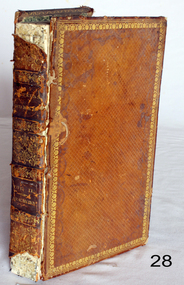
... He was, however, happy to work with Methodists and dissenters and recognised their major contributions in evangelism and education. In 1776, Porteus was nominated as Bishop of Chester, taking up the appointment in 1777. ...He was, however, happy to work with Methodists and dissenters and recognised their major contributions in evangelism and education. In 1776, Porteus was nominated as Bishop of Chester, taking up the appointment in 1777. ...Rev Robert Hodgson: His father was Robert Hodgson Snr, of Congleton, and Mildred (née Porteus) in early 1773. He was baptised on 22 September 1773 at St Peter's Church, Congleton. Hodgson was a close relative (by marriage on his father's side and by blood on his mother's side) of Beilby Porteus, Bishop of London of whom Hodgson wrote a biography of Porteus. On his mother's side, he was a descendant of Augustine Warner Jnr., who presided as the Speaker of the Virginia House of Burgesses during the time of Bacon's Rebellion (Warner served before the Rebellion in 1676, and after the Rebellion in 1677.) Hodgson was educated at Macclesfield School and Peterhouse, Cambridge, where he graduated with a BA as 14th Wrangler in 1795. He was appointed rector of St George's, Hanover Square for over forty years, from 1803 until his death in 1844. Bishop Beilby Porteus: Beilby Porteus 8 May 1731 – 13 May 1809), successively Bishop of Chester and London was a Church of England reformer and a leading abolitionist in England. He was the first Anglican in a position of authority to seriously challenge the Church's position on slavery. Porteus was born in York on 8 May 1731, the youngest of the 19 children of Elizabeth Jennings and Robert Porteus ( 1758/9), a planter. Although the family was of Scottish ancestry, his parents were Virginian planters who had returned to England in 1720 as a result of the economic difficulties in the province and for the sake of his father's health. Educated at York and Ripon Grammar School, he was a classics scholar at Christ's College, Cambridge, becoming a fellow in 1752. In 1759 he won the Seatonian Prize for his poem Death: A Poetical Essay, a work for which he is still remembered. He was ordained as a priest in 1757, and in 1762 was appointed as domestic chaplain to Thomas Secker, Archbishop of Canterbury, acting as his assistant at Lambeth Palace for six years. It was during these years that it is thought he became more aware of the conditions of the enslaved Africans in the American colonies and the British West Indies. He corresponded with clergy and missionaries, receiving reports on the appalling conditions facing the slaves from Rev James Ramsay in the West Indies and from Granville Sharp, the English lawyer who had supported the cases of freed slaves in England. In 1769 Beilby Porteus was appointed as chaplain to King George III. He was also Rector of Lambeth (a living shared between the Archbishop of Canterbury and the Crown) from 1767 to 1777, and later Master of St Cross, Winchester (1776–77). He was concerned about trends within the Church of England towards what he regarded as the watering-down of the truth of Scripture and stood for doctrinal purity. He was, however, happy to work with Methodists and dissenters and recognised their major contributions in evangelism and education. In 1776, Porteus was nominated as Bishop of Chester, taking up the appointment in 1777. He was Renowned as a scholar and a popular preacher, it was in 1783 that the young bishop was to first come to national attention by preaching his most famous and influential sermon. In 1787, Porteus was translated to the bishopric of London on the advice of Prime Minister William Pitt, a position he held until his death in 1809. As is customary, he was also appointed to the Privy Council, and Dean of the Chapel Royal. In 1788, he supported Sir William Dolben's Slave Trade Bill from the bench of bishops, and over the next quarter-century, he became the leading advocate within the Church of England for the abolition of slavery, lending support to such men as Wilberforce, Granville Sharp, Henry Thornton, and Zachary Macaulay to secure the eventual passage of the Slave Trade Act in 1807.Beilby Porteus was one of the most significant, albeit under-rated church figures of the 18th century. His sermons continued to be read by many, and his legacy as a foremost abolitionist was such that his name was almost as well known in the early 19th century as those of Wilberforce and Thomas Clarkson but 100 years later he had become one of the 'forgotten abolitionists', and today his role has largely been ignored and his name has been consigned to the footnotes of history. His primary claim to fame in the 21st century is for his poem on Death and, possibly unfairly, as the supposed prototype for the pompous Mr. Collins in Jane Austen's novel ”Pride and Prejudice”. But, ironically, Porteus' most lasting contribution was one for which he is little-known, the Sunday Observance Act of 1781 (a response to what he saw as the moral decay of England), which legislated how the public were allowed to spend their recreation time at weekends these laws continued for the following 200 years until the passing of the Sunday Trading Act of 1994.Book of sermons cover is brown with gold border and decoration Beilby Porteus (or Porteous; 8 May 1731 – 13 May 1809), successively Bishop of Chester and of London, was a Church of England reformer and a leading abolitionist in England. He was the first Anglican in a position of authority to seriously challenge the Church's position on slavery. The Works of The Right Reverend Beilby Porteus Vol 2” . Spine has “Porteus’ Works, Vol. II Sermons”. The works of the Right Reverend Beilby Porteus, D.D., late Bishop of London; with his life, by the Rev. Robert Hodgson, A.M.F.R.S. and one of the Chaplains in Ordinary to His Majesty. A New Edition in Six Volumes. Vol. II – Sermons. Published in 1811 for T. Cadell and W., Davies, in The Strand, London. Printed by G. Sidney, Northumberland-street. flagstaff hill, warrnambool, shipwrecked coast, flagstaff hill maritime museum, maritime museum, shipwreck coast, flagstaff hill maritime village, great ocean road, right reverend beilby porteous, sermons, london reverend -
 Uniting Church Archives - Synod of Victoria
BW photo, Undated
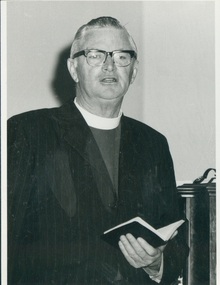
... All his energies were thrown into the task of building up its members in personal holiness and vigorous evangelism. Stanway was ordained in St Paul's Cathedral, Melbourne on St Thomas Day 1934 and was placed in charge of the Old Mission Church of St James and St John, Melbourne. ...All his energies were thrown into the task of building up its members in personal holiness and vigorous evangelism. Stanway was ordained in St Paul's Cathedral, Melbourne on St Thomas Day 1934 and was placed in charge of the Old Mission Church of St James and St John, Melbourne. ...STANWAY, ALFRED (b. 9 Sept 1908; d. Melbourne, Vic, 27 June 1989). Anglican bishop, missionary. Stanway grew up in the Wimmera district of western Victoria, and left school when 14 years old. He found work in Melbourne, trained as an accountant, and at the age of 20, held a responsible position with a publishing company. This background, allied with an uncommon flair for figures and finance, was to stand him in good stead throughout his life. But he had little knowledge and no experience of the grace of God until 29 July 1928. At the Evening Service in the parish church of Fairfield on 29 July, he heard the Rev C H Nash (q.v.) preach a sermon which led to his conversion. Within two years he made up his mind to become a missionary and began night studies in order to matriculate. He entered Ridley College in March 1932 to prepare for ordination undertaking week-end duties as a catechist at Deer Park and St Albans. He joined the CMS League of Youth, became chairman, and gathered a fine band of young people many of whom were to become missionaries. He was closely involved with the Belgrave Heights Convention (then at Upwey) and established a League of Youth camp on the site. All his energies were thrown into the task of building up its members in personal holiness and vigorous evangelism. Stanway was ordained in St Paul's Cathedral, Melbourne on St Thomas Day 1934 and was placed in charge of the Old Mission Church of St James and St John, Melbourne. The duties were light enough to allow him to enrol in the Melbourne Teachers College and to complete the Diploma in Teaching. On 26 January 1937, he sailed for Africa to become a missionary in the Anglican Diocese of Mombasa, which at that time embraced the whole of Kenya. He was sent to the hot coastal town of Kaloleni as principal of a Secondary Boys School. Before he left Melbourne, he had become engaged to Marjory Harrison: she followed him to Africa and their marriage took place in Mombasa Cathedral in June 1939. He remained at Kaloleni until 1944 when he was transferred to the inland station of Maseno where all his gifts were to be deployed as rural dean of Nyanza. His oversight of some 500 village churches as well as a widespread primary school system was so efficient that in 1948 he was appointed archdeacon of Kenya with his home and office in Nairobi. As secretary of the African Church Council and of the African Education Board, he was responsible for all African work in the diocese. His contacts with government ministers and public servants were of first class significance at the time when the cry of Uhuru and the demand for independence was travelling throughout the colonial world. On 2 Feb 1951, Alfred Stanway was consecrated in Westminster Abbey as the third Anglican Bp of Central Tanganyika. This Diocese was the special sphere of the CMS Australia, and he already knew most of the missionary personnel. He brought with him the understanding and experience of one who had fully shared the lot and problems of a district missionary, but he came to the diocese at a time when it had yet to recover from its losses in personnel and finance as a result of the war. His immediate task was to provide the impetus of fresh leadership and a long-term overall policy. His aim from-the outset was to build up a strong autonomous church with its own indigenous pastorate. With the whole-hearted confidence of the home base, he was able to enlist the service of new missionaries. He saw a great increase in the number of African clergy and he encouraged village evangelists to open new fields of work. Simple structures were built as new churches at the rate of two a week, week in and week out, year by year. He worked hard to meet the need for Christian literature, bookshops, adult literacy and theological training. He opened Bible schools for village evangelists and sent suitable clergy overseas for further studies. He encouraged initiative in others, helped them to find and use their talents, and gave them his unstinted confidence and support. Fresh finance was required for new ventures. This led him to travel widely in Germany and America, where he raised large funds for these projects. Mackay House was built in Dodoma as the central administrative base for the diocese, hospitals such as those at Mvumi and Hombolo were modernised or established, schools were built and upgraded. In keeping with his vision for ultimate leadership by African personnel, he consecrated Yohana Omari in 1955 as his assistant, he was the first national to become a bp in East Africa. Bp Stanway then set on foot the long and complicated process for the division of his sprawling diocese. In 1963, the diocese of Victoria Nyanza came into being; in 1965, that of Morogoro; in 1966, that of Western Tanganyika. Yet in 1971, his own diocese of Central Tanganyika, though greatly reduced in size, had more churches and more clergy than in its undivided state in 195 l. Stanway then played a leading part in the formation of the Province of Tanzania in 1970, with an African abp as metropolitan. A year later, after 35 years in East Africa and 20 years as bishop of Central Tanganyika, he resigned. His leadership and achievements throughout those years had placed him in the front rank as a great missionary statesman. Stanway had returned to Melbourne at the time when his resignation took effect in August 1971. His early love for Ridley College reasserted itself and he went into residence as deputy principal under the Rev Dr Leon Morris. He was put in charge of chapel worship and the pastoral oversight of the students. All his gifts and experience were called into play as he sought to guide and encourage those who were on the threshold of their ministry. The whole bent of his heart was to foster the spiritual life and missionary calling of those whose hearts the Lord had touched. It was during those years that his life-long zeal for the spread of the gospel through Christian literature had its ultimate flowering. It had begun in his Nairobi days with a small church bookstall, this had developed into a major book-shop in the heart of the city. Then in Dodoma he had established the Central Tanganyika Press in order to promote the publication and distribution of Christian literature at all levels. He had marked out Kevin Engel, trained him, and launched him on the international scene. Hence it was natural that in Melbourne he and Kevin Engel should found the Australian Christian Literature Society. But his time at Ridley College was not to last. Unknown to him, the Rev J R W Stott had put his name forward as that of a person who could head a new school of theology in the United States to provide a sound training for evangelical ordinands. Such a task would have been formidable enough for a younger man who had grown up in America. How could an Australian who had spent half his life in Africa hope to succeed in a venture of that kind in America? How could one who had been a missionary, not a theologian, found a new school to train men for ordination? Nevertheless he rose to the challenge. In Sept 1975, he and Mrs Stanway left Melbourne for Sewickly, an outer suburb of Pittsburg, with the promise of three years' service. He had to start from scratch. He found a house to live in, but there was no land for the school, no funds in hand, no staff yet appointed, no students, and no buildings. His drive, his infections enthusiasm, and his flair for practical enterprise carried the day. One by one, obstacles were overcome and support grew in volume and strength. Twelve months after his arrival, in Sept 1976, the Trinity Episcopal School for Ministry was opened with three staff members, seventeen students, and the goodwill of the whole American Episcopal Church to win. During the next two years, the school took shape and was firmly established. Bp Stanway left an indelible stamp on every aspect of its life and work, its spiritual tone and ideals, its financial and administrative principles. He had inspired widespread support among evangelical episcopalians and had imparted a strong sense of divine guidance and purpose. The council would gladly have extended his term in office beyond three years, but at 75 years of age he knew that his health had begun to fail. When he finally relinquished his office in Nov 1978, he could look back on those three years as the crown of his ministry. It is not too much to say that his name was even more highly honoured and revered in the Trinity School of Ministry than in his own dearly loved Africa. His return to Melbourne led to quiet retirement at Mount Waverley where he settled down to a long battle with the ever worsening effects of Parkinson's Disease. The slow loss of physical capacity and the ultimate failure in powers of speech were a great trial, but he never complained. His faith was summed up in his brief reply when he was asked why he had not prayed for healing: 'What God allows, I accept'. That acceptance was without reserve; his testimony was never brighter. His mental powers were undiminished and his spiritual concerns were as wide as ever. He kept in touch with CMS, he went to church, he met with missionaries, he led Bible studies in his home as long as he was able. Africa was always in his heart, news from Sewickly always gave him great pleasure. He had left a mark for God on three great continents and his death left sad but thankful hearts in them all. It was the close of a life in which he had felt that he could never do enough for God who had done so much for him. One of Bp Stanway's sayings was 'when the Holy Spirit takes hold of you, anything can happen'. So it was in his case. He was very human, with his full share of human foibles and frailties. He had a great zest for life and an endless fund of stories drawn from his own experience. He was himself the subject of many stories, some true, others legendary. His vibrant personality always seemed to fill the house where he was, his presence could not be overlooked. His own home was one in which Mrs Stanway had a paramount influence. She was a trained teacher, a skilled artist, a born hostess and a first-class linguist. They had no children of their own, but were devoted Godparents and always deeply interested in the children of missionaries. Home life allowed him to relax in a serene and contented atmosphere and to exercise his gifts for friendship and hospitality. He was always on the watch for souls, a person-to-person evangelist par excellence. He was a man of faith and prayer who dared to believe in the God of the impossible. His love for Africa, his total dedication as a missionary; his gifts as a soulwinner; his genius for finance; his shrewd practical initiatives, and his statesmanlike vision were outstanding characteristics. But great or small, all his gifts were laid out in the service of the gospel, and that service marked him out as one of the most remarkable Australian missionaries of his generation. M L Loane, Men to Remember (Sydney, 1987) Rev. Alfred Stanway is standing with open book in hand, dressed in clerical garb.Bishop Alfred Stanwaybishop alfred stanway -
 Merbein District Historical Society
Document, The Evangel Church Paper of St. John's Merbein, Jun.1960
... The Evangel Church Paper of St. John's Merbein...The Evangel Church Paper of St. John's Merbein Document ... -
Unions Ballarat
From growth via despair to optimism, 2002
... Includes an essay that relates to Ballarat history: Ballarat and Federation, the evangel and social concerns. BTLC ballarat trades and labour council; ballarat trades hall Religion Victorian Baptist Historical Society social history social customs Front cover: title and description. ...The book is a series of essays about the history of religion within societies - particularly Baptism - in Victoria.Includes an essay that relates to Ballarat history: Ballarat and Federation, the evangel and social concerns.Paperback; green and black background cover; yellow and brown lettering; colour picture of Reverend Joseph Hunter Goble; black and white photos; 152 pages.Front cover: title and description. Spine: title and publishing organisation's name. Back: review.btlc, ballarat trades and labour council;, ballarat trades hall, religion, victorian baptist historical society, social history, social customs -
Linton Mechanics Institute and Free Library Collection
Book - Memoir, Haslam, Rev. W, Yet not I, [n.d.] [c.1882?]
... The author was strongly influenced by Methodist revivalism/evangelism. 283 p. : dark blue cover, embossed in gold and black with decorative design. ...A sequel to a previous memoir, "From death into life". Documents the author's religious experience and spiritual journey, and the years of his Church of England ministry. The author was strongly influenced by Methodist revivalism/evangelism.283 p. : dark blue cover, embossed in gold and black with decorative design. Title and author's name in gold on front cover, title only on spine. Title page missing, title and publication details for catalogue record taken from cover.non-fictionA sequel to a previous memoir, "From death into life". Documents the author's religious experience and spiritual journey, and the years of his Church of England ministry. The author was strongly influenced by Methodist revivalism/evangelism.religion, rev. w. haslam
