
Showing 56 items matching "evening cape"
-
 Bendigo Historical Society Inc.
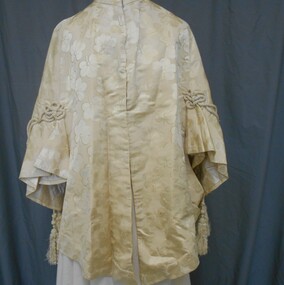
Clothing - CREAM SILK EVENING CAPE (RELATED TO 11400.842), Evening Cape
... CREAM SILK EVENING CAPE (RELATED TO 11400.842)...Evening Cape......cream silk evening cape...COSTUME Female cream silk evening cape A card with the cape is hand written - ''For Historical Soc.if wanted, From M.Bush's Collection. ...Cream silk, woven in a jacquard style, featuring a floral design. Fully lined with cream silk satin. A 4cm deep, stand-up mandarin style collar. Eight metal hook and eyes fasten the front in a concealed way. Heavy cording, finished with pearl trimmed tassels,a double inverted pleat, 22cm long at the centre back hemline. Three darts at shoulders giving a 'sleeve-like' shape. Lower edges of which are elaborately corded. A 12cm'slit' at the lower edge seam with the front panel gives more flexibilty to the wearer. Tassel head and decorative 1.5cm ''ball'' are woven in a ''turks head'' style. A 2.5cm wide silk ribbon, attached at centre back, and possibly tied around the waist.A card with the cape is hand written - ''For Historical Soc.if wanted, From M.Bush's Collection. Could have been from Mrs. Mueller's. Gift from Mrs. E.G.JARRETT''costume, female, cream silk evening cape -
 Bendigo Historical Society Inc.
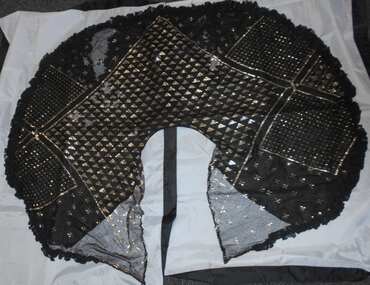
Textile - Black and gold patterned evening cape, 1850s
... Black and gold patterned evening cape......Evening cape...Jane Thornton Collection: Woman's evening cape c.1850s. Black and gold cape with lace trim lined with black silk....Jane died on 18 April 1884. Evening wear Evening cape Jane Thornton Collection: Woman's evening cape c.1850s. ...Jane Thornton married William Dixon in Northumberland in the 1850s. William Dixon was a pitman who was recruited in England to manage a mine at Eaglehawk. He arrived in about 1857 without his family. His wife Jane and three children arrived on the "Great Britain" in 1863. Two more children were born at Eaglehawk. William died on 28 March 1876. Jane died on 18 April 1884.Jane Thornton Collection: Woman's evening cape c.1850s. Black and gold cape with lace trim lined with black silk.evening wear, evening cape -
 Bendigo Historical Society Inc.
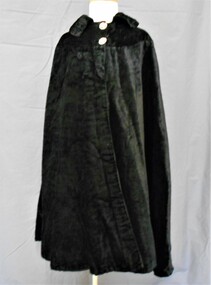
Clothing - MAGGIE BARBER COLLECTION: 3/4 LENGTH BLACK VELVET EVENING CAPE, Early 1900's
... MAGGIE BARBER COLLECTION: 3/4 LENGTH BLACK VELVET EVENING CAPE...3/4 length black velvet evening cape...Clothing MAGGIE BARBER COLLECTION: 3/4 LENGTH BLACK VELVET EVENING CAPE ...Clothing. Black, crushed velvet cape with a slightly peaked turn back collar, featuring a 6 cm wide ruched panel at each side front collar. Two circular diamente buttons 2.50 cm diameter fasten the front of the circular 15 cm deep yoke. Two bound button holes fasten the buttons at the throat.costume, female, 3/4 length black velvet evening cape -
 Kew Historical Society Inc
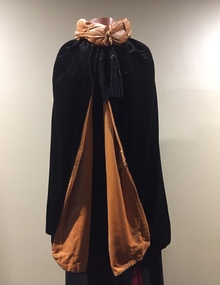
Clothing - Reversible Black Velvet and Apricot Silk Evening Cape, 1920s
... Reversible Black Velvet and Apricot Silk Evening Cape...Reversible black velvet and apricot silk evening cape with black tassels. The rolled collar is typical of the 1920s....Clothing Reversible Black Velvet and Apricot Silk Evening Cape ....The Fashion & Design collection of the Kew Historical Society includes examples of women’s, men’s, children’s and infants’ clothing from the 18th, 19th and 20th centuries. Items in the collection were largely produced for, or purchased by women in Melbourne, and includes examples of outerwear, protective wear, nightwear, underwear and costume accessories. This cape is one of a number of items donated to the Fashion Collection by Dione McIntyre. The cape was owned by her mother Lillian Cohen.The McIntyre Collection of clothing and clothing accessories forms one of the largest single donations to our Fashion & Design collection. It includes clothing and clothing accessories worn by four women in the Cohen and McIntyre families across three generations. The items worn by Melbourne architect, and Kew resident, Dione McIntyre date from the 1960s and 1970s, and include evening wear, day wear, hats and shoes. As Dione McIntyre often accompanied her husband, fellow architect Peter McIntyre, to formal events, there are a number of pieces of evening wear among the items. The McIntyre Collection also includes items worn by women of an earlier generation: by Lilian Cohen, Dione McIntyre's mother, and by her mother-in-law, the wife of the architect Robert McIntyre. At the other end of the chronological spectrum are a number of outfits belonging to, worn and donated by Annie McIntyre. These include outfits created by notable late 20th century Australian and/or international fashion designers. The McIntyre Collection is significant historically and artistically as it includes examples of design that demonstrate changing tastes in fashion over an 80-year period. The collection is also significant in that it includes the work of a large number of Melbourne designers from the 1960s to the 1990s. Reversible black velvet and apricot silk evening cape with black tassels. The rolled collar is typical of the 1920s.women's clothing, evening wear, capes, australian fashion - 1920s, lillian cohen, mcintyre collection -
 Kew Historical Society Inc
Clothing - Royal Blue Crushed Velvet Evening Cape, 1940s
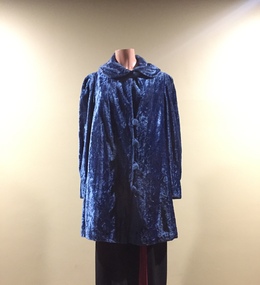
... Royal Blue Crushed Velvet Evening Cape...Royal blue crushed velvet hip length evening cape held at the front with large buttons of the same fabric and colour. ...The top has a wide rounded collar Clothing Royal Blue Crushed Velvet Evening Cape ...The Fashion & Design collection of the Kew Historical Society includes examples of women’s, men’s, children’s and infants’ clothing from the 18th, 19th and 20th centuries. Items in the collection were largely produced for, or purchased by women in Melbourne, and includes examples of outerwear, protective wear, nightwear, underwear and costume accessories.Royal blue crushed velvet hip length evening cape held at the front with large buttons of the same fabric and colour. The top has a wide rounded collarcapes, women's clothing, outerwear, evening wear -
 City of Moorabbin Historical Society (Operating the Box Cottage Museum)
Clothing, Lady's black evening shoulder cape, c1910
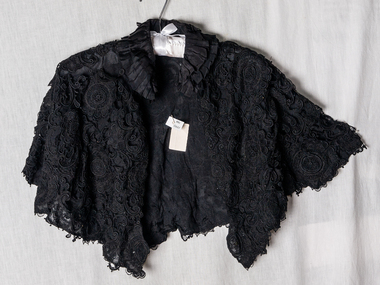
... Clothing, Lady's black evening shoulder cape...A lady's evening shoulder cape made of black Guipure lace,satin and voile ...The women of the early settler families in Moorabbin Shire were accomplished dressmakers, craftworkers and made the clothing for their families A typical evening shoulder cape worn by early settler women in Moorabbin Shire c1910 The family of Nance Blackburn were pioneer market gardeners. blackburn nance, pioneers, market gardeners, early settlers, moorabbin shire, bentleigh, cheltenham, moorabbin, dressmaking, clothing, A lady's evening shoulder cape made of black Guipure lace,satin and voile Clothing, Lady's black evening shoulder cape Family of Nance Blackburn ...The women of the early settler families in Moorabbin Shire were accomplished dressmakers, craftworkers and made the clothing for their familiesA typical evening shoulder cape worn by early settler women in Moorabbin Shire c1910 The family of Nance Blackburn were pioneer market gardeners.A lady's evening shoulder cape made of black Guipure lace,satin and voile blackburn nance, pioneers, market gardeners, early settlers, moorabbin shire, bentleigh, cheltenham, moorabbin, dressmaking, clothing, -
 Brighton Historical Society
Cape, Evening cape, 1974
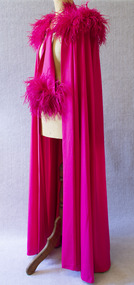
... Evening cape...It's been a pleasure to dress people, to make them look good and feel pleased with themselves." pearl's boutique pearl's of brighton paula folks 1970s Full-length bright pink rayon jersey cape with pink ostrich feathers around the collar. Evening cape Cape Van Roth ...This cape was worn in a pre-racing season fashion parade held in October 1974 by Pearl's Boutique, a well-known fashion boutique that operated in Brighton from 1965 until 2005. Paula Folks, the store's manager at the time, recalled that this parade had been loosely red, white and blue themed in honour of Princess Anne's wedding to Mark Phillips, which took place on 14 November of that year. The parade was likely held at Tudor Court in Caulfield, a popular reception venue. Pearl's Boutique was established by Elsebe Wilhelmine Wills and Pearl Murray in 1965. The two friends had grown up together in Horsham, and decided to go into business together after reading in Fashionweek that women in their thirties, forties, fifties and older had trouble finding young-looking styles. Setting out to fill this gap in the market, they established a store at 240 St Kilda Street, near the Brighton Yacht Club, with Elsebe handled the buying while Pearl fronted the shop. They moved to 40 Church Street, Brighton in 1967. Paula Folks joined the business as a manager in 1968, became a partner in 1971 and took over from the original owners in 1988. When she closed the boutique in 2005, she donated a number of garments to Brighton Historical Society. Reflecting fondly on her 38 years at Pearls, she told The Age, "I have enjoyed all my days here because people are special to me. I love fashion. It's been a pleasure to dress people, to make them look good and feel pleased with themselves."Full-length bright pink rayon jersey cape with pink ostrich feathers around the collar.pearl's boutique, pearl's of brighton, paula folks, 1970s -
 Whitehorse Historical Society Inc.
Clothing - Evening cape, C 1890's
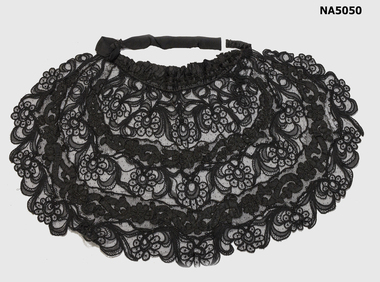
... Evening cape...Clothing Evening cape ...UnknownRare survivor of 1890's fashion Female black lace cape. Guipure - small collar fastened with black grosgrain silk ribbon with bow - 2 beaded flower motif.female evening and/of morning wear -
 Kew Historical Society Inc
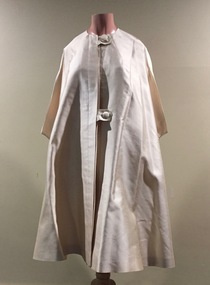
Clothing - Cream Silk Evening Cape, House of Youth, 1960s
... Cream Silk Evening Cape...Clothing Cream Silk Evening Cape House of Youth House of Youth ...THE HOUSE OF YOUTH label was founded c.1935) by Mr. Samuel Stein. By 1955 Mrs. Stein, his son, Philip, and his daughter, Elizabeth, all played an active part in the business. The connection with Dior came to them without seeking. Dior, that man of fashion genius, had come to the conclusion that the Australian market offered a scope he could not afford to ignore. He questioned many visitors to Paris and decided that the House of Youth was the obvious channel through which his designs should flow to the Australian woman. Completely versatile, this firm is capable of covering every phase of fashion production, from impeccably tailored suits and coats to softly draped, intricately cut dresses and evening gowns. Mr. Philip Stein was modest when asked what Dior thought of their copies, but confessed that Dior, had been "very flattering". Dior had-been greatly impressed with the standard of Australian craftsmanship, and, as a result of the success of this joint Parisian-Australian fashion venture, it is whispered that the great man himself is seriously contemplating a visit to Australia. (Source: The Argus 22 Feb 1955)The Fashion & Design collection of the Kew Historical Society includes examples of women’s, men’s, children’s and infants’ clothing from the 18th, 19th and 20th centuries. Items in the collection were largely produced for, or purchased by women in Melbourne, and includes examples of outerwear, protective wear, nightwear, underwear and costume accessories.Three quarter length flared cream coloured silk cape caught at the neck and waist with two large buttons covered with the same coloured fabric.Label: House of Youthwomen's clothing, house of youth, evening coats, australian fashion - 1960s -
 Kew Historical Society Inc
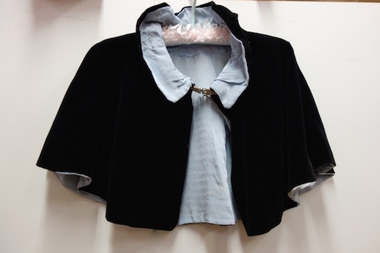
Clothing - Black velvet evening cape with blue silk lining, c. 1907
... Black velvet evening cape with blue silk lining...Clothing Black velvet evening cape with blue silk lining ...The Fashion & Design collection of the Kew Historical Society includes examples of women’s, men’s, children’s and infants’ clothing from the 18th, 19th and 20th centuries. Items in the collection were largely produced for, or purchased by women in Melbourne, and includes examples of outerwear, protective wear, nightwear, underwear and costume accessories.Black velvet capelet with pale blue lining held at the neck with a gilt metal clasp.women's clothing, fashion -- 1900s, evening wear, outerwear, capelets, fashion design -
 Kew Historical Society Inc
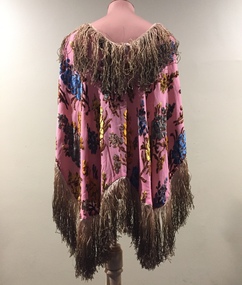
Clothing - Fringed Cut Velvet & Chenille Evening Cape, 1890s
... Fringed Cut Velvet & Chenille Evening Cape...Clothing Fringed Cut Velvet & Chenille Evening Cape ...The Fashion & Design collection of Kew Historical Society includes examples of women’s, men’s, children’s and infants' clothing from the 18th, 19th and 20th centuries. While the collection includes some examples of international fashion, most items were handmade or purchased in Melbourne. Cut velvet pelerine featuring multicoloured garlands of flowers in shades of gold, brown and blue on a pink ground. Chenille trim and long silk fringe, Centre front hook and eye closure, Lined with pale pink silk.women's clothing, outerwear -- capes, fashion -- 1890s, fashion design -
 Flagstaff Hill Maritime Museum and Village
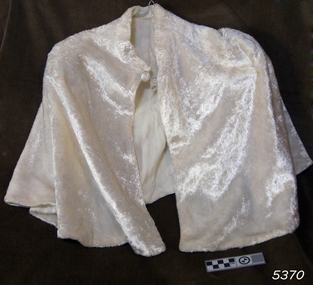
Cape
... White velvet evening cape. Circa 1920...flagstaff hill warrnambool shipwrecked-coast flagstaff-hill flagstaff-hill-maritime-museum maritime-museum shipwreck-coast flagstaff-hill-maritime-village White velvet evening cape. Circa 1920 Cape ...White velvet evening cape. Circa 1920flagstaff hill, warrnambool, shipwrecked-coast, flagstaff-hill, flagstaff-hill-maritime-museum, maritime-museum, shipwreck-coast, flagstaff-hill-maritime-village -
 Port Fairy Historical Society Museum and Archives
Clothing - Cape, c.1920
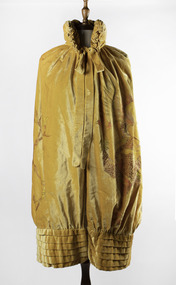
... Gold velvet evening cape with ruched collar and pleated basque handpainted dragon, flora outlined in gold thread with silk lining...not recorded A beautiful example of feminine apparel from the art deco period costume female art deco Gold velvet evening cape with ruched collar and pleated basque handpainted dragon, flora outlined in gold thread with silk lining Clothing Cape ...not recordedA beautiful example of feminine apparel from the art deco periodGold velvet evening cape with ruched collar and pleated basque handpainted dragon, flora outlined in gold thread with silk liningcostume, female, art deco -
 Stawell Historical Society Inc
Clothing - Costume and Accessories, 1949
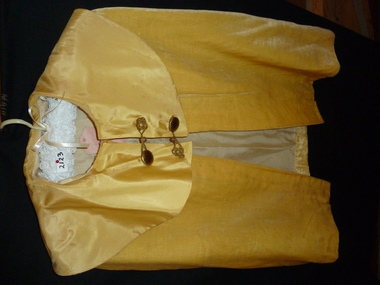
... Yellow Velvet Evening Cape with Taffeta Collar. Cream Silk Linings Gold Frog & Button Fastenings on collar. ...Stawell Clothing Material Yellow Velvet Evening Cape with Taffeta Collar. Cream Silk Linings Gold Frog & Button Fastenings on collar. ...Yellow Velvet Evening Cape with Taffeta Collar. Cream Silk Linings Gold Frog & Button Fastenings on collar. Waist Length. McClure collectionstawell clothing material -
 Glenelg Shire Council Cultural Collection
Costume - Costume - Cape, n.d
... Hand-made long black velvet evening cape with collar, smocking around shoulder region and diamante clasp at neckline, 3 press stud closures at neckline, lined with black taffeta....Hand-made long black velvet evening cape with collar, smocking around shoulder region and diamante clasp at neckline, 3 press stud closures at neckline, lined with black taffeta. ...Hand-made long black velvet evening cape with collar, smocking around shoulder region and diamante clasp at neckline, 3 press stud closures at neckline, lined with black taffeta. -
 Flagstaff Hill Maritime Museum and Village
Clothing - Capelet, c. 20th century
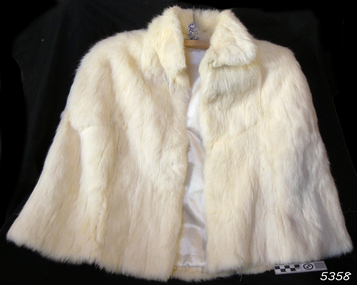
... cape...evening wear...A capelet is a small cape, usually worn around a person's shoulders and often chosen to wear with an evening outfit. ...A capelet was a fashionable garment from the late 19th to the early 20th centuries. flagstaff hill warrnambool flagstaff-hill flagstaff-hill-maritime-museum maritime-museum shipwreck-coast flagstaff-hill-maritime-village capelet cape evening wear fur garment fashion Edwardian Victorian white fur Capelet with collar. ...A capelet is a small cape, usually worn around a person's shoulders and often chosen to wear with an evening outfit. The design may include a hood, collar or even ruffles. Fabrics range from fur, leather, velvet and wool to shear silk and net. Trimmings include buttons, lace, ribbon, and tassels. A capelet was a fashionable garment from the late 19th to the early 20th centuries.Capelet with collar. White fur lined with white fabric. flagstaff hill, warrnambool, flagstaff-hill, flagstaff-hill-maritime-museum, maritime-museum, shipwreck-coast, flagstaff-hill-maritime-village, capelet, cape, evening wear, fur garment, fashion, edwardian, victorian, white fur -
 Brighton Historical Society
Outfit, Evening outfit, 1930s
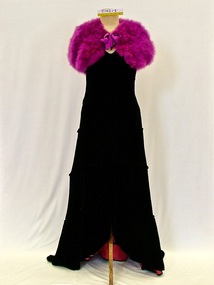
... evening dress...feather cape...Evening outfit comprising magenta feathered cape, full-length black velvet dress and a spray of silk flowers. ...Her family migrated to Australia, living first in St Kilda before building the house 'Avon' at 42 Bay Street, Brighton, where Bertha lived with her husband Ambrose Reginald Dudfield until 1975. evening dress feather cape bertha dudfield brighton 1930s Evening outfit comprising magenta feathered cape, full-length black velvet dress and a spray of silk flowers. ...This evening outfit was made and worn by Bertha Frances Dudfield (nee Bruere, 1892-1982). Bertha was born in Christchurch, New Zealand in 1892, one of twelve surviving children. Her family migrated to Australia, living first in St Kilda before building the house 'Avon' at 42 Bay Street, Brighton, where Bertha lived with her husband Ambrose Reginald Dudfield until 1975.Evening outfit comprising magenta feathered cape, full-length black velvet dress and a spray of silk flowers. Hem of dress lined with magenta and yellow silk. .1 - cape .2 - dress .3 - floral sprayevening dress, feather cape, bertha dudfield, brighton, 1930s -
 Warrnambool and District Historical Society Inc.
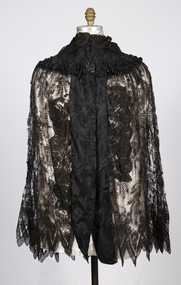
Clothing - Black beaded cape, c. 1880
... This item has np known provenance but is a beautiful example of a woman's evening cape dating from the second half of the 19th century. ...This item has np known provenance but is a beautiful example of a woman's evening cape dating from the second half of the 19th century. ...This item has np known provenance but is a beautiful example of a woman's evening cape dating from the second half of the 19th century. The original owner would have been a lady of considerable means who attended social functions requiring an item such as this.This item is retained as a fine example of 19th century woman's clothing.This is woman's cape made of black lace and patterned satin with satin rouches and black beaded rosettes around the shoulders and the front. The beading has long tassels. The cape is knee length. It has grey lining around the inside of the shoulders. At the front there are two hooks and eyes to allow the cape to be fastened.at the neck.woman's vintage clothing, lady's vintage cape -
 Bendigo Historical Society Inc.
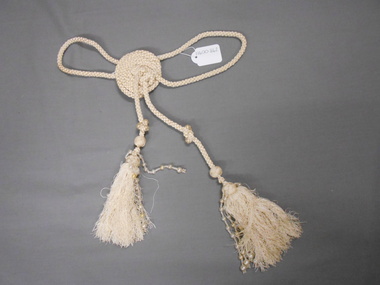
Clothing - DECORATIVE CORDING AND PEARL TRIMMED TASSEL, Tassel, 1920's - 30's,maybe1800's
... Matching 11400.843, there is no evidence on the evening cape that it was at one time, attached. ...Matching 11400.843, there is no evidence on the evening cape that it was at one time, attached. ...Cream silk, cord, wound into a 7cm diameter disk, with loops and decorative pearl trimmed tassel. Matching 11400.843, there is no evidence on the evening cape that it was at one time, attached. This item may be a decorative item that was worn over the wrist, and added interest to the wearer of the cape. A ''turk's head'' woven ball'', 1.5cm diameter, and tassel head, add to this decorative item.costume accessories, female, decorative cord and pearl trimmed tassel -
 Kew Historical Society Inc
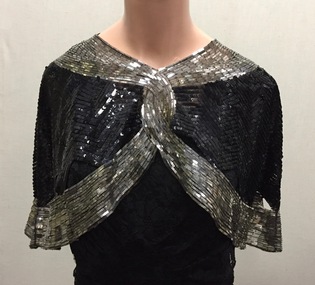
Clothing - Black and Silver Sequin Capelet, 1930s
... Black silk chiffon or georgette fitted evening cape,let entirely covered in silver metal rectangles and black sequins. ...It is however probable that the two fitted capes were commercially made. evening wear capelets doris bennett (nee wilmott) women's clothing fashion - 1930s Black silk chiffon or georgette fitted evening cape,let entirely covered in silver metal rectangles and black sequins. ...Doris Mercy Willmott was born in May 1896 in Stamford Hill, London, the eldest of three daughters of Albert and Minnie Willmott. The family lived in various parts of north London until the beginning of the First World War, when they moved to Redhill in Surrey. It was in Redhill that Doris met her future husband, Frederick John (Jack) Bennett. Jack had met Eric Mercy, a cousin of Minnie’s, in the Australian Imperial Force (AIF) and visited the Wilmotts with him whilst on leave from France. Although Jack Bennett returned to Melbourne in March 1919, he and Doris continued to correspond and they were engaged in March 1923. She came to Melbourne on her own, and was married in the Congregational Church in Canterbury on 23 December 1923. By 1931 Doris and Jack and their three sons - John Willmott, Winfield Robert Curtis and Peter Reginald Dane - moved to 21 Tooronga Road, Hawthorn but moved back to his father’s home, Therapia, 2 (now 6) Hepburn Street, Auburn, shortly before his father’s death. In 1937, the Bennett family moved back to the United Kingdom, spending the war years in Uxbridge and Torquay. The family returned to Melbourne in October 1946, after the deaths of Doris’ parents. The family lived at 12 Stanhope Grove, Camberwell and 51 The Ridge, Canterbury before Jack died in February 1952. After this Doris moved to 12 Stanley Grove, Canterbury, her home until c. 1970 when she moved to 25 Corhampton Road, North Balwyn. She died in May 1980 in Princeton Nursing Home, 3 Bellett Street, Camberwell. (Adapted from notes provided by Sue Barnett, the donor).The collection of evening clothes owned and worn by Doris Mercy Bennett, of which this item is one, date from the 1930s and may have been purchased in Australia or in the United Kingdom. Each of the items, apart from the evening dress, which has a few minor tears in the lace, is of fine quality and evidences Doris Bennett’s love of glamour and style. While the evening dress and the mantilla are of the same fabric, the two capes might have been worn with the dress as alternative fashion accessories. None of the items has a maker’s mark, however each displays evidence of fine dressmaking skills. It is however probable that the two fitted capes were commercially made.Black silk chiffon or georgette fitted evening cape,let entirely covered in silver metal rectangles and black sequins. The cape gives the appearance of being joined at the front, however it is made in one piece. The cape has open scalloped sections bordering the lower band of silver metal rectangles. The cape was owned and worn by Doris Mercy Bennett (nee Willmott) [1896-1980], and donated to the Society by her grandaughter. evening wear, capelets, doris bennett (nee wilmott), women's clothing, fashion - 1930s -
 Flagstaff Hill Maritime Museum and Village
Document, 12-01-1882
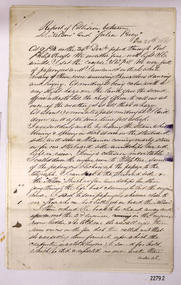
... Cape Otway on the morning of the 25th December 1881, and you are hereby expected to attend at the Board Room, Custom House, Melbourne, at 2pm, on 13th January instant to show cause why you should not be censured accordingly. [Signature] Secretary" This document refers to the matter of a collision between two steamships, the Julia Percy and the Nelson, on 25th December 1881. The Julia Percy was at that time owned by her first owners, the Warrnambool Steam Packet Company, and she sailed under the command of Captain Chapman. She had left Melbourne the evening...Cape Otway on the morning of the 25th December 1881, and you are hereby expected to attend at the Board Room, Custom House, Melbourne, at 2pm, on 13th January instant to show cause why you should not be censured accordingly. [Signature] Secretary" This document refers to the matter of a collision between two steamships, the Julia Percy and the Nelson, on 25th December 1881. The Julia Percy was at that time owned by her first owners, the Warrnambool Steam Packet Company, and she sailed under the command of Captain Chapman. She had left Melbourne the evening ...This hand written letter, in black ink script on blue lined paper, is impressed with the official stamp of the Victoria Steam Navigation Board. The left margin has the reference “S82/12" It is transcribed: "Victoria Steam Navigation Board, Melbourne, January 12th 1882 To Frederick Chapman, Master, S.S. "Julia Percy" You are herewith furnished with a copy of the report of the Official Court which assembled to enquire into the circumstances attending the collision between the steamers "Julia Percy" and "Nelson" off Apollo Bay near Cape Otway on the morning of the 25th December 1881, and you are hereby expected to attend at the Board Room, Custom House, Melbourne, at 2pm, on 13th January instant to show cause why you should not be censured accordingly. [Signature] Secretary" This document refers to the matter of a collision between two steamships, the Julia Percy and the Nelson, on 25th December 1881. The Julia Percy was at that time owned by her first owners, the Warrnambool Steam Packet Company, and she sailed under the command of Captain Chapman. She had left Melbourne the evening of 24th December, with about 150 passengers, sailing in fine weather through Port Phillip Heads around 9pm. She was headed for Warrnambool, Belfast (now named Port Fairy) and Portland. The Julia Percy was off Apollo Bay when Captain Chapman was woken by the ship’s whistle after midnight, the steamer Nelson being on a collision course with the Julia Percy.[See Link.] The Nelson struck Julia Percy midship. Boats were lowered from the ship (apart from a damaged lifeboat) and about 30-40 of the passengers boarded the Nelson. The engine room and the forehold were checked and found clear of water. The company manager, Mr Evans, had been on the Nelson, so he boarded and inspected the Julia Percy and the decision was made to continue on to Warrnambool with the passengers as there appeared to be no immediate danger. However, Captain Thomas Smith said the Nelson was taking on water, so Julia Percy followed her for about an hour towards Melbourne on standby in case of need. Then Julia Percy turned around towards Warrnambool again. Shortly afterwards the Nelson turned to follow her, the ships stopped and passengers were returned to Julia Percy, and three from Julia Percy boarded the Nelson. Both ships proceeded on their way. Julia Percy passed Cape Otway light afterwards, signalling that there had been a collision. It was discovered later that one of the passengers was missing, then thought to have boarded the Nelson but later thought to have fallen into the sea and drowned while trying to jump from Julia Percy to Nelson. There had been 3 tickets purchased under the same name of that passenger “Cutler”; a father, son and friend named Wordsworth, which had caused quite some confusion. No further mishap occurred to either ship and both the Julia Percy and the Nelson reached their destinations safely. An enquiry was instigated by the Victoria Steam Navigation Board regarding the cause of the accident between the two steamships, in connection with the death of Cutler who was supposed to have lost his life by the collision. The enquiry resulted in the following decision: "The Victorian Steam Navigation Board having taken into consideration the points urged by Captain Thos [Thomas] Smith and also by his legal advisers, is of opinion that the charge prepared against him has been sustained, but taking into consideration Captain Smith’s previous good conduct and character, the board suspends his master’s certificate No 227 issued by this board for a period of six calendar months from this date – Robert Fullarton, Chairman. “The Victorian Steam Navigation Board having beard the statement of Captain Frederick Chapman urged in his defense to the charge of dereliction of duty as master of the Julia Percy, in having no standing order on board that vessel to be called in the event of any approaching steamer’s lights being seen, find such charge sustained, and censure him accordingly – Robert Fullarton, Chairman.” ABOUT “JULIA PERCY” The S.S. Julia Percy (later named Leeuwin ) was an iron passenger-cargo steam ship built in 1876. At one point in time the Julia Percy would sail from Warrnambool to Melbourne every Friday and return from Melbourne to Warrnambool every Tuesday. The cost of a return ticket for a Saloon Fare was £1.0.0. She would sail “if practical and weather permitting”. Shipping was the cheapest and most practical means of carrying produce and goods during the period 1840-1890. Regular domestic steamer services commenced in the Warrnambool district in the late 1850’s and by 1870 the passenger trade was booming. Produce was loaded from the jetty into ‘lighters’ (small boats), which took it to the ships at anchorage in the bay. Passengers were taken to the ship’s side then climbed aboard up ladders or gangways. The coming of the railway in October 1889 meant the gradual decline and end of the steam shipping era. The Julia Percy was built in Glasgow by Thomas Wingate & Company, Whiteinch, in 1876 for the Warrnambool Steam Packet Company, which commissioned her for trade in Victoria’s western district. She was first registered in Warrnambool, Victoria in 1876. The Julia Percy changed hands several times. Her next owner was the Western Steam Navigation Co (1887), managed by Mr. T.H. Osborne (the company’s office was on the corner of Timor and Liebig Streets, Its north-western wall is now part of the current Warrnambool Regional Art Gallery. ) The Melbourne Steamship Co became the next owners (1890), followed by William Howard Smith and Sons (1901) for use in Queensland coastal trades, then she was bought by George Turnbull in 1903 and used for local mail contract in Western Australia. The Julia Percy was sold to the Melbourne Steamship Company Ltd. (1906) and re-named the “Leeuwin” but continued in her Western Australian coastal run. She was converted into a coal hulk in Melbourne in 1910 as a result of damaged caused when she was driven against the jetty at Dongara during a gale. The ship was eventually dismantled and scuttled in Bass Strait on 28 December 1934. The document is significant for its association with the wreck of the Leeuwin (Julia Percy), which is on the Victorian Heritage Register, VHR S413. . It is historically significant for being a rare artefact that has potential to interpret aspects of Western Victoria’s 19th century steamship trade and Victorian cultural history. The Leeuwin (Julia Percy) is listed on the Victorian Heritage Register as being historically significant ‘as one of only four wrecks of steamships in Victorian waters associated with the western district of Victoria’s coastal steamship trade. Reports of Victoria Steam Navigation Board about the collision on 25th December 1881 between the steamers " Julia Percy" and "Nelson". Letter from Victoria Steam Navigation Board, Melbourne to Frederick Chapman, Master, S.S. "Julia Percy", dated January 12th 1882. reference on letter in left margin "S82/12"flagstaff hill, flagstaff hill –maritime museum, maritime museum, shipwreck coast, flagstaff hill maritime village, victoria steam navigation board, captain frederick chapman, captain thomas smith, thomas wingate & company, steamer julia percy, steamer leeuwin, steamer nelson, steam ship, warrnambool steam packet company, t. h. ostorne, western steam navigation co., charles cutler -
 Bendigo Historical Society Inc.
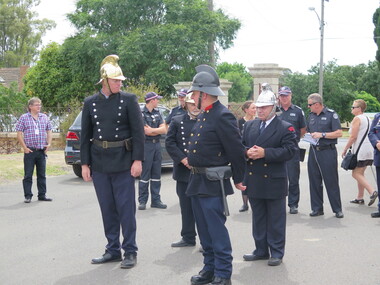
Photograph - The Galatea Tragedy - 150th Anniversary, 18th Dec 2017
... Cape Colony in South Africa before crossing the Indian Ocean to Australia. The Prince continued his tour to country Victoria and in Bendigo tragedy struck on 18th Dec 1867. A model of the royal ship Galatea, crewed by young boys, was the centerpiece of a reception and a procession. The procession circled round, and entering the Camp Reserve piled the torches into one general bonfire. At this time the demonstration of the evening...Cape Colony in South Africa before crossing the Indian Ocean to Australia. The Prince continued his tour to country Victoria and in Bendigo tragedy struck on 18th Dec 1867. A model of the royal ship Galatea, crewed by young boys, was the centerpiece of a reception and a procession. The procession circled round, and entering the Camp Reserve piled the torches into one general bonfire. At this time the demonstration of the evening ...Born in 1844 Prince Alfred was the fourth child and second son of Queen Victoria and Prince Albert. He joined the Royal Navy at age 14 as a midshipman and by 1866 had attained the rank of captain and had command of HMS Galatea, a steam-powered sail-equipped frigate. In the same year, Alfred was made Duke of Edinburgh. In January 1867 the Galatea set sail from Plymouth on a round the world voyage visiting the Mediterranean before making a state visit to the emperor of Brazil. Two months were spent in the Cape Colony in South Africa before crossing the Indian Ocean to Australia. The Prince continued his tour to country Victoria and in Bendigo tragedy struck on 18th Dec 1867. A model of the royal ship Galatea, crewed by young boys, was the centerpiece of a reception and a procession. The procession circled round, and entering the Camp Reserve piled the torches into one general bonfire. At this time the demonstration of the evening was marred by a sad accident. The Bendigo Volunteer Fire Brigade put on a demonstration with lighted torches which were carelessly extinguished, embers floated onto the model ship which quickly caught fire. Witnesses also reported that firecrackers were being thrown. the accident was caused either owing, to the fireworks or careless use of the torches. Three boys in the model ship were burned to death and several others injured. The Volunteer Fire Brigades' rigged ship Galatea, which had formed a conspicuous object in the proceedings of the morning was driven along the crowded thoroughfare manned with young citizens dressed in sailor costumes, and took fire from the fireworks. Some of the sails immediately caught fire, and before an escape could be made, four of the occupants were most severely burnt. With. the assistance of the bystanders, the flames were quenched, but so severe were the injuries sustained by the lads, that they had to be conveyed to the hospital. Of the four, one, James Brown, son of Mr.James Brown, formerly, of the Water Supply department in Sandhurst and now of Tasmania, recovered from his injuries, but the other three died shortly after the accident. They were Wm. Langston McGrath, Sylvester Francis Cahill and Thomas Walters, each about eight years of age. They were buried at the Back Creek Cemetery, and a movement, initiated b ythe citizens, resulted in their graves being marked by public memorials. In connection with this sad event it should be mentioned that when the explosion of fireworks on board the model ship took place, Mr. Meagher, the captain of the brigade, although struck on the head by a rocket, dragged several of the boys from the flames. He and Mr. Hickey, one of the members of the brigade, were severely burned in their efforts to save the boys, in which they were assisted by Mr. Irving.Bendigo Historical Society excursion to the Bendigo Cemetery and visit to the graves and memorial of the three boys burned to death in a model of the ship Galatea during the visit of the Prince AlfredDuke of Edinburgh in 1867. The DVD contains a slide show of the excursion. The photos taken by Libby Luke are published here.history, bendigo, galatea tragedy -
 Kew Historical Society Inc
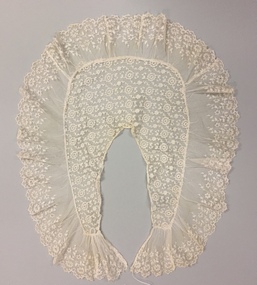
Clothing - Lace Pelerine, 1900s
... cape that covers the shoulders. It was most popular during the mid- to late nineteenth century. women's clothing lace collars pelerines Cream net machine embroidered collar with ruffle of chemical lace. Machine constructed post World War 1. Worn in the evening ...The Fashion & Design collection of Kew Historical Society includes examples of textiles dating from the 18th, 19th and 20th centuries. Some of the textiles, were used as items of clothing, others as items of household decoration, or simply as travel souvenirs. These textiles were created both domestically and internationally. Predictably with the growth of an ethnically and culturally more diverse community in Kew after the Second World War, textiles, clothing and objects in the collection inevitably reflected this diversity. A pelerine is a small cape that covers the shoulders. It was most popular during the mid- to late nineteenth century. Cream net machine embroidered collar with ruffle of chemical lace. Machine constructed post World War 1. Worn in the evening women's clothing, lace, collars, pelerines -
 Kew Historical Society Inc
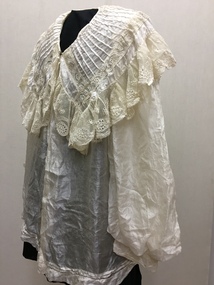
Clothing - Silk & Lace Bed Jacket, c. 1902-11
... The collection includes day dresses, evening dresses, evening coats, capes, and undergarments. As the wife of a mining engineer, and later mine manager, Edith Weir’s clothing has historic significance as examples of clothing worn by upper middle class Australian women in domestic circumstances and at social and civic events. ...An item forming part of a collection of costumes, photographs and documents relating to the Weir family who lived in the mansion originally named Illapa, 84 Princess Street, Kew, from c.1917 to 1950. This historically significant collection includes items relating to both George Weir (1866-1937) and his wife Edith Mary Weir (1867-1948). George Weir attained national prominence in the mining industry, becoming General Manager of the North Broken Hill Silver Mining Company in 1903 (later renamed North Broken Hill Mining Company 1905-12, and North Broken Hill Ltd 1912-1988), and subsequently President of the Mine Owners Association. He was to remain General Manager of North Broken Hill Ltd until his retirement in 1926.This garment is significant as it is part of 25-piece collection of women’s clothing owned by Edith Mary Weir (nee Betteridge), who was born in Clare, South Australia in 1867 and who died in Kew at the age of 81 in 1948. The items of clothing in the collection date from the 1880s to the 1940s and constitute outstanding examples of dressmaker’s skills from each of these decades. The collection includes day dresses, evening dresses, evening coats, capes, and undergarments. As the wife of a mining engineer, and later mine manager, Edith Weir’s clothing has historic significance as examples of clothing worn by upper middle class Australian women in domestic circumstances and at social and civic events. The costumes in the collection represent the periods when Edith Weir lived in Broken Hill, New South Wales, and in Kew, Melbourne. A number of the costumes from the 1920s to the 1940s are of a particularly fine quality, being both rare, representative and intact examples of Australian fashion of the period. The garments in the Weir Collection were donated to the Kew Historical Society by the granddaughter of Edith Weir. An Edwardian slik, net and broderie anglaise bed jacket, bought by and worn by Edith Mary (Betteridge) Weir. Given the date of the item, the jacket was initially worn in Broken Hill where the Weir's lived, when her husband was Manager of the North Broken Hill Mine and later brought to Kew, ca. 1917 when the Weirs moved to Princess Street, Kew. The jacket was gifted by Edith Weir's grandaughter. It forms part of the Society's Weir Collection.edith mary weir (nee betteridge), 84 princes street (kew), costumes, fashion & design collection - kew historical society, women's clothing, weir collection -
 Kew Historical Society Inc
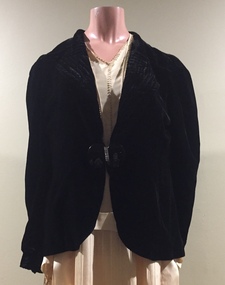
Clothing - Black velvet jacket with diamanté clasp, 1930s
... This black velvet jacket with diamanté clasp was collected by Teresa Mayer, KHS member, and donated to our collection in 1988. women's clothing fashion -- melbourne -- 1930s capes Black silk velvet evening jacket with ornamental diamanté clip at front. ...The Fashion & Design collection of the Kew Historical Society includes examples of women’s, men’s, children’s and infants’ clothing from the 18th, 19th and 20th centuries. Items in the collection were largely produced for, or purchased by women in Melbourne, and includes examples of outerwear, protective wear, nightwear, underwear and costume accessories. This black velvet jacket with diamanté clasp was collected by Teresa Mayer, KHS member, and donated to our collection in 1988.Black silk velvet evening jacket with ornamental diamanté clip at front.women's clothing, fashion -- melbourne -- 1930s, capes -
 Kew Historical Society Inc
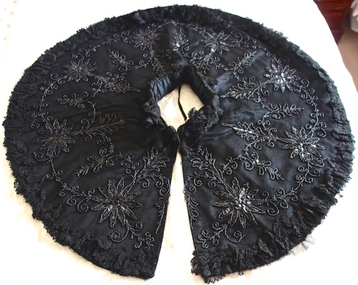
Clothing - Silk & tulle capelet decorated with jet passementerie, c.1900
... Well-provenanced evening cape, worn by Bridget Fitzgerald in the Central Victorian Goldfields district. bridget fitzgerald bridget shannon women's clothing australian fashion - 1890s capelets capes A black satin shoulder capelet covered with fine silk tulle, embroidered with jet passementerie and black sequins. ...The capelet was owned by Bridget Fitzgerald (nee Shannon) who emigrated to Australia from Ireland and subsequently lived in the Victorian country town of Tilden. Bridget died in about 1906 and is buried in the Kyneton cemetery. The capelet was passed on by descent to her granddaughter.Well-provenanced evening cape, worn by Bridget Fitzgerald in the Central Victorian Goldfields district.A black satin shoulder capelet covered with fine silk tulle, embroidered with jet passementerie and black sequins. The capelet which when open is circular is joined at the front by eyelets and hooks. The second photo includes a photo of the donor, Mrs Joan Carr, with the cape at the time of its donation.bridget fitzgerald, bridget shannon, women's clothing, australian fashion - 1890s, capelets, capes -
 Kew Historical Society Inc
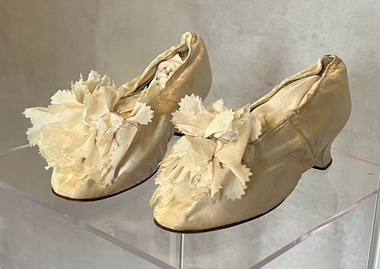
Footwear - Pair of leather soled silk wedding shoes, 1891
... The collection includes day dresses, evening dresses, evening coats, capes, shoes and undergarments. As the wife of a mining engineer, and later mine manager, Edith Weir’s clothing has historic significance as examples of clothing worn by upper middle class Australian women in domestic circumstances and at social and civic events. ...An item forming part of a collection of costumes, photographs and documents relating to the Weir family who lived in the mansion originally named Illapa, 84 Princess Street, Kew, from c.1917 to 1950. This historically significant collection includes items relating to both George Weir (1866-1937) and his wife Edith Mary Weir (1867-1948). George Weir attained national prominence in the mining industry, becoming General Manager of the North Broken Hill Silver Mining Company in 1903 (later renamed North Broken Hill Mining Company 1905-12, and North Broken Hill Ltd 1912-1988), and subsequently President of the Mine Owners Association. He was to remain General Manager of North Broken Hill Ltd until his retirement in 1926.These shoes are significant as they are part of a 30-piece collection of women’s clothing owned by Edith Mary Weir (nee Betteridge), who was born in Clare, South Australia in 1867 and who died in Kew at the age of 81 in 1948. The items of clothing in the collection date from the 1880s to the 1940s and constitute outstanding examples of dressmaker’s skills from each of these decades. The collection includes day dresses, evening dresses, evening coats, capes, shoes and undergarments. As the wife of a mining engineer, and later mine manager, Edith Weir’s clothing has historic significance as examples of clothing worn by upper middle class Australian women in domestic circumstances and at social and civic events. The costumes in the collection represent the periods when Edith Weir lived in Broken Hill, New South Wales, and in Kew, Melbourne. A number of the costumes from the 1920s to the 1940s are of a particularly fine quality, being both rare, representative and intact examples of Australian fashion of the period. The garments in the Weir Collection were donated to the Kew Historical Society by the granddaughter of Edith Weir. Pair of ivory silk shoes, worn by Edith Mary Betteridge at her marriage to George Weir in Broken Hill in 1891. The shoes were worn with her ivory silk wedding dress.edith mary (betteridge) weir, 84 princess street (kew), footwear, women's shoes, wedding shoes -
 Kew Historical Society Inc
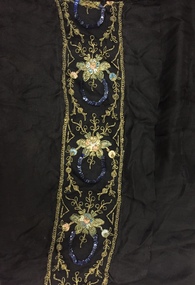
Clothing - Black Chiffon Scarf with Multicoloured Silk Embroidery, c. 1926-1931
... The collection includes day dresses, evening dresses, evening coats, capes, shoes and undergarments. As the wife of a mining engineer, and later mine manager, Edith Weir’s clothing has historic significance as examples of clothing worn by upper middle class Australian women in domestic circumstances and at social and civic events. ...An item forming part of a collection of costumes, photographs and documents relating to the Weir family who lived in the mansion originally named Illapa, 84 Princess Street, Kew, from c.1917 to 1950. This historically significant collection includes items relating to both George Weir (1866-1937) and his wife Edith Mary Weir (1867-1948). George Weir attained national prominence in the mining industry, becoming General Manager of the North Broken Hill Silver Mining Company in 1903 (later renamed North Broken Hill Mining Company 1905-12, and North Broken Hill Ltd 1912-1988), and subsequently President of the Mine Owners Association. He was to remain General Manager of North Broken Hill Ltd until his retirement in 1926.This scarf is part of a 30-piece collection of women’s clothing owned by Edith Mary Weir (nee Betteridge), who was born in Clare, South Australia in 1867 and who died in Kew at the age of 81 in 1948. The items of clothing in the collection date from the 1880s to the 1940s and constitute outstanding examples of dressmaker’s skills from each of these decades. The collection includes day dresses, evening dresses, evening coats, capes, shoes and undergarments. As the wife of a mining engineer, and later mine manager, Edith Weir’s clothing has historic significance as examples of clothing worn by upper middle class Australian women in domestic circumstances and at social and civic events. The costumes in the collection represent the periods when Edith Weir lived in Broken Hill, New South Wales, and in Kew, Melbourne. A number of the costumes from the 1920s to the 1940s are of a particularly fine quality, being both rare, representative and intact examples of Australian fashion of the period. The garments in the Weir Collection were donated to the Kew Historical Society by the granddaughter of Edith Weir in 2017Very long, doubled chiffon evening scarf with a silk tassle at one end and multicoloured hand embroidered flowers at the other. The scarf was owned by Edith Mary Weir.edith mary (betteridge) weir, 84 princess street -kew, australian fashion, scarfs -
 Kew Historical Society Inc
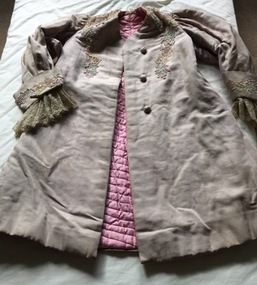
Clothing - Silk & Guipure Lace Evening Coat with Quilted Pink Silk Lining, 1920s
... The collection includes day dresses, evening dresses, evening coats, capes, and undergarments. As the wife and daughter of a mine manager, the collection includes representative examples of clothing worn by upper middle class Australian women in domestic circumstances, and at social and civic events. ...An item forming part of a collection of costumes, photographs and documents relating to the Weir family who lived in a mansion, originally named Illapa, at 84 Princess Street, Kew, from c.1917 to 1950. This historically significant collection includes items relating to both George Weir (1866-1937), his wife Edith Mary Weir (1867-1948) and their children. George Weir attained national prominence in the mining industry, becoming General Manager of the North Broken Hill Silver Mining Company in 1903 (later renamed North Broken Hill Mining Company 1905-12, and North Broken Hill Ltd 1912-1988), and subsequently President of the Mine Owners Association. He was to remain General Manager of North Broken Hill Ltd until his retirement in 1926.This garment is part of a collection of women’s clothing, owned and worn by Edith Mary Weir (nee Betteridge) - born in Clare, South Australia 1867, died Kew 1948 - and also by her daughter. The garments date from the 1880s to the 1930s. The collection includes day dresses, evening dresses, evening coats, capes, and undergarments. As the wife and daughter of a mine manager, the collection includes representative examples of clothing worn by upper middle class Australian women in domestic circumstances, and at social and civic events. A number of the costumes from the 1920s to the 1930s are of a particularly fine quality, being both rare, representative and intact examples of Australian fashion of the period. The garments in the Weir Collection were donated to the Kew Historical Society by a granddaughter of Edith Weir in 2017.Beige silk theatre or opera jacket with multi-coloured guipure lace at the neck, on the front bordering the opening, and on the cuffs. The long sleeves have extensive old lace extending beyond the wide cuffs. The inside is lined with quilted pink silk, which has darker silk panels at the front. The jacket has a high neck. It is closed using three embroidered fabric buttons at the frontedith mary weir (nee betteridge), 84 princess street - kew, australian fashion, women's clothing, costumes, coats -
 Kew Historical Society Inc
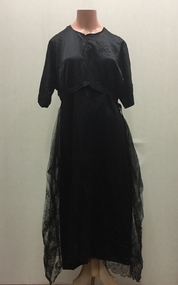
Clothing - Black Silk & Chantilly Lace Evening Dress, 1920s
... The collection includes day dresses, evening dresses, evening coats, capes, and undergarments. As the wife and daughter of a mine manager, the collection includes representative examples of clothing worn by upper middle class Australian women in domestic circumstances, and at social and civic events. ...An item forming part of a collection of costumes, photographs and documents relating to the Weir family who lived in a mansion, originally named Illapa, at 84 Princess Street, Kew, from c.1917 to 1950. This historically significant collection includes items relating to both George Weir (1866-1937), his wife Edith Mary Weir (1867-1948) and their children. George Weir attained national prominence in the mining industry, becoming General Manager of the North Broken Hill Silver Mining Company in 1903 (later renamed North Broken Hill Mining Company 1905-12, and North Broken Hill Ltd 1912-1988), and subsequently President of the Mine Owners Association. He was to remain General Manager of North Broken Hill Ltd until his retirement in 1926.This garment is part of a collection of women’s clothing, owned and worn by Edith Mary Weir (nee Betteridge) - born in Clare, South Australia 1867, died Kew 1948 - and also by her daughter. The garments date from the 1880s to the 1930s. The collection includes day dresses, evening dresses, evening coats, capes, and undergarments. As the wife and daughter of a mine manager, the collection includes representative examples of clothing worn by upper middle class Australian women in domestic circumstances, and at social and civic events. A number of the costumes from the 1920s to the 1930s are of a particularly fine quality, being both rare, representative and intact examples of Australian fashion of the period. The garments in the Weir Collection were donated to the Kew Historical Society by a granddaughter of Edith Weir in 2017.Long black silk waisted dress, gathered at the waist with and featuring a full skirt. The short-sleeved bodice has a high round neck with a small amount of embroidery at the front in the form of abstract flowers. The skirt features an additional Chantilly lace overskirt that is scalloped at the hem. edith mary weir (nee betteridge), 84 princess street - kew, australian fashion, women's clothing, costumes, coats
