
Showing 18 items matching "eyelet maker"
-
 Trafalgar Holden Museum
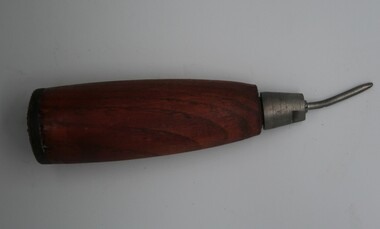
Tool - Eyelet maker
... Eyelet maker......Eyelet maker...Eyelet maker used in leather work ca1900...Eyelet maker used in leather work ca1900 Used and sold by Holden and Frost Tool Eyelet maker Metal spike tool with wooden handle Tool Eyelet maker ...Eyelet maker used in leather work ca1900Used and sold by Holden and FrostMetal spike tool with wooden handletool, eyelet maker -
 Flagstaff Hill Maritime Museum and Village
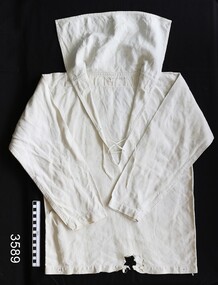
Uniform - Sailor's Shirt, 1920's
... Flagstaff Hill Flagstaff Hill Maritime Museum and Village Warrnambool Maritime Museum Maritime Village Great Ocean Road Shipwreck Coast Sailor’s shirt sailor’s top sailor’s uniform uniform W R Angus Largs Bay 1928 1920s ship’s doctor Maker's tag "MADE BY / - - - - JONES / S - - - - E -", size tag "2.", hand written "LOGAN". Sailor’s shirt (or top); white linen 1920s-era shirt with a square collar at the back. The neck slit has eyelets ...This sailor's white linen shirt or top was acquired by Dr Angus when working as a Ship's Surgeon on S.S. 'Larg's Bay' returning from the U.K. in 1928 after studies. It was donated to Flagstaff Hill Maritime Village by the family of Doctor William Roy Angus, Surgeon and Oculist. It is part of the “W.R. Angus Collection” which includes historical medical equipment, surgical instruments and material once belonging to Dr Edward Ryan and Dr Thomas Francis Ryan, (both of Nhill, Victoria) as well as Dr Angus’ belongings. The Collection’s history spans the medical practices of the two Doctors Ryan, from 1885-1926 plus that of Dr Angus, up until 1969. ABOUT THE “W.R.ANGUS COLLECTION” Doctor William Roy Angus M.B., B.S., Adel., 1923, F.R.C.S. Edin.,1928 (also known as Dr Roy Angus) was born in Murrumbeena, Victoria in 1901 and lived until 1970. He qualified as a doctor in 1923 at University of Adelaide, was Resident Medical Officer at the Royal Adelaide Hospital in 1924 and for a period was house surgeon to Sir (then Mr.) Henry Simpson Newland. Dr Angus was briefly an Assistant to Dr Riddell of Kapunda, then commenced private practice at Curramulka, Yorke Peninsula, SA, where he was physician, surgeon and chemist. In 1926, he was appointed as new Medical Assistant to Dr Thomas Francis Ryan (T.F. Ryan, or Tom), in Nhill, Victoria, where his experiences included radiology and pharmacy. In 1927 he was Acting House Surgeon in Dr Tom Ryan’s absence. Dr Angus had become engaged to Gladys Forsyth and they decided he would take time to further his studies overseas in the UK in 1927. He studied at London University College Hospital and at Edinburgh Royal Infirmary and in 1928, was awarded FRCS (Fellow from the Royal College of Surgeons), Edinburgh. He worked his passage back to Australia as a Ship’s Surgeon on the on the Australian Commonwealth Line’s SS Largs Bay. Dr Angus married Gladys in 1929, in Ballarat. (They went on to have one son (Graham 1932, born in SA) and two daughters (Helen (died 12/07/1996) and Berenice (Berry), both born at Mira, Nhill ) Dr Angus was a ‘flying doctor’ for the A.I.M. (Australian Inland Ministry) Aerial Medical Service in 1928 . The organisation began in South Australia through the Presbyterian Church in that year, with its first station being in the remote town of Oodnadatta, where Dr Angus was stationed. He was locum tenens there on North-South Railway at 21 Mile Camp. He took up this ‘flying doctor’ position in response to a call from Dr John Flynn; the organisation was later known as the Flying Doctor Service, then the Royal Flying Doctor Service. A lot of his work during this time involved dental surgery also. Between 1928-1932 he was surgeon at the Curramulka Hospital, Yorke Peninsula, South Australia. In 1933 Dr Angus returned to Nhill where he’d previously worked as Medical Assistant and purchased a share of the Nelson Street practice and Mira hospital from Dr Les Middleton one of the Middleton Brothers, the current owners of what was once Dr Tom Ryan’s practice. Dr L Middleton was House Surgeon to the Nhill Hospital 1926-1933, when he resigned. [Dr Tom Ryan’s practice had originally belonged to his older brother Dr Edward Ryan, who came to Nhill in 1885. Dr Edward saw patients at his rooms, firstly in Victoria Street and in 1886 in Nelson Street, until 1901. The Nelson Street practice also had a 2 bed ward, called Mira Private Hospital ). Dr Edward Ryan was House Surgeon at the Nhill Hospital 1884-1902 . He also had occasions where he successfully performed veterinary surgery for the local farmers too. Dr Tom Ryan then purchased the practice from his brother in 1901. Both Dr Edward and Dr Tom Ryan work as surgeons included eye surgery. Dr Tom Ryan performed many of his operations in the Mira private hospital on his premises. He too was House Surgeon at the Nhill Hospital 1902-1926. Dr Tom Ryan had one of the only two pieces of radiology equipment in Victoria during his practicing years – The Royal Melbourne Hospital had the other one. Over the years Dr Tom Ryan gradually set up what was effectively a training school for country general-practitioner-surgeons. Each patient was carefully examined, including using the X-ray machine, and any surgery was discussed and planned with Dr Ryan’s assistants several days in advance. Dr Angus gained experience in using the X-ray machine there during his time as assistant to Dr Ryan. Dr Tom Ryan moved from Nhill in 1926. He became a Fellow of the Royal Australasian College of Surgeons in 1927, soon after its formation, a rare accolade for a doctor outside any of the major cities. He remained a bachelor and died suddenly on 7th Dec 1955, aged 91, at his home in Ararat. Scholarships and prizes are still awarded to medical students in the honour of Dr T.F. Ryan and his father, Dr Michael Ryan, and brother, John Patrick Ryan. ] When Dr Angus bought into the Nelson Street premises in Nhill he was also appointed as the Nhill Hospital’s Honorary House Surgeon 1933-1938. His practitioner’s plate from his Nhill surgery states “HOURS Daily, except Tuesdays, Fridays and Saturday afternoons, 9-10am, 2-4pm, 7-8pm. Sundays by appointment”. This plate is now mounted on the doorway to the Port Medical Office at Flagstaff Hill Maritime Village, Warrnambool. Dr Edward Ryan and Dr Tom Ryan had an extensive collection of historical medical equipment and materials spanning 1884-1926 and when Dr Angus took up practice in their old premises he obtained this collection, a large part of which is now on display at the Port Medical Office at Flagstaff Hill Maritime Village in Warrnambool. During his time in Nhill Dr Angus was involved in the merging of the Mira Hospital and Nhill Public Hospital into one public hospital and the property titles passed on to Nhill Hospital in 1939. In 1939 Dr Angus and his family moved to Warrnambool where he purchased “Birchwood,” the 1852 home and medical practice of Dr John Hunter Henderson, at 214 Koroit Street. (This property was sold in1965 to the State Government and is now the site of the Warrnambool Police Station. ). The Angus family was able to afford gardeners, cooks and maids; their home was a popular place for visiting dignitaries to stay whilst visiting Warrnambool. Dr Angus had his own silk worm farm at home in a Mulberry tree. His young daughter used his centrifuge for spinning the silk. Dr Angus was appointed on a part-time basis as Port Medical Officer (Health Officer) in Warrnambool and held this position until the 1940’s when the government no longer required the service of a Port Medical Officer in Warrnambool; he was thus Warrnambool’s last serving Port Medical Officer. (The duties of a Port Medical Officer were outlined by the Colonial Secretary on 21st June, 1839 under the terms of the Quarantine Act. Masters of immigrant ships arriving in port reported incidents of diseases, illness and death and the Port Medical Officer made a decision on whether the ship required Quarantine and for how long, in this way preventing contagious illness from spreading from new immigrants to the residents already in the colony.) Dr Angus was a member of the Australian Medical Association, for 35 years and surgeon at the Warrnambool Base Hospital 1939-1942, He served as a Surgeon Captain during WWII1942-45, in Ballarat, Victoria, and in Bonegilla, N.S.W., completing his service just before the end of the war due to suffering from a heart attack. During his convalescence he carved an intricate and ‘most artistic’ chess set from the material that dentures were made from. He then studied ophthalmology at the Royal Melbourne Eye and Ear Hospital and created cosmetically superior artificial eyes by pioneering using the intrascleral cartilage. Angus received accolades from the Ophthalmological Society of Australasia for this work. He returned to Warrnambool to commence practice as an ophthalmologist, pioneering in artificial eye improvements. He was Honorary Consultant Ophthalmologist to Warrnambool Base Hospital for 31 years. He made monthly visits to Portland as a visiting surgeon, to perform eye surgery. He represented the Victorian South-West subdivision of the Australian Medical Association as its secretary between 1949 and 1956 and as chairman from 1956 to 1958. In 1968 Dr Angus was elected member of Spain’s Barraquer Institute of Barcelona after his research work in Intrasclearal cartilage grafting, becoming one of the few Australian ophthalmologists to receive this honour, and in the following year presented his final paper on Living Intrasclearal Cartilage Implants at the Inaugural Meeting of the Australian College of Ophthalmologists in Melbourne In his personal life Dr Angus was a Presbyterian and treated Sunday as a Sabbath, a day of rest. He would visit 3 or 4 country patients on a Sunday, taking his children along ‘for the ride’ and to visit with him. Sunday evenings he would play the pianola and sing Scottish songs to his family. One of Dr Angus’ patients was Margaret MacKenzie, author of a book on local shipwrecks that she’d seen as an eye witness from the late 1880’s in Peterborough, Victoria. In the early 1950’s Dr Angus, painted a picture of a shipwreck for the cover jacket of Margaret’s book, Shipwrecks and More Shipwrecks. She was blind in later life and her daughter wrote the actual book for her. Dr Angus and his wife Gladys were very involved in Warrnambool’s society with a strong interest in civic affairs. Their interests included organisations such as Red Cross, Rostrum, Warrnambool and District Historical Society (founding members), Wine and Food Society, Steering Committee for Tertiary Education in Warrnambool, Local National Trust, Good Neighbour Council, Housing Commission Advisory Board, United Services Institute, Legion of Ex-Servicemen, Olympic Pool Committee, Food for Britain Organisation, Warrnambool Hospital, Anti-Cancer Council, Boys’ Club, Charitable Council, National Fitness Council and Air Raid Precautions Group. He was also a member of the Steam Preservation Society and derived much pleasure from a steam traction engine on his farm. He had an interest in people and the community He and his wife Gladys were both involved in the creation of Flagstaff Hill, including the layout of the gardens. After his death (28th March 1970) his family requested his practitioner’s plate, medical instruments and some personal belongings be displayed in the Port Medical Office surgery at Flagstaff Hill Maritime Village, and be called the “W. R. Angus Collection”. The W.R. Angus Collection is significant for still being located at the site it is connected with, Doctor Angus being the last Port Medical Officer in Warrnambool. The collection of medical instruments and other equipment is culturally significant, being a historical example of medicine from late 19th to mid-20th century. Dr Angus assisted Dr Tom Ryan, a pioneer in the use of X-rays and ocular surgery. Sailor’s shirt (or top); white linen 1920s-era shirt with a square collar at the back. The neck slit has eyelets with lacing threaded across. Pocket inside on left breast. Hem has four eyelet holes, two at the front, and two at the back. It is part of the W.R. Angus CollectionMaker's tag "MADE BY / - - - - JONES / S - - - - E -", size tag "2.", hand written "LOGAN". flagstaff hill, flagstaff hill maritime museum and village, warrnambool, maritime museum, maritime village, great ocean road, shipwreck coast, sailor’s shirt, sailor’s top, sailor’s uniform, uniform, w r angus, largs bay, 1928, 1920s, ship’s doctor -
 Geelong RSL Sub Branch
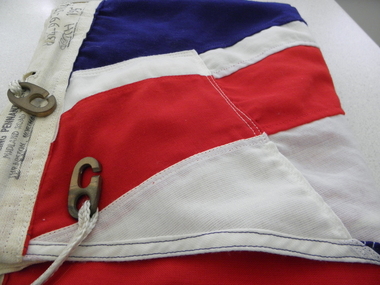
Flag, 1985
... On the white edge band the makers name, stock number 8834-99-5714529 6BDTH 1985, an upwards arrow in a circle and in black ink the name Peter Wilson. Union Jack, oblong red white and blue, cloth, three metal eyelets on the white edge band, two brass toggles for hanging the flag onto a flagpost. ...Union Jack made in 1985 and possibly once in the possession of Peter Wilson.A Union Jack that was once in the possession of Peter Wilson.Union Jack, oblong red white and blue, cloth, three metal eyelets on the white edge band, two brass toggles for hanging the flag onto a flagpost.On the white edge band the makers name, stock number 8834-99-5714529 6BDTH 1985, an upwards arrow in a circle and in black ink the name Peter Wilson.flag, union jack, united kingdom. -
 Glenelg Shire Council Cultural Collection
Flag - Flag - Portland, Dorset, United Kingdom, n.d
... eyelets. Top quarter pale yellow, image of castle tower, other three quarters divided in half vertically, one half royal blue, the other green. Synthetic fabric. b) Clear plastic bag for (a). Maker's...eyelets. Top quarter pale yellow, image of castle tower, other three quarters divided in half vertically, one half royal blue, the other green. Synthetic fabric. b) Clear plastic bag for (a). Maker's ...a) Flag from Portland, Dorset, rectangular, white border top end, brass eyelets. Top quarter pale yellow, image of castle tower, other three quarters divided in half vertically, one half royal blue, the other green. Synthetic fabric. b) Clear plastic bag for (a). Maker's stamp attachedflag, portland dorset, united kingdom -
Glenelg Shire Council Cultural Collection
Headwear - Hat - Portland Primary School, n.d
... Dark green fabric 'floppy' hat (poly/cotton) White printed logo on front 'Portland Primary School No. 489' Two eyelets either side of crown. Maker's tag inside...Portland Primary School childrens wear uniform Dark green fabric 'floppy' hat (poly/cotton) White printed logo on front 'Portland Primary School No. 489' Two eyelets either side of crown. Maker's tag inside Headwear Hat - Portland Primary School PRIMARY SCHOOL WEAR ...Dark green fabric 'floppy' hat (poly/cotton) White printed logo on front 'Portland Primary School No. 489' Two eyelets either side of crown. Maker's tag insideportland primary school, childrens wear, uniform -
 Bendigo Military Museum
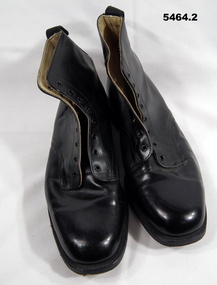
Footwear - BOOTS, RAN, BAXTER FOOTWEAR GROUP
... FORREST UNIFORM FOOTWEAR PARADE UNIFORM Makers stamp inside boots ‘BAXTER FOOTWEAR GROUP/LEATHER QTR, LINING/112941 42 40 / LEATHER SOLE” STAMP ON SOLE “RAN/LE/MADE IN AUSTRALIA “ Boots- pair black leather RAN Parade ground boots. No Laces in eyelets ...Uniform boots belonging to E.D. FORRESTBoots- pair black leather RAN Parade ground boots. No Laces in eyelets.Makers stamp inside boots ‘BAXTER FOOTWEAR GROUP/LEATHER QTR, LINING/112941 42 40 / LEATHER SOLE” STAMP ON SOLE “RAN/LE/MADE IN AUSTRALIA “uniform, footwear, parade uniform -
 Bendigo Military Museum
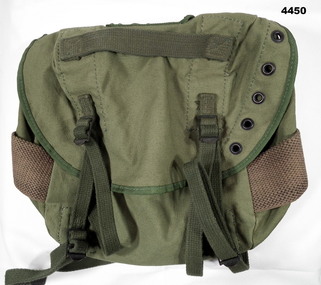
Equipment - UTILITY PACK, Hall Mark International, March 1984
... Utility pack, canvas, green colour, water proof inner liner, flap has two straps and buckles, 5 eyelets on one side, webbing strap around sides and back khaki colour, makers details inside flap....The item was commonly called a “Bum Pack” Utility pack webbing equipment On pack in black, “8465 - 66 - 063 - 6073, D (arrow up) D Au” Utility pack, canvas, green colour, water proof inner liner, flap has two straps and buckles, 5 eyelets on one side, webbing strap around sides and back khaki colour, makers details inside flap. ...The item was commonly called a “Bum Pack”Utility pack, canvas, green colour, water proof inner liner, flap has two straps and buckles, 5 eyelets on one side, webbing strap around sides and back khaki colour, makers details inside flap.On pack in black, “8465 - 66 - 063 - 6073, D (arrow up) D Au”utility pack, webbing, equipment -
 Bendigo Military Museum
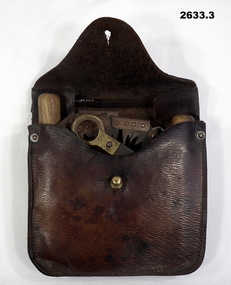
Equipment - POUCH WITH HANDSAW, Jabez Cliff & Co, 1918
... .1) Leather rectangular pouch, stitched seams, brass stud closer, leather straps at rear to attach to belt, stamped maker's labels. .2) Metal & brass tool, saw toothed teeth, linear shape, 2 brass eyelets on ends to attach brass & timber detachable handles, handles cylindrical shape. .3) Metal file linear, 3 flat sides....Item from 17th Light Horse Regiment collection. trades-tools-saws containers military equipment - army Passchendaele barracks trust Stamped on belt strap: "Jabez Cliff & Co Walshall 1918" .1) Leather rectangular pouch, stitched seams, brass stud closer, leather straps at rear to attach to belt, stamped maker's labels. .2) Metal & brass tool, saw toothed teeth, linear shape, 2 brass eyelets on ends to attach brass & timber detachable handles, handles cylindrical shape. .3) Metal file linear, 3 flat sides. ...Item from 17th Light Horse Regiment collection..1) Leather rectangular pouch, stitched seams, brass stud closer, leather straps at rear to attach to belt, stamped maker's labels. .2) Metal & brass tool, saw toothed teeth, linear shape, 2 brass eyelets on ends to attach brass & timber detachable handles, handles cylindrical shape. .3) Metal file linear, 3 flat sides.Stamped on belt strap: "Jabez Cliff & Co Walshall 1918"trades-tools-saws, containers, military equipment - army, passchendaele barracks trust -
 Bendigo Military Museum
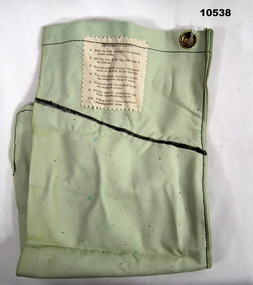
Equipment - WATER FILTER BAG, C.1945
... Water Filter Bag, green canvas type material with opening at the top with a brass eyelet in one corner, rectangular shape then narrows down to one corner. One side has a light brown colour material sewn on with instructions, other side has in black text the makers details....Filter water gajones In black text, " ^ Waring & Gillow Ltd 1945 Cat No AF.10005" Water Filter Bag, green canvas type material with opening at the top with a brass eyelet in one corner, rectangular shape then narrows down to one corner. One side has a light brown colour material sewn on with instructions, other side has in black text the makers details. ...Collection re G.A. Jones 3790932, refer Cat No 10053.2P for his service details.Water Filter Bag, green canvas type material with opening at the top with a brass eyelet in one corner, rectangular shape then narrows down to one corner. One side has a light brown colour material sewn on with instructions, other side has in black text the makers details.In black text, " ^ Waring & Gillow Ltd 1945 Cat No AF.10005"filter, water, gajones -
 Warrnambool and District Historical Society Inc.
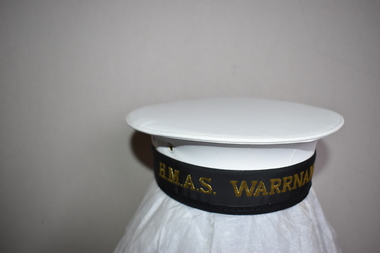
Seaman's Hat, H.M.A.S Warrnambool, Early 21st century
... eyelets on each side. The base has a black ribbon with a black bow and lettering in woven gold thread. Inside there is a leather band with a white bow and a navy blue ribbon to act as a chin strap. This is attached on one side only. Inside also is a white label with the maker’s...eyelets on each side. The base has a black ribbon with a black bow and lettering in woven gold thread. Inside there is a leather band with a white bow and a navy blue ribbon to act as a chin strap. This is attached on one side only. Inside also is a white label with the maker’s ...In 2005 the H.M.A.S. Warrnambool was de-commissioned in Darwin and the Mayor of Warrnambool, Cr Glenys Phillpot, was present at the ceremonies connected to this event. She obtained this sailor’s hat at that time as a souvenir of the ship. It appears to be brand new. H.M.A.S. Warrnambool was the second ship with this name. The first H.M.A.S. Warrnambool was built in Sydney in 1941 and commissioned for anti-submarine and mine sweeping duties. In 1947 it was struck by a mine in northern Australian waters and sunk with the loss of four lives. The second H.M.A.S. Warrnambool was commissioned in 1981as a patrol boat in northern Australian waters. It had steamed over 500,000 miles before the end of its working life in 2005 and had visited Warrnambool several times. This sailor’s cap is of importance as a memento of the second ship named H.M.A.S. Warrnambool and particularly commemorates the de-commissioning of that ship in 2005 in Darwin. This is a white seaman’s hat with a flat oval-shaped crown made of stiffened white material with two white metal eyelets on each side. The base has a black ribbon with a black bow and lettering in woven gold thread. Inside there is a leather band with a white bow and a navy blue ribbon to act as a chin strap. This is attached on one side only. Inside also is a white label with the maker’s information on it. H.M.A.S. Warrnambool MAPE uniform headwear of the MCH group of companies 3405-66-075-6064 E 5 R.A.N. -
 Embroiderers Guild, Victoria
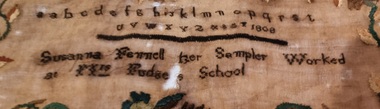
Textile - Susannah Fennell Sampler 1808, Susannah Fennell, 1808
... maker to donor. Sampler donated by descendant. Unusual sampler with diamond band in solid satin stitch. Possibly from Bristol England. Alphabet Sampler Five alphabets, "Susanah Fennell her sampler worked at Mrs Fudges school 1808" English band sampler. Linen embroidered in satin stitch, eyelet ...Research underway on Mrs Fudges school and to link maker to donor. Sampler donated by descendant.Unusual sampler with diamond band in solid satin stitch. Possibly from Bristol England.English band sampler. Linen embroidered in satin stitch, eyelet, half cross stitches in dark green, brown and beige cotton, scrolling frame around inscription. Diamond band in solid satin stitch.Five alphabets, "Susanah Fennell her sampler worked at Mrs Fudges school 1808"alphabet, sampler -
 Geelong Naval and Maritime Museum
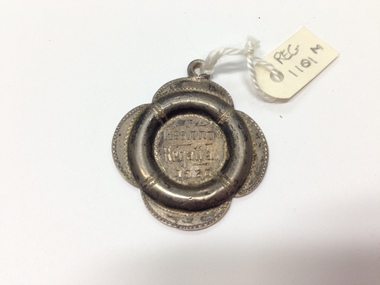
Medallion, Cadet Cutter Race, c.1920
... A silver decorative medal in the shape of a ring buoy with an eyelet at the top for hanging. Engraved on front and back and stamped by maker "Hammerton". ...A silver decorative medal in the shape of a ring buoy with an eyelet at the top for hanging. Engraved on front and back and stamped by maker "Hammerton". ...UnknownA silver decorative medal in the shape of a ring buoy with an eyelet at the top for hanging. Engraved on front and back and stamped by maker "Hammerton". "Geelong Regatta 1920" engraved on front. "Cutter Race/ Cadet J. Kroger" engraved on back. Medal stamped "HAMMERTON" on back.geelong regatta 1920, j. kroger, hammerton medal, cutter race geelong regatta -
 Wangaratta RSL Sub Branch
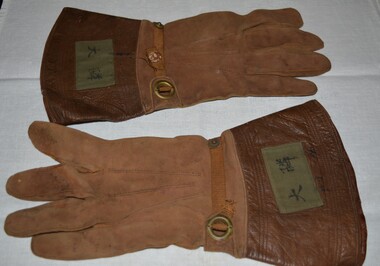
Souvenir - Japanese Leather Gloves, c1940
... This material choice was common among military aviation uniforms, reflecting the need for durable and functional gear in extreme conditions. gloves WW2 Japan Inside glove - japanese makers patch Brown suede gloves with brown ribbon strap threaded through an eyelet and secured with a press stud. ...During World War II, Japanese pilot gauntlets were made from a combination of suede and leather. Specifically, the gloves featured high-quality deer hide suede for the finger section, while the upper portion was made of heavy cowhide leather, providing both warmth and protection. This pair of gauntlets are believed to be souvenired by an Australian soldier in New Guinea during WW2. This material choice was common among military aviation uniforms, reflecting the need for durable and functional gear in extreme conditions. Brown suede gloves with brown ribbon strap threaded through an eyelet and secured with a press stud. A green patch of material with two black japanese symbols is sewn onto brown leather trim attached to suede.Inside glove - japanese makers patchgloves, ww2, japan -
 Embroiderers Guild, Victoria
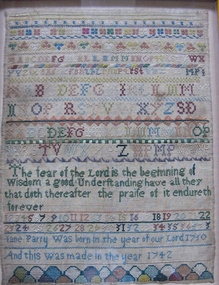
Textile - Jane Parry 1742 Band Sampler, Jane Parry, 1742
... Bands of pattern, letters, numbers, religious text and maker's name Jane Parry and when born 1730, and when she made the sampler 1742. Cross stitch, Satin stitch and eyelets were used. ...Bands of pattern, letters, numbers, religious text and maker's name Jane Parry and when born 1730, and when she made the sampler 1742. Cross stitch, Satin stitch and eyelets were used. ...Acquired with money from the Sampler Exhibition at the Guild - March 1988.Aged linen ground with multi-coloured cotton thread. Bands of pattern, letters, numbers, religious text and maker's name Jane Parry and when born 1730, and when she made the sampler 1742. Cross stitch, Satin stitch and eyelets were used. Restored, mounted and framed in 1988."The Fear of the Lord is the beginning of wisdom. A good understanding have all they that doth thereafter the praise of it endureth forever". "Jane Parry was born in the year of our Lord 1730 and this was made in the year 1742"embroidery, sampler, 18th century, england, counted thread, alphabets -
 Hume City Civic Collection
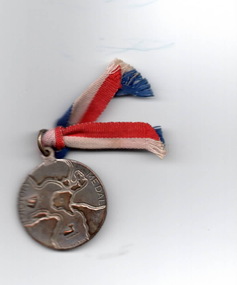
Medal, Lyndon Dadswell, Victory Medal, 1945
... makers were Stokes & Sons. The medal was one way generations would know about Worlds War 2 in 1945. Victory Medal World War 2 Schools Medals A small medal with a striped red, white and blue ribbon threaded through an eyelet at the top. ...A Victory Medal was given to school children after the end of World War 2 in 1945. 1 150 000 of these medals were distributed to Australian school children to coincide with the end of the war in the Pacific in August 1945. It was designed by Lyndon Dadswell and the makers were Stokes & Sons.The medal was one way generations would know about Worlds War 2 in 1945.A small medal with a striped red, white and blue ribbon threaded through an eyelet at the top. The words 'Victory Medal' with a world map are on one side and a soldier with a sword and map of Australia with 1945 are on the other side.victory medal, world war 2, schools, medals -
 University of Melbourne, Burnley Campus Archives
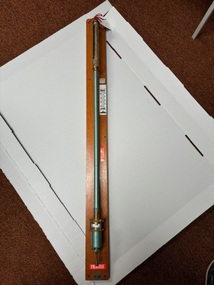
Instrument - Mercury Barometer and Thermometer, A.L. Franklin, Early twentieth century
... maker, A.L.Franklin. The column of mercury is supported by the pressure of air on the free surface of the mercury in the cistern at the bottom. Its level can be adjusted to a datum using the screw at the bottom and then the height of the column can be accurately read off using a vernier scale at the top. Attached to a backing timber board with a thermometer. Thermometer made by Townson and Mercer. Metal vertical hanging eyelet...maker, A.L.Franklin. The column of mercury is supported by the pressure of air on the free surface of the mercury in the cistern at the bottom. Its level can be adjusted to a datum using the screw at the bottom and then the height of the column can be accurately read off using a vernier scale at the top. Attached to a backing timber board with a thermometer. Thermometer made by Townson and Mercer. Metal vertical hanging eyelet ...A Fortin style mercury barometer from well-known Australian instrument maker, A.L.Franklin. The column of mercury is supported by the pressure of air on the free surface of the mercury in the cistern at the bottom. Its level can be adjusted to a datum using the screw at the bottom and then the height of the column can be accurately read off using a vernier scale at the top. Attached to a backing timber board with a thermometer. Thermometer made by Townson and Mercer. Metal vertical hanging eyelet.A.L.Franklin, established 1919, scientific instrument makers, Brookvale, NSW; A.L Franklin Sydney No. 457; Townson and Mercer Distributors Pty Ltd throughout Aust and NZ.;weather station, soil science, science, student outside activities, measurements, air pressure, atmospheric pressure, air temperature, artifact -
 Trafalgar Holden Museum
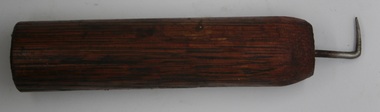
Tool - Eyelet tool
... Used circa 1900 for boot makers to put lace holes in leather boots/shoes used during the late 19th and early 20th centuries for boot making tool cobbler hole making eyelet tool with wooden and metal hook bent to 90 degrees for pressing eyelet holes Tool Eyelet tool ...Used circa 1900 for boot makers to put lace holes in leather boots/shoesused during the late 19th and early 20th centuries for boot makingeyelet tool with wooden and metal hook bent to 90 degrees for pressing eyelet holestool, cobbler, hole making -
 Kilmore Historical Society
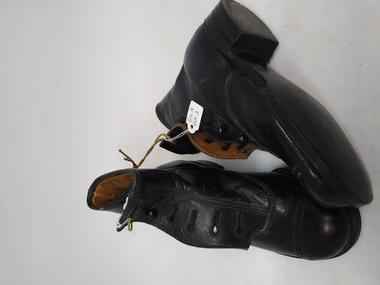
Footwear - Pair Child's black leather boots, Child's black leather boots
... makers mark on polished leather sole. Nailed leather heel. Decorative machine stitching and punching over toe puff. Tan leather interface on stitched eyelet holes. ...makers mark on polished leather sole. Nailed leather heel. Decorative machine stitching and punching over toe puff. Tan leather interface on stitched eyelet holes. ...Pair Child's 6 button black leather boots. Round worn makers mark on polished leather sole. Nailed leather heel. Decorative machine stitching and punching over toe puff. Tan leather interface on stitched eyelet holes. Inner lining white material. Inner sole white leather. Stiff supports under toe and heel leatherWorn stamped makers mark on sole. Size 1 stamped on sole instep
