
Showing 16 items matching "f moor"
-
 Vision Australia
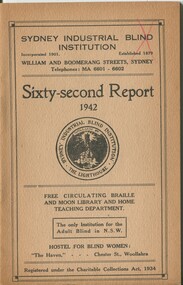
Administrative record - Text, Sydney Industrial Blind Institution: Sixty-Second Report 1942, 1943
... ...F Moor...Articles in the annual report include: shortage of materials due to the war, employment has been found for over 60 people in munitions, aircraft, radio and other organisations, the retirement of two country collectors due to health reasons and the inability to currently recruit replacements, the limits of 'The Haven' have been reached and some requests for accommodation have had to be turned away due to a shortage of space, the quarterly concerts by musical artists have continued via the 'Glow Worm' sessions at 2.45pm each Saturday, the passing of transcribers Misses F. Moor and M. Rattray, and an explanation for not listing subscribers due to the shortage of paper....Sydney Industrial Blind Institution Annual Report O F Vidler Roy Kippax Employment Haven Hostel Auxiliaries F Moor M Rattray 1 printed volume with black and white illustrations Sydney Industrial Blind Institution: Sixty-Second Report 1942 Administrative record Text ...Articles in the annual report include: shortage of materials due to the war, employment has been found for over 60 people in munitions, aircraft, radio and other organisations, the retirement of two country collectors due to health reasons and the inability to currently recruit replacements, the limits of 'The Haven' have been reached and some requests for accommodation have had to be turned away due to a shortage of space, the quarterly concerts by musical artists have continued via the 'Glow Worm' sessions at 2.45pm each Saturday, the passing of transcribers Misses F. Moor and M. Rattray, and an explanation for not listing subscribers due to the shortage of paper.1 printed volume with black and white illustrationssydney industrial blind institution, annual report, o f vidler, roy kippax, employment, haven hostel, auxiliaries, f moor, m rattray -
 Flagstaff Hill Maritime Museum and Village
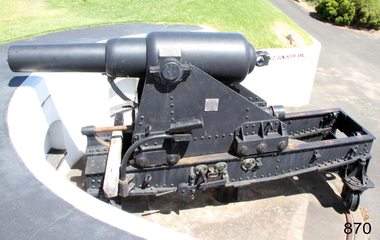
Weapon - Cannon, 1866
... Moor known to exist in the State of Victoria. Funding was received to repair Cannon No.2 and its iron carriage. After completion, both Cannon No 1 and No. 2 were 'fired' in a public re-enactment on April 4th, 2026. (Conservation Management Plan for Victorian Guns and Cannon, South Western Victoria, May 2008, ref W/F...Moor known to exist in the State of Victoria. Funding was received to repair Cannon No.2 and its iron carriage. After completion, both Cannon No 1 and No. 2 were 'fired' in a public re-enactment on April 4th, 2026. (Conservation Management Plan for Victorian Guns and Cannon, South Western Victoria, May 2008, ref W/F ...In the years following the Crimean War (1854-1857J) there was a great concern in the Colony that Imperial Russia would attempt an invasion. Coastal defences in the colony of Victoria were greatly strengthened by the Government as a result. Warrnambool was originally protected by cannons at Cannon Hill, approximately 1 kilometer west of the Flagstaff Hill Fortifications. These cannons included two 1866 guns, both 80 Pound Rifled Muzzle Loaders (RML) purchased by Victoria’s Colonial Government. They were part of a shipment of 26 such guns sent from England in December 1866. They are registered as No. 23 (80cwt-2qr-0lbs) - Gun 1, and No.13 (81cwt-1qr-12lbs) - Gun 2. They were cast at the Royal Gun Factory, Woolwich Arsenal, in 1866 and have a 6.3 inch bore. Both barrels carry the Royal Cypher of Queen Victoria, Insignia of the Royal Engineers, within the Garter and Motto surmounted by the Crown, with the Royal Cypher of Queen Victoria within the Garter (letters in centre “VR”, motto “HONI SOIT QUI MAL Y PENSE”, "Shame be to him who thinks evil of it."). The guns were originally supplied with wooden carriages. (The Royal Arsenal at Woolwich, England, was established eleven years after the Restoration of King Charles II. It was the principal supplier of armaments to the British and Empire Governments. At the height of its operations during World War One the factory covered 1300 acres and employed very nearly 80,000 workers. Woolwich was the Headquarters of the Royal Artillery since the raising of that Regiment in 1716. The Arsenal was closed in the late 1960’s.) These two cannons were transferred to the Warrnambool Garrison Artillery Battery Fortifications erected at Flagstaff Hill in 1887 as part of Victoria’s Coastal Defences. The original wooden carriages were subsequently replaced with the present iron garrison carriages in 1888. They are a “C” pivot. The ‘racers’ or curved track set into the floor of the gun emplacement (which enabled the guns to be traversed more quickly) are as specified for guns up to 10 inch, being of wrought iron 2.78 inches wide. A temporary third gun, now no longer on Flagstaff Hill’s site, was a 5 inch Rifled Breech Loading (BL) Armstrong gun mounted on an Elswick hydro pneumatic disappearing carriage It was faster to load and fire than the 80 pound RMLs and its arrival spelt the end of the older 80 pound guns’ useful life, apart from being used for practice sessions. The 5 inch BL gun was the main defensive weapon of the Warrnambool Battery until the Battery was downgraded in importance and the gun was recalled to Melbourne in 1910. The State of Victoria took over the ownership of the guns at the time of Australian Federation in 1901. In about 1901/1902 the Garrison Battery was converted to the Warrnambool Battery of the Australian Field Artillery (No 4 Field Battery). It was equipped with 4.7 inch naval guns mounted on field carriages. They were now a mobile unit but continued to use the Warrnambool Garrison area at Flagstaff Hill for practice. When the Fortifications were declared obsolete, the two 80 Pounder RML were relocated to Cannon Hill in 1910. On the outbreak of World War One the 4.7 inch guns were recalled to Melbourne, and the Battery was disbanded. Most of the personnel probably re-enlisted in the local 4th Australian Light Horse Regiment. The two 80 Pounder RML were moved back to the Fortifications in 1973. They were both fully restored by Army First Year Apprentices at the Ordinance Factory in Bendigo in time for the centenary year of the fortifications in 1987. The guns are capable of firing 80 pound (32.3kg) armour piercing exploding shells 3.65kms out to sea. They were original manned by volunteers before a paid Garrison was established. Now the Guns are again fired by volunteers on Special Event days. Since restoration the Gun Number 1 had been fired on a regular basis but Gun Number 2 hadn’t been fired since the mid 1990’s. In April 2015 Gun Number 2 was serviced in preparation for the firing of both cannons on the ANZAC Centenary commemorations on April 25th 2015. Other guns from the original Cannon Hill location were obsolete by the time the 1887 Warrnambool Garrison Artillery Battery was built. These guns are (1) a 32 Pounder Muzzle Loading Smooth Bore (SB) cast in 1813 at the famous Carron Foundry, number 80837 and now located in the Warrnambool Botanic Gardens (2) a 68 Pounder Muzzle Loading Smooth Bore cast in 1861 at the equally august Low Moor Foundry, number 10310 and now located on the lawn area at the entrance to Flagstaff Hill Maritime Village. Both of these guns are mounted on their original wooden garrison carriages. There are only seven 32 Pounder SB made by Carron and fifteen 68 Pounder SB made at Low Moor known to exist in the State of Victoria. Funding was received to repair Cannon No.2 and its iron carriage. After completion, both Cannon No 1 and No. 2 were 'fired' in a public re-enactment on April 4th, 2026. (Conservation Management Plan for Victorian Guns and Cannon, South Western Victoria, May 2008, ref W/F/05)The Warrnambool Garrison has been added to the Victorian Heritage Register H1250 “for its intact battery and guns, a strong reminder of Victoria’s wealth and determination to protect itself from the perceived threat of invasion in the 1880’s.” The City of Warrnambool is one of several custodians of a collection of artillery pieces of heritage significance at a state, national and international level. These pieces are directly related to the defence of south-west Victoria in the 19th century. The care and preservation come under the Heritage Act 1995. Cannon. 80 Pound Rifled Muzzle Loading (RML) Gun on iron carriage and slide, installed in the Battery at Flagstaff Hill’s Fortifications. Made in 1866 at the Royal Gun Factory (R-G-F), Woolich, England. Gun Reg No 13. Flagstaff Hill Garrison Gun 2 (Gun No. 2). Insignia of the Royal Engineers, and the weight of the gun, stamped on top of the gun’s barrel. There is a brass plate on the side of the gun with the details of 1987 restoration.Stamped into the metal on top of the barrel, Insignia of the Royal Engineers; Garter and Motto “HONI SOIT QUI MAL Y PENSE”, surmounted by the Crown, with the Royal Cypher of Queen Victoria “VR” within the Garter. Also stamped on top of the gun are 2 inward pointing arrows above the weight ”81-1-12”. Brass plate “RESTORATION / BY / FIRST YEAR / APPRENTICES / ORDANANCE FACTORY / BENDIGO 1987”flagstaff hill, warrnambool, shipwrecked coast, flagstaff hill maritime museum, maritime museum, shipwreck coast, flagstaff hill maritime village, great ocean road, colonial defences, victoria’s coastal defences, warrnambool fortification, warrnambool garrison battery, warrnambool volunteer corps, ordinance, armaments, cannon hill fortifications, 4th australian light horse regiment, no 4 field battery, 80 pound cannon rifled muzzle loaders (rml), victorian colonial government, royal gun factory england, woolwich arsenal, royal cypher of queen victoria, garrison gun -
 Mission to Seafarers Victoria
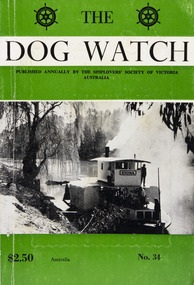
Journal (item) - Periodicals-Annual, Shiplovers' Society of Victoria, The Annual Dog Watch
... moored along side the historic wharf at Echuca. Contributes to our knowledge of the importance of shipping and places on record those stories of the sea which would otherwise be lost. sailing ships steamships shipping seafaring life shiplovers' society of victoria dog watch murray river paddlesteamers echuca etona ps etona Contents Foreword - G. F ...This journal provides the reader with glimpses of the adventures and hardships of a seaman's life. Many of the stories are of sailing ships. PS Etona was built in 1898 at Milang, South Australia as a missionary church steamer for the Church of England. The Etona's run was from Mannum, South Australia, where she was based up to Renmark. As churches were built in river tower she was no longer required and in 1912 she was sold to Captain Arch Conner who used her as a fishing steamer at Boundary Bend for many years. She was brought out of retirement during the 1956 floods to do trips up the Murrumbidgee River. She was eventually bought by interest in Echuca and restoration was commenced in 1962. The Etona, now fully restored with her original steam engine can now be seen moored along side the historic wharf at Echuca.Contributes to our knowledge of the importance of shipping and places on record those stories of the sea which would otherwise be lost.Contents Foreword - G. F. Tilley - 5 The "Etona" - H. Vaughan Evans - 6 Editorial - Russell Hemingway - 11 The Old Lady Of The River - Captain J. Gaby - 19 "Takapuna" Interlude On A Moonless Night - E. Harper - 31 Maritime Museum of Tasmania - J. Miller - 34 The Confederate Raiders "Florida" and "Alabama" - A. R. Osmond - 36 "Ease After War . . . Doth Greatly Please" - Captain W. J. Cowling - 44 Mutiny At Sea - P. R. Wilkins - 49 War Service In The Indian Ocean - H. Mossman - 51 Cape Horn - Captain Eino Koivistoinen - 57 "Tragedy of Loss" - Jonathan john - 61 The End of The "Queen Elizabeth" - Bradley J. Newell - 62 London Could Cope With Him - Dr. Stanislaw Bernatt - 68 Three Ships Canals - N. S. Smith - 69 The Loss Of The "Eyoshi Maru" - Captain M. B. Glasier - 77 A Small Consignment But Valuable - J. B. Hodgson - 85 Lowden and The "Candida" - D. R. Rickard - 87 "Lauriston" Sails On - F. W. Rudd - 89 Confusion of Identities, "Young Australian", "Young Australia" and "Carl" - J. M. MacKenzie - 93 Rescue from "Clarissa", 1957 - Captain Leif Asklund - 97 Journey Home - Captain W. E. Eastoe - 100 Disaster At Blanket Bay - J. K. Loney - 104 The End Of The "Antiope" - Captain Bruce Bell - 106 The "Great Britain" - C. E. Bonwick - 108 Search The Coast To Shark Bay - Rear-Admiral Charles Adair U.S.N. - 110 The "Polly Woodside" Family - Rev. H. W. Coffey - 121 Book Reviews - 123sailing ships, steamships, shipping, seafaring life, shiplovers' society of victoria, dog watch, murray river, paddlesteamers, echuca, etona, ps etona -
 Flagstaff Hill Maritime Museum and Village
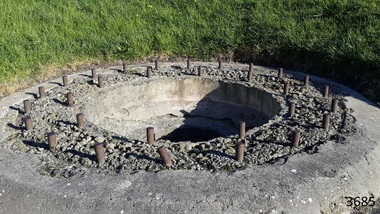
Gun Emplacement, 1890's
... There are only seven 32 Pounder SB made by Carron and fifteen 68 Pounder SB made at Low Moor known to exist in the State of Victoria [references; Flagstaff Hill Maritime Village interpretation boards, information sheets and other documents; South Western Victoria Guns and Cannon report, May 2008, ref W/F/08] ...There are only seven 32 Pounder SB made by Carron and fifteen 68 Pounder SB made at Low Moor known to exist in the State of Victoria [references; Flagstaff Hill Maritime Village interpretation boards, information sheets and other documents; South Western Victoria Guns and Cannon report, May 2008, ref W/F/08] The Gun embankment is contained within the heritage listed Lady Bay Lighthouse Comples, on the Victorian Heritage Register VHR H1520. ...The Warrnambool Battery on Flagstaff Hill has embankments for 3 guns. Those on the left and right still have cannon in place but in the centre is an empty embankment, apart from this concrete ring with metal threaded studs. In 1898 a 5 inch breech loading gun (BL) was installed here. The gun had a hydro-pneumatic disappearing carriage (hence the sign on the concrete wall "5" BL HP").. This type of gun was faster to load and fire that the 80 pound RML’s installed on either side of it. Its arrival spelt the end of the 80 pound RML guns’ useful life, although they continued to be used for practice sessions. The 5 inch BL was the main defensive weapon of the Warrnambool Battery until the Battery was downgraded in importance. It was removed in 1904 and recalled to Melbourne in 1910. The gun emplacement ring is all that remains of the mounting for a 5 inch Armstrong rifled breech loading gun. HISTOR of the WARRNAMBOOL GUNS & CANNON In the years following the Crimean War (1854-1857J) there was a great concern in the Colony that Imperial Russia would attempt an invasion. Coastal defences in the colony of Victoria were greatly strengthened by the Government as a result. Warrnambool was originally protected by cannons at Cannon Hill, approximately 1 kilometer west of the Flagstaff Hill Fortifications. The cannons included two 1866 guns, both 80 Pound Rifled Muzzle Loaders (RML) purchased by Victoria’s Colonial Government. They were part of a shipment of 26 such guns sent from England in December 1866. They are registered as No. 23 (80cwt-2qr-0lbs) - Gun 1, and No.13 (81cwt-1qr-12lbs) - Gun 2. They were cast at the Royal Gun Factory, Woolwich Arsenal, in 1866 and have a 6.3 inch bore. Both barrels carry the Royal Cypher of Queen Victoria, Insignia of the Royal Engineers, within the Garter and Motto surmounted by the Crown, with the Royal Cypher of Queen Victoria within the Garter (letters in centre “VR”, motto “HONI SOIT QUI MAL Y PENSE”, "Shame be to him who thinks evil of it."). The guns were originally supplied with wooden carriages. (The Royal Arsenal at Woolwich, England, was established eleven years after the Restoration of King Charles II. It was the principal supplier of armaments to the British and Empire Governments. At the height of its operations during World War One the factory covered 1300 acres and employed very nearly 80,000 workers. Woolwich was the Headquarters of the Royal Artillery since the raising of that Regiment in 1716. The Arsenal was closed in the late 1960’s.) These two 80pdr cannons were transferred to the Warrnambool Garrison Artillery Battery Fortifications erected at Flagstaff Hill in 1887 as part of Victoria’s Coastal Defences. The original wooden carriages were subsequently replaced with the present iron garrison carriages in 1888. They are a “C” pivot. The ‘racers’ or curved track set into the floor of the gun emplacement (which enabled the guns to be traversed more quickly) are as specified for guns up to 10 inch, being of wrought iron 2.78 inches wide. A temporary third gun, now no longer on Flagstaff Hill’s site, was the 5 inch Rifled Breech Loading (BL) Armstrong gun mounted on an Elswick hydro pneumatic disappearing carriage and installed in this very concrete base or pad. The State of Victoria took over the ownership of the guns at the time of Australian Federation in 1901. In about 1901/1902 the Garrison Battery was converted to the Warrnambool Battery of the Australian Field Artillery (No 4 Field Battery). It was equipped with 4.7 inch naval guns mounted on field carriages. They were now a mobile unit but continued to use the Warrnambool Garrison area at Flagstaff Hill for practice. When the Fortifications were declared obsolete the two 80 Pounder RML were relocated to Cannon Hill in 1910. On the outbreak of World War One the 4.7 inch guns were recalled to Melbourne, and the Battery was disbanded. Most of the personnel probably re-enlisted in the local 4th Australian Light Horse Regiment. The two 80 Pounder RML were moved back to the Fortifications in 1973. They were both fully restored by Army First Year Apprentices at the Ordinance Factory in Bendigo in time for the centenary year of the fortifications in 1987. The guns are capable of firing 80 pound (32.3kg) armour piercing exploding shells 3.65kms out to sea. They were originally manned by volunteers before a paid Garrison was established. Now the Guns are again fired by volunteers on Special Event days. Since restoration the Gun Number 1 had been fired on a regular basis but Gun Number 2 hadn’t been fired since the mid 1990’s. In April 2015 Gun Number 2 was serviced in preparation for the firing of both cannons on the ANZAC Centenary commemorations on April 25th 2015. Other guns from the original Cannon Hill location were obsolete by the time the 1887 Warrnambool Garrison Artillery Battery was built. These guns are (1) a 32 Pounder Muzzle Loading Smooth Bore (SB) cast in 1813 at the famous Carron Foundry, number 80837 and now located in the Warrnambool Botanic Gardens. It is now mounted on a replica carriage due to the original carriage being in a fragile condition (the original carriage stored under cover at Flagstaff Hill). (2) a 68 Pounder Muzzle Loading Smooth Bore cast in 1861 at the equally august Low Moor Foundry, number 10310 and now located on the lawn area at the entrance to Flagstaff Hill Maritime Village. It is still mounted on its original wooden garrison carriage. Its wooden slide compressor mechanism is fragile and now kept in Flagstaff Hill’s storage. There are only seven 32 Pounder SB made by Carron and fifteen 68 Pounder SB made at Low Moor known to exist in the State of Victoria [references; Flagstaff Hill Maritime Village interpretation boards, information sheets and other documents; South Western Victoria Guns and Cannon report, May 2008, ref W/F/08] The Gun embankment is contained within the heritage listed Lady Bay Lighthouse Comples, on the Victorian Heritage Register VHR H1520. The gun emplacement base is evidence of the last defences installed on this stretch of coastline. The Warrnambool Garrison has been added to the Victorian Heritage Register H1250 “for its intact battery and guns, a strong reminder of Victoria’s wealth and determination to protect itself from the perceived threat of invasion in the 1880’s.” The City of Warrnambool is one of several custodians of a collection of artillery pieces of heritage significance at a state, national and international level. These pieces are directly related to the defence of south-west Victoria in the 19th century. The care and preservation come under the Heritage Act 1995. Gun emplacement; the remains of the mounting platform of a temporary third gun installed in 1898 in the centre of the battery. This consists of a circular concrete well or sump surrounded by two rings of mounting bolts, the inner of 10 and the outer of 20. The base once held a 5 inch Armstrong rifled breech loading gun with hydro-pneumatic disappearing. In the centre of the ring on the ground is a keyhole shaped space. The gun was removed in 1904. flagstaff hill, warrnambool, shipwrecked coast, flagstaff hill maritime museum, maritime museum, shipwreck coast, flagstaff hill maritime village, great ocean road, colonial defences, victoria’s coastal defences, warrnambool fortification, warrnambool garrison battery, warrnambool volunteer corps, ordinance, armaments, cannon hill fortifications, flagstaff hill fortifications, 4th australian light horse regiment, garrison gun, 5 inch breech loading gun, emplacement for hydro-pneumatic disappearing carriage, gun emplacement -
 Glenelg Shire Council Cultural Collection
Photograph - Photograph - Ships Moored at ILS Anderson, 13/01/1987
... Two livestock vessels ('Danny F' and EL Taspah, Kuwait') moored ILS Anderson...Port of Portland Authority Archives Port of Portland Archives Portland Harbour Ship Berthed Danny F EL Taspah Kuwait K S Anderson Front: Back- '21 13/1/87' - black pen Two livestock vessels ('Danny F' and EL Taspah, Kuwait') moored ILS Anderson Photograph Photograph - Ships Moored at ILS Anderson ...Port of Portland Authority ArchivesFront: Back- '21 13/1/87' - black penport of portland archives, portland harbour, ship berthed, danny f, el taspah, kuwait, k s anderson -
Glenelg Shire Council Cultural Collection
Photograph - Photograph - Ships Berthed, 13/01/1987
... Same as 3501 (Two livestock vessels ('Danny F' and EL Taspah, Kuwait') moored ILS Anderson), slightly different view....Same as 3501 (Two livestock vessels ('Danny F' and EL Taspah, Kuwait') moored ILS Anderson), slightly different view. ...Port of Portland Authority ArchivesBack: '22 13/1/87' - black penport of portland archives -
Glenelg Shire Council Cultural Collection
Photograph - Photograph - Boats, 13/01/1987
... (Two livestock vessels ('Danny F' and EL Taspah, Kuwait') moored ILS Anderson)...(Two livestock vessels ('Danny F' and EL Taspah, Kuwait') moored ILS Anderson) Photograph Photograph - Boats ...Port of Portland Authority ArchivesBack: '23 13/1/87'port of portland archives -
 Phillip Island and District Historical Society Inc.
Photograph - Post Card, 1900's
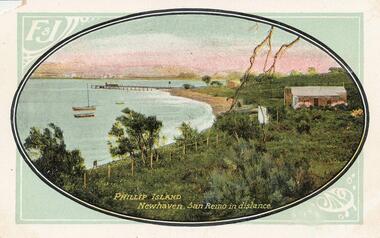
... 'F & J" Coloured Postcard with oval photograph of Newhaven with San Remo in the distance. Two boates moored close to Newhaven beach with Jetty behind. ...Donated by Jean ParleColoured Postcard with oval photograph of Newhaven with San Remo in the distance. Two boates moored close to Newhaven beach with Jetty behind. Three buildings, a fence and trees."Phillip Island Newhaven, San Remo in distance." 'F & J"newhaven foreshore, phillip island, jean parle -
 Phillip Island and District Historical Society Inc.
Photograph - Post Cards, Late 1800's
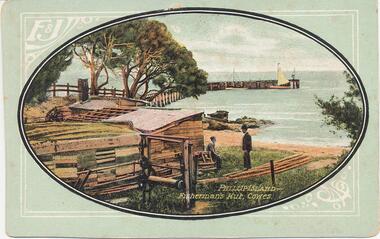
... moored. 2. View of the Cowes Jetty with Jetty Shed in foreground and the Steamer "Lady Loch" in the distance. 3. Surf breaking over the rocks at Phillip Island Back Beach. 4. Cape Woolamai cliffs and shoreline. 5. View of Cowes Jetty taken from a Steamer 6. Wool team and horse and buggy in the background on road to Cowes Photograph - Post Cards F ...Six Postcards donated by Joyce Suto of MitchamSix colour postcards. 1. The hut was probably Mr Cox's. View to Jetty in background with two yachts moored. 2. View of the Cowes Jetty with Jetty Shed in foreground and the Steamer "Lady Loch" in the distance. 3. Surf breaking over the rocks at Phillip Island Back Beach. 4. Cape Woolamai cliffs and shoreline. 5. View of Cowes Jetty taken from a Steamer 6. Wool team and horse and buggy in the background on road to Cowes1. Phillip Island - Fisherman's Hut, Cowes. 2. Phillip Island - Cowes Jetty. Govt. Steamer "Lady Loch" in distance. 3. Phillip Island. Back Beach. 4. Phillip Island - Cape Woolamai. Home of Mutton Bird. 5. Phillip Island - Cowes from Steamer. 6. Phillip Island - Wool Team on road to Cowes.coastline cape woolamai, cowes jetty, fisherman's beach hut, mr cox beach hut, steamers, steamer lady loch, cowes pier phillip island, joyce suto -
 Flagstaff Hill Maritime Museum and Village
Weapon - Cannon, 1866
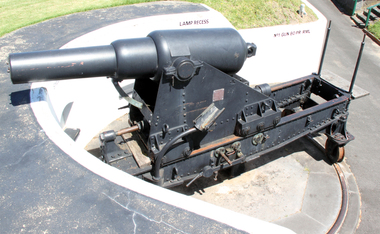
... There are only seven 32 Pounder SB made by Carron and fifteen 68 Pounder SB made at Low Moor known to exist in the State of Victoria On April 4th, 2026, both Cannon No 1 and the recently restored Cannon No. 2 were 'fired' in a public re-enactment. (Conservation Management Plan for Victorian Guns and Cannon, South Western Victoria, May 2008, ref W/F/04)...There are only seven 32 Pounder SB made by Carron and fifteen 68 Pounder SB made at Low Moor known to exist in the State of Victoria On April 4th, 2026, both Cannon No 1 and the recently restored Cannon No. 2 were 'fired' in a public re-enactment. (Conservation Management Plan for Victorian Guns and Cannon, South Western Victoria, May 2008, ref W/F/04) The Warrnambool Garrison has been added to the Victorian Heritage Register H1250 “for its intact battery and guns, a strong reminder of Victoria’s wealth and determination to protect itself from the perceived threat of invasion in the 1880’s.” ...In the years following the Crimean War (1854-1857J) there was a great concern in the Colony that Imperial Russia would attempt an invasion. Coastal defences in the colony of Victoria were greatly strengthened by the Government as a result. Warrnambool was originally protected by cannons at Cannon Hill, approximately 1 kilometer west of the Flagstaff Hill Fortifications. These cannons included two 1866 guns, both 80 Pound Rifled Muzzle Loaders (RML) purchased by Victoria’s Colonial Government. They were part of a shipment of 26 such guns sent from England in December 1866. They are registered as No. 23 (80cwt-2qr-0lbs) - Gun 1, and No.13 (81cwt-1qr-12lbs) - Gun 2. They were cast at the Royal Gun Factory, Woolwich Arsenal, in 1866 and have a 6.3 inch bore. Both barrels carry the Royal Cypher of Queen Victoria, Insignia of the Royal Engineers, within the Garter and Motto surmounted by the Crown, with the Royal Cypher of Queen Victoria within the Garter (letters in centre “VR”, motto “HONI SOIT QUI MAL Y PENSE”, "Shame be to him who thinks evil of it."). The guns were originally supplied with wooden carriages. (The Royal Arsenal at Woolwich, England, was established eleven years after the Restoration of King Charles II. It was the principal supplier of armaments to the British and Empire Governments. At the height of its operations during World War One the factory covered 1300 acres and employed very nearly 80,000 workers. Woolwich was the Headquarters of the Royal Artillery since the raising of that Regiment in 1716. The Arsenal was closed in the late 1960’s.) These two cannons were transferred to the Warrnambool Garrison Artillery Battery Fortifications erected at Flagstaff Hill in 1887 as part of Victoria’s Coastal Defences. The original wooden carriages were subsequently replaced with the present iron garrison carriages in 1888. They are a “C” pivot. The ‘racers’ or curved track set into the floor of the gun emplacement (which enabled the guns to be traversed more quickly) are as specified for guns up to 10 inch, being of wrought iron 2.78 inches wide. A temporary third gun, now no longer on Flagstaff Hill’s site, was a 5 inch Rifled Breech Loading (BL) Armstrong gun mounted on an Elswick hydro pneumatic disappearing carriage It was faster to load and fire than the 80 pound RMLs and its arrival spelt the end of the older 80 pound guns’ useful life, apart from being used for practice sessions. The 5 inch BL gun was the main defensive weapon of the Warrnambool Battery until the Battery was downgraded in importance and the gun was recalled to Melbourne in 1910. The State of Victoria took over the ownership of the guns at the time of Australian Federation in 1901. In about 1901/1902 the Garrison Battery was converted to the Warrnambool Battery of the Australian Field Artillery (No 4 Field Battery). It was equipped with 4.7 inch naval guns mounted on field carriages. They were now a mobile unit but continued to use the Warrnambool Garrison area at Flagstaff Hill for practice. When the Fortifications were declared obsolete the two 80 Pounder RML were relocated to Cannon Hill in 1910. On the outbreak of World War One the 4.7 inch guns were recalled to Melbourne, and the Battery was disbanded. Most of the personnel probably re-enlisted in the local 4th Australian Light Horse Regiment. The two 80 Pounder RML were moved back to the Fortifications in 1973. They were both fully restored by Army First Year Apprentices at the Ordinance Factory in Bendigo in time for the centenary year of the fortifications in 1987. The guns are capable of firing 80 pound (32.3kg) armour piercing exploding shells 3.65kms out to sea. They were original manned by volunteers before a paid Garrison was established. Now the Guns are again fired by volunteers on Special Event days. Since restoration the Gun Number 1 had been fired on a regular basis but Gun Number 2 hadn’t been fired since the mid 1990’s. In April 2015 Gun Number 2 was serviced in preparation for the firing of both cannons on the ANZAC Centenary commemorations on April 25th 2015. Other guns from the original Cannon Hill location were obsolete by the time the 1887 Warrnambool Garrison Artillery Battery was built. These guns are (1) a 32 Pounder Muzzle Loading Smooth Bore (SB) cast in 1813 at the famous Carron Foundry, number 80837 and now located in the Warrnambool Botanic Gardens (2) a 68 Pounder Muzzle Loading Smooth Bore cast in 1861 at the equally august Low Moor Foundry, number 10310 and now located on the lawn area at the entrance to Flagstaff Hill Maritime Village. Both of these guns are mounted on their original wooden garrison carriages. There are only seven 32 Pounder SB made by Carron and fifteen 68 Pounder SB made at Low Moor known to exist in the State of Victoria On April 4th, 2026, both Cannon No 1 and the recently restored Cannon No. 2 were 'fired' in a public re-enactment. (Conservation Management Plan for Victorian Guns and Cannon, South Western Victoria, May 2008, ref W/F/04)The Warrnambool Garrison has been added to the Victorian Heritage Register H1250 “for its intact battery and guns, a strong reminder of Victoria’s wealth and determination to protect itself from the perceived threat of invasion in the 1880’s.” The City of Warrnambool is one of several custodians of a collection of artillery pieces of heritage significance at a state, national and international level. These pieces are directly related to the defence of south-west Victoria in the 19th century. The care and preservation come under the Heritage Act 1995. Cannon. 80 Pounder Rifled Muzzle Loading (RML) Gun on iron carriage and slide, installed in the Battery at Flagstaff Hill’s Fortifications.. Made in 1866 at the Royal Gun Factory (R-G-F), Woolich, England. Gun Reg No - 23. Flagstaff Hill Garrison Gun 1 (Gun No. 1) Insignia of the Royal Engineers, and the weight of the gun, stamped on top of the gun’s barrel. There is a brass plate on the side of the gun with the details of 1987 restoration.Stamped on axle cover on side of barrel “R-G-F / No 23 / 1866”. Stamped into the metal on top of the barrel, Insignia of the Royal Engineers; Garter and Motto “HONI SOIT QUI MAL Y PENSE”, surmounted by the Crown, with the Royal Cypher of Queen Victoria “VR” within the Garter. Also stamped on top of the gun are 2 inward pointing arrows above the weight ”81-2-0”. Brass plate “RESTORATION / BY / FIRST YEAR / APPRENTICES / ORDANANCE FACTORY / BENDIGO 1987”flagstaff hill, warrnambool, shipwrecked coast, flagstaff hill maritime museum, maritime museum, shipwreck coast, flagstaff hill maritime village, great ocean road, cannon, 80 pounder, rifled muzzle, loading, royal gun factory, woolich -
Glen Eira Historical Society
Document - St David’s Uniting Church, Glen Huntly
... Milligan M Miss Chapman May Choirs Abhaywickrema M Theobald J Jones F Abhaywickrema P Riegelhuth J Riegelhuth J Bates T Bates L Ballantyne M Kuhn M Kite L Cameron M Hoare J Roach R Avery D Holmes J Havie J Chapman M Brownbill Ella Barren B Pregnall Joy Hearn Edward Henry Toolambool Road McIntyre Ted Moyle Jenny Avery Daisy Powney Maisie Vertigan Olwyn Dawson Harry Davidson Eileen Mitchell Mabel McCowan Roger Wright Lyn Yeaman J Courtnay J Smith J Yeaman D Fenton S Jones F Penfound J Wright L Lord E Brownbill J Brownbill E Hunter J Mitchell M Barren B Moores E Donaldson J Coulson O Moyle B Johnston E Peden A Osbourne I McCowan R Waters R Rev Duke S Mrs. ...Order of service for the induction of Rev. K Moorhead into the Parish of Glen Huntly 19/01/1984 Order of service for the celebration of the life of Ronald. Henry Summers 1921 – 1999 at St David’s Uniting Church, Glen Huntly, dated June 08/06/1999. Reprinted service of holy communion for Glen Huntly Uniting Parish date unknown. Pamphlet, including photograph of St David’s Uniting Church Parish of Glen Huntly, for the rededication of the Peace Memorial. Pipe organ; for the uniting of the Congregational Methodist and Presbyterian in the Glen Huntly Parish. Reprinted leaflet, with order of service for re-dedication of organ at St David’s 03/03/1985.moorhead kenneth h rev., st david’s uniting church., glen huntly, hunkin edward rev., grange road, waters r rev., rayment rosalie rev, stuart-murray j. dr., duke s. mrs., wallis ken, denholm robin rev., summers ronald henry, gray robin dr., roach harry, roach rene, purcell mr., purcell mrs., stephen cathy, harkness jeff, funston neil, funston robin, sypott e., neerim road, hutchison a, rosedale avenue, barnes peter, fenton r, rockell d, clarke j miss, ness p miss, osborne ivy miss, brownbill jim, courtnay s., fenton leo, johnston e, leather t, moyle b, ness r, peden a, pregnell max, rockell d., jones a., halls, uhe mrs., milligan m miss, chapman may, choirs, abhaywickrema m, theobald j, jones f, abhaywickrema p, riegelhuth j, riegelhuth j, bates t, bates l, ballantyne m, kuhn m, kite l, cameron m, hoare j, roach r, avery d, holmes j, havie j, chapman m, brownbill ella, barren b, pregnall joy, hearn edward henry, toolambool road, mcintyre ted, moyle jenny, avery daisy, powney maisie, vertigan olwyn, dawson harry, davidson eileen, mitchell mabel, mccowan roger, wright lyn, yeaman j, courtnay j, smith j, yeaman d, fenton s, jones f, penfound j, wright l, lord e, brownbill j, brownbill e, hunter j, mitchell m, barren b, moores e, donaldson j, coulson o, moyle b, johnston e, peden a, osbourne i, mccowan r, waters r rev, duke s mrs., adam a. j. rev, hewitt john, davis lyle, organs, cowan john n, organists, scotland betty, musicians, vertigan earle l rev., muirhead j, andrewartha c. w., lomas chas., foundation stone, anderson george rev., fraser finley dr., hadley s. c. rev., simon r. p., mcnair mr, fender mr, forster k rev., flynn john dr., vertigan s. a. rev., muirhead j, smith a.w.f., glen huntly plant nursery, alcock bruce, callen graeme, murrumbeena, neerim road -
 Bendigo Historical Society Inc.
Document - LONG GULLY HISTORY GROUP COLLECTION: CITY OF BENDIGO
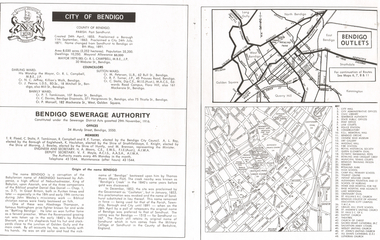
... Bendigo Sewerage Authority Members: T R Flood, C Stoltz, P Tomkinson, R Campbell, R F Turner, A L Roy, K Houlahan, E Knight, J Bowles, M Brennan, H A Moors and V F Moyle. ...Bendigo Sewerage Authority Members: T R Flood, C Stoltz, P Tomkinson, R Campbell, R F Turner, A L Roy, K Houlahan, E Knight, J Bowles, M Brennan, H A Moors and V F Moyle. ...Page with the titled City of Bendigo includes when the County was created, proclaimed a Borough, then a City and a name change, the area, population, swellings and Mayoral Allowance. Darling Ward Councillors were: Cr R L Campbell, The Mayor, Cr N C Jeffrey, and Cr J Pearce. Sutton Ward Councillors, Cr M Petersen, Cr R F Turner, and Cr C Stoltz. and Barkly Ward Councillors, Cr P T Tomkinson, Cr C Davies and Cr P Mansell. Bendigo Sewerage Authority Members: T R Flood, C Stoltz, P Tomkinson, R Campbell, R F Turner, A L Roy, K Houlahan, E Knight, J Bowles, M Brennan, H A Moors and V F Moyle. Also mentioned is the Origin of the name Bendigo. There is a small map of Bendigo Outlet roads and another map with services, attractions, churches, etc.bendigo, history, long gully history group, the long gully history group - city of bendigo, cr r l campbell, cr n c jeffrey, cr j pearce, cr m petersen, cr r f turner, cr c stoltz, cr p t tomkinson, cr c davies, bendigo disposals, cr p mansell, bendigo sewerage authority, t r flood, bendigo city council, a l roy, borough of eaglehawk, k houlahan, shire of strathfieldsaye, e knight, shire of marong, j bowles, shire of huntly, m brennan, h a moors, v f moyle, abednego, john wesley, abednego thompson, battling bendigo, richard sherratt, thomas myers, castleton, sandhurst, military college of sandhurst england -
 Bendigo Historical Society Inc.
Document - NORMAN OLIVER COLLECTION: MAYORAL RETIREMENT SPEECH, UNDATED
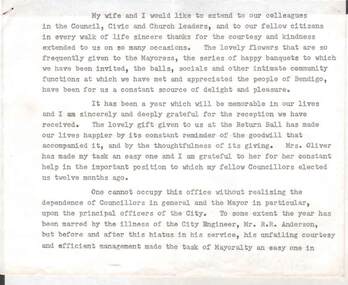
... F. (Dick) Turner was Mayor 1965-66. Individuals mentioned in this speech : Mr R. R. Anderson (City Engineer), Mr H. A. Moors...F. (Dick) Turner was Mayor 1965-66. Individuals mentioned in this speech : Mr R. R. Anderson (City Engineer), Mr H. A. Moors ...The Norman Oliver collection. Norman Oliver was three times Mayor of Bendigo - 1950-51, 1964-65, 1970-71. Six typed pages, stapled, undated. Mentions that his successor as Mayor will be Cr Turner. R. F. (Dick) Turner was Mayor 1965-66. Individuals mentioned in this speech : Mr R. R. Anderson (City Engineer), Mr H. A. Moors (Bendigo Sewerage Authority), Mr A. J. Watts (Town Clerk) and wife, Miss B. Liddell (staff), Douglas Anderson (Victorian Promotion Committee), Mr Sidney Morrell (New York), Mr Brian Harrison (MP of London), Sir Norman Martin (Victorian Inland Meat Authority), Mr Evans (Department of Immigration), Lindsay Thompson (MLC and Minister of Housing). Mr Sid Mellis and Mr J. Jeffrey, both retired Hargreaves St businessmen, have been associated with the Mayor's Blanket Appeal.bendigo, council, speech notes, norman joseph oliver , councillor norman oliver. mayor of bendigo. victorian promotion committee. victorian inland meat authority. mayor's blanket appeal. -
 Bendigo Military Museum
Postcard - POSTCARD, ASH, U.K, F. Frith and Co, c. WW1
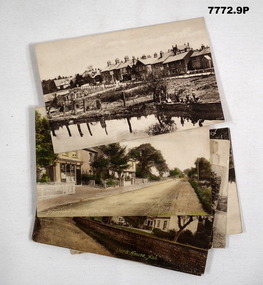
... moored on bank. Buildings on far side of river. 8. Sepia toned photograph of a row of houses fronting a road. 9. Sepia toned photograph featuring people on a wharf. Row of houses in back ground. Postcard POSTCARD, ASH, U.K. F ...Cards collected by R.H. Baron when visiting his Uncle who lived near the village of ASH, UK. c.Nov 1918. Part of the "Robert H. Baron", No. 3596 and Cooper Collections. See Catalogue No. 1981P for details of Baron's service.1. Coloured photograph of a street featuring building including a Post Office. 2. Coloured photograph of a house fronting a gravel road. 3. Sepia toned photograph of a gravel road, vegetation and trees. 4. Sepia toned photograph of a row of houses fronting a gravel road. 5. Sepia toned photograph of a row of houses. Man standing next to a horse and cart. Large pond in foreground. 6. Sepia toned photograph of a row of houses. Man standing next to a horse and cart. Large pond in foreground. 7. Sepia toned photograph of a river with boats moored on bank. Buildings on far side of river. 8. Sepia toned photograph of a row of houses fronting a road. 9. Sepia toned photograph featuring people on a wharf. Row of houses in back ground.1. Pinewood Post Office, Ash. Handwritten in faded black ink on back: 'This is the road Uncle lives in. he live just about opposite the cross (or house in middle) I made on the card, Bob'. 2. York House, Ash. Handwritten in black ink on back: 'Just near my Uncle's place in Ash, Bob.' 3. Fox Hills, Ash. Handwritten in faded black ink on back: 'Letter from R.H. Baron to his brother Freddy - no date.' 4. Ash Common, Victoria Hall, etc. Handwritten in faded black ink on back: ' Of course you will know Ash as you have wrote it bit when writing to Uncle, Bob'. 5. Ash Village & Pond: Handwritten in faded black ink on back: 'This is Ash Village - is about 1 mile from where Uncle lives. Bob.' 6. Ash Village and Pond: Handwritten in faded black ink on back: 'Letter to Elsie from R.H. Baron - no date.' 7. Ash Vale. The Wharf. Handwritten in faded black ink on back: 'Letter to Elsie from R.H. Baron - no date.' 8. Ash Vale. The Wharf. Handwritten in faded black ink on back: 'Partial letter to R.H. Baron's brother - c.Armistice Day. 9. Ash Vale. Handwritten in faded black ink on back: 'Another view of Ash, Bob.'robert h. baron, cooper collection, postcards, ash uk, ww1 -
 Expression Australia
Newsletter, The Victorian Deaf News January 1937
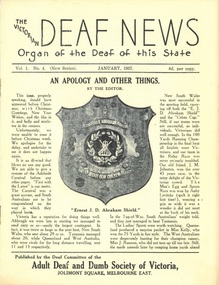
... Published by the Deaf Committee of the Adult Deaf and Dumb Society of Victoria 'The Victorian Deaf News' Newsletter is a significant publication as an historical record giving and insight into the people, activities and events of the Deaf Community in Victoria. e. j. d. abraham shield, kelly, ransom, roly mcgrath, bundy, plunkett, wilbow, levitzke, puddy, dickenson, salton, warburton, south australian carnival, british deaf times, george frankland, joe hepworth, h. m. cuttell, british deaf times, alex mcgregor, h. b. beale, george wilkinson, british deaf monthly, maxwell s. fry, herr albreghs, douglas tilden, thomas williamson, w. k. morrison, g. r. davidson, f. e. frewin, j. mclean, g. newnham, j. m. johnston, r. dow, r. lygon, i. guthrie, alf tyzzer, mrs j. e. muir, t. peters, mrs a. wilson, deaf men's guild, deaf women's guild, w. burgess, w. bladier, j. collins, colin johns, mrs w. a. patterson, vernon griffiths, hood, mrs ed johnson, e. moores. ferguson stokes, damman, hopkins, abbott, richie, thomas james derby, ashby, nancy newton, reiffel, hunt, o'keeffe, caroline, pickett, sinnott, peters, mrs g. h. oakley, c. t. o. graham, Vol. 1 No. 4 (New Series) January 1937; Size 24.5cmHx18.5cmW; 16 pages The Victorian Deaf News January 1937 Newsletter ...Published by the Deaf Committee of the Adult Deaf and Dumb Society of Victoria'The Victorian Deaf News' Newsletter is a significant publication as an historical record giving and insight into the people, activities and events of the Deaf Community in Victoria.Vol. 1 No. 4 (New Series) January 1937; Size 24.5cmHx18.5cmW; 16 pagese. j. d. abraham shield, kelly, ransom, roly mcgrath, bundy, plunkett, wilbow, levitzke, puddy, dickenson, salton, warburton, south australian carnival, british deaf times, george frankland, joe hepworth, h. m. cuttell, british deaf times, alex mcgregor, h. b. beale, george wilkinson, british deaf monthly, maxwell s. fry, herr albreghs, douglas tilden, thomas williamson, w. k. morrison, g. r. davidson, f. e. frewin, j. mclean, g. newnham, j. m. johnston, r. dow, r. lygon, i. guthrie, alf tyzzer, mrs j. e. muir, t. peters, mrs a. wilson, deaf men's guild, deaf women's guild, w. burgess, w. bladier, j. collins, colin johns, mrs w. a. patterson, vernon griffiths, hood, mrs ed johnson, e. moores. ferguson stokes, damman, hopkins, abbott, richie, thomas james derby, ashby, nancy newton, reiffel, hunt, o'keeffe, caroline, pickett, sinnott, peters, mrs g. h. oakley, c. t. o. graham, -
 Lakes Entrance Historical Society
Postcard - Baang Yarnda on the Tambo River, c1930
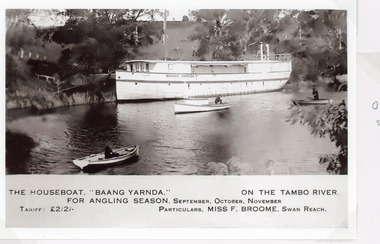
... Particulars:.Miss F Broome Swan Reach Sepia toned postcard of the houseboat Baang Yarnda associated with Broome's Federal Hotel houseboat is moored in the Tambo River, people fishing from two small rowing boats and motor boat on river. ...The houseboat Baang Yarnda on the Tambo River for angling season, September October November. Tariff 2 pound 2 shillings Particulars Miss F Broome Swan ReachSepia toned postcard of the houseboat Baang Yarnda associated with Broome's Federal Hotel houseboat is moored in the Tambo River, people fishing from two small rowing boats and motor boat on river. Tambo Upper VictoriaThe Boat Baang Yarnda On the Tambo River. For Angling Season September, October, November Tariff Pounds 2/2/. Particulars:.Miss F Broome Swan Reachguesthouses, tourism, boats and boating
