
Showing 3688 items matching "fabric "
-
 Sunshine and District Historical Society Incorporated
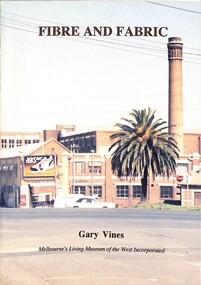
Book - Fibre and Fabric, Melbourne's Living Museum of the West, 1993
... Fibre and Fabric...... Fabric...Fibre and Fabric - The wool, cotton, textile and allied industries in Melbourne's west...The picture on the front cover is the Former Bradford Cotton Mill 'Bradmills'. Fibre and Fabric Book Fibre and Fabric Melbourne's Living Museum of the West Vines, Gary ...The book covers the history of wool, cotton, textile and allied industries in Australia and Melbourne's westSlim A5 book, well-illustrated. The picture on the front cover is the Former Bradford Cotton Mill 'Bradmills'.non-fictionThe book covers the history of wool, cotton, textile and allied industries in Australia and Melbourne's westfibre, fabric, work in the west, wool, cotton and textile industries in melbourne's west, employment -
 Melbourne Legacy
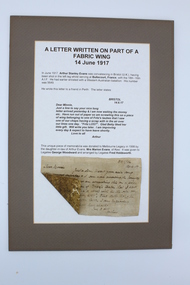
Document, Letter written on part of a fabric wing 14 June 1917, 1917
... Letter written on part of a fabric wing 14 June 1917...The letter was written on the fabric of an aircraft wing. The letter was written by Arthur Stanley Evans while convalescing in Briston in 1917. ...Lower left hand corner folded over showing the reverse side of the fabric. Original letter rectangular in shape. ...The original letter is hand written on a piece of wing fabric from a German aircraft shot down over Allied lines....Letter written on part of a fabric wing 14 June 1917 Document ...A wartime letter written by Arthur Evans that was later mounted on card for display purposes. It was donated to Legacy in 1998. The letter was written on the fabric of an aircraft wing. The letter was written by Arthur Stanley Evans while convalescing in Briston in 1917. He had been injured at Bullecourt, France with the 18th-16th AIF. The letter says 'Dear Minnie, Just a line to say your nice long letter arrived yesterday and I am now waiting the money etc. Have run out of paper so am scrawling this on a piece of wing belonging to one of Fritz's tubes that I saw one of our chaps having a scrap with in the air over our lines one day. "Fritz LOST". Glad Betty liked her little gift. Will write you later. I am improving every day and expect to have leave shortly. Love to all, Arthur." Not to let war time shortages of paper get in Arthur Evans way, he improvised and his letter to Minnie, it arrived intact. The fabric would be quite durable and light. A great memento to show family and friends.Despite war time shortages a little ingenuity can overcome many difficulties.Backing, ply board. Letter and short story typed on white cardboard, cardboard fixed to ply backing. Original letter fixed to white cardboard. Lower left hand corner folded over showing the reverse side of the fabric. Original letter rectangular in shape. All of the above is surrounded by a brownish border.The letter, the story and how the letter came to Legacy is printed in brown ink. The original letter is hand written on a piece of wing fabric from a German aircraft shot down over Allied lines.souvenir, world war one -
 National Wool Museum
Book, Fibre and Fabric
... Fibre and Fabric..."Fibre and Fabric: the wool, cotton, textile and allied industries in Melbourne's West" - Gary Vines, 1993. ...FIBRE AND FABRIC / Gary Vines / Melbourne's Living Museum of the West Incorportated..."Fibre and Fabric: the wool, cotton, textile and allied industries in Melbourne's West" - Gary Vines, 1993. ..."Fibre and Fabric: the wool, cotton, textile and allied industries in Melbourne's West" - Gary Vines, 1993. This book is a short history of the wool, cotton, textile and allied industries of the area west of Melbourne. It looks at how, why and when these industries developed and their effect upon the cultural and geographic landscape.FIBRE AND FABRIC / Gary Vines / Melbourne's Living Museum of the West Incorportatedtextile industry - history woollen mills - history, textile industry - history, woollen mills - history -
 National Wool Museum
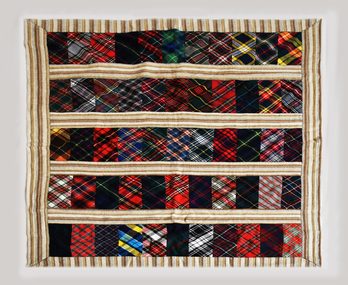
Textile - Quilt, Ms Jane McGrath, Tartan Fabric Sample, c.1990
... Tartan Fabric Sample...Jane McGrath made this quilt 30 years ago from a tartan fabric sample book (c.1990). It was one of her first quilts. ...The rows of tartan samples are broken with a boarder of white, grey, and brown fabric which runs in parallel lines. This fabric is also used to bind the quilt together at the edges. ...Jane McGrath made this quilt 30 years ago from a tartan fabric sample book (c.1990). It was one of her first quilts. ...Jane McGrath made this quilt 30 years ago from a tartan fabric sample book (c.1990). It was one of her first quilts. Jane was inspired to quilt by her mother Shirley Critchley. Jane recalls her mother being a very talented quilter, with one example being the “Unpicked Jumper Wagga” which can be found within the National Wool Museum’s Collection (REG 8283). Shirley taught Jane the basics in quilting and assisted her in preparing this quilt. The quilt is backed with material from disused woollen skirts. Jane could not recall what material was used for the internal insulating fabric. Jane donated the Tartan Fabric Sample Quilt to the National Wool Museum in 2021. The quilt had been languishing in her cupboard for many years and had found its way to the op-shop pile, as her children had no desire to inherit her quilts. The top layer of the quilt consists of five distinct rows of tartan samples appliqued together. The rows of tartan samples are broken with a boarder of white, grey, and brown fabric which runs in parallel lines. This fabric is also used to bind the quilt together at the edges. The internal insulating fabric of the quilt is not known. The backing fabric is a grey coloured wool originating from disused skirts. The Tartan samples contain stripes of varying width and colour. The samples have been arranged so that the stripes run diagonal on the quilt. Many different colours have been used. The predominant colours are red and black, with lessening amounts of blue, yellow, white, green, and grey featuring. quilts, tartan fabric samples, upcycle, shirley critchley/jane mcgrath collection -
![Memorabilia - Patch, Thomastown Golf Club, Thomastown Golf Club [fabric patch]](/media/collectors/4f729f5697f83e03086015b8/items/64c0c581d07af9549e8c60c2/item-media/65ac6b2ffc29fd7dc16a018e/item-fit-380x285.jpg?cb=6) Greensborough Historical Society
Greensborough Historical SocietyMemorabilia - Patch, Thomastown Golf Club, Thomastown Golf Club [fabric patch]
... Thomastown Golf Club [fabric patch]...Fabric golf patch in yellow and brown....Thomastown Golf Club Robert Jones identity patch Fabric golf patch in yellow and brown. Thomastown Golf Club [fabric patch] Memorabilia Patch Thomastown Golf Club ...Golf 'patch' available to Thomastown Golf Club members. Patches such as this would be sewn onto an outer garment to identify team members.Thomastown Golf Club was a social golf club formed in 1976. This is part of the Robert (Bob) Jones collection of Club memorabilia.Fabric golf patch in yellow and brown.thomastown golf club, robert jones, identity patch -
 NMIT (Northern Melbourne Institute of TAFE)
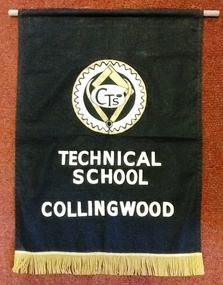
School banner: Collingwood Technical School, School banner: Collingwood Technical School Black fabric banner with gold tassell at bottom, on a timber rod
... School banner: Collingwood Technical School Black fabric banner with gold tassell at bottom, on a timber rod...Black fabric (probably cotton) banner with gold tassell at bottom...Also stencilled on is 'TECHNICAL / SCHOOL / COLLINGWOOD' Black fabric (probably cotton) banner with gold tassell at bottom School banner: Collingwood Technical School Black fabric banner with gold tassell at bottom, on a timber rod School banner: Collingwood Technical School ...Black fabric (probably cotton) banner with gold tassell at bottomBlack, white and gold CTS logo stencilled on it. Also stencilled on is 'TECHNICAL / SCHOOL / COLLINGWOOD' collingwood technical school, banner, nmit. -
 Hymettus Cottage & Garden Ballarat
Functional object - Bookmark, Fabric bookworm bookmark
... Fabric bookworm bookmark......Fabric...Bookmark Fabric bookworm craft Fabric bookworm bookmark Functional object Bookmark ...bookmark, fabric, bookworm, craft -
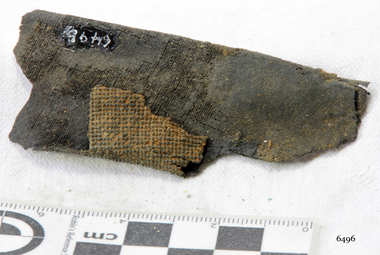 Flagstaff Hill Maritime Museum and Village
Fabric
... Fabric......fabric...Small piece of fabric that has been coated with unknown substance, very fragile. ...From the wreck of the Falls of Halladale. Fabric ...The iron-hulled, four-masted barque, the Falls of Halladale, was a bulk carrier of general cargo. She left New York in August 1908 on her way to Melbourne and Sydney. In her hold, along with 56,763 tiles of unusual beautiful green American slates (roofing tiles), 5,673 coils of barbed wire, 600 stoves, 500 sewing machines, 6500 gallons of oil, 14400 gallons of benzene, and many other manufactured items, were 117 cases of crockery and glassware. Three months later and close to her destination, a navigational error caused the Falls of Halladale to be wrecked on a reef off the Peterborough headland at 3 am on the morning of the 15th of November, 1908. The captain and 29 crew members all survived, but her valuable cargo was largely lost, despite two salvage attempts in 1908-09 and 1910. ABOUT THE ‘FALLS OF HALLADALE’ (1886 - 1908) Built: in1886 by Russell & Co., Greenock shipyards, River Clyde, Scotland, UK. The company was founded in 1870 (or 1873) as a partnership between Joseph Russell (1834-1917), Anderson Rodger and William Todd Lithgow. During the period 1882-92 Russell & Co., standardised designs, which sped up their building process so much that they were able to build 271 ships over that time. In 1886 they introduced a 3000 ton class of sailing vessel with auxiliary engines and brace halyard winches. In 1890 they broke the world output record. Owner: Falls Line, Wright, Breakenridge & Co, 111 Union Street, Glasgow, Scotland. Configuration: Four masted sailing ship; iron-hulled barque; iron masts, wire rigging, fore & aft lifting bridges. Size: Length 83.87m x Breadth 12.6m x Depth 7.23m, Gross tonnage 2085 ton Wrecked: the night of 14th November 1908, Curdies Inlet, Peterborough south west Victoria Crew: 29 The Falls of Halladale was a four-masted sailing ship built-in 1886 in Glasgow, Scotland, for the long-distance cargo trade and was mostly used for Pacific grain trade. She was owned by Wright, Breakenridge & Co of Glasgow and was one of several Falls Line ships, all of which were named after waterfalls in Scotland. The lines flag was of red, blue and white vertical stripes. The Falls of Halladale had a sturdy construction built to carry maximum cargo and able to maintain full sail in heavy gales, one of the last of the ‘windjammers’ that sailed the Trade Route. She and her sister ship, the Falls of Garry, were the first ships in the world to include fore and aft lifting bridges. Previous to this, heavily loaded vessels could have heavy seas break along the full length of the deck, causing serious injury or even death to those on deck. The new, raised catwalk-type decking allowed the crew to move above the deck stormy conditions. This idea is still used today on the most modern tankers and cargo vessels and has proved to be an important step forward in the safety of men at sea. On 4th August 1908, with new sails, 29 crew, and 2800 tons of cargo, the Falls of Halladale left New York, bound for Melbourne and Sydney via the Cape of Good Hope. The cargo on board was valued at £35,000 and included 56,763 tiles of American slate roofing tiles (roof slates), 5,673 coils of barbed wire, 600 stoves, 500 sewing machines, 6,500 gallons of oil, 14,400 gallons of benzene, plumbing iron, 117 cases of crockery and glassware and many other manufactured items. The Falls of Halladale had been at sail for 102 days when, at 3 am on the night of 14th November 1908, under full sail in calm seas with a six knots breeze behind and misleading fog along the coast, the great vessel rose upon an ocean swell and settled on top of a submerged reef near Peterborough on the south-west Victoria’s coast. The ship was jammed on the rocks and began filling with water. The crew launched the two lifeboats and all 29 crew landed safely on the beach over 4 miles away at the Bay of Islands. The postmistress at Peterborough, who kept a watch for vessels in distress, saw the stranding and sent out an alert to the local people. A rescue party went to the aid of the sailors and the Port Campbell rocket crew was dispatched, but the crew had all managed to reach shore safely by the time help arrived. The ship stayed in full sail on the rocky shelf for nearly two months, attracting hundreds of sightseers who watched her slowly disintegrate until the pounding seas and dynamiting by salvagers finally broke her back, and her remains disappeared back into deeper water. The valuable cargo was largely lost, despite two salvage attempts in 1908-09 and 1910. Further salvage operations were made from 1974-1986, during which time 22,000 slate tiles were recovered with the help of 14 oil drums to float them, plus personal artefacts, ship fittings, reams of paper and other items. The Court of Marine Inquiry in Melbourne ruled that the foundering of the ship was entirely due to Captain David Wood Thomson’s navigational error, not too technical failure of the Clyde-built ship. The shipwreck is a popular site for divers, about 300m offshore and in 3 – 15m of water. Some of the original cargo can be seen at the site, including pieces of roof slate and coils of barbed wire. The Falls of Halladale shipwreck is listed on the Victorian Heritage Register (No. S255). She was one of the last ships to sail the Trade Routes. She is one of the first vessels to have fore and aft lifting bridges. She is an example of the remains of an International Cargo Ship and also represents aspects of Victoria’s shipping industry. The wreck is protected as a Historic Shipwreck under the Commonwealth Historic Shipwrecks Act (1976).Small piece of fabric that has been coated with unknown substance, very fragile. From the wreck of the Falls of Halladale.flagstaff hill, warrnambool, shipwrecked-coast, flagstaff-hill, flagstaff-hill-maritime-museum, maritime-museum, shipwreck-coast, flagstaff-hill-maritime-village, falls of halladale, fabric, russell & co. -
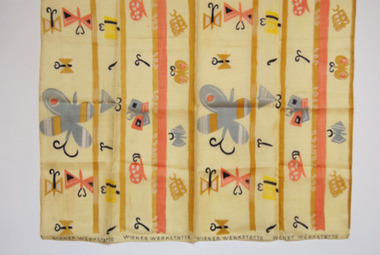 Duldig Studio museum + sculpture garden
Fabric, Mathilda Flogl, Falter designed by Mathilda Flogl 1924-31, 1924-31
... Fabric...This piece of fabric, known Fälter (butterfly), was designed by Mathilda Flögl (1893-1958), who worked in the textile department of the Wiener Werkstätte in Vienna. ...Remnant of a block-printed silk fabric used to make the bedspread for Karl Duldig and Slawa Horowitz-Duldig's bed in Vienna....This piece of fabric, known Fälter (butterfly), was designed by Mathilda Flögl (1893-1958), who worked in the textile department of the Wiener Werkstätte in Vienna. ...This piece of fabric, known Fälter (butterfly), was designed by Mathilda Flögl (1893-1958), who worked in the textile department of the Wiener Werkstätte in Vienna. It is a remnant of the fabric that was used to make a bedspread for Karl and Slawa’s bed in their Vienna apartment where it lay decoratively over a gold brocade eiderdown. The purchase demonstrated Slawa’s interest in and knowledge of modern design and her commitment to the idea of enriching everyday life with beautiful objects, a principal of the Viennese Secession. Following the Duldigs removal from Vienna, the original bedspread and remnant were safeguarded and preserved by Slawa’s sister, Rella, in the basement of her Paris apartment. In 1948 the bedspread and this remnant were sent to Australia. The bedspread was a much-loved item but deteriorated over the years. In 1955 it was made into curtains, which are held in the Duldig Studio Collection. The Photographs of the bedspread in its original location are also held in the collection. The remnant is in pristine condition. The Wiener Werkstätte (Vienna Workshop) was a guild of designers and craftsmen that was founded by the architect Josef Hoffman (1879-1956) and the designer Koloman Moser (1868-1918). The firm manufactured a range of interior furnishings between 1903 and 1932. The textile department opened in 1900, and produced about 1,800 designs, mainly for printed fabrics for furnishings and apparel. The designs were characterised by simplified forms and vivid colours, and inspired by Eastern European peasant art and geometric motifs in contemporary painting. The workshop had a profound impact of European art and design, and its work is still celebrated today. Mathilde Flögl was born in the Czech Republic in 1893, and studied at the Kunstgerwerbeschule in Vienna. In 1916 she began working at the Weiner Werkstätte, and where she designed more than 120 textile patterns. This fabric Fälter or Butterfly was designed in 1924. The butterfly was a favourite motif of Flögl. In this design she plays with a variety of whimsical abstractions and arrangement of both the butterfly and the snail on a background of abstract colour stripes and blocks. Ann Carew 2016The fabric is of great aesthetic interest as an example of the work of the Viennese workshops, and the noted designer textile designer Mathilde Flögl. The original pencil drawings, pencil and gouache designs, and fabric swatches for Fälter are held in the MAK Museum in Vienna, and the Victorian and Albert Museum in London have a sample of piece of the silk fabric in an alternate colour wave. The Museum of Applied Arts in Sydney holds a swatch book of textiles from the Wiener Werkstätte, however Flögl’s work is not represented. The National Gallery of Victoria holds a similar swatch book. The remnant has an excellent provenance, is associated with a powerful personal narrative, and is significant and rare item relating to history of the Wiener Werkstätte in Vienna, and the oeuvre of Matilda Flögl. Ann Carew 2016Remnant of a block-printed silk fabric used to make the bedspread for Karl Duldig and Slawa Horowitz-Duldig's bed in Vienna. -
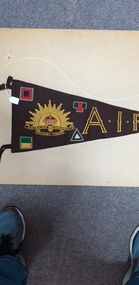 Colac RSL Sub Branch
Souvenir - AIF Pennant, Blue Fabric Pennant
... Blue Fabric Pennant...Dark Blue fabric Pennant with Gold writing and Battalion Colour Patches x 4....Blue Fabric Pennant Souvenir AIF Pennant ...Baulch Family CollectionSignificantDark Blue fabric Pennant with Gold writing and Battalion Colour Patches x 4.Gold coloured Rising Sun, Battalion coloured patches x 4. (check which battalions??) AIF in gold lettering -
 Warrnambool and District Historical Society Inc.
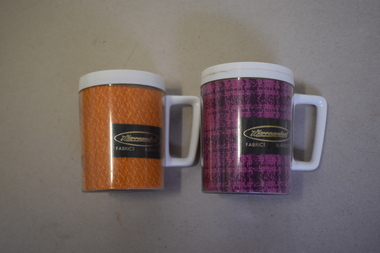
Mugs, Newlyne Mfg. Co Pty Ltd, Warrnambool Fabric Blankets, Mid 20th century
... Warrnambool Fabric Blankets....1 & .2 Warrnambool Fabrics Blankets Steditemp Insulated Ware Made in Australia by Newlyne MFG Co Pty Ltd Division of J. ...The maker’s name is etched into the base of the mug. Warrnambool Fabric Blankets Mugs Newlyne Mfg. Co Pty Ltd ...These mugs are souvenirs of the Warrnambool Woollen Mill. They were either sold as souvenirs or given to clients of the mill. The Warrnambool Woollen Mill in South Warrnambool was opened in 1910 with the first manager being John Bennett, an Englishman who recruited skilled weavers and bought mill equipment from his home country. At the height of production the mill was employing up to 700 people. In 1958 the mill became the first in Australia to manufacture electric blankets. In 1968 the mill was sold to the Dunlop company and in the ensuing years various companies owned the plant. In the year 2000 the mill was closed and the equipment was sold. The buildings were sold to a private developer and the first residents moved into the new housing estate in 2009. These mugs are of interest as mementoes of the Warrnambool Woollen Mill, a key industry in the development of Warrnambool and one that operated for 90 years. .1 This is an insulated plastic mug with a mottled orange-coloured body and a white rim on the top opening and a white handle. On the side of the mug is a printed name with gold lettering on a brown background. The maker’s name is etched into the base of the mug. .2 This is an insulated plastic mug with a purple and black mottled body and a white rim on the top opening and a white handle. On the side of the mug is a printed name on a brown background with gold lettering. The maker’s name is etched into the base of the mug. .1 & .2 Warrnambool Fabrics Blankets Steditemp Insulated Ware Made in Australia by Newlyne MFG Co Pty Ltd Division of J. Glaser & Co Melbourne warrnambool woollen mill -
 Alfred Hospital Nurses League - Nursing History Collection
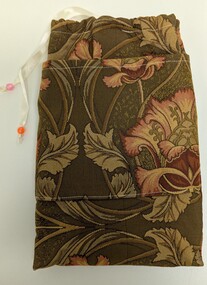
Functional object - Fabric bag, Fabric bag for broken brick from Alfred Hospital Main Nurses Home, unknown
... Fabric bag for broken brick from Alfred Hospital Main Nurses Home...Drawstring bag made from upholstery fabric, with a complex, repeating floral and leaf pattern (? ...designed by William Morris)in shades of brown, gold and pinkish-orange colours, pocket in matching fabric on front. White satin ribbon drawstring with a coloured plastic bead on each end Fabric bag for broken brick from Alfred Hospital Main Nurses Home Functional object Fabric bag ...made to hold 202510.027.01 - broken brick from Main Nurses Home Alfred Hospital. Donor used the bag to carry the brick to nursing reunionsAs it protected the brick significant to the Alfred Hospital Nurses League as many members lived there during their training and there was much controversy around the demolition of the building.Drawstring bag made from upholstery fabric, with a complex, repeating floral and leaf pattern (? designed by William Morris)in shades of brown, gold and pinkish-orange colours, pocket in matching fabric on front. White satin ribbon drawstring with a coloured plastic bead on each endprevious catalogue number written on white cotton tape and sewn to backalfred hospital main nursing home, nurses home, alfred hospital, alfred hospital nurses league -
National Wool Museum
Book, Wool Fabric Resource Guide
... Wool Fabric Resource Guide..."Wool Fabric Resource Guide" - Australian Wool Corporation, c.1985...."Wool Fabric Resource Guide" - Australian Wool Corporation, c.1985. ..."Wool Fabric Resource Guide" - Australian Wool Corporation, c.1985.textile production machine knitting woollen mills, australian wool corporation, cloth - woollen, cloth - worsted, textile production, machine knitting, woollen mills -
Tatura Irrigation & Wartime Camps Museum
Book, Fabric of Society. The Templer Journey. An Embroidered History, 2009
... Fabric of Society. The Templer Journey. An Embroidered History...This book covers in word and pictures the vision, the evolution and the creationof "The Templer Society - Fabric of Society...This book covers in word and pictures the vision, the evolution and the creationof "The Templer Society - Fabric of Society the templer journey embroidered history kuhnle l tatura ww2 templers books collections Beige soft cover book with 2 street scenes on the front cover and a large rural scene on the back cover Fabric of Society. ...This book covers in word and pictures the vision, the evolution and the creationof "The Templer Society - Fabric of SocietyBeige soft cover book with 2 street scenes on the front cover and a large rural scene on the back coverthe templer journey, embroidered history, kuhnle l, tatura, ww2, templers, books, collections -
![Advertisement - Digital image, Robia [fabric], 12/09/1935](/media/collectors/4f729f5697f83e03086015b8/items/5a1a555a21ea671ca45c94a7/item-media/5a1a55c221ea671ca45cf602/item-fit-380x285.jpg?cb=6) Greensborough Historical Society
Greensborough Historical SocietyAdvertisement - Digital image, Robia [fabric], 12/09/1935
... Robia [fabric]...This advertisement for Robia fabric and depicts an elegant image of a completed dress....Robia [fabric] Advertisement - Digital image ...These advertisements were found in a suitcase donated by a GHS member. The case contained newspapers and other items. This advertisement for Robia fabric and depicts an elegant image of a completed dress.Although the advertisement not Greensborough based, it came from a local home.Digital copy of newspaper advertisement.robia fabric -
National Wool Museum
Book, Fabric of Our Community
... Fabric of Our Community..."Fabric of our community" - City of Hamilton Art Gallery, 1988. ..."Fabric of our community" - City of Hamilton Art Gallery, 1988. ..."Fabric of our community" - City of Hamilton Art Gallery, 1988. Catalogue for an exhibition of modern quilts produced to celebrate the bicentenary in Hamilton. They were accompanied by a display of historic textiles from the Hamilton Art Gallery's permanent collection.quilting patchwork handicrafts, city of hamilton art gallery, quilting, patchwork, handicrafts -
Federation University Historical Collection
Booklet, Social Fabric - Past to Future: Celebrating 100 years of women's sufferage in the central goldfields region of Victoria 1908 - 2008
... Social Fabric - Past to Future: Celebrating 100 years of women's sufferage in the central goldfields region of Victoria 1908 - 2008...A5 booklet titled Social Fabric - Past to Future: Celebrating 100 years of women's sufferage in the central goldfields region of Victoria wth photograph of two women having a cup of tea on the front cover....Social Fabric - Past to Future: Celebrating 100 years of women's sufferage in the central goldfields region of Victoria 1908 - 2008 Booklet ...A5 booklet titled Social Fabric - Past to Future: Celebrating 100 years of women's sufferage in the central goldfields region of Victoria wth photograph of two women having a cup of tea on the front cover.social fabric - past to future, women's sufferage, elizabeth ann hooke buchan, sarah jane dunstone, helen hunt, bessie lee, cecille bucknall joyce, annie lowe, reverend henry greenwood, george chessell, reverend brian wibberley, james blackburne, helen hart, j.c.f. ulbrich, james hugh gearing, alfred outtrim, eliza hubble, emily h. colman, e.r. edwards, j.b. edwards, annie c. stubbs, harriet a. stubbs, eliz. a stubbs, h. toole, mrs waddell, mary haylock, mary hill -
 Ararat Gallery TAMA
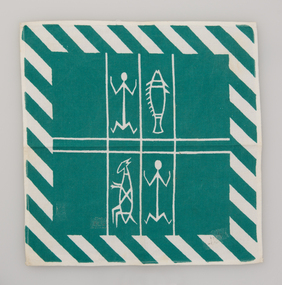
Frances Burke, Hemmed, fabric square, 1950-1955
... Hemmed, fabric square...Burke’s furnishing fabrics took their place in influential modern buildings Australia-wide through collaborations with leading architects and interior designers. ...Written by Nanette Carter and Robyn Oswald-Jacobs. Hemmed, fabric square Frances Burke ...Frances Burke: Designer of Modern Textiles Australia’s most influential and celebrated textile designer of the mid-20th century, Frances Burke (1904-1994), employed Australian native flora, garden flowers, marine subjects, Indigenous culture and increasingly, abstract motifs in her stunning modern fabrics. A confident, determined designer and businesswoman; Burke made the shift from fine art to design in 1937. While she began by designing dress fabrics for Melbourne’s fashionable Georges Department store, printing them on linen using lino blocks, she was an early adopter of the screen-printing process and during the war years began printing on cotton. Burke’s furnishing fabrics took their place in influential modern buildings Australia-wide through collaborations with leading architects and interior designers. They included Robin Boyd’s 1949 House of Tomorrow, Roy Grounds’ Quamby flats, Guilford Bell’s Royal Hayman Island Resort for Ansett Airlines, and Yuncken, Freeman Brothers, Griffiths and Simpson’s Canberra Civic Centre Theatre. In the post-war period, Burke made regular trips to the United States and Europe, on her return advising homeowners and manufacturers on the latest trends in products, colours and home design in lectures and interviews. At New Design her fabric showroom and interior design consultancy Burke introduced furniture by emerging designers Clement Meadmore and Grant Featherston in the early 1950s and presented local and imported homewares, mostly from the United States. She was enthusiastic about the convenient and comfortable lifestyle experienced by ordinary American women. Her fabrics and advice were regularly featured in Australian Home Beautiful, Australian House and Garden and the newspapers of the day. Some of Burke’s designs had remarkable longevity. Tiger Stripe (1938) for example, continued to be produced in a wide range of colours until 1970 and Crete (1946) remained a popular choice for interiors into the 1960s. Drawing from a rich variety of sources including Indigenous culture in Goanna (c.1954) and Pacific Island tapa cloth designs in Bird and Tree (1940), Burke also looked to Japan in designs such as Plum Blossom (1948) and Zen (1965). She loved exploring the potential of native flora, seen in designs including Waratah (1955) and Flannel Flower (1955), while garden flowers were the source for many other designs including Belladonna (1940), Periwinkle (n.d.) and Rose (1947). Burke’s clever interplay of a single striking printed colour with lively gestural lines revealing the white base fabric, gave her designs a vibrancy that characterised the optimistic post-war era. This can be seen in Burke’s fabrics for Hayman Island including Angel Fish and Seapiece (both 1949) which expressed the freshness and excitement of the luxurious new tropical resort and led to further commissions. Burke’s three decades in business (1937-1970) were an unparalleled success in the story of Australian design. Her fabrics have been collected by the NGA, the Powerhouse Museum, NGV, RMIT Design Archives and Sydney Living Museums in addition to Ararat Gallery TAMA. Written by Nanette Carter and Robyn Oswald-Jacobs. -
 Ararat Gallery TAMA
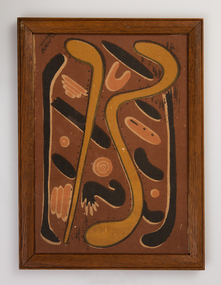
Frances Burke, Fabric piece, framed
... Fabric piece, framed...Burke’s furnishing fabrics took their place in influential modern buildings Australia-wide through collaborations with leading architects and interior designers. ...Written by Nanette Carter and Robyn Oswald-Jacobs. Fabric piece, framed Frances Burke ...Frances Burke: Designer of Modern Textiles Australia’s most influential and celebrated textile designer of the mid-20th century, Frances Burke (1904-1994), employed Australian native flora, garden flowers, marine subjects, Indigenous culture and increasingly, abstract motifs in her stunning modern fabrics. A confident, determined designer and businesswoman; Burke made the shift from fine art to design in 1937. While she began by designing dress fabrics for Melbourne’s fashionable Georges Department store, printing them on linen using lino blocks, she was an early adopter of the screen-printing process and during the war years began printing on cotton. Burke’s furnishing fabrics took their place in influential modern buildings Australia-wide through collaborations with leading architects and interior designers. They included Robin Boyd’s 1949 House of Tomorrow, Roy Grounds’ Quamby flats, Guilford Bell’s Royal Hayman Island Resort for Ansett Airlines, and Yuncken, Freeman Brothers, Griffiths and Simpson’s Canberra Civic Centre Theatre. In the post-war period, Burke made regular trips to the United States and Europe, on her return advising homeowners and manufacturers on the latest trends in products, colours and home design in lectures and interviews. At New Design her fabric showroom and interior design consultancy Burke introduced furniture by emerging designers Clement Meadmore and Grant Featherston in the early 1950s and presented local and imported homewares, mostly from the United States. She was enthusiastic about the convenient and comfortable lifestyle experienced by ordinary American women. Her fabrics and advice were regularly featured in Australian Home Beautiful, Australian House and Garden and the newspapers of the day. Some of Burke’s designs had remarkable longevity. Tiger Stripe (1938) for example, continued to be produced in a wide range of colours until 1970 and Crete (1946) remained a popular choice for interiors into the 1960s. Drawing from a rich variety of sources including Indigenous culture in Goanna (c.1954) and Pacific Island tapa cloth designs in Bird and Tree (1940), Burke also looked to Japan in designs such as Plum Blossom (1948) and Zen (1965). She loved exploring the potential of native flora, seen in designs including Waratah (1955) and Flannel Flower (1955), while garden flowers were the source for many other designs including Belladonna (1940), Periwinkle (n.d.) and Rose (1947). Burke’s clever interplay of a single striking printed colour with lively gestural lines revealing the white base fabric, gave her designs a vibrancy that characterised the optimistic post-war era. This can be seen in Burke’s fabrics for Hayman Island including Angel Fish and Seapiece (both 1949) which expressed the freshness and excitement of the luxurious new tropical resort and led to further commissions. Burke’s three decades in business (1937-1970) were an unparalleled success in the story of Australian design. Her fabrics have been collected by the NGA, the Powerhouse Museum, NGV, RMIT Design Archives and Sydney Living Museums in addition to Ararat Gallery TAMA. Written by Nanette Carter and Robyn Oswald-Jacobs. -
National Wool Museum
Book, Fibre and Fabric
... Fibre and Fabric..."Fibre and Fabric: the wool, cotton, textile and allied industries in Melbourne's West" - Gary Vines, 1993. ..."Fibre and Fabric: the wool, cotton, textile and allied industries in Melbourne's West" - Gary Vines, 1993. ..."Fibre and Fabric: the wool, cotton, textile and allied industries in Melbourne's West" - Gary Vines, 1993. This book is a short history of the wool, cotton, textile and allied industries of the area west of Melbourne. It looks at how, why and when these industries developed and their effect upon the cultural and geographic landscape.textile industry - history woollen mills - history, textile industry - history, woollen mills - history -
University of Melbourne, Burnley Campus Archives
Thesis, Nicholas P. Withers, The Fabric of Landscape: An Investigation of Fabric Types in Landscape Heritage in Victoria, 2001
... The Fabric of Landscape: An Investigation of Fabric Types in Landscape Heritage in Victoria...Withers, Institute of Land and Food Resources, University of Mel bourne 2001. The Fabric of Landscape: An Investigation of Fabric Types in Landscape Heritage in Victoria Thesis Nicholas P. ...Handwritten note : addressed to Greg from N. Withersthesis, bachelor of applied science (horticulture), nicholas p withers, landscape construction -
 Greensborough Historical Society
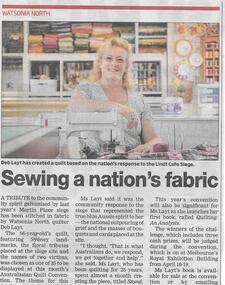
Newspaper clipping, Sewing a nation's fabric, 15/04/2015
... Sewing a nation's fabric...Sewing a nation's fabric Newspaper clipping Diamond Valley Leader ...Watsonia North quilter Deb Layt has crafted a quilt in response to the 2014 Martin Place Lindt Cafe siege.News clipping, black text, colour image.deb layt, quilting, watsonia north -
 Colac RSL Sub Branch
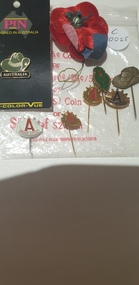
Badge - Funds raising badges x 8, badges and Fabric Poppy
... badges and Fabric Poppy...Fund raising items Minor Refer to photos Assortment of Fund raising Badges badges and Fabric Poppy Badge Funds raising badges x 8 ...Fund raising itemsMinorAssortment of Fund raising BadgesRefer to photos -
Moorabbin Air Museum
Textile (item) - Paint sample Vampire FB.9 Brown Pod Port Side and Green Pod Starboard Side, Paint/fabric samples
... Paint/fabric samples...Paint/fabric samples Textile Paint sample Vampire FB.9 Brown Pod Port Side and Green Pod Starboard Side ... -
 Alfred Hospital Nurses League - Nursing History Collection
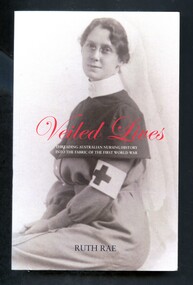
Book - Illustrated book, Ruth Rae 1957, Veiled Lives: threading Australian nursing history into the fabric of the First World War, 2009
... Veiled Lives: threading Australian nursing history into the fabric of the First World War...The back cover has a photograph of a civilian nurse in uniform (Pearl Lottie Trayhurn, Paramatta Hospital) the back cover also has a summary of the book Veiled Lives: threading Australian nursing history into the fabric of the First World War Book Illustrated book Ruth Rae 1957- The College of Nursing Fine Line Print and Copy Service ...A history of the Australian nurses who served in the 1914-1918 conflict. Also includes history of nursing in Australia pre federation, the Boer War, and the influenza pandemicIllustrated book. Front cover has a black and white photograph of a nurse in military uniform (Pearl Lottie Trayhurn) main title in red and subsidiary tile in white overprinted on this photo. Author's name printed in black at bottom. Main title printed in red on spine along with authors name and publisher's mark printed in black. The back cover has a photograph of a civilian nurse in uniform (Pearl Lottie Trayhurn, Paramatta Hospital) the back cover also has a summary of the booknon-fictionA history of the Australian nurses who served in the 1914-1918 conflict. Also includes history of nursing in Australia pre federation, the Boer War, and the influenza pandemicmilitary nursing-australia-history, world war 1914-1918-nursing, boer war-nursing, colonial history-australia-nursing, nurses -
 Alfred Hospital Nurses League - Nursing History Collection
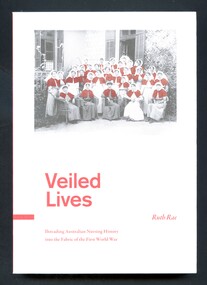
Book - Illustrated Book, Ruth Rae 1957, Veiled Lives: threading Australian nursing history into the fabric of the First World War, 2015
... Veiled Lives: threading Australian nursing history into the fabric of the First World War...Veiled Lives: threading Australian nursing history into the fabric of the First World War Book Illustrated Book Ruth Rae 1957- Australian College of Nursing ...In this book the author considers the family and social lives, civilian nurse training, military nursing experiences and premature deaths of qualified Australian nurse who endured the horrors of the 1914-1918 War. Veiled Lives also uncovers the impact of their absence on the nurses' families, friends, colleagues, communities and their profession.illustrated book with white front and back covers and red spine. The front cover has a red, black and white photograph of a group of nurses: group portrait if the matron and nursing staff of the 1st AGH with Matron Nellie Miles-Walker (centre front). Title and author's name are printed in red below this photo. Abbreviated title and author's name printed in white on the spine. Back cover has abbreviated title printed in red and a summary of the book printed in black.non-fictionIn this book the author considers the family and social lives, civilian nurse training, military nursing experiences and premature deaths of qualified Australian nurse who endured the horrors of the 1914-1918 War. Veiled Lives also uncovers the impact of their absence on the nurses' families, friends, colleagues, communities and their profession.world war 1914-1918, military nursing-australia, australia army-nurses, nurses -
Moorabbin Air Museum
Manual (item) - Aircraft Painting, Paints, Dopes & Fabric
... Paints, Dopes & Fabric...Paints, Dopes & Fabric Manual Aircraft Painting ... -
Moorabbin Air Museum
Manual (item) - Aviation Technical Training, Aviation Technician Training Series Aircraft Fabric Covering
... Aviation Technician Training Series Aircraft Fabric Covering...Aviation Technical Training Aviation Technician Training Series Aircraft Fabric Covering Manual Aviation Technical Training ...Aviation Technical Training -
![Photograph, [Finishing, scouring and milling of fabric]](/media/collectors/510b3f7f023fd725b4cd52cc/items/54065f5b9821f50e3cc9f4e6/item-media/54065f5b9821f50e3cc9f4e7/item-fit-380x285.jpg?cb=6) National Wool Museum
National Wool MuseumPhotograph, [Finishing, scouring and milling of fabric]
... [Finishing, scouring and milling of fabric]...Textile Mills Woollen Mills Classweave Industries Pty Ltd Federal Woollen Mills Ltd Scouring Milling Textile Mills Woollen Mills Milling Room - part still there 18 23/87 [Finishing, scouring and milling of fabric] Photograph ...Acquired when "Classweave Industries" closed down.Milling Room - part still there 18 23/87textile mills woollen mills, classweave industries pty ltd federal woollen mills ltd, scouring, milling, textile mills, woollen mills -
Stawell Historical Society Inc
Instrument - Realia, Textile Fabric Pilling Testing Machine, c1950
... Textile Fabric Pilling Testing Machine...Used at Norwellan for testing cloth North Western Woollen Mills became Norwellan Textiles then AUNDE manufacture Peg Load Checked at 2 lbs 20.11.69 Wood and iron Instrument with handle that drags metal pin repeatedly over a cloth sample. Textile Fabric Pilling Testing Machine Instrument Realia ...Used at Norwellan for testing cloth North Western Woollen Mills became Norwellan Textiles then AUNDEWood and iron Instrument with handle that drags metal pin repeatedly over a cloth sample.Peg Load Checked at 2 lbs 20.11.69manufacture
