
Showing 39 items matching "fabric painting"
-
 Moorabbin Air Museum
Manual (Series) - Aviation technician training manuals - Ansett, Aviation Technician Training Series AIrcraft Batteries ; Aircraft Fabric Covering ; Aircraft Painting and Finishing ; Aircraft Weight and Balance
... Aviation Technician Training Series AIrcraft Batteries ; Aircraft Fabric Covering ; Aircraft Painting and Finishing ; Aircraft Weight and Balance...Ansett Technical Training Aviation Technician Training Series AIrcraft Batteries ; Aircraft Fabric Covering ; Aircraft Painting and Finishing ; Aircraft Weight and Balance Manual Aviation technician training manuals - Ansett ...Ansett Technical TraningOverview of varaious technical topics for training purposesEA-AB-1 ; EA-ADF ; EA-AP-2; EA-BALOverview of lead acid/NI-Cad aircraft batteries ; fabric coverings; painting and finishing; aircraft weight & balance -
 Embroiderers Guild, Victoria
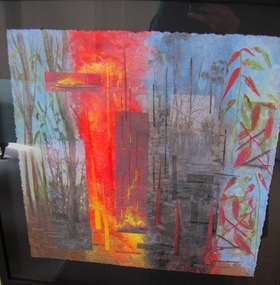
Textile - Machine Embroidery Panel, Sue Martin (member), "Regeneration", 2007
... ...Fabric painting...Embroidery Machine embroidery Fabric painting Fabricate Exhibition 2007 Abstract landscape depicting a bushfire and regeneration of the countryside. ...Purchased from Fabricate Exhibition at the Guild 2007. Abstract landscape depicting a bushfire and regeneration of the countryside.embroidery, machine embroidery, fabric painting, fabricate exhibition 2007 -
Moorabbin Air Museum
Manual - Aviation Technician Integrated Training Program, Aviation Technician Integrated Training Program Airframe Section Books 1 through 9 EA-ITP-A
... Aircraft fabric covering/painting & finishing/welding...Aviation technical integrated training program Aircraft structures Metal structural repairs Aircraft fabric covering/painting & finishing/welding Aircraft assembly & rigging Electrical systems Hydraulic & pneumatic systems Landing gear systems Cabin atmosphere control systems Fire & rain control systems Technical overview of aircraft structures for training purposes, circa 1981 2 ring folder. ...Technical overview of aircraft structures for training purposes, circa 19812 ring folder. Possible duplicate itemnon-fictionTechnical overview of aircraft structures for training purposes, circa 1981aircraft structures, metal structural repairs, aircraft fabric covering/painting & finishing/welding, aircraft assembly & rigging, electrical systems, hydraulic & pneumatic systems, landing gear systems, cabin atmosphere control systems, fire & rain control systems -
 Embroiderers Guild, Victoria
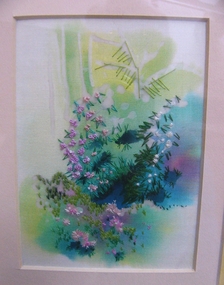
Artwork, other - Embroidered Picture, framed, Miss Katherine Tilley, 'Rhododendrons', 1984
... Fabric painting on silk in blues and greens. Highlighted with stitchery using fly stitch, French knots and straight stitch in tones of pink and green. ...Embroidery Surface stitchery Pictures 1980-2000 Australia Creative Embroidery Silk Embroidery Fabric painting on silk in blues and greens. Highlighted with stitchery using fly stitch, French knots and straight stitch in tones of pink and green. ...Designed and worked by Miss Katherine Tilley. Purchased from the Amies Collection Fund, 1984.Fabric painting on silk in blues and greens. Highlighted with stitchery using fly stitch, French knots and straight stitch in tones of pink and green. Narrow frame with triple mounts.embroidery, surface stitchery, pictures, 1980-2000, australia, creative embroidery, silk embroidery -
 Australian Gliding Museum
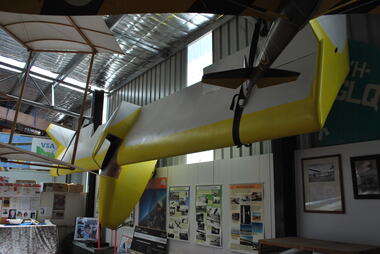
Machine - Glider, 1957
... The glider is of wood / fabric construction and has been restored for static display by recovering with new fabric and painting. ...The glider is of wood / fabric construction and has been restored for static display by recovering with new fabric and painting. Machine Glider Cliff Brown ...The aircraft was built in 1957 by Cliff Brown. It is an EPB 1, a 26 foot tailless sailplane designed in United States by Al Backstrom, Phil Easley and Jack Powell in 1954 as a simple, cheap, compact craft.A small number of single seat gliders of this type were built in Australia in the 1950s. As far as is presently known, the only surviving substantially complete EPB 1s are Cliff Brown’s glider and another held by the RAAF Association at Bull Creek in Western Australia. Unfortunately, no trace exists of the Flying Plank built by Glidair Sailplanes in Sydney and test flown by Fred Hoinville at Moorabbin in 1957. In addition, a larger two seat derivative (known as the Twin Plank) designed and built by Glidair Sailplanes (completed 1958) is held at the Power House Museum, Castlehill, in Sydney. Single seat tailless glider with wing tip rudders. The glider is of wood / fabric construction and has been restored for static display by recovering with new fabric and painting. Noneaustralian gliding, glider, flying wing, flying plank, home-built, cliff brown, al backstrom, fred hoinville, glidair sailplanes -
 Flagstaff Hill Maritime Museum and Village
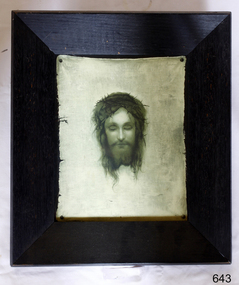
Print - Religious Print, Reinthal & Newman, Jesus Chrisus, ca 1906 - 1960s
... Print of an oil painting representing Jesus Christ, closed eyes, tear on cheek, with a crown of thorns, titled “Jesus Christus”, produced in 1874 by 19th-century artist Gabriel Cornelius von Max (GAB MAX). Print on paper; black and grey drawing on beige canvas-look background with image of fixing pins in each corner, edges look like torn fabric. ...Print of an oil painting representing Jesus Christ, closed eyes, tear on cheek, with a crown of thorns, titled “Jesus Christus”, produced in 1874 by 19th-century artist Gabriel Cornelius von Max (GAB MAX). Print on paper; black and grey drawing on beige canvas-look background with image of fixing pins in each corner, edges look like torn fabric. ...Print of an original oil painting created in 1874 (these numbers are in the top left corner) by artist Gabriel Max ("Gab Max" is in the top right corner) and reproduced by Kodak. The reproduction was likely made for the Mission to Seamen from the early 1906 to the 1960s to hang in its chapel. The publisher Reinthal & Newman, New York, was in business between 1906 and 1928. The company originally published postcards, but from 1920, it published prints of art from original works of famous and not-so-well-known artists. The published items were distributed by the House of Art, NY, which continued into the 1950s. The print was donated by the Williamstown Lightkeepers' Auxiliary to become part of the original furnishings of St Nicholas Seamen's Church, Williamstown, Victoria. The church was operated by the Mission to Seamen organisation. THE MISSIONS TO SEAMEN (Brief History): - The Missions to Seamen was an Anglican charity in Great Britain that has served the world's seafarers since 1856. Its symbol is a Flying Angel, inspired by a Bible verse. Today, there are centres in over 200 ports worldwide where seamen of all backgrounds are offered a warm welcome and provided with a wide range of facilities. In Victoria, the organisation began in Williamstown in 1857 as a Sailors’ Church, also known as ‘Bethel’ or the ‘Floating Church’ in an old hulk floating in Hobson’s Bay, Port of Melbourne. It soon became part of the Missions to Seamen, Victoria. In 2000, the organisation, now named Mission to Seafarers, still operated locally in Melbourne, Portland, Geelong and Hastings. The Ladies’ Harbour Lights Guild was formed in 1906 to support the Missions to Seamen in Melbourne and other centres, such as Williamstown. Two of the most significant ladies of the Guild were founder Ethel Augusta Godfrey and foundation member Alice Sibthorpe Tracy (who established a branch of the Guild in Warrnambool in 1920). The Guild continued its work until the 1960s. In 1943, a former Williamstown bank was purchased for the Missions to Seamen Club. The chapel was named St Nicholas’ Seamen’s Church and was supported by the Ladies’ Harbour Lights Guild, the Williamstown Lightkeepers’ Auxiliary and the League of Soldiers’ and Sailors’ Friends. It ceased operation in 1966. A Missions to Seamen Chapel and Recreation Room was a significant feature of ports during the late 1800s and 1900s. It seemed appropriate for Flagstaff Hill to include such a representation within the new Maritime Village, and the Melbourne Board of Management of Missions to Seamen Victoria gave its permission on 21st May 1979 for the entire furnishings of the Williamstown chapel to be transferred to Flagstaff Hill. The St Nicholas Seamen’s Church was officially opened on October 11, 1981, and resembles the Williamstown chapel. The print is significant because of its association with the Mission to Seamen in Williamstown, Victoria, and the Williamstown Lightkeepers' Auxiliary. This organisation had strong connections to the colonisation of Victoria by people travelling and arriving by sea. The picture is also significant as a representation of 19th-century religious art by Gabriel Cornelius von Max.Print of an oil painting representing Jesus Christ, closed eyes, tear on cheek, with a crown of thorns, titled “Jesus Christus”, produced in 1874 by 19th-century artist Gabriel Cornelius von Max (GAB MAX). Print on paper; black and grey drawing on beige canvas-look background with image of fixing pins in each corner, edges look like torn fabric. Published by Reinthal & Newman, New York. Print is behind glass, mounted in a heavy wooden frame that is painted dark brown. The reverse has numbers on a small white label. The base of the reverse has two small holes, each with indentations from something round. The backing board has indentations from nails no longer there. There are remnants of the original hanging wire, but this has been replaced. Part of the St Nicholas Seamen's Church Collection.FRONT: Top left :1874” Top right “GAB MAX” [Gabriel Cornelius von Max] Handwritten script under the picture “Jesus Christus”. Printed bottom left on front “A33 © REINTHAL & NEWMAN PUBS. N.Y.” REVERSE: “162” written in black felt pen on white label. Pencilled on reverse "11 3/8 x 9 1/4" and "Kodak" and other indecipherable markings.flagstaff hill, warrnambool, shipwrecked-coast, flagstaff-hill, flagstaff-hill-maritime-museum, maritime-museum, shipwreck-coast, flagstaff-hill-maritime-village, christian art, picture of jesus christ, jesus christus, photographic print of jesus christ, missions to seamen victoria, mission to seafarers, flying angel’s club, religious worship, reinthal & newman new york, jesus christ with crown of thorns, religion, religious service, sailors rest, bethel sailors’ church, bethel floating church, ladies harbour light guild, harbor lights guild, joy club for fighters, ladies lightkeepers’ auxiliary, st nicholas mission to seamen church williamstown, mission to seamen williamstown, st nicholas seamen’s church flagstaff hill, 139 nelson place williamstown, print, religious print, jesus christ, 1874, 19th century artist, gabriel cornelius von max, gab max, gabriel max, reinthal & newman, oil painting, st nicholas seamen's church, a33 © reinthal & newman pubs. n.y., kodak, house of art, williamstown lighthouse keepers' auxiliary, flagstaff hill maritime museum and village, maritime museum, maritime village, shipwreck coast, great ocean road, worship service, st nicholas seamen’s church, williamstown, st nicholas missions to seamen’s church williamstown, missions to seamen, st nicholas missions to seamen’s church flagstaff hill, anglican church, church furnishings, religious furnishings -
 Mission to Seafarers Victoria
Painting - Painting, Acrylic, Ramon Honisett, Untitled, 1990-2000
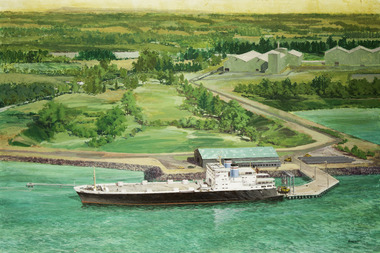
... The frame incorporates a beige fabric slip with gilt edge the actual dark wood frame also with inset banded gilt edge. The back of the painting is covered with brown paper in places damaged. ...The frame incorporates a beige fabric slip with gilt edge the actual dark wood frame also with inset banded gilt edge. The back of the painting is covered with brown paper in places damaged. ...Ramon (Ray) Francis Honisett (11.04.1931 - 30.08.2019), Fellow RMIT and medallist specialised in philatelic design, marine and military aircraft painting art and was active in the 1960s - 1990s. Ray Honisett used to live in Rye, in the Mornington Peninsula. According to Gavin Fry's book: The painting likely depicts the Lysaght Endeavour loading at Hastings. "The Lysaght Endeavour and its sister ship Lysaght Entreprise were built in Newcastle in 1973 specifically to serve the regional steel industry on the route Port Kembla - Westernport - Adelaide. Even after being lengthened by 17 metres, the two ships had remarkably short working lines, with both being broken up by 1988."Maritime artLarge framed unglazed landscape format painting predominantly green depicting in foreground a merchant vessel, a roll-on roll-off cargo ship moored at a single quayside on a river or river mouth. The middle ground shows a moderate solid jetty leading to large storage sheds at right. The background appears primarily rural with fields and hills in the distance. The location is probably Hastings Western Port in Victoria - notice the forklifts loading rolls of steel produced at the nearby steel rolling mill - the buildings in the distance. You can see the rolls of steel lined up on the hard stand to the right of the ship. The funnel colours suggest the Australian National Line. The frame incorporates a beige fabric slip with gilt edge the actual dark wood frame also with inset banded gilt edge. The back of the painting is covered with brown paper in places damaged. Hangs on a cotton cord threaded between two screw in eyelet hooks.at lower right corner single uc word in black paint : "HONISETT"tankers, marine painting, maritime art, ramon honisett, ray honisett, anl maritime art prize, acta maritime art prize, hastings, western port, victoria, steel, roll on roll off, forklift, mornington peninsula, artwork-paintings -
 Halls Gap & Grampians Historical Society
Photograph - Coloured, C 1995
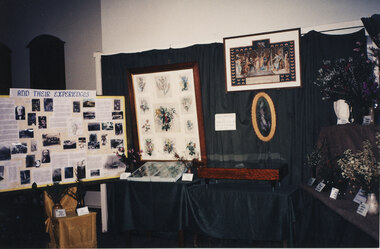
... The photo shows a display of an historical theme set up in front of a dark fabric draped from a frame and over tables. A framed painting (consisting of twelve individual paintings) can be seen in the centre together with a certificate to its right....paintings are by Henrietta D'Alton. Beneath the frame in its current (2010) location in the Halls Gap Hall is a plaque which reads "Henrietta D'Alton (1836-1922). This collection of wildflower water-colours won an award at the Colonial & Indian Exhibition of 1886 in London". EVENTS Wildflower Show The photo shows a display of an historical theme set up in front of a dark fabric ...A display in the Historic Section of the 1995 Wildflower Show held in the Halls Gap Hall in 1995. The framed wildflower paintings are by Henrietta D'Alton. Beneath the frame in its current (2010) location in the Halls Gap Hall is a plaque which reads "Henrietta D'Alton (1836-1922). This collection of wildflower water-colours won an award at the Colonial & Indian Exhibition of 1886 in London".The photo shows a display of an historical theme set up in front of a dark fabric draped from a frame and over tables. A framed painting (consisting of twelve individual paintings) can be seen in the centre together with a certificate to its right.events, wildflower show -
 Geoffrey Kaye Museum of Anaesthetic History
Painting - Portrait, Graham Inson, Presidential Portrait of Associate Professor Peter Livingstone, 1993
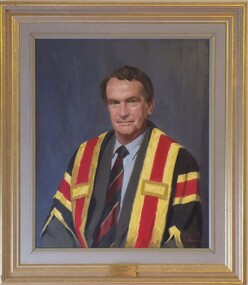
... Oil painting on canvas of Associate Professor Peter Livingstone, seated at an angle facing left, wearing the College gown and tie with a dark plain background. Mounted on a fabric...A finalist in the 1990 and 1992 Doug Moran Portrait Prize, he has painted numerous official portraits of politicians, academics and for many of Australia's largest Companies. painting livingstone, peter anzca president inson, graham [brass plaque] ASSOCIATE PROFESSOR / PETER D LIVINGSTONE / INAUGURAL PRESIDENT / 1992 / PRESENTED BY THE / AUSTRALIAN SOCIETY OF ANAESTHETISTS Oil painting on canvas of Associate Professor Peter Livingstone, seated at an angle facing left, wearing the College gown and tie with a dark plain background. Mounted on a fabric ...The sitter, Associate Professor Peter D Livingstone, was the Inaugural President of the newly established ANZCA, February 1992. The portrait was later unveiled at the Council Meeting [17-18 Feb 1994] followed by the official opening of Ulimaroa on 19 February 1994. Further information about Professor Livingstone is found on Lives of the Fellows; http://anzca.online-exhibition.net/fellows/fellows-1992/peter-david-livingstone/ The artist Graham Inson is represented in many major public and private art collections. A finalist in the 1990 and 1992 Doug Moran Portrait Prize, he has painted numerous official portraits of politicians, academics and for many of Australia's largest Companies. Oil painting on canvas of Associate Professor Peter Livingstone, seated at an angle facing left, wearing the College gown and tie with a dark plain background. Mounted on a fabric backing in a gold leaf frame with a small brass plaque affixed to the lower center of the frame.[brass plaque] ASSOCIATE PROFESSOR / PETER D LIVINGSTONE / INAUGURAL PRESIDENT / 1992 / PRESENTED BY THE / AUSTRALIAN SOCIETY OF ANAESTHETISTSpainting, livingstone, peter, anzca president, inson, graham -
 Yarra City Council
Painting - Public Art, Rule 30
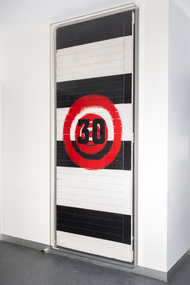
... Painting) from Melbourne’s VCA in 1994, and a Master of Fine Art (Research) from Sydney’s CoFA in 2003. His unique combination of materials and the potent imagery in his works expose the impact of British settlement and religious order imposed on his people. 'Rule 30' was accessioned into the City of Yarra Collection in 2020 through Council’s ‘Percent for Art’ scheme. The work is installed in the Bob Rose stand of Victoria Park. racism sport football AFL Accompanying label The number '30' cut out of fabric ...Clinton Naina’s earliest memory is attending Collingwood football matches at Victoria Park with his father and uncles. His dad was an avid Collingwood supporter and Naina proudly wore his football colours. Lining up to enter the grounds at the big old black-and-white painted wooden doors gave Naina the feeling of entering into another world. 'Rule 30' is a comment on race relations in sport. The artwork is made from the original doors located at the front entrance of the Collingwood Football Club’s grounds at Victoria Park. When the club was refurbished the door was gifted to Naina by a friend—an ex-Collingwood football player—for use in his art practice. The work depicts a big red target painted on the existing Black and white stripes—Collingwood colours—of the door. Naina placed a fabric number ‘30’ on top of the target—created from material used for numbers on the back of players’ football vests. This represents the individuals who have been racially vilified while playing football over many years. The red represents the colour of human blood, while the Blak and white Collingwood colours already painted on the wood are a very fitting comment on race relations. The door itself becomes a potent metaphor for “overcoming barriers, making change, breaking down doors and moving forth into a new era of respect for people”. Rule 30 in the AFL was the first racial vilification code in Australian sport. It prohibited conduct between players, clubs and other AFL officials, which threatened, disparaged, vilified or insulted another person on the basis of that person’s race, religion, colour, descent or ethnic origin. In 2013, ‘Rule 30’ was amended to ‘Rule 35’ to combat other forms of discrimination including disability, appearance and sexuality.The number '30' cut out of fabric placed on top of a painted red target at the centre of an existing black and white wooden door.Accompanying labelracism, sport, football, afl -
 Bendigo Historical Society Inc.
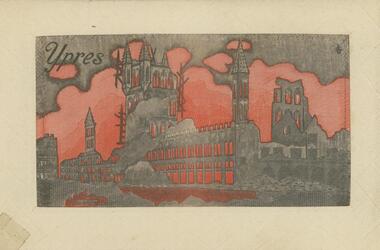
Postcard - ROY AND DORIS KELLY COLLECTION: BUILDINGS OF YPRES, 1900-1920
... Postcard, abstract red and black painting of buildings in Ypres, France. Printed on fabric (silk?) One of cards painted by WW1 German prisoners in France. ...POSTCARD Postcard Ypres France Postcard, abstract red and black painting of buildings in Ypres, France. Printed on fabric (silk?) One of cards painted by WW1 German prisoners in France. ...Postcard, abstract red and black painting of buildings in Ypres, France. Printed on fabric (silk?) One of cards painted by WW1 German prisoners in France. Message written in pencil on the back. (see attached image 1402.006a.jpg)postcard, postcard, ypres, france -
 National Vietnam Veterans Museum (NVVM)
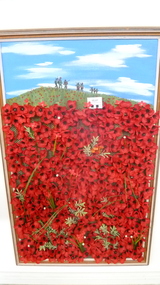
Artwork, other, Artwork, Poppy Field
... Framed painting of armed soldiers on a hill with a display of red poppies below. Poppies are fabric....Red Poppies Artwork Painting Framed painting of armed soldiers on a hill with a display of red poppies below. Poppies are fabric. ...Framed painting of armed soldiers on a hill with a display of red poppies below. Poppies are fabric.red poppies, artwork, painting -
Moorabbin Air Museum
Booklet (Item) - A.P.2656A Volume 1 Includes preparation spray painting brush painting storage camouflage fabric and metal skins, External and internal finish of aircraft
... A.P.2656A Volume 1 Includes preparation spray painting brush painting storage camouflage fabric and metal skins...External and internal finish of aircraft Booklet A.P.2656A Volume 1 Includes preparation spray painting brush painting storage camouflage fabric and metal skins ... -
 Geoffrey Kaye Museum of Anaesthetic History
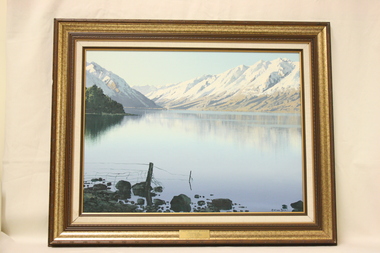
Painting, Graham Binsley, Lake Ohau, New Zealand
... An oil painting on board depicting a scene of snow-capped mountains around Lake Ohau, New Zealand. The painting is set in a fabric mount with a gold and bronze frame. ...McK HOLMES / June, 1990" An oil painting on board depicting a scene of snow-capped mountains around Lake Ohau, New Zealand. The painting is set in a fabric mount with a gold and bronze frame. ...An oil painting on board depicting a scene of snow-capped mountains around Lake Ohau, New Zealand. The painting is set in a fabric mount with a gold and bronze frame. There is a brass plaque affixed to the front of the frame detailing donor information.Plaque on front of frame. "LAKE OHAU, NEW ZEALAND / Presented By C. McK HOLMES / June, 1990"lake ohau, painting, oil paint, oil painting, scenery, landscape, landscape painting -
Moorabbin Air Museum
Manual (item) - Aircraft Painting, Paints, Dopes & Fabric
... Paints, Dopes & Fabric Manual Aircraft Painting ... -
 Bendigo Historical Society Inc.
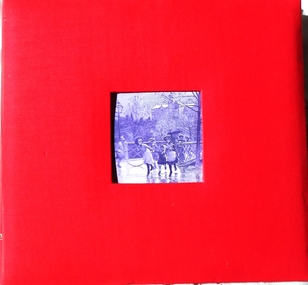
Painting - Architectural watercolours, Historic and Monumental Architecture, 1951
... Photo album with red fabric cover containing water colour paintings created by Glen Jones depicting buildings of Bendigo. ...Bendigo buildings Matriculation Watercolour paintings Architectural paintings Glen Jones Photo album with red fabric cover containing water colour paintings created by Glen Jones depicting buildings of Bendigo. ...Glen Jones was born in Bendigo on September 10, 1934. He graduated from Bendigo High School in 1951 and then attended Bendigo Teachers' College. He began his teaching career as an Art, Craft and Woodwork teacher in Rochester in 1955. Biographical notes provided by Glen's family are attached as a media file.Photo album with red fabric cover containing water colour paintings created by Glen Jones depicting buildings of Bendigo. Each water colour painting is mounted on coloured card with descriptive labels attached. The folio of paintings was produced as a project for Glen's Matriculation Certificate in 1951.bendigo buildings, matriculation, watercolour paintings, architectural paintings, glen jones -
 Australian Gliding Museum
Machine - Glider – Sailplane, 1940
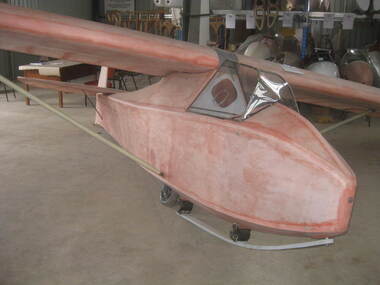
... Wood and fabric single seat glider sailplane with strutted wings and strutted tailplane – features metal framed perspex canopy, central fuselage skid and wheel, small tail skid, instruments include airspeed, turn and bank indicator; variometer and altimeter. Metal parts include struts and fairing covering wing joint. All surfaces are pink doped – awaiting painting...Also the aircraft provides an insight into gliding technology in Australia in the 1940s. australian gliding glider sailplane coogee tom proctor victorian motorless flight group geelong gliding club Wood and fabric single seat glider sailplane with strutted wings and strutted tailplane – features metal framed perspex canopy, central fuselage skid and wheel, small tail skid, instruments include airspeed, turn and bank indicator; variometer and altimeter. Metal parts include struts and fairing covering wing joint. All surfaces are pink doped – awaiting painting ...The “Coogee” is an intermediate single seat sailplane designed and built by Tom Proctor in 1940. Only one was built. It was first flown at Stuart Hill near Bendigo Victoria in January 1941 and was maintained in flying condition until 1967. The aircraft was flown extensively by the Victorian Motorless Flight Group (now the Melbourne Gliding Club) and Geelong Gliding Club and several subsequent owners. This exhibit is a "one off" Australian designed and built glider similar in some respects to the Hutter H17. Its usage is relevant to the history of gliding in Victoria in the post war years. Also the aircraft provides an insight into gliding technology in Australia in the 1940s. Wood and fabric single seat glider sailplane with strutted wings and strutted tailplane – features metal framed perspex canopy, central fuselage skid and wheel, small tail skid, instruments include airspeed, turn and bank indicator; variometer and altimeter. Metal parts include struts and fairing covering wing joint. All surfaces are pink doped – awaiting painting.australian gliding, glider, sailplane, coogee, tom proctor, victorian motorless flight group, geelong gliding club -
 Australian Gliding Museum
Machine - Glider – Sailplane, 2015
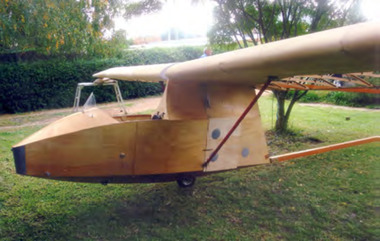
... fabric. The fuselage woodwork is sealed with varnish. In addition to the finishing work (including painting) and rigging of the main components, the linkages for Ray’s control rod modification may need further engineering to make them operational. ...fabric. The fuselage woodwork is sealed with varnish. In addition to the finishing work (including painting) and rigging of the main components, the linkages for Ray’s control rod modification may need further engineering to make them operational. ...The Salamandra is a Polish glider designed by Waclaw Czerwinski at the Military Glider Workshops in Krakow in 1936. This glider, designated “W.W.S.1”, was produced in substantial numbers prior to the second world war and used in Poland and some other eastern European countries for training pilots. Only one example survived the war, hidden away in the village of Goleszow in Silesia. In addition, no technical drawings could be found, so when the glider was discovered, the Gliding Institute being keen to re-establish gliding in Poland, used the glider to draw up new plans for construction. Five were built for the Institute in 1947 before production was resumed of the “Salamandra 48” at the SZD Jezow Workshops. Improvement were made by adding airbrakes and structural changes for the “Salamandra 49” and a windscreen and larger tailplane were changes adopted for the “Salamandra 53”. An export version designated “53A” was sold to and built under licence in China. Production of the Salamandra ceased in the early 1960s. Total production may have been in excess of 500. The glider was well regarded as a light weight trainer capable of soaring performance. The Museum’s replica was built by Ray Ash and may be may be classified as a “Salamandra 53”. However, he has added something of his own to the design by replacing the cable runs in the wings with control rods. The glider is substantially complete. The wings and tail / rudder surfaces have been covered with poly-fibre fabric. The fuselage woodwork is sealed with varnish. In addition to the finishing work (including painting) and rigging of the main components, the linkages for Ray’s control rod modification may need further engineering to make them operational. The Ray Ash Salamandra is the first of the type to appear in Australia. The Salamandra did not play any role in the development of gliding in Australia in the early years. However, it is an important exhibit in that it shows in tangible form a nacelle fuselage training glider in configuration and construction detail. As such it revisits the pioneering era of the 1930s and 1940s in Australia when wood, wire and fabric were the rule and the nacelle primary glider was generally the first step up for pilots who had mastered the basics in an open primary.Nacelled solo training glider of traditional wood and fabric construction. Construction incomplete.Noneaustralian gliding, sailplane, glider, salamandra, czerwinshi, poland, ash -
 National Wool Museum
Clothing - Jumper, Jenny McMahon, 1993
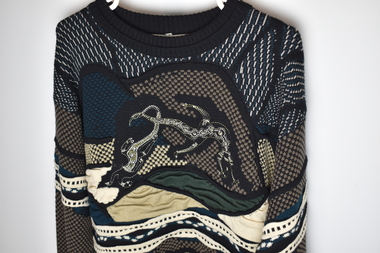
... painting was translated into a pattern by textile designer Jenny McMahon. It was then turned into a jumper using wool sourced entirely from the region. It was fully processed, from fleece to fabric...painting was translated into a pattern by textile designer Jenny McMahon. It was then turned into a jumper using wool sourced entirely from the region. It was fully processed, from fleece to fabric ...Stanley Couzens, a Gunditjmara man and long-time Geelong resident, painted the story 'Ceremonial Hunting Grounds in the You Yangs' upon commission from the Geelong Wool Combing Company. It depicts hunting in the You Yangs, today referred to as its original Wadawurrung name Wurdi Youang, the distinctive granite peaks that overlook the region. In 1993, Couzens’ painting was translated into a pattern by textile designer Jenny McMahon. It was then turned into a jumper using wool sourced entirely from the region. It was fully processed, from fleece to fabric, in Geelong. The jumper was given to attendees at the opening of the Geelong Wool Combing company on 10 December 1993. Among the many guests, was the Prime Minister Paul Keating.Mens knitted jumper depicting an image of the You Yangs and Corio Bay on the front of the jumper in colours including brown, green, cream, black, with white and gold stitching. The central motif extends to the back of the jumper. A cardboard tag attached to the label explains the provenance of the design and manufacture of the jumper.merino sheep knitting, mcmahon, jeni - mcmahon's farm, corio bay, victoria, merino sheep, knitting, stanley couzens, you yangs, jumper, design, gunditjmara, geelong wool combing company, wurdi youang, jenny mcmahon -
 Robin Boyd Foundation
Furniture - Sofa, Robin Boyd
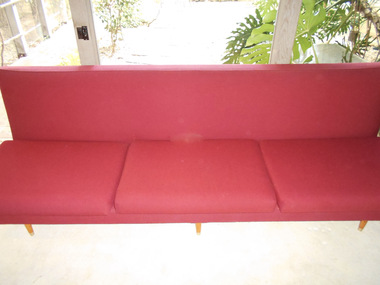
... painting 'Man on Sofa' by Tony Woods (item A05) was purchased and hung. The original sofa is currently stored offsite. The sofa was reproduced in the 2017 Boyd Collection by K5 (item F004 and F035). sofa Domain Park Robin Boyd Deep red woolen fabric, three loose seat cushions, no arms, 6 timber legs each with a brass foot cover. ...Robin Boyd designed this three-seater sofa. The sofa was featured in the promotional brochure for Domain Park Flats in 1962. The original sofa was recovered from yellow upholstery to red in 1967 when the painting 'Man on Sofa' by Tony Woods (item A05) was purchased and hung. The original sofa is currently stored offsite. The sofa was reproduced in the 2017 Boyd Collection by K5 (item F004 and F035).Deep red woolen fabric, three loose seat cushions, no arms, 6 timber legs each with a brass foot cover.sofa, domain park, robin boyd -
 Embroiderers Guild, Victoria
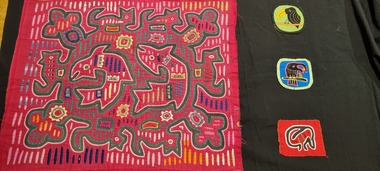
Accessory - San Blas Mola Panel
... painting. Following 1925 Guna Revolution, securing their autonomy, making and wearing Molas became a symbol of cultural identity and independence. Embroidery Mola Reverse applique Black panel with rectangle of reverse applique in very bright colours - orange, blue, pink, black, with red fabric predominant. ...traditional hand sewn crafted by indigenous Guna (Kuna) people of the San Blas Islands, panama and Colombia. Usually made in pairs to decorate the front and back of a Guna woman's blouse. Artists fill nearly all the spaces, traditionally believed to leave no room for evil spirits to settle. Evolving from ancestral geometric body painting. Following 1925 Guna Revolution, securing their autonomy, making and wearing Molas became a symbol of cultural identity and independence.Black panel with rectangle of reverse applique in very bright colours - orange, blue, pink, black, with red fabric predominant. Depicting two dolphins/sharks. Three separate motifs depict birds. Part of Mola - traditional garment.embroidery, mola, reverse applique -
 Embroiderers Guild, Victoria
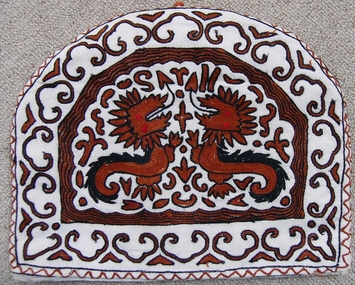
Textile - Indian Sohrai Tea Cosy
... Sohrai embroidery is a traditional art form inspired by the, ritualistic, nature-based wall paintings of Jharkhand, India, created by tribal women, often during harvest seasons. This style features intricate, geometric, and figurative motifs—such as animals, birds, and plants—translated onto fabrics using techniques like Kantha stitch, embroidery, and sometimes mirror work....Sohrai embroidery is a traditional art form inspired by the, ritualistic, nature-based wall paintings of Jharkhand, India, created by tribal women, often during harvest seasons. This style features intricate, geometric, and figurative motifs—such as animals, birds, and plants—translated onto fabrics using techniques like Kantha stitch, embroidery, and sometimes mirror work. ...Sohrai embroidery is a traditional art form inspired by the, ritualistic, nature-based wall paintings of Jharkhand, India, created by tribal women, often during harvest seasons. This style features intricate, geometric, and figurative motifs—such as animals, birds, and plants—translated onto fabrics using techniques like Kantha stitch, embroidery, and sometimes mirror work.Tea cosy is probably Indian. It is of cream cotton fabric with a tamboured design of dragons in brown and black. Includes tea cloth and napkins.embroidery, tea cosy, india?, tambour work -
 Benalla Art Gallery
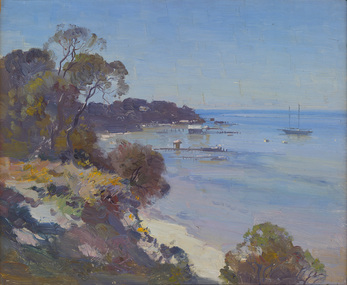
Painting, Penleigh BOYD, Portsea, 1921
... Interwar Painting Beachscape Boats Building Trees Rocks Marine Australian art Recto: Signed and dated "Penleigh Boyd / 21" inscribed in paint l.l.c of composition; Not titled Beachscape with rocks, trees, water, piers, buildings, sky and sailing boat. Gold wood moulding with fabric ...Born: Westbury, Wiltshire, England 1890; Arrived: Melbourne, Victoria, Australia 1893; Died: Warragul, Victoria, Australia 1923InterwarGift of Mrs E.E. Ledger, 1975Beachscape with rocks, trees, water, piers, buildings, sky and sailing boat. Gold wood moulding with fabric and gold insert frame.Recto: Signed and dated "Penleigh Boyd / 21" inscribed in paint l.l.c of composition; Not titledpainting, beachscape, boats, building, trees, rocks, marine, australian art -
 National Wool Museum
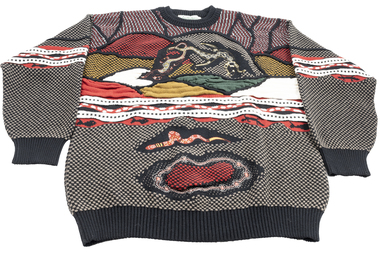
Clothing - Jumper, Geelong Wool Combing, 1993
... painting was translated into a pattern by textile designer Jenny McMahon. It was then turned into a jumper using wool sourced entirely from the region. It was fully processed, from fleece to fabric...painting was translated into a pattern by textile designer Jenny McMahon. It was then turned into a jumper using wool sourced entirely from the region. It was fully processed, from fleece to fabric ...Stanley Couzens, a Gunditjmara man and long-time Geelong resident, painted the story 'Ceremonial Hunting Grounds, in the You Yangs' upon commission from the Geelong Wool Combing Company. It depicts hunting in the You Yangs, today referred to as its original Wadawurrung name Wurdi Youang, the distinctive granite peaks that overlook the region. In 1993, Couzens’ painting was translated into a pattern by textile designer Jenny McMahon. It was then turned into a jumper using wool sourced entirely from the region. It was fully processed, from fleece to fabric, in Geelong. The jumper was given to attendees at the opening of the Geelong Wool Combing company on 10 December 1993. Among the many guests, was the Prime Minister Paul Keating.Woolen Jumper containing red, mustard, green and cream depicting Indigenous artwork. Sold colour cuffs and collar of black. Size XL, label stitched to inside neck with paper swing-tag attached. jumper, wool, geelong, 1993, geelong wool combing ltd, stanley couzens, woolmark, you yangs, corio bay, wathourong, snake, fish, wurdi youang, jenny mcmahon -
 National Wool Museum
Container - Miniature Bool Bale, Geelong Wool Combing, 1993
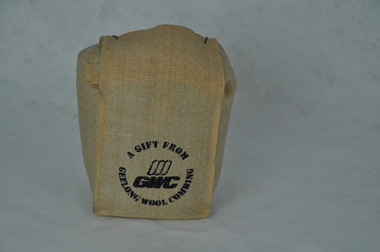
... painting was translated into a pattern by textile designer Jenny McMahon. It was then turned into a jumper using wool sourced entirely from the region. It was fully processed, from fleece to fabric...painting was translated into a pattern by textile designer Jenny McMahon. It was then turned into a jumper using wool sourced entirely from the region. It was fully processed, from fleece to fabric ...Stanley Couzens, a Gunditjmara man and long-time Geelong resident, painted the story 'Ceremonial Hunting Grounds, in the You Yangs' upon commission from the Geelong Wool Combing Company. It depicts hunting in the You Yangs, today referred to as its original Wadawurrung name Wurdi Youang, the distinctive granite peaks that overlook the region. In 1993, Couzens’ painting was translated into a pattern by textile designer Jenny McMahon. It was then turned into a jumper using wool sourced entirely from the region. It was fully processed, from fleece to fabric, in Geelong. The jumper was given to attendees at the opening of the Geelong Wool Combing company packaged in these miniature wool bales, on 10 December 1993. Among the many guests, was the Prime Minister Paul Keating.Synthetic miniature wool bale packaging, with miniature bale hooks, previously containing a jumper. Miniature wool bale features two stenciled designs in black ink. Features two stenciled design with black ink. First stencil on front reads "A Gift From/ GWC/ Geelong Wool Combing ". Second stencil on back reads "Pure/ Australian/ Wool" with Woolmark logo above. Small tag on bottom right corner reads "XL".wool bales, wadawurrung, gunditjmara, stanley couzens, you yangs, wurdi youang, jumper, packaging, geelong, jenny mcmahon, geelong wool combing company, gifts, corporate gifts -
 National Wool Museum
Painting - Ceremonial Hunting Grounds in the You Yangs, Stanley Couzens, 1993
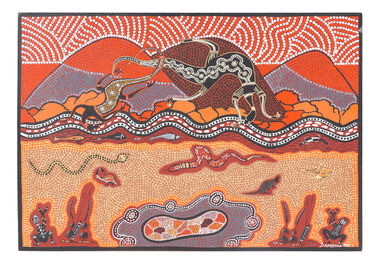
... painting was translated into a pattern by textile designer Jenny McMahon. It was then turned into a jumper using wool sourced entirely from the region. It was fully processed, from fleece to fabric...painting was translated into a pattern by textile designer Jenny McMahon. It was then turned into a jumper using wool sourced entirely from the region. It was fully processed, from fleece to fabric ...Stanley Couzens, a Gunditjmara man and long-time Geelong resident, painted this story upon commission from the Geelong Wool Combing Company. It depicts hunting in the You Yangs, the distinctive granite peaks that overlook the region. In 1993, Couzens’ painting was translated into a pattern by textile designer Jenny McMahon. It was then turned into a jumper using wool sourced entirely from the region. It was fully processed, from fleece to fabric, in Geelong. The jumper was given to attendees at the opening of the Geelong Wool Combing company on 10 December 1993. Among the many guests, was the Prime Minister Paul Keating. The painting was acquired with the permission of the Couzens family.Framed acrylic painting on board, showcasing the You Yangs mountain range, people, and local flora and fauna in warm earth tones. The painting is signed 'S. Couzens 93' in the bottom right hand corner. The painting is framed in a dark wooden frame.Bottom right corner - 'S. Couzens 93'you yangs, gunditjmara, design, geelong wool combing company, jumper, jenny mcmahon, wurdi youang, geelong, stanley couzens -
 National Wool Museum
Clothing - 35 Life, Canwen Zhao, 2022
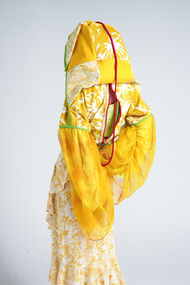
... fabric dyed with turmeric and plant dyes. This not only ensures functionality but also adds a sense of elegance. The length can be adjusted using drawstrings. Artist Bio: Zhao Canwen is a multidisciplinary fashion designer with a strong passion for integrating art, history, culture, and sustainable design. With over 15 years of experience in painting...fabric dyed with turmeric and plant dyes. This not only ensures functionality but also adds a sense of elegance. The length can be adjusted using drawstrings. Artist Bio: Zhao Canwen is a multidisciplinary fashion designer with a strong passion for integrating art, history, culture, and sustainable design. With over 15 years of experience in painting ...Canwen Zhao was awarded the $10,000 We The Makers Acquisitive Prize for '35 Life' in 2023. Artist Statement: "35life" is a sustainable fashion project that transforms second-hand clothing materials into urban street outdoor-style products. Highlighting prominent Chinese classic red and green colours not only conveys eastern aesthetics but also adds a sense of unity to the clothing collection. The high-saturation and high-brightness full-colour palette keeps the clothing consistently "fresh," allowing any trendy colours to seamlessly integrate into the project's designs, thus extending the lifespan of the garments. Additionally, all clothing items can quickly transform into a stylish bag for convenient daily carrying and home storage. These bags are made from leftover fabric generated during the production process and serve as original packaging for sale. This approach not only reduces excessive packaging but also enhances the chances of resale in the second-hand market. The project draws inspiration from the traditional Chinese cultural concept of "huo feng ding," meaning "exchange the old for the new." it's also influenced by the designer's personal experience with health issues, making the designs suitable for individuals who can't be exposed to sunlight for extended periods, adapting to the changing urban lifestyle. 35life aims to provide visually pleasing and comfortable dressing experiences for urban dwellers who are busy with work and experience high levels of stress. Unlike traditional design patterns, this project adopts a unique design approach. It selects 3-5 pieces of raw materials based on their colours, and then disassembles them through structural lines. While retaining most of their functionality, these materials are rearranged and assembled on a flat surface before being shaped on a dress form. Subsequently, various ways of creating storage bags are derived from the initial clothing prototypes. After refining the designs, the final products are developed, and similar materials are used to create samples. Therefore, under this design methodology, even for the same garment, it is impossible to produce two identical pieces of clothing. Each garment is truly one-of-a-kind, which enhances its rarity and contributes to the longevity of the fashion pieces. The project includes various types of clothing, each with unique storage methods. This yellow look, named "elegant beach sunscreen monarch," draws its fashion inspiration from traditional Han Chinese attire and its storage concept from the Chinese cultural concept of "jiu jiu gui yi." the design employs flat pattern cutting, utilizing materials from the second-hand market such as beach towels, children's waterproof clothing, and women's dresses. Similar colours and patterns are reassembled through cutting and combining. For the sleeves, quick-drying, sun-protective sport fabric forms the base, overlaid with discarded silk fabric dyed with turmeric and plant dyes. This not only ensures functionality but also adds a sense of elegance. The length can be adjusted using drawstrings. Artist Bio: Zhao Canwen is a multidisciplinary fashion designer with a strong passion for integrating art, history, culture, and sustainable design. With over 15 years of experience in painting, she draws inspiration from ancient Chinese philosophy and aesthetics, which gives her a unique sense of beauty. After 8 years of fashion and art training, she possesses a keen insight into current trends and tends to combine art with commercial needs. Zhao's design style is diverse, characterized by a multidimensional approach, a focus on colour application, and storytelling through details.Outfit consisting of six pieces: - Orange plastic eye wear with green paint - Pair of red and green metal clip on earrings - Red beaded phone case with attached beads on string - Pair of red and green painted running shoes - Yellow and green hooded garment with red piping and zips - Brown bag with green beaded handlessustainable, fashion, we the makers, art, culture, design, chinese philosophy, prize -
 The 69 Collective
Painting, Leah Mariani, Beach bums, 2013
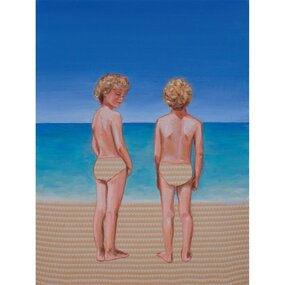
... This artwork is part of 69Fifteen, the book published in 2013 celebrating 69 Smith Street Gallery’s 15th year in operation as an artist-run space. leah mariani 69 smith street gallery artist-run initiative artist-run space melbourne art galleries painting www.leahmariani.com Oil on cotton fabric. Image of two young boys standing beside each other looking out to sea. ...This artwork is part of 69Fifteen, the book published in 2013 celebrating 69 Smith Street Gallery’s 15th year in operation as an artist-run space.Oil on cotton fabric. Image of two young boys standing beside each other looking out to sea. They are painted against a background of blue-green water and a clear blue sky. The pattern on the sand is repeated in the boys' swimming costumes. One of the boys has his head turned away from the water.leah mariani, 69 smith street gallery, artist-run initiative, artist-run space, melbourne art galleries, painting, www.leahmariani.com -
 Duldig Studio museum + sculpture garden
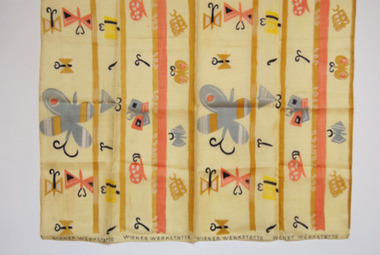
Fabric, Mathilda Flogl, Falter designed by Mathilda Flogl 1924-31, 1924-31
... fabrics for furnishings and apparel. The designs were characterised by simplified forms and vivid colours, and inspired by Eastern European peasant art and geometric motifs in contemporary painting. ...fabrics for furnishings and apparel. The designs were characterised by simplified forms and vivid colours, and inspired by Eastern European peasant art and geometric motifs in contemporary painting. ...This piece of fabric, known Fälter (butterfly), was designed by Mathilda Flögl (1893-1958), who worked in the textile department of the Wiener Werkstätte in Vienna. It is a remnant of the fabric that was used to make a bedspread for Karl and Slawa’s bed in their Vienna apartment where it lay decoratively over a gold brocade eiderdown. The purchase demonstrated Slawa’s interest in and knowledge of modern design and her commitment to the idea of enriching everyday life with beautiful objects, a principal of the Viennese Secession. Following the Duldigs removal from Vienna, the original bedspread and remnant were safeguarded and preserved by Slawa’s sister, Rella, in the basement of her Paris apartment. In 1948 the bedspread and this remnant were sent to Australia. The bedspread was a much-loved item but deteriorated over the years. In 1955 it was made into curtains, which are held in the Duldig Studio Collection. The Photographs of the bedspread in its original location are also held in the collection. The remnant is in pristine condition. The Wiener Werkstätte (Vienna Workshop) was a guild of designers and craftsmen that was founded by the architect Josef Hoffman (1879-1956) and the designer Koloman Moser (1868-1918). The firm manufactured a range of interior furnishings between 1903 and 1932. The textile department opened in 1900, and produced about 1,800 designs, mainly for printed fabrics for furnishings and apparel. The designs were characterised by simplified forms and vivid colours, and inspired by Eastern European peasant art and geometric motifs in contemporary painting. The workshop had a profound impact of European art and design, and its work is still celebrated today. Mathilde Flögl was born in the Czech Republic in 1893, and studied at the Kunstgerwerbeschule in Vienna. In 1916 she began working at the Weiner Werkstätte, and where she designed more than 120 textile patterns. This fabric Fälter or Butterfly was designed in 1924. The butterfly was a favourite motif of Flögl. In this design she plays with a variety of whimsical abstractions and arrangement of both the butterfly and the snail on a background of abstract colour stripes and blocks. Ann Carew 2016The fabric is of great aesthetic interest as an example of the work of the Viennese workshops, and the noted designer textile designer Mathilde Flögl. The original pencil drawings, pencil and gouache designs, and fabric swatches for Fälter are held in the MAK Museum in Vienna, and the Victorian and Albert Museum in London have a sample of piece of the silk fabric in an alternate colour wave. The Museum of Applied Arts in Sydney holds a swatch book of textiles from the Wiener Werkstätte, however Flögl’s work is not represented. The National Gallery of Victoria holds a similar swatch book. The remnant has an excellent provenance, is associated with a powerful personal narrative, and is significant and rare item relating to history of the Wiener Werkstätte in Vienna, and the oeuvre of Matilda Flögl. Ann Carew 2016Remnant of a block-printed silk fabric used to make the bedspread for Karl Duldig and Slawa Horowitz-Duldig's bed in Vienna. -
 Whitehorse Historical Society Inc.
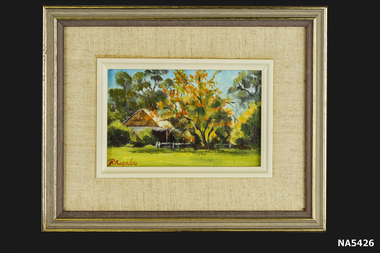
Painting - Schwerkolt Cottage, Autumn Schwerkolt Cottage '88, 1988
... Schwerkolt Cottage - Mitcham Painting mounted on beige fabric with inner beige plastic frame. ...Schwerkolt Cottage - Mitcham Painting mounted on beige fabric with inner beige plastic frame. ...Painting of Schwerkolt Cottage by Barbara Rogalski, member of WHS "Autumn" is one of 4 paintings.Oil painting of end of building in treed setting with autumn tree in foreground on grass. Schwerkolt Cottage - Mitcham Painting mounted on beige fabric with inner beige plastic frame. Outer frame of brown wood with gold rim.Signed by B. Rogalskipainting, schwerkolt cottage - autumn, barbara rogalski
