
Showing 6 items matching "family charcoal iron"
-
 Flagstaff Hill Maritime Museum and Village
Domestic object - Iron
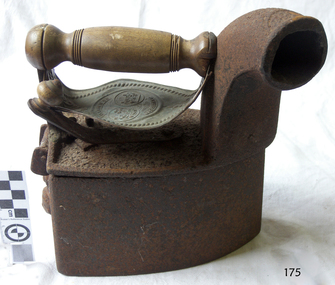
... ...Family charcoal iron...Self Heating Family Charcoal Iron. Box iron with wooden handle and brass finger guard. ...Flagstaff Hill Warrnambool Shipwrecked-coast Flagstaff-Hill Flagstaff-Hill-Maritime-Museum Maritime-Museum Shipwreck-coast Flagstaff-Hill-Maritime-Village iron self heating iron coal iron laundry Family charcoal iron T & G Clair & Co Two emblems within circles plus the inscription "Awarded To / T & G Clark & Co. on the finger guard Self Heating Family Charcoal Iron. ...Self Heating Family Charcoal Iron. Box iron with wooden handle and brass finger guard. The finger guard has two round emblems and the inscription "Awarded To T & G Clark & Co" on it.Two emblems within circles plus the inscription "Awarded To / T & G Clark & Co. on the finger guardflagstaff hill, warrnambool, shipwrecked-coast, flagstaff-hill, flagstaff-hill-maritime-museum, maritime-museum, shipwreck-coast, flagstaff-hill-maritime-village, iron, self heating iron, coal iron, laundry, family charcoal iron, t & g clair & co -
 Flagstaff Hill Maritime Museum and Village
Domestic object - Iron
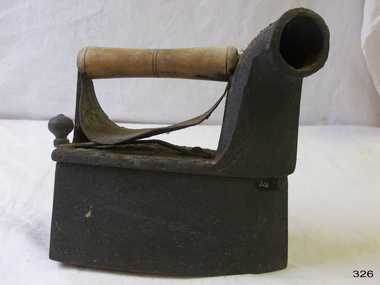
... ...Family charcoal iron...Flagstaff Hill Flagstaff Hill Maritime Museum and Village Warrnambool Maritime Museum Maritime Village Great Ocean Road Shipwreck Coast iron domestic iron box iron laundry equipment household item Family charcoal iron On top of iron"8" Charcoal box iron with iron body, wooden handle and metal finger guard. ...The iron is an example of laundry equipment from the Victorian era before electricity was commonly available.Charcoal box iron with iron body, wooden handle and metal finger guard. It has been painted black. Inscription on top of iron.On top of iron"8"flagstaff hill, flagstaff hill maritime museum and village, warrnambool, maritime museum, maritime village, great ocean road, shipwreck coast, iron, domestic iron, box iron, laundry equipment, household item, family charcoal iron -
 Flagstaff Hill Maritime Museum and Village
Iron
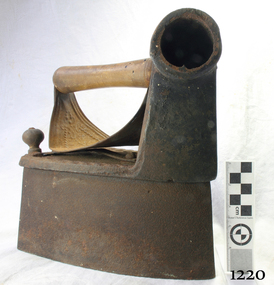
... Charcoal Box iron, self heating family charcoal iron. Hinged top with wooden handle and grate inside. ...Flagstaff Hill Warrnambool Shipwrecked-coast Flagstaff-Hill Flagstaff-Hill-Maritime-Museum Maritime-Museum Shipwreck-coast Flagstaff-Hill-Maritime-Village Charcoal Box iron, self heating family charcoal iron. Hinged top with wooden handle and grate inside. ...Charcoal Box iron, self heating family charcoal iron. Hinged top with wooden handle and grate inside. Has hand heat shield Also metal protecting plate for hand. Manufactured by C. H. Crane, Wolverhampton, England H22.5 x W 12 x L 24 flagstaff hill, warrnambool, shipwrecked-coast, flagstaff-hill, flagstaff-hill-maritime-museum, maritime-museum, shipwreck-coast, flagstaff-hill-maritime-village -
 City of Moorabbin Historical Society (Operating the Box Cottage Museum)
Document - Kitchen equipment, charcoal sad iron, c1880
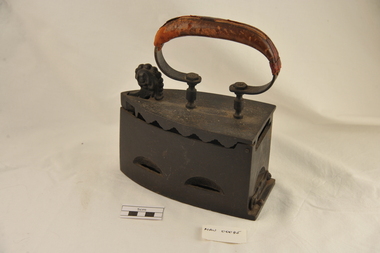
... This type of Charcoal iron was used by early settler families in Moorabbin Shire. ...This type of Charcoal iron was used by early settler families in Moorabbin Shire. ...This type of Charcoal iron was used by early settler families in Moorabbin Shire. The body or ‘box’ of the iron was filled with red-hot coals from the Kitchen hearth. This made for hot as well as smoky ironing and the handle would have become very hot. This type of iron is still used in some countries where electric power is unavailable. This Charcoal flat iron was used by the Curtis family who were early settlers in Moorabbin Shire c1880. A charcoal sad iron with leather covered handle c 1880 The cast iron body or ‘box’ of this sad iron was filled with red-hot coals from the hearth and great care had to be taken to prevent scorching the material to be smoothed.iron charcoal, flat iron, early settlers, pioneers, moorabbin, brighton, market gardeners, craftwork, sewing, laundry equipment, kitchens -
 Kiewa Valley Historical Society
Iron - Charcoal, c1850 - 1920
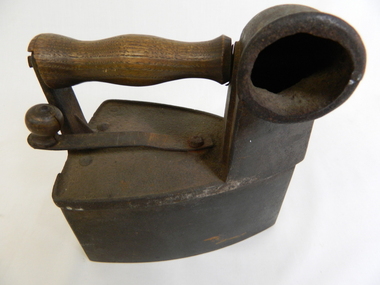
... iron, to press the family's clothes and linen. Small bellows were used to fire up the embers to keep the iron hot. In the Kiewa Valley the embers would have been from the local hard wood growing on the farms. Ron White worked for the SEC on the Kiewa Hydro Electric Scheme. The iron belonged to his mother. Ron remembers being a boy of approximately 8 years of age, watching his mother do her ironing with this charcoal ...This iron was used by women, in their domestic role, to press the clothes from the mid 19th century. Coal embers were put inside, heating the base of the iron, to press the family's clothes and linen. Small bellows were used to fire up the embers to keep the iron hot. In the Kiewa Valley the embers would have been from the local hard wood growing on the farms.Ron White worked for the SEC on the Kiewa Hydro Electric Scheme. The iron belonged to his mother. Ron remembers being a boy of approximately 8 years of age, watching his mother do her ironing with this charcoal iron in the c1920s.This iron is made of cast iron. It has a hinged lid so that coal embers can be put inside for heat. The lid has a curved funnel. Bellows are used to blow air into the iron and keep the coals burning. It has a wooden handle and a lever (also with a wooden handle) to open the lid. There is a 2 and a half centimetre hole at the back of the iron to check the coals. The hole has a swivel cover.There is an embossed "S" on the swivel cover.iron, laudry, household, charcoal, antique, domestic, pressing clothes -
 Friends of Westgarthtown
Functional object - Trunk/ Koffer, c. 1840s
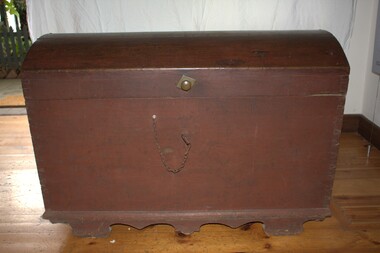
... family archives and Lutheran church committee papers. Constructed in the robust mid-19th-century German style, the chest likely features oak timbers, dovetail joinery, and iron fittings typical of sea-going koffers of the period. Its painted decoration, including the name “C. Ziebell” in large black charcoal ...The chest was constructed to allowable dimensions for storage in the ship's hold. The sturdy watertight construction afforded protection for the chests contents. It can be imagined that these would be household utensils, items of clothing and the most treasured ornaments as space permitted. It is likely that the contents included some building tools and as well, implements which Christian Ziebell used in his trade as a butcher in Bruel, thereby enabling him to undertake profitable work on his arrival in Australia.This object is of primary significance. The Koffer was constructed to allowable dimensions for storage in the ship’s hold. The sturdy watertight construction afforded protection for the Koffer’s contents on the voyage aboard the Privislaw from Hamburg, Germany to Hobsons Bay, Australia in 1850. The Koffer held the precious necessities for life for Christian Ziebell's family at their new destination. It is likely that the contents included some building tools as well, implements that Christian used in his trade as a butcher in Bruel, thereby enabling him to undertake profitable work on arrival in Australia. The wooden Koffer was airtight, so if lost overboard it would be retrievable. Some were fixed to the ship’s deck. After they settled at Westgarthtown the Koffer continued to contain the precious documents through each generation. Only the current owners saw the contents in each generation, and the children always regarded it as a “treasure chest”, which was always locked and out of bounds for them. This German-made sea chest, dating from the late 1840s, holds exceptional historical, cultural, and interpretive significance as an original migration object belonging to Christian and Sophia Ziebell during their maiden voyage to Australia. Serving as the family’s personal storage trunk aboard the Pribislaw in 1849, the chest would have functioned as a container for clothing, tools, and essential belongings. Later it served as storage for family archives and Lutheran church committee papers. Constructed in the robust mid-19th-century German style, the chest likely features oak timbers, dovetail joinery, and iron fittings typical of sea-going koffers of the period. Its painted decoration, including the name “C. Ziebell” in large black charcoal script, provides strong, direct provenance and reflects both ownership and pride in family identity. Such personalised embellishment was common among German migrants who decorated their chests during periods of spare time aboard the ship. As one of the rare surviving objects directly associated with the Ziebell family’s migration story, this chest embodies themes of aspiration, hardship, cultural continuity, and settlement. It is a tangible link between the family’s Mecklenburg origins and their new life at Westgarthtown, offering powerful interpretive value for understanding early German-Wendish migration and daily life at sea. Built to specifications for sea voyaging it is also a reminder of the planning required prior to considered migration. Its survival enriches the museum’s capacity to convey the lived experience of Christian and Sophia Ziebell and the foundational story of the community they helped to establish. Large wooden trunk/koffer. Base is rectangular, and lid is rectancular to fit the base but curves between the front and back. Morticed corners; protruding base with beveled edge. Supported by profiled runners with four built-in feet. Handle for carrying on each end, and locking mechanism on front.'C. Ziebell' written in large font on back of chestpersonal effects, travel goods, pribislaw, johann christian ziebell, german migration, luggage
