
Showing 66 items matching "fashion -- 1900s"
-
 Kiewa Valley Historical Society
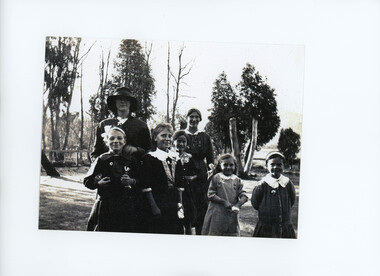
Photo - Family dressed in the fashion of the early 1900s
... Photo - Family dressed in the fashion of the early 1900s...During the early 1900s little girls' dresses were fashioned on the style worn by older women. ...Photo - Family dressed in the fashion of the early 1900s ...During the early 1900s little girls' dresses were fashioned on the style worn by older women. Girls dresses were knee length with trimmings of lace and ribbon. Collars were often removable for ease of washing. Leather lace-up boots and woollen stocking or socks were usually worn with these dresses. A pinafore or apron would be worn over the dresses to help keep them clean. Girls' hair was kept long, with curls and tied with ribbons.Boys' clothing was fashioned on sailor suits, blouses/shirts with a collar and trousers or knickerbockers. Woollen jackets, shirts and ties were suitable attire for older boys. Children's fashion of this time was dictated by long lasting durability, local manufacture, earthy colours and ease of mobility. Because of the long distance to haberdashery stores, the majority of children's garments would have been hand made by a local seamstress, mother or relation.Black and white photo of a family with 5 children in the foreground with trees in the background.children's clothing -
 Kew Historical Society Inc
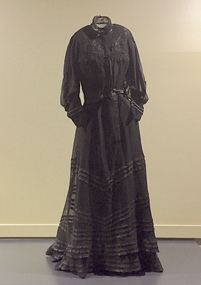
Clothing - Black Lace Evening Dress, c.1907
... ...australian fashion - 1900s...Clearly, 'women's work' and the skills that educated and wealthy women acquired in the period allowed them to fashion their own garments. fashion & design collection - kew historical society australian fashion - 1900s evening dresses lily clara wishart fashion design fashion -- 1900s Full length evening dress in four parts. ...Lily and William Wishart lived during this period in 'Noranook', Fernhurst grove, Kew. There are numerous contemporary accounts of the social and civic activities of Lily Wishart as mayoress of Kew. In a description of a 'Mayoral At Home' in the Kew Recreation Hall, a report in The Australasian (10 Aug 1907, p.46) described the event thus: MAYORAL AT HOME In the Kew Recreation-hall on Thursday evening the Mayor and Mrs. W. Wishart gave an at home to between two and three hundred guests. ... Prior to the musical programme, the mayor and mayoress held a reception, standing on a dais at one side of the room. Mrs. Wishart was gowned in black glace silk, trimmed with handsome lace applique, and she wore a cream Maltese lace scarf over her shoulders, and held a bouquet of cardinal carnations.' This may be the dress in the collection. Another interesting and relevant report is an account in The Argus (19 March 1907, p.6): 'WOMEN'S WORK EXHIBITION The mayoress of Kew (Mrs. W. Wishart) invited the ladies of the district to meet in the mayor's room, town-hall, Kew, at half past 3 o'clock tomorrow afternoon, to consider steps to be taken locally in support of the proposed Exhibition of Women's Work.'The dress is locally significant as the work of a skilled home-dressmaker in Kew, who was also a leading civic figure in the municipality. One tends to think of amateur dressmakers as women who could not afford to purchase clothes from a retailer. Clearly, 'women's work' and the skills that educated and wealthy women acquired in the period allowed them to fashion their own garments.Full length evening dress in four parts. Undergarments include two items: a basic black silk petticoat and an upper black silk slip, the latter with two bands of ruffles. The lace dress is in two parts: a bodice and a skirt. The black, high-necked bodice is constructed of silk organza to which guipure lace has been extensively applied. The bodice has long puffed sleeves, gathered on the forearm to form a wide band of lace and ribbon at the wrist. The skirt is constructed of the same black fabric with descending bands of gathered black silk ribbon, used as ornamentation. The skirt also features a long train. Apart from the donor information about its provenance, the style of the dress can confidently be dated to the period 1900-1910. The dress was made and worn to civic functions by Mrs Lily Wishart, Mayoress of Kew in 1906-7. Earlier items belonging to William and Lily Wishart entered the collection as early as 2002. The dress was donated by a descendant of a friend of Lily Wishart in 2020. The photograph of the dress and its components attached to the record needed to be digitally enhanced so that details of the dress could be viewed online, as the fabric of the dress is an intense black. A physical assessment of the dress is included in the condition report.fashion & design collection - kew historical society, australian fashion - 1900s, evening dresses, lily clara wishart, fashion design, fashion -- 1900s -
 Kew Historical Society Inc
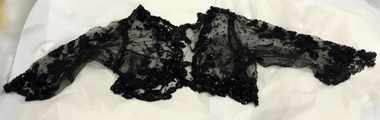
Clothing - Black Lace Bolero, c.1900
... ...fashion -- 1900s...Items in the collection were largely produced for, or purchased by women in Melbourne, and includes examples of outerwear, protective wear, nightwear, underwear and costume accessories. women's clothing boleros lace fashion design fashion -- 1900s Black lace and bead on tulle bolero. ca. 1900. ...The Fashion & Design collection of the Kew Historical Society includes examples of women’s, men’s, children’s and infants’ clothing from the 18th, 19th and 20th centuries. Items in the collection were largely produced for, or purchased by women in Melbourne, and includes examples of outerwear, protective wear, nightwear, underwear and costume accessories.Black lace and bead on tulle bolero. ca. 1900.women's clothing, boleros, lace, fashion design, fashion -- 1900s -
 Kew Historical Society Inc
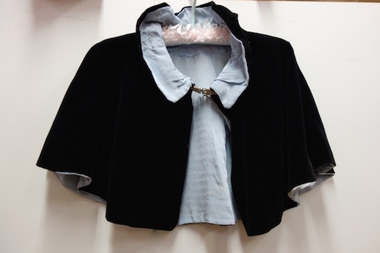
Clothing - Black velvet evening cape with blue silk lining, c. 1907
... ...fashion -- 1900s...Items in the collection were largely produced for, or purchased by women in Melbourne, and includes examples of outerwear, protective wear, nightwear, underwear and costume accessories. women's clothing fashion -- 1900s evening wear outerwear capelets fashion design Black velvet capelet with pale blue lining held at the neck with a gilt metal clasp. ...The Fashion & Design collection of the Kew Historical Society includes examples of women’s, men’s, children’s and infants’ clothing from the 18th, 19th and 20th centuries. Items in the collection were largely produced for, or purchased by women in Melbourne, and includes examples of outerwear, protective wear, nightwear, underwear and costume accessories.Black velvet capelet with pale blue lining held at the neck with a gilt metal clasp.women's clothing, fashion -- 1900s, evening wear, outerwear, capelets, fashion design -
 Kew Historical Society Inc
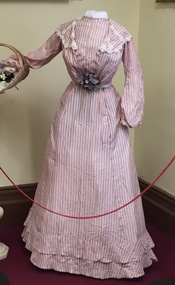
Clothing - Two Piece, Pink & White Striped Day Dress, 1900s
... ...australian fashion - 1900s...Items in the collection were largely produced for, or purchased by women in Melbourne, and includes examples of outerwear, protective wear, nightwear, underwear and costume accessories. women's clothing day dresses australian fashion - 1900s There is a small faded label on the rear collar of the dress, on which is hand printed the name of the dressmaker. ...The Fashion & Design collection of the Kew Historical Society includes examples of women’s, men’s, children’s and infants’ clothing from the 18th, 19th and 20th centuries. Items in the collection were largely produced for, or purchased by women in Melbourne, and includes examples of outerwear, protective wear, nightwear, underwear and costume accessories.Very fine, lightweight silk two-piece pink and white striped dress comprising a long skirt and a short fitted jacket. The jacket is edged with cream lace at the collar and front. On examination, the lace, while appearing to be in a later style has been judged to be of the period.There is a small faded label on the rear collar of the dress, on which is hand printed the name of the dressmaker. The name has been variously interpreted as reading Miss Gibbens, Miss Gibbons, or Miss Gibbuis. women's clothing, day dresses, australian fashion - 1900s -
 Kew Historical Society Inc
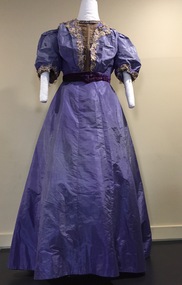
Clothing - Purple Silk Ball Gown, 1898-1904
... ...australian fashion - 1900s...The Fashion & Design collection of the Kew Historical Society includes examples of women’s, men’s, children’s and infants’ clothing from the 18th, 19th and 20th centuries. Items in the collection were largely produced for, or purchased by women in Melbourne, and includes examples of outerwear, protective wear, nightwear, underwear and costume accessories. ball gowns - 1900s australian fashion - 1900s costume Shot silk purple ball gown, featuring a fitted silk bodice with puff sleeves and a wide full-length skirt. ...The Fashion & Design collection of the Kew Historical Society includes examples of women’s, men’s, children’s and infants’ clothing from the 18th, 19th and 20th centuries. Items in the collection were largely produced for, or purchased by women in Melbourne, and includes examples of outerwear, protective wear, nightwear, underwear and costume accessories.Shot silk purple ball gown, featuring a fitted silk bodice with puff sleeves and a wide full-length skirt. The dress has coloured guipure lace at the neck and the cuffs, which has been identified as being of the period. The brush braid on the hem has probably been replaced at a later date. Dated to 1899-1900. ball gowns - 1900s, australian fashion - 1900s, costume -
 Kew Historical Society Inc
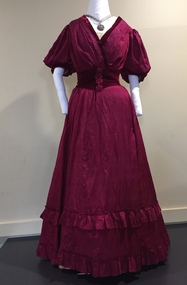
Clothing - Cerise Silk & Velvet Ball Gown, c.1901
... australian fashion - 1900s...This gown is believed to have been owned and worn by a member of the Smart family of 'Turinville', in Barnard Grove, Kew. australian fashion - 1900s ball gowns - 1900s evening dresses evening wear women's clothing Two-piece dress comprised of a bodice and floor length skirt made of a soft, lightweight cerise coloured silk fabric. ...The Fashion & Design collection of the Kew Historical Society includes examples of women’s, men’s, children’s and infants’ clothing from the 18th, 19th and 20th centuries. Items in the collection were largely produced for, or purchased by women in Melbourne, and includes examples of outerwear, protective wear, nightwear, underwear and costume accessories. This gown is believed to have been owned and worn by a member of the Smart family of 'Turinville', in Barnard Grove, Kew.Two-piece dress comprised of a bodice and floor length skirt made of a soft, lightweight cerise coloured silk fabric. The bodice features a v-shaped rear neck. A wide velvet cummerbund is part of the outfit. Dated to c. 1901. (Measurements: Length 132 x Waist 62-73, Chest 76 cm)australian fashion - 1900s, ball gowns - 1900s, evening dresses, evening wear, women's clothing -
 Kew Historical Society Inc
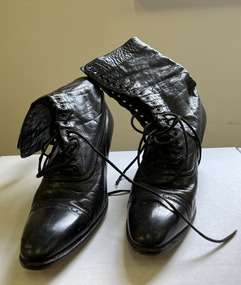
Clothing - Women's black leather lace-up boots, 1890-1910
... ...fashion 1900s...Pair of comparatively rare Edwardian women's boots Footwear fashion -- 1890s fashion 1900s Inside in biro "3286 / G. Smitt" Pair of women's black leather boots. ...Pair of women's leather boots given to the donor by Miss Denbigh of 18 Gordon Avenue, Kew in the 1950s. The Denbigh sisters were the daughters of John Denbigh, a pioneer of Kew, and the first resident of 'Wimba' in Cotham Road. The mid nineteenth century silk patchwork quilt in the collection also comes from the Denbigh family via a different donor. The style of the boots conforms to late Victorian or Edwardian.Pair of comparatively rare Edwardian women's bootsPair of women's black leather boots. Leather insoles and soles. Mid-calf length with a 2-3 inch heel. Glazed black kidskin or calf leather upper with a glossy finish on the lower foot area. Inside in biro "3286 / G. Smitt"footwear, fashion -- 1890s, fashion 1900s -
 Kew Historical Society Inc
Clothing - White Muslin Lingerie Dress, 1900s
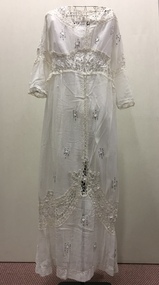
... australian fashion - 1900s...This elaborately detailed example is believed to date from the first years of the 20th century. australian fashion - 1900s women's clothing white muslin dresses embroidery tea dresses lingerie dresses rosemary vaughan-smith Long white cotton muslin lingerie dress with inserted panels of white lace and additional white and black embroidery applied to the shoulders, waist and hem. ...The Fashion & Design collection of the Kew Historical Society includes examples of women’s, men’s, children’s and infants’ clothing from the 18th, 19th and 20th centuries. Items in the collection were largely produced for, or purchased by women in Melbourne, and includes examples of outerwear, protective wear, nightwear, underwear and costume accessories. This lingerie dress is one of a number of items donated to the Fashion Collection by Rosemary-Vaughan Smith.While lingerie dresses were produced for and worn by women between 1900 and 1920, the main period in which they were worn was between 1900 and 1910. This elaborately detailed example is believed to date from the first years of the 20th century.Long white cotton muslin lingerie dress with inserted panels of white lace and additional white and black embroidery applied to the shoulders, waist and hem. australian fashion - 1900s, women's clothing, white muslin dresses, embroidery, tea dresses, lingerie dresses, rosemary vaughan-smith -
 Kew Historical Society Inc
Clothing - Silk and Lace Two Piece Day Dress, 1900s
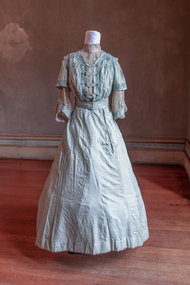
... ...fashion -- 1900s...The garments in the Weir Collection were donated to the Kew Historical Society by a granddaughter of Edith Weir in 2017. edith mary weir (nee betteridge) women's clothing dresses fashion -- 1900s weir collection Pale blue shot silk dress, comprised of a separate pale blue silk bodice and a wide flaring skirt of the same fabric. ...An item forming part of a collection of costumes, photographs and documents relating to the Weir family who lived in a mansion, originally named Illapa, at 84 Princess Street, Kew, from c.1917 to 1950. This historically significant collection includes items relating to both George Weir (1866-1937), his wife Edith Mary Weir (1867-1948) and their children. George Weir attained national prominence in the mining industry, becoming General Manager of the North Broken Hill Silver Mining Company in 1903 (later renamed North Broken Hill Mining Company 1905-12, and North Broken Hill Ltd 1912-1988), and subsequently President of the Mine Owners Association. He was to remain General Manager of North Broken Hill Ltd until his retirement in 1926.This garment is part of a collection of women’s clothing, owned and worn by Edith Mary Weir (nee Betteridge) - born in Clare, South Australia 1867, died Kew 1948 - and also by her daughter. The garments date from the 1880s to the 1930s. The collection includes day dresses, evening dresses, evening coats, capes, and undergarments. As the wife and daughter of a mine manager, the collection includes representative examples of clothing worn by upper middle class Australian women in domestic circumstances, and at social and civic events. A number of the costumes from the 1920s to the 1930s are of a particularly fine quality, being both rare, representative and intact examples of Australian fashion of the period. The garments in the Weir Collection were donated to the Kew Historical Society by a granddaughter of Edith Weir in 2017.Pale blue shot silk dress, comprised of a separate pale blue silk bodice and a wide flaring skirt of the same fabric. The bodice features silk embroidery in the same colour as the dress and wide bands of brown lace at the neck, on the front of the bodice and on the sleeves. Blue silk fabric tabs extend across the lace at the front with gold buttons at either end. The bodice has an attached blue silk belt. As part of the ensemble, there are also pale blue silk stockings, of the period. edith mary weir (nee betteridge), women's clothing, dresses, fashion -- 1900s, weir collection -
 Kew Historical Society Inc
Clothing - Pale Blue Muslin, Silk, & Lace Dress, 1910-14
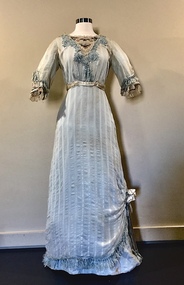
... ...fashion - 1900s...The garment's integrity and design also contribute to its aesthetic significance as a representative item of women's outerwear during the first decades of the twentieth century. women's clothing edwardian dresses lilian ballantine australian fashion - 1910s mary macqueen finlay mcqueen memorial church east kew presbyterian church alan mcqueen kew war memorial archibald dill ballantine leo baeck centre 31 harp road -- kew (vic.) a&g ballantine women's clothing -- 1900s fashion - 1900s fashion design Pale blue striped muslin single-piece dress with lace, tulle and embroidery at the neck and on the cuffs. ...The dress was in the cupboard of Muriel Kerr, the donor's recently deceased mother. The donor remembers being shown it and trying it on in the late '70s or early '80s and being told that it belonged to her great-grandmother, Lilian Armstrong Ballantine (nee Power) [1887-1967]. Lilian Ballantine lived at 31 Harp Road (now the site of the Leo Baeck Centre) from the early 1920s to 1967. Lilian's married Archibald Dill Ballantine [1883-1947], in 1910. He was a member of the Monumental firm of A&G Ballantine, responsible for the Kew War Memorial (and possibly the Springthorpe Memorial). Lilian was highly involved with the Finlay McQueen Memorial Church [ie the East Kew Presbyterian Church]. Lilian's daughter, Mary (the donor's grandmother) married Alan McQueen, the son of Finlay McQueen, the first Minister of the East Kew Church. Mary Macqueen lived at 1 Oswin Street; she was a well-known artist. The dress is significant due to its associations with a family with strong connections, through a number of generations, to Kew East and its spiritual institutions. The garment's integrity and design also contribute to its aesthetic significance as a representative item of women's outerwear during the first decades of the twentieth century.Pale blue striped muslin single-piece dress with lace, tulle and embroidery at the neck and on the cuffs. The lace at the neck and cuffs is embroidered with coloured flowers, and edged with tulle. Bordering the v-neckline is a deeper blue guipure lace (possibly added later). There is a satin flower on the right side of the skirt which gathers the hem, exposing the deeper blue cotton underskirt. The dress has a narrow band of blue satin at the high waist. The cotton underskirt is attached by thread in places to the outer layer. Both the outer and under layers are attached with metal hooks and eyes. Edging the cuffs and hem of the dress is blue commercial fringing. The exterior of the dress has a slight brown tinge which is not apparent on the inside hem, suggesting that it has been discoloured through exposure. There are minor stains.women's clothing, edwardian dresses, lilian ballantine, australian fashion - 1910s, mary macqueen, finlay mcqueen memorial church, east kew presbyterian church, alan mcqueen, kew war memorial, archibald dill ballantine, leo baeck centre, 31 harp road -- kew (vic.), a&g ballantine, women's clothing -- 1900s, fashion - 1900s, fashion design -
 Kew Historical Society Inc
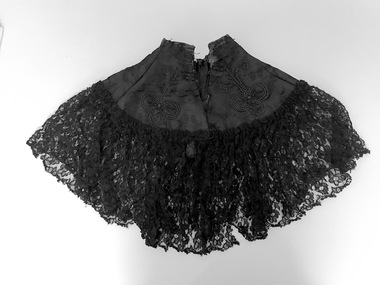
Clothing - Black satin and lace capelet, c.1900
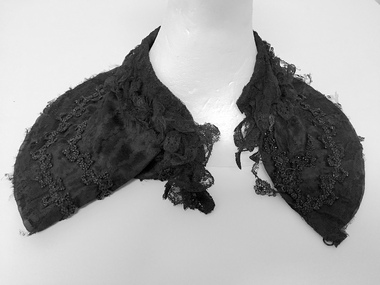
... ...fashion -- 1890s -- 1900s...The item was passed by descent to her daughter Catherine Francis Helen Taylor (nee Gulliver) [born 1896], and then to her granddaughter, Doris Catherine Kriesfield (nee Taylor) [1922-2015]. fashion design women's clothing outerwear capes capelets fashion -- 1890s -- 1900s mourning wear Victorian-era capelet, designed to cover the shoulders, and ornamented with a double band of jet passementerie. ...Western fashion in the 1890s saw women's capes become an item of fashionable choice as they fell gracefully over an expansive sleeve. Capes often had a high neck, and were frequently trimmed with jet passementerie and fur. This capelet has a fashionable dog-collar neckline which became fashionable from c.1895, lasting as a style to c.1905. The capelet was probably part of a mourning ensemble.The capelet originally belonged to Catherine Francis Ellen Gulliver (nee Wells) who was born in Ballarat in 1874. The item was passed by descent to her daughter Catherine Francis Helen Taylor (nee Gulliver) [born 1896], and then to her granddaughter, Doris Catherine Kriesfield (nee Taylor) [1922-2015]. Victorian-era capelet, designed to cover the shoulders, and ornamented with a double band of jet passementerie. The capelet has a high dog neck collar, which is lined with leather. The original lace, of which some remains, has been removed in the past, probably due to damage, leaving some traces of its original style. The front of the capelet has large hooks and eyes.fashion design, women's clothing, outerwear, capes, capelets, fashion -- 1890s -- 1900s, mourning wear -
 Kew Historical Society Inc
Clothing - Black satin and lace capelet, c.1900
... ...fashion -- 1890s -- 1900s...The item was passed by descent to her daughter Catherine Francis Helen Taylor (nee Gulliver) [born 1896], and then to her granddaughter, Doris Catherine Kriesfield (nee Taylor) [1922-2015]. fashion design women's clothing outerwear capes capelets fashion -- 1890s -- 1900s mourning wear catherine francis ellen gulliver doris catherine kriesfield Victorian-era capelet, designed to cover the shoulders, and ornamented with shamrocks outlined in jet passementerie. ...Western fashion in the 1890s saw women's capes become an item of fashionable choice as they fell gracefully over an expansive sleeve. Capes often had a high neck, and were frequently trimmed with jet passementerie and fur. This capelet has a fashionable dog-collar neckline which became fashionable from c.1895, lasting as a style to c.1905. The capelet was probably part of a mourning ensemble.The capelet originally belonged to Catherine Francis Ellen Gulliver (nee Wells) who was born in Ballarat in 1874. The item was passed by descent to her daughter Catherine Francis Helen Taylor (nee Gulliver) [born 1896], and then to her granddaughter, Doris Catherine Kriesfield (nee Taylor) [1922-2015]. Victorian-era capelet, designed to cover the shoulders, and ornamented with shamrocks outlined in jet passementerie. The capelet has a dog-collar neck, that is lined with leather. The original lace, forms a wide border edging the satin. The front of the capelet has large hooks and eyes.fashion design, women's clothing, outerwear, capes, capelets, fashion -- 1890s -- 1900s, mourning wear, catherine francis ellen gulliver, doris catherine kriesfield -
 Brighton Historical Society
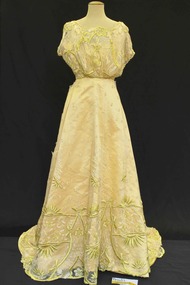
Clothing - Dress, Evening dress, c. 1909
... ...1900s fashion...Some of these items were passed down to two of Clara's nieces, Miss Mary Bell and Mrs Lois Lillies, who donated them to BHS around 1973. woolbrook septimus miller cantala henry 'money' miller gwendoline miller clara miller 1900s fashion caulfield brighton general cemetery A yellow and lime green silk and net evening dress from c.1909. ...This evening dress belonged to Clara Johnstone Miller (nee Bell, 1866-1910). Clara was the only daughter of Mr James Bell, a councillor of the Shire of Leigh (today a part of Golden Plains Shire) and owner of Woolbrook Homestead in Teesdale, near Geelong. In 1888, Clara married prominent businessman, racehorse owner, racing identity and pastoralist Septimus Miller (1854-1925). Septimus was the sixth of seven children born to Henry 'Money' Miller and Eliza Miller (nee Mattinson). 'Money' Miller was a well known financier and politician and reputedly one of Australia's wealthiest people in his time. In 1889, Clara and Septimus moved into the house 'Cantala' in Dandenong Road, Caulfield. They had one child, Gwendoline Stewart Miller, who died in 1902 at the age of thirteen of diabetes - a largely untreatable condition at the time (insulin would not be discovered until 1921). Clara died in 1910, aged only 44. Septimus subsequently married Helen (nee Henderson), with whom he had a son, Ronald (1915-1990). The Millers were buried in the Brighton General Cemetery in a large Gothic-style vault. Upon Clara's death, Septimus sent much of her clothing and Gwendoline's to her mother Mary Bell. Some of these items were passed down to two of Clara's nieces, Miss Mary Bell and Mrs Lois Lillies, who donated them to BHS around 1973.A yellow and lime green silk and net evening dress from c.1909. The bodice is constructed of a golden silk satin with an over bodice of a very soft gold net with soft gold and lime green embroidery decorated with flower and bow motif's. The neckline is bateau like in shape with the edge following the flowers of the lace design. The bodice is sleeveless with a loose detached cap that hangs down over the top of the arm with a lace covering. The under fabric of the bodice is shaped and lightly boned but the over lace is looser, nipping in at the waist where it joins the skirt. At the back, the bodice neckline scoops lower than the front with the lace overlay creating a v shape at the centre back. The bodice is secured with hooks and eyes and waist tapes. The skirt is flat fronted and floor length consisting of the same golden yellow silk with soft gold and lime green embroidered net over skirt. The lace net over skirt features larger motifs and greater embellishment towards the bottom of the skirt. The lace over lay also has an edge that follows the design of the lace rather than a straight edge. At the back the underskirt is flat and shaped but the over skirt is lightly gathered and loose hanging. The skirt finishes in a full skirt and a rounded, small train.woolbrook, septimus miller, cantala, henry 'money' miller, gwendoline miller, clara miller, 1900s fashion, caulfield, brighton general cemetery -
 Brighton Historical Society
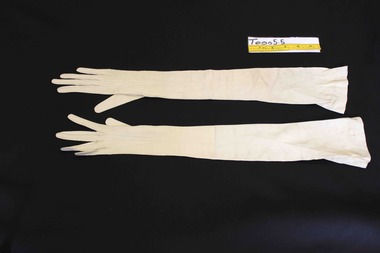
Accessory - Gloves, 1900
... ...1900s fashion...Some of these items were passed down to two of Clara's nieces, Miss Mary Bell and Mrs Lois Lillies, who donated them to BHS around 1973. woolbrook septimus miller henry 'money' miller gwendoline miller cantala clara miller gloves caulfield brighton general cemetery 1900s fashion buckley and nunn A black ink stamp on the inside of the right glove over the wrist: 5 3/4, Made in France, Buckley and Nunn Limited, Melbourne. ...These gloves belonged to Clara Johnstone Miller (nee Bell, 1866-1910). Clara was the only daughter of Mr James Bell, a councillor of the Shire of Leigh (today a part of Golden Plains Shire) and owner of Woolbrook Homestead in Teesdale, near Geelong. In 1888, Clara married prominent businessman, racehorse owner, racing identity and pastoralist Septimus Miller (1854-1925). Septimus was the sixth of seven children born to Henry 'Money' Miller and Eliza Miller (nee Mattinson). 'Money' Miller was a well known financier and politician and reputedly one of Australia's wealthiest people in his time. In 1889, Clara and Septimus moved into the house 'Cantala' in Dandenong Road, Caulfield. They had one child, Gwendoline Stewart Miller, who died in 1902 at the age of thirteen of diabetes - a largely untreatable condition at the time (insulin would not be discovered until 1921). Clara died in 1910, aged only 44. Septimus subsequently married Helen (nee Henderson), with whom he had a son, Ronald (1915-1990). The Millers were buried in the Brighton General Cemetery in a large Gothic-style vault. Upon Clara's death, Septimus sent much of her clothing and Gwendoline's to her mother Mary Bell. Some of these items were passed down to two of Clara's nieces, Miss Mary Bell and Mrs Lois Lillies, who donated them to BHS around 1973.A pair of very fine ivory doeskin evening gloves. The gloves feature full pique insert seams around the fingers and thumb with a slit on the inside arm from mid thumb to mid fore arm and three white shell buttons. The gloves extend high to high on the upper arms and feature a ribbon covered elastic to aid hold on the upper arm. A black ink stamp on the inside of the right glove over the wrist: 5 3/4, Made in France, Buckley and Nunn Limited, Melbourne. A black ink stamp on the inside of the left glove over the wrist: Grand Prix Exposition, 1900, Medallere D'or, Merlier, Depose (? Very faint), Made in France. A blue ink stamp on the inside of the left glove over the top side of the wrist: 797, 221'65, C51Cwoolbrook, septimus miller, henry 'money' miller, gwendoline miller, cantala, clara miller, gloves, caulfield, brighton general cemetery, 1900s fashion, buckley and nunn -
 Kew Historical Society Inc
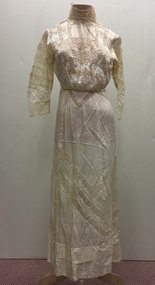
Clothing - Silk & Lace Lingerie Dress, 1900s
... ...fashion - broken hill - 1900s...The garments in the Weir Collection were donated to the Kew Historical Society by a granddaughter of Edith Weir in 2017. edith mary weir (nee betteridge) 84 princess street - kew (vic) women's clothing costumes dresses - lingerie dresses fashion - broken hill - 1900s Cream silk lingerie dress featuring wide inset panels of lace of the same colour. ...An item forming part of a collection of costumes, photographs and documents relating to the Weir family who lived in the mansion originally named Illapa, 84 Princess Street, Kew, from c.1917 to 1950. This historically significant collection includes items relating to both George Weir (1866-1937) and his wife Edith Mary Weir (1867-1948). George Weir attained national prominence in the mining industry, becoming General Manager of the North Broken Hill Silver Mining Company in 1903 (later renamed North Broken Hill Mining Company 1905-12, and North Broken Hill Ltd 1912-1988), and subsequently President of the Mine Owners Association. He was to remain General Manager of North Broken Hill Ltd until his retirement in 1926.This garment is part of a collection of women’s clothing, owned and worn by Edith Mary Weir (nee Betteridge) - born in Clare, South Australia 1867, died Kew 1948 - and also by her daughter. The garments date from the 1880s to the 1930s. The collection includes day dresses, evening dresses, evening coats, capes, and undergarments. As the wife and daughter of a mine manager, the collection includes representative examples of clothing worn by upper middle class Australian women in domestic circumstances, and at social and civic events. A number of the costumes from the 1920s to the 1930s are of a particularly fine quality, being both rare, representative and intact examples of Australian fashion of the period. The garments in the Weir Collection were donated to the Kew Historical Society by a granddaughter of Edith Weir in 2017.Cream silk lingerie dress featuring wide inset panels of lace of the same colour. The bands of lace are of varying widths and appear on the bodice, the skirt and the sleeves. The dress is loose fitting but held at the waist by a silk cord. The lace yoke has a high neck. An initial assessment suggested that the buttons might be a later addition.edith mary weir (nee betteridge), 84 princess street - kew (vic), women's clothing, costumes, dresses - lingerie dresses, fashion - broken hill - 1900s -
 Tennis Australia
Cardboard container, 1904
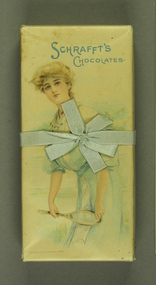
... Lid depicts a woman dressed in early 1900s fashion holding a racquet. 'SCHRAFFT'S CHOCOLATES' and 'COPYRIGHT 1904, W.F. ...Lid depicts a woman dressed in early 1900s fashion holding a racquet. 'SCHRAFFT'S CHOCOLATES' and 'COPYRIGHT 1904, W.F. ...Cardboard box, originally a packaging for chocolates. Lid depicts a woman dressed in early 1900s fashion holding a racquet. 'SCHRAFFT'S CHOCOLATES' and 'COPYRIGHT 1904, W.F. SCHRAFFT & SONS' printed on lid next to image. Blue ribbon is attached to sides of lid and tied in a bow on top centre. Box contains only a loose rice paper lining. Materials: Cardboard, Ink, Papertennis -
 Flagstaff Hill Maritime Museum and Village
Domestic object - Basket, 1890-1920s
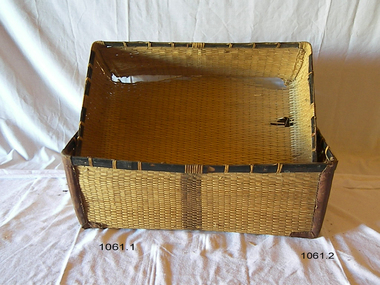
... The subject item was probability used at the end of the Victorian era and into the Edwardian period around the 1900s as a household storage facility. These types of wicker or cane containers started to go out of fashion due to their fragility around the 1920s into the 1940s due as well to the introduction of synthetic materials. flagstaff hill warrnambool shipwrecked-coast flagstaff-hill flagstaff-hill-maritime-museum maritime-museum shipwreck-coast flagstaff-hill-maritime-village None Wicker cane rectangular shaped domestic storage container with reinforced leather pads on 4 corner sides. lid fits inside the other. ...Before the invention of woven baskets, people used tree bark to make simple containers. These containers could be used to transport gathered food and other items but crumbled after only a few uses. Weaving strips of bark or other plant material to support the bark containers would be the next step, followed by entirely woven baskets. The last innovation appears to be baskets so tightly woven that they could hold water. Depending on soil conditions, baskets may or may not be preserved in the archaeological record. Sites in the Middle East show that weaving techniques were used to make mats and possibly also baskets, circa 8000 BCE. Twined baskets date back to 7000 in Oasisamerica. Baskets made with interwoven techniques were common at 3000 BCE. Baskets were originally designed as multi-purpose vessels to carry and store materials and to keep stray items about the home. The plant life available in a region affects the choice of material, which in turn influences the weaving technique. Rattan and other members of the Arecaceae or palm tree family, the thin grasses of temperate regions, and broad-leaved tropical bromeliads each require a different method of twisting and braiding to be made into a basket. The practice of basket making has evolved into an art. Artistic freedom allows basket makers with a wide choice of colours, materials, sizes, patterns, and details.Before the advent of plastics (1907), the is now used for many different types and styles of storage container rattan, wicker or cane was used to make containers with a lid for the storage of linens etc. The subject item was probability used at the end of the Victorian era and into the Edwardian period around the 1900s as a household storage facility. These types of wicker or cane containers started to go out of fashion due to their fragility around the 1920s into the 1940s due as well to the introduction of synthetic materials. Wicker cane rectangular shaped domestic storage container with reinforced leather pads on 4 corner sides. lid fits inside the other. Black cane piece around top edge.Noneflagstaff hill, warrnambool, shipwrecked-coast, flagstaff-hill, flagstaff-hill-maritime-museum, maritime-museum, shipwreck-coast, flagstaff-hill-maritime-village -
 Ballarat Clarendon College
Photograph, 1908 (estimated)
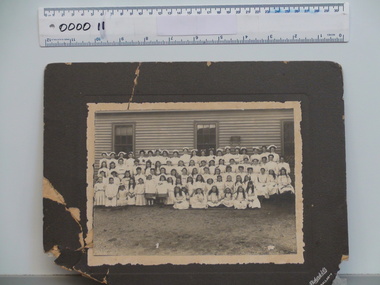
... fashions, hair coiffure and accessories and added costuming are fascinating. The sport detail from the basketball hoop is significant. This photograph has social significance because of its detail regarding female school activities in the early 1900s. 1908 uniform richardson clarendon ladies college costume menagerie hilda farmer avenel halls sylvia eyres ella morrow florence sides gertie owen laela williams lorna dowler emma buchanan phyllis doepel daisy llewellyn adeline purser sophie anderson helen mathieson d brophy lily wright margaret dowler dulce deardon gladys small marjory howe jessie kelsall erica mckay pearl eyres iris llewellyn edith bishop marjorie walker violet howard hazel wlls effie white mimi murphy carrie miners edith murphy irene palamountain miss allan marjorie salmon dollie snow naomi franklin elsie powell rachael kennedy rose paull sylvia barnett esther lilah emblling trixie kliender chrissie anderson agnes wheen kitty dawbarn hazel clements m serjeant dolly gill beryl bach dorothy nicholas frances gill meg moore jessie eyres blanche murphy merle booth melba mcconnel edna clark betty lester bessie hoad madge dearden kate cameron olive mathews grace nicholas mollie souter isabel mctaggart madge llewellyn mollie mary buley alice ralph ruth tyler rebecca abraham joyce eyres nellie salmon Printed on front righthand bottom corner of mount: 'Richards & Co/Ballarat' Black and white photograph mounted on grey card of Clarendon Ladies College student cohort in 1908. ...This extraordinary record of the student cohort in 1908 reveals many aspects of school life in the early 1900's. The fashions, hair coiffure and accessories and added costuming are fascinating. The sport detail from the basketball hoop is significant. This photograph has social significance because of its detail regarding female school activities in the early 1900s. Black and white photograph mounted on grey card of Clarendon Ladies College student cohort in 1908. The students are arranged in five tiered rows. The photograph is taken against wall of a timber building. There is a basketball net fixed to the wall above the last row. Many of the girls are wearing fancy hats, some decorated with birds. Two young girls in the front row wear poster boards over their clothing advertising an event not to be missed; something to do with a menagerie. All the students are dressed in white, some in dresses, some n skirts and blouses and many have aprons over their skirts. The photograph is accompanied with a typed list of namesPrinted on front righthand bottom corner of mount: 'Richards & Co/Ballarat'1908, uniform, richardson, clarendon ladies college, costume, menagerie, hilda farmer, avenel halls, sylvia eyres, ella morrow, florence sides, gertie owen, laela williams, lorna dowler, emma buchanan, phyllis doepel, daisy llewellyn, adeline purser, sophie anderson, helen mathieson, d brophy, lily wright, margaret dowler, dulce deardon, gladys small, marjory howe, jessie kelsall, erica mckay, pearl eyres, iris llewellyn, edith bishop, marjorie walker, violet howard, hazel wlls, effie white, mimi murphy, carrie miners, edith murphy, irene palamountain, miss allan, marjorie salmon, dollie snow, naomi franklin, elsie powell, rachael kennedy, rose paull, sylvia barnett, esther, lilah emblling, trixie kliender, chrissie anderson, agnes wheen, kitty dawbarn, hazel clements, m serjeant, dolly gill, beryl bach, dorothy nicholas, frances gill, meg moore, jessie eyres, blanche murphy, merle booth, melba mcconnel, edna clark, betty lester, bessie hoad, madge dearden, kate cameron, olive mathews, grace nicholas, mollie souter, isabel mctaggart, madge llewellyn, mollie mary buley, alice ralph, ruth tyler, rebecca abraham, joyce eyres, nellie salmon -
 Flagstaff Hill Maritime Museum and Village
Clothing - Skirt, before April 1874
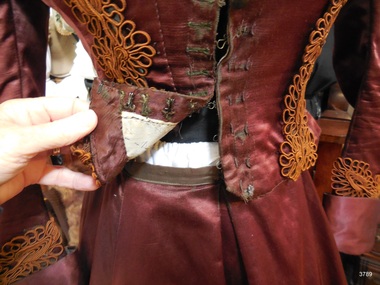
... It is a fine example of female fashion of the mid to late 1900s. The outfit is significant for its connection with a wedding uniting two colonial families from Northern Ireland who immigrated to Australia in the mid-1850s. ...THE SKIRT The skirt has a gentle, soft, feminine design which keeps it in good shape and condition, preserving it from soiling and prolonging its life: - the satin fabric is softly pleated at the waist and falls gently to almost floor length - the opening is concealed at the back within one of the folds and closes with hooks and eyes underneath the bow at the back of the jacket - the horizontal stitching at the base of the skirt joins the lining to the skirt, and the firmness it creates allows it to gently flare out at the base without the need of hooped petticoats - a removable fabric lining at the hem protects the front and back of the skirt from friction and soiling from the wearer’s footwear THE SKIRT This evening outfit is significant for its connection with colonial Australia, Victoria and Warrnambool. It is a fine example of female fashion of the mid to late 1900s. The outfit is significant for its connection with a wedding uniting two colonial families from Northern Ireland who immigrated to Australia in the mid-1850s. The families had a significant role in the history of Warrnambool and district. The outfit is significant too for connecting the colonial families to the indigenous culture of the district and the contact between the native and European people. The lined, floor-length, amber satin skirt has gentle folds that gather into a fitted waistband. One of the folds at the back conceals the opening of the skirt that fastens using metal hooks and eyes. The bow at the back of the jacket covers the top of the closure. There are metal hooks distributed around the top of the waistband. The skirt is stitched horizontally around the hem in several rows. There is a removable fabric lining at the base of the skirt.evening skirt, ladies 1h century skirt, satin skirt, antique satin skirt -
 Flagstaff Hill Maritime Museum and Village
Accessory - Handkerchief, 20th century
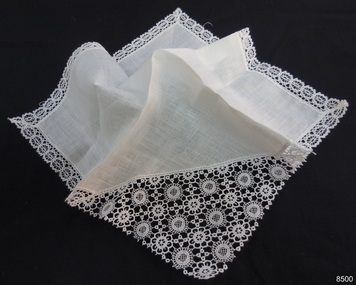
... This handkerchief is a representation of fine needlework and women's fashion accessories in the late 19th and early 20th century. flagstaff hill warrnambool shipwrecked coast flagstaff hill maritime museum maritime museum shipwreck coast flagstaff hill maritime village great ocean road handkerchief lace handkerchief woman's handkerchief women's accessory fine fabric craftwork White fine lawn cotton handkerchief, square with machine made lace handstitched to lawn. Features two separate types of lace which are carefully cut on the edges. The design of the lace is circa 1900s ...This fine lawn handkerchief has machine made lace trim. Although lace was being machine made from the 1600’s the design of the lace on this handkerchief is circa 1900’s. This handkerchief is a representation of fine needlework and women's fashion accessories in the late 19th and early 20th century.White fine lawn cotton handkerchief, square with machine made lace handstitched to lawn. Features two separate types of lace which are carefully cut on the edges. The design of the lace is circa 1900s.flagstaff hill, warrnambool, shipwrecked coast, flagstaff hill maritime museum, maritime museum, shipwreck coast, flagstaff hill maritime village, great ocean road, handkerchief, lace handkerchief, woman's handkerchief, women's accessory, fine fabric craftwork -
 Flagstaff Hill Maritime Museum and Village
Accessory - Handkerchief, c. 19th century
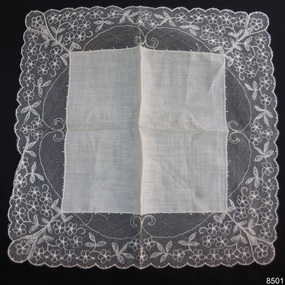
... It is also an example of women's fashion accessories in the late 19th and early 20th century. flagstaff hill warrnambool shipwrecked coast flagstaff hill maritime museum maritime museum shipwreck coast flagstaff hill maritime village great ocean road handkerchief lace handkerchief woman's handkerchief women's accessory silk handkerchief fine handcraft needlecraft ladies' handkerchief 1900s White starched silk handkerchief, square shape, very soft fabric edged with 5cm embroidered net lace. ...The handkerchief was on display at Flagstaff Hill reception area from 2008-2105 as an example of fine needlework with a lace pattern typical of the early 1900's. During that era the house mistress would often carry two handkerchiefs, one for blowing her nose and one out on show, perhaps in an apron pocket.This handkerchief is an example of fine handmade needlework. It is also an example of women's fashion accessories in the late 19th and early 20th century.White starched silk handkerchief, square shape, very soft fabric edged with 5cm embroidered net lace. Net was embroidered as a strip then joined at corners. The design is backstitched then the lace has been joined to the fabric using blanket stitch. flagstaff hill, warrnambool, shipwrecked coast, flagstaff hill maritime museum, maritime museum, shipwreck coast, flagstaff hill maritime village, great ocean road, handkerchief, lace handkerchief, woman's handkerchief, women's accessory, silk handkerchief, fine handcraft, needlecraft, ladies' handkerchief, 1900s -
 Flagstaff Hill Maritime Museum and Village
Clothing - Evening Outfit, before April 1874
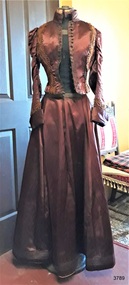
... The evening outfit and its accompanying mannequin serve as notable examples of female fashion from the mid to late 1900s. These items reflect the styles and trends that were prevalent during this period, offering insight into the clothing choices and cultural influences that shaped women's attire. ...This amber satin evening outfit was worn by Mrs Isabella Mitchell (nee Russell, 1840 – 1929) at the wedding of her brother Alexander (c.1846–1938) and Eliza (nee Moore, c.1854–1939). The jacket and skirt attach at the waist by joining the metal rings around the base of the jacket, and the metal hooks on the waistband of the skirt. The outfit was donated with its own mannequin and fits it perfectly. In the colonial days, outer clothing was rarely, if ever, washed, due to the expense of fabrics and the difficulty in careful laundering. Clever methods were employed to reduce the occurrence of soiling. The mannequin included with the donation would also help keep the outfit in good shape and ensure a flattering fit. FAMILIES’ HISTORY The families connected with this wedding, where the outfit was worn, are from Warrnambool’s colonial days. Isabella and Alexander’s parents, Robert Russell and Elizabeth (nee Mitchell), were born in 1808 and married about 1830. They were from farming families in Northern Ireland, where they raised their seven children before migrating to Australia in the early colonial days, around 1857. Their graves are in the Tower Hill Cemetery. Alexander’s wife, Eliza (nee Moore, born in 1854), was also from Northern Ireland and migrated to Australia in 1858 with her parents, Thomas and Nancy Moore, in the last voyage of the sailing ship “Chance”. Isabella (Bella) talked with her granddaughter Ruby Akers about her memories of Alexander and Eliza’s wedding and other events in her life. Ruby recorded these memories in a letter. She says, “They were married in the Warrnambool Congregational Church by a pioneer minister, the Reverend Uriah Coombs. The bride wore a pale blue silk wedding gown, which she made herself. Bella was Matron of Honora, and Ian McCasker was best man. In those days, the transport to the church was usually a carriage – similar to a cab – and a pair of white ponies. They would have the reception at home, go for a drive afterwards, and at night there would be a dance. They did all the catering themselves … Eliza carried on farming in the Dennington, Yarpturk and Purnim districts until they moved to Camperdown around 1905…” Ruby’s letter later mentions “[Isabella] could recall seeing a blackfellows’ corroboree being performed near where the Dennington Bridge now stands. It was rather a terrifying experience; they seemed to be in a warlike mood, and one never knew what they would do next. One lubra came running to Granny, crying, Hide me, bad man kill me. She was bleeding from a wound in the head: probably the result of a blow from a waddy. My mother [Margaret Jane McLaughlan nee Mitchell], coming home from school in the 1800s, often met blackfellows walking ahead with spears and boomerang, the two lubras – they usually had two – following in the rear, carrying the children or any burdens they had.“ Margaret was probably in primary school at the time she saw these things. Alexander and Eliza had ten children. One of their daughters, Margaret Jane, was born in Warrnambool in 1879. She married William McCullagh, and they had eleven children. Margaret made headlines in the Warrnambool newspapers for celebrating her 100th birthday. She had lived in the district for 60 years before moving to Melbourne. Alexander passed away at the age of 92, and Eliza passed away six months later, aged 85. Their graves are in the Colac cemetery. Isabella married Ralph Mitchell, and their daughter Margaret Jane married John McLauchlan in 1891. Margaret and John’s daughter, Ruby Elizabeth Jane, married Fredrick Akers in 1938. Fredrick, born in England, was a Boer War veteran and served in the British Army. He migrated to Queensland, Australia, in 1913, and joined the Australian Army to fight in World War I. In 1935, he moved to Warrnambool, where he served in the Volunteer Defence Corps from 1938 to 1945. Both Ruby and Fredrick are buried in the Tower Hill Cemetery.The evening outfit and its accompanying mannequin serve as notable examples of female fashion from the mid to late 1900s. These items reflect the styles and trends that were prevalent during this period, offering insight into the clothing choices and cultural influences that shaped women's attire. Beyond their representation of period fashion, the outfit and mannequin are significant due to their association with colonial pioneer families from Australia, specifically Victoria and Warrnambool. These families played an important role in the development and history of the region, and the items are linked to their legacy. The evening outfit and mannequin are also notable for their connection to a wedding that united two colonial families originating from Northern Ireland. These families immigrated to Australia in the mid-1850s and became influential figures within the Warrnambool district. The wedding marked a significant event, symbolising the merging of two prominent family lineages. Furthermore, the significance of the evening outfit and mannequin extends to their connection with the colonial families’ contact with the indigenous culture of the district. These items represent a period of interaction between the native and European peoples, highlighting the cultural exchanges that occurred within the region. This lady’s evening outfit is made from amber coloured satin fabric. It comprises a short-waisted, long-sleeved jacket and a long skirt, and it has its own neck-to-floor wooden mannequin on a pedestal. The outfit was worn by Mrs Isabella Mitchell (nee Russell) as the Matron of Honour at the wedding of her brother Alexander Russell and his fiancée Eliza Moore in Warrnambool, 29th April 1874.flagstaff hill, warrnambool, shipwrecked coast, flagstaff hill maritime museum, maritime museum, shipwreck coast, flagstaff hill maritime village, great ocean road, evening outfit, wedding outfit, bridesmaid’ outfit, matron of honour outfit, clothing female, clothing late 19th century, clothing wedding late 19th century, clothing bridesmaid late 19th century, clothing antique, clothing ladies, women’s clothing, women’s fashion, alexander russell, eliza russell, eliza moore, isabella mitchell, bella mitchell, bella russell, isabella russell, ralph russell, ian mccusker, ruby akers, fredrick william akers, ruby mclauchlan, margaret jane mclaughlan nee mitchell, margaret jane mclaughlan centenarian, william mclaughlan, robert russell, elizabeth russell nee mitchell, irish immigrants, warrnambool volunteer defence corps 1938-1945, antique satin outfit, warrnambool wedding 1874, congregational church warrnambool, reverend uriah coombs, dennington farmer, yarpturk farmer, purnim district farmer, camperdown resident 1905, dennington bridge, indigenous corroboree in dennington, corroboree in warrnambool, 1880s corroboree in warrnambool, lubra and baby, indigenous corroboree in warrnambool, mccullagh family -
 Flagstaff Hill Maritime Museum and Village
Clothing - Mourning Outfit, Late 19th to early-20th centuries
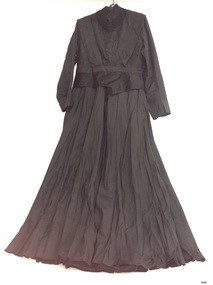
... The jacket has a peplum or flounce below the waistline, a fashion that was seen in the 1860s and is still around in the 1900s. The outfit represents the female mourning fashion and wardrobe from the late 19th to early 20th centuries. ...The jacket has a peplum or flounce below the waistline, a fashion that was seen in the 1860s and is still around in the 1900s. The outfit represents the female mourning fashion and wardrobe from the late 19th to early 20th centuries. ...This Edwardian-era mourning outfit was worn by a wealthy woman from the rural area of Willaura, southeast of the Grampians. It was inherited by the donor from his mother, who had purchased it from a clearing sale in the 1960s. The jacket has a peplum or flounce below the waistline, a fashion that was seen in the 1860s and is still around in the 1900s. The outfit represents the female mourning fashion and wardrobe from the late 19th to early 20th centuries. Such garments were a necessary inclusion as death often occurred to the young, due to illness, accidents and hard work - it was a regular part of life in rural Victoria. Mourning outfits were part of a person’s wardrobe and often passed from one generation to the next. This particular outfit appears to have been adjusted at some stage to allow for a wider waistline. The original skirt may have been replaced by the one that is now part of this outfit; the skirt is all machine-sewn, unlike the jacket and petticoat. The fabric of the skirt may be silk or it could be a synthetic fibre such as artificial silk or rayon; both were available in the 1800s,but nylon wasn’t invented until the 1930s. This skirt has sunray pleating, which was advertised on skirts for sale in the 1890s, and 1909, and was part of a fashionable bridal gown train in the 1930s. The mourning of death was part of both family and community life, particularly in rural and remote areas. People were bonded through work, religion, disasters, tragedy and social activities, supporting one another. They came together from near and far on such an occasion, giving each other the care that was needed and showing respect for the member who had passed away.This three-piece silk Edwardian mourning outfit is significant historically for its connection with rural Victoria and the social and religious customs surrounding the death of a family or community member. The high-quality outfit is also significant for representing the financial management of the times, being tailored by a dressmaker for a person of means and then adjusted to fit at least one different-sized person. Ladies’ Edwardian mourning outfit; three-piece tailored suit comprising of a black silk long sleeve, short-waist fitted and lined Jacket, a long sunray pleated skirt and long, lined petticoat. Items have been machine-sown and hand-sewn by a dressmaker. The skirt has handmade buttons of the same fabric.Handwritten in ballpoint pen “Jenny” and “Mrs Sheila Handscombe, Wallaura, Jenny”flagstaff hill maritime museum and village, warrnambool, shipwreck coast, edwardian era, tailor-made, dressmaker, mourning outfit, handmade garment, mourning dress, death mourning, sunray pleats, western district victoria -
 Flagstaff Hill Maritime Museum and Village
Clothing - Mourning Outfit, jacket, Late 19th to early-20th centuries
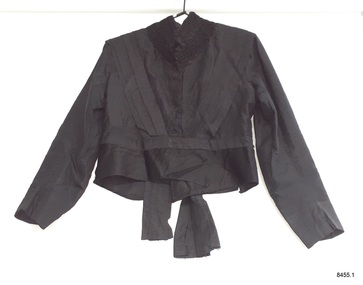
... The jacket has a peplum or flounce below the waistline, a fashion that was seen in the 1860s and is still around in the 1900s. The outfit represents the female mourning fashion and wardrobe from the late 19th to early 20th centuries. ...The jacket has a peplum or flounce below the waistline, a fashion that was seen in the 1860s and is still around in the 1900s. The outfit represents the female mourning fashion and wardrobe from the late 19th to early 20th centuries. ...This Edwardian era mourning outfit was worn by a wealthy woman from the rural area of Willaura, southeast of the Grampians. It was inherited by the donor from his mother, who had purchased it from a clearing sale in the 1960s. The jacket has a peplum or flounce below the waistline, a fashion that was seen in the 1860s and is still around in the 1900s. The outfit represents the female mourning fashion and wardrobe from the late 19th to early 20th centuries. Such garments were a necessary inclusion as death occurred often to the young, due to illness, accidents and hard work - it was a regular part of life in rural Victoria. Mourning outfits were a part of a person’s wardrobe and often passed from one generation to the next. This particular outfit appears to have been adjusted at some stage to allow for a wider waistline. The original skirt may have been replaced by the one that is now part of this outfit; the skirt is all machine-sewn, unlike the jacket and petticoat. The fabric of the skirt may be silk or it could be a synthetic fibre such as artificial silk or rayon; both were available in the 1800s,but nylon wasn’t invented until the 1930s. This skirt has sunray pleating, which was advertised on skirts for sale in the 1890s, and 1909, and was part of a fashionable bridal gown train in the 1930s. The mourning of death was part of both family and community life, particularly in rural and remote areas. People were bonded through work, religion, disasters, tragedy and social activities, supporting one another. They came together from near and far on such an occasion, giving each other the care that was needed and showing respect for the member who had passed away.This three-piece silk Edwardian mourning outfit is significant historically for its connection with rural Victoria and the social and religious customs surrounding the death of a family or community member. The high-quality outfit is also significant for representing the financial management of the times, being tailored by a dressmaker for a person of means and then adjusted to fit at least one different-sized person. The black silk tailor-made jacket is one of three pieces of a ladies’ Edwardian mourning outfit. It has long sleeves, a stand-up collar trimmed with appliqued black crochet lace, and pleated sashes on the left and right sides from front to back fastened at the shoulder and waist. The jacket has a peplum or flounce below the waistline. The front of the jacket has brass hooks and fabric eye fastenings. The back of the jacket has two tails. The jacket is lined and the shoulders are padded. It has been machine sewn and finished with hand stitching. A white card is tied with a ribbon inside and has an inscription. The poplin skirt on the jacket has been cut up to the waist at the side seams. There is an attached card with an inscription, handwritten in ballpoint pen.“Jenny” and “Mrs Sheila Handscombe, Wallaura, Jenny”flagstaff hill maritime museum and village, warrnambool, shipwreck coast, edwardian era, tailor-made, dressmaker, mourning outfit, handmade garment, mourning dress, death mourning, sunray pleats, sunburst pleats, western district victoria, mourning jacket -
 Flagstaff Hill Maritime Museum and Village
Clothing - Mourning Outfit, skirt, Late 19th to early-20th centuries
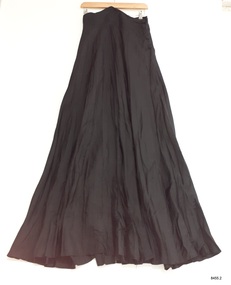
... The jacket has a peplum or flounce below the waistline, a fashion that was seen in the 1860s and is still around in the 1900s. The outfit represents the female mourning fashion and wardrobe from the late 19th to early 20th centuries. ...The jacket has a peplum or flounce below the waistline, a fashion that was seen in the 1860s and is still around in the 1900s. The outfit represents the female mourning fashion and wardrobe from the late 19th to early 20th centuries. ...This Edwardian-era mourning outfit was worn by a wealthy woman from the rural area of Willaura, southeast of the Grampians. It was inherited by the donor from his mother, who had purchased it from a clearing sale in the 1960s. The jacket has a peplum or flounce below the waistline, a fashion that was seen in the 1860s and is still around in the 1900s. The outfit represents the female mourning fashion and wardrobe from the late 19th to early 20th centuries. Such garments were a necessary inclusion as death often occurred to the young, due to illness, accidents and hard work - it was a regular part of life in rural Victoria. Mourning outfits were part of a person’s wardrobe and often passed from one generation to the next. This particular outfit appears to have been adjusted at some stage to allow for a wider waistline. The original skirt may have been replaced by the one that is now part of this outfit; the skirt is all machine-sewn, unlike the jacket and petticoat. The fabric of the skirt may be silk or it could be a synthetic fibre such as artificial silk or rayon; both were available in the 1800s, but nylon wasn’t invented until the 1930s. This skirt has sunray pleating, which was advertised on skirts for sale in the 1890s, and 1909, and was part of a fashionable bridal gown train in the 1930s. The mourning of death was part of both family and community life, particularly in rural and remote areas. People were bonded through work, religion, disasters, tragedy and social activities, supporting one another. They came together from near and far on such an occasion, giving each other the care that was needed and showing respect for the member who had passed away.This three-piece silk Edwardian mourning outfit is significant historically for its connection with rural Victoria and the social and religious customs surrounding the death of a family or community member. The high-quality outfit is also significant for representing the financial management of the times, being tailored by a dressmaker for a person of means and then adjusted to fit at least one different-sized person. The full-length black silk tailor-made skirt is one of three pieces of a ladies’ Edwardian mourning outfit. The skirt is made from black silky fabric. The garment has only two seams; at the side closure and the centre back. The whole skirt has sunray pleats; narrow pleats at the waist that fan outwards towards the hem. The top of the skirt is finished with a waistband that is shaped as an upward V shape in the centre. The side seam is closed with four self-fabric buttons with silver metal backing. The shirt has been machine sewn.flagstaff hill maritime museum and village, warrnambool, shipwreck coast, edwardian era, tailor-made, dressmaker, mourning outfit, mourning dress, death mourning, sunray pleats, western district victoria, full-length skirt -
 Flagstaff Hill Maritime Museum and Village
Clothing - Mourning Outfit, petticoat, Late 19th to early-20th centuries
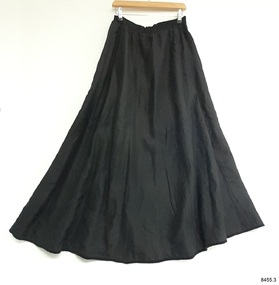
... The jacket has a peplum or flounce below the waistline, a fashion that was seen in the 1860s and is still around in the 1900s. The outfit represents the female mourning fashion and wardrobe from the late 19th to early 20th centuries. ...The jacket has a peplum or flounce below the waistline, a fashion that was seen in the 1860s and is still around in the 1900s. The outfit represents the female mourning fashion and wardrobe from the late 19th to early 20th centuries. ...This Edwardian-era mourning outfit was worn by a wealthy woman from the rural area of Willaura, southeast of the Grampians. It was inherited by the donor from his mother, who had purchased it from a clearing sale in the 1960s. The jacket has a peplum or flounce below the waistline, a fashion that was seen in the 1860s and is still around in the 1900s. The outfit represents the female mourning fashion and wardrobe from the late 19th to early 20th centuries. Such garments were a necessary inclusion as death often occurred to the young, due to illness, accidents and hard work - it was a regular part of life in rural Victoria. Mourning outfits were part of a person’s wardrobe and often passed from one generation to the next. This particular outfit appears to have been adjusted at some stage to allow for a wider waistline. The original skirt may have been replaced by the one that is now part of this outfit; the skirt is all machine-sewn, unlike the jacket and petticoat. The fabric of the skirt may be silk or it could be a synthetic fibre such as artificial silk or rayon; both were available in the 1800s,but nylon wasn’t invented until the 1930s. This skirt has sunray pleating, which was advertised on skirts for sale in the 1890s, and 1909, and was part of a fashionable bridal gown train in the 1930s. The mourning of death was part of both family and community life, particularly in rural and remote areas. People were bonded through work, religion, disasters, tragedy and social activities, supporting one another. They came together from near and far on such an occasion, giving each other the care that was needed and showing respect for the member who had passed away.This three-piece silk Edwardian mourning outfit is significant historically for its connection with rural Victoria and the social and religious customs surrounding the death of a family or community member. The high-quality outfit is also significant for representing the financial management of the times, being tailored by a dressmaker for a person of means and then adjusted to fit at least one different-sized person. The full-length black silk tailor-made petticoat is one of three pieces of a ladies’ Edwardian mourning outfit. The petticoat is made from black silk lined with lightweight cotton. The petticoat and lining are constructed from eight panels each, brought together at the waist and gently gathered into the band. The back seam opening is fastened with brass hooks and fabric eyes. The lining has been reinforced with a heavier-weight hem. The hemline is finished with black velvet ribbon than encloses both the petticoat and lining. flagstaff hill maritime museum and village, warrnambool, shipwreck coast, edwardian era, tailor-made, dressmaker, mourning outfit, handmade garment, mourning dress, death mourning, sunray pleats, western district victoria, petticoat, undergarment, slip -
 City of Moorabbin Historical Society (Operating the Box Cottage Museum)
Headwear - Clothing, Bowler Hat black, 20thC
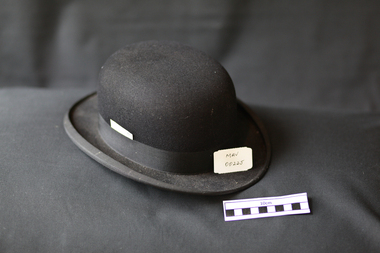
... In England and Commonwealth the Bowler hat remained popular throughout the 1800s and through the first half of the 1900s, being worn by everyone from politicians, actors, accountants, bankers, and the 'everyman' on the street. The family of Nance Blackman were early settlers in Moorabbin Shire hats hatters blackman nance clothing suits fashion wear bankers actors politicians bowler hats derby hats top hats social classes moorabbin cheltenham bentleigh brighton market gardeners pioneers early settlers bowler thomas bowler william lock & co. ltd. london england america canada Inside Crown & Band ; The Cobweb Felt / easiest/ fitting / extra light / Inside Band Best Quality / 6111 A black felt Bowler hat with cream silk lining and black ribbon band Headwear Clothing, Bowler Hat black The Cobweb Felt Co Ltd ...The Bowler hat, characterised by its dome-like crown, was invented in 1849 by a pair of hat-makers: brothers Thomas and William Bowler. They were commissioned by the famous London hat retailer “Lock & Co” to invent a close-fitting, low-crowned hat for their customer Mr. Edward Coke. It would be sturdy and not easily knocked or blown off the wearer’s head. The difference between a Bowler hat and a Derby hat is simply that Bowler hats are British, Derby hats are American. The Bowler / Derby hat was devised in London during a time when the top hat was the upper-class men’s hat of choice and the lower social class wore soft, cloth caps. However, the top hat was impractical and inconvenient for those on horseback as it easily toppled over and was easily damaged. Bowler hats were termed “stiff” hats– they were given a coat of shellac in the construction process and therefore never conformed to the shape of the wearers head. While very stiff, the hat is lined in a beautiful, soft silk to ensure comfort. The Bowler hat marked the first middle ground between formality and casual wear. c1900 The Derby hats were very popular for all classes in USA including criminals like Butch Cassidy & Sundance Kid and c1920 many fashionable women also wore them. In England and Commonwealth the Bowler hat remained popular throughout the 1800s and through the first half of the 1900s, being worn by everyone from politicians, actors, accountants, bankers, and the 'everyman' on the street.The family of Nance Blackman were early settlers in Moorabbin ShireA black felt Bowler hat with cream silk lining and black ribbon bandInside Crown & Band ; The Cobweb Felt / easiest/ fitting / extra light / Inside Band Best Quality / 6111hats, hatters, blackman nance, clothing, suits, fashion wear, bankers, actors, politicians, bowler hats, derby hats, top hats, social classes, moorabbin, cheltenham, bentleigh, brighton, market gardeners, pioneers, early settlers, bowler thomas, bowler william, lock & co. ltd. london, england, america, canada -
 Flagstaff Hill Maritime Museum and Village
Bonnet, late 1800s - early 1900s
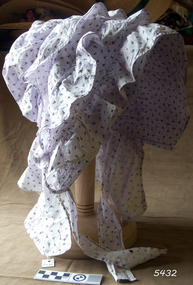
... This style of bonnet was commonly worn outdoors by women in South West Victoria in the late 1800s - early 1900s The bonnet is significant as a typical of women's outdoor headwear in Australia in the late 19th and early 20th century. flagstaff hill warrnambool shipwrecked-coast flagstaff-hill flagstaff-hill-maritime-museum maritime-museum shipwreck-coast flagstaff-hill-maritime-village ladies bonnet outdoor bonnet hat bonnet headwear ladies clothing late 19th century bonnet early 20th century bonnet women's fashion australian fashion australian millinery Ladies outdoor bonnet, white cotton with narrow mauve stripes and small flowers. ...This style of bonnet was commonly worn outdoors by women in South West Victoria in the late 1800s - early 1900sThe bonnet is significant as a typical of women's outdoor headwear in Australia in the late 19th and early 20th century.Ladies outdoor bonnet, white cotton with narrow mauve stripes and small flowers. Bonnet is trimmed with frills and straps to tie under the chin. Dated late 19th to early 20th century.flagstaff hill, warrnambool, shipwrecked-coast, flagstaff-hill, flagstaff-hill-maritime-museum, maritime-museum, shipwreck-coast, flagstaff-hill-maritime-village, ladies bonnet, outdoor bonnet, hat, bonnet, headwear, ladies clothing, late 19th century bonnet, early 20th century bonnet, women's fashion, australian fashion, australian millinery -
 Flagstaff Hill Maritime Museum and Village
Clothing - Combination Undergarment, Late 1800s
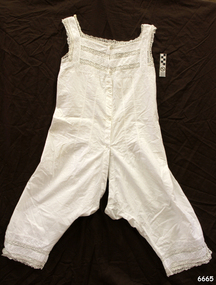
... fashion...lingerie...under-structure...1900s...Flagstaff Hill Maritime Museum and Village Maritime Museum Maritime Village Warrnambool Great Ocean Road Southwest Victoria Victorian era combination undergarment all-in-one underwear combination ‘combinations’ one-piece underwear one-piece undergarment chemise and bloomers combination chemise and bloomers divided bifurcated split chemise and drawers women’s underwear ladies’ underwear undergarment women’s clothing women’s fashion lingerie under-structure 1900s undergarments 19th-century undergarment 20th century handmade clothing handmade lace hand-worked lace Paton family Trefnant Yangery lady's combinations ladies combinations Women’s white cotton and lace all-In-one combination undergarment. ...This handmade women’s combination undergarment features hand-worked lace panels and trim, and fine pintucks. It is one of seven handmade items of white cotton underwear, all made with beautiful needlework and embroidery skill. The lingerie once belonged to the donor’s great-grandmother’s family, the Paton family of ‘Trefnant’, Yangery, in southwest Victoria. The design of this combination undergarment, or ‘combination’, includes a chemise attached to a pair of drawers or bloomers. The combination is divided, or bifurcated, from the waist to the crutch for easier urinating. This one-piece type of underwear was worn by females from the 1860s and into the early 1900s. The 19th Century garments had front button closures like this one, and those made in the 1900s more often had back closures. Combination underwear was popular because the all-in-one design had far fewer gathers and bulk, making the other clothing look much smoother. The collection of women’s late-19th-century undergarments is an example of clothing that women would include in their wardrobes. The garments add to the study of the evolution of women's fashions and practicality for the early Australian settlers. The fine linen fabric and the careful needlework in these handmade garments and hand-worked lace trims reflect the maker’s dedication to making even serviceable garments beautiful to look at and wear. Women’s white cotton and lace all-In-one combination undergarment. The handmade underwear is a combined chemise and bloomers. It has a front button closure and is trimmed with hand-worked lace panels on the bodice and lace edging around armholes, the neck, and the bottom of the legs. The left and right sides are divided from the waist to the crutch.flagstaff hill maritime museum and village, maritime museum, maritime village, warrnambool, great ocean road, southwest victoria, victorian era, combination undergarment, all-in-one underwear, combination, ‘combinations’, one-piece underwear, one-piece undergarment, chemise and bloomers, combination chemise and bloomers, divided, bifurcated, split, chemise and drawers, women’s underwear, ladies’ underwear, undergarment, women’s clothing, women’s fashion, lingerie, under-structure, 1900s undergarments, 19th-century undergarment, 20th century, handmade clothing, handmade lace, hand-worked lace, paton family, trefnant, yangery, lady's combinations, ladies combinations
