
Showing 18 items matching "fashion cut pattern"
-
 Whitehorse Historical Society Inc.
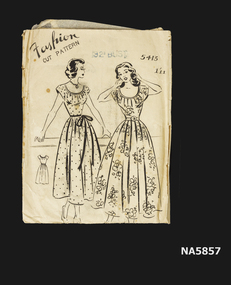
Domestic object - Fashion Cut Pattern No.5413, Fashion Cut Pattern, 1950's
... Fashion Cut Pattern No.5413......Fashion Cut Pattern...Fashion Cut Pattern No.5413 Bust 32" 1'11 Pattern in cream paper sleeve. ...Fashion Cut Pattern...Domestic dressmaking for Women's fashion Women's fashion Dressmaking Paper patterns 1950's Fashion Cut Pattern As above Fashion Cut Pattern No.5413 Bust 32" 1'11 Pattern in cream paper sleeve. ...Domestic dressmaking for Women's fashionFashion Cut Pattern No.5413 Bust 32" 1'11 Pattern in cream paper sleeve. Has picture of two models wearing dresses with flared skirtsAs abovewomen's fashion, dressmaking, paper patterns, 1950's, fashion cut pattern -
 Whitehorse Historical Society Inc.
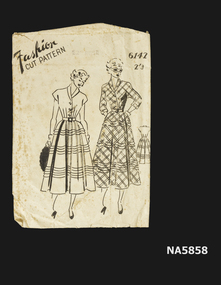
Domestic object - Fashion Cut Pattern No.6142, Fashion Cut Pattern, 1950's
... Fashion Cut Pattern No.6142...Fashion Cut Pattern No.6142 2'3 Pattern in cream paper sleeve Has two models with dresses; one with long sleeves and one without....Fashion Cut Pattern...Domestic object Fashion Cut Pattern No.6142 Fashion Cut Pattern ...Fashion Cut Pattern No.6142 2'3 Pattern in cream paper sleeve Has two models with dresses; one with long sleeves and one without.As abovefashion cut patterns, 1950's, dressmaking paper patterns -
 Whitehorse Historical Society Inc.
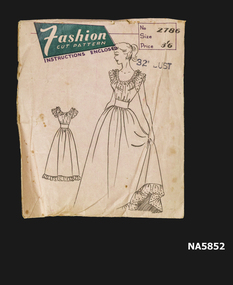
Domestic object - Fashion Cut Pattern No. 2786, C 1950's
... Fashion Cut Pattern No. 2786......Fashion Cut Pattern...Fashion Cut Pattern No. 2786 Pattern in a light pink sleeve with picture of lady in a long nightgown. ...Domestic dressmaking for women Dressmaking Ladies wear Nightwear C 1950's Fashion Cut Pattern As above Fashion Cut Pattern No. 2786 Pattern in a light pink sleeve with picture of lady in a long nightgown. ...Domestic dressmaking for womenFashion Cut Pattern No. 2786 Pattern in a light pink sleeve with picture of lady in a long nightgown. Price 3/6, 32" Bust.As abovedressmaking, ladies wear, nightwear, c 1950's, fashion cut pattern -
 Flagstaff Hill Maritime Museum and Village
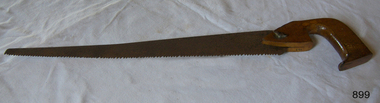
Tool - Compass Saw, Mid to late 20th Century
... cut only on the pull stroke and set with the teeth projecting only on one side, rather than in the modern fashion with an alternating set. Saws were also made of bronze and later iron. In the Iron Age, frame saws were developed holding the thin blades in tension. The earliest known sawmill is the Roman Hierapolis sawmill from the third century AD used for cutting stone. The subject item is believed to date from around the mid to late 20th century and is regarded as a modern item. The maker is unknown but the pattern ...A saw is a tool consisting of a tough blade, wire, or chain with a hard-toothed edge. It is used to cut through material, very often wood, though sometimes metal or stone. The cut is made by placing the toothed edge against the material and moving it forcefully forth and less vigorously back or continuously forward. This force may be applied by hand, or powered by steam, water, electricity or other power sources. An abrasive saw has a powered circular blade designed to cut through metal or ceramic. In ancient Egypt, open (unframed) saws made of copper are documented as early as the Early Dynastic Period, circa 3,100–2,686 BC. Many copper saws were found in tombs dating to the 31st century BC. Models of saws have been found in many contexts throughout Egyptian history. As the saw developed, teeth were raked to cut only on the pull stroke and set with the teeth projecting only on one side, rather than in the modern fashion with an alternating set. Saws were also made of bronze and later iron. In the Iron Age, frame saws were developed holding the thin blades in tension. The earliest known sawmill is the Roman Hierapolis sawmill from the third century AD used for cutting stone.The subject item is believed to date from around the mid to late 20th century and is regarded as a modern item. The maker is unknown but the pattern or design and type of wood used indicate it is a tool of modern manufacture. Compass saw blade with wooden handle attached with wingnut.Noneflagstaff hill, warrnambool, flagstaff-hill, flagstaff-hill-maritime-museum, maritime-museum, shipwreck-coast, flagstaff-hill-maritime-village, wood cutting, wood saw, cross cut saw, cabinet makers tools, wood working tools, tool -
 Flagstaff Hill Maritime Museum and Village
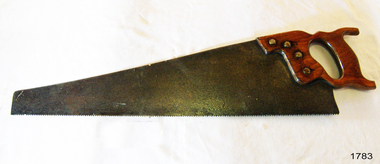
Tool - Wood Saw, Mid to late 20th century
... cut only on the pull stroke and set with the teeth projecting only on one side, rather than in the modern fashion with an alternating set. Saws were also made of bronze and later iron. In the Iron Age, frame saws were developed holding the thin blades in tension. The earliest known sawmill is the Roman Hierapolis sawmill from the third century AD used for cutting stone. The subject item at this time cannot be associated with an historical event, person or place, provenance is unknown, as the maker is unknown but the pattern ...A saw is a tool consisting of a tough blade, wire, or chain with a hard-toothed edge. It is used to cut through material, very often wood, though sometimes metal or stone. The cut is made by placing the toothed edge against the material and moving it forcefully forth and less vigorously back or continuously forward. This force may be applied by hand, or powered by steam, water, electricity or other power sources. An abrasive saw has a powered circular blade designed to cut through metal or ceramic. In ancient Egypt, open (unframed) saws made of copper are documented as early as the Early Dynastic Period, circa 3,100–2,686 BC. Many copper saws were found in tombs dating to the 31st century BC. Models of saws have been found in many contexts throughout Egyptian history. As the saw developed, teeth were raked to cut only on the pull stroke and set with the teeth projecting only on one side, rather than in the modern fashion with an alternating set. Saws were also made of bronze and later iron. In the Iron Age, frame saws were developed holding the thin blades in tension. The earliest known sawmill is the Roman Hierapolis sawmill from the third century AD used for cutting stone. The subject item at this time cannot be associated with an historical event, person or place, provenance is unknown, as the maker is unknown but the pattern or design and type of wood used indicate it is a tool of modern manufacture around the mid to late 20th century.Wood hand saw with wooden handle attached to saw by 4 rivets. No blade markings Noneflagstaff hill, warrnambool, flagstaff-hill, flagstaff-hill-maritime-museum, maritime-museum, shipwreck-coast, flagstaff-hill-maritime-village, handsaw, wood saw, carpenders tools, cabinet makers tools, wood cutting -
 Flagstaff Hill Maritime Museum and Village
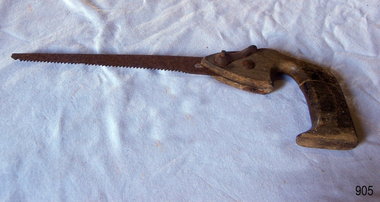
Tool - Saw, Mid 20th Century
... cut only on the pull stroke and set with the teeth projecting only on one side, rather than in the modern fashion with an alternating set. Saws were also made of bronze and later iron. In the Iron Age, frame saws were developed holding the thin blades in tension. The earliest known sawmill is the Roman Hierapolis sawmill from the third century AD used for cutting stone. The subject item is believed to date from around the mid to late 20th century and is regarded as a modern item. The maker is unknown but the pattern ...A saw is a tool consisting of a tough blade, wire, or chain with a hard-toothed edge. It is used to cut through material, very often wood, though sometimes metal or stone. The cut is made by placing the toothed edge against the material and moving it forcefully forth and less vigorously back or continuously forward. This force may be applied by hand, or powered by steam, water, electricity or other power sources. An abrasive saw has a powered circular blade designed to cut through metal or ceramic. In ancient Egypt, open (unframed) saws made of copper are documented as early as the Early Dynastic Period, circa 3,100–2,686 BC. Many copper saws were found in tombs dating to the 31st century BC. Models of saws have been found in many contexts throughout Egyptian history. As the saw developed, teeth were raked to cut only on the pull stroke and set with the teeth projecting only on one side, rather than in the modern fashion with an alternating set. Saws were also made of bronze and later iron. In the Iron Age, frame saws were developed holding the thin blades in tension. The earliest known sawmill is the Roman Hierapolis sawmill from the third century AD used for cutting stone.The subject item is believed to date from around the mid to late 20th century and is regarded as a modern item. The maker is unknown but the pattern or design and type of wood used indicate it is a tool of modern manufacture. Compass saw blade with wooden with open handle blade attached with wingnut lever at side to adjust long narrow blade Noneflagstaff hill, warrnambool, flagstaff-hill, flagstaff-hill-maritime-museum, maritime-museum, shipwreck-coast, flagstaff-hill-maritime-village, wood cutting, wood saw, cross cut saw, cabinet makers tools, wood working tools, tool -
 Flagstaff Hill Maritime Museum and Village
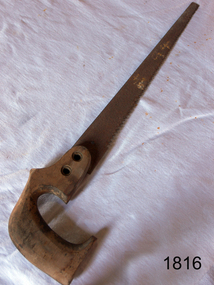
Tool - Compass Saw, Mid to late 20th Century
... cut only on the pull stroke and set with the teeth projecting only on one side, rather than in the modern fashion with an alternating set. Saws were also made of bronze and later iron. In the Iron Age, frame saws were developed holding the thin blades in tension. The earliest known sawmill is the Roman Hierapolis sawmill from the third century AD used for cutting stone. The subject item is believed to date from around the mid to late 20th century and is regarded as a modern item. The maker is unknown but the pattern ...A saw is a tool consisting of a tough blade, wire, or chain with a hard-toothed edge. It is used to cut through material, very often wood, though sometimes metal or stone. The cut is made by placing the toothed edge against the material and moving it forcefully forth and less vigorously back or continuously forward. This force may be applied by hand, or powered by steam, water, electricity or other power sources. An abrasive saw has a powered circular blade designed to cut through metal or ceramic. In ancient Egypt, open (unframed) saws made of copper are documented as early as the Early Dynastic Period, circa 3,100–2,686 BC. Many copper saws were found in tombs dating to the 31st century BC. Models of saws have been found in many contexts throughout Egyptian history. As the saw developed, teeth were raked to cut only on the pull stroke and set with the teeth projecting only on one side, rather than in the modern fashion with an alternating set. Saws were also made of bronze and later iron. In the Iron Age, frame saws were developed holding the thin blades in tension. The earliest known sawmill is the Roman Hierapolis sawmill from the third century AD used for cutting stone.The subject item is believed to date from around the mid to late 20th century and is regarded as a modern item. The maker is unknown but the pattern or design and type of wood used indicate it is a tool of modern manufacture.Compass saw with wooden handle and metal blade. Small teeth. flagstaff hill, warrnambool, flagstaff-hill, flagstaff-hill-maritime-museum, maritime-museum, shipwreck-coast, flagstaff-hill-maritime-village, wood cutting, wood saw, cross cut saw, cabinet makers tools, wood working tools, tool, compass saw -
 Flagstaff Hill Maritime Museum and Village
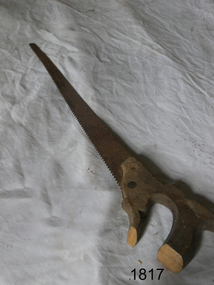
Tool - Compass Saw, Mid to late 20th Century
... cut only on the pull stroke and set with the teeth projecting only on one side, rather than in the modern fashion with an alternating set. Saws were also made of bronze and later iron. In the Iron Age, frame saws were developed holding the thin blades in tension. The earliest known sawmill is the Roman Hierapolis sawmill from the third century AD used for cutting stone. The subject item is believed to date from around the mid to late 20th century and is regarded as a modern item. The maker is unknown but the pattern ...A saw is a tool consisting of a tough blade, wire, or chain with a hard-toothed edge. It is used to cut through material, very often wood, though sometimes metal or stone. The cut is made by placing the toothed edge against the material and moving it forcefully forth and less vigorously back or continuously forward. This force may be applied by hand, or powered by steam, water, electricity or other power sources. An abrasive saw has a powered circular blade designed to cut through metal or ceramic. In ancient Egypt, open (unframed) saws made of copper are documented as early as the Early Dynastic Period, circa 3,100–2,686 BC. Many copper saws were found in tombs dating to the 31st century BC. Models of saws have been found in many contexts throughout Egyptian history. As the saw developed, teeth were raked to cut only on the pull stroke and set with the teeth projecting only on one side, rather than in the modern fashion with an alternating set. Saws were also made of bronze and later iron. In the Iron Age, frame saws were developed holding the thin blades in tension. The earliest known sawmill is the Roman Hierapolis sawmill from the third century AD used for cutting stone.The subject item is believed to date from around the mid to late 20th century and is regarded as a modern item. The maker is unknown but the pattern or design and type of wood used indicate it is a tool of modern manufacture. Compass saw with wooden handle broken and metal blade. Small teeth.Noneflagstaff hill, warrnambool, flagstaff-hill, flagstaff-hill-maritime-museum, maritime-museum, shipwreck-coast, flagstaff-hill-maritime-village, wood cutting, wood saw, cross cut saw, cabinet makers tools, wood working tools, tool, compass saw -
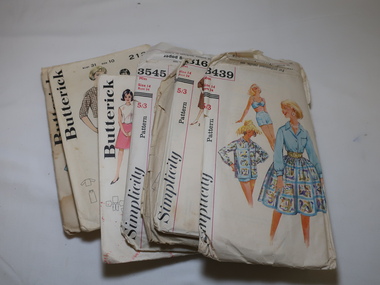 Kiewa Valley Historical Society
Sewing Patterns - ladies
... patterns to make clothes. Companies included 'Simplicity, Butterick and Vogue etc. The packet would contain transparent paper shapes with printed lines and instructions. These were pinned onto the material, cut, then sewn together as per the lines and the included instructions. In the 1950s and 1960s women sewed the clothes for the family. In the Kiewa Valley dress shops were not available and a journey to the bigger cities was less frequent than it is today. dressmaker Simplicity Butterick ladies fashion ...Dressmakers used patterns to make clothes. Companies included 'Simplicity, Butterick and Vogue etc. The packet would contain transparent paper shapes with printed lines and instructions. These were pinned onto the material, cut, then sewn together as per the lines and the included instructions.In the 1950s and 1960s women sewed the clothes for the family. In the Kiewa Valley dress shops were not available and a journey to the bigger cities was less frequent than it is today.Coloured pictures showing the finished garment. Patterns were in sizes. eg. size 10 1. Fashion - lady's dress 2. x3 Simplicity - lady's clothes 3. x3 Butterick lady's clothesdressmaker, simplicity butterick, ladies fashion -
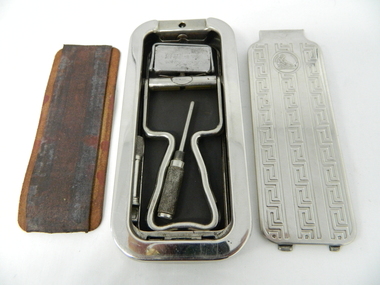 Kiewa Valley Historical Society
Razor Personal Vintage, circa 1940s to 1950s
... fashions and "gadgets", the basic living conditions where still maintained at city levels. This particular razor was in its heyday a sophisticated safety razor and brought down the demand for the services of the "professional" barber(shaver). One of the problems of the superseded straight razor was the high levels of cuts and nicks to the face. As this particular razor was fairly expensive it would have been used by men who were in the middle to upper socio-economical position in Kiewa Valley before the late 1950's safety razor non disposable men's shaving implement Three bands of a Greek key pattern ...This item(razor) was used by men, only before fashion dictated that women should shave their legs and underarms. There is information that this razor was first used circa 1922 and it lasted up until circa 1958. It permitted the user to have a compact shaving apparatus at hand in any environment. It provided a safe and easy way of sharpening the more permanent blade. This type of razor replaced the straight, open, or cut-throat razors. The mobility of this item was further enhanced by Gillette with their double bladed disposable razor. Time taken(shaving) and costs involved where crucial factors in the ever growing pace of domestic lifestyle in the post 1920s.This historical item presents that, even though the Kiewa Region was an inland rural settlement which in the 1920's was not as close to "modern" fashions and "gadgets", the basic living conditions where still maintained at city levels. This particular razor was in its heyday a sophisticated safety razor and brought down the demand for the services of the "professional" barber(shaver). One of the problems of the superseded straight razor was the high levels of cuts and nicks to the face. As this particular razor was fairly expensive it would have been used by men who were in the middle to upper socio-economical position in Kiewa Valley before the late 1950'sThis item is a Sheffield steel(stamped inside) metal box(Viscount model) containing a red leather fine shaving strap and in its lid a grey honing stone. Both bottom and top lids are removable to allow for replacements of strap and stone. On the bottom lid appears "The Whetter" trade mark, registered in the U.S.A. in 1950.Three bands of a Greek key pattern has been pressed on the lid. A circled identification inscription. " ROLLS RAZOR Ltd, MADE IN ENGLAND" and patented information appears within this inscription. "Patented in England and Abroad. English patents numbers 467383. 284428. 242718. 242717" On the outside of the base lid within a circle are "ROLLS RAZOR" and the sketch of a long haired naked man (side view), crouched, with both hands stretched forward operating the razor. On a slab underneath are the words "The Whetter"safety razor, non disposable, men's shaving implement -
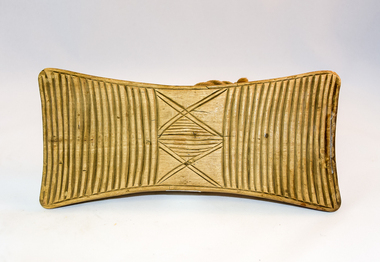 Kiewa Valley Historical Society
Pat Butter Profiler, Circa 1950s
... patterns. On each end it has horizontal grooves cut into the wood which produce distinct lines onto the surface of the butter. between these grooves there is a section of two double lines crossing in the middle and separated by eleven horizontal lines The base has an elongated rectangular shape. The upper body has been sanded into a smooth convex shaped form where a wooden circular hand grip has been fashioned...patterns. On each end it has horizontal grooves cut into the wood which produce distinct lines onto the surface of the butter. between these grooves there is a section of two double lines crossing in the middle and separated by eleven horizontal lines The base has an elongated rectangular shape. The upper body has been sanded into a smooth convex shaped form where a wooden circular hand grip has been fashioned ...This butter pat profiler may have been manufactured post 1967(year post codes appeared in Australia) however the post code was only stamped on after it was machined. This type of butter mould was used by rural families to fashion home/farm made butter. This period was in most rural regions a time of self sufficiency where any domestic type implement which could be fashioned by the family would be crafted with skill. Shopping for goods required catalogues from stores located in major rural towns and cities and involved lengthy waiting times. Travelling to and from these specialised stores was not pleasant due to the relatively poor quality of the roads and the lengthy times taken. The small general stores in the Kiewa Valley could not cater for all the needs of the valley. The 1960's was a time when facilities especially goods and services started to improve drastically. The S.E.C. of Victoria with its Kiewa Hydro Electricity Scheme provided not only an improvement of facilities in the valley but also a increase in the population. This increase resulted in a greater demand for local produce.This item is one of many domestic food processing implements used by Kiewa Valley households in the mid 1900s, whether on the farm or in the small towns and hamlets. Self sufficiency was the key to survival during these early times. Where ever possible supplies from within the valley were preferred to that brought in by travelling salesmen or traders. This butter mould and butter pat was commonly used to fashion "home" made butter throughout the valley and in some cases supplied to "outside" regional towns. Although this method of production was phased out by better access to goods from nearby cities the revival of the good organic home grown produce in the 1980s saw a greater demand of this type of farm based produce.This butter Pat/Profiler has on its base two patterns. On each end it has horizontal grooves cut into the wood which produce distinct lines onto the surface of the butter. between these grooves there is a section of two double lines crossing in the middle and separated by eleven horizontal lines The base has an elongated rectangular shape. The upper body has been sanded into a smooth convex shaped form where a wooden circular hand grip has been fashioned.On the top of the hand grip is stamped in black print"T. & W. Davies" and under this"TAWONGA 3697"domestic food preparation, wooden butter pat, butter mould circular, dairy industry -
 National Wool Museum
Book, Pattern, Fashion and Knitting Patterns no. 7
... FASHION and KNITTING / Patterns / NUMBER 7 / 2'6 / Wonderful / cut-out offers / A fur hat / for 26s. / Presents / to make / Sewing / and / knitting / fashions...patterns for womens garments. Knitting Handicrafts - history Sewing Fashion Knitting Handicrafts - history Sewing Fashion FASHION and KNITTING / Patterns / NUMBER 7 / 2'6 / Wonderful / cut-out offers / A fur hat / for 26s. / Presents / to make / Sewing / and / knitting / fashions Fashion and Knitting Patterns no. 7 Book, Pattern ...This book was owned by the late Dr Elizabeth Kerr and was donated to the Museum by the executor of her estate, Margaret Cameron. It is an English periodical from Nov. 1965 containing knitting and sewing patterns for womens garments.FASHION and KNITTING / Patterns / NUMBER 7 / 2'6 / Wonderful / cut-out offers / A fur hat / for 26s. / Presents / to make / Sewing / and / knitting / fashionsknitting handicrafts - history sewing fashion, knitting, handicrafts - history, sewing, fashion -
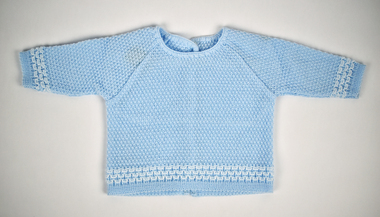 National Wool Museum
Textile - Children's Clothing Set, c.1980
... Knitwear Clothing Children's Knitwear Children's clothing Manufacturing Fashion Textile Production Machine Knitting clothing set .1) [ label at neck of cardigan] SIZE 000 .2) [some letters cut off label] FIT AGE 0-3 MONTHS WEIGHT 6KG ACRYLIC HAND WASH OR GENTLE MACHINE WASH COLD RINSE [D]O NOT TUMBLE DRY WARM IRON [D]RY CLEANABLE (A) [MA]DE IN AUSTRALIA Two Piece pale blue suit, consisting of jumper and leggings with all-over pattern in double moss stitch and garter stitch border. ...Sample of Kathryn Knitwear Collection, Label style suggests it may not be manufactured by Kathryn Knitwear, but was retained as a sample. Kathryn Knitwear, founded by Robert Blake, manufactured high quality children’s knitwear in Melbourne from the 1940s – 1980s. Robert Blake began manufacturing children’s knitwear in his bedroom in Strathmore using a hand powered machine in the late 1940s. The operation moved to Ascot Vale and Essendon, before eventually establishing a factory in Moonee Ponds in the early 1950s. The business continued to expand, necessitating a move to a new factory in Broadmeadows. By 1962, the Broadmeadows factory was producing an average of 20,000 garments per month, which increased to 24,000 by 1964. Robert Blake’s Son, Brendan recalls that “The Kathryn brand was famous around Australia, anywhere children needed to keep warm and dress smartly. It also won a number of wool fashion awards”, including the 1969 Wool Awards, which was held by the Australian Wool Bureau and published in Women’s Weekly. The Kathryn range was designed for durability, comfort and care, without sacrificing style. They used patterning techniques that increase stretchiness, comfort and fit, as well as integrating decorative elements into the fabric to prevent them from being bulky, uncomfortable or tight. Making longevity of style a priority, Brendan Blake remembers that “there was one particular garment that was in the range for at least thirty years”. He also recalls “In the past, when women have found out that I was associated with Kathryn Knitwear, they would often relate to me the story of a garment they had purchased or received as a gift and, when their child had grown out of it, they would hand it on to another child. Several ladies have told me of purchasing garments for their daughters’ glory box, or saving a particular garment after their daughter had grown out of it. Brendan Blake: “At the peak of their operation they employed approximately two hundred people, mainly women and girls. A family would often seek to send their daughter to work in this company because they knew they would be looked after and safe. One lady wrote to me telling me that working at the Moonee Ponds Factory prior to getting married was the happiest time of her life.” In 1963, workers at the Kathryn factory earned £13 per week, which was 8 shillings and 8 pence higher than the minimum weekly wage for female workers in the textile manufacturing industry (£12 11s 4d). By 1970, the Kathryn Knitwear brand expanded from children’s knitwear into womenswear under the brand name ‘Lady Kathryn’, and for boys and men under ‘Robert Blake’. Continuing to diversify their distribution, they also began exporting ‘Kathryn’ garments to New Zealand, the Pacific Islands, and Japan. ‘Kathryn Knitwear’ was well-known for their early adoption of modern materials and techniques that had broad appeal to their customer base. This is shown in their early use of the acrylic fibre ‘Orlon’ in the 50s and 60s and ‘Superwash’ wool in the 1970s. Many of Kathryn Knitwear’s styles, particularly those that were long running staples of the brand, were available in both wool and Orlon to suit the consumer’s preference. Orlon was developed by DuPont in the 1940s and became the first commercially successful acrylic fibre in the 1950s and 1960s. The development of Orlon coincided with an increase in availability of washing machines in everyday Australian homes. The great appeal of Orlon was that while wool garments still had to be hand-washed, Orlon’s shrink-resistant nature made it machine washable and dryable. This was a very appealing prospect, especially for the seemingly unending task of cleaning active children’s clothing. Machine washable wool would not be available until the development of the ‘Superwash’ treatment by the Australian Wool Board and CSIRO in 1970. Far from the humble origins of one man in his bedroom with a hand-cranked machine; at its closure in 1980, the Broadmeadows factory of ‘Kathryn’ housed more than 100 machines, including 53 sewing machines and 45 knitting machines. Robert Blake was “a passionate advocate for wool and Australian Made” throughout his whole life. A strong thread that ties through the lifespan of Robert Blake and Kathryn Knitwear is a balance between adopting new innovations without sacrificing the core values of durability, comfort, care and style that had made the brand so well known. Their legacy forms an integral part of both Australian social and manufacturing history.Two Piece pale blue suit, consisting of jumper and leggings with all-over pattern in double moss stitch and garter stitch border. Jumper opens down the back and closes with three pearlescent plastic buttons. Scalloped motif at bottom and cuff has white accent. Leggings have closed feet and decorative ties at ankle, and are constructed primarily as one piece and seamed up at centre back and inseam, with additional gusset piece.1) [ label at neck of cardigan] SIZE 000 .2) [some letters cut off label] FIT AGE 0-3 MONTHS WEIGHT 6KG ACRYLIC HAND WASH OR GENTLE MACHINE WASH COLD RINSE [D]O NOT TUMBLE DRY WARM IRON [D]RY CLEANABLE (A) [MA]DE IN AUSTRALIAknitwear, clothing, children's knitwear, children's clothing, manufacturing, fashion textile production, machine knitting, clothing set -
 Clunes Museum
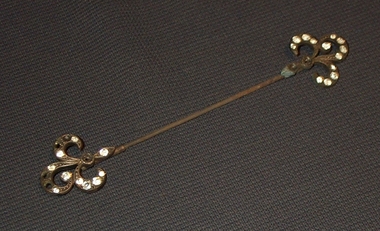
Accessory - HAT PIN
... PERSONAL ADORNMENT FASHION ITEM NIL METAL HAT PIN WITH CUT GLASS DECORATION INSET ON EACH OF THE FLEUR DE LYS PATTERN AT EACH END OF THE PIN Accessory HAT PIN ...METAL HAT PIN WITH CUT GLASS DECORATION INSET ON EACH OF THE FLEUR DE LYS PATTERN AT EACH END OF THE PINNILpersonal adornment, fashion item -
 Kew Historical Society Inc
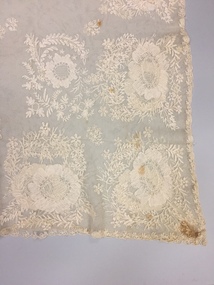
Textile - Fragment of Net and Tulle Fabric, 1880s
... Fashion & Design collection of Kew Historical Society includes examples of textiles dating from the 18th, 19th and 20th centuries. Some of the textiles, were used as items of clothing, others as items of household decoration, or simply as travel souvenirs. These textiles were created both domestically and internationally. Predictably with the growth of an ethnically and culturally more diverse community in Kew after the Second World War, textiles, clothing and objects in the collection inevitably reflected this diversity. lace embroidery tulle Length of heavily embroidered tulle with a border detail on three edges and one cut side. The pattern ...The Fashion & Design collection of Kew Historical Society includes examples of textiles dating from the 18th, 19th and 20th centuries. Some of the textiles, were used as items of clothing, others as items of household decoration, or simply as travel souvenirs. These textiles were created both domestically and internationally. Predictably with the growth of an ethnically and culturally more diverse community in Kew after the Second World War, textiles, clothing and objects in the collection inevitably reflected this diversity. Length of heavily embroidered tulle with a border detail on three edges and one cut side. The pattern is of flowers and leaves. Machine chain stitch onto net. The floral centres are hand madelace, embroidery, tulle -
 Whitehorse Historical Society Inc.
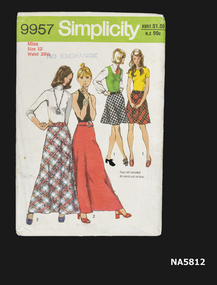
Domestic object - Simplicity Sewing Pattern No. 9957, Simplicity Patterns. Auckland, NZ, C 1972
... - Example of 1970's fashion - Example of domestic dressmaking patterns Domestic dressmaking Dressmaking pattern Various, size, price, fabric requirements C 1970's - Simplicity Sewing Pattern No. 9957 size 12 - Flared skirt pattern - cut on bias - 2 skirt lengths - Patten for contour belt Domestic object Simplicity Sewing Pattern No. 9957 Simplicity Patterns. ...- Example of 1970's fashion - Example of domestic dressmaking patternsC 1970's - Simplicity Sewing Pattern No. 9957 size 12 - Flared skirt pattern - cut on bias - 2 skirt lengths - Patten for contour beltVarious, size, price, fabric requirements domestic dressmaking, dressmaking pattern -
 Whitehorse Historical Society Inc.
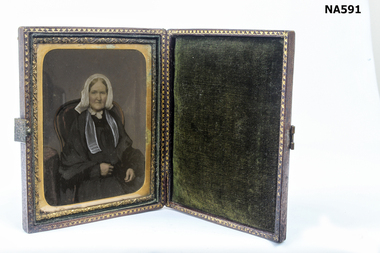
Functional object - Photo In Case
... cut by use of multiple lens. Collected (friends, celebrities, etc.) , for albums; not used as visiting cards. Mainly 1860s, but the fashion revived in the 1890s with a larger 'cabinet card' photography photographs / slides / film Hand tinted, with oil paint Carte de Viste of a middle aged woman. Held in a hinged leather bound case with a clip fastener. Photo surrounded by patterned ...Carte de Visite. Portrait photograph, c. 2.25x3.5 ins.card mounted, with the photographer's name, etc. on the back. Cost cut by use of multiple lens. Collected (friends, celebrities, etc.) , for albums; not used as visiting cards. Mainly 1860s, but the fashion revived in the 1890s with a larger 'cabinet card'Hand tinted, with oil paint Carte de Viste of a middle aged woman. Held in a hinged leather bound case with a clip fastener. Photo surrounded by patterned gold leaf on left hand inner side. The right hand side covered with padded brown velvet. Daguerreotype.photography, photographs / slides / film -
 Whitehorse Historical Society Inc.
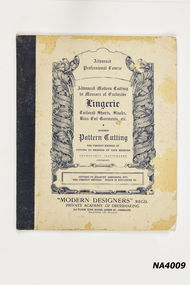
Book - Pattern Book, Advanced Modern Cutting to Measure of Exclusive Lingerie-Tailored Shorts, Slacks, Bias Cut Garments etc
... Part of the Till collection NA4003 BOOKS Fashion Advanced Modern Cutting to Measure of Exclusive Lingerie Advanced Modern Cutting to Measure of Exclusive Lingerie-Tailored Shorts, Slacks, Bias Cut Garments etc. Book Pattern ...Part of the Till collection NA4003Advanced Modern Cutting to Measure of Exclusive Lingeriebooks, fashion
