
Showing 20 items matching "fedoras"
-
 Kew Historical Society Inc
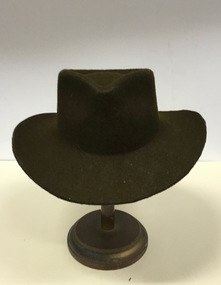
Headwear - Brown Felt Fedora, 1970s
... ...fedoras...At one stage the fedora style became a symbol of the women's rights movement....A small unadorned dark brown felt fedora, assumed to be designed for a child. ...Headwear Brown Felt Fedora ...Hat styles have sometimes changed little over the last 100 years. The 'fedora' style used for the manufacture of this 1970s hat dates from the 1890s. Originally a style favoured by women, it became primarily used for men's hats in the early 20th century, being popularised by the Prince of Wales, later Edward VIII. At one stage the fedora style became a symbol of the women's rights movement.The Kew Historical Society’s fashion and design collection is comprised of costumes, hats, shoes and personal accessories. Many of these items were purchased or handmade in Victoria; some locally in Kew. The extensive hat collection comprises items dating from the 1860s to the 1970s. Most of the hats in the collection were created by milliners for women. There are however a number of early and important men’s hats in the collection. The headwear collection is particularly significant in that it includes the work of notable Australian and international milliners.A small unadorned dark brown felt fedora, assumed to be designed for a child. The hat has an indented crown and a soft brim. It is otherwise with adornment.Nilchildren's hats, headwear, fedoras -
 Kew Historical Society Inc
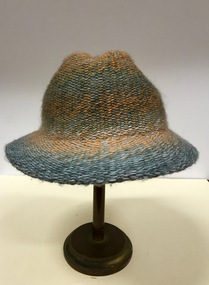
Headwear - Fedora, 1970s
... Fedora......fedoras...While the hat is based on the shape of a fedora the design is softened by the varying shades of colour in the weave....Headwear Fedora ...The Kew Historical Society’s fashion and design collection is comprised of costumes, hats, shoes and personal accessories. Many of these items were purchased or handmade in Victoria; some locally in Kew. The extensive hat collection comprises items dating from the 1860s to the 1970s. Most of the hats in the collection were created by milliners for women. There are however a number of early and important men’s hats in the collection. The headwear collection is particularly significant in that it includes the work of notable Australian and international milliners.Faux wool woman’s hat made of 'polyacryl' and 'thermoplastisch' in shades of blue and yellow. While the hat is based on the shape of a fedora the design is softened by the varying shades of colour in the weave.Label: 70% Polyacryl 30% Thermoplastisch, Made in Italywomen's clothing -- hats, fedoras -
 Kew Historical Society Inc
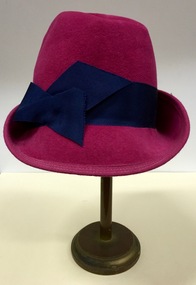
Headwear - Pink Felt & Ribbon Fedora, La Rene, 1960s
... La Rene was also a Sydney design house and it is believed that the fedora in the Kew collection is an Australian product. ...Deep pink coloured felt woman’s fedora by La Rene with a broad navy ribbon at the base of the crown. ...Headwear Pink Felt & Ribbon Fedora La Rene ...In the descriptions of two hats by La Rene in the Museum Victoria collection it is suggested that their origin may be French. La Rene was also a Sydney design house and it is believed that the fedora in the Kew collection is an Australian product. This hat and the MV examples have similar attributes.The Kew Historical Society’s fashion and design collection is comprised of costumes, hats, shoes and personal accessories. Many of these items were purchased or handmade in Victoria; some locally in Kew. The extensive hat collection comprises items dating from the 1860s to the 1970s. While most of the hats in the collection were created by milliners for women, there are a number of early and important men’s hats in the collection. The headwear collection is particularly significant in that it includes the work of notable Australian and international milliners.Deep pink coloured felt woman’s fedora by La Rene with a broad navy ribbon at the base of the crown. The rim is fastened to the crown at one side of the hat.Label: Fashioned by La Rene. 37-6622; 36-1690women's clothing -- hats, headwear, milliners - la rene -
 Mission to Seafarers Victoria
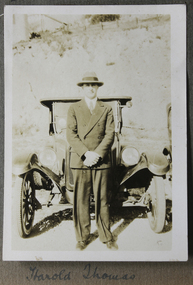
Photograph, Harold Thomas
... Harold Thomas in costume and fedora standing in front of car...duncan album harold thomas Harold Thomas in costume and fedora standing in front of car Harold Thomas Photograph Photograph ...Harold Thomas in costume and fedora standing in front of carduncan album, harold thomas -
 Bendigo Historical Society Inc.
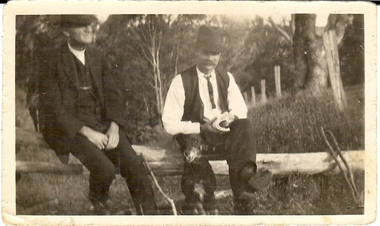
Photograph - BASIL MILLER COLLECTION: 2 MEN
... Man on left, dark 3 piece suit, with watch chain and Fedora hat. Man on right, shirt sleeves, narrow tie, waistcoat, trousers and boots, wearing Fedora hat is reading a book.Possibly are relatives of Basil Miller....Man on left, dark 3 piece suit, with watch chain and Fedora hat. Man on right, shirt sleeves, narrow tie, waistcoat, trousers and boots, wearing Fedora hat is reading a book.Possibly are relatives of Basil Miller. ...Black and white photograph of 2 men sitting on fallen tree. Man on left, dark 3 piece suit, with watch chain and Fedora hat. Man on right, shirt sleeves, narrow tie, waistcoat, trousers and boots, wearing Fedora hat is reading a book.Possibly are relatives of Basil Miller.person, individual, basil miller -
 Wangaratta High School
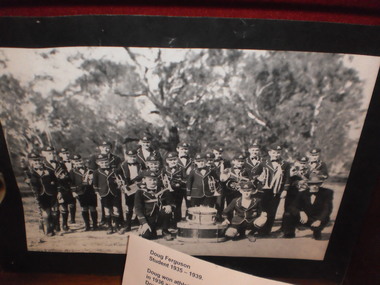
WHS Band photo 1938, 1938
... Boy in black suit and fedora is Doug Ferguson....Boy in black suit and fedora is Doug Ferguson. WHS Band photo 1938 ...Black and white image of the Wangaratta High school band on black backing paper. Boy in black suit and fedora is Doug Ferguson. -
 Wodonga & District Historical Society Inc
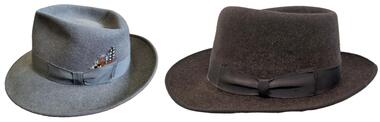
Clothing - Men's Hats - Akubra and Fayrefield, 1950s
... Hat One is an Akubra Clubman featuring a feather in the brim. Hat Two is a fedora style hat manufactured by Fayrefield of Melbourne. ...Hat One is an Akubra Clubman featuring a feather in the brim. Hat Two is a fedora style hat manufactured by Fayrefield of Melbourne. ...The company which was to become the manufacturer of the iconic Australian Akubra hat was founded in Tasmania in 1876 by Benjamin Dunkerley at his Kensington Hat Mills in Hobart. In 1906 he relocated to a small workshop in Surrey Hills, New South Wales. He was joined by British hatmaker in 1904. In 1911 Dunkerley Hat Mills is registered with seven shareholders and in 1912 Akubra brand was registered. In 1918 Benjamin Dunkerley died and Stephen Keir became the patriarch of the company which was to remain in the hands of the Keir family for five generations. In 2023 Akubra is acquired by Andrew and Nicola Forrest’s private investment group Tattarang to ensure it remained as an Australian company. During its long history Akubra has produced a wide range of styles as well as having a contract for the manufacture of the Australian Military slouch hat. The Akubra “Clubman” first appeared in 1953. Fayrefield Hats were manufactured by the United Felt Hat Company Pty Ltd. in Abbotsford, Victoria from about 1920. The Company operated in a factory formally owned by Denton Hats. They relocated to Eltham, Victoria sometime in the 1940s. The Australian hat manufacturing industry received a major boost in the late 1920s with the introduction of tariffs on imported hats. As well as selling a wide range of men’s hats, Fayrefield also manufactured Australian military hats in the 1960s. Both of these hats were sold by Ewart Bros. Menswear in High Street, Wodonga. Clarrie and Jeff Ewart opened their business, Ewart Bros. Menswear in High Street, Wodonga in 1954. After 45 years of service to the Wodonga community Ewart Bros. closed their doors on Friday 3rd April 1998.These hats are significant because they were manufactured by two iconic Australian companies and sold by an important, long-serving Wodonga business.Two men's hats sold by Ewart Brothers of Wodonga. Hat One is an Akubra Clubman featuring a feather in the brim. Hat Two is a fedora style hat manufactured by Fayrefield of Melbourne. Branding and logos on both hatsaustralian hat makufacturers, akubra, fayrefield, ewart bros. menswear -
 Whitehorse Historical Society Inc.
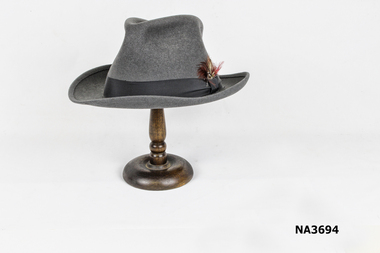
Headwear - Hat - Man's, not known
... A grey fedora, Huckel brand, 'Belvedene' style. Black ribbed band. he feathers are mostly brown and red, one has white spots. ...not known costume male headware Price sticker from shop 'Norris $49-95 A grey fedora, Huckel brand, 'Belvedene' style. Black ribbed band. he feathers are mostly brown and red, one has white spots. ...not knownA grey fedora, Huckel brand, 'Belvedene' style. Black ribbed band. he feathers are mostly brown and red, one has white spots. Brand details printed in gold and blue inside under the peak and on both sides.Price sticker from shop 'Norris $49-95costume, male headware -
 Sir Reginald Ansett Transport Museum
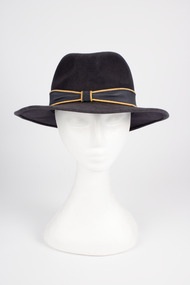
Hat, 1990 - 2001
... Navy Blue wool-felt wide brimmed hostess hat. Fedora style. Navy grosgrain ribbon trim bordered with yellow piping. ...Navy Blue wool-felt wide brimmed hostess hat. Fedora style. Navy grosgrain ribbon trim bordered with yellow piping. ...1999 to 2001 worn by male and female flight attendants.DNavy Blue wool-felt wide brimmed hostess hat. Fedora style. Navy grosgrain ribbon trim bordered with yellow piping. Decorative tuck on front of trim and twist detail on back. Dent in crown. Black grosgrain sweatband. 15mm White label with WEISS Australia. Faded name ALISON (?) on manufacturers label. White label with WEISS Australia. uniform, hat, hostess, stewardess, flight attendants, navy blue, steward, weiss, wool felt -
 Mission to Seafarers Victoria
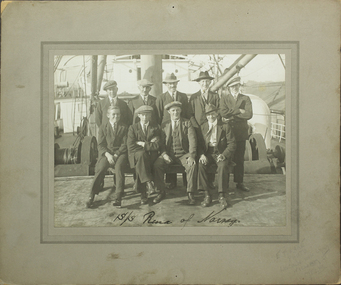
Photograph - Mounted photograph, Sepia, S.S. Rine? of Norvag, early to mid 20th C
... Norvag crewmen in suits and caps or fedoras . The photograph has been mounted onto a cardboard frame. ...Norvag crewmen in suits and caps or fedoras . The photograph has been mounted onto a cardboard frame. ...This is a photograph of crew members on the S.S. R-? Norvag. Inscription and Exact name of ship to be checked..Black and white photograph of S.S. R-? Norvag crewmen in suits and caps or fedoras . The photograph has been mounted onto a cardboard frame. The bottom reads, 'S.S. r-? Norvag" handwritten in black ink. The photograph itself is of 9 men in two rows, 5 on top row standing and 4 in the bottom row sitting on a bench.The men are posed on the ship's deck. On front with photograph:: S.S. Rine-? of Norvag Lwr r. corner very faint in pencil: E.T Lake photo. Lincoln inn , CH-? William Street / Melbnorvag, s.s. norvag, crews and ships -
 Southern Sherbrooke Historical Society Inc.
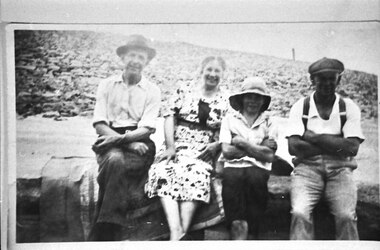
Photograph - Bill Slingo Senior and Junior, Ann Lord and Bill Lord
... Bill Lord is dressed in dark trousers, open-necked shirt (with rolled-up sleeves), and a fedora. Ann Lord in a patterned summer dress. ...Bill Lord is dressed in dark trousers, open-necked shirt (with rolled-up sleeves), and a fedora. Ann Lord in a patterned summer dress. ...Photograph features a Graham Paige car at Lysterfield Reservoir. Bill Lord is dressed in dark trousers, open-necked shirt (with rolled-up sleeves), and a fedora. Ann Lord in a patterned summer dress. Bill Slingo junior in dark shorts, light shirt and sunhat, and Bill Slingo Senior in trousers with braces, a white shirt and a peaked cap. They are seated on a bench or wall. The Lords are seated on a satin-edged blanket. Behind the group a dam wall is visible. Photo was most likely taken by Alice Lord on the same day as VSSHP0267.03. . -
 Southern Sherbrooke Historical Society Inc.
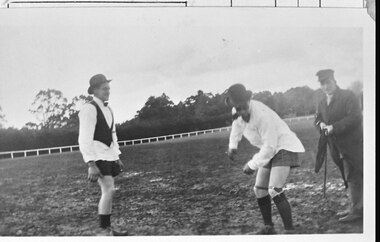
Photograph - Photo - Oldies vs Youngies football captains, Bill Hermon and Haldon Westcomb
... The man on the left is wearing a hat, possibly a fedora, white dress shirt and bowtie, a black tuxedo waistcoat, dark boxer shorts or shorts, socks and shoes or laceup boots. ...The man on the left is wearing a hat, possibly a fedora, white dress shirt and bowtie, a black tuxedo waistcoat, dark boxer shorts or shorts, socks and shoes or laceup boots. ...B&W photo shows three men in a muddy field, possibly a sports ground. A white fence with uprights and a top rail edges the field behind them, and the land beyond the fence is heavily treed. The man on the left is wearing a hat, possibly a fedora, white dress shirt and bowtie, a black tuxedo waistcoat, dark boxer shorts or shorts, socks and shoes or laceup boots. He appears to have dark glasses and a moustache. The man in the middle also has a hat, a white shirt and shorts, and what appears to be a large dark bowtie or cravat. He is wearing long socks with suspenders, and laceup boots or shoes. He is bent forwards as if catching or throwing something. The man on the right has a peaked cap, a long dark coat over a shirt and trousers, and either dress shoes or boots. He is holding a stick and other items. dated c.1950s. -
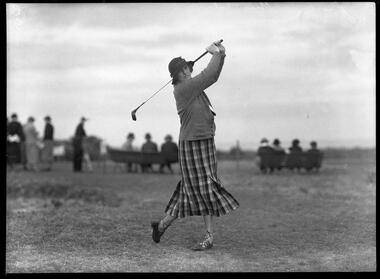 City of Melbourne Libraries
Photograph, Bull, Hugh Jones, 1897-1993, Mrs Clive Robinson, née Christina “Nin” McMaster
... Mrs Clive Robinson, née Christina “Nin” McMaster Smartly attired in fedora and lace-up highland dancing style shoes, Australian Team Captain Mrs Clive Robinson’s tartan kick pleat skirt flies up as she practises her swing. ...Mrs Clive Robinson, née Christina “Nin” McMaster Smartly attired in fedora and lace-up highland dancing style shoes, Australian Team Captain Mrs Clive Robinson’s tartan kick pleat skirt flies up as she practises her swing. ...Mrs Clive Robinson, née Christina “Nin” McMaster Smartly attired in fedora and lace-up highland dancing style shoes, Australian Team Captain Mrs Clive Robinson’s tartan kick pleat skirt flies up as she practises her swing. Mrs Clive “Nin” Robinson (1985-1971) was a NSW golf champion. Raised on a 5,000 acre sheep station, during WWII she drove a charcoal burning truck and cooked for the forces at Air Force House. Featured in "Newsworthy: Melbourne in photographs 1933-1936" exhibition at East Melbourne Library, October to December 2023. Exhibition caption by project volunteer, Fiona Collyer. Photographer notations on slide: "Mrs Robinson B98" Published: The Age 27 August 1935 p. 6 Published title: Golf Championships Begin. Published caption: A galaxy of champions will take part in the Australian Women's Golf Championship tomorrow. Three are shown here. Below — Mrs. C. Robinson, national champion. On the right — Miss J. Hood Hammond, champion of New South Wales and Miss Gardiner, Queensland champion. Trove article identifier: http://nla.gov.au/nla.news-article203984927 Description: Female golfer teeing off. She is wearing a hat, cardigan, tartan skirt and "Highland dancing" style shoes. Blurred spectators can be seen in the background. Research by project volunteer, Fiona Collyer: Mrs Clive Robinson née Christina Jeanie McMaster, known as "Nin" Mrs Clive Robinson (1895-1971) was a NSW golf champion. She won the Australian Women's amateur golf championship in 1934. Nin was captain of the team who won the Tasman Cup against New Zealand in 1934. She was the captain of the Australian team who competed against the visiting British women’s team in the Australian Women's Golf Championship in 1935 at Royal Melbourne. In 1936 Nin won the NSW Ladies Championship. Nin was raised by parents Mr and Mrs John McMaster on an 8000 acre sheep station called "Weetalabah” near Coolah, 135 kilometres northeast of Dubbo NSW. In 1923 she married Dr. Clive Robinson, a Macquarie Street specialist, and they lived in Point Piper with their daughter Diana. During WWII Nin drove a charcoal burning truck and cooked for the forces at Air Force House. She died of leukemia in 1971. Note: Highland dancing style of shoesPhotographer notations on slide: "Mrs Robinson B98".golf, women golfers, royal melbourne golf club -
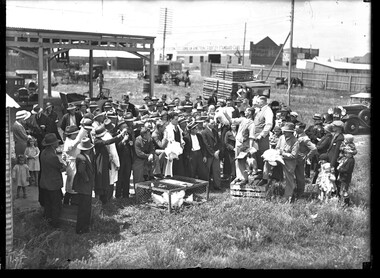 City of Melbourne Libraries
Photograph, Bull, Hugh Jones, 1897-1993, Poultry auction for Christmas dinners, Bentleigh Poultry Market
... The majority of the substantial crowd is male, mostly wearing Fedora hats and jackets or suits and ties. ...The majority of the substantial crowd is male, mostly wearing Fedora hats and jackets or suits and ties. Some women are present, wearing hats and coats, and at least seven children are visible, some dressed up, others dressed more casually. ...Published: Age (Melbourne, Vic.: 1854- ), Thursday 21 December 1933, page 11 Published title: : POULTRY FOR CHRISTMAS DINNERS Published caption: With the approach of the Festive Season, the demand for poultry of all descriptions tends to harden and good clearances of many thousands of birds have been effected at recent auctions. The above picture was taken yesterday at the sale conducted by Messrs. Parnham and Carter of Bentleigh, whose auctions are the largest in Melbourne on the basis of individual sales. The auctioneer's assistant is holding up a prime goose for the appraisement of bidders preparing for Christmas fare. Trove article identifier: http://nla.gov.au/nla.news-article203351699 Research by project volunteer, Louise McKenzie: This photo is full of action! A poultry auction is in full flight. The serious-looking auctioneer and his assistant stand on a Parnham & Carter wooden box so that the auctioneer can make eye contact with the bidding crowd. The auctioneer is wearing a waistcoat and tie and has his pencil and paper ready to record the winning bids. The assistant in overalls is holding a live white duck in each hand. Two other assistants also hold live birds. A wire cage on the ground holds a few white chickens – presumably the next auction items. The majority of the substantial crowd is male, mostly wearing Fedora hats and jackets or suits and ties. Some women are present, wearing hats and coats, and at least seven children are visible, some dressed up, others dressed more casually. The auction is taking place in a rural setting, possibly on the site where the birds are farmed. It is an informal, rather rough, grassed area next to a large shed with a high verandah. Two horse drawn vehicles are visible in the background, as well as five motorised vehicles. There are stacks of wooden boxes or crates which look as if they transport birds, and two cows are grazing by the fence. There are two telegraph poles with many lines. In the adjacent block is a very large car business comprising two large brick warehouse style buildings, plus outbuildings. The signage on one brick warehouse mentions Standard Cars. Both a man and a woman have their arms raised to bid. It is an occasion – but a serious one. We cannot be sure if these birds are for breeding or the table, but buying poultry for the Christmas meal was a tradition in Melbourne with purchasers going either to the auctions, or perhaps the Queen Victoria Market. The Argus in its article “Christmas Dinner” on 6 December 1932 advised of increased demand for turkeys and chickens ahead of a possible Christmas shortage. Part of this shortage would be because of the outbreak of Newcastle disease which resulted in a quarantine around Melbourne within which all killing must be under supervision and bear the Government brand. They believed this would result in smaller producers not bothering to get such a permit as "for many of them the poultry cheque is only pin money for their wives.” Interestingly, an article in the Sun News Pictorial of 26 January 1934 reported a strong market, and “One auctioneer stated that buyers were taking up chickens freely now for the Centenary celebrations because they would probably never be as plentiful at the present levels of prices until next season.” That same article quoted officials of the Department of Agriculture stating that "…they had received a fair number of inquiries from farmers recently on the possibilities of table poultry breeding for local and export markets. The good prices being paid for poultry were attracting interest.” In fact, on 29 December 1933, the Sun News-Pictorial had reported that for the first time, the innovation of holding poultry sales in Melbourne between the Christmas and New Year holidays had been trialled the day before, and had proved successful. The Bentleigh area had a long history of poultry farming. The Seal of the Municipality of Moorabbin has a cockerel featured in the top right quadrant, and according to its local history website, “Writers in the local press gave advice on breeding, feeding, marketing and other matters of concern to anyone keeping fowls. In 1914 poultry farms were spread from Ormond, through Cheltenham and Mentone to Mordialloc.” The Encyclopedia of Melbourne online advises that the Shire of Moorabbin once covered an extensive area of the south-eastern suburbs, land where the Boon wurrung people had hunted, fished and collected water from the natural springs near Beaumaris and Cheltenham. The Boon wurrung reputedly called this district Mooroobin, a name that Richard and John King adapted to Moorabbin for the cattle run they established in the mid-1840s. The sandy soil of much of the district proved suitable for market gardening which flourished in Moorabbin from the 1850s. Some districts, such as Highett, remained largely devoted to cattle, while fishing was a major activity in the coastal villages. Moorabbin's population remained tiny throughout the 19th and much of the early 20th century with less than 1000 ratepayers in the shire. When the more popular coastal resort areas of the shire seceded after World War I, Moorabbin was left as an under-serviced, still largely rural area. It was not until the 1930s that the population rose above 20,000. By the late 1930s poultry farming had been added to market gardening as a local industry. But northern sections of the city, such as Bentleigh and McKinnon, were beginning to develop as residential areas. The local council took steps to attract industry and new residents to the city by erecting reputedly the largest neon sign in Melbourne at the time on the Point Nepean Road (later Nepean Highway), pointing out that plentiful residential and industrial land was available. The era of gardeners’ picnics, the formation of the Market Gardeners’ & Fruit Growers’ Association, and the Moorabbin Horticultural, Poultry & Dog Society Spring Shows was over. References: POULTRY SALES HELD (1933, December 29). The Sun News-Pictorial (Melbourne, Vic. : 1922 - 1954; 1956), p. 20. Retrieved July 30, 2024, from http://nla.gov.au/nla.news-article276124760 MUCH INTEREST IN POULTRY (1934, January 26). The Sun News-Pictorial (Melbourne, Vic. : 1922 - 1954; 1956), p. 30. Retrieved July 30, 2024, from http://nla.gov.au/nla.news-article277292695 Christmas Dinner. (1932, December 6). The Argus (Melbourne, Vic. : 1848 - 1957), p. 6. Retrieved July 30, 2024, from http://nla.gov.au/nla.news-article4512606 'Moorabin', eMelbourne, https://www.emelbourne.net.au/biogs/EM01004b.htm 'City of Glen Eira Thematic Environmental History [Refresh] 2020', prepared for The City of Glen Eira by Built Heritage P/L, https://www.gleneira.vic.gov.au/media/7583/glen-eira-c214glen-city-of-glen-eira-thematic-environmentla-history-refresh-2020.pdf Photographer notations on slide: "Poultry for Christmas Dinners Age 21-12-33 B9".christmas, poultry -
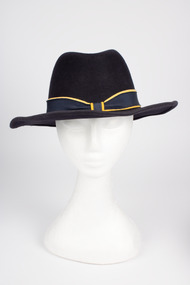 Sir Reginald Ansett Transport Museum
Hat, 1999 - 2001
... Worn by male & female flight attendants 1999 - 2001 flight attendants stewardess / steward navy blue fedora yellow piping 1999 - 2001 wool felt weiss australia White maker's label with black print "Weiss Australia". ...Worn by male & female flight attendants 1999 - 2001Navy-blue wool-felt wide-brimmed hostess hat. Navy grosgrain ribbon trim bordered with yellow piping. Decorative tuck on front of trim & twist detail on back. Dent in crown. Black grosgrain sweatband. White maker's label with black print - "Weiss Australia". Faded blue biro with owner's initials (possibly SAR?or SPR?). 15mm round white label under sweatband with black upper-case lettering "SEP".White maker's label with black print "Weiss Australia". Faded blue biro with owner's initials (possibly SAR? or SPR?). 15mm round white sticker under sweatband with black upper-case lettering "SEP"flight attendants, stewardess / steward, navy blue fedora, yellow piping, 1999 - 2001, wool felt, weiss australia -
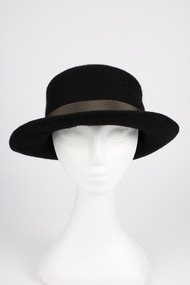 Sir Reginald Ansett Transport Museum
Headwear - Hat, Fedora
... ...fedora...Headwear Hat, Fedora ...Black felt wide brimmed hat with grey satin ribbon.flight attendant, hostess, fedora, stewardess -
 Kew Historical Society Inc
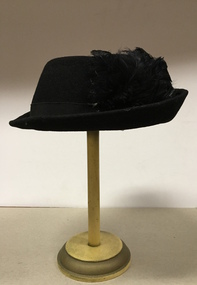
Headwear - Black Fedora, 1970s
... A decorative group of feathers is used at the rear of the hat. Headwear Black Fedora ...The Kew Historical Society’s fashion and design collection is comprised of costumes, hats, shoes and personal accessories. Many of these items were purchased or handmade in Victoria; some locally in Kew. The extensive hat collection comprises items dating from the 1860s to the 1970s. Most of the hats in the collection were created by milliners for women. There are however a number of early and important men’s hats in the collection. The headwear collection is particularly significant in that it includes the work of notable Australian and international milliners.Black hat featuring a low crown and a narrow brim. A decorative group of feathers is used at the rear of the hat.Nilheadwear, women's hats -
 Vision Australia
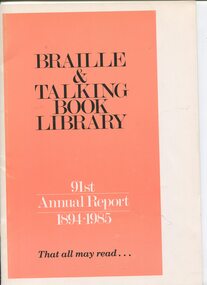
Administrative record - Text, Braille and Talking Book Library 91st Annual Report 1894-1985: that all may read, 1985
... Annual report Braille and Talking Book Library John Cockayne Nancy Phelan Book of the Year Barrett Reid Jan Smark Jim Simmonds Maria Cafici Milena Bektus Maria Darroch Lee Saunders John Sullivan Eve Mahlab Fedora Trinker Toula Theophilus Ralph Hunter 1 volume of text and illustrations Braille and Talking Book Library 91st Annual Report 1894-1985: that all may read Administrative record Text ...Annual report of the Braille & Talking Book Library including Minutes of the AGM, Board of Director's Report, President's report and financial statements. Items also included are: embedding the new philosophy 'that all may read', VIP Tours began with tour of library and lunch at 'Onions' restaurant afterwards, increased loans but also a 5 month waiting list for new borrowers, Children's Christmas Party conducted, Barrett Reid, Joyce Nicholson and Dr Stephen Murray-Smith continue to be the literary panel for Braille Book of the Year, Annual Garden Party at Benalla, 63rd work anniversary of Alice McClelland, computerisation of card catalogue has received funds and should be completed by early 1986, and have the added benefit of eliminating wait times for new borrowers, resignation of Clare Lovegrove and Beverley Johnson and appointment of Seija Makinen and Alana McCann, first joint commission of braille books from RIDBC by Library and 8 state organisations, and purchase of an electric conveyor belt to help load the Australia Post truck with the daily 30 bags of mail received and the same outgoing.1 volume of text and illustrationsannual report, braille and talking book library, john cockayne, nancy phelan, book of the year, barrett reid, jan smark, jim simmonds, maria cafici, milena bektus, maria darroch, lee saunders, john sullivan, eve mahlab, fedora trinker, toula theophilus, ralph hunter -
 Returned Nurses RSL Sub-branch
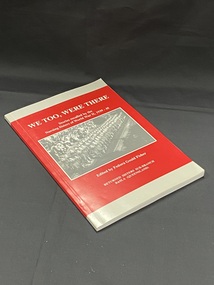
Book - Paperback book, Fedora Gould Fisher, We too, were there: stories recalled by the Nursing Sisters of World War II, 1939-45, 1995
... Fedora Gould Fisher...We too, were there: stories recalled by the Nursing Sisters of World War II, 1939-45 Book Paperback book Fedora Gould Fisher Returned Sisters Sub-Branch R&SLA (Queensland) ...The stories of the nurses of the Australian Army Nursing Service (AANS) during World War Two. They served in all theatres of war where Australian soldiers fought.Red cover with a grey strip across the top and bottom. There is a black and white image of nurses in uniform marching along a street lined with crowds of people, in the centre. The title and editor details are printed in white text.non-fictionThe stories of the nurses of the Australian Army Nursing Service (AANS) during World War Two. They served in all theatres of war where Australian soldiers fought. wwii, world war ii 1939-1945, nurses queensland, wwii medical care, australian army nurses -
 Returned Nurses RSL Sub-branch
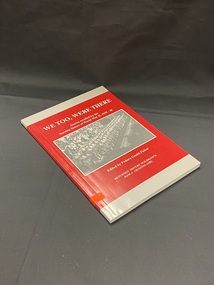
Book - Paperback book, Fedora Gould Fisher, We too, were there: stories recalled by the Nursing Sisters of World War II, 1939-45, 1995
... Fedora Gould Fisher...We too, were there: stories recalled by the Nursing Sisters of World War II, 1939-45 Book Paperback book Fedora Gould Fisher Returned Sisters Sub-Branch R&SLA (Queensland) ...The stories of the nurses of the Australian Army Nursing Service (AANS) during World War Two. They served in all theatres of war where Australian soldiers fought.Red cover with a grey strip across the top and bottom. There is a black and white image of nurses in uniform marching along a street lined with crowds of people, in the centre. The title and editor details are printed in white text.non-fictionThe stories of the nurses of the Australian Army Nursing Service (AANS) during World War Two. They served in all theatres of war where Australian soldiers fought. wwii, world war ii 1939-1945, nurses queensland, wwii medical care, australian army nurses
