
Showing 5 items matching "ferranti"
-
 Emerald Museum & Nobelius Heritage Park
Booklet - Ferranti Radio Manual, Ferranti Radio, Ferranti Radio, Table Models 005 & 105, Operating Instructions, Circa late 1930s
... Ferranti Radio, Table Models 005 & 105, Operating Instructions...ferranti...In addition, in 1951 Ferranti began selling the first commercially available computer, the Ferranti Mark 1....Ferranti Radio...In addition, in 1951 Ferranti began selling the first commercially available computer, the Ferranti Mark 1. ...Ferranti was a UK electrical engineering and equipment firm that operated for over a century from 1885 until it went bankrupt in 1993. The firm was known for work in the area of power grid systems and defence electronics. In addition, in 1951 Ferranti began selling the first commercially available computer, the Ferranti Mark 1.The object is historically and socially significant as it give an insight into the technical history of electronics and the social and comercial impact of technology on society.Green printing on buff coloured paper cover, bound with staples.Conceptual pencil sketches of two hose layouts with plan and elevation views, sketches are crossed outferranti, radio, operating instructions, 5, 105 -
 Monash University Museum of Computing History
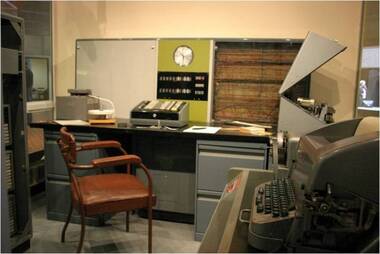
Ferranti Sirius mainframe computer, 1961
... The Ferranti Sirius is an electronic second-generation transistor computer and is one of three remaining examples of this machine left in the world. ...Red label on front “Ferranti tape reader. Type TR 5. Serial No. 477”. ...The Ferranti Sirius is an electronic second-generation transistor computer and is one of three remaining examples of this machine left in the world. ...The Ferranti Sirius is an electronic second-generation transistor computer and is one of three remaining examples of this machine left in the world. It was an important addition to the computing facilities at Monash University in the early 1960s and provided access for computer programming and research for many early computer professionals, academics and teachers. The Ferranti Sirius computer was built in a period of rapid growth in computing technology. The first stored program computers appeared in the late 1940s and used individual designs with valve technology. By the mid-1950s valve technology was replaced by transistors and the first mass produced commercial computers became available. The Ferranti Sirius was announced in 1959 and offered a “small” academic computer. It was designed and built by the English company Ferranti Ltd and sold through a local office of the company in Melbourne. The Sirius was manufactured at the Ferranti Ltd.’s West Gorton, England factory from 1959 to 1963 and, in all, the company produced probably 22 installations although only 16 were actually recorded as sold; this included one at Ferranti’s Bureau in London and one at Ferranti’s Melbourne Bureau. Only 7 were exported and 4 of these 7 were located in Melbourne, Australia. All four were associated with computing at Monash University – the Sirius in the MMoCH collection was purchased by Monash University in 1962, a smaller Ferranti Sirius was used on the Caulfield campus (prior to amalgamation with Monash University) from 1963, the Ferranti company had its own Ferranti Sirius initially temporarily installed at Clayton campus in 1962 and then placed in their office in Queens Road, Melbourne. A fourth computer was purchased by ICIANZ (now Orica) in 1962 and was transferred to Clayton campus in 1967. Only two of these Melbourne examples have survived; one in the MMoCH collection and one at Museums Victoria. There is an example of the Ferranti Sirius in the Science Museum Group collection in the UK as well. The Ferranti Sirius in the MMoCH collection was the first computer purchased by Monash University and it was shipped to Australia to be installed by November 1962. The University had a similar model computer on loan from Ferranti Ltd during the first part of the year and it was returned to the office of the company in Queens Road, Melbourne once the University’s own machine was installed. The computer was placed on site at Clayton campus, Monash University. The computer operated from 1962 until 1972 when it was officially decommissioned. The Ferranti Sirius was sold to Mr Paul Stewart in late 1974 and removed from Monash University. Mr Stewart later donated the computer back to the University in 1988 and it was transferred to the collection of the Monash Museum of Computing History after 2001. The Ferranti Sirius is an electronic second-generation transistor computer and is one of three remaining examples of this machine left in the world. It was an important addition to the computing facilities at Monash University in the early 1960s and provided access for computer programming and research for many early computer professionals, academics and teachers. The Ferranti Sirius is of scientific (technological) significance as one of the early transistor digital computers that transitioned computing from first-generation valve computers to second generation commercial installations. This example of the Sirius is of historical significance in its role as a part of the Computer Centre, Clayton campus, Monash University which provided computing facilities in Melbourne in the early 1960s when there were few installations available for academic, administrative and commercial users. Staff and students were able to undertake investigative research and learn programming techniques. The Computer Centre encouraged the use of the computer across all disciplines and this provided the base to establish computer science as a subject offering and, later, a new department in the University. This growth in computer education eventually culminated in the establishment of the Faculty of Information Technology, Monash University. The Ferranti Sirius in the collection at Monash Museum of Computing History has a main unit with a CPU and memory combined with input/output equipment and one extra cabinet of memory. The Central Processing Unit is a floor-standing unit which contains the computer circuits, power supplies and has a decimal digit display panel and a normal clock. A moveable control panel is placed in front of the Unit (Currently set on a recreated desk/filing cabinet support in the display). The Sirius base unit uses acoustic delay line memory with 1000 word store. An additional 3000 word memory cabinet is set adjacent to the CPU and can be connected to increase the memory. The computer is supported by a range of input/output devices. There is a Ferranti Paper tape reader, located on desk in front of CPU. Red label on front “Ferranti tape reader. Type TR 5. Serial No. 477”. Adjacent to the CPU is a set of Simplified tape editing equipment in three pieces which includes a (1) Table unit with switches on front face. Metal tag on reverse reads “Creed & Co. Model No. S4060. Serial No. 1457. Original Customers Marking GRP7 V706”. The table has a numbered internal tag “Table Serial No. 198579. (2)Creed teletype set on table unit. Metal tag on reverse “Creed & Co. Model No. 75RPR K4M4. Serial No. 5897 Made in England”. (3)Creed paper tape reader set on table unit. This set of equipment could read paper tape and print it, or copy paper tape while allowing it to be edited, or allow a programmer or data preparation person to type and punch a new program or data. It has no electrical connection to the computer. Paper tapes were usually torn off and carried across to the computer. There is also another table unit with switches on front face and changeable setting switch on front right side which holds a Ferranti Westrex paper tape punch set. Label on reverse “Teletype Code BRPE11” This was the Computer’s only output device. BRPE-11 is a teletype model number. -
 Bendigo Military Museum
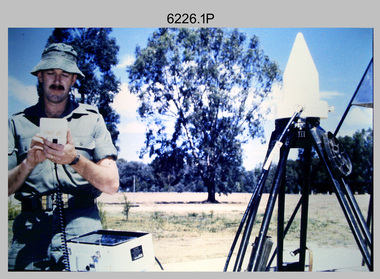
Photograph - Demonstration of TI4100 GPS Receiver, Royal Australian Survey Corps, c1988
... The GPS receivers and Ferranti FILS3 helicopter and vehicle mounted Inertial Positioning System (IPS) replaced the TRANSIT satellite receivers. ...The GPS receivers and Ferranti FILS3 helicopter and vehicle mounted Inertial Positioning System (IPS) replaced the TRANSIT satellite receivers. ...This is a set of four photographs of WO2 Graham Ragless from the Royal Australian Survey Corps demonstrating the operation of Global Positioning System equipment in c1988. The photos were probably taken at the School of Military Survey (SMS), Bonegilla, VIC. Texas Instruments TI4100 portable Global Positioning System (GPS) geodetic receivers were introduced from 1986–1988. The GPS receivers and Ferranti FILS3 helicopter and vehicle mounted Inertial Positioning System (IPS) replaced the TRANSIT satellite receivers. The equipment was deployed to establish the baseline for a GPS controlled air camera and photogrammetric system to significantly reduce the requirement for ground survey to accurately control air photography for topographic mapping. Personnel from the four field survey squadrons at this time were trained at the SMS to operate the TI4100 receivers. Field survey operations using GPS and IPS equipment followed in the late 1980s. This technology is described in more detail in the RA Svy booklet titled An Introduction to Topographic Mapping. See record ID - 6010. WO2 Graham Ragless progressed to the rank of WO1 and was appointed as RSM of the Army Survey Regiment from 1990 to 1992. Refer to item 6186.2P for more photographs of WO2 Graham Ragless demonstrating the TI4100.This is a set of four photographs of a technician from the Royal Australian Survey Corps demonstrating the operation of Global Positioning System equipment in c1988. Colour photos are on 35mm slide film and were scanned at 96 dpi. .1) to .4) - Photo, colour, c1988, WO2 Graham Ragless demonstrating the operation of a TI4100 GPS receiverThere are no annotations.royal australian survey corps, rasvy, army survey regiment, army svy regt, fortuna, asr, surveying -
 Bendigo Military Museum
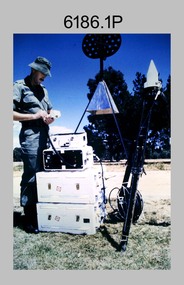
Photograph - Demonstration of TI4100 GPS Receiver, Royal Australian Survey Corps, c1988
... The GPS receivers and Ferranti FILS3 helicopter and vehicle mounted Inertial Positioning System (IPS) replaced the TRANSIT satellite receivers. ...The GPS receivers and Ferranti FILS3 helicopter and vehicle mounted Inertial Positioning System (IPS) replaced the TRANSIT satellite receivers. ...This is a set of two photographs of WO2 Graham Ragless from the Royal Australian Survey Corps demonstrating the operation of Global Positioning System equipment in c1988. The photos were probably taken at the School of Military Survey (SMS), Bonegilla, VIC. Texas Instruments TI4100 portable Global Positioning System (GPS) geodetic receivers were introduced from 1986–1988. The GPS receivers and Ferranti FILS3 helicopter and vehicle mounted Inertial Positioning System (IPS) replaced the TRANSIT satellite receivers. The equipment was deployed to establish the baseline for a GPS controlled air camera and photogrammetric system to significantly reduce the requirement for ground survey to accurately control air photography for topographic mapping. Personnel from the four field survey squadrons at this time were trained at the SMS to operate the TI4100 receivers. Field survey operations using GPS and IPS equipment followed in the late 1980s. This technology is described in more detail in the RA Svy booklet titled An Introduction to Topographic Mapping. See record ID - 6010. WO2 Graham Ragless progressed to the rank of WO1 and was appointed as RSM of the Army Survey Regiment from 1990 to 1992. Refer to item 6226.4P for more photographs of WO2 Graham Ragless demonstrating the TI4100.This is a set of two photographs of a technician from the Royal Australian Survey Corps demonstrating the operation of Global Positioning System equipment in c1988. Colour photos are on 35mm slide film and were scanned at 96 dpi. .1) and .2) - Photo, colour, c1988, WO2 Graham Ragless demonstrating the operation of a TI4100 GPS receiverThere are no annotations.royal australian survey corps, rasvy, army survey regiment, army svy regt, fortuna, asr, surveying -
 Bendigo Historical Society Inc.
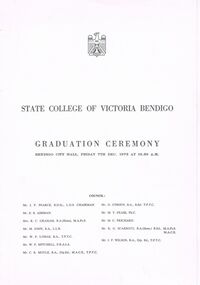
Document - LA TROBE UNIVERSITY BENDIGO COLLECTION: STATE COLLEGE OF VICTORIA BENDIGO GRADUATION CEREMONY 1978
... Colliss, Miss J. de Ferranti, Mr. A. J. McIntosh, Mrs. S. M. Wheeler, Mr. ...Colliss, Miss J. de Ferranti, Mr. A. J. McIntosh, Mrs. S. M. Wheeler, Mr. ...A white document titled 'State College of Victoria Bendigo Graduation Ceremony.' Bendigo City Hall, Friday 7th Dec. 1973 at 10.30 A.M. Council: Mr. J. P. Pearce, Mr. E. B. Ashman, Mrs. R. C. Graham, Mr. M. John, Mr. W. P. Lomas, Mr. W. P. Mitchell, Mr. C. R. Moyle, Mr. D. O'Brien, Mr. M. T. Pease, Mr. M. C. Prichard, Mr. K. G. Scarrott and Mr. J. P. Wilson. On the inside cover is a list of the Staff: Principal: Mr. K. G. Scarrott. Vice-Principal: Miss A. Downard and Warden for Men: Mr. F. M. Courtis. Art Staff - Mr. F. M. Courtis, Mr. B. A. Clemson, Mr. K. G. Harrison, Mr. K. W. Endersby, Mr. L. J. Langan, Mr. R. N. Bruce, Mr. D. J. Watson, Mr. R. J. Harris, Mrs. M. M. Clemson. Education - Mr. D. O'Brien, Mr. F. A. Jones, Mrs. N. F. Fawdry, Mr. A. D. Maltby, Mr. J. Brasier, Mr. A. Attrill, Mr. K. P. O'Hagan, Mrs. M. J. Smith, Mr. E. F. Bell, Miss P. R. Wess. English - Mr. T. J. McCabe, Mr. G. L. Colson, Mr. W. P. Lomas, Miss M. C. Gates, Mr. R. M. Counahan, Mrs. R. M. Griffiths, Mrs. E. L. Angus. Library and Aids - Mr. B. D. Gill, Mr. J. R. Goodrich, Mrs. E. I. Perry, Mr. R. D. Robinson, Mrs J. A. Maltby, Mrs. G. L. Barnes. Mathematics - Mr. K. C. Coles, Mr. A. J. Jones, Mrs. H. Knox, Mr. C. T. Dillon. Music - Mr. B. R. Reed, Mrs. B. P. Hyett, Miss E. A. McConnell, Mrs. M. P. Hibberd. Physical Education - Mr. R. Colliss, Miss J. de Ferranti, Mr. A. J. McIntosh, Mrs. S. M. Wheeler, Mr. D. Pinniger, Mrs. S. L. Anderson. Procedures and Practice of Teaching - Mr. B. T. Geary, Mr. C. J. Barnes, Mrs. D. E. Plim. Science - Mr. R. F. Colbourne, Mr. R. E. Martin, Mr. L. E. Leeson, Mr. N. J. West, Mr. P. L. Killeen. Social Science - Mr. L. A. Hall, Mr. J. A. White, Mr. R. B. Silverback, Mr. G. F. McIntosh, Mr. G. N. Dunn, Mrs. S. Sarto. International Teacher Fellow - Mr. D. J. Jones. Associated Medical Staff - Dr. L. M. Cleeve. Registrar - Mr. W. D. Kolle. On the following page is an outline of the program which includes an introduction by the Chairman of the Council Mr. J. P. Pearce. The signing of the Graduation Book is - student representatives are presented to Mr. J. Revell Inspector of Schools, by Miss Downward. The Principal's speech is presented by Mr. K. G. Scarrott. Miss Downward presents all the graduating students to Mr. Moyle. Congratulations are offered by Cr. A. Craig, Cr. M. O'Halloran for the Shire of Strathfieldsaye and the Principal of Golden Square State School, Mr. J. Hendry. The Occasional Address is presented by Mr. C. R. Moyle. The Master of Ceremonies is Mr. B. A. Clemson. The pianist is Barbara Hyett and the organist Michael Bottomley. On the back of the program is a list of the graduating students - Diploma of Teaching (Primary) - Rita J. Aniolkowski, Debra A. Ball, Valda J. Batey, Judith Batten, Mrs. Julie Bennett, Lidija A. Bertlands, Verence A. Bonsor, Barry R. Borneman, Michael K. Bottomley, Gregory Bowen, Ian G. Butcher, Christine V. Callaghan, Elizabeth A. Cannard, Janette J. Chaffey, Mrs. Sandra K. Chamberlain, Lorraine J. Chambers, Suzanne E. Chislett Mrs. Elaine Clark, Kathleen A. Cleave, Jennifer R. Cody, Janice E. Cole, Mimie E. Crook, Lidia Czerkaskyj, Kathryn F. Davis, Ivan J. Dedini, Bryan W. Derrick, Kaye E. Dillon, Bernadette M. Dixon, Marie L. Dowd, Dianne M. Dwyer, Helen D. Eames, Norma C. Eddy, Mrs. Rozlyn Effenberg, Barbara I. Fairmaid, Anne C. Ferry, Noela M. Flanagan, Lorraine J. Ford, Helen T. Fraser, Pauline H. Fraser, Julian F. Fuhrmann, Mrs. Susan L. Gemmell, Lynette M. Gilmore, Timothy A. Godber, Stephen J. Gough, Rosemary Joy Graves, Robyn M. Hanna, Geoffrey J. Harrison, Aileen M. Harrop, Margaret E. Harry, Kathryn Hermecz, Jennifer A. Hewetson, Mary Hickey, Mrs. Susan Higgins, Mandy S. Hilson, Anthony V. Holland, Galye A. Holyman, Julie M. Hyde, Susan B. James, Lorraine I. Joiner, Annie N. Jones, Ian D. Jones, Mrs. Margot E. Jones, Heather M. Jordan, Helen R. Keane, Joy Keating, Clare R. Keogh, Margaret T. La Fontaine, Kerry M. Larcombe, Julie T. Lewis, Michael R. May, Catherine A. Mays, Colin S. McKeown, Elaine A. McNabb, Bruce J. Meager, Noel C. Meredith, Margaret C. Metcalf, Jennifer J. Millard, Kerry M. Muldowney, Mrs. Kathleen E. Muller, Diane Nankivell, Roslyn B. Nankivell, Lennard Roy Neilsen, Mrs. Nanette B. Newstead, Anne M. O'Sullivan, Mrs. K. S. Parker, Heather J. Perrin, Kaye P. Ramsdale, Elaine J. Reddington, Cheryl Reid, John E. Reid, Mary L. Reilly, Mrs. Andra F. Robertson, Edwin D. Rogers, Mrs. Lorraine J. Rogers, James J. Rolfe, Laurice J. Ryall, Bernadette Ryan, Colleen F. Ryan, Alan J. Sands, Mrs. Judith A. Scarrott, Peter B. Scarrott, Suzanne M. Scott, Lynette J. Scown, Kathleen A. Sexton, Wendy A. Scheumack, Bryan W. Simm, Irene Simonaitis, Christine M. Smith, Heather N. Smith, Mary A. Smith, David G. Steel, Kate F. Stewart, Robyn F. Sutton, Barbara L. Turner, Robyn J. Turner, Dawn E. Veal, Ann Vickers, Johanna M. Vringer, Lisa D. Watkins, Barbara A. Watts, Sherrie M. West, Annette L. Whiting, Teresa L. Williamson, Jennifer L. Wirth, Margaret E. Wishart. Trained Infant Teachers' Certificate - Mrs. Annette Reid. Trained Primary Teachers' Certificate - Mrs. Gail Bennett, Prudence E. Chapman, Christine Colbert, Patricia L. Harris, Mrs. Gwenda Haveckin, Mrs. Jill Hobbs, Wayne Jackson. Mrs. Barbara Liston. In the centre of this program is a ticket for Miss J. C. Burnett to attend it.bendigo, education, state college of victoria bendigo, la trobe university bendigo collection, collection, bendigo teachers' college, bendigo, education, teaching, teachers, students, tertiary education, graduands, graduates, staff, graduation, bendigo teachers' college staff, bendigo teachers' college students
