Showing 7 items matching "finding aid"
-
Narre Warren and District Family History GroupBook, Finding Aid for the Berwick & Cranbourne Shire Rate Books
... Finding Aid for the Berwick & Cranbourne Shire Rate Books...References on which file a particular locality begins. in ringfolder Finding Aid for the Berwick & Cranbourne Shire Rate Books Book ...A finding aid to the digital copies of the rate books for the Shire of Berwick and Cranbourne. References on which file a particular locality begins.in ringfoldernon-fictionA finding aid to the digital copies of the rate books for the Shire of Berwick and Cranbourne. References on which file a particular locality begins.doveton, jeetho, tooradin, yallock, lyndhurst, iona (vic.), rate books, council rates -
Victorian Aboriginal Corporation for LanguagesBook, Museum of Victoria, Indigenous cultures ethnohistoric material : Anthropology Department : Manuscript Collection - inventory boxes 1-24, 25-45, 1993
... finding aid...Victorian Aboriginal Corporation for Languages 33 Saxon Street Brunswick melbourne finding aid Howitt Spencer Kenyon Robinson Young Balfour Johns Wright Seeger Wright Cowle Gillen Officer Benporath Croll Mitchell Endacott Cahill Indigenous cultures ethnohistoric material : Anthropology Department : Manuscript Collection - inventory boxes 1-24, 25-45 Book Museum of Victoria ...finding aid, howitt, spencer, kenyon, robinson, young, balfour, johns, wright, seeger, wright, cowle, gillen, officer, benporath, croll, mitchell, endacott, cahill -
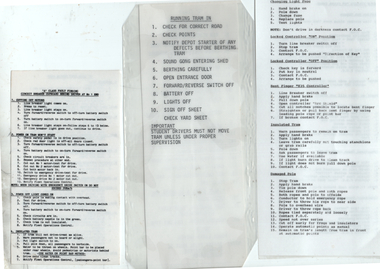
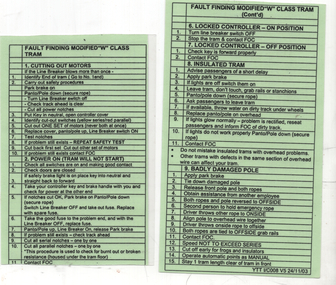
Melbourne Tram MuseumDocument - Set of three fault finding sheets, c2000
... Issued to drivers to aid fault finding of modified W class, A class and Z class trams. undated c2000....Melbourne Tram Museum 8 Wallen Road Hawthorn melbourne Issued to drivers to aid fault finding of modified W class, A class and Z class trams. undated c2000. ...Issued to drivers to aid fault finding of modified W class, A class and Z class trams. undated c2000.Yields information about fault finding for trams by drivers.Set of 3 laminated sheets for tram fault finding - cheat sheets.tramways, training, a class, z class, w class, faults -
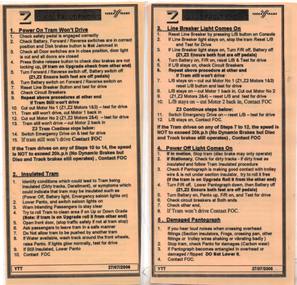
Melbourne Tram MuseumDocument - Set of two fault sheets, Yarra Trams, 27/7/2006
... Issued to drivers to aid fault finding of Z class, and B class trams. ...Melbourne Tram Museum 8 Wallen Road Hawthorn melbourne Issued to drivers to aid fault finding of Z class, and B class trams. ...Issued to drivers to aid fault finding of Z class, and B class trams. Dated 27/7/2006Yields information about fault finding for trams by drivers.Pocket size sheets printed on yellow paper and laminated.trams, tramways, faults, b class, z class -
Melbourne Tram MuseumDocument, Yarra Trams, "Set of six fault finding sheets", 1/2001
... Issued to drivers to aid fault finding of modified W class, A class and B class trams. ...Melbourne Tram Museum 8 Wallen Road Hawthorn melbourne Issued to drivers to aid fault finding of modified W class, A class and B class trams. ...Issued to drivers to aid fault finding of modified W class, A class and B class trams. Includes a list of A class tram destinations. Dated Jan. 2001Yields information about fault finding for trams by drivers.Set of 7 laminated sheets for tram fault finding - cheat sheets.tramways, faults, w class, b class, a class, destinations -
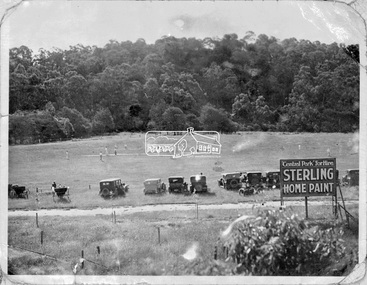
Eltham District Historical Society IncNegative - Photograph, Cricket match, Central Park, Eltham, c.1931
... aid of the recently-acquired park near the railway station, and from every point of view the day was a success. The Central Park contains 9½ acres, and has the Diamond Creek on one side and the railway line on the other. It cost £760, of which the council contributed £500, and the citizens, are finding...aid of the recently-acquired park near the railway station, and from every point of view the day was a success. The Central Park contains 9½ acres, and has the Diamond Creek on one side and the railway line on the other. It cost £760, of which the council contributed £500, and the citizens, are finding ...The new Central Park was opened on Monday, 21 April 1930 by Mr. W.H. Everard, M.L.A. followed by a sports carnival. The Advertiser reported on Friday, April 25, 1930 that – “Perfect weather prevailed on Monday for the sports gathering in aid of the recently-acquired park near the railway station, and from every point of view the day was a success. The Central Park contains 9½ acres, and has the Diamond Creek on one side and the railway line on the other. It cost £760, of which the council contributed £500, and the citizens, are finding the balance. Already about £80 has been spent in levelling, and a pavilion has been erected by the footballers, who will use the ground for training until it is sufficiently, improved for matches. There is ample shade along the banks of the creek, where there were numerous picnic parties. The committee has already done some planting on the railway side of the park, and where the trees grow on the higher side, overlooking the arena, the natural stand will have shade, command a view of the events, and have the trees on the banks of the creek in the distance. There were between 600 and 700 people present, many in motor cars having a little difficulty in, finding their way under the aqueduct to the ground, but the council is at present effecting improvements to the road. A merry-go round was a source of pleasure to the children, and the Northcote Soldiers and Citizens Band under Bandmaster Gore, de-lighted everyone with their varied selections of good music.” “Cr. E. J. Andrew, president of the Park Committee, said it was the first function held in the park, and although the citizens have guaranteed £420 towards it, there is still some-thing owing. Mr. W. H. Everard, M.L.A., who can always be relied upon to attend any gathering which draws the people together, said that he and Mrs. Everard had great pleasure in being present to declare the park open. He congratulated the Eltham people upon their public spirit, and the new park would be more appreciated in years to come. The other park is a splendid one, but it is far away, and one is required close to the station, so that young people can have a day's enjoyment, without having to go far from the station. The trouble in Victoria is not having enough parks. The early settlers did a lot in getting park lands, but the present generation is not doing enough. Eltham people are entitled to the highest commendation for their action, and Cr. Andrew and the council are to be thanked for what they have done. What is wanted is ingress and egress so that people can get in comfortably. When he was motoring in his wife said, "Surely you are not going down that precipice," and he replied that he would go anywhere where the people were. In the future it will be the big centre of Eltham.” Reproduced on page 96 of 'Pioneers & Painters'This photo forms part of a collection of photographs gathered by the Shire of Eltham for their centenary project book,"Pioneers and Painters: 100 years of the Shire of Eltham" by Alan Marshall (1971). The collection of over 500 images is held in partnership between Eltham District Historical Society and Yarra Plenty Regional Library (Eltham Library) and is now formally known as the 'The Shire of Eltham Pioneers Photograph Collection.' It is significant in being the first community sourced collection representing the places and people of the Shire's first one hundred years.Digital image 4 x 5 inch B&W Neg 9 x12.5 cm printsepp, shire of eltham pioneers photograph collection, eltham, eltham central park, automobile, central park, cricket match, pioneers and painters -

Bendigo Historical Society Inc.Letter - Michele Matthews Collection: PHD Research - Relief during the great depression, Dec 1932
... finding them in severe poverty. She explains that the family has four children and lacks even the most basic necessities, including adequate clothing and bedding. The children reportedly have insufficient clothing to attend school, and the family possesses only a single worn blanket. Mrs. Crane asks whether clothing, materials for sewing, or other practical assistance can be provided rather than simply financial aid...finding them in severe poverty. She explains that the family has four children and lacks even the most basic necessities, including adequate clothing and bedding. The children reportedly have insufficient clothing to attend school, and the family possesses only a single worn blanket. Mrs. Crane asks whether clothing, materials for sewing, or other practical assistance can be provided rather than simply financial aid ...Dr Michele Matthews has been a local and social historian for nearly three decades since she first used correspondence held by the then Bendigo City Council for her Honours thesis. She is an ardent advocate for the use of local history records to tell Victorian and Australian history from a grassroots perspective. Michele’s MA thesis, ‘A forgotten “Father” of Federation: Sir John Quick 1852‑1911’ (2003), and her PhD thesis, ‘Survivors, schemes, Samaritans and shareholders: the impact of the Great Depression on Bendigo and District 1925‑1935’ (2007), both drew heavily on Bendigo and district records. Michele Matthews Collection: PHD Research - Relief during the great depression This item includes the following document: 8672.87a This file contains a series of letters documenting an application for charitable assistance on behalf of Mrs. M. Sheen of Bendigo during 1933–1934. The correspondence follows the request from its initial referral through investigation and final resolution by local welfare authorities. The first letter, dated 11 December 1934, is from the State Relief Committee in Melbourne to the Public Assistance Committee in Bendigo. The Committee forwards Mrs. Sheen's application for assistance and asks local authorities to investigate her circumstances. They request advice on whether the case can be managed locally or whether financial assistance should be provided by the State Relief Committee. Attached is a handwritten appeal from Mrs. Crane, who describes visiting the Sheen family and finding them in severe poverty. She explains that the family has four children and lacks even the most basic necessities, including adequate clothing and bedding. The children reportedly have insufficient clothing to attend school, and the family possesses only a single worn blanket. Mrs. Crane asks whether clothing, materials for sewing, or other practical assistance can be provided rather than simply financial aid, believing this would better meet the family's immediate needs. The next stage of the correspondence shows that the Mayor of Bendigo acknowledges Mrs. Crane's request and arranges for the Sheen family to receive relief through the Bendigo Benevolent Asylum. Mr. Pool, the head of the household, is instructed to attend the asylum so assistance can be organised. Subsequent memoranda between the Town Clerk, the Bendigo Benevolent Asylum, and the State Relief Committee confirm that the case has been investigated locally. The Superintendent of the Benevolent Asylum reports that Mrs. Sheen has now been adequately supplied with the clothing her family required and recommends that no further assistance from the State Relief Committee is necessary. The final document records the clothing issued to the family. Items supplied include singlets, girls' singlets, boys' singlets, boys' trousers, shirts, flannelette garments, boots, and shoes. This inventory demonstrates that the response focused on providing essential clothing for the children, addressing the specific deficiencies identified in the original appeal.bendigo, michele matthews collection, 1930s depression, letters seeking support in bendigo during the great depression 1932 to 1934