
Showing 4 items matching "fire tube boiler"
-
 Port of Echuca
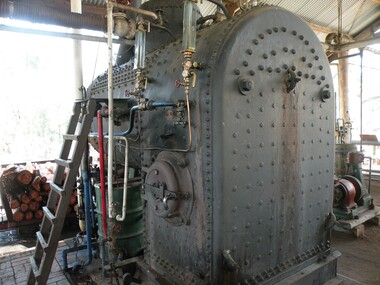
Functional object - Locomotive Type Fire Tube Boiler, 1927
... Locomotive Type Fire Tube Boiler...This is an example of a fire tube boiler where the fire from the fire box heats the water surrounding the fire tubes running through the boiler, smoke escapes out the smoke stack and the steam is captured in the dome and sent through pipes toward other engines in the Port of Echuca Steam Display. ...Large cast iron, fire tube boiler with 124 fire tubes, fire box, steam dome and exhaust chimney. ...Functional object Locomotive Type Fire Tube Boiler Johnson Bros. USA ...This Johnson Bros. (USA) Locomotive Type Boiler was from a steam shovel (that moved on rails) that excavated rock and soil during the construction of Stevens Weir near Deniliquin NSW in 1934. It has a working pressure of 100psi. This is an example of a fire tube boiler where the fire from the fire box heats the water surrounding the fire tubes running through the boiler, smoke escapes out the smoke stack and the steam is captured in the dome and sent through pipes toward other engines in the Port of Echuca Steam Display. Two glass gauges are fitted on the side of the firebox. Two safety valves are fitted at the top of the boiler to maintain the correct and safe pressure. It still functions today for visitors most days of the week.A good example of the technology and industrial history of the Riverina region of southern NSW and northern Victoria. It is an integral part of the Port of Echuca Steam Display running secondary engines off the steam produced within this boiler. Large cast iron, fire tube boiler with 124 fire tubes, fire box, steam dome and exhaust chimney. boiler, johnson bros, steam display, kevin hutchinson steam shed -
 Flagstaff Hill Maritime Museum and Village
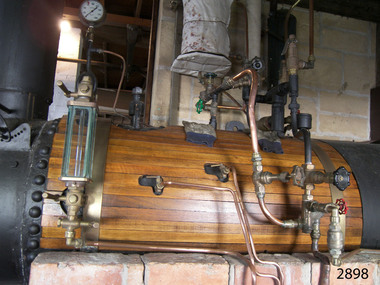
Equipment - Boiler, T & F Johnson, boilermakers, late 19th century
... Tube Boiler...steam boiler...steam technology...underfired boiler...horizontal boiler...timber clad boiler...steam power...industrialisation...boilermakers...South Melbourne...Dewrance...John Dewrance...pressure gauge...Dewrance pressure gauge...T & F Johnson...London...steam engine...steam locomotive...pounds per square inch...19th century...steam machine...Johnson Tyne Foundry...colonial boiler...fire...Steam boilers were used in factories throughout Australia, mounted over similar designs of brick furnaces. This heat from the fire travels through the tubes in this fire tube boiler and the water heats as it circulates around them. ...Steam boilers were used in factories throughout Australia, mounted over similar designs of brick furnaces. This heat from the fire travels through the tubes in this fire tube boiler and the water heats as it circulates around them. ...A steam boiler like this late 18th century boiler, is often called a colonial boiler. Steam boilers were used in factories throughout Australia, mounted over similar designs of brick furnaces. This heat from the fire travels through the tubes in this fire tube boiler and the water heats as it circulates around them. Another kind of boiler is a water tube boiler, in which the water is inside the tubes and the heat of the combustion surrounds the tubes. The boiler in our collection burned wood as fuel but others of this design could also burn coal, coke, gas and liquid fuels. The boiler was made by T & F Johnson, boilermakers. In 1922 their factory was located at Coventry Street, South Melbourne. They were still advertising their 'Colonial, multi, vertical boilers, all sizes' at the same address in 1934. The connected pressure gauge, made in London by Dewrance, measures 0 to 400 pounds per square inch. John Dewrance is renowned as a pioneer of the steam locomotive in the early 19th century. He founded John Dewrance & Co. in South London in 1844. His son Sir John Dewrance took over in 1879. In 1939 the company became a subsidiary of Babcock & Wilcox, and was eventually owned by Emerson. How the boiler works: - A boiler is about two-thirds filled with water and heat is applied, in this case in the form of burning wood. The heat is transferred through the metal of the boiler to the water. When the water boils the steam rises to the top, and as it escapes from the boiler the steam pressure builds up in the steam space to later be released to do work; drive machinery such as ship and train engines, turbines, presses, wheels, and driving belts to operate looms and saws. The heat associated with the boiler can be used for preserving food, sterilising, factory manufacturing processes, and steaming wood for shipbuilding. Every boiler has several components fitted for safe operation: - - Safety valves - Gauge glass - Pressure gauge - Main steam stop valve - Water check valve - Blowdown valve - Manhole doorThe boiler is a significant item that gives us a snapshot of early Melbourne's industrial history. It is an example of the technological advancement during the Industrial Revolution where steam-driven machinery and motors could perform tasks more efficiently than manual labour. The makers were one of many boilermaker businesses in Melbourne during the early late-19th andearly 20th centuries. The maritime trade and skills of boilermaking are still learned and applied today. The Dewrance steam pressure gauge connected to the boiler was made by the London firms foundered by John Dewrance. He was renowned for developing the steam locomotive in the early 19th century.Boiler; a horizontal cylindrical underfired steam boiler. It is a multi-tubular design and is timber plank-clad, with brass fittings and pressure gauges. The boiler has an iron door at one end with a metal chimney above it. It is installed over a brick-enclosed solid fuel furnace. Two large, wood-mounted pressure gauges are connected to the boiler and have inscriptions. An inscription is on a red, cast iron plaque above the boiler door. The boiler's maker is T & F Johnson, South Melbourne. One of the pressure gauges was made by Dewrance, London..Maker's plate: "T & F JOHNSON / BOILERMAKERS / SOUTH MELBOURNE" Pressure gauge: "POUNDS PRESSURE / PER [square] INCH / DEWRANCE LONDON"flagstaff hill, warrnambool, maritime museum, shipwreck coast, flagstaff hill maritime village, great ocean road, boiler, multi tube boiler, steam boiler, steam technology, underfired boiler, horizontal boiler, timber clad boiler, steam power, industrialisation, boilermakers, south melbourne, dewrance, john dewrance, pressure gauge, dewrance pressure gauge, t & f johnson, london, steam engine, steam locomotive, pounds per square inch, 19th century, steam machine, johnson tyne foundry, colonial boiler, fire tube boiler -
 Bendigo Historical Society Inc.
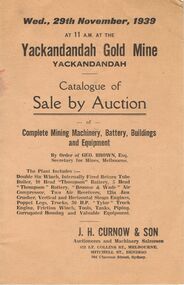
Document - IAN DYETT COLLECTION: AUCTION CATALOGUE - YACKANDANDAH GOLD MINE
... The Plant Includes:- Double 8in Winch, Internally Fired Return Tube Boiler, 10 Head Thompson Battery, 5 Head Thompson Battery, 'Broome & Wade' air Compressor, two Air Receivers, 12in Jaw Crusher, Vertical and Horizontal Steam Engines, Poppet Legs, Trucks, 30 H.P. ...The Plant Includes:- Double 8in Winch, Internally Fired Return Tube Boiler, 10 Head Thompson Battery, 5 Head Thompson Battery, 'Broome & Wade' air Compressor, two Air Receivers, 12in Jaw Crusher, Vertical and Horizontal Steam Engines, Poppet Legs, Trucks, 30 H.P. ...Light tan coloured auction catalogue for a sale at the Yackandandah Gold Mine, Yackandandah on 29th November, 1939 of Complete Mining Machinery, Battery, Buildings and Equipment, By Order of Geo. Brown, Esq, Secretary for Mines, Melbourne. The Plant Includes:- Double 8in Winch, Internally Fired Return Tube Boiler, 10 Head Thompson Battery, 5 Head Thompson Battery, 'Broome & Wade' air Compressor, two Air Receivers, 12in Jaw Crusher, Vertical and Horizontal Steam Engines, Poppet Legs, Trucks, 30 H.P. 'Tylor' Truck Engine, Friction Winch, Tools, Tanks, Piping, Corrugated Housing and Valuable Equipment.J.; H. Curnow & Son were the auctioneers. Catalogue printed by The Cambridge Press.business, auctioneers, j h curnow & son pty ltd, ian dyett collection - auction catalogue - yackandandah gold mine, geo brown esq, j h curnow & son, the cambridge press -
 Puffing Billy Railway
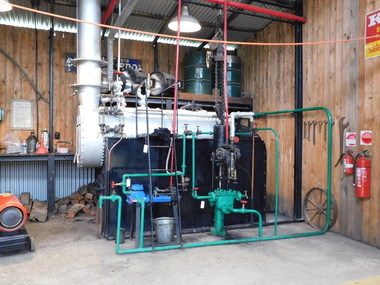
George and George multi tube under fired boiler, 1929
... Boiler purchased by Malvern city council to supply steam to a stationary vertical engine that drove a stone crusher. Built by George and George Pty. Ltd., Melbourne in 1929, it is an external under-fired return-flue type 18 tube boiler capable of supplying steam at 100 pounds per square inch (600 kPa). ...Historic - Industrial Steam Boiler Equipment george and george malvern steam boiler stone crusher puffing billy George and George Pty Ltd, Melbourne 1929 Steel, Cast Iron George and George multi tube under fired boiler George and George ...Boiler purchased by Malvern city council to supply steam to a stationary vertical engine that drove a stone crusher. Built by George and George Pty. Ltd., Melbourne in 1929, it is an external under-fired return-flue type 18 tube boiler capable of supplying steam at 100 pounds per square inch (600 kPa). This boiler can be occasionally seen in steam at the Museum supplying steam for the operation of stationary engines on display near by. Donated by Malvern City Council in 1969. Historic - Industrial Steam Boiler EquipmentSteel, Cast IronGeorge and George Pty Ltd, Melbourne 1929george and george, malvern, steam, boiler, stone crusher, puffing billy
