
Showing 19 items matching "firearms - history"
-
 Bendigo Military Museum
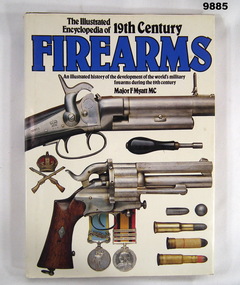
Book - REFERENCE, FIREARMS, Major F. MYATT MC, "THE ILLUSTRATED ENCYCLOPEDIA OF 19TH CENTURY FIREARMS", 1989
... History...Firearms..."The Illustrated/ Encyclopedia of 19th Century/ FIREARMS/ An illustrated history of the development of the world's military/ firearms during the 19th century."..."The Illustrated/ Encyclopedia of 19th Century/ FIREARMS/ An illustrated history of the development of the world's military/ firearms during the 19th century." ...Information from the Title page. "The Illustrated/ Encyclopedia of 19th Century/ FIREARMS/ An illustrated history of the development of the world's military/ firearms during the 19th century."Hard cover book with dust cover. Hardcover - cardboard, dark brown colour buckram with gold colour print on spine. Dust cover - paper, black and blue colour print on front, spine and back. Illustrated front to back - colour photographs of various firearms on off white background. 216 pages - cut, plain, white colour paper. Illustrated black and white and colour photographs, posters and paintings. Colour and line drawings. End papers - illustrated in colour photograph of firearms equipment. Front handwritten information. Shop adhesive label on back of dust cover. Handwritten information - grey lead pencil "1979 $75-". Shop adhesive label - red and black print "Was 45.00/ MARY MARTIN'S/ BARGAIN PRICE/ $$ 19.99".publications, books, refernce guide, history, firearms -
 Monbulk RSL Sub Branch
Book, Marshall Cavendish, Guns and how they work, 1979
... Firearms - History...Firearms - History Military weapons - History The history of firearms and their development and their workings and development Index, ill, p.192. ...The history of firearms and their development and their workings and developmentIndex, ill, p.192.The history of firearms and their development and their workings and developmentfirearms - history, military weapons - history -
 Monbulk RSL Sub Branch
Book, Christopher Chant, Illustrated history of small arms, 1996
... Firearms - History...Firearms - History Small arms - History A detailed guide to the infantrymans weapons of the twentieth century. ...A detailed guide to the infantrymans weapons of the twentieth century.Index, ill, p.144.non-fictionA detailed guide to the infantrymans weapons of the twentieth century.firearms - history, small arms - history -
 Monbulk RSL Sub Branch
Book, Exeter Books, A history of marksmanship, 1972
... Firearms - History...Firearms - History Shooting - History An illustrated survey of man's use of missile weapons since the Stone Age. ...An illustrated survey of man's use of missile weapons since the Stone Age.Ill, p.319.non-fictionAn illustrated survey of man's use of missile weapons since the Stone Age. firearms - history, shooting - history -
 National Vietnam Veterans Museum (NVVM)
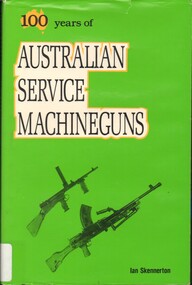
Book, Skennerton, Ian, 100 years of Australian Service Machineguns
... Australia. Army - Firearms - History - 20th century...Australia. Army - Firearms - History - 20th century Machine Guns Australia's history of issues and manufacture is unique, with such renowned foreign guns as the U.S. 100 years of Australian Service Machineguns Book Book Skennerton, Ian ...Australia's history of issues and manufacture is unique, with such renowned foreign guns as the U.S.Australia's history of issues and manufacture is unique, with such renowned foreign guns as the U.S.australia. army - firearms - history - 20th century, machine guns -
 Bendigo Military Museum
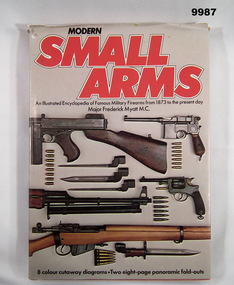
Book - MILITARY, FIREARMS, Frederick Myatt, "MODERN SMALL ARMS", 1978
... History...Firearms...From Title Page; "MODERN/ SMALL ARMS/ An Illustrated Encyclopedia of Famous Military Firearms from 1873 to the present day." Publication Book Military History Firearms Encyclopedia Hard cover book with dust cover. ...From Title Page; "MODERN/ SMALL ARMS/ An Illustrated Encyclopedia of Famous Military Firearms from 1873 to the present day."Hard cover book with dust cover. Hardcover - cardboard, with red colour buckram, gold colour print on spine. Dustcover - paper, red and black print on front and spine. Illustrated in colour, photographic collection of small firearms front to back. 240 pages, cut, plain, white colour paper. Illustrated - pictorial collection of colour photographs and diagrams of firearms. End papers - illustrated colour photograph of firearm. publication, book, military history, firearms, encyclopedia -
 Bendigo Military Museum
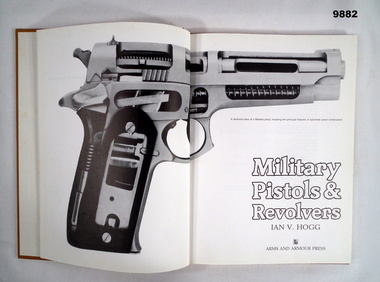
Book - REFERENCE, PISTOLS, REVOLVERS, Ian V Hogg, 'MILITARY PISTOLS & REVOLVERS', 1987
... History...Firearms...Publications Books Reference guide History Firearms Handwritten information - black ink pen "25/-" Hard cover book; Cover - cardboard, brown colour buckram, gold colour print on spine. 128 pages - cut, plain, white colour paper. ...Hard cover book; Cover - cardboard, brown colour buckram, gold colour print on spine. 128 pages - cut, plain, white colour paper. Illustrated black and white photographs and technical drawings. Front end paper - handwritten information. Handwritten information - black ink pen "25/-"publications, books, reference guide, history, firearms -
 Bendigo Military Museum
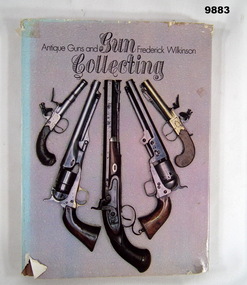
Book - REFERENCE, GUNS, Frederick WILKINSON, "ANTIQUE GUNS AND GUN COLLECTING", 1974
... History...Firearms...Publications Books Reference Guide History Firearms Handwritten information - grey lead pencil "$45". ...Hard cover book with dustcover. Hard cover - cardboard, dark brown colour, buckram with silver colour print on spine. Dust cover - paper, black and blue colour ink print on front and spine. Background mid blue colour. Jacket illustrations - front - in colour photograph, five antique guns. Back - in colour photograph, montage collection of antique guns. 96 pages - cut, plain, off white colour paper. Illustrated black and white and colour photographs, paintings and sketches. End papers - illustrated, pen and ink drawings of hunting scenes 1709. Front - handwritten information.Handwritten information - grey lead pencil "$45".publications, books, reference guide, history, firearms -
 Bendigo Military Museum
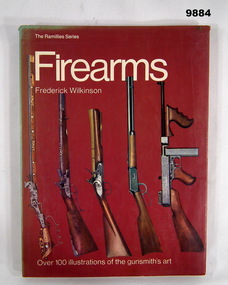
Book - REFERENCE, FIREARMS, Frederick WILKINSON, "FIREARMS", 1974, This edition 1977
... History...Firearms...Information from front cover; "FIREARMS/ OVER 100 Illustrations of the gunsmith's art". Publications Books Reference Guide History Firearms Handwritten information - blue ink pen, "To Wayne/ Happy Christmas & Happy New Year/ From John and Frances Christmas 1978." ...Information from front cover; "FIREARMS/ OVER 100 Illustrations of the gunsmith's art".Hard cover book with dust cover. Hard cover - cardboard, red colour paper, white colour print on front and spine. Illustrated - colour photograph of five firearms. Dust cover - paper, description as above for colour, print and illustration. 80 pages, cut, plain, white colour paper. Illustrated black and white and colour photographs, drawings and technical drawings. Front end paper - handwritten information.Handwritten information - blue ink pen, "To Wayne/ Happy Christmas & Happy New Year/ From John and Frances Christmas 1978." Grey lead pencil - "$35"publications, books, reference guide, history, firearms -
 Flagstaff Hill Maritime Museum and Village
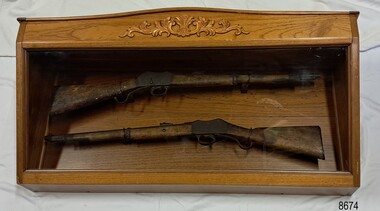
Weapon - Historic Rifles, Royal Small Arms Factory, 1877-1900
... firearms remained in the stables and were noticed by schoolboy Robert Jellie in 1940 and seen again in 1946. In 1995, the property was sold by the Education Department to a private owner. The Woodford Community donated the pair of Martini-Henry Carbines to the Victoria Police Museum in the late 1990s for mounting and display, which was funded by the Victoria Police Historical Society Inc. The decorative wood and glass display case and frame were designed to preserve the significant history...history. The case and display each have a horizontal board with a gently curved edge and carved decorations added. The identical firearms...history. The case and display each have a horizontal board with a gently curved edge and carved decorations added. The identical firearms ...Martini-Henry Artillery Carbin rifles were made by the Royal Small Arms Factory at Enfield, Britain, from 1877 until 1900. Many were distributed to the British Colonies, including this pair, which was allocated to the Woodford Police, Victoria Police District of Warrnambool, Southwest Victoria. The Carbine model rifles were shorter than the standard rifles and more suited to mounted police and troopers. It is likely that in the early 20th century, Victoria Police replaced the two carbines with more modern firearms, and the outdated guns were stored in the stables. The rifles were left there and likely forgotten about due to changes in police staff. In 1915, police authorities announced that they would be replacing patrol horses with bicycles and would also close some smaller police stations. This affected Woodford Police Station, which closed in 1917. The forgotten firearms remained in the stables and were noticed by schoolboy Robert Jellie in 1940 and seen again in 1946. In 1995, the property was sold by the Education Department to a private owner. The Woodford Community donated the pair of Martini-Henry Carbines to the Victoria Police Museum in the late 1990s for mounting and display, which was funded by the Victoria Police Historical Society Inc. The decorative wood and glass display case and frame were designed to preserve the significant history of the guns. On November 1st 1999, the display was presented to Warrnambool Police and the local community due to the historical significance of the Woodford Police Station. In 2025, these items were formally deaccessioned by the Victoria Police Museum, and ownership was transferred to the Warrnambool Police Station. On March 10th, 2025, the display was transferred to Flagstaff Hill Maritime Museum and Village, where the historical story of the Martini-Henry Carbines could continue to be preserved and accessed by local families, the community, visitors to the area, and online visitors. WOODFORD POLICE: - The small settlement at Woodford was established in the 1840s around the Merri River where there was a ford across the water and a bridge from 1848 to 1851. The area was settled very early in Victoria’s history, and the river crossing provided travellers with access to the early route between Port Fairy (named Belfast at that time), Warrnambool and Melbourne. Occasionally, a Warrnambool police trooper would ride through Woodford and the district. In December 1854, Woodford Police barracks and stables were built on the hill by the Merri River on Bridge Road east, where Jubilee Park now stands. A local mounted trooper kept law and order in the area. In 1856, a lock-up was installed, and the first Woodford Police Station was in action in 1857. By 1871, the police station had been moved from the hill to land across the Merri River bridge, on the southern side of Bridge Road west, near Mill Street. In 1890, the police residence there was replaced by a stone Edwardian-style building with the stables and lock-up behind it and the old police station at the rear. The police continued to have a presence in Woodford until it was closed by the Police Commissioner in July 1917 for economic reasons. The residence was used for government housing until 1923, when it was taken over by the Education Department for the school teacher’s home. In 1995, it became privately owned. THE MARTINI-HENRY ARTILLERY CARBINE: - The Martini-Henry rifles were made in Britain from 1871 at the Royal Small Arms factory at Enfield and were stamped with the symbol of the Royal Cipher (Crown over VR) over ENFIELD to identify their origin. They were named after two of several people who helped design this method: Swiss Friederich von Martini and Scotsman Alexander Henry. The design was breech-loaded, and the inner barrel was rifled. A thumb rest was incorporated into the top right of the bullet receiver’s chamber. The small teardrop lever on the right side of the rifle showed whether the rifle was ready to be shot. In 1877, the shorter, lighter-weight Carbine version of the firearm was produced for mounted troops and artillery. Its official name was “Carbine, B.L., Rifled, Martini-Henry.” The bullets were slightly lighter in weight than those used for the longer rifle. The sight position was adjusted for the shorter gun, and wings were added to the sight on the tip, making it easier to slide the rifle back into a saddle bag. Some of the later Carbines also had leather sight covers screwed to the stock to prevent them from catching on the saddle bags. The Carbines had accessories available, such as barrel extensions with bayonets and swivels for adding slings. The Martini-Henry Carbine designs were later modified to fire the British .303 ammunition. Eventually, by 1900, the Martini-Henry Carbines were replaced by the Lee Enfield gun design. The pair of Martini-Henry Carbine firearms represents policing in the early pre-1900 days of colonial settlement; Woodford was one of the first townships settled in Victoria, and it had a police presence from 1854 until 1917. The rifles and display provide a historic connection between the location of Woodford and relatives and associates. The carbine rifles show a stage in the evolution of weapon design, adapted to suit mounted troops, and adding features to streamline use and storage. The ammunition was also improved during this progression. The carbines are important for their connection to policing law and order in a remote area. They are significant for their association with the township of Woodford, which was important to travel in the southwest Victoria district, providing access across a river for a road between Port Fairy and Melbourne, and later Warrnambool, and supplying food, goods and accommodation for the travellers. A pair of mounted rifles is mounted behind glass in a timer case, accompanied by a framed display of two photographs and an account of the rifles’ history. The case and display each have a horizontal board with a gently curved edge and carved decorations added. The identical firearms are British-made Martini Henry Carbine breach-loaded rifled guns, supplied by Britain to its Colonial troops from around 1877. The rifles are lever-action, single-shot .500 calibre weapons. They have a teardrop lever on their right side. They were used by Victoria Police mounted troops at the Woodford Police Station, Victoria. The black and white photographs were taken in 1946. The left photograph has a circled area; the right photograph is an enlarged view of the circled area, showing the Woodford Police Station in detail. The printed text is on textured paper with the Victoria Police watermark. It gives a summary of the rifle’s history. There is an inscription on the left photograph. Left photograph, handwritten in white pen: “WOODFORD” Document’s print: “During the late 1840s the small town of Woodford grew around the crossing of the Merri River on the Melbourne/Port Fairy Rad. Woodford was proclaimed a township in 1854 and a police quarters was established there in 1857. The police station remained until 1917 when it was closed and police service from then on was provided from Warrnambool. The building was then used as a school residence and is now privately owned. In !940 Robert JELLIE, then a schoolboy, observed two rifles mounted on the wall of the disused stable at the rear of the old police building. Following the devastating flood of 1946 (see photograph above) the rifles were again seen in the room next to the stable but were not seen again until the building was sold by the Education Department many years later. It was a recognition of the historical value of the rifles which led to their donation to the Warrnambool Police Complex. The rifles have been authenticated by the Victoria Police Armoury as being Victoria Police issue some time before 1900. The rifles are an identical pair of the famous British-made Martini Henry, a .500 inch calibre military weapon widely used by British Colonial troops. Victoria Police and the wider community of Warrnambool are indebted to the members of the Woodford community for their fine gesture in donating the rifles for mounting so that their historical importance can be preserved and they can be displayed for generations to come. This display was funded by the Victoria Police Historical Society Incorporated, and presented on the first day of November, 1999.”flagstaff hill maritime museum and village, great ocean road, shipwreck coast, martini henry, victoria police, woodford police station, rifle, carbine, display case, british, martini henry carbine, breech-loaded, rifled, colonial, single-shot, .500 calibre, weapon, gun, 1877, troops, mounted troops, merri river, victoria police woodford, victoria police warrnambool, victoria police melbourne, police quarters, robert jellie, school residence, stable, 1946 flood, victoria police armoury, identical pair, british colonial troops, victoria police historical society incorporated, woodford, bicycles, found by a schoolboy, edwardian-style building, victoria police museum, warrnambool police station -
 Flagstaff Hill Maritime Museum and Village
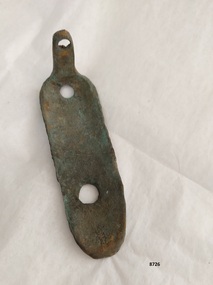
Weapon - Gun Butt Plate, circa 1870's
... history. Flagstaff Hill Maritime Museum and Village Warrnambool Great Ocean Road Shipwreck Coast firearms Butt Plate Gun Butt Plate Rifle Butt Plate salvage Loch Ard Loch Ard wreck Loch Ard salvage An L shaped metal plate with one long, concave side (with two formed holes) and a narrow, short vertical arm with one hole. ...This Butt Plate was salvaged from the wreck of the Loch Ard, on the southwest coast of Victoria and donated by a friend of the diver. Butt plates were fittings added to the end of guns or rifles in order to protect the wood from splitting or suffering damage. The ship Loch Ard was built on the River Clyde in Scotland in 1873 for the prestigious Loch Line of colonial clipper ships, designed for the Australian run. It sailed from England on 1st March 1878 carrying 37 crew, 17 passengers and a load of cargo including "firearms" worth 173 Pounds (plus 22 tons of lead shot). The general cargo reflected the affluence of Melbourne at the time. Also on board were straw hats, umbrellas, perfumes, clay pipes, pianos, clocks, confectionary, linen and candles, as well as a heavier load of railway irons, cement, lead and copper. There were items included that were intended for display in the Melbourne International Exhibition in 1880 - a diverse general cargo ranging from luxury items to bulk railway iron. On 1 June 1878, emerging from fog and hearing too late the sound of breakers against the tall limestone cliffs, the vessel struck the southern foot of Mutton Bird Island and sank in 23 metres of water. Of the fifty-four people on board only two survived, one young male crewman, Tom Pearce, and one young female passenger, Eva Carmichael. Ten days after the Loch Ard tragedy, salvage rights to the wreck were sold at auction for £2,120. Cargo valued at £3,000 was salvaged and placed on the beach, but most washed back into the sea when another storm developed. The wreck of Loch Ard still lies at the base of Mutton Bird Island. Much of the cargo has now been salvaged and some was washed up into what is now known as Loch Ard Gorge. Cargo and artefacts have also been illegally salvaged over many years before protective legislation was introduced in 1976. One of the most unlikely pieces of cargo to have survived the shipwreck was a Minton porcelain peacock - one of only seven in the world. The peacock was destined for the Melbourne International Exhibition in 1880. It had been well packed, which gave it adequate protection during the violent storm. Today, the Minton peacock can be seen at the Flagstaff Hill Maritime Museum in Warrnambool. From Australia's most dramatic shipwreck it has now become Australia's most valuable shipwreck artefact and is one of very few 'objects' on the Victorian State Heritage Register.Flagstaff Hill’s collection of artefacts from LOCH ARD is significant for being one of the largest collections of artefacts from this shipwreck in Victoria. It is significant for its association with the shipwreck, which is on the Victorian Heritage Register (VHR S417). The collection is significant because of the relationship between the objects, as together they have a high potential to interpret the story of the LOCH ARD. The LOCH ARD collection is archaeologically significant as the remains of a large international passenger and cargo ship. The LOCH ARD collection is historically significant for representing aspects of Victoria’s shipping history and its potential to interpret sub-theme 1.5 of Victoria’s Framework of Historical Themes (living with natural processes). The collection is also historically significant for its association with the LOCH ARD, which was one of the worst and best known shipwrecks in Victoria’s history.An L shaped metal plate with one long, concave side (with two formed holes) and a narrow, short vertical arm with one hole. It is hand-forged and shaped with no joins and has green oxidation patina (indicating a copper based metal) on the inner side and green verdigris and a rusty, flaking layer on the outer side.flagstaff hill maritime museum and village, warrnambool, great ocean road, shipwreck coast, firearms, butt plate, gun butt plate, rifle butt plate, salvage, loch ard, loch ard wreck, loch ard salvage -
 Glen Eira Historical Society
Document - Caulfield City Rifle Club No. 119, 294 Glen Huntly Road, Elsternwick
... Two pages of typed notes on the history of the Caulfield City Rifle Club by Kevin Armstrong, undated. The notes contain a timeline ranging from 1928 to 1969 with emphasis on the cost of ammunition an firearms over time. ...Two pages of typed notes on the history of the Caulfield City Rifle Club by Kevin Armstrong, undated. The notes contain a timeline ranging from 1928 to 1969 with emphasis on the cost of ammunition an firearms over time. ...Two pages of typed notes on the history of the Caulfield City Rifle Club by Kevin Armstrong, undated. The notes contain a timeline ranging from 1928 to 1969 with emphasis on the cost of ammunition an firearms over time. The file also includes two pages of handwritten research notes, undated and unattributed, about the various changes undergone throughout the early history, 1915 to 1941, of the land and the club.horsey h r, armstrong kevin, elsternwick, elsternwick rifle range, world war 1939-1945, caulfield city rifle club, caulfield city council, glen huntly road, riddell parade, commonwealth defence department, volunteer defence corps, caulfield small bore rifle club, lewis constructions, elsternwick post office -
 Bendigo Military Museum
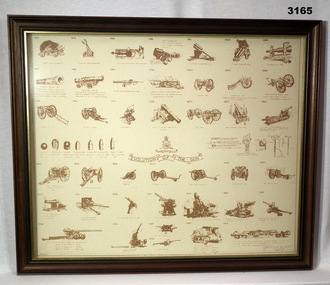
Print - MONTAGE ARTILLERY,FRAMED, 3.1956
... military history-army arms-firearms illustrations-prints glass technology Gun artillery In centre printed inside scroll: “EVOLUTION OF THE GUN” Wooden frame, glass fronted montage of printed, drawn guns from 1245 to 1954. ...Wooden frame, glass fronted montage of printed, drawn guns from 1245 to 1954.In centre printed inside scroll: “EVOLUTION OF THE GUN”military history-army, arms-firearms, illustrations-prints, glass technology, gun, artillery -
 Bendigo Military Museum
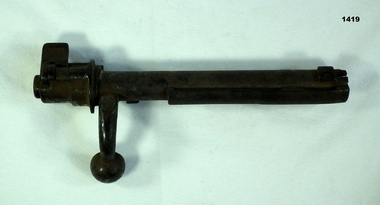
Weapon - BOLT, RIFLE, C.WW1
... Refer Cat No 1367.5 for his service history. arms weapons firearms parts Rifle bolt jones Rifle Bolt from a Non British Rifle. ...Item souvenired by Edwin James Jones No 3511 AIF. Refer Cat No 1367.5 for his service history.Rifle Bolt from a Non British Rifle. Bolt lever has a hemispheric knob with kurling Front locking Boltarms, weapons, firearms parts, rifle, bolt, jones -
 Bendigo Historical Society Inc.
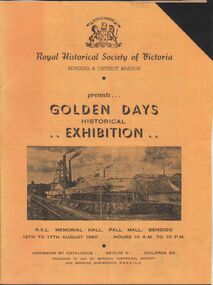
Document - GOLDEN DAYS HISTORICAL EXHIBITION COLLECTION: ADVERTISING PROGRAM
... Inside, program lists major displays: antiques, bushranging, coins and tokens, documents, fashions, firearms, geology, gold mining, pioneers, postal history, prints and photography, shipping, sport....History golden days historical exhibition Original and copy of original: (10410a) golden coloured A5 program. On top of front page 'Royal Historical Society of Victoria, Bendigo and District Branch presents Golden Days Historical Exhibition, R.S.L. Memorial Hall, Pall Mall,Bendigo, 12 to 17th August 1960. Hours 10 a.m. to 10 p.m. Adults 3/- children 6d.' Inside, program lists major displays: antiques, bushranging, coins and tokens, documents, fashions, firearms ...Original and copy of original: (10410a) golden coloured A5 program. On top of front page 'Royal Historical Society of Victoria, Bendigo and District Branch presents Golden Days Historical Exhibition, R.S.L. Memorial Hall, Pall Mall,Bendigo, 12 to 17th August 1960. Hours 10 a.m. to 10 p.m. Adults 3/- children 6d.' Inside, program lists major displays: antiques, bushranging, coins and tokens, documents, fashions, firearms, geology, gold mining, pioneers, postal history, prints and photography, shipping, sport.bendigo, history, golden days historical exhibition -
 Bendigo Historical Society Inc.
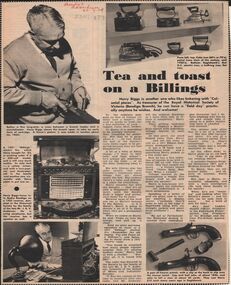
Newspaper - LYDIA CHANCELLOR COLLECTION: HARRY BIGGS
... PERSON Individual harry biggs Lydia Chancellor Collection collection Harry Biggs Bendigo history male person individual Bendigo Historical Society Royal Historical Society (Bendigo Branch) arms firearms clubs and associations heritage recreations societies irons collection pieces antiques antique A newspaper article from the Bendigo 'Advertiser' titled 'Tea and toast on a billings.' ...A newspaper article from the Bendigo 'Advertiser' titled 'Tea and toast on a billings.' This article tells of Harry's love of collecting colonial pieces and his voluntary job as treasurer of the Royal Historical Society of Victoria (Bendigo Branch). 30/7/1969.person, individual, harry biggs, lydia chancellor collection, collection, harry biggs, bendigo, history, male, person, individual, bendigo historical society, royal historical society (bendigo branch), arms, firearms, clubs and associations, heritage, recreations, societies, irons, collection pieces, antiques, antique -
 Bendigo Historical Society Inc.
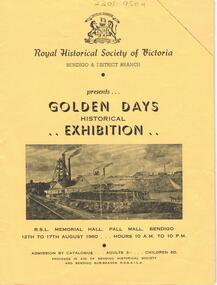
Document - LYDIA CHANCELLOR COLLECTION: ROYAL HISTORICAL SOCIETY OF VICTORIA
... The categories of exhibits are antiques, bush ranging, coins and tokens, documents, fashions, firearms, geology, gold mining, pioneers, postal history, prints and photography, shipping and sport. ...HISTORY Australian exhibition Lydia Chancellor Collection collection Bendigo Australia Royal Historical Society of Victoria exhibits Bendigo City Council A yellow catalogue published by the Royal Historical Society of Victoria Bendigo & District Branch. It is presenting the ' Golden Days Historical Exhibition ' at the R.S.L. Memorial Hall, Pall Mall, Bendigo 12th to 17th August 1960. The categories of exhibits are antiques, bush ranging, coins and tokens, documents, fashions, firearms ...A yellow catalogue published by the Royal Historical Society of Victoria Bendigo & District Branch. It is presenting the ' Golden Days Historical Exhibition ' at the R.S.L. Memorial Hall, Pall Mall, Bendigo 12th to 17th August 1960. The categories of exhibits are antiques, bush ranging, coins and tokens, documents, fashions, firearms, geology, gold mining, pioneers, postal history, prints and photography, shipping and sport. Within the catalogue are Bendigo Advertiser July and August cuttings relating to the exhibition.history, australian, exhibition, lydia chancellor collection, collection, bendigo, australia, royal historical society of victoria, exhibits, bendigo city council -
 The Beechworth Burke Museum
Postcard, 2005
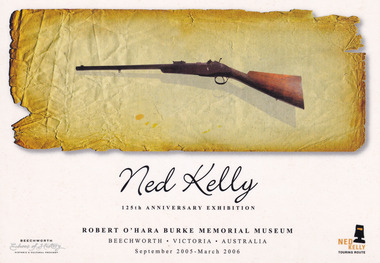
... The item can be compared with other Kelly photographs in Burke Museum's collection. kelly album ned kelly exhibition ned kelly's rifle betty snider-enfield .557 caliber rifle revolver exhibition beechworth burke museum 125th anniversary firearm Obverse: Ned Kelly / 125th ANNIVERSARY EXHIBITION / ROBERT O'HARA BURKE MEMORIAL MUSEUM BEECHWORTH . VICTORIA . AUSTRALIA / September 2005-2006 / BEECHWORTH / Echoes of History / HISTORIC & CULTURAL PRECINCT / NED / KELLY / TOURING ROUTE / REVERSE: Ned Kelly / 125th ANNIVERSARY EXHIBITION / ROBERT O'HARA BURKE MEMORIAL MUSEUM BEECHWORTH . ...To commemorate the 125th anniversary of Edward “Ned” Kelly’s committal trial in the Beechworth Historic Courthouse, the Robert O’Hara Burke Memorial Museum (henceforth Burke Museum) commissioned this postcard to coincide with their exhibition dating September 2005 to March 2006 and titled the Ned Kelly 125th Anniversary Exhibition. The postcard depicts a Snider-Enfield of .577 calibre which was reputedly favoured by the Bushranger. The firearm is of typical 1870s hunting design and was displayed as a focal point within this exhibition. The firearm, which was named “Betty” was reportedly taken by Kelly from Henry Dudley. The weapon has the letter ‘K’ engraved into the wood of the fore end. Other items also displayed in this exhibition include the Burke’s Kelly death mask, a replica of the Kelly Gang armour and photographs from the Burke Museum’s Kelly album. This postcard advertises an exhibition held at the Beechworth Burke Museum to commemorate the 125th anniversary of Kelly’s committal trial, which took place in Beechworth's historic courthouse. The selection and interpretation of items like the gun called 'Betty' are significant for understanding the changing nature of Kelly scholarship, treatment and curation, in particular, the popular and iconic myth of the Australian bushranger. The item can be compared with other Kelly photographs in Burke Museum's collection.Rectangular colour printed postcard celebrating Ned Kelly 125th Anniversary Exhibition at Burke Museum, Beechworth. Inset image of Ned Kelly's rifle. Obverse: Ned Kelly / 125th ANNIVERSARY EXHIBITION / ROBERT O'HARA BURKE MEMORIAL MUSEUM BEECHWORTH . VICTORIA . AUSTRALIA / September 2005-2006 / BEECHWORTH / Echoes of History / HISTORIC & CULTURAL PRECINCT / NED / KELLY / TOURING ROUTE / REVERSE: Ned Kelly / 125th ANNIVERSARY EXHIBITION / ROBERT O'HARA BURKE MEMORIAL MUSEUM BEECHWORTH . VICTORIA . AUSTRALIA / September 2005-2006 / AFFIX STAMP HERE / 7250 / This is the rifle that was taken from Henry Dudley by Ned Kelly. It became Ned's favourite / rifle, which he called 'Betty'. Note the 'K' carved into the wood of the fore-end. / Interestingly, there is at least one other rifle owned by Ned Kelly that also has a 'K' engraved / into it by Ned- the Colt revolving carbine used by Ned at Glenrowan /kelly album, ned kelly exhibition, ned kelly's rifle, betty, snider-enfield, .557 caliber, rifle, revolver, exhibition, beechworth, burke museum, 125th anniversary, firearm -
 The Beechworth Burke Museum
Photograph
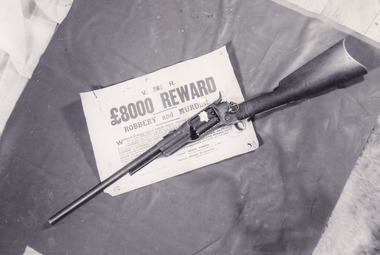
... firearms of the Kelly Gang. More research is needed to solidify the connection of this particular weapon to Byrne other than the handwritten note on the back of the photograph. The Burke Museum Beechworth is home to a significant collection of photographs connected to Ned Kelly and the Kelly Gang. Photographs like this one are valuable for what they can potentially reveal about the Kelly Gang and the Police force during this period. Alongside the study of the other images, photographs from this collection have the ability to further expand current knowledge on this period of Australian history ...In this image a Colt 1855 Revolving Rifle is placed upon a sign detailing an £8,000 reward for robbery and murder. Writing on the rear of the photograph identifies the rifle as having belonged to Joe Byrne. In colonial Victoria, the Colt brand firearm was highly popular. They began their popularity in the goldfields of the early 1850s. Individuals, particularly those coming to Victoria with prior experience in the goldfield, brought with them a means of self-defence because of the prevalence of assault and robbery on the goldfields. In the 1860s, the Colt firearm became popular among the Victorian Police force. It was decided in June 1864 by Chief Commissioner of Police, Frederick Standish that the Colt revolvers were far more practical, being of simpler construction and therefore, more easily cleaned and less dangerous than the revolvers used prior to this: the Adams and Kerr firearms. The Colt revolver remained in use in regional districts of Victoria as late as the early 1880 when they were used at the Kelly siege at Glenrowan. The £8,000 reward was issued in 1879 after the Kelly Gang committed numerous bank robberies at Euroa and Jerilderie. In the year prior, the Kelly Gang murdered three policemen at Stringybark Creek. This resulted in the creation of the “Felon’s Apprehension Act 1878” which enabled an individual, whether a part of the Police force or civilian, to shoot a declared outlaw on sight. After the bank robberies, the Police force of NSW and Victoria increased the existing reward to this £8,000 amount.This photograph is significant for what it can potentially reveal about the Kelly Gang and firearms made in this period. The rifle in the image is a Colt Revolving Rifle which was known to have been used by the Victorian Police force from the early 1850s to the late 1880s. It is also known that the Kelly Gang stole police rifles which they used to practise with and so the identification of the rifle as having belonged to Joe Byrne is of significant importance to researchers studying the firearms of the Kelly Gang. More research is needed to solidify the connection of this particular weapon to Byrne other than the handwritten note on the back of the photograph. The Burke Museum Beechworth is home to a significant collection of photographs connected to Ned Kelly and the Kelly Gang. Photographs like this one are valuable for what they can potentially reveal about the Kelly Gang and the Police force during this period. Alongside the study of the other images, photographs from this collection have the ability to further expand current knowledge on this period of Australian history. There is also the capability to provide an analysis of how these firearms and Kelly memorabilia have been received in the past. It could be beneficial to undertake a close study of the use history and reception of these artefacts within the museum context.Black and white rectangular reproduced photograph printed on matte photographic paperReverse: 10268 / Joe Byrne's / Riflekelly album, ned kelly, kelly gang, joe byrne, rewards, outlaw, criminals, bushrangers, colt, police, firearm, beechworth, reward, felon's apprehension act 1878, 1880, glenrowan, colt revolver, revolving rifle, 8000 pound reward, jerilderie, euroa, beechworth goldfield
