
Showing 5 items matching "fireman's ball"
-
 Hume City Civic Collection
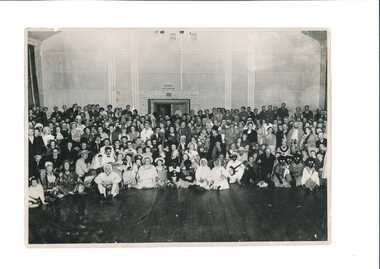
Photograph, Fireman's Ball, 26th August 1936
... Fireman's Ball...Fireman's Ball...The people were attending the annual Fireman's Ball in the Sunbury Memorial Hall in 1936. ...Fireman's Ball Photograph ...The people were attending the annual Fireman's Ball in the Sunbury Memorial Hall in 1936. At the time this was one of the popular events held in Sunbury.Dances and formal balls and other community social events were popular in many towns throughout the country.A black and white photograph of a group of people in fancy dress assembled in a large hall. fireman's ball, sunbury, memorial hall -
 Flagstaff Hill Maritime Museum and Village
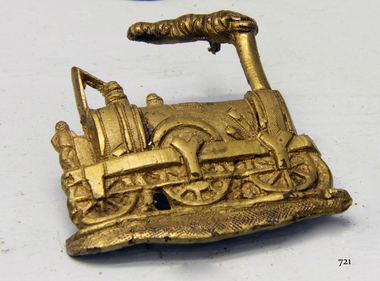
Accessory - Badge, Before 1855
... The shipwreck is of additional historical significance for representing aspects of Victoria’s shipping history and for its association with the first passenger ship, which was designed not only to be the fastest and most luxurious of its day but foundered on its maiden voyage to Australia. warrnambool flagstaff-hill flagstaff-hill-maritime-museum shipwreck-coast flagstaff-hill-maritime-village schomberg shipwrecked-artefact clipper ship black ball line 1855 shipwreck captain forbes ss queen badge Charles Tayleur Great Western Railway Vulcan Foundry Isambard Kingdom Brunel locomoive brooch Gold coloured brass badge depicting an 1840's steam engine or locomotive with the figure of a fireman standing on the back. ...The badge recovered from the Schomberg wreck is believed to depict one of the first steam engines. The engine's design by Charles Tayleur & Co. was to be produced for the Great Western Railway in England. The first nineteen of these locomotives were ordered by Isambard Kingdom Brunel for the Great Western Railway including six 2-2-2 Charles Tayleur locomotives. They were built by Charles Tayleur and Company, which later the Vulcan Foundry. The locomotives were unsuccessful and were rapidly supplemented by the Star Class locomotives ordered by Daniel Gooch once he had been appointed as the Locomotive Engineer. As built, they comprised two groups of three, the first group, was delivered in 1837. This locomotive was the first to run on the Great Western Railway when it was tested on 28 December 1837 from its shed at West Drayton. It was withdrawn in 1843 but was rebuilt as a 2-2-2T tank locomotive and returned to service in 1846, running in this form until 1868. It survived for two more years at Reading as a stationary boiler. It is named after the workshops where it was built, which themselves were named after the Roman god of fire. (Although a supposition, it is possible that the owner was a passenger on the ill-fated Schomberg and that they worked either for the Great Western Railway or the Vulcan Foundry that made the engine in the 1830s.) Wreck of the Schomberg: Schomberg was a large three-masted full-ship rigged wooden ship built in 1855 by Alexander Hall and Co in Aberdeen, Scotland for James Baines' famous Black Ball Line at £43,103. The vessel was 288 feet (88 meters) in length, with a beam of 45 feet (14 meters), a depth of 29.5 feet (8.99 meters) of 2,284 tons. The mainmast was 210 feet (64 meters) high and she carried 3.3 acres of sail. The vessel was constructed with three skins. One planked fore and aft, and two diagonally planked, fastened together with screw-threaded trunnels (wooden rails). The Schomberg is one of only three clipper wrecks in Victorian waters that operated the England to Australia run. While the other two, Empress of the Sea and Lightning, were built by the famous American shipbuilder, Donald Mac Kay. Schomberg was an attempt to build a faster ship than Mac Kay and a vessel fast enough to break the sailing record to Australia. The Schomberg sailed on her maiden voyage from Liverpool on 6 October 1855, under the command of Captain James Forbes, on its maiden voyage to Australia with a general cargo, jewellery, spirits, machinery, and 2,000 tons of iron rails and equipment intended to build the Melbourne to Geelong Railway and a bridge over the Yarra from Melbourne to Hawthorn. She also carried a cow for fresh milk, pens for fowls and pigs, plus 90,000 gallons of water for washing and drinking. She also carried 17,000 letters and 31,800 newspapers. There were approximately 473 passengers and a crew of 105. It was hoped that Schomberg would make Melbourne in sixty days, setting a record for the voyage, but light winds at the equator dashed those expectations. The ship sighted Moonlight Head in southwest Victoria on Christmas Day but through a deadly combination of wind, currents, and unmarked sand spits, the vessel gently ran aground on 26 December 1855 on a spit that juts into Newfield Bay, just east of Curdies Inlet, and the present town of Peterborough. Fortunately, the SS Queen was nearby and managed to save all passengers and crew. The steamers Keera and Maitland were dispatched to salvage the passenger's baggage and the more valuable cargo. Other salvage attempts were made, but deteriorating weather made the work impossible, and within two weeks the Schomberg's hull was broken up and the vessel abandoned. The wrecking of the Schomberg caused quite a public stir, particularly in light of the fact the vessel was supposed to be, the most perfect clipper ship ever built. Captain Forbes was charged in the Supreme Court under suspicion that he was playing cards with two female passengers below decks when his ship ran aground. Despite a protest meeting, two inquiries, and the court proceedings, he was found not guilty and cleared of all charges. In 1975, divers from Flagstaff Hill, including Peter Ronald, found an ornate communion set at the wreck. The set comprised a jug, two chalices, a plate, and a lid. The lid did not fit any of the other objects and in 1978 a piece of the lid broke off, revealing a glint of gold. As museum staff carefully examined the lid and removed marine growth, they found a diamond ring, which is currently on display in the Great Circle Gallery at the Flagstaff Hill Maritime Museum that also displays ship fittings and equipment, and personal effects. Most of the artefacts were salvaged from the wreck by Peter Ronald, former director of Flagstaff Hill.The Schomberg has historical significance as one of the first luxurious ships built to bring emigrants to Australia to cash in on the gold rush era. And is included on the Victorian Heritage Register (VHR S612). The collection of Schomberg artefacts held at Flagstaff Hill Museum is primarily significant because of the relationship between these recovered items having a high potential to interpret the story of the Schomberg and its foundering during a storm. The shipwreck is of additional historical significance for representing aspects of Victoria’s shipping history and for its association with the first passenger ship, which was designed not only to be the fastest and most luxurious of its day but foundered on its maiden voyage to Australia.Gold coloured brass badge depicting an 1840's steam engine or locomotive with the figure of a fireman standing on the back. Smoke is coming from the smokestack. The reverse has three holes, possible where a mounting pin or fastener was attached. The badge was recovered from the wreck of the Schomberg.warrnambool, flagstaff-hill, flagstaff-hill-maritime-museum, shipwreck-coast, flagstaff-hill-maritime-village, schomberg, shipwrecked-artefact, clipper ship, black ball line, 1855 shipwreck, captain forbes, ss queen, badge, charles tayleur, great western railway, vulcan foundry, isambard kingdom brunel, locomoive, brooch -
 Bendigo Military Museum
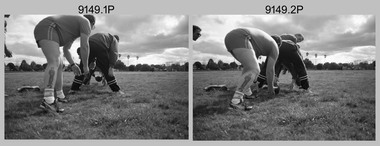
Photograph - Army Survey Regiment Inter-Squadron Athletics Competition, Bendigo, 1991
... fireman’s carry and tug-of-war novelty events. Royal Australian Survey Corps RASvy Army Survey Regiment Army Svy Regt Fortuna No personnel are identified. This is a set of 48 photographs of an Army Survey Regiment inter-squadron athletics competition held at Bendigo on the 4th of September 1991. The photographs are on 35mm negative film and scanned at 2400 dpi. They are part of the Army Survey Regiment’s Collection. .1) - Photo, black & white, 1991, tunnel ball ...This is a set of 48 photographs of an Army Survey Regiment inter-squadron athletics competition held at Epsom, Bendigo on the 4th of September 1991. Personnel from Headquarters, Air Survey, Cartographic and Lithographic Squadrons took part in traditional athletics events, wheelbarrow race, sack race, fireman’s carry and tug-of-war novelty events.This is a set of 48 photographs of an Army Survey Regiment inter-squadron athletics competition held at Bendigo on the 4th of September 1991. The photographs are on 35mm negative film and scanned at 2400 dpi. They are part of the Army Survey Regiment’s Collection. .1) - Photo, black & white, 1991, tunnel ball. Unidentified personnel. .2) - Photo, black & white, 1991, tunnel ball. Unidentified personnel, Ken ‘Sluggo’ Slater at far left. .3) - Photo, black & white, 1991, tunnel ball. Left team - Allison (Ottaway) Wooldrage 4th from front. Right team: 3rd - Sue (Foote) Bourne, 4th - Ailsa (Sorby) Miller, 5th - Paula (Golding) Brinsmead. In background L to R: Brian Paul, Mick Sarson, Mick Minchin. .4) - Photo, black & white, 1991, high jump. Unidentified athlete. .5) - Photo, black & white, 1991, high jump. Stuart Midgley. .6) - Photo, black & white, 1991, high jump. Scott Cameron. .7) - Photo, black & white, 1991, high jump, Matt Jackson CSM. .8) - Photo, black & white, 1991, distance race. Bob Garritty. .9) - Photo, black & white, 1991, distance race. CO LTCOL Rene van den Tol. .10) - Photo, black & white, 1991, distance race. Unidentified athletes. .11) - Photo, black & white, 1991, 100m sprint race. L to R: unidentified, Scott Cameron, Brendan McKinless, Barry Miller, remainder unidentified. .12) - Photo, black & white, 1991, 100m sprint race. L to R: unidentified (x2), Steve Wegener, Andrew Morrison-Evans. .13) - Photo, black & white, 1991, long jump. L to R: Roger Pearson, Dale Hudson, unidentified athlete. .14) - Photo, black & white, 1991, long jump. Dave Read. .15) - Photo, black & white, 1991, long jump. Unidentified athlete. .16) - Photo, black & white, 1991, long jump. L to R: Roger Pearson, unidentified athlete, Allan Hancox. .17) - Photo, black & white, 1991, long jump. L to R: unidentified athlete, Allan Hancox. .18) - Photo, black & white, 1991, long jump. Brendan McKinless, unidentified, Dale Hudson, unidentified athlete. .19) - Photo, black & white, 1991, long jump. Mick Hogan. .20) - Photo, black & white, 1991, long jump. Cam Bramich. .21) - Photo, black & white, 1991, tug-of-war, Cartographic Squadron L to R: Andrew Quin, Frank Savy, unidentified, Ian Baldwin. .22) - Photo, black & white, 1991, tug-of-war, Cartographic Squadron L to R: Matt Jackson CSM, Craig Kellet, Andrew Quin. .23) - Photo, black & white, 1991, tug-of-war, Cartographic Squadron: Ian Baldwin. .24) - Photo, black & white, 1991, tug-of-war, Cartographic Squadron L to R: Ian Baldwin, unidentified, Casey Northausen – facing away, Matt Jackson CSM, unidentified, Chris Woodman. .25) - Photo, black & white, 1991, tug-of-war, Cartographic Squadron L to R: Casey Northausen, Ian Baldwin, unidentified, Peter Tuddenham, Andrew Quin, Craig Kellet, Matt Jackson CSM, unidentified. Chris Woodman. .26) - Photo, black & white, 1991, tug-of-war, Headquarters Squadron L to R: Ken ‘Sluggo’ Slater, unidentified (x5), Paul Leskovec, unidentified, John ‘Stormy’ Tempest. .27) - Photo, black & white, 1991, tug-of-war, Headquarters Squadron L to R: Ken ‘Sluggo’ Slater, RSM WO1 Graham Ragless, unidentified, Geoff ‘GT’ Ford, Paul Leskovec, unidentified, John ‘Stormy’ Tempest. .28) - Photo, black & white, 1991, tug-of-war, Air Survey Squadron L to R: Grant Lloyd, unidentified. .29) - Photo, black & white, 1991, tug-of-war, Lithographic Squadron L to R: Peter Swandale, Tony Purton, unidentified, Shane Campbell, Syd Anstee, Graeme Spong, Dary; South. .30) - Photo, black & white, 1991, tug-of-war, Lithographic L to R: Syd Anstee, Graeme Spong. .31) - Photo, black & white, 1991, tug-of-war, Lithographic Squadron: Shane Campbell. .32) to .34) - Photo, black & white, 1991, discus. Unidentified athletes. .35) - Photo, black & white, 1991, discus. L to R: Bob Sheppard, Shaun Byers, Trevor Clarke, Ian Baldwin, Grant Lloyd. .36) - Photo, black & white, 1991, javelin. L to R: Ken Labouchardiere, unidentified, Shaun Byers, unidentified athlete, unidentified (x2). .37) - Photo, black & white, 1991, javelin. L to R: Cam Bramich, Penny Knott, Paula (Golding) Brinsmead, unidentified (x2). .38) - Photo, black & white, 1991, javelin. L to R: Penny Knott, Paula (Golding) Brinsmead, Cam Bramich, unidentified (x2). .39) - Photo, black & white, 1991, javelin. L to R: Tony Purton, Shane Campbell. .40) - Photo, black & white, 1991, sack race. Unidentified athlete, Brian Paul in left background. .41) - Photo, black & white, 1991, sack race. Perry Langberg. .42) - Photo, black & white, 1991, sack race. Noel ‘Nesty’ Coulthard, unidentified athlete in left background. .43) - Photo, black & white, 1991, sack race. Colin Cuskelly. .44) - Photo, black & white, 1991, sack race. Unidentified athlete. .45) - Photo, black & white, 1991, sack race. L to R: unidentified athlete, Gary Warnest. .46) - Photo, black & white, 1991, wheelbarrow race. Noel ‘Nesty’ Coulthard. .47) - Photo, black & white, 1991, wheelbarrow race. L to R: unidentified, Rob Bogumil, unidentified, Russell ‘Rusty’ Williams, Bill Jones, Geoff ‘GT’ Ford, Bob Rogister, Matt Jackson CSM. .48) - Photo, black & white, 1991, firemans carry. L to R: Keith Quinton, Daryl South.No personnel are identified.royal australian survey corps, rasvy, army survey regiment, army svy regt, fortuna -
 Rutherglen Historical Society
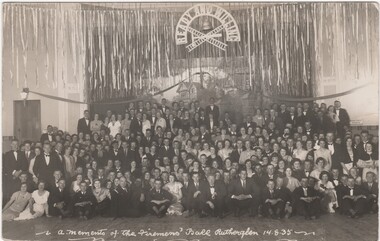
Image, 14/08/1935
... rutherglen firemans ball dances balls fire brigade At bottom of photo: "A Memento of the Firemens' Ball, Rutherglen 14/8/35" Black and white post card photograph a group of people in ball dress. ...Black and white post card photograph a group of people in ball dress.At bottom of photo: "A Memento of the Firemens' Ball, Rutherglen 14/8/35"rutherglen firemans ball, dances, balls, fire brigade -
 Rutherglen Historical Society
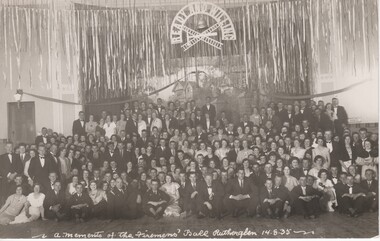
Image, 14/08/1935
... ball dances fire brigade rutherglen firemans ball Written on a section of the photo: "A Memento of the Firemens' Ball, Rutherglen, 14.8.35" Black and white postcard photograph of large group of people attending a ball. ...Black and white postcard photograph of large group of people attending a ball.Written on a section of the photo: "A Memento of the Firemens' Ball, Rutherglen, 14.8.35"ball, dances, fire brigade, rutherglen firemans ball
