
Showing 25 items matching "first aid post"
-
 Kew Historical Society Inc
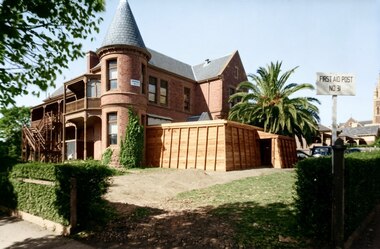
Wilton (later Kew RSL), 63 Cotham Road, Kew, c.1942 — First Aid Post No. 31, c.1942
... Wilton (later Kew RSL), 63 Cotham Road, Kew, c.1942 — First Aid Post No. 31......First Aid Post...The timber structure and sign are the WWII First Aid Post No. 31, built in the front garden as part of Kew’s Air Raid Precautions....Shows two-storey red brick Victorian house with conical slate tower, two-storey timber verandah, palm tree in front garden, large timber air-raid / first-aid shelter built in front garden, sign on post at right: “FIRST AID POST NO 31”, hedge and Cotham Road / Charles Street corner, Kew Presbyterian church spire in distance at right....Wilton (later Kew RSL), 63 Cotham Road, Kew, c.1942 — First Aid Post No. 31 ...Designed by Guyon Purchase for Dr. William Walsh in 1886, the building was originally called Wilton. In 1934, following Walsh's death, the Kew Council bought a number of properties near the corner of Cotham Road and Charles Street, including 'Wilton' (by that time known as 'Landene') with the intention of erecting a new town hall. In 1948 the Kew Sub-Branch of the R.S.S. & A.I.L.A. purchased the building for its meeting rooms at a cost of £10,067. The timber structure and sign are the WWII First Aid Post No. 31, built in the front garden as part of Kew’s Air Raid Precautions.Colourised photograph of Wilton, 63 Cotham Road, Kew, taken c.1942. Shows two-storey red brick Victorian house with conical slate tower, two-storey timber verandah, palm tree in front garden, large timber air-raid / first-aid shelter built in front garden, sign on post at right: “FIRST AID POST NO 31”, hedge and Cotham Road / Charles Street corner, Kew Presbyterian church spire in distance at right.wilton, kew rsl, cotham road, charles street, first aid post, wwii, air raid precautions -
 Running Rabbits Military Museum operated by the Upwey Belgrave RSL Sub Branch
Photo
... First Aid Post & Helicopter...Photo Vietnam Army First Aid Post & Helicopter Photo ...First Aid Post & Helicopterphoto, vietnam, army -
 Glen Eira Historical Society
Air Raid Precaution (ARP) in Caulfield
... Photograph of Ambulance Squad for First Aid Post used by Air Raid Precaution during World War 2, Brigadier Cohen presenting Ambulance...Caulfield Air Raid Precaution World War 1939-1945 Ambulances Cohen Brigadier Photograph of Ambulance Squad for First Aid Post used by Air Raid Precaution during World War 2, Brigadier Cohen presenting Ambulance Air Raid Precaution (ARP) in Caulfield ...Photograph of Ambulance Squad for First Aid Post used by Air Raid Precaution during World War 2, Brigadier Cohen presenting Ambulancecaulfield, air raid precaution, world war 1939-1945, ambulances, cohen, brigadier -
 Port Melbourne Historical & Preservation Society
Plan - WWII alterations to Excelsior Hall, Port Melbourne, City Engineer, 13 Apr 1942
... Plan on tracing paper for Excelsior Hall to be set up as a first-aid post (in the event of gas attack) and A.R.P. training centre in World War II. 1942....War - World War II Built Environment - Civic Excelsior Hall Engineering Department - City of Port Melbourne "City of Port Melbourne : Excelsior Hall" Plan on tracing paper for Excelsior Hall to be set up as a first-aid post (in the event of gas attack) and A.R.P. training centre in World War II. 1942. ...Plan on tracing paper for Excelsior Hall to be set up as a first-aid post (in the event of gas attack) and A.R.P. training centre in World War II. 1942."City of Port Melbourne : Excelsior Hall"war - world war ii, built environment - civic, excelsior hall, engineering department - city of port melbourne -
 Flagstaff Hill Maritime Museum and Village
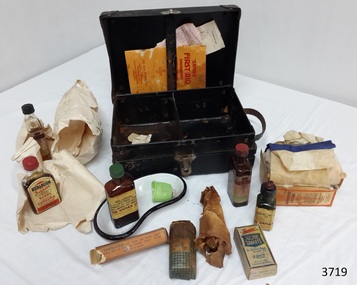
Equipment - First Aid Case, Thomas Urquhart & Son Pty Ltd (Thos. Urquhart), 1930-1939
... From our archives], Celebrating the 125th Birthday of the First Aid Kit , The Story of Johnson & Johnson, , http://www.kilmerhouse.com/2013/06/from-1888-to-2013-celebrating-the-125th-birthday-of-the-first-aid-kit/ Post Master General’s section of the Commonwealth of Australia Gazette, Issue No. 73, Thursday 27th September 1951 http://trove.nla.gov.au/newspaper/article/232185299?...From our archives], Celebrating the 125th Birthday of the First Aid Kit , The Story of Johnson & Johnson, , http://www.kilmerhouse.com/2013/06/from-1888-to-2013-celebrating-the-125th-birthday-of-the-first-aid-kit/ Post Master General’s section of the Commonwealth of Australia Gazette, Issue No. 73, Thursday 27th September 1951 http://trove.nla.gov.au/newspaper/article/232185299? ...This small, portable 1930s Sanax First Aid Case has been strongly constructed, with corners reinforced with metal to take knocks and bumps, so it could be quickly transported to the site of an emergency. Having these supplies organised into a kit made them easily accessible and reduces time to take them to the site of the accident. It was possibly designed for use in factories because the booklet in the case states that the kit complies with “Part 1, Victorian Factories Regulations”. The text of the printed brand “Sanax First Aid Case” is right-way up when the case stands vertically on its hinged side. In modern times people are well aware of the importance of quick treatment when accident and injury occur. However, before the first commercial First Aid Kit was made by Johnson & Johnson in 1888, people had little knowledge about treating injuries and lacked information about suitable supplies to keep on hand for emergencies. They were often unaware of how to help in that critical time before the doctor or other assistance arrived, a particularly important time for the many people living in remote areas. A quote from Johnson’s & Johnson’s 1888 price list explains “It is a fact, which is everywhere being recognized, that many lives are lost and much suffering entailed in such accidents on account of the lack of the simple but necessary articles required to afford prompt assistance to the wounded.” One example of the value of First Aid assistance to community groups is shown in an article from the Weekly Times, 29th November 1930. It records a report from the Annuello Branch of the Younger Set (a Country Women’s Organisation), telling that on Armistice Day their president Mrs Jamieson, presented the Annuello School with the gift of a Sanax Red Cross First Aid outfit, which was accepted as being “of great practical use to the scholars.” (Annuello is a remote wheat growing area in the Mallee region of North Western Victoria, which became a soldier settlement area after World War I. There is a strain of wheat named ‘Annuello’ due to its suitability for that area. ) The Sanax Case in our Collection contains instructions, equipment and medical items suitable for use in emergency situations. The Case was one of 42 patterns available from Sanax that conformed to ‘Part 1, Victorian Factories Regulations’. It includes items made by Sanax Company and by Burroughs Wellcome & Co. (Australia) Ltd., Sydney, NSW. A quote at the back of the First Aid Emergency Instructions booklet says: “Sanax products are made in Australia by or under the supervision of qualified chemists, from the highest quality materials. They are dependable for the purposes written on labels.” BOOKLET included in First Aid Case: “SANAX” First-Aid Emergency Instructions has orange cover and white pages, joined in the centre by two staples. Booklet contains First Aid Instructions for general events listed in alphabetical order. It also contains an indexed sections headed “Poisoning, and what to do” written by S.A. Burrows, Ph.C., Vuc and N.Z. There are instructions and diagrams on how to perform Artificial Respiration. There are advertisement for Sanax products throughout the booklet that include; - Sanax Ambulance Stretcher for timber mills, mines, ships and quarries - Saw dust masks (porous rubber) for workers in dust, paint or duco sprayers Inside cover lists Sanax’s Australian made products including - tablets and powders for headaches, neuralgia, influenza, colds - snuff for Catarrh that is “quite harmless” - First Aid Cases that come in a range of 42 patterns - sunburn preventatives and treatments - healing salve for carbuncles, pock, pimples, boils, varicose ulcers etc. - snake bite outfits and kits LEAFLETS included in First Aid Case: (1) Tannafax Tannic Acid Jelly. Tannafax should be kept at hand in every home. It should be applied direct from the tube and used with neither oil nor grease. Where a large area has to be covered the clamped end may be torn or cut off to give a wider mouth to the tube. Collapsible tubes of different sizes. Made in Australia. Burroughs Wellcome & Co. (Australia) Ltd. (Incorporated in England). Sydney, NSW. Assorted Houses, London, New York, Montreal, Cape Town, Milan, Bombay, Shanghai, Buenos Aires. Copyright A. 1817, J. 9463 (2) Tabloid. The strong thing is the just - - . Tabloid marks the wor - - Burroughs Wellcome & Comp. The use of the word is to enab – the prescriber, dispenser and patient to get the right thing with one short word, instead of the firm’s long name. If another maker apply the word to his product, the act is unlawful. Tabloid is our trade mark and brand. If a vendor disregard it in dispensing or selling, the act is unlawful for the same reason. We prosecute both offenders rigorously, in the interest of prescribers, dispensers, patients and the owners of the trade mark. Please inform us of any instance of either offence. Burroughs Wellcome & Co. (Australia) Ltd. (Incorporated in England). Telephone Number - M 4184 (4 lines) All communications to G.P.O. Box No. 1185 DD. Copyright Sy. 20. & J 9894. Medicines and Equipment included in First Aid Case: - Absorbent Cotton, Sanax, for absorbing blood or drying a wound. As a swab for washing wounds; to place above a compress to keep the heat in: or as a pad to protect wounds or fractures. The Sanax Co. Manuf. Chemists, Melbourne. Regd. Office: 5 Brunswick St, Fitzroy. N.6. - ACHE tablets, Sanax, for all aches, pains, fevers etc. Dose: 2 to 3 tablets with a draught of water, every 3 hours. Children in proportion. For influenza or colds, take the bedtime dose with a hot lemon drink or toddy. Recommended for Headaches, Colds, Influenza, Fevers, Neuralgia, Rheumatism, Nerve Pains, Sleeplessness, and Seasickness. Three Sanax Ache tablets equals one Sanax Ache powder. Each tablet contains 1.75grs. each Phenacotinum and Acety acSzilcyl, and .75grs Ammon Brom. Etc.. Sanax brand specialties are prepared by highly qualified pharmaceutical chemists and may be accepted as safe and effective for the purpose indicated on the label. The Sanax Co. Melbourne - Eye lotion, Sanax, “in eye bath full strength or diluted with equal parts of water. Sanax Co. Brunswich St, Fitzroy, Melbourne. - Iodine, Sanax, POISON, with instructions for what to do if swallowed. - Kuraburn, Sanax, Applied to the burn and allowed to dry, the pain and heat instantly disappear, and blistering is prevented. If necessary, apply again in an hours. To safeguard against burning when sunbathing, apply before exposure to the sun. If already sunburnet, use Kuraburn as directions above. Safe and harmless. Sole makers, The Sanax Co. Brunswick St. - - Vic. - Sal Volatile, Sanax, - - stimulant for - - nervous aches - - or as smelling salts Dose - - - - Solution of A- - - 5%, . The Sanax Co. Brunswick St, Melbourne. - Tannafax, Burroughs Wellcome & Co. Australia Ltd. Sydney, N.S.W., 20gm. Approx., Tannic Acid Jelly, (Tannic Acid with 0.5% Phenol in a water-soluble base) for burns and scalds. A.N. 15050, p188, logo of a unicorn. Apply lightly, allow to dry, and bandage loosely. Do not apply oil or grease. - bottle wrapped in brown paper, unknown contents, paper adhered to bottle. - dish, kidney shaped, metal, white enamel with black rim - eye bath, green, plastic or Bakelite SANAX COMPANY The Sanax Company was at the address of 5 Brunswick Street, Fitzroy [Melbourne] at least as early as November 1924, as shown by its advertisement of Ache Powder in the Weekly Times, 8th November 1924. It was still at this address in September 1951, when it advertised First Aid outfits and components in the Post Master General’s section of the Commonwealth of Australia Gazette. REFERENCES: Annuello, Victoria; Wikipedia, https://en.wikipedia.org/wiki/Annuello,_Victoria Annuello Younger Set, Branch Activities and Local Reports, Country Women’s Organisations, Weekly Times, 29 November 1930, Trove http://trove.nla.gov.au/newspaper/article/224921009?searchTerm=%22sanax%22%20and%20%22melbourne%22&searchLimits=# Commonwealth of Australia Gazette, Issue 32, 24th April 1915, https://www.legislation.gov.au/file/1915GN32 [Johnson & Johnson Price List, September 1, 1888, p. 20. From our archives], Celebrating the 125th Birthday of the First Aid Kit , The Story of Johnson & Johnson, , http://www.kilmerhouse.com/2013/06/from-1888-to-2013-celebrating-the-125th-birthday-of-the-first-aid-kit/ Post Master General’s section of the Commonwealth of Australia Gazette, Issue No. 73, Thursday 27th September 1951 http://trove.nla.gov.au/newspaper/article/232185299?searchTerm=%22sanax%22%20and%20%22fitzroy%22&searchLimits= Sanax First Aid Emergency Instructions, by S.A. Burrows, publisher Sanax Ltd. Fitzroy, Victoria, 1930-1939 English, book, Illustrated edition, Trove http://trove.nla.gov.au/version/40948895 Access to emergency medical help in early settlement days of Victoria could take quite some time, especially in remote areas. From 1888 First Aid Kits and instructions became available for work sites, offices, community groups and individuals, helping to bridge the gap between the accident and the arrival of medical assistance. This portable Sanax First Aid Case is an example of portable medical equipment made in Melbourne, Australia, in the 1930’s and available to the public. It contains a range of items plus information to be used in a variety of injuries and emergencies in in factories, households, businesses and local communities, and instructions on their use. First Aid Case, portable, Sanax First Aid Case. First Aid kit in strong black cardboard carry case with metal reinforced corners, metal hinges on lid, metal catch and leather carry handle. Inside lid is a vertical strap with narrow gap behind it. Base is divided into two compartments. Manufactured by Sanax, Fitzroy, Melbourne, C. 1930-1939 Contents include "Sanax" First Aid instructions booklet, 2 leaflets, metal kidney dish enamelled in white with black trim on edge, green plastic or Bakelite eye bath, eye lotion, Tannafax tannic acid jelly, Sal Volitile, Kuraburn, Iodine, Argyrol, ACHE tablets, absorbent cotton in cardboard box, gauze bandage, and UNKNOWN wrapped bottle. Printed in gold on lid of case “SANAX” FIRST AID CASE. Most of the contents, as well as the case, show the “SANAX” brand. Some contents are inscribed Burroughs Wellcome & Co. (Australia) Ltd., flagstaff hill, warrnambool, shipwrecked coast, flagstaff hill maritime museum, maritime museum, shipwreck coast, flagstaff hill maritime village, great ocean road, first aid items, first aid kit, emergency first aid, medical emergency kit, home emergency kit, industrial emergency kit, sanax company fitzroy melbourne, burroughs wellcome & co. (australia) ltd, thos. urquhart & son pty. ltd. melbourne, sanax first aid case, sanax first-aid emergency instructions, part 1 victorian factories regulations, tabloid medical supplies -
 City of Moorabbin Historical Society (Operating the Box Cottage Museum)
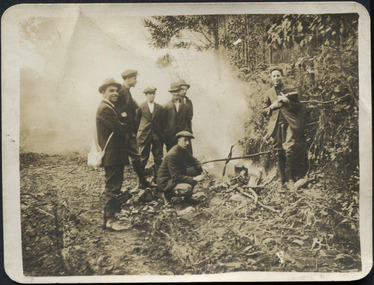
Photograph, postcard "Boiling the Billy" c1900, Early 1900's "Boiling the Billy", c1900
... first began in 1861 as cards mailed by private post. In the 1870s picture postcards grew in popularity throughout the United States, Britain, Europe, and Japan. Cards were first permitted to have a "Divided Back," with text written on the left half of a dividing line and the address on the right half, beginning in England in 1902. Around 1900 the first postcards made of "Real Photos" rather than artwork began to circulate, aided...first began in 1861 as cards mailed by private post. In the 1870s picture postcards grew in popularity throughout the United States, Britain, Europe, and Japan. Cards were first permitted to have a "Divided Back," with text written on the left half of a dividing line and the address on the right half, beginning in England in 1902. Around 1900 the first postcards made of "Real Photos" rather than artwork began to circulate, aided ...Early 1900's. "Boiling the billy". The term billy or billycan is particularly associated with Australian usage, but is also used in the UK and Ireland. It is widely accepted that the term "billycan" is derived from the large cans used for transporting bouilli or bully beef on Australia-bound ships or during exploration of the outback, which after use were modified for boiling water over a camp fire. Postcards developed out of the complex tradition of nineteenth-century printed calling cards, beginning with the advent of the Cartes-de-Visite in France. In the 1850s, Parisian photographer Andre Adolphe Eugene Disderi invented a photographic process involving egg white, albumen, and silver nitrate to create inexpensive portraits on paper cards. These photographic Cartes-de-Visites were 2 1/2 (75mm) by 4 inches (98mm) and became a popular, collectable form of "visiting cards" world-wide. Photographers would reprint portraits of famous individuals they had taken at their studios or during travel and sell them as collectable cards. Postcards as we know them now first began in 1861 as cards mailed by private post. In the 1870s picture postcards grew in popularity throughout the United States, Britain, Europe, and Japan. Cards were first permitted to have a "Divided Back," with text written on the left half of a dividing line and the address on the right half, beginning in England in 1902. Around 1900 the first postcards made of "Real Photos" rather than artwork began to circulate, aided in by advances in amateur photography equipment by companies such as Kodak. Kodak also introduced postcard paper for photographic development and photography studios began to offer portraits printed as postcards Many local town, countryside, and architectural images were captured during this period by local photographers, then printed and sold as postcards . Advances in amateur photography all contributed to a postcard craze that lasted from 1900 to the First World War. Postcards were the preferred means to send a quick note, whether across town or across a continent.Postcard with a black and white Photograph on the front and a 'Divided Back ' for the message and address. There are seven men surrounding the billy suspended over a camp fire. The ground has a lot of dead branches around. One man is bending down towards the billy. Two men on either side of the camp fire are carrying either a white bag across their shoulders or the fish in their hands. You can see, that there is some steam also coming out of the billy, which means that its hot. Court Post Card. / this space may be used for correspondence. / The address only to be written here.1900's, boiling the billy , postcards, photographers, england, hungary, america, cartes-de-visite, visiting cards, moorabbin, cheltenham, bentleigh, market gardeners, early settlers, pioneers, -
 Australian Commando Association - Victoria
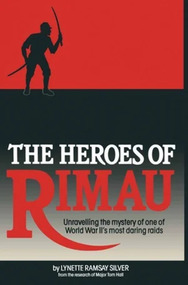
Book, Lenette Ramsay Silver, The Heros of RIMAU
... post-war record, the mission was an utter failure. All of the party were captured of killed - ten of them beheaded in Singapore only five weeks before the Japanese surrender in, it was claimed, a ceremonial execution. The fate of eleven of the others remains officially unknown. After a 31 year search, Major Tom Hall, with the assistance of writer Lynette Silver, has overturned the official version and uncovered the truth. Aided by thousands of Japanese and Allied documents and by the first ...On September 11, 1944, the British submarine "Porpoise" slipped quietly from Fremantle Harbour, bound for Indonesia. It was carrying the 23 Australian and British members of Operation Rimau who, under the leadership of the remarkable Lieutenant-Colonel Ivan Lyon of the Gordon Highlanders, intended to repeat the successful Jaywick raid of 1943 by blowing up 60 ships in Japanese-occupied Singapore Harbour, 19 days later, the preliminary part of the operation successfully completed, the submarine commander bade farewell to the raiders at Pedjantan Island, promising to return to pick them up in 38 days' time. A handful of Chinese and Malays and the conquering Japanese were the only people ever to see the 23 men again. According to the scant official post-war record, the mission was an utter failure. All of the party were captured of killed - ten of them beheaded in Singapore only five weeks before the Japanese surrender in, it was claimed, a ceremonial execution. The fate of eleven of the others remains officially unknown. After a 31 year search, Major Tom Hall, with the assistance of writer Lynette Silver, has overturned the official version and uncovered the truth. Aided by thousands of Japanese and Allied documents and by the first-hand accounts of several Indonesians and Malays, sole witnesses to the events of 1944, they have established the fate of every member of the party and unravelled the story of "The Heroes of Rimau" - a story that has for 45 years been all but lost, distorted by hearsay and fantasy, by military cover-ups and conspiracy, by official bungling, ineptitude and apathy. This book not only chronicles a feat of extraordinary daring in the face of overwhelming odds - a gripping tale of inspired courage, self-sacrifice and eventual tragedy - it also exposes the appalling sequence of events which has, until now, resulted in the shameful suppression of the truth about one of the most amazing stories to emerge from World War II.Self-government publication comprising 314 pages with some black-and-white photographs.non-fictionOn September 11, 1944, the British submarine "Porpoise" slipped quietly from Fremantle Harbour, bound for Indonesia. It was carrying the 23 Australian and British members of Operation Rimau who, under the leadership of the remarkable Lieutenant-Colonel Ivan Lyon of the Gordon Highlanders, intended to repeat the successful Jaywick raid of 1943 by blowing up 60 ships in Japanese-occupied Singapore Harbour, 19 days later, the preliminary part of the operation successfully completed, the submarine commander bade farewell to the raiders at Pedjantan Island, promising to return to pick them up in 38 days' time. A handful of Chinese and Malays and the conquering Japanese were the only people ever to see the 23 men again. According to the scant official post-war record, the mission was an utter failure. All of the party were captured of killed - ten of them beheaded in Singapore only five weeks before the Japanese surrender in, it was claimed, a ceremonial execution. The fate of eleven of the others remains officially unknown. After a 31 year search, Major Tom Hall, with the assistance of writer Lynette Silver, has overturned the official version and uncovered the truth. Aided by thousands of Japanese and Allied documents and by the first-hand accounts of several Indonesians and Malays, sole witnesses to the events of 1944, they have established the fate of every member of the party and unravelled the story of "The Heroes of Rimau" - a story that has for 45 years been all but lost, distorted by hearsay and fantasy, by military cover-ups and conspiracy, by official bungling, ineptitude and apathy. This book not only chronicles a feat of extraordinary daring in the face of overwhelming odds - a gripping tale of inspired courage, self-sacrifice and eventual tragedy - it also exposes the appalling sequence of events which has, until now, resulted in the shameful suppression of the truth about one of the most amazing stories to emerge from World War II. -
 Bendigo Military Museum
Equipment - DRESSING, FIELD, c1956
... Part of standard issue equipment to front line servicemen for first aid. Issued to Robert G. Jackson. Posted to Butterworth in 1966-69 as Flight Sergeant....Part of standard issue equipment to front line servicemen for first aid. Issued to Robert G. Jackson. Posted to Butterworth in 1966-69 as Flight Sergeant. ...Part of standard issue equipment to front line servicemen for first aid. Issued to Robert G. Jackson. Posted to Butterworth in 1966-69 as Flight Sergeant.Small compressed Brown packet made of paper with yellow label affixed on both sides. Label has black writing, Packet in middle has white pull strings so that package can be ripped open easily. Contents of packet is a white sterilised bandage to be used on burns. On both ends are instructions on how to open packet.Labelled - "Standard dressing B.P.C. No. 11 Medium burn dressing" followed by directions for use. Instructions on both ends - "To open packet pull tape".medical, butterworth, -
 Bendigo Military Museum
Equipment - COTTON WOOL, Greenhaigh's Pty Ltd
... Jackson posted to Butterworth, Malaysia from 1966-69 as part of field First Aid Kit....Jackson posted to Butterworth, Malaysia from 1966-69 as part of field First Aid Kit. ...Issued to Sergeant Robert G. Jackson posted to Butterworth, Malaysia from 1966-69 as part of field First Aid Kit.Packet in brown in rectangular cubed shape. White paper wrapped around with description of contents written in dark blue writing. Contents of packet one ounce of compressed cotton wool.Written on end and one side "Compressed absorbent cotton wool - 1 ounce"butterworth, medical equipment -
 Bendigo Military Museum
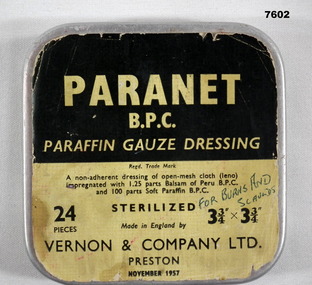
Equipment - DRESSING, PARAFFIN GAUZE, Vernon & Company Ltd, Nov 1957
... Part of first aid kit issued to Flight Sergeant Robert G. Jackson posted to Butterworth Base, Malaysia 1966-69. ...Part of first aid kit issued to Flight Sergeant Robert G. Jackson posted to Butterworth Base, Malaysia 1966-69. ...Part of first aid kit issued to Flight Sergeant Robert G. Jackson posted to Butterworth Base, Malaysia 1966-69. Dressing is a non adherent dressing of open mesh cloth.Silver tin container paraffin gauze dressing. Square shaped with curved corners and black and yellow label stuck to the top. Contents 24 pieces of paraffin gauze dressing.Noted in pen on label "For Burns and Scalds" Labelled "Paraffin Gauze dressings".medical, butterworth -
 Bendigo Military Museum
Equipment - DRESSING, FIELD, Johnson & Johnson Pty Ltd, AUG 1943
... Part of first aid kit issued to Flight Sergeant "Robert G. Jackson" posted to Butterworth, Malaysia from 1966-69. ...Part of first aid kit issued to Flight Sergeant "Robert G. Jackson" posted to Butterworth, Malaysia from 1966-69. ...Part of first aid kit issued to Flight Sergeant "Robert G. Jackson" posted to Butterworth, Malaysia from 1966-69. Brown canvas packet containing 2 No. First Field dressing. Written on front in black writing, instructions to open and description of contents and directions for use.Details of how to open, contents and use on front.medical, butterworth, robert g jackson -
 Bendigo Military Museum
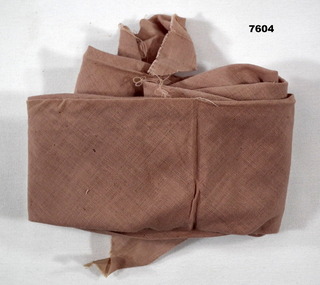
Equipment - SPLINT BANDAGE
... Part of first aid kit issued to Flight Sergeant "Robert G. Jackson". Posted to Butterworth, Malaysia from 1966 - 69...Part of first aid kit issued to Flight Sergeant "Robert G. Jackson". Posted to Butterworth, Malaysia from 1966 - 69 Medical Butterworth ROBERT G. ...Part of first aid kit issued to Flight Sergeant "Robert G. Jackson". Posted to Butterworth, Malaysia from 1966 - 69Triangular cloth bandage, brown in colour, folded up into a small parcel to be used in relation to fractures and breaks.medical, butterworth, robert g. jackson -
 Bendigo Military Museum
Equipment - SPLINT BANDAGE
... Part of first aid kit issued to Flight Sergeant "Robert G. Jackson" posted to Butterworth, Malaysia from 1966 - 69....Part of first aid kit issued to Flight Sergeant "Robert G. Jackson" posted to Butterworth, Malaysia from 1966 - 69. ...Part of first aid kit issued to Flight Sergeant "Robert G. Jackson" posted to Butterworth, Malaysia from 1966 - 69.White, loose splint bandage with drawing in black writing of various types of applications to various types of injuries that may occur. Bandage is triangular shape and folded.Titled the "Vernaid Bandage" and lots of drawings of bandage being applied to injured people.medical supplies, butterworth, malaysia, robert g jackson -
 Kiewa Valley Historical Society
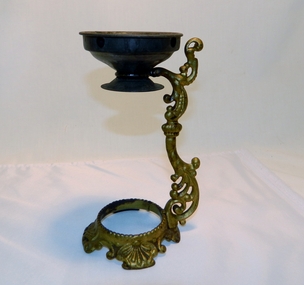
Vaporiser Cresolene, circa late1800's to early 1900's
... post mid 1900's. However it was a good attraction for rural communities wanting relief of "rural" pests. home based vaporisers first aid home nursing over-the-counter medicines See KVHS 0342 (B) for markings and advertising material printed on the box which contains this item. ...This Cresolene vapouriser is an "American" product when "home" based remedial products were of a high demand due to lack of specialised medical facilities such as a hospital in rural communities. "An apparatus for reducing medicated liquids to a state of vapor suitable for inhalation or application to accessible mucous membrane A device for volatising liquid anesthetics." The only criteria used by Health authorities in the decision to provide a community with hospitals was and still is the size of the population it feeds. The introduction of the SEC Victorian Hydro Electricity Scheme started in the 1940's, was the impetus for health planners to build a hospital in the Kiewa Valley. Rural regions especially those considered semi or fully remote locations had to rely on farm based remedial health "alternative medical treatment". This product is such a remedy.This vapouriser is very significant to a rural area such as the Kiewa Valley as it demonstrates the "home" remedies that were available to rural communities such as the cattle and sheep stations before the Kiewa Valley had a hospital(1949). The influx of workers employed by the SEC Vic. Hydro Electricity Scheme(circa 1940's onward) changed dramatically the need for a hospital and specialised medical treatment. The reliance of "health products" such as this vaporiser were still in high demand especially when on the box of this product was printed "Guaranteed under the Food and Drugs Act, June 30, 1906, Serial no. 436". Also on the packaging is printed "A remedy Whooping Cough also Asthma, Catarrh, Colds Diptheria, Croup, Coughs Hay Fever, Sore Throat, Influenza, Etc." An additional benefit of this product "Is obnoxious to Moths, Flies, Mosquitos, Ants, Cock Roaches, Hen Lice, and other Troublesome insects." This advertising is dated before a tightening in the "advertising" legislation of post mid 1900's. However it was a good attraction for rural communities wanting relief of "rural" pests. This vaporiser stand with its cradle and dish is made from cast iron (stand) and tin (dish). At the bottom of the "dish" is a flame diffusion port with eight heat directional holes. The stand upright is painted gold in colour.See KVHS 0342 (B) for markings and advertising material printed on the box which contains this item.home based vaporisers, first aid, home nursing, over-the-counter medicines -
 Kiewa Valley Historical Society
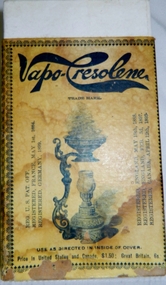
Box Vaporiser Cresolene
... post mid 1900's. However it was a good "purchase" for rural communities wanting relief of "rural" pests. home based vaporisers first aid home nursing over-the-counter medicines Box Vaporiser Cresolene ...This packaging/box containing a home based health product was in use well before the Federal Department of Health legislation tightened up the permissible advertising for "health" products. The strict Occupation and Health Legislation of the later 1900's would not have allowed the grandiose statements printed on this container. It was only later in the 1900's that stricter laws covering medical or quasi medical products came into Australian legislation.This box is very significant (in the time period of pre 1940's), to a semi isolated region as the Kiewa Valley, especially before the valley had a hospital, pre 1949. The reliance of "health products" such as what is stored in this box, were still in high demand, especially when on the box of this product was printed "Guaranteed under the Food and Drugs Act, June 30, 1906, Serial no. 436", a quasi legitimising statement. Also on the packaging is printed "A remedy Whooping Cough also Asthma, Catarrh, Colds Diptheria, Croup, Coughs Hay Fever, Sore Throat, Influenza, Etc." An additional benefit of this product "Is obnoxious to Moths, Flies, Mosquitos, Ants, Cock Roaches, Hen Lice, and other Troublesome insects." This advertising is dated before a tightening in the "advertising" legislation of post mid 1900's. However it was a good "purchase" for rural communities wanting relief of "rural" pests.home based vaporisers, first aid, home nursing, over-the-counter medicines -
 Warrnambool and District Historical Society Inc.
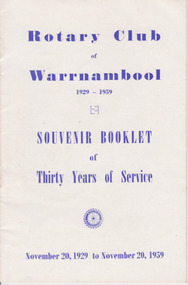
Booklet, Rotary Club of Warrnambool, 1929-1959, Printed prior to November 1959
... first 30 years of service by the Rotary Club of Warrnambool. It gives an overview of the many local projects which have been helped over the years and also lists the club office bearers Its significance lies in the list of projects which were happening in the period 1929-1959 such as assistance to Natural disasters and hardship in the post wars and Depression years as well as community projects such as tree planting and overseas aid.. ...This booklet relates the history of the first 30 years of service by the Rotary Club of Warrnambool. It gives an overview of the many local projects which have been helped over the years and also lists the club office bearers Its significance lies in the list of projects which were happening in the period 1929-1959 such as assistance to Natural disasters and hardship in the post wars and Depression years as well as community projects such as tree planting and overseas aid.. The list of Officebearers is a reflection of community identities and one facet of their contribution to society. In one paragraph state what is significant, the type of significance it holds, and why it is significantWhite Gloss card cover. Front cover has blue text, Rotary Club of Warrnambool 1929-1959, Souvenir Booklet of Thirty Years of Service. Small Rotary International Wheel. November 20, 1929 to November 20, 1959. Back cover Collett &Bain Printers 34 Kepler St Warrnambool. 16 PagesPrinted by Collett & Bain, 34 Kepler St Warrnamboolrotary, rotary club of warrnambool, horace i holmes, charter 3237 -
 Eltham District Historical Society Inc
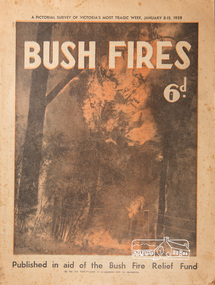
Magazine, Sun News-Pictorial, Bush Fires: A pictorial survey of Victoria's most tragic week, January 8-15, 1939, 1939
... post-offices, churches, and other buildings, represent a loss of at least half a million. At least 1500 are homeless. For their aid, money raised in appeals has now passed the £50,000 mark, and the biggest relief organisation ever set up in peace time has swung into operation. The First...post-offices, churches, and other buildings, represent a loss of at least half a million. At least 1500 are homeless. For their aid, money raised in appeals has now passed the £50,000 mark, and the biggest relief organisation ever set up in peace time has swung into operation. The First ...THE WEEK REVIEWED (Article; Bush Fires: A pictorial survey of Victoria's most tragic week, January 8-15, 1939. Published in aid of the Bush Fire Relief Fund by the Sun News-Pictorial in co-operation with its newsagents, pp2-3) THE fiercest bush fires Australia has known since its discovery are quiescent at the moment, and Victoria, in the comparative coolness of the change which came with rain on Sunday night, has begun·to count its losses. In the fiery eight days, from Sunday to Sunday, at least sixty-six men, women and children have lost their lives in forest fires, or have succumbed to burns and shock; many others have died from heat; and several serious cases of burns are being treated in hospitals. Two babies in Narrandera district have died, and ten others are in hospital, because of milk soured by the record temperatures of those eight days. Forest damage totals at least a million pounds, and incalculable damage has been done to the seedlings which were to have been the forests of the future. Water conservation will be seriously affected by the silting-up of reservoirs and streams from which protective timber has been taken by the all-engulfing flames. More than a thousand houses have been destroyed, and these, with 40 mills, and schools, post-offices, churches, and other buildings, represent a loss of at least half a million. At least 1500 are homeless. For their aid, money raised in appeals has now passed the £50,000 mark, and the biggest relief organisation ever set up in peace time has swung into operation. The First Hint Victoria's first hint of what was to come appeared on Sunday, January 8, when most parts of the State awoke to find a blistering day awaiting. At 12.20 p.m., when the thermometer reached its highest for the day, 109.6 degrees, the first fire victims were at that moment going to their death on a bush track five feet wide off the main road to Narbethong. They were the forestry officers Charles Isaac Demby and John Hartley Barling, who went to warn Demby of his danger when he parted from his companions, and was himself surrounded by the treacherous fire. It was not until 8 o'clock next morning that the tragic news was flashed throughout the State. Searchers found the two charred bodies close together, one seeking protection in the nook of two logs. Barling's watch had stopped at 1.20. In the meantime, tragedy was spreading its cloak. By Monday, big fires were raging at Toolangi, Erica, Yallourn, Monbulk, Frankston, Dromana, Drouin South, Glenburn, and Blackwood, with smaller outbreaks at many other centres. In the ensuing week, while women and children were evacuated as fast as the flames would permit, Erica-scene of the 1926 fire disaster-thrice escaped doom by a change of wind. Indeed, those who have been in the fire country these past days say that the numbers of times a change of wind has saved towns from destruction is amazing. In the towns they speak of miracles. Monday's Miracles The escapes from Monett's Mill at Erica and from the Hardwood Company's Mill at Murrindindi, near where Demby and Barling went to their death, were Monday's miracles. Twenty came out alive from each mill. At the first a 60ft. dugout provided an oven-like refuge; at the second, 12 women and children survived in the smoke-filled gloom of a three-roomed cottage while their eight men, their clothes sometimes afire, poured water on the wooden walls. Three houses out of ten remained when the fire had passed. Record Temperatures Sunday had been the hottest Melbourne day for 33 years; Monday dropped to a 76.1 degree maximum; but Tuesday dawned hotter than ever, the mercury reaching 112.5. By now rumor was racing ahead of fact; whole towns were being reported lost; the alarm was raised for scores of missing persons. But fact soon overtook rumor, and within a few days the staggering toll began to mount to a figure beyond the wildest imaginings of the panic-stricken. Six died from heat on this torrid Tuesday, and the fires spread in a wide swathe from south-west to north-east across the State. Fish died in shallow streams. A curtain of smoke hid the sky from all Victoria, and hung far out to sea. It alarmed passengers on ships. On the Ormonde, on the voyage to Sydney from Burnie, women ran on deck, believing fire had broken out in the hold. Days later the smoke reached New Zealand. In Melbourne thousands of fire-volunteers were leaving in cars: vans, motor-buses-anything reliable on wheels-to aid the country in its grim fight. In the fires at Rubicon and. Narbethong, seventeen were facing death this day. But not till Wednesday, when Melbourne breathed again in a cool change, while the country still sweltered in temperatures up to 117 degrees, did the news come through the tree blocked roads. A woman and her little daughter, trapped on the road, were among those who died. Their bodies, and those of menfolk with them, were found strewn out at intervals along the road, where the furnace of the surrounding fire had dropped them in their tracks as they ran. Twelve died at a Rubicon mill, five on the road at Narbethong. At Alexandra, not far distant, a baby was born while the fires raged, and stretcher-bearers brought in the injured. On Thursday the State Government voted £5000 for the relief of fire victims. The Governor (Lord Huntingfield) and the Lord Mayor (Cr. Coles) visited some of the stricken areas, and dipped into their pockets personally. Later, the City Council, too, voted £5000. Friday, The 13th Friday, the Thirteenth, justified its evil name. A blistering northerly came early in the morning, presaging destruction, and forcing the mercury to a new record of 114 degrees. Racing fires killed at least ten in those terrible 12 hours. Four children were engulfed in the furnace at Colac. Panic drove them, uncontrollable, into the smoke-filled road when the fire raced down behind their home. They choked to death. In other parts fires were joining to make fronts of scores of miles. Kinglake was being menaced on two fronts, £60,000 worth of timber was going up in smoke in Ballarat district. Warburton was surrounded. Residents at Lorne, favoured resort, were being driven to the sea-front by a fire which destroyed at least 20 homes. Healewille. with flames visible from the town at one stage, was in a trough between two fires which burned four guest-houses, seven homes and left its surrounding beauty-spots wastes of bowed-over, blackened tree-fern fronds; with its famous Sanctuary, however, intact. Most of Omeo was destroyed this black day: Noojee. while 200 residents crouched in the river, was being reduced to a waste of buckled iron and smoking timber; Erica was once again saved by a change of wind. Beneath a pall of smoke, the Rubicon victims were buried at Alexandra. Friday night and the early hours of Saturday saw the streets of beleagured towns strewn with exhausted fire-fighters. Their flails beside them, ready for the next call, they lay where exhaustion overtook them-on footpaths, beside lamp-posts, in gutters, in cars, under trucks. Saturday's dawn brought clear skies and lower temperatures in many parts, and from the burnt-out areas came a great rush of tragic reports. The death-roll rushed past the fifty mark with incredible speed. Some had been trapped on roads, others at mills; some, after burying their treasures, had clung too long to the places they had made their homes for many years. Four men lost their lives because one went back for his dog. By Sunday, when the first of the saving rain came, nearly another score of names had been added to the list.Newspaper magazine, 48 pages (incl. covers). Fully digitised and searchable PDFPublished in aid of the Bush Fire Relief Fund by the Sun News-Pictorial in co-operation with its newsagents.bushfires, 1939 bushfires, black friday, warrandyte -
 Bendigo Historical Society Inc.
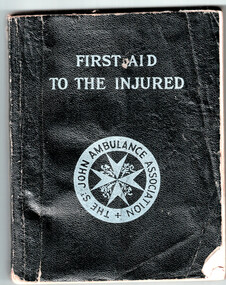
Book - First Aid to the Injured - The St John Ambulance association, 1942
... Joan Filbey Collection: Book First Aid to the Injured - The St John Ambulance association. The book is a copy of the Thirty-ninth edition first impression (1942), Price 2/6 net; by post, 2/8. ...As a result, the role and organisation of St John Ambulance varies by country. history bendigo joan filbey collection st john ambulance first aid book maxwell roberts Joan Filbey Collection: Book First Aid to the Injured - The St John Ambulance association. The book is a copy of the Thirty-ninth edition first impression (1942), Price 2/6 net; by post, 2/8. ...The St John Ambulance Association, which was founded in 1877 in England. Its first uniformed first-aiders were founded in 1887 as the St John Ambulance Brigade. These two have since been merged into a single association. St John Ambulance now have over 40 national organisations, many of which are affiliated with Johanniter International, and over 300,000 volunteers worldwide. The Order of St John owns the brand name in most countries (with the notable exception of India, which has a St John Ambulance organisation that is unconnected to the international movement). Logos vary in different countries but always contain the eight-pointed white Maltese cross as the essential identifier. Like the Order, St John Ambulance associations accept members of all religions. Their geographic organisation differs from the Order, and they have to contend with the differing national laws, medical practices and cultures of countries. As a result, the role and organisation of St John Ambulance varies by country.Joan Filbey Collection: Book First Aid to the Injured - The St John Ambulance association. The book is a copy of the Thirty-ninth edition first impression (1942), Price 2/6 net; by post, 2/8. The book is published by the St John Ambulance Association (Victoria Centre) 217 Lonsdale Street Melbourne. Inside Front Cover - a sketch of a skeleton along with arteries and bones marked. It is sttsched to the cover by masking tape. Written in ink is "Maxwell A. Roberts, SEC Bendigo"history, bendigo, joan filbey collection, st john ambulance, first aid book, maxwell roberts -
 Kiewa Valley Historical Society
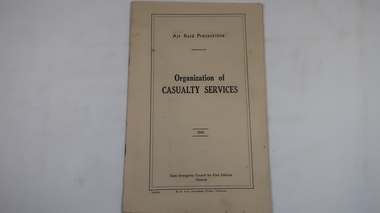
Book - Air Raid Precautions, 1941, Organisation of Casualty Services by State Emergency Council for Civil Defence Victoria
... See also KVHS 0937 (photo), KVHS 0938 (certificate), KVHS 1259 (book) This book informed the volunteers of First Aid posts, ambulances, rescue teams etc. air raid wwii bogong air observers hut khes Cream coloured book with black print on cover. 31 pages printed on both sides and with some black & white photos. ...An Air Observers Hut was used by volunteers 24 / 7 at Bogong to monitor the skies for enemy aircraft during WWII. Bogong was built by the SECV during the construction of the Kiewa Hydro Electric Scheme. See also KVHS 0937 (photo), KVHS 0938 (certificate), KVHS 1259 (book)This book informed the volunteers of First Aid posts, ambulances, rescue teams etc.Cream coloured book with black print on cover. 31 pages printed on both sides and with some black & white photos. Bound by 2 staples.air raid, wwii, bogong air observers hut, khes -
Southern Sherbrooke Historical Society Inc.
Information folder - Helen Gibson
... First Aid to the Injured, signed Rupert M. Downes, James Paterson, Henry Smith, Enid Paterson, dated 1st May 1939, 23.5 x 17 cms -letter of reference for Helen Gibson, typed, from Nobel Park Pre School Play Group, signed F. A. McGregor & F. B. Jenkins, undated but post...First Aid to the Injured, signed Rupert M. Downes, James Paterson, Henry Smith, Enid Paterson, dated 1st May 1939, 23.5 x 17 cms -letter of reference for Helen Gibson, typed, from Nobel Park Pre School Play Group, signed F. A. McGregor & F. B. Jenkins, undated but post ...Material formed part of estate of Helen Gibson and was acquired by the society.A4 folder containing documents pertaining to Helen Gibson. Contents: -letter of reference for Helen Gibson, handwritten, from William L. McSpeddon, Vicar, Drouin, Victoria, "To whom it may concern", dated 16th March 1944, A4 sheet folded in half -letter of reference for Helen Gibson, typed, from Ethel O. Matthews, ex-Sister-in-charge of [Infant Welfare] Centres in Dandenong Shire, "To whom it may concern", dated February 1952, 20.5 x 25.5 cms -letter of reference for Helen Gibson, handwritten, from A. Corcoran (?) Cleveland, Sister-in-charge, Port Melbourne Baby Health Centre, "To whom it may concern", dated 16th Aug 1946,16.5 x 19.5 cms -letter of reference for Helen Gibson, handwritten, from A. M. Adams, Sub-head, Correspondence School, Blackfriars, Sydney, dated 14th July 1931, 20 x 25 cms -Certificate of Competency as a Pre-School Play Leader, Department of Health, Victoria, No. 20, for Helen Alice Gibson, examiners Madeleine [illegible] & Gillian Henriques, signed N. Narbara Meredith & Helen W. Paul & [illegible], 27 x 21.5 cms -certificate, St John Ambulance Association, certifying that Helen Gibson has attended a course of instruction in home nursing. signed Arthur Sherwin, James Paterson, [illegible] Loomis, Enid Paterson, dated 25th Sep 1939, 23.5 x 17 cms -certificate, St John Ambulance Association, certifying that Helen Gibson has attended a course of instruction in rendering First Aid to the Injured, signed Rupert M. Downes, James Paterson, Henry Smith, Enid Paterson, dated 1st May 1939, 23.5 x 17 cms -letter of reference for Helen Gibson, typed, from Nobel Park Pre School Play Group, signed F. A. McGregor & F. B. Jenkins, undated but post-December 1951, 26.5 x 20.5 cms -letter of reference for Helen Gibson, typed, from Correspondence School, Blackfriars, Sydney, signed W. Finigan, dated 9th Feb 1032, 26.5 x 20.5 cms -letter of reference for Helen Gibson (labelled 'Copy" at head), typed, from Harry S. Needham, Archdeacon & Rector of Orange, NSW, dated 24th Feb 1932, 26.5 x 20.5 cms -letter of reference for Helen Gibson, typed, from G.W.S. Anderson, District Censor, Victoria Lines Of Communication Area, Melbourne, dated 26th July 1945, 21 x 18 cms -letter of reference for Helen Gibson, handwritten, from Enid Paterson, President, Garfield Country Women's Association, undated, 20.5 x 26.5 cms -letter of reference for Helen Gibson, typed, from W. Finigan, Headmaster, The Correspondence School, Blackfriars, Sydney, dated 16th Sep 1943, 20.5 x 26 cms (last three items held together with rusted pin) -also in back of folder is envelope containing the following items: -notebook, black, 16 x 10 cms, "Plots, Ideas, Bird Diary 1925" inside front cover, handwritten contents include story ideas and extracts copied from Joan Aiken's "The Way To Write For Children", extract from Wm. Temple's commentary on John's Gospel, a list of aboriginal names, and reminiscences by Miss Balmer -brown business-sized envelope with "References" written in pencil -brown A4 envelope with "Certificates P. L. St John Ambulance" written in ink and "Miss Helen A. Gibson" typed in blue ink, containing blue certificate stating that Helen Gibson has passed examinations and is entitled to receive the medallion, signed [illegible], General Secretary, dated 29th June 1942, 13 x 10 cms -cardboard certificate of baptism into the Church of God, for Ian Harold Gibson, born 13th May 1915, signed Edwin Dodd, St John, Nar-nar-goonhelen alice gibson, ian harold gibson, st john ambulance, pre-school centres, melbourne -
 Melbourne Legacy
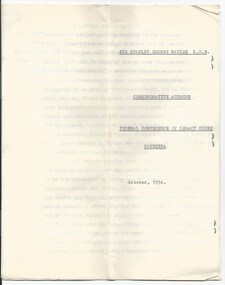
Document - Speech, Commemorative Address - Sir Stanley Savige K.B.E. Federal Conference of Legacy Clubs, Canberra, 10/1954
... first camps held for the boys and girls by Melbourne Club. These were erected on his own seaside property, and were originally conducted under his personal direction and largely with the aid of funds he had collected. There was hardly an important post...first camps held for the boys and girls by Melbourne Club. These were erected on his own seaside property, and were originally conducted under his personal direction and largely with the aid of funds he had collected. There was hardly an important post ...After the death of Stan Savige this address was given at the Canberra Conference in October 1954. It is tribute to his life. Sir Stanley Savige KBE : Commemorative Address Federal Conference of Legacy Clubs, Canberra : October 1954. On the 15th of May this year Legacy learned to its enduring sorrow of the death of its Founder, Lieut. General Stanley George Savige KBE, CB, CBE, DSO, MC, ED, for more than 30 years affectionately known to us all as Legatee Stan Savige. He was the embodiment of all those things for which Legacy stands, and each one of us who knew him and worked with him feels a great and abiding sense of personal loss. It is proper, therefore, that those of us at this Conference, the first after his passing, representative of Legacy throughout the Commonwealth, and comprising so many who were his friends, so many who knew the depth of his love for Legacy, should acknowledge our debt to our Founder and ensure, so far as we may, that the inspiration of his life and work in this Cause shall not be lost to those who follow after. It was not ordained that Stanley George Savige - should enjoy a long life, but it was to prove a life of outstanding service. Born at Morwell in Victoria some 63 years ago, he received with his brothers and sisters such education as was then available to a lad in a mining district. He had no particular opportunities of advancement, but from his early days he cherished a strong ambition to make a success of his life, and with this in view he lost no opportunity of adding to his knowledge. Always a lover of the open country, a good bushman and a fine shot, he became as a young man, a Scoutmaster with a keen following of boys. Even in those early days he attracted youth and showed undoubted promise of the quality of leadership which later was to make him famous. Opportunity came with the first World War, and he took his place as a private soldier in the original 24th Battalion AIF. Followed Gallipoli and Anzac where his marksmanship and bush craft stood him in good stead. Conscious that his early training was not sufficient to secure the promotion he desired, he set himself to enlarge it. Only a man of fine fibre and rare determination could apply himself to study on that war torn Peninsula, where our men, hitherto untested, suffered every known hardship and no man knew, from hour to hour, whether he would survive. But Savige achieved it. Himself then a Corporal he found another Corporal who was a former Schoolmaster and learned from him all that he had to teach. Savige was on his way. He was commissioned on the Field and allotted the heroic task of leading the last party off that desperate coast during the famous evacuation. In France he became the Adjutant of his Battalion and one of the best known officers in the 6th Brigade. He won the Military Cross and was mentioned in despatches. Early in 1918 he received a signal distinction, He was included in a small but distinguished band of Officers and Non-Commissioned Officers from the British and Dominion Forces most carefully selected for individual courage and proved qualities of leadership, and was sent to Persia, under the command of Major-General Dunsterville, Kipling’s famous Stalky, to assist and mobilise the friendly tribes with a view to protecting the road to India, left wide open by the withdrawal of Russia. The story of the Dunsterforce, its suffering and achievements in the face of incredible hardships and difficulties, was later to be told by Savige in his book “Stalky’s Forlorn Hope”. He emerged, finally, unscathed, despite his active participation in several of the bloodiest battles of all time, with the rank of Captain and a DSO and MC to his credit, to say nothing of three mentions in despatches. In later years, further decorations were to be conferred upon him, but I believe he valued none of these so highly as his awards for outstanding personal bravery won in the Field when he was an Officer of comparatively junior rank. Such was the man who in August 1923, at the instance of his former Commander, Major-General Sir John Gellibrand, gathered around him a handful of men who had fought and laughed with him over four well remembered years. This small band adopted the name of “Legacy”, but its purpose then was, in the main, to assist in safeguarding the interests of ex-servicemen in this country. Worthy although the case undoubtedly was, the conception and ideal which was to distinguish Legacy from all kindred post-war movements did not emerge until two years later. The torch had not been lit. Legacy had not yet found its soul. What has been achieved since then is known to you all. The Legacy ideal, unique in its conception, with no known counterpart elsewhere, is now accepted, welcomed and honoured throughout the Commonwealth and abroad. But in those early days the achievements of our Founder in the face of all manner of difficulties and frustrations are worthy of our lasting memory and thankfulness. As the source of every river lies in the hills, so must the inspiration from which stems a great conceptions of service to one’s fellow men be lofty and above reproach. Savige was the embodiment of this new expression of comradeship, as he was the central figure and driving force of the little group that sponsored it. But for his zeal, his faith and determination, it is likely that the flame, newly kindled, might have flickered and died. The idea of men returned from active service pledging for the sake of their former comradeship, their personal assistance to the widows, and above all, to the children of those who had fought beside them and paid the full price of War, was so completely new and unexpected that it was by no means readily accepted. There were no funds, no precedents to guide the new adventurers, only the clear bright flame of an ideal just envisaged, and the conviction that the Cause was unassailable. Nor were there lacking many who said that the community held no place for Legacy, that it was born of sentiment only, and would quickly pass. The scoffers are gone and one since forgotten, but the torch remains and burns brighter than ever. Down the years of Legacy there are many names deserving of honour, men from all States and all stations of life, but no name stands out in such clear and bold relief as does the name of our Founder. By his works you shall know him. He was, in truth, the Soul of Legacy. He sought no office and preferred to work as one of the team. Six years went by before he accepted the Presidency of Melbourne Club, and then only because his fellows would book no further delay. “The Spirit of Legacy is Service” - so runs the Charter, and that was Savige’s Creed. By virtue of his attainments he was called upon to take a leading part in the administration of Legacy, first within his own club and later, as Chairman of the Co-ordinating Council of Legacy in Australia. But always it was the essentially human character of the work which enthralled and upheld him, and the tasks which gave him most joy were those which brought him into close personal contact with the youngsters and their home life. Like their elders they recognised his goodwill and his leadership and responded to it. It was Savige who made possible the first camps held for the boys and girls by Melbourne Club. These were erected on his own seaside property, and were originally conducted under his personal direction and largely with the aid of funds he had collected. There was hardly an important post in his own Club that Savige did not at some time occupy and adorn. He was happiest in the company of those men with whom he had served in the field, and cherished always the comradeship born of active service which is of the essence of Legacy. He was a man of strong convictions but attentive always to another’s point of view. As a Legatee he played a leading part in bringing hope and encouragement to many a mother on whom the whole responsibility of a young family had been suddenly and tragically laid; in the attainment of the ambitions of many an orphan child, which not so long since had seemed to him or her to be mere dreams, impossible of realisation. Comfort for the bereaved, new hope for the children’s physical and educational welfare, assistance with the home, aid for the sick, money for the needy and a new courage to face a future that hitherto had held no promise, all these facets of Legacy endeavour combine to present a living and enduring memorial to the man we honour as our Founder today. Between the two World Wars in addition to establishing himself successfully in civilian life and answering the constant calls of Legacy on his energy and time, Savige maintained an active association with the Army. He was convinced that a Second AIF would one day be urgently called upon, and as a Battalion Commander he spared no effort to train the Officers under his charge during the uneasy years of peace for the trial that he felt must come. These men have all subsequently had distinguished military careers, their names are well known and many of the serve in Legacy today. When the second crisis came, Savige himself was one of the first to offer, and although his youth was spent, he proudly carried the number VX13 throughout the terrible years that followed. This time he was to command, first the 17th Australian Infantry Brigade in the first action of the Second AIF against the enemy at Barida, and subsequently at Tobruk and Derna - all famous names now. It was his patrols which gave the warning - unheeded at the time - that Rommel’s reinforcements were reaching North Africa far earlier than was expected. Then followed the grim days of Greece and Crete when the fine qualities of his leadership were put to the utmost test. I have been told by those who were closest to him it was typical of Savige that when his convoys were on the move back and were being blasted from the air by the unopposed Luftwaffe, he should sit by the side of the open road, wearing his red banded cap, to steady the morale of men who had then no chance of hitting back at the enemy. Unorthodox no doubt, but here was a man indeed. Throughout the whole campaign and later when he commended the 3rd division in New Guinea and later still when with the rank of Lieutenant-General he became a Corps Commander in New Guinea and Bouganville, it was at all times characteristic of him that he should see for himself the situation in the forward areas. He dealt personally with his subordinate commanders whenever it was possible to do so. No one says his G.S.O. 1. understood better than he did the importance of front line troops seeing their G.O.C. frequently, and knowing that he was aware of and prepared to share their hardships and dangers. He took many risks that he should not have taken, exhausted himself physically and mentally times without number, and considered himself not at all in order to secure the success of his operations. Finally, in Bouganville, he brought his campaign to a victorious conclusion and accepted the personal surrender of the Japanese Commander. Savige is known as one of Australia’s most human military leaders, but let no one believe that he did not ask and receive the utmost of his men. He trained them in a hard school but he was ever conscious of their needs and observant and thoughtful of their welfare. Fearless and untiring under conditions which brought younger men down, he asked nothing that he was not himself prepared to give and do. The close of the Second World War left him with the same brave heart; but a vitality greatly impaired. He was called up again and again to perform important national tasks, notably that of Co-ordinator of Demobilisation and Dispersal. But his interest in Legacy never flagged it was in fact more personal than ever, for under his command many junior legatees, sons of former comrades had proved themselves worthy of their Fathers in war and in peace. In the bearing and achievements of the young men of the Second A.I.F. he took a particular and justifiable pride. He applied himself to the Extension of Legacy to areas where it had not previously been practicable to operate. His record of service and close personal contact with the men of both wars made him a most welcome pioneer and many new Clubs and Groups resulted from his efforts. He founded, and I doubt whether any one else could have done so, the Club in the great Capital of our Empire. His reputation and obvious sincerity surmounted obstacles that might well have daunted lesser man. Legacy’s debt to him visibly increased. But he was ever a simple man, with a great love and understanding of his fellow men and a true Legatee at heart. Much that he did will never be known or recognised, save by those who benefitted. His service in Legacy ranged from the humble kitchen of cottage and farm to our representation in Westminster Abbey itself. A knighthood set the seal upon an outstanding career. None the less when upon the death of Field Marshall Sir Thomas Blamey, Lieut. General Sir Stanley Savige became the Patron of the Melbourne Club, he retained at his own express desire, the title of Legatee Savige, and when on that final day we bade him farewell, when the Flags he had served so well were lowered and the guns which had formed a grim final salute, it was apparent to all who had eyes to see that this great and simple man had won such a place in the hearts and affection of his fellow country men as is given to few men indeed. From the packed Cathedral, escorted by his fellow Generals, followed by men of his own Units, by Legatees and a great company of others who had cause to honour and esteem him, he made his last journey. But that is not the end. His voice and presence are lost to us but his memory and inspiration must ever remain. As he has bequeathed to the National War Memorial yonder his diaries, records and battle plans, so he has bequeathed to us his fellow Legatees his greatest achievement and his trust, Legacy itself. Never was the Torch passed by worthier hands. Now it is ours to hold it high. Whatever material memorial the future many hold for him, Legacy owes its Founder a livelier recompense. It is within our power to implement what I believe to be his greatest wish, that Legacy and its ideal of comradeship and service shall flourish and endure. Let each one of us then resolve that we shall, within our Clubs, in all tasks to which we are assigned, both great and small, keep in our minds the life and spirit of Stanley George Savige, so that we may be proud at all times to say of Legacy to those who follow after - “If you would see his memorial - Look around you”.The tribute to Stanley Savige shows how greatly he was regarded by the Legatees.Off white quarto paper with black type, address given about Stan Savige to the Canberra Conference, x 12 pages.savige, speech, obituary -
 Returned Nurses RSL Sub-branch
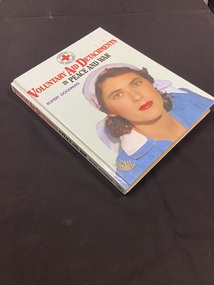
Book, Rupert Goodman, Voluntary Aid Detachments in peace and war: the history of Voluntary Aid Detachments in Australia during the 20th century, 1991
... Aid Movement 2. VAD's in World War 1 3. VAD's between the wars 4. The Middle East contingents, World War 2 5. VAD/AAMWS in the defence of Australia 6. AAMWS in South-west pacific area, 1943-1946. 7. Civilian VAD's in war-time Australia 8. VAD/ AAMWS in the post-war world. 'VICTORIAN BRANCH / LIBRARY / ANZAC HOUSE' [Stamped in red ink on the first ...1. Origins of the Voluntary Aid Movement 2. VAD's in World War 1 3. VAD's between the wars 4. The Middle East contingents, World War 2 5. VAD/AAMWS in the defence of Australia 6. AAMWS in South-west pacific area, 1943-1946. 7. Civilian VAD's in war-time Australia 8. VAD/ AAMWS in the post-war world.Hardcover book with a light green cover. The Title is printed in red and black. There is a female nurse on the front cover in a blue uniform and white red cross head scarf. The Australian Red Cross symbol is at the top of the front cover.non-fiction1. Origins of the Voluntary Aid Movement 2. VAD's in World War 1 3. VAD's between the wars 4. The Middle East contingents, World War 2 5. VAD/AAMWS in the defence of Australia 6. AAMWS in South-west pacific area, 1943-1946. 7. Civilian VAD's in war-time Australia 8. VAD/ AAMWS in the post-war world.australian army voluntary aid detachments, vad, history of vad, australian red cross, australian armed forces, medical care, world war 1, ww1, wwi, world war 2, ww2, wwii -
 Returned Nurses RSL Sub-branch
Book, Rupert Goodman, Voluntary Aid Detachments in peace and war: the history of Voluntary Aid Detachments in Australia during the 20th century, 1991
... Aid Movement 2. VAD's in World War 1 3. VAD's between the wars 4. The Middle East contingents, World War 2 5. VAD/AAMWS in the defence of Australia 6. AAMWS in South-west pacific area, 1943-1946. 7. Civilian VAD's in war-time Australia 8. VAD/ AAMWS in the post-war world. 'Rupert Goodwin' [Handwritten author signature in blue ink written diagonally next to the author's name on the title page] 'B108B' [Handwritten in red pen in the top right corner of first ...1. Origins of the Voluntary Aid Movement 2. VAD's in World War 1 3. VAD's between the wars 4. The Middle East contingents, World War 2 5. VAD/AAMWS in the defence of Australia 6. AAMWS in South-west pacific area, 1943-1946. 7. Civilian VAD's in war-time Australia 8. VAD/ AAMWS in the post-war world.Hardcover book with a light green cover. The Title is printed in red and black. There is a female nurse on the front cover in a blue uniform and white red cross head scarf. The Australian Red Cross symbol is at the top of the front cover.non-fiction1. Origins of the Voluntary Aid Movement 2. VAD's in World War 1 3. VAD's between the wars 4. The Middle East contingents, World War 2 5. VAD/AAMWS in the defence of Australia 6. AAMWS in South-west pacific area, 1943-1946. 7. Civilian VAD's in war-time Australia 8. VAD/ AAMWS in the post-war world.australian army voluntary aid detachments, vad, history of vad, australian red cross, australian armed forces, medical care, world war 1, ww1, wwi, world war 2, ww2, wwii -
 Returned Nurses RSL Sub-branch
Book, Rupert Goodman, Voluntary Aid Detachments in peace and war: the history of Voluntary Aid Detachments in Australia during the 20th century, 1991
... Aid Movement 2. VAD's in World War 1 3. VAD's between the wars 4. The Middle East contingents, World War 2 5. VAD/AAMWS in the defence of Australia 6. AAMWS in South-west pacific area, 1943-1946. 7. Civilian VAD's in war-time Australia 8. VAD/ AAMWS in the post-war world. 'To Cath with best wishes from the author. Rupert Goodwin' [Handwritten in blue ink on the title page] 'B108a' [Handwritten in pencil in the top right corner of first ...1. Origins of the Voluntary Aid Movement 2. VAD's in World War 1 3. VAD's between the wars 4. The Middle East contingents, World War 2 5. VAD/AAMWS in the defence of Australia 6. AAMWS in South-west pacific area, 1943-1946. 7. Civilian VAD's in war-time Australia 8. VAD/ AAMWS in the post-war world.Hardcover book with a light green cover. The Title is printed in red and black. There is a female nurse on the front cover in a blue uniform and white red cross head scarf. The Australian Red Cross symbol is at the top of the front cover.non-fiction1. Origins of the Voluntary Aid Movement 2. VAD's in World War 1 3. VAD's between the wars 4. The Middle East contingents, World War 2 5. VAD/AAMWS in the defence of Australia 6. AAMWS in South-west pacific area, 1943-1946. 7. Civilian VAD's in war-time Australia 8. VAD/ AAMWS in the post-war world.australian army voluntary aid detachments, vad, history of vad, australian red cross, australian armed forces, medical care, world war 1, ww1, wwi, world war 2, ww2, wwii -
 Returned Nurses RSL Sub-branch
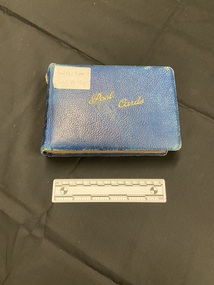
Album - Photograph album, WW1 - V.A.D, [1918?]
... Aid Detachment VAD WW1 WWI First World War Alice Broadhurst 'WW1 PA4 / -V.A.D.' [handwritten in black ink on a white sticker on the front cover] '7/6 / Passed on to Miss Waite / after death of A.B. / Fre[?]' [handwritten in pencil on the inside front cover] 'Alice Broadhurst / Heatherleigh / Tunstall / Victoria' [Handwritten in black ink on the first page] [Annotations describing photos on most pages, handwritten in black ink] Small blue photograph album with worn cover. White sticker label in top left corner with 'WW1 VAD' written on it. 'Post ...Photograph album that belonged to Alice Broadhurst, a Red Cross Nurse and Voluntary Aide Detachment in the First World War. Included are photographs of her time as a V.A.D., patients, nurses, buildings and group gatherings, as well as photos of her family and her home at 'Heatherleigh' in Victoria. Small blue photograph album with worn cover. White sticker label in top left corner with 'WW1 VAD' written on it. 'Post Cards' is printed in gold in the centre of the front cover.'WW1 PA4 / -V.A.D.' [handwritten in black ink on a white sticker on the front cover] '7/6 / Passed on to Miss Waite / after death of A.B. / Fre[?]' [handwritten in pencil on the inside front cover] 'Alice Broadhurst / Heatherleigh / Tunstall / Victoria' [Handwritten in black ink on the first page] [Annotations describing photos on most pages, handwritten in black ink]nurses, voluntary aid detachment, vad, ww1, wwi, first world war, alice broadhurst
