
Showing 10 items matching "first aid textbook"
-
 Flagstaff Hill Maritime Museum and Village
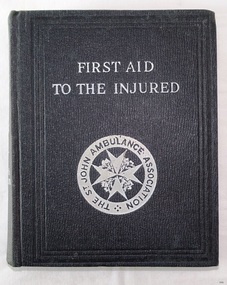
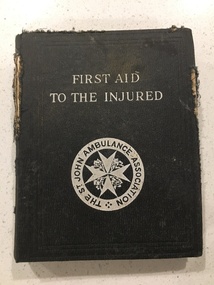
Book - Medical Textbook, First Aid to the Injured, 1939
... ...First Aid textbook...Handbook, First Aid, "First Aid to the Injured", part of the W.R. Angus Collection. Book was written and published by The Authorised textbook of the St. ...Angus Collection”. The First Aid textbook is significant as an example of first aid treatment in the early to mid 20th century. ...This book titled First Aid to the Injured was the personal property of Dr. William Roy Angus. It was donated to Flagstaff Hill Maritime Village by the family of Doctor William Roy Angus, Surgeon and Oculist. It is part of the “W.R. Angus Collection” that includes historical medical equipment, surgical instruments and material once belonging to Dr Edward Ryan and Dr Thomas Francis Ryan, (both of Nhill, Victoria) as well as Dr Angus’ own belongings. The Collection’s history spans the medical practices of the two Doctors Ryan, from 1885-1926 plus that of Dr Angus, up until 1969. ABOUT THE “W.R.ANGUS COLLECTION” Doctor William Roy Angus M.B., B.S., Adel., 1923, F.R.C.S. Edin.,1928 (also known as Dr Roy Angus) was born in Murrumbeena, Victoria in 1901 and lived until 1970. He qualified as a doctor in 1923 at University of Adelaide, was Resident Medical Officer at the Royal Adelaide Hospital in 1924 and for a period was house surgeon to Sir (then Mr.) Henry Simpson Newland. Dr Angus was briefly an Assistant to Dr Riddell of Kapunda, then commenced private practice at Curramulka, Yorke Peninsula, SA, where he was physician, surgeon and chemist. In 1926, he was appointed as new Medical Assistant to Dr Thomas Francis Ryan (T.F. Ryan, or Tom), in Nhill, Victoria, where his experiences included radiology and pharmacy. In 1927 he was Acting House Surgeon in Dr Tom Ryan’s absence. Dr Angus had become engaged to Gladys Forsyth and they decided he further his studies overseas in the UK in 1927. He studied at London University College Hospital and at Edinburgh Royal Infirmary and in 1928, was awarded FRCS (Fellow from the Royal College of Surgeons), Edinburgh. He worked his passage back to Australia as a Ship’s Surgeon on the on the Australian Commonwealth Line’s T.S.S. Largs Bay. Dr Angus married Gladys in 1929, in Ballarat. (They went on to have one son (Graham 1932, born in SA) and two daughters (Helen (died 12/07/1996) and Berenice (Berry), both born at Mira, Nhill According to Berry, her mother Gladys made a lot of their clothes. She was very talented and did some lovely embroidery including lingerie for her trousseau and beautifully handmade baby clothes. Dr Angus was a ‘flying doctor’ for the A.I.M. (Australian Inland Ministry) Aerial Medical Service in 1928. Its first station was in the remote town of Oodnadatta, where Dr Angus was stationed. He was locum tenens there on North-South Railway at 21 Mile Camp. He took up this ‘flying doctor’ position in response to a call from Dr John Flynn; the organisation was later known as the Flying Doctor Service, then the Royal Flying Doctor Service. A lot of his work during this time involved dental surgery also. Between 1928-1932 he was surgeon at the Curramulka Hospital, Yorke Peninsula, South Australia. In 1933 Dr Angus returned to Nhill and purchased a share of the Nelson Street practice and Mira hospital (a 2 bed ward at the Nelson Street Practice) from Dr Les Middleton one of the Middleton Brothers, the current owners of what previously once Dr Tom Ryan’s practice. Dr Tom and his brother had worked as surgeons included eye surgery. Dr Tom Ryan performed many of his operations in the Mira private hospital on his premises. He had been House Surgeon at the Nhill Hospital 1902-1926. Dr Tom Ryan had one of the only two pieces of radiology equipment in Victoria during his practicing years – The Royal Melbourne Hospital had the other one. Over the years Dr Tom Ryan had gradually set up what was effectively a training school for country general-practitioner-surgeons. Each patient was carefully examined, including using the X-ray machine, and any surgery was discussed and planned with Dr Ryan’s assistants several days in advance. Dr Angus gained experience in using the X-ray machine there during his time as assistant to Dr Ryan. When Dr Angus bought into the Nelson Street premises in Nhill he was also appointed as the Nhill Hospital’s Honorary House Surgeon 1933-1938. His practitioner’s plate from his Nhill surgery is now mounted on the doorway to the Port Medical Office at Flagstaff Hill Maritime Village, Warrnambool. When Dr Angus took up practice in the Dr Edward and Dr Tom Ryan’s old premises he obtained their extensive collection of historical medical equipment and materials spanning 1884-1926. A large part of this collection is now on display at the Port Medical Office at Flagstaff Hill Maritime Village in Warrnambool. In 1939 Dr Angus and his family moved to Warrnambool where he purchased “Birchwood,” the 1852 home and medical practice of Dr John Hunter Henderson, at 214 Koroit Street. (This property was sold in1965 to the State Government and is now the site of the Warrnambool Police Station and an ALDI sore is on the land that was once their tennis court). The Angus family was able to afford gardeners, cooks and maids; their home was a popular place for visiting dignitaries to stay whilst visiting Warrnambool. Dr Angus had his own silk worm farm at home in a Mulberry tree. His young daughter used his centrifuge for spinning the silk. Dr Angus was appointed on a part-time basis as Port Medical Officer (Health Officer) in Warrnambool and held this position until the 1940’s when the government no longer required the service of a Port Medical Officer in Warrnambool; he was thus Warrnambool’s last serving Port Medical Officer. (Masters of immigrant ships arriving in port reported incidents of diseases, illness and death and the Port Medical Officer made a decision on whether the ship required Quarantine and for how long, in this way preventing contagious illness from spreading from new immigrants to the residents already in the colony.) Dr Angus was a member of the Australian Medical Association, for 35 years and surgeon at the Warrnambool Base Hospital 1939-1942, He served with the Australian Department of Defence as a Surgeon Captain during WWII 1942-45, in Ballarat, Victoria, and in Bonegilla, N.S.W., completing his service just before the end of the war due to suffering from a heart attack. During his convalescence he carved an intricate and ‘most artistic’ chess set from the material that dentures were made from. He then studied ophthalmology at the Royal Melbourne Eye and Ear Hospital and created cosmetically superior artificial eyes by pioneering using the intrascleral cartilage. Angus received accolades from the Ophthalmological Society of Australasia for this work. He returned to Warrnambool to commence practice as an ophthalmologist, pioneering in artificial eye improvements. He was Honorary Consultant Ophthalmologist to Warrnambool Base Hospital for 31 years. He made monthly visits to Portland as a visiting surgeon, to perform eye surgery. He represented the Victorian South-West subdivision of the Australian Medical Association as its secretary between 1949 and 1956 and as chairman from 1956 to 1958. In 1968 Dr Angus was elected member of Spain’s Barraquer Institute of Barcelona after his research work in Intrasclearal cartilage grafting, becoming one of the few Australian ophthalmologists to receive this honour, and in the following year presented his final paper on Living Intrasclearal Cartilage Implants at the Inaugural Meeting of the Australian College of Ophthalmologists in Melbourne In his personal life Dr Angus was a Presbyterian and treated Sunday as a Sabbath, a day of rest. He would visit 3 or 4 country patients on a Sunday, taking his children along ‘for the ride’ and to visit with him. Sunday evenings he would play the pianola and sing Scottish songs to his family. One of Dr Angus’ patients was Margaret MacKenzie, author of a book on local shipwrecks that she’d seen as an eye witness from the late 1880’s in Peterborough, Victoria. In the early 1950’s Dr Angus, painted a picture of a shipwreck for the cover jacket of Margaret’s book, Shipwrecks and More Shipwrecks. She was blind in later life and her daughter wrote the actual book for her. Dr Angus and his wife Gladys were very involved in Warrnambool’s society with a strong interest in civic affairs. He had an interest in people and the community. They were both involved in the creation of Flagstaff Hill, including the layout of the gardens. After his death (28th March 1970) his family requested his practitioner’s plate, medical instruments and some personal belongings be displayed in the Port Medical Office surgery at Flagstaff Hill Maritime Village, and be called the “W. R. Angus Collection”. The First Aid textbook is significant as an example of first aid treatment in the early to mid 20th century. The W.R. Angus Collection is significant for still being located at the site it is connected with, Doctor Angus being the last Port Medical Officer in Warrnambool. The collection of medical instruments and other equipment is culturally significant, being an historical example of medicine, administration, household equipment and clothing from late 19th to mid-20th century. Dr Angus assisted Dr Tom Ryan, a pioneer in the use of X-rays and in ocular surgery. Handbook, First Aid, "First Aid to the Injured", part of the W.R. Angus Collection. Book was written and published by The Authorised textbook of the St. John Ambulance Association, 1939 - 39th Edition, 8th impression. Diagram attached inside front cover shows bones and arteries. Textbook includes illustrations, diagrams and photos. Inscribed in black ink "W.R. Angus / Warrnambool / Victoria / 1939" Inscribed in black ink "W.R. Angus / Warrnambool / Victoria / 1939" Handwritten “ANGUS” in capital letters on foot edge of text block. flagstaff hill, warrnambool, shipwrecked coast, flagstaff hill maritime museum, maritime museum, shipwreck coast, flagstaff hill maritime village, great ocean road, dr w r angus, dr ryan, t.s.s. largs bay, warrnambool base hospital, nhill base hospital, mira hospital, flying doctor, department of defence australia, australian army, army, medical treatment, medical history, medical education, st john first aid, book, st john ambulance association, medical textbook, first aid textbook -
 Warrnambool and District Historical Society Inc.
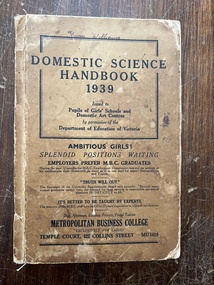
Book - Domestic Science Handbook, Osboldstone & Co. Pty.Ltd, Domestic Science Handbook 1939, 1939
... first aid, nutrition, weights and measures and stoves and has a section containing cooking recipes. It is presumed the handbook is a commercial publication that used the many advertisements to defray the cost of publication and that the book was issued free to the pupils. No information is available on Gwen Williams, the owner of this copy. This handbook is of interest as it offers an insight into what was taught in domestic science lessons for girls in Victoria in 1939. school textbooks ...A domestic science handbook for Victorian school studentsThis is a book of 120 pages. It has a light brown cover with black printing and an image of a small child on the back cover. The pages contain printed material and black and white advertisements. The front cover is almost completely detached from the spine. The pages are bound with metal staples.non-fictionA domestic science handbook for Victorian school studentsschool textbooks 1939, domestic science in schools 1939 -
 Alfred Hospital Nurses League - Nursing History Collection
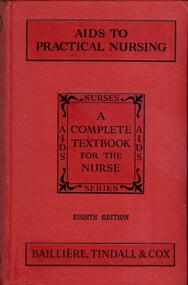
Book - Illustrated textbook, Marjorie Houghton, Aids to practical nursing, 1958 (reprint of 1956 8th edition)
... first published in 1938, one of the books in the Nurses Aids Series Of significance to the AHNL as it was a textbook used by student nurses Nursing Nursing-history First aid An historic textbook for student nurses on all aspects of practical nursing At base of front end-page is a printed black and white donation sticker: black Maltese cross in circle, "This book was donated to Alfred Archival Association Nursing Division by " Administration (handwritten in ink). ...An historic textbook for student nurses on all aspects of practical nursingIllustrated textbook with red binding and black printnon-fictionAn historic textbook for student nurses on all aspects of practical nursingnursing, nursing-history, first aid -
 Alfred Hospital Nurses League - Nursing History Collection
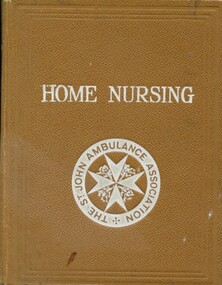
Book - Illustrated textbook, St John Ambulance Association, Home nursing, 1941
... The St John Ambulance Association was established in 1877, first edion of this book was published in the late 1800's Gives insight into first aid practice in the 1930's First aid St John Ambulance Vintage book designed to teach individuals how to nurse an invalid or injured person in their home when professional help might not be immediately available On front endpage there is a handwritten name [?]and a small rectangular adress lable with green print, donor's details, At bottom of this page there is a printed black and white donation sticker: black Maltese cross in circle, 'This book was donated to Alfred Archival Association Nursing Division by' previous catalogue number Illustrated textbook with light brown leather binding. ...Vintage book designed to teach individuals how to nurse an invalid or injured person in their home when professional help might not be immediately availableIllustrated textbook with light brown leather binding. Front cover has an embossed border, white print detailing title and the emblem of the St John Ambulance Association. Title, edition and 'S.J.A.A.' are printed in white on spine.non-fictionVintage book designed to teach individuals how to nurse an invalid or injured person in their home when professional help might not be immediately availablefirst aid, st john ambulance -
 Alfred Hospital Nurses League - Nursing History Collection
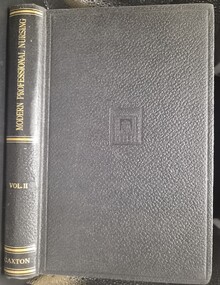
Book - Illustrated textbook, Douglas Hay Scott et al, Modern Professional Nursing Volume 2, 1949
... Part of four volume set, designed as a complete reference for professional nurses of 1940's Insight into nursing education in the 1940's Nursing-study and teaching hygiene first aid Vintage textbook covering foundational nursing topics of hygiene, first aid, and theory and practice of nursing On front end page 'Noreen Johnston' [handwritten black ink] underneath this is s a printed black and white donation sticker: black Maltese cross in circle, 'This book was donated to Alfred Archival Association Nursing Division by' and the previous catalogue number [handwritten black ink] Languages Illustrated text book with faux leather binding. ...Vintage textbook covering foundational nursing topics of hygiene, first aid, and theory and practice of nursingIllustrated text book with faux leather binding. Front cover has an embossed logo of the publisher. Gilt stamping on spine detailing title, volume and publishernon-fictionVintage textbook covering foundational nursing topics of hygiene, first aid, and theory and practice of nursingnursing-study and teaching, hygiene, first aid -
 Yarrawonga and Mulwala Pioneer Museum
Book - First Aid, First Aid to the Injured, 1928
... textbook of the "St John Ambulancer" Black hardcover, 294 pages. Worn spine and right cover edge. Appears to be well used. Contains black and white illustrations. Name written in pencil first page "T Hanrahan, Yarrawonga" First Aid ...Black hardcover, 294 pages. Worn spine and right cover edge. Appears to be well used. Contains black and white illustrations. Name written in pencil first page "T Hanrahan, Yarrawonga" 39th Edition, Published 1928, 1st Edition entitled "Aids for cases of Injuries or Sudden Illness, 1878 Ther authorised textbook of the "St John Ambulancer" -
 Mont De Lancey
Book, R.T. Glazebrook, Electricity and Magnetism, 1920
... Electricity Magnetism Textbook Electricity and Magnetism is an influential textbook by Sir Richard Tetley Glazebrook, first published in 1903, which provides a detailed introduction to the theoretical and practical aspects of the subject. It is designed as a classroom aid ...Electricity and Magnetism is an influential textbook by Sir Richard Tetley Glazebrook, first published in 1903, which provides a detailed introduction to the theoretical and practical aspects of the subject. It is designed as a classroom aid for both students and teachers, combining theoretical principles with practical experiments, diagrams, and examples from early university physics courses.A light green cloth covered hardcover book titled, Electricity and Magnetism. The front cover has the title, and Cambridge Physical Series printed in black lettering at the top. The spine has the title, author R.T. Glazebrook, M.A., F.R.S. and publisher crest and name. Inside there is a Preface, Answers to Examples and an Index. After page134 is a fold out page of seven handwritten magnetism examples. Pp.440.Electricity and Magnetism is an influential textbook by Sir Richard Tetley Glazebrook, first published in 1903, which provides a detailed introduction to the theoretical and practical aspects of the subject. It is designed as a classroom aid for both students and teachers, combining theoretical principles with practical experiments, diagrams, and examples from early university physics courses. electricity, magnetism, textbook -
 Flagstaff Hill Maritime Museum and Village
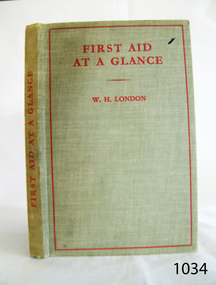
Book - Reference Medical/First Aid, William H. London, First Aid At A Glance, 1939
... Unlike standard medical textbooks of the era, this publication was structured with concise text, a logical layout, and clear illustrations so first-aiders could assess and treat injuries "at a glance" without flipping through lengthy prose. The author, William H. London, was an Australian safety expert, first-aid...Unlike standard medical textbooks of the era, this publication was structured with concise text, a logical layout, and clear illustrations so first-aiders could assess and treat injuries "at a glance" without flipping through lengthy prose. The author, William H. London, was an Australian safety expert, first-aid ...Published on the eve of World War II in 1939, First Aid at a Glance is a compact, highly practical emergency manual. Designed as a concise summary for quick reference during crisis situations, it covers core civil defence and emergency medical topics such as the treatment of wounds, severe bleeding, and shock. Other subjects covered in this publication are fracture immobilisation and bandaging techniques, resuscitation and drowning intervention, and the management of casualties in public, industrial, or home settings.Hard cover book, First Aid at a Glance Author: William H. London Publisher: Angus & Robertson, Sydney, Australia Date: 1939 Further Information: Green cloth covered hardback volume with title in rednon-fictionPublished on the eve of World War II in 1939, First Aid at a Glance is a compact, highly practical emergency manual. Designed as a concise summary for quick reference during crisis situations, it covers core civil defence and emergency medical topics such as the treatment of wounds, severe bleeding, and shock. Other subjects covered in this publication are fracture immobilisation and bandaging techniques, resuscitation and drowning intervention, and the management of casualties in public, industrial, or home settings.flagstaff hill, warrnambool, shipwrecked-coast, flagstaff-hill, flagstaff-hill-maritime-museum, maritime-museum, shipwreck-coast, flagstaff-hill-maritime-village, first aid at a glance, book, william london, w.r. angus -
 Alfred Hospital Nurses League - Nursing History Collection
Book - Illustrated textbook, St John Ambulance Association, Home nursing, 1939
... The St John Ambulance Association was established in 1877, first edion of this book was published in the late 1800's Gives insight into first aid practice in the 1930's First aid St John Ambulance Vintage book designed to teach individuals how to nurse an invalid or injured person in their home when professional help might not be immediately available On front endpage there is a handwritten name [F Bennett] Illustrated textbook with light brown clothbinding. ...Vintage book designed to teach individuals how to nurse an invalid or injured person in their home when professional help might not be immediately availableIllustrated textbook with light brown clothbinding. Front cover has an embossed border, title and the emblem of the St John Ambulance Association, some traces of white ink remain. non-fictionVintage book designed to teach individuals how to nurse an invalid or injured person in their home when professional help might not be immediately availablefirst aid, st john ambulance -
 Emerald Museum & Nobelius Heritage Park
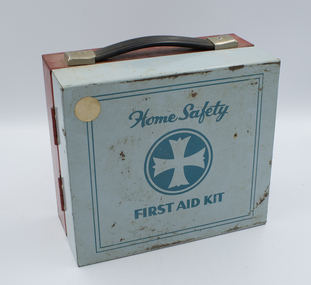
Functional object - First Aid Kit, William Wallace & Co, c. late 1950s
... first aid kit. On the left are two hinges connecting the two parts; on the right is a metal clasp closing the box. A carrying handle is attached to the top of the box, on the red rear section. The box still contains many elements of the first aid kit itself: - Three first aid guidebooks (a 283-page textbook published by St Johns Ambulance Association, a 27-page booklet published by Smith & Nephew, and a 15-page booklet published by Savlon) - Tubes of "strangulator tubing," cotton wool, boracic (boric) acid, sodium bicarbonate, and salt tablets - Vials of Sal Volatile (smelling salts), Acriflavine antiseptic, calamine lotion, castor oil, and benzethonium chloride germicide. - Five sachets of Bex Powder (a mix of caffeine, aspirin, and phenacetin) - A cardboard box containing a squeeze tube of 'Portex Medicated Plastic Skin' (likely a combination painkiller and liquid bandage) - A carboard box containing an eye dropper - Several bandages - A eye dust remover - A plastic cup...FIRST AID / 'Savlon'" The metal box is a rectangular prism in two equal halves, one painted blue and the other red. The blue side - the front - features a cross and text announcing it as a home first aid kit. On the left are two hinges connecting the two parts; on the right is a metal clasp closing the box. A carrying handle is attached to the top of the box, on the red rear section. The box still contains many elements of the first aid kit itself: - Three first aid guidebooks (a 283-page textbook ...This kit most likely originates from the late 1950s. The enclosed St Johns Ambulance first aid guide was published in 1955 (the 8th impression of the 40th Edition). It belonged to Doug Twaits , presumably first when he lived in Kew; while a residence in Kew is not recorded in biographical information about him, this too would most likely have occurred in the late 1950s after he returned from Papua New Guinea and before he lived in Essendon. Twaits had previously lived in Emerald, and would return later in life. The first aid book was not originally included in the kit and may not be contemporaneous with the box it is now stored in. However, based on the items stored within the kit it is unlikely to originate from much later, and it most likely did originate at a similar time to the enclosed book. In particular, Dex Powder was banned in the 1970s due to health risks, placing a hard limit on how late it could be from.This kit represents the state of home healthcare in the mid-20th century.The metal box is a rectangular prism in two equal halves, one painted blue and the other red. The blue side - the front - features a cross and text announcing it as a home first aid kit. On the left are two hinges connecting the two parts; on the right is a metal clasp closing the box. A carrying handle is attached to the top of the box, on the red rear section. The box still contains many elements of the first aid kit itself: - Three first aid guidebooks (a 283-page textbook published by St Johns Ambulance Association, a 27-page booklet published by Smith & Nephew, and a 15-page booklet published by Savlon) - Tubes of "strangulator tubing," cotton wool, boracic (boric) acid, sodium bicarbonate, and salt tablets - Vials of Sal Volatile (smelling salts), Acriflavine antiseptic, calamine lotion, castor oil, and benzethonium chloride germicide. - Five sachets of Bex Powder (a mix of caffeine, aspirin, and phenacetin) - A cardboard box containing a squeeze tube of 'Portex Medicated Plastic Skin' (likely a combination painkiller and liquid bandage) - A carboard box containing an eye dropper - Several bandages - A eye dust remover - A plastic cupBox: "Home Safety / FIRST AID KIT" Black Book: "FIRST AID / TO THE INJURED / THE ST. JOHN AMBULANCE ASSOCIATION" Black Book, handwritten inside cover: "D. TWAITS / 101 BARKERS ROAD / KEW" Red Booklet, Front Cover: "FIRST AID / S&N" Red Booklet, Rear Cover: "S&N / Published by / SMITH & NEPHEW LTD / Welwyn Garden City, Herts., England / Manufacturers of / Elastoplast Products / Gypsona P.O.P. Bandages / Surgical Dressings, etc. / PRINTED IN ENGLAND 893EL" Blue Booklet: "HANDBOOK OF / FIRST AID / 'Savlon'"medical & health, 1950s
