
Showing 28 items matching "first expeditionary force"
-
 Port Melbourne Historical & Preservation Society
Photograph, First Australian Expeditionary Force - Troop Ships at Port Melbourne, 19 Oct 1914
... First Australian Expeditionary Force - Troop Ships at Port Melbourne...View of the First Australian Expeditionary Force troop ships at Port Melbourne piers on 19 Oct 1914, with Oriental Mills in foreground. ...Piers and Wharves - Princes Pier Piers and Wharves - Railway Pier Piers and Wharves - Station Pier Piers and Wharves - Town Pier South Melbourne Gasworks War - World War I Harpers Oriental Mill View of the First Australian Expeditionary Force troop ships at Port Melbourne piers on 19 Oct 1914, with Oriental Mills in foreground. ...View of the First Australian Expeditionary Force troop ships at Port Melbourne piers on 19 Oct 1914, with Oriental Mills in foreground. The horse-drawn tramway that was used to take coal from Town Pier to the Gasworks can also be seen in the foreground.. Port Melbourne's other two main piers at the time, Railway Pier (later Station Pier) and New Railway Pier (later Princess Pier) can be seen in the background.piers and wharves - princes pier, piers and wharves - railway pier, piers and wharves - station pier, piers and wharves - town pier, south melbourne gasworks, war - world war i, harpers oriental mill -
 Bendigo Historical Society Inc.
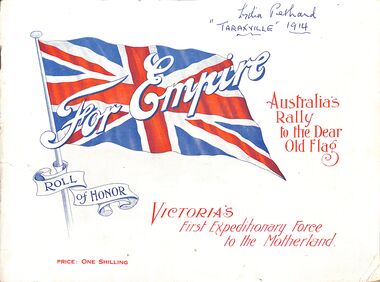
Book - "For Empire. Australia's Rally to the Dear Old Flag.", 1914
... ...First Expeditionary Force...A Second Expeditionary Force is now in course of enrolment. Our Victorian First Contingent comprises some 6,700 officers and men, and this booklet is issued as a souvenir of Victoria's complement and to serve as a record and memento of the gallant men who responded so readily to the call to arms. ...Victoria's First Expeditionary Force to the Motherland. Soft cover. ...Victoria's First Expeditionary Force to the Motherland. Soft cover. ...Booklet issued in September 1914 containing a complete roll of the first Victorian Contingent to "the Motherland", documenting Australia's offer to send troops to Great Britain after the declaration of war, and the response by Victoria. Around 6,700 men volunteered within three weeks to take part in an "expeditionary force", and gathered at a camp at Broadmeadows in preparation for sailing on one of 26 troopships being sent by Australia. The booklet was produced as a souvenir to the "gallant men who responded so readily to the call to arms. Theirs is the spirit that has built up the greatness of England's empire." The wish that they have a "speedy and safe return to sunny Australia" underlines the naivety or innocence of the times. ON the declaration of war the Commonwealth Government immediately cabled the Imperial Authorities, offering to send an Expeditionary Force of 20,000 men to assist the Empire in this the greatest struggle in history. The offer was gratefully accepted by the mother country and immediately the enrolment of volunteers was begun, officers and men enthusiastically rallied to the call, and in the course of two or three weeks the whole of the contingents were in camp. The offer was made on the 3rd August, 1914, and before the end of September the troops were ready for the front. The command of the Expeditionary Force has been entrusted to Brigadier-General Bridges, who is ably assisted by the best officers in Australia. To transport the troops to England twenty-six of the largest and best liners that come to Australian waters have been engaged as troopships. The whole of the cost (estimated at more than £5,000,000) of equipping and maintaining the troops during the war will be borne by Australia, and even if the cost should be treble the amount it will be cheerfully and readily responded to in aid of the Empire. A Second Expeditionary Force is now in course of enrolment. Our Victorian First Contingent comprises some 6,700 officers and men, and this booklet is issued as a souvenir of Victoria's complement and to serve as a record and memento of the gallant men who responded so readily to the call to arms. Theirs is the spirit that has built up the greatness of England's Empire—the spirit that will support it while empires last. May Providence guide them to speedy victory and a safe return to sunny Australia. September, 1914. The booklet also mentions that a secondary expeditionary force is being assembled, so may have also functioned as an inducement to enlist. "For Empire. Australia's Rally to the Dear Old Flag." Roll of Honor. Victoria's First Expeditionary Force to the Motherland. Soft cover. Front cover contains image of Union Jack. Title in white, and subtitles in red . Stapled in spine. Publisher's name and address on back cover to bottom right. Contains black and white images. Index of soldiers names listed by Divisional Headquarters and Battalions. 16 pages. soldiers, world war one, british empire, first expeditionary force -
 Bendigo Military Museum
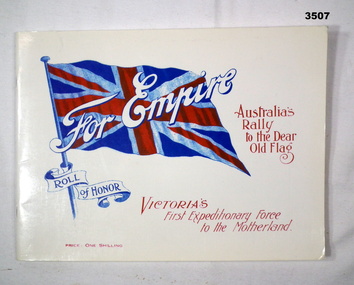
Booklet - BOOKLET VICTORIA WW1, For Empire, Possibly post WW1
... Victoria's First Expeditionary Force to the Motherland. Roll of Honour” Price: “One Shilling” Handwritten inscription 1st page top L in blue ink. ...Victoria's First Expeditionary Force to the Motherland. Roll of Honour” Price: “One Shilling” Handwritten inscription 1st page top L in blue ink. ...From the Introduction: Our Victorian First Contingent comprises some 6700 officers and men, and this booklet is issued as a souvenir of Victoria's complement and to serve as a record and momento ......Soft cardboard cover, glossy finish. White background with red / blue / white print over a red / white / blue flag. Cover & pages stapled centre fold. Pages unnumbered, cut, plain, white, illustrated black / white photos. Booklet appears to be a facsimile of a souvenir booklet with the introduction dated 1914. Printed on cover: “For Empire, Australia's Rally to the Dear Old Flag. Victoria's First Expeditionary Force to the Motherland. Roll of Honour” Price: “One Shilling” Handwritten inscription 1st page top L in blue ink. “Peter Ball”booklet, contingent, victoria -
 Warrnambool and District Historical Society Inc.
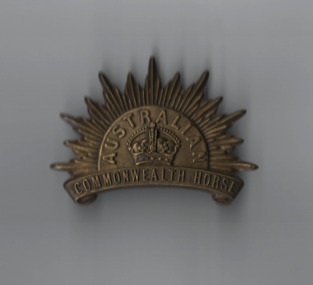
Badge, Australian Commonwealth Horse, C1902
... It was the first expeditionary force established by the Commonwealth of Australia following Federation in 1901 and the first to wear the Rising Sun Badge, a design chosen by the British Commander in Chief of the Australian Forces, Sir Edward Hutton. ...It was the first expeditionary force established by the Commonwealth of Australia following Federation in 1901 and the first to wear the Rising Sun Badge, a design chosen by the British Commander in Chief of the Australian Forces, Sir Edward Hutton. ...This is the badge of the Australian Commonwealth Horse which was a mounted infantry unit of the Australian Army established during the Second Boer War in 1902. It was the first expeditionary force established by the Commonwealth of Australia following Federation in 1901 and the first to wear the Rising Sun Badge, a design chosen by the British Commander in Chief of the Australian Forces, Sir Edward Hutton. This Rising Sun Badge was the second version of a military badge used by Australian soldiers in 1902.This badge is of great interest as the hat badge worn by the Australian Commonwealth Horse in the Boer War. It is not known if it has any local significance. Brass semi-circular badge in the shape of the rising sun with slightly curved bottom edge. There is text along the bottom edge with "Australia" in a semi-circle above a crown in low relief.two hooks on the back of the badge."Commonwealth Horse" in scroll alonf bottom of badge. "Australia " in semicircle below the rays of the sun.warrnambool, commonwealth horse badge, military badges of australia, australian commonwealth horse badge -
 B-24 Liberator Memorial Restoration Australia Inc
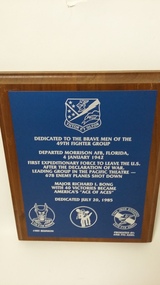
Plaque 49th Fighter Group
... DEPARTED MORRISON AFB, FLORIDA,4 JANUARY 1942.FIRST EXPEDITIONARY FORCE TO LEAVE THE U.S.AFTER THE DECLARATION OF WAR. ...DEPARTED MORRISON AFB, FLORIDA,4 JANUARY 1942.FIRST EXPEDITIONARY FORCE TO LEAVE THE U.S.AFTER THE DECLARATION OF WAR. ...Included in the collection of Bill Bakker ex RNEIAAFRectangular wooden plaque with blue enameled, silver printed plate attached DEDICATED TO THE BRAVE MEN OF THE 49TH FIGHTER GROUP. DEPARTED MORRISON AFB, FLORIDA,4 JANUARY 1942.FIRST EXPEDITIONARY FORCE TO LEAVE THE U.S.AFTER THE DECLARATION OF WAR. LEADING GROUP IN THE PACIFIC THEATRE- 678 ENEMY PLANES SHOT DOWN MAJOR RICHARD I. BONG WITH 40 VICTORIES BECAME AMERICA'S "ACE OF ACES" DEDICATED JULY 20, 1985 1985 REUNION PRESENTED BY 49FTG ASSN. -
 Lara RSL Sub Branch
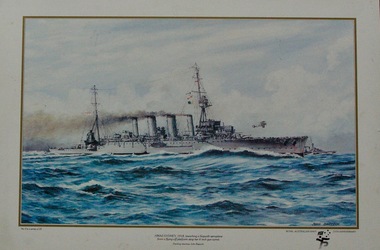
Coloured Print of HMAS SYDNEY 1918
... During the early stages of World War I, Sydney was involved in supporting the Australian Naval and Military Expeditionary Force, and escorting the first ANZAC convoy. ...During the early stages of World War I, Sydney was involved in supporting the Australian Naval and Military Expeditionary Force, and escorting the first ANZAC convoy. On 9 November 1914, the cruiser defeated the German cruiser SMS Emden at the Battle of Cocos. ...HMAS Sydney was a Chatham-class light cruiser of the Royal Australian Navy. Laid down in 1911 and launched in 1912, the cruiser was commissioned into the RAN in 1913. During the early stages of World War I, Sydney was involved in supporting the Australian Naval and Military Expeditionary Force, and escorting the first ANZAC convoy. On 9 November 1914, the cruiser defeated the German cruiser SMS Emden at the Battle of Cocos. During 1915 and 1916, Sydney operated on the North America and West Indies Station, before joining the 2nd Light Cruiser Squadron at Greenock, Scotland in November 1916. On 4 May 1917, the cruiser was involved in an inconclusive action against the German zeppelin L43; neither was damaged. During late 1917, Sydney became the first Australian warship to launch an aircraft, and the first warship to do so from a rotatable platform.Rectangular shaped mounted Print of HMAS SYDNEY 1918HMAS SYDNEY 1918,launching a Sopwith aeroplane from a flying-off platform atop her 6 inch gun turret. ROYAL AUSTRALIAN NAVY 75TH ANNIVERSARYww1, hmas sydney,lara r.s.l. australian naval ships, light cruisers. -
 The Beechworth Burke Museum
Photograph
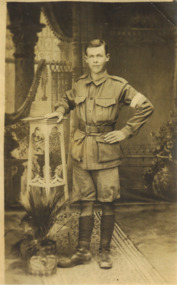
... The first significant Australian action of the war was the Australian Naval and Military Expeditionary Force’s (ANMEF) landing on Rabaul on 11 September 1914. ...It is believed this photograph was taken in the early 1900s during World War I. Depicted is a 19 year old male soldier named Thomas "Tom" Lacey, who was a resident of Beechworth, Victoria. He is dressed in an Australian military uniform and posing inside a photographic portrait studio.The record is historically significant due to its connection to World War I. This conflict is integral to Australian culture as it was the single greatest loss of life and the greatest repatriation of casualties in the country's history. Australia’s involvement in the First World War began when Britain and Germany went to war on 4 August 1914. The first significant Australian action of the war was the Australian Naval and Military Expeditionary Force’s (ANMEF) landing on Rabaul on 11 September 1914. The ANMEF took possession of German New Guinea at Toma on 17 September 1914 and of the neighbouring islands of the Bismarck Archipelago in October 1914. On 9 November 1914, the Royal Australian Navy made a major contribution when HMAS Sydney destroyed the German raider SMS Emden. On 25 April 1915, members of the Australian Imperial Force (AIF) landed on Gallipoli in Turkey with troops from New Zealand, Britain, and France. This began a campaign that ended with an evacuation of allied troops beginning in December 1915. The next year, Australian forces fought campaigns on the Western Front and in the Middle East. The record has strong research potential. This is due to the ongoing public and scholarly interest in war, history, and especially the ANZAC legend, which is commemorated annually on 25 April, known as ANZAC Day.Sepia rectangular photograph printed on paper.Reverse: 3417.1 /military album, wwi, world war i, thomas lacey, tom lacey, soldier, australian army, war -
 The Beechworth Burke Museum
Postcard
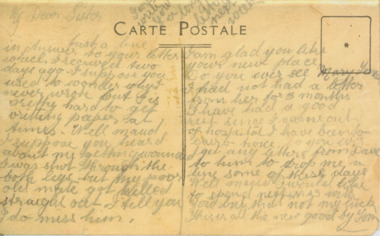
... The first significant Australian action of the war was the Australian Naval and Military Expeditionary Force’s (ANMEF) landing on Rabaul on 11 September 1914. ...Depicted is a handwritten note written by Thomas "Tom" Lacey. It is addressed to his sister, Maude. This letter accompanies a portrait of Tom dressed in an Australian army uniform (record number 3417.1). Tom was a resident of Beechworth, and was only nineteen years old when he fought in World War I.The record is historically significant due to its connection to World War I. This conflict is integral to Australian culture as it was the single greatest loss of life and the greatest repatriation of casualties in the country's history. Australia’s involvement in the First World War began when Britain and Germany went to war on 4 August 1914. The first significant Australian action of the war was the Australian Naval and Military Expeditionary Force’s (ANMEF) landing on Rabaul on 11 September 1914. The ANMEF took possession of German New Guinea at Toma on 17 September 1914 and of the neighbouring islands of the Bismarck Archipelago in October 1914. On 9 November 1914, the Royal Australian Navy made a major contribution when HMAS Sydney destroyed the German raider SMS Emden. On 25 April 1915, members of the Australian Imperial Force (AIF) landed on Gallipoli in Turkey with troops from New Zealand, Britain, and France. This began a campaign that ended with an evacuation of allied troops beginning in December 1915. The next year, Australian forces fought campaigns on the Western Front and in the Middle East. The record has strong research potential. This is due to the ongoing public and scholarly interest in war, history, and especially the ANZAC legend, which is commemorated annually on 25 April, known as ANZAC Day.Sepia rectangular postcard printed on paper.Obverse: My Dear Sister / I will / write / you / a long / letter / next / week / CARTE POSTALE / Just a line / in (?) to your letter / which I received two / days ago. I suppose you / used to wonder why I / never wrote but it is / pretty hard to get / writting paper at / (?). Well maud / I suppose you heard / about me getting around / I was shot through the / both legs but my poor / old mate got killed / straight out. I tell you / I do miss him. / I am glad you like / your new place. / Do you ever see Mary Y(?) / I had not had a letter / from her for 3 months / I have had a good / rest since I came out / of hospital I have been to / Cairo twice. Do you ever / get any letters from Dave / (?) him to drop me a / line some of these days / Well Maud I would like / to spend next XMAS with / you but that not my luck / this is all the new good by Tom /military album, beechworth, tom lacey, army, world war i, wwi, letter, thomas lacey -
 The Beechworth Burke Museum
Postcard
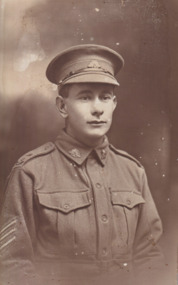
... Force. The record is historically significant due to its connection to World War I. This conflict is integral to Australian culture as it was the single greatest loss of life and the greatest repatriation of casualties in the country's history. Australia’s involvement in the First World War began when the Australian government established the Australian Imperial Force (AIF) in August 1914. Immediately, men were recruited to serve the British Empire in the Middle East and on the Western Front. The first significant Australian action of the war was the Australian Naval and Military Expeditionary ...Taken on an unknown date, depicted is a portrait of a young, unidentified male soldier. He is dressed in an Australian military uniform. It is believed that this soldier was part of The Australian Imperial Force during World War I. This can be inferred by the chevron rank insignia visible on the uniform. The placement of this insignia on the sleeve of the right arm suggests that this soldier was either a Warrant Officer or a Non-Commissioned Officer (NCO). Specifically, the number of chevron stripes - here, there are three - are believed to signify a Sergeant ranking. The man in this photograph is also wearing a 'Rising Sun' collar badge on his coat. Australia, unlike most other Commonwealth countries, did not adopt metal regimental badges during the First World War. All units were issued with the Australian Army General Service Badge, better known as the 'Rising Sun’ badge. This insignia is almost always identified with the Australian Imperial Force.The record is historically significant due to its connection to World War I. This conflict is integral to Australian culture as it was the single greatest loss of life and the greatest repatriation of casualties in the country's history. Australia’s involvement in the First World War began when the Australian government established the Australian Imperial Force (AIF) in August 1914. Immediately, men were recruited to serve the British Empire in the Middle East and on the Western Front. The first significant Australian action of the war was the Australian Naval and Military Expeditionary Force’s (ANMEF) landing on Rabaul on 11 September 1914. The ANMEF took possession of German New Guinea at Toma on 17 September 1914 and of the neighbouring islands of the Bismarck Archipelago in October 1914. On 25 April 1915, members of the AIF landed on Gallipoli in Turkey with troops from New Zealand, Britain, and France. This specific event holds very strong significance within Australian history. The record has strong research potential. This is due to the ongoing public and scholarly interest in war, history, and especially the ANZAC legend, which is commemorated annually on 25 April, known as ANZAC Day.Sepia rectangular postcard printed on card.Reverse: CARD / JAS.C.CRADDEN, / 182 PITT ST, SYDNEY. / Cecil Johnson / BMM2640.1 /military album, wwi, world war i, postcard, australian army, australian imperial force, aif, sergeant, warrant officer, non-commissioned officer, portrait -
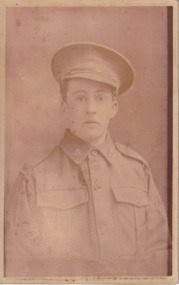 The Beechworth Burke Museum
Postcard
... Force. The record is historically significant due to its connection to World War I. This conflict is integral to Australian culture as it was the single greatest loss of life and the greatest repatriation of casualties in the country's history. Australia’s involvement in the First World War began when the Australian government established the Australian Imperial Force (AIF) in August 1914. Immediately, men were recruited to serve the British Empire in the Middle East and on the Western Front. The first significant Australian action of the war was the Australian Naval and Military Expeditionary ...Taken on an unknown date, depicted is a portrait of a young, unidentified male soldier. He is dressed in an Australian military uniform. It is believed that this soldier was part of The Australian Imperial Force during World War I. This can be inferred by the 'Rising Sun' collar badge on his coat. Australia, unlike most other Commonwealth countries, did not adopt metal regimental badges during the First World War. All units were issued with the Australian Army General Service Badge, better known as the 'Rising Sun’ badge. This insignia is almost always identified with the Australian Imperial Force.The record is historically significant due to its connection to World War I. This conflict is integral to Australian culture as it was the single greatest loss of life and the greatest repatriation of casualties in the country's history. Australia’s involvement in the First World War began when the Australian government established the Australian Imperial Force (AIF) in August 1914. Immediately, men were recruited to serve the British Empire in the Middle East and on the Western Front. The first significant Australian action of the war was the Australian Naval and Military Expeditionary Force’s (ANMEF) landing on Rabaul on 11 September 1914. The ANMEF took possession of German New Guinea at Toma on 17 September 1914 and of the neighbouring islands of the Bismarck Archipelago in October 1914. On 25 April 1915, members of the AIF landed on Gallipoli in Turkey with troops from New Zealand, Britain, and France. This specific event holds very strong significance within Australian history. The record has strong research potential. This is due to the ongoing public and scholarly interest in war, history, and especially the ANZAC legend, which is commemorated annually on 25 April, known as ANZAC Day.Sepia rectangular postcard printed on card.Reverse: BMM2640.2 / POST CARD / Write here for Inland Postage only / The Address to be written heremilitary album, wwi, world war i, australian army, australian imperial force, aif, uniform, postcard, portrait -
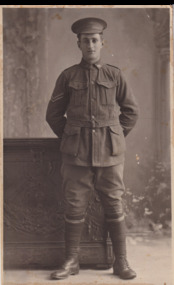 The Beechworth Burke Museum
Postcard
... Force. The record is historically significant due to its connection to World War I. This conflict is integral to Australian culture as it was the single greatest loss of life and the greatest repatriation of casualties in the country's history. Australia’s involvement in the First World War began when the Australian government established the Australian Imperial Force (AIF) in August 1914. Immediately, men were recruited to serve the British Empire in the Middle East and on the Western Front. The first significant Australian action of the war was the Australian Naval and Military Expeditionary ...Taken on an unknown date, depicted is a full-length portrait of a young, unidentified male soldier. He is dressed in an Australian military uniform. It is believed that this soldier was part of The Australian Imperial Force during World War I. This can be inferred by the chevron rank insignia visible on the uniform. The placement of this insignia on the sleeve of the right arm suggests that this soldier was either a Warrant Officer or a Non-Commissioned Officer (NCO). Specifically, the number of chevron stripes - here, there are two - are believed to signify a Corporal rank. The man in this photograph is also wearing a 'Rising Sun' collar badge on his coat. Australia, unlike most other Commonwealth countries, did not adopt metal regimental badges during the First World War. All units were issued with the Australian Army General Service Badge, better known as the 'Rising Sun’ badge. This insignia is almost always identified with the Australian Imperial Force.The record is historically significant due to its connection to World War I. This conflict is integral to Australian culture as it was the single greatest loss of life and the greatest repatriation of casualties in the country's history. Australia’s involvement in the First World War began when the Australian government established the Australian Imperial Force (AIF) in August 1914. Immediately, men were recruited to serve the British Empire in the Middle East and on the Western Front. The first significant Australian action of the war was the Australian Naval and Military Expeditionary Force’s (ANMEF) landing on Rabaul on 11 September 1914. The ANMEF took possession of German New Guinea at Toma on 17 September 1914 and of the neighbouring islands of the Bismarck Archipelago in October 1914. On 25 April 1915, members of the AIF landed on Gallipoli in Turkey with troops from New Zealand, Britain, and France. This specific event holds very strong significance within Australian history. The record has strong research potential. This is due to the ongoing public and scholarly interest in war, history, and especially the ANZAC legend, which is commemorated annually on 25 April, known as ANZAC Day.Black and white rectangular postcard printed on card.Reverse: Mendelssohn & Co., / Swanston St., Melbourne / POST CARD / KODAK / CORRESPONDENCE / ADDRESS ONLY / AUSTRAL / AUSTRAL / KODAK / BMM 2640.3 /military album, world war i, wwi, corporal, portrait, soldier, australian imperial force, aif, postcard, uniform -
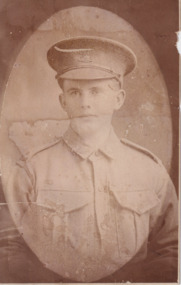 The Beechworth Burke Museum
Postcard
... Force. The record is historically significant due to its connection to World War I. This conflict is integral to Australian culture as it was the single greatest loss of life and the greatest repatriation of casualties in the country's history. Australia’s involvement in the First World War began when the Australian government established the Australian Imperial Force (AIF) in August 1914. Immediately, men were recruited to serve the British Empire in the Middle East and on the Western Front. The first significant Australian action of the war was the Australian Naval and Military Expeditionary ...Taken on an unknown date, depicted is a portrait of a young, unidentified male soldier. He is dressed in an Australian military uniform. It is believed that this soldier was part of The Australian Imperial Force during World War I. This can be inferred by the chevron rank insignia visible on the uniform. The placement of this insignia on the sleeve of the right arm suggests that this soldier was either a Warrant Officer or a Non-Commissioned Officer (NCO). Specifically, the number of chevron stripes - here, there are two - are believed to signify a Corporal rank. The man in this photograph is also wearing a 'Rising Sun' collar badge on his coat. Australia, unlike most other Commonwealth countries, did not adopt metal regimental badges during the First World War. All units were issued with the Australian Army General Service Badge, better known as the 'Rising Sun’ badge. This insignia is almost always identified with the Australian Imperial Force.The record is historically significant due to its connection to World War I. This conflict is integral to Australian culture as it was the single greatest loss of life and the greatest repatriation of casualties in the country's history. Australia’s involvement in the First World War began when the Australian government established the Australian Imperial Force (AIF) in August 1914. Immediately, men were recruited to serve the British Empire in the Middle East and on the Western Front. The first significant Australian action of the war was the Australian Naval and Military Expeditionary Force’s (ANMEF) landing on Rabaul on 11 September 1914. The ANMEF took possession of German New Guinea at Toma on 17 September 1914 and of the neighbouring islands of the Bismarck Archipelago in October 1914. On 25 April 1915, members of the AIF landed on Gallipoli in Turkey with troops from New Zealand, Britain, and France. This specific event holds very strong significance within Australian history. The record has strong research potential. This is due to the ongoing public and scholarly interest in war, history, and especially the ANZAC legend, which is commemorated annually on 25 April, known as ANZAC Day.Sepia rectangular postcard printed on card.Reverse: BMM 2640.4 / P RD / Write here for Inland Postage on /military album, aif, australian imperial force, corporal, war, wwi, world war i, rising sun, badge, uniform, military -
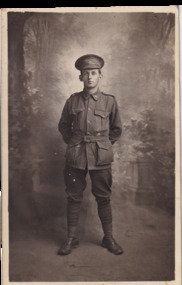 The Beechworth Burke Museum
Postcard
... Force. The record is historically significant due to its connection to World War I. This conflict is integral to Australian culture as it was the single greatest loss of life and the greatest repatriation of casualties in the country's history. Australia’s involvement in the First World War began when the Australian government established the Australian Imperial Force (AIF) in August 1914. Immediately, men were recruited to serve the British Empire in the Middle East and on the Western Front. The first significant Australian action of the war was the Australian Naval and Military Expeditionary ...Taken on an unknown date, depicted is a full-length portrait of a young, unidentified male soldier. He is dressed in an Australian military uniform. It is believed that this soldier was part of The Australian Imperial Force during World War I. This can be inferred by the 'Rising Sun' collar badge on his coat. Australia, unlike most other Commonwealth countries, did not adopt metal regimental badges during the First World War. All units were issued with the Australian Army General Service Badge, better known as the 'Rising Sun’ badge. This insignia is almost always identified with the Australian Imperial Force.The record is historically significant due to its connection to World War I. This conflict is integral to Australian culture as it was the single greatest loss of life and the greatest repatriation of casualties in the country's history. Australia’s involvement in the First World War began when the Australian government established the Australian Imperial Force (AIF) in August 1914. Immediately, men were recruited to serve the British Empire in the Middle East and on the Western Front. The first significant Australian action of the war was the Australian Naval and Military Expeditionary Force’s (ANMEF) landing on Rabaul on 11 September 1914. The ANMEF took possession of German New Guinea at Toma on 17 September 1914 and of the neighbouring islands of the Bismarck Archipelago in October 1914. On 25 April 1915, members of the AIF landed on Gallipoli in Turkey with troops from New Zealand, Britain, and France. This specific event holds very strong significance within Australian history. The record has strong research potential. This is due to the ongoing public and scholarly interest in war, history, and especially the ANZAC legend, which is commemorated annually on 25 April, known as ANZAC Day.Black and white postcard printed on card.Reverse: BMM 2640 / POST CARD / KODAK / 5 CORRESPONDENCE / ADDRESS ONLY / AUSTRAL / AUSTRAL / KODAK / R. McGEEHAN, PHOTO, 57 ELM GROVE RIPPONLEA, / EXTRA COPIES & ENLARGEMENTS OBTAINABLE. /military album, military, war, world war i, wwi, australian imperial force, aif, rising sun, uniform, portrait -
 The Beechworth Burke Museum
Photograph
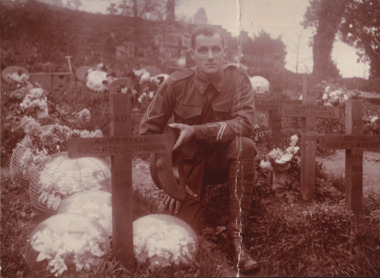
... First World War began when the Australian government established the Australian Imperial Force (AIF) in August 1914. Immediately, men were recruited to serve the British Empire in the Middle East and on the Western Front. The first significant Australian action of the war was the Australian Naval and Military Expeditionary ...Taken on an unknown date, depicted is a portrait of a young, unidentified male soldier kneeling beside a grave in a cemetery. He is dressed in an Australian military uniform. The cemetery pictured is the Arnos Vale Cemetery in Bristol, United Kingdom. There are multiple crosses marking graves in this photograph, all marked in memory of different soldiers who fought with the Australian Imperial Force (AIF) during World War I. It is believed that the soldier who is kneeling was also part of the Australian Imperial Force. This can be inferred by the chevron rank insignia visible on the uniform. The placement of this insignia on the sleeve of the right arm suggests that this soldier was either a Warrant Officer or a Non-Commissioned Officer (NCO). Another signifier of the Australian Imperial Force uniform are the three inverted chevron stripes positioned on the lower part of the left sleeve, near the wrist. These are called Good Conduct Stripes and were worn by Warrant Officers and NCOs. This patch consisted of a single chevron stripe for each year of military service meeting certain requirements of good conduct. Additionally, the man in this photograph is also wearing a 'Rising Sun' collar badge on his coat. Australia, unlike most other Commonwealth countries, did not adopt metal regimental badges during the First World War. All units were issued with the Australian Army General Service Badge, better known as the 'Rising Sun’ badge. This insignia is almost always identified with the Australian Imperial Force. Furthermore, the grave that this unidentified soldier is kneeling next to is the resting place of Private John James (J. J.) Simpson. He was born in Stanley, Victoria in 1883. He enlisted in the Australian Imperial Force in Melbourne, Victoria on 12 July, 1915, with the service number 4909. John James Simpson was then posted to the 60th Company Depot at Seymour for military recruit training. John James Simpson was reported wounded in action in France on 19 July, 1916. He was admitted to 13th General Hospital, France with gunshot wounds to his legs. From Boulogne, France, he traveled to the United Kingdom aboard the Hospital Ship 'St. Denis' for medical care. Upon arrival, he was admitted to 2nd Southern General Hospital, Bristol, England on 27 July, 1916. John James Simpson passed away from his wounds on 1 August, 1916. He was 33 years old.The record is historically significant due to its connection to World War I. This conflict is integral to Australian culture as it was the single greatest loss of life and the greatest repatriation of casualties in the country's history. Australia’s involvement in the First World War began when the Australian government established the Australian Imperial Force (AIF) in August 1914. Immediately, men were recruited to serve the British Empire in the Middle East and on the Western Front. The first significant Australian action of the war was the Australian Naval and Military Expeditionary Force’s (ANMEF) landing on Rabaul on 11 September 1914. The ANMEF took possession of German New Guinea at Toma on 17 September 1914 and of the neighbouring islands of the Bismarck Archipelago in October 1914. On 25 April 1915, members of the AIF landed on Gallipoli in Turkey with troops from New Zealand, Britain, and France. This specific event holds very strong significance within Australian history. The record has strong research potential. This is due to the ongoing public and scholarly interest in war, history, and especially the ANZAC legend, which is commemorated annually on 25 April, known as ANZAC Day.Sepia rectangular photograph printed on matte photographic paper mounted on card.Obverse: A.I.F. / AUSTRALIA / 441, PTE.T. / T (?) / 26B (?) / 6.1.17 / (?) / LANGTON RD. / ST. ANNES PK. / BRISTOL / A.I.F. / AUSTRALIA. / 708, GNR B.L.CRAWFORD. / FR / 5 D.A.C. / 13.2.17 / A.I.F. / AUSTRALIA. / 4481, P (?) D.MORRIS. / (?) / 31.12.(?) / A.I.F. / AUSTRALIA. / 4909, PTE J.J.SIMPSON. / 608(?) / 1.8.16 / Winchester / LANGTON RD. / ST. ANNES PK / BRISTOL / Reverse: 2641 /military album, military, war, world war i, wwi, australian imperial force, aif, j. j. simpson, uniform, cemetery -
 The Beechworth Burke Museum
Postcard, 1916
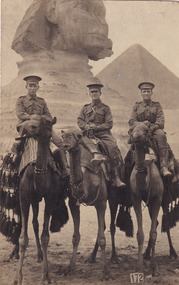
... first contingent of the AIF departed Australia by ship in November 1914. England was their destination. Although, their convoy was diverted to Egypt after the Australian High Commissioner in London, Sir George Reid, and the British military authorities unanimously agreed that the overcrowded military camps in England were unsuitable for so many men over winter. The AIF disembarked in Alexandria, Egypt on 3 December 1914, and the men moved to training camps near Cairo. It was in Egypt that the AIF and the New Zealand Expeditionary Force...first contingent of the AIF departed Australia by ship in November 1914. England was their destination. Although, their convoy was diverted to Egypt after the Australian High Commissioner in London, Sir George Reid, and the British military authorities unanimously agreed that the overcrowded military camps in England were unsuitable for so many men over winter. The AIF disembarked in Alexandria, Egypt on 3 December 1914, and the men moved to training camps near Cairo. It was in Egypt that the AIF and the New Zealand Expeditionary Force ...The photograph on the obverse side of the postcard was taken in Egypt on 4 March 1916, during World War I. Depicted are three unidentified Australian soldiers part of the Australian Imperial Force. They are dressed in military uniforms. Each of these men are seated atop a camel's back. All three camels are draped in - what are believed to be - traditional Egyptian textiles, including tassels, carpets and beads. In the background, we can see a triangular pyramid and the Great Sphinx of Giza. The Australian Imperial Force (AIF) were established by the Australian government in August 1914. This announcement marked the beginning of Australia's involvement in World War I. Immediately, men were recruited to serve the British Empire in the Middle East and on the Western Front. The first contingent of the AIF departed Australia by ship in November 1914. England was their destination. Although, their convoy was diverted to Egypt after the Australian High Commissioner in London, Sir George Reid, and the British military authorities unanimously agreed that the overcrowded military camps in England were unsuitable for so many men over winter. The AIF disembarked in Alexandria, Egypt on 3 December 1914, and the men moved to training camps near Cairo. It was in Egypt that the AIF and the New Zealand Expeditionary Force (NZEF) formed one united corps - the Australian and New Zealand Army Corps (ANZAC). This group of troops trained in the desert beneath the pyramids until March 1915.The record is historically significant due to its connection to World War I. This conflict is integral to Australian culture as it was the single greatest loss of life and the greatest repatriation of casualties in the country's history. On 25 April 1915, members of the Australian Imperial Force landed on Gallipoli in Turkey with troops from New Zealand, Britain, and France. This specific event holds very strong significance within Australian history. The record has strong research potential. This is due to the ongoing public and scholarly interest in war, history, and especially the ANZAC legend, which is commemorated annually on 25 April, known as ANZAC Day. The record's unique research potential is strengthened by its relationship to a historically significant site: the Egyptian pyramids. Since the postcard was produced in 1916, the record can be used as primary evidence for historians and conservationists studying these sites, or how these sites have evolved over time. The record may also be a useful resource for those interested in the history of Egyptian textiles. Furthermore, it may also provide insight into international relations between Egypt and Australia in the past and present.Sepia rectangular postcard printed on paper.Obverse: 172 / Reverse: 6536 / CARTE POSTALE / 4/3/16 / Rough riders under / the shadow of the / pyramids /military album, army, war, wwi, world war i, egypt, pyramid, great sphinx of giza, textiles, australian imperial force, aif, uniform -
 The Beechworth Burke Museum
Postcard, 1918
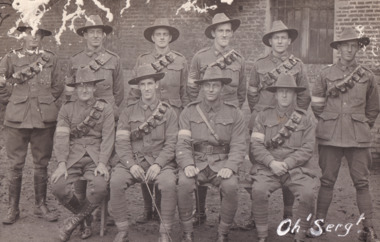
... First World War began when the Australian government established the Australian Imperial Force (AIF) in August 1914. Immediately, men were recruited to serve the British Empire in the Middle East and on the Western Front. The first significant Australian action of the war was the Australian Naval and Military Expeditionary ...It is believed that the photograph on the obverse side of the postcard was taken in 1918. Depicted are ten Australian male soldiers. Their names are transcribed in pencil on the reverse side of the postcard. Each soldier is dressed in a formal military uniform. It is believed that these soldiers were part of The Australian Imperial Force during World War I. This can be inferred by the chevron rank insignia visible on the uniforms of nine of ten men. The placement of this insignia on the sleeves of their right arms suggests that they were either Warrant Officers or Non-Commissioned Officers (NCO). Specifically, the number of chevron stripes - here, nine men have three - are believed to signify a Corporal rank. The men pictured on this postcard are also wearing 'Rising Sun' collar badges on their coats. Australia, unlike most other Commonwealth countries, did not adopt metal regimental badges during the First World War. All units were issued with the Australian Army General Service Badge, better known as the 'Rising Sun’ badge. This insignia is almost always identified with the Australian Imperial Force. Another characteristic of the Australian Imperial Force uniform are the rectangular colour patches worn by all men on this postcard. In March 1915, a new scheme of unit identification was devised to replace the wearing of unit titles. This consisted of cloth colour patches on the upper arms of a soldier’s tunic. The black and white nature of the record means that we cannot establish which battalion these soldiers were part of. However, one of the handwritten signatures on the reverse side of the postcard reads "W.A. Griggs". This was the signature of Sergeant William Archibald Griggs. Further research shows that Griggs was part of the 5th Australian Division Signals Company. Therefore, it is believed these soldiers were part of the ANZAC Signal Companies. The main role of the Signal Companies during World War I was the laying and maintenance of telephone cables and switchboards, used to connect various units in their area. Furthermore, the man standing in the back row, third from the left side, has an Overseas Service chevron patch on his coat. In January 1918, the Australian Imperial Force approved the wearing of the overseas service chevrons which had been adopted by the British Army. These were embroidered or woven inverted chevrons worn above the cuff on the right arm. Due to a shortage of supply, some men had chevrons privately made. For each year of war service, a blue chevron was awarded, and those men who had embarked in 1914 received a red chevron to indicate that year’s service; however, the black and white nature of the postcard makes it difficult to determine what colours are on this man's patch.The record is historically significant due to its connection to World War I. This conflict is integral to Australian culture as it was the single greatest loss of life and the greatest repatriation of casualties in the country's history. Australia’s involvement in the First World War began when the Australian government established the Australian Imperial Force (AIF) in August 1914. Immediately, men were recruited to serve the British Empire in the Middle East and on the Western Front. The first significant Australian action of the war was the Australian Naval and Military Expeditionary Force’s (ANMEF) landing on Rabaul on 11 September 1914. The ANMEF took possession of German New Guinea at Toma on 17 September 1914 and of the neighbouring islands of the Bismarck Archipelago in October 1914. On 25 April 1915, members of the AIF landed on Gallipoli in Turkey with troops from New Zealand, Britain, and France. This specific event holds very strong significance within Australian history. The record has strong research potential. This is due to the ongoing public and scholarly interest in war, history, and especially the ANZAC legend, which is commemorated annually on 25 April, known as ANZAC Day.Black and white rectangular postcard printed on paper.Obverse: Oh 'Serg!' / Reverse: CARTE POSTALE / 6537 / Correspondance / Adresse / w.a. Grigg / J. Fain / Ruckling / R.J Farrar / (?) / Clarke / L (?) / GFFisher / R. M. Forrest / With Compliments / Sgt's Mess / November 1918 /military album, army, aif, uniform, military, wwi, world war i, rising sun badge, william archibald griggs, anzac, signal companies, postcard, patches, chevron -
 The Beechworth Burke Museum
Postcard
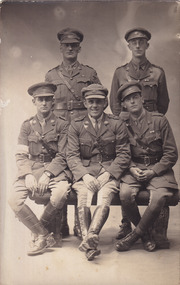
... First World War began when the Australian government established the Australian Imperial Force (AIF) in August 1914. Immediately, men were recruited to serve the British Empire in the Middle East and on the Western Front. The first significant Australian action of the war was the Australian Naval and Military Expeditionary ...The photograph on the obverse side of the postcard was taken some time between 1914-1918. Depicted are five unidentified Australian soldiers. They are all dressed in military uniforms. It is believed that these soldiers were part of The Australian Imperial Force during World War I. This can be inferred by the 'Rising Sun' collar badges on their coats. Australia, unlike most other Commonwealth countries, did not adopt metal regimental badges during the First World War. All units were issued with the Australian Army General Service Badge, better known as the 'Rising Sun’ badge. This insignia is almost always identified with the Australian Imperial Force. Another characteristic of the Australian Imperial Force uniform are rectangular colour patches. One is visible on the soldier in the front row, first from the left on this postcard. In March 1915, a new scheme of unit identification was devised to replace the wearing of unit titles. This consisted of cloth colour patches on the right arms of a soldier’s tunic. The sepia nature of the record means that we cannot determine the colour, and therefore cannot establish which battalion this soldier was part of. Furthermore, the man seated in the middle of the front row has an Overseas Service chevron patch on his coat. In January 1918, the Australian Imperial Force approved the wearing of the overseas service chevrons which had been adopted by the British Army. These were embroidered or woven inverted chevrons worn above the cuff on the right arm. Due to a shortage of supply, some men had chevrons privately made. For each year of war service, a blue chevron was awarded, and those men who had embarked in 1914 received a red chevron to indicate that year’s service; however, the sepia nature of the postcard makes it difficult to determine what colours are on this man's patch.The record is historically significant due to its connection to World War I. This conflict is integral to Australian culture as it was the single greatest loss of life and the greatest repatriation of casualties in the country's history. Australia’s involvement in the First World War began when the Australian government established the Australian Imperial Force (AIF) in August 1914. Immediately, men were recruited to serve the British Empire in the Middle East and on the Western Front. The first significant Australian action of the war was the Australian Naval and Military Expeditionary Force’s (ANMEF) landing on Rabaul on 11 September 1914. The ANMEF took possession of German New Guinea at Toma on 17 September 1914 and of the neighbouring islands of the Bismarck Archipelago in October 1914. On 25 April 1915, members of the AIF landed on Gallipoli in Turkey with troops from New Zealand, Britain, and France. This specific event holds very strong significance within Australian history. The record has strong research potential. This is due to the ongoing public and scholarly interest in war, history, and especially the ANZAC legend, which is commemorated annually on 25 April, known as ANZAC Day.Sepia rectangular postcard printed on paper.Reverse: CARTE POSTALE / hyossest (?) / 6538 /military album, army, aif, australian imperial force, postcard, wwi, world war i, portrait, soldiers -
 City of Moorabbin Historical Society (Operating the Box Cottage Museum)
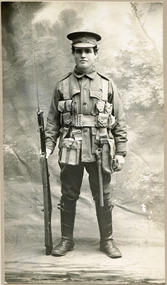
Photograph, 1916 William Henry Thomas in WW1 Uniform, 1916 William Henry Thomas in WW1 Uniform, 1916
... first ww...world war one...uniform...wickham road...south brighton...moorabbin...world war 1 1914- 1918, thomas street,early settlers, pioneers, market gardeners, australian infantry force, soldiers, key's cup, victorian war memorials, cheltenham, mckinnon,...keys road moorabbin...ss castalia, british expeditionary...Private Thomas returned to Australia on the hospital transport Castalia 13 April 1919 and his enlistment was terminated 26 September 1919 Private William Henry Thomas and his family are examples of the patriotism exhibited by the market gardeners, and indeed throughout Australia, during the World War 1 1914-1918. william henry thomas 1916 1894 first ww world war one uniform wickham road south brighton moorabbin world war 1 1914- 1918, thomas street,early settlers, pioneers, market gardeners, australian infantry force, soldiers, key's cup, victorian war memorials, cheltenham, mckinnon, keys road moorabbin ss castalia, british expeditionary force ww1 1914- 1918, 24th battalion 1st aif, 6th australian machine gun company 1st aif, influenza epidemic 1919, alexandria egypt, methodist church, Front of Mount : Ainor Studio Auburn Back of Mount : William Henry Thomas / 1st World War 1916 / Keys Rd., Moorabbin / Born 1894 / Christened at Wesleyan ( Methodist ) Church / Wickham Rd., / South Brighton / now Uniting Church unsigned undated Photograph is black and white. ...1916 William Henry Thomas of Keys Road , South Brighton (now Moorabbin ) in WW 1 1914 -1918 1st AIF uniform. William was born in 1894 , Christened at the Wesleyan Church. (Methodist), Wickham Road, South Brighton and attended Moorabbin State School. . Private Thomas was a market gardener in Moorabbin prior to his enlistment in the Australian Imperial Force on 19 July 1915. Both his parents wrote separate letters giving their consent for their son to serve overseas due to " the pressing request of my son William Henry, also the urgent need of recruits do give my consent that he shall go to the front." September 29th 1915 he left Australia with the 5th Reinforcements of the 24th Battalion for Egypt. March 1916 he was hospitalised with Mumps and shortly after left Alexandria to join the British Expeditionary Force for France where he transferred to the 6th Australian Machine Gun Company.. Whilst on leave in England he received medical attention before returning to France and 13 November 1918 he spent a week in the care of the 7rh Field Ambulance suffering with influenza . Private Thomas returned to Australia on the hospital transport Castalia 13 April 1919 and his enlistment was terminated 26 September 1919Private William Henry Thomas and his family are examples of the patriotism exhibited by the market gardeners, and indeed throughout Australia, during the World War 1 1914-1918. Photograph is black and white. William Henry Thomas is standing straight and tall in the centre of the photograph, looking directly at the photographer while holding a weapon in his right hand. He is in his military uniform (WW1) .Front of Mount : Ainor Studio Auburn Back of Mount : William Henry Thomas / 1st World War 1916 / Keys Rd., Moorabbin / Born 1894 / Christened at Wesleyan ( Methodist ) Church / Wickham Rd., / South Brighton / now Uniting Church unsigned undatedwilliam henry thomas, 1916, 1894, first ww, world war one, uniform, wickham road, south brighton, moorabbin, world war 1 1914- 1918, thomas street,early settlers, pioneers, market gardeners, australian infantry force, soldiers, key's cup, victorian war memorials, cheltenham, mckinnon,, keys road moorabbin, ss castalia, british expeditionary force ww1 1914- 1918, 24th battalion 1st aif, 6th australian machine gun company 1st aif, influenza epidemic 1919, alexandria egypt, methodist church, -
 Bendigo Military Museum
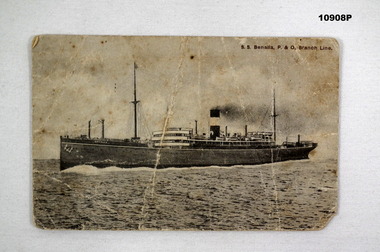
Photograph - PHOTOGRAPHIC POSTCARD, HMAT BENALLA, H.M. Flatt, c.WW1
... It was part of the first convoy of ships transporting troops of the Australian Expeditionary Force out of Albany W.A, in November 1914. ...It was part of the first convoy of ships transporting troops of the Australian Expeditionary Force out of Albany W.A, in November 1914. ...S.S. Benalla was a WW1 troopship renamed HMAT A24 Benalla. It was part of the first convoy of ships transporting troops of the Australian Expeditionary Force out of Albany W.A, in November 1914. Part of the Meade Collection. See Cat 10785P for details of service for "Ernest James Meade" No. 2112.Black and white photographic postcard of a ship under steam at sea. Single funnel with mast fore and aft. Name of ship on bow "BENALLA". Blank postcard format in brown type on back.Printed in brown lettering on top RH Corner; "S.S. BENALLA, P & O BRANCH LINE"meade collection, ernest james meade, postcard, hmat benalla, australian expeditionary force, ww1, troopship -
 Waverley RSL Sub Branch
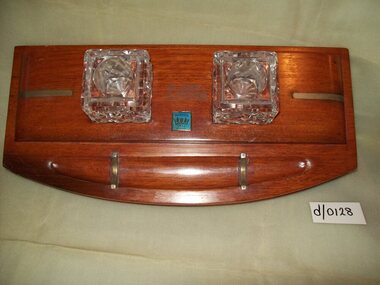
Desk Set H.M.A.S. Sydney
... During the early stages of World War I, Sydney was involved in supporting the Australian Naval and Military Expeditionary Force, and escorting the first ANZAC convoy. On 9 November 1914, the cruiser defeated the German cruiser SMS Emden at the Battle of Cocos. ...During the early stages of World War I, Sydney was involved in supporting the Australian Naval and Military Expeditionary Force, and escorting the first ANZAC convoy. On 9 November 1914, the cruiser defeated the German cruiser SMS Emden at the Battle of Cocos. ...HMAS Sydney was a Chatham class light cruiser of the Royal Australian Navy (RAN). Laid down in 1911 and launched in 1912, the cruiser was commissioned into the RAN in 1913. During the early stages of World War I, Sydney was involved in supporting the Australian Naval and Military Expeditionary Force, and escorting the first ANZAC convoy. On 9 November 1914, the cruiser defeated the German cruiser SMS Emden at the Battle of Cocos. During 1915 and 1916, Sydney operated on the North America and West Indies Station, before joining the 2nd Light Cruiser Squadron at Greenock, Scotland in November 1916. On 4 May 1917, the cruiser was involved in an inconclusive action against the German zeppelin L43; neither was damaged. During late 1917, Sydney became the first Australian warship to launch an aircraft, and the first warship to do so from a rotatable platform. After the war's end, Sydney spent a year in reserve before being reactivated to serve as Flagship of the RAN. The cruiser was decommissioned in 1928 and broken up for scrap. Several sections of the ship, including her bow and foremast, have been preserved as monuments, and three of the ship's main guns saw later use in shore fortifications.A number of these desk sets were manufactured and given to the Headmasters of selected schools throughout Australia in recognition of the efforts of school children in assisting the War effort during World War IMade from timber extracted from a companionway or staircase in the battle cruiser H.M.A.S. Sydney 2 x 5 cm.square glass containers are fitted. Blue attachment advising,wood from H.M.A.S. Sydney h.m.a.s. sydney, desk set, r.a.n -
 Bendigo Military Museum
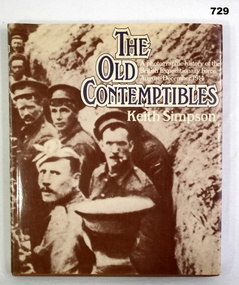
Book - BOOKS, Keith Simpson, The Old Contemptibles: A Photographic History of the British Expeditionary Force August-December 1914, 1982
... first page "From Bishop Noel Daly's collection 2004" Tan coloured hardcover with dust jacket. Front of dust jacket has sepia photo of several soldiers standing in a trench. Back cover has four smaller photos. The Old Contemptibles: A Photographic History of the British Expeditionary Force ...Tan coloured hardcover with dust jacket. Front of dust jacket has sepia photo of several soldiers standing in a trench. Back cover has four smaller photos.Written on first page "Sister M Seagrave" Sticker on first page "From Bishop Noel Daly's collection 2004"books, military history -
 Myrtleford and District Historical Society
Memorial Plaque, Memorial Plaque Factory, "Dead Man's Penny", Circa 1921
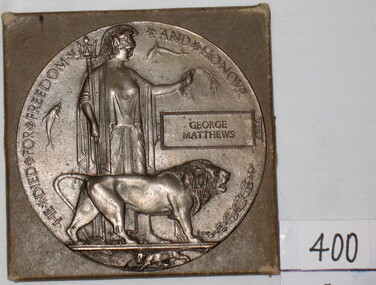
... First World War. George enlisted with the Otago Regiment, New Zealand Expeditionary Force as a rifleman. ...First World War. George enlisted with the Otago Regiment, New Zealand Expeditionary Force as a rifleman. ...The "Dead Man's Penny" of Private George Matthews (24/1744) is a district link to the First World War. George enlisted with the Otago Regiment, New Zealand Expeditionary Force as a rifleman. Born in 1891, he was a former pupil of Myrtleford State School 955 and was one of four first cousins killed in action and recorded in a memorial window and honour board at the Uniting (formerly Methodist) Church, the Soldier's Memorial Square and on the State School Honour Board. George's parents, John and Mary Matthews,received the plaque in a pack, together with a letter and commemorative scroll from King George V. George Matthews is buried at the Caterpillar Valley (N.Z.) Memorial, France, having died on October 1, 1916, aged 25. The memorial plaque links local family tragedy to world conflict. It represents the impact of such events must have had on small town communities. George Matthews' enlistment in New Zealand is an indicator of the migratory nature of men involved in gold mining after the decline of the industry in Victoria and New South Wales in the late 19th centuryA World War 1 memorial plaque issued to next-of-kin of all British and Empire service personnel who died as a result of the war. They were round and cast in bronze, hence their similarity to the much smaller penny coin. The plaque includes an image of Britannia, holding a trident and standing with a lion. Britannia holds an oak leaf above the deceased's name, which is recorded without rank. Two dolphins swim around Britannia, symbolizing sea power, and at the base a second lion is tearing apart the German eagle. Around the picture a legend reads: "He died for freedom and Honour"Name engraved: GEORGE MATTHEWSmemorial plaque dead man's penny george matthews -
 Stawell RSL Sub Branch War Museum
Certificate of Discharge, Australian Military Forces, Document, June 1919
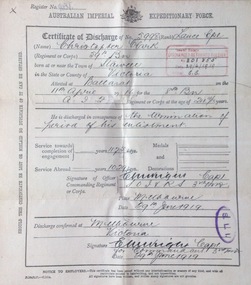
... WW1 Australian Imperial Expeditionary Force Certificate of Discharge of Soldier No 5998 Christopher Clark Australian Imperial Expeditionary Force WW1,59th Battalion Christopher Clark was born in Stawell on 25th December 1892 and was brought up on the family farm in Callawdda and worked in the district and then in Queensland where he obtained an engine drivers licence and drove the sugar trains then worked on the steam boiler engines in the sugar mills. When the First...WW1 Australian Imperial Expeditionary Force Certificate of Discharge No 5998 Christopher Clark 59th Battalion Born in Stawell Christopher was a WW1 Serviceman from Stawell ww1 serviceman soldiers military stawell Form is filled out for soldier Christopher Clark WW1 Australian Imperial Expeditionary Force Certificate of Discharge of Soldier No 5998 Christopher Clark Australian Imperial Expeditionary Force WW1,59th Battalion Christopher Clark was born in Stawell on 25th December 1892 and was brought up on the family farm in Callawdda and worked in the district and then in Queensland where he obtained an engine drivers licence and drove the sugar trains then worked on the steam boiler engines in the sugar mills. When the First ...Each soldier had one of these forms filled out on Discharge from the army. WW1 Australian Imperial Expeditionary Force Certificate of Discharge No 5998 Christopher Clark 59th Battalion Born in StawellChristopher was a WW1 Serviceman from Stawell WW1 Australian Imperial Expeditionary Force Certificate of Discharge of Soldier No 5998 Christopher Clark Australian Imperial Expeditionary Force WW1,59th Battalion Christopher Clark was born in Stawell on 25th December 1892 and was brought up on the family farm in Callawdda and worked in the district and then in Queensland where he obtained an engine drivers licence and drove the sugar trains then worked on the steam boiler engines in the sugar mills. When the First World War started he came back to Stawell and enlisted in the army on 11/4/1916. He was sent to France in the 59th Battalion. He was in the army 1175 days, serving 1029 days abroad. During his service he was promoted to Lance Corporal. Details from his daughter Ruth Clark of Ararat December 2017.Form is filled out for soldier Christopher Clarkww1, serviceman, soldiers, military, stawell -
 Stawell RSL Sub Branch War Museum
Protograph of WW1 soldier Christopher Clark, Portrait WW2 Soldier Christopher Clark, Approx 1916
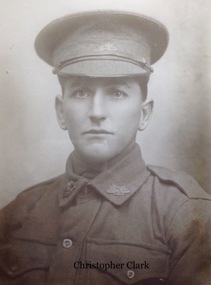
... Framed Studio Portrait of Soldier No 5998 Christopher Clark Australian Imperial Expeditionary Force WW1,59th Battalion Christopher Clark was born in Stawell on 25th December 1892 and was brought up on the family farm in Callawdda and worked in the district and then in Queensland where he obtained an engine drivers licence and drove the sugar trains then worked on the steam boiler engines in the sugar mills. When the First...Soldier in WW1 Australian Imperial Expeditionary Force No 5998 Christopher Clark 59th Battalion Born in Stawell Christopher was a WW1 Serviceman from Stawell who returned to Australia ww1 serviceman soldiers military stawell Framed Studio Portrait of Soldier No 5998 Christopher Clark Australian Imperial Expeditionary Force WW1,59th Battalion Christopher Clark was born in Stawell on 25th December 1892 and was brought up on the family farm in Callawdda and worked in the district and then in Queensland where he obtained an engine drivers licence and drove the sugar trains then worked on the steam boiler engines in the sugar mills. When the First ...Soldier in WW1 Australian Imperial Expeditionary Force No 5998 Christopher Clark 59th Battalion Born in StawellChristopher was a WW1 Serviceman from Stawell who returned to Australia Framed Studio Portrait of Soldier No 5998 Christopher Clark Australian Imperial Expeditionary Force WW1,59th Battalion Christopher Clark was born in Stawell on 25th December 1892 and was brought up on the family farm in Callawdda and worked in the district and then in Queensland where he obtained an engine drivers licence and drove the sugar trains then worked on the steam boiler engines in the sugar mills. When the First World War started he came back to Stawell and enlisted in the army on 11/4/1916. He was sent to France in the 59th Battalion. He was in the army 1175 days, serving 1029 days abroad. During his service he was promoted to Lance Corporal. Details from his daughter Ruth Clark of Ararat December 2017.ww1, serviceman, soldiers, military, stawell -
 Stawell RSL Sub Branch War Museum
Certificate of Appreciation from Stawell Borough and Shire for WW1 soldier Christopher Clark, Certificate of Appreciation, Approx 1916
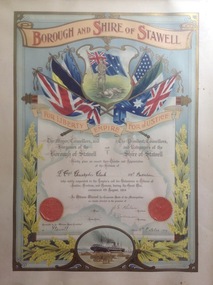
... Framed Certificate of Appreciation for Soldier No 5998 Christopher Clark Australian Imperial Expeditionary Force WW1, 59th Battalion Christopher Clark was born in Stawell on 25th December 1892 and was brought up on the family farm in Callawdda and worked in the district and then in Queensland where he obtained an engine drivers licence and drove the sugar trains then worked on the steam boiler engines in the sugar mills. When the First...Soldier in WW1 Australian Imperial Expeditionary Force No 5998 Christopher Clark 59th Battalion Born in Stawell Christopher was a WW1 Serviceman from Stawell ww1 serviceman soldiers military stawell Soldier No 5998 Christopher Clark Australian Imperial Expeditionary Force WW1 59th Battalion Born in Stawell Framed Certificate of Appreciation for Soldier No 5998 Christopher Clark Australian Imperial Expeditionary Force WW1, 59th Battalion Christopher Clark was born in Stawell on 25th December 1892 and was brought up on the family farm in Callawdda and worked in the district and then in Queensland where he obtained an engine drivers licence and drove the sugar trains then worked on the steam boiler engines in the sugar mills. When the First ...Soldier in WW1 Australian Imperial Expeditionary Force No 5998 Christopher Clark 59th Battalion Born in StawellChristopher was a WW1 Serviceman from Stawell Framed Certificate of Appreciation for Soldier No 5998 Christopher Clark Australian Imperial Expeditionary Force WW1, 59th Battalion Christopher Clark was born in Stawell on 25th December 1892 and was brought up on the family farm in Callawdda and worked in the district and then in Queensland where he obtained an engine drivers licence and drove the sugar trains then worked on the steam boiler engines in the sugar mills. When the First World War started he came back to Stawell and enlisted in the army on 11/4/1916. He was sent to France in the 59th Battalion. He was in the army 1175 days, serving 1029 days abroad. During his service he was promoted to Lance Corporal. Details from his daughter Ruth Clark of Ararat December 2017. Soldier No 5998 Christopher Clark Australian Imperial Expeditionary Force WW1 59th Battalion Born in Stawellww1, serviceman, soldiers, military, stawell -
 Wangaratta RSL Sub Branch
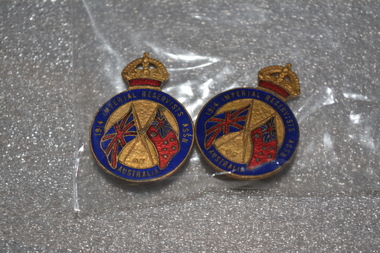
Badge - Badge - 1914 Imperial Reservists, c1914
... first troop convoy to leave Australia in November 1914. These men were distinct from the newly formed Australian Imperial Force (AIF), which was raised in August 1914 for service under the Australian government, although many Australian citizens volunteered for service. British Imperial Reservists (IRs) who were living in Australia were recalled to the British Expeditionary ...In 1914, approximately 6,000 Imperial Reservists—men who had previously served in British regiments, emigrated and were living in Australia. Upon the outbreak of war in August 1914, these men were recalled to serve with their old British units. Many of these reservists sailed in the first troop convoy to leave Australia in November 1914. These men were distinct from the newly formed Australian Imperial Force (AIF), which was raised in August 1914 for service under the Australian government, although many Australian citizens volunteered for service.British Imperial Reservists (IRs) who were living in Australia were recalled to the British Expeditionary Forces in World War One (WWI). Reservists sailed from Melbourne, Victoria on the HMAT Miltiades as part of the first convoy (Convoy 1) of troops leaving Australia in October 1914.Gold badge with crown on top, blue around outside, with Union Jack and Red Ensign in the middle. Has a horse shoe hook on back with a number.On front: 1914 Imperial reservists Assn, Australia. On back: One has 96, the other 69.wwi, world war 1, imperial reservists, australia -
 Kew Historical Society Inc
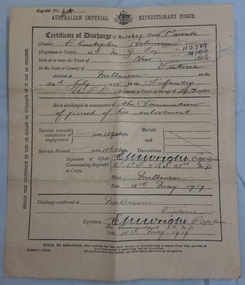
Photograph - Document, Australian Imperial Expeditionary Force, Certificate of Discharge, Private Christopher Robinson, V12637, 1919
... expeditionary force...certificates of discharge - first world war...christopher robinson australian imperial expeditionary force certificates of discharge - first world war Document recording the discharge of Private Christopher Robinson from the First AIF in 1919. ...Document recording the discharge of Private Christopher Robinson from the First AIF in 1919. He is described as a Salesman and his address pre and post enlistment is given as 11 St John's Parade, Kew, his family home..christopher robinson, australian imperial expeditionary force, certificates of discharge - first world war -
 Department of Energy, Environment and Climate Action
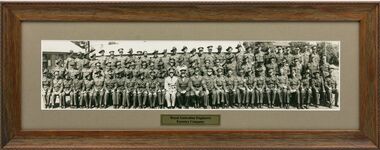
Photo - Royal Australian Engineers - Forestry Company
... Soon after the outbreak of World War Two, the British Government requested experienced forestry soldiers from Australia, New Zealand and Canada to be deployed in France as part of the British Expeditionary Force. The first Forestry Company (2/1) was based in Sydney with men from NSW, Queensland and South Australia, led by Captain Cyril Richard Cole, a professional forester from the Australian Capital Territory. ...Soon after the outbreak of World War Two, the British Government requested experienced forestry soldiers from Australia, New Zealand and Canada to be deployed in France as part of the British Expeditionary Force. The first Forestry Company (2/1) was based in Sydney with men from NSW, Queensland and South Australia, led by Captain Cyril Richard Cole, a professional forester from the Australian Capital Territory. ...Soon after the outbreak of World War Two, the British Government requested experienced forestry soldiers from Australia, New Zealand and Canada to be deployed in France as part of the British Expeditionary Force. The first Forestry Company (2/1) was based in Sydney with men from NSW, Queensland and South Australia, led by Captain Cyril Richard Cole, a professional forester from the Australian Capital Territory. The second Forestry Company (2/2) included many Forests Commission staff, local sawmillers and experienced bushmen from Victoria, WA and Tasmania including veterans of the First World War. They were led by Captain Andrew Leonard (Ben) Benallack, a graduate from the Victorian School of Forestry in 1922. Both Forestry Companies sailed from Fremantle on the Stratheden in late May 1940 and landed in England not long after the evacuation of Dunkirk. The foresters were recalled to Australia at the insistence of Prime Minister John Curtin in late 1943 because of the War in the Pacific. After reequipping and some refresher training in jungle warfare at Kapooka the 2/2 Forestry Company was deployed to Lae in Papua New Guinea in May 1944. This photograph was probably taken in Australia before deployment to PNG.Photo in wooden frame of Royal Australian Engineers Forestry Company
