
Showing 18 items matching "flight director"
-
 Moorabbin Air Museum
Manual (Item) - Flight Director System - General Dynamics
... Flight Director System - General Dynamics...Flight Director System - General Dynamics...Flight Director System - General Dynamics Manual Flight Director System - General Dynamics ... -
Moorabbin Air Museum
Manual (Item) - Collins Flight Director Indicator Overhaul Manual with Illustrated Parts Catalogue, Collins Instruction Book: 329B-7 Flight Director Indicator
... Collins Flight Director Indicator Overhaul Manual with Illustrated Parts Catalogue...Collins Instruction Book: 329B-7 Flight Director Indicator...Orange soft-cover book Collins Instruction Book: 329B-7 Flight Director Indicator Manual Collins Flight Director Indicator Overhaul Manual with Illustrated Parts Catalogue ... -
Moorabbin Air Museum
Manual (Item) - Collins Avionics 329B-8G Flight Director Indicator
... Collins Avionics 329B-8G Flight Director Indicator ...Collins Avionics 329B-8G Flight Director Indicator ...Collins Avionics 329B-8G Flight Director Indicator Manual Collins Avionics 329B-8G Flight Director Indicator ... -
Moorabbin Air Museum
Manual (Item) - Collins Avionics 614E-7/7 Flight Director Control
... Collins Avionics 614E-7/7 Flight Director Control...Collins Avionics 614E-7/7 Flight Director Control...Collins Avionics 614E-7/7 Flight Director Control Manual Collins Avionics 614E-7/7 Flight Director Control ... -
Moorabbin Air Museum
Manual (Item) - Collins Avionics Steering Computer 562A-5F & Overhaul & Flight Director control - 614E-7. Overhaul & Parts Manual
... Collins Avionics Steering Computer 562A-5F & Overhaul & Flight Director control - 614E-7. Overhaul & Parts Manual ...Collins Avionics Steering Computer 562A-5F & Overhaul & Flight Director control - 614E-7. Overhaul & Parts Manual ...Collins Avionics Steering Computer 562A-5F & Overhaul & Flight Director control - 614E-7. Overhaul & Parts Manual Manual Collins Avionics Steering Computer 562A-5F & Overhaul & Flight Director control - 614E-7. ... -
Moorabbin Air Museum
Manual - Maintenance Manual STARS Flight Director Instrument Systems, Sperry Rand
... Maintenance Manual STARS Flight Director Instrument Systems...Sperry Rand Manual Maintenance Manual STARS Flight Director Instrument Systems ... -
Moorabbin Air Museum
Manual - Department of Civil Aviation Training Courses, Airworthiness Training Course Notes Basic Systems Course Flight Voice Recorder
... ...Flight director...Department of Civil Aviation Training Courses VAR & VOR Flight Control Systems Flight director Integrated & Automatic Flight Control Systems G.P.W.S. ...Technical overview of fligh voice recorder for training purposes3 ring foldernon-fictionTechnical overview of fligh voice recorder for training purposesvar & vor, flight control systems, flight director, integrated & automatic flight control systems, g.p.w.s. -
Moorabbin Air Museum
Manual - Lockheed Hercules technical training, Customer Training Electronics
... ...Flight director system...Lockheed Hercules technical training Equipment installation Gables intercommunication system Voice recorders Flight recorders Emergency transmitter HF/VHF Distance measuring equipment Beacon Transponder Altimeter Weather radar system Flight director system Magnetic compass Autopilot Doppler radar Technical overview of Hercules electronics systems, circa 1976 Customer Training Electronics Manual Lockheed Hercules technical training ...Technical overview of Hercules electronics systems, circa 1976non-fictionTechnical overview of Hercules electronics systems, circa 1976equipment installation, gables intercommunication system, voice recorders, flight recorders, emergency transmitter, hf/vhf, distance measuring equipment, beacon, transponder, altimeter, weather radar system, flight director system, magnetic compass, autopilot, doppler radar -
Moorabbin Air Museum
Manual - Ansett Boeing 727 operating manuals, Boeing 727 Pilot's Course Notes Navigation and Instruments September 1985
... ...Flight director systems...Ansett Boeing 727 operating manuals Pitot static system Air data system Pitot static heat Mach airspeed indicators Mach/airspeed warning Altimeters Flight recorders Clocks Attitude director indicator Standby horizon indicator Compass system Horizontal situation indicator Standby magnetic compass Integrated flight system Flight director systems Proximity warning systems Performance data computer Stall warning system Overview of navigation & instruments in Boeing 727 for pilots, circa 1985 Spiral bound book type manual Boeing 727 Pilot's Course Notes Navigation and Instruments September 1985 Manual Ansett Boeing 727 operating manuals ...Overview of navigation & instruments in Boeing 727 for pilots, circa 1985Spiral bound book type manual non-fictionOverview of navigation & instruments in Boeing 727 for pilots, circa 1985pitot static system, air data system, pitot static heat, mach airspeed indicators, mach/airspeed warning, altimeters, flight recorders, clocks, attitude director indicator, standby horizon indicator, compass system, horizontal situation indicator, standby magnetic compass, integrated flight system, flight director systems, proximity warning systems, performance data computer, stall warning system -
 Federation University Historical Collection
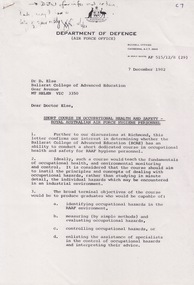
Document - Document - Correspondence, VIOSH: Department of Defence - Air Force Office, Canberra, December 1982
... ...flight lieutenant...director...Information provided by K R Stone, Flight Lieutenant for Director General of Air Force Health Services. ...Information provided by K R Stone, Flight Lieutenant for Director General of Air Force Health Services. viosh victorian institute of occupational safety and health department of defence air force office raaf ballarat college of advanced education dennis else k r stone flight lieutenant director general of air force health services short course in occupational health and safety raaf hygiene personnel hearing loss industrial chemicals hazardous industrial procedures Letterhead of Department of Defence - Air Force Office.Signature of K R Stone Eight A4 pages,typed. ...Victorian Institute of Occupational Safety and Health (VIOSH) Australia is the Asia-Pacific centre for teaching and research in occupational health and safety (OHS) and is known as one of Australia's leaders on the field. VIOSH has a global reputation for its innovative approach within the field of OHS management. VIOSH had its first intake of students in 1979. At that time the Institution was known as the Ballarat College of Advanced Education. In 1990 it became known as Ballarat University College, then in 1994 as University of Ballarat. It was 2014 that it became Federation University. VIOSH Australia students are safety managers, senior advisors and experienced OHS professionals. They come from all over Australia and industry. Students are taught active research and enquiry; rather than textbook learning and a one-size fits all approach. VIOSH accepts people into the Graduate Diploma of Occupational Hazard Management who have no undergraduate degree - on the basis of extensive work experience and knowledge Letter from the Department of Defence to Dennis Else looking at the possibility of Ballarat College of Advanced Education conducting a short course in occupational health and safety for RAAF hygiene personnel. It would teach the fundamentals of occupational health and environmental monitoring and control. Better use of the practical time allocated is needed. Noise induced hearing loss is the most widespread occupational health risk in the RAAF. Industrial chemicals used and hazardous industrial procedures in the repair and maintenance of aircraft are an issue needing resolution. Existing terminal objectives for basic hygiene inspectors course in occupational health and safety are provided for comment. Information provided by K R Stone, Flight Lieutenant for Director General of Air Force Health Services. Eight A4 pages,typed. Handwritten note top left cornerLetterhead of Department of Defence - Air Force Office.Signature of K R Stoneviosh, victorian institute of occupational safety and health, department of defence, air force office, raaf, ballarat college of advanced education, dennis else, k r stone, flight lieutenant, director general of air force health services, short course in occupational health and safety, raaf hygiene personnel, hearing loss, industrial chemicals, hazardous industrial procedures -
Bendigo Historical Society Inc.
Document - ROYAL PRINCESS THEATRE COLLECTION: BENDIGO ORCHESTRAL SOCIETY & YMCA CHOIR. MARITANA, 7 Aug, 1933
... Director... Mr Oscar Flight. Deputy Director...Musical Director, Mr Oscar Flight. Deputy Director, Mr Alfred Sayer. ...Musical Director Mr Oscar Flight. Deputy Director Mr Alfred Sayer. ...Princess Theatre, Bendigo. Bendigo Orchestral Society & YMCA Choir. Maritana, Souvenir Programme 6d. Mon. Tues. Wed. August 7, 8, 9. Opera Produced by Mr E A Parker. Musical Director, Mr Oscar Flight. Deputy Director, Mr Alfred Sayer. Leader of Orchestra Mrs McKinnon. Chorus trained by Mr Wilfred Taylor. Chairman of Committee, Mr W Spencer Lake. Business Manager, Mr C J Greenhill. Pictures of artists: Miss Paulyne Bindley, Mr E A Parker, Miss Gwen De Ravin, Mr Wilfred Taylor, Miss Alva Stewart, Mr H H Turner, Mr Oscar Flight. Group photo of Ballet dancers. Argument - Maritana, a handsome Gitana, whilst singing to a crowd of people in a square in Madrid, attracts the admiration of the King. Don Jose, and unscrupulous courtier, observing this, determines to satisfy the . . . Characters: Paulyne Bindley, Gwenneth De Ravin, E A Parker, Wilfred Taylor, Lyell Shepherd, J W Smith, H H Turner, Lindsay Wright. Court Ballet: Miss Mercia Wright. Solo Dancer: Miss Fay Drummond. Chorus of Soldiers, Gypsies, and Populace. Deputy Principals: Alva Stewart, Frieda Bertuch, H J Allen. Costumes: Madame Tettrazini, Miss Ada Colton, Mrs E A Parker. Orchestra. Violins: Mrs C Adams, Miss J Anderson, Mr R Bright, Mr O Flight (jnr), Mrs S A Grant Mrs H Hillman, Miss J Houston, Mr G Krost, Mrs S McKinnon, Miss A McKinnon, Miss A McNair, A Sayer, Mrs L Shepherd, A Swift, H Timms. Viola: Mr P Coope. 'Cellos: Miss R Giudice, Mr W S Lake. Bass: Mr J Ditchburn. Flute: Mr A E Sayer. Clarinets: Mr B Smith, Mr P Waterman. Harpiste: Miss Whitelock. Cornets: Mr W Norman, Mr P Smith Mr A Swift, Mr F Taylor. Horns: Mr W Green, Mr N McPherson. Trombones: Mr Les Bishop, Mr E J Meagher. Drums: Me J McLaughlin. Piano: Miss I Benson, Miss E Flight. Chorus. Sopranos: Miss D Broome, S Brown, Mrs R Burland, Miss Betty Cant, E Colclough, E Collins, Bessie Davis, P Dunn, G Farmont, M Heyes, D Hoking, B Harpin, M Kitto, D Kirkwood, E Parker, L Simpson, Ida Stephenson, M Stephenson, L Smalley, Mrs W Taylor, V Thorpe, Miss Myrtle Taylor, Annie Thomas, Mrs C Walk, Miss R Wallent. Contraltos: Miss F Bertuch, Mrs D Campbell, Miss I De Ravin, M Davis, P Elliot, Mrs J Greenhill, Mess N Irving, I James, J Seers, J Shepherd, G Stephens. Tenors: J Cotton, G English, D Finery, Alec Jones, E Jeffery, D Parker, J Sims. Basses: D Doran, J Finerty, J H Hardie, A B Kirkwood, W L Macauley, S C Powell, R Prigg, W Reed, Les Spencely, Cyril Taylor, Ken Taylor. Mr Ron Hovenden, Scenic Artist. Ballet: Misses Clarice Harry, Rita Lansell, Thelma McKenzie, Mena Bailey, Dorothy Roberts, Fay Drummond, Kath Dungey, Jean Wright. Dance Mistress Miss Mercia Wright. Photo of dance group on rear cover. Printed down right side: Mr W. Reed - With Compliments from ''Maritana'' Committee. Sep 5/33. Signed: W Spencer Lake. Very decorative cover. B/ Envelope addressed to Mr W Reed, Lily St, Bendigo. 2 pieces of white tape on left side one top and one at bottom, stamp gone post mark Bendigo.Reed & Co., Printers, Bendigotheatre, opera, bendigo orchestral society:ymca cho, princess theatre. bendigo orchestral society & ymca choir. maritana. august 7, 8, 9. opera by mr e a parker. musical director, mr oscar flight. deputy director, mr alfred sayer. leader of orchestra mrs mckinnon. chorus trained: mr wilfred taylor. chairman of committee, mr w spencer lake. business manager, mr c j greenhill. photos of: miss paulyne bindley, mr e a parker, miss gwen de ravin, mr wilfred taylor, miss alva stewart, mr h h turner, mr oscar flight. group photo of ballet dancers. argument - maritana, a handsome gitana, whilst singing to a crowd of people in a square in madrid, attracts. . . characters: paulyne bindley, gwenneth de ravin, e a parker, wilfred taylor, lyell shepherd, j w smith, h h turner, lindsay wright. court ballet: miss mercia wright. solo dancer: miss fay drummond. chorus of soldiers, gypsies, and populace. deputy principals: alva stewart, frieda bertuch, h j allen. costumes: madame tettrazini, miss ada colton, mrs e a parker. orchestra. violins: mrs c adams, miss j anderson, mr r bright, mr o flight (jnr), mrs s a grant mrs h hillman, miss j houston, mr g krost, mrs s mckinnon, miss a mckinnon, miss a mcnair, a sayer, mrs l shepherd, a swift, h timms. viola: mr p coope. 'cellos: miss r giudice, mr w s lake. bass: mr j ditchburn. flute: mr a e sayer. clarinets: mr b smith, mr p waterman. harpiste: miss whitelock. cornets: mr w norman, mr p smith mr a swift, mr f taylor. horns: mr w green, mr n mcpherson. trombones: mr les bishop, mr e j meagher. drums: me j mclaughlin. piano: miss i benson, miss e flight. chorus. sopranos: miss d broome, s brown, mrs r burland, miss betty cant, e colclough, e collins, bessie davis, p dunn, g farmont, m heyes, d hoking, b harpin, m kitto, d kirkwood, e parker, l simpson, ida stephenson, m stephenson, l smalley, mrs w taylor, v thorpe, miss myrtle taylor, annie thomas, mrs c walk, miss r wallent. contraltos: miss f bertuch, mrs d campbell, miss i de ravin, m davis, p elliot, mrs j greenhill, mess n irving, i james, j seers, j shepherd, g stephens. tenors: j cotton, g english, d finery, alec jones, e jeffery, d parker, j sims. basses: d doran, j finerty, j h hardie, a b kirkwood, w l macauley, s c powell, r prigg, w reed, les spencely, cyril taylor, ken taylor. mr ron hovenden, scenic artist. ballet: misses clarice harry, rita lansell, thelma mckenzie, mena bailey, dorothy roberts, fay drummond, kath dungey, jean wright. dance mistress miss mercia wright. photo of dance group. -
 Dunkeld Museum Inc.
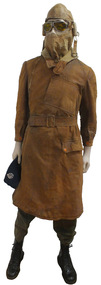
Coat, Flying, During World War 1
... Flight Commander and temporary Captain when his cousin Captain Duigan was wounded. He represented Australia at von Richtofen's funeral and presented the Australian wreath. Following his discharge after being seriously wounded, he returned home and became a grazier in the Dunkeld area. He maintained his interest in aviation throughout his life with a strong connection with Reg Ansett and was a director...Flight Commander and temporary Captain when his cousin Captain Duigan was wounded. He represented Australia at von Richtofen's funeral and presented the Australian wreath. Following his discharge after being seriously wounded, he returned home and became a grazier in the Dunkeld area. He maintained his interest in aviation throughout his life with a strong connection with Reg Ansett and was a director ...This coat was owned and worn by Lieutenant T L(known as Leigh) Simpson D.F.C. who joined the Royal Flying Corps during Workd War 1. He was born in Hamilton Victoria and had an interest through his family in flying, before the war. In 1916 he transferred from the Light Horse Field Ambulance to the 68th Australian Sqd. Royal Flying Corps. He was promoted to lieutenant of the 3rd Squadron. During the war he was a pilot and photographer and took hundreds of reconnaissance photos over occupied territory. He was involved in photographing enemy positions and supplying information to the artillery batteries which then shelled those positions. He was involved in a number of missions involving direct contact with the enemy including Baron von Richtofen and was involved in the "dog fight" which led to von Richtofen's death. In May 1918 he had been promoted to Flight Commander and temporary Captain when his cousin Captain Duigan was wounded. He represented Australia at von Richtofen's funeral and presented the Australian wreath. Following his discharge after being seriously wounded, he returned home and became a grazier in the Dunkeld area. He maintained his interest in aviation throughout his life with a strong connection with Reg Ansett and was a director of Ansett Airways Pty Ltd for many years. He died in Dunkeld in 1960This flying coat is significant because it was owned by Lieutenant Thomas Leigh Simpson DFC while he was in the Australian Flying Corps during World War 1. World War 1 Flying coat. Tan leather, nap finish. Lining wool fabric. Map pocket on front of chest. Internal pocket on left front behind map pocket and external pocket below the waist on the left hand front towards the side.L Simpson on the inside left front.t leigh simpson, royal flying corps, baron von richtofen, australian aviation -
Bendigo Historical Society Inc.
Document - LYRIC THEATRE, MYER'S PATRIOTIC WORKERS' SOCIETY, 20 September, 1917
... Musical Director: Mr E H Collett. Leader of Orchestra: Mr O Flight. Accompanist: Miss MacGillivray. ...Musical Director: Mr E H Collett. Leader of Orchestra: Mr O Flight. Accompanist: Miss MacGillivray. ...Lyric Theatre, Myer's Patriotic Workers' Society. Grand Concert, Thursday, September 20th, 1917, 8pm. Admission 2/- (Entitling to Reserve) and 1/-. Musical Director: Mr E H Collett. Leader of Orchestra: Mr O Flight. Accompanist: Miss MacGillivray. Home Made Confectionery will be sold by Ladies. Programme: God Save the King. Part I: 'Trumpet of the Fort' 'Angles Guard Thee' 'Where my Caravan has rested' 'Villanell' 'Le Babillard' 'Hark to the Mandolin' 'Come Back, One Day'. Part II: 'Sunshine and Showers' unnamed song, 'Prologue', 'Spirit of the Wood' 'They Sang God Save The King' 'Hullamzo Balaton' 'The Two Grenadiers' 'Farwell to Summer'. Overtures: Lyric Orchestra. Songs: Mr EH Collett, Miss Elsie Code, Miss Winnie Mayberry, Mr J Warren, Mr F Monaghan, Mr H S Barkell. Duets: Misses c Ronan and J Sherlock, Misses J Pearson and L Bain, Miss E Code and Mr H S Barkell, Miss W Mayberry and Mr E H Collett. Flute Solo: Mr A E Sayer. Violin Solo: Miss Myrtle Knight. God Bless Our Splendid Men. Back Cover- Myer's Patriotic Workers' Society was formed by the Employees of Myer's' Bendigo, with the object of forwarding comforts to the soldiers from the Bendigo district who have joined the Australian Imperial Forces. Names were invited from the public, when no less than twelve hundred names were recorded, and the Society is making every effort to despatch the parcels as quickly as possible. So far six hundred and fifty parcels have been sent at a cost of 10/- (plus postage, 2/-) each The proceeds of this Concert go towards augmenting the funds of the Society to carry out this obligation.Bolton Bros. Printers, Bendigoprogram, theatre, lyric theatre -
Bendigo Historical Society Inc.
Document - THE BENDIGO CHOIR, FIRST CONCERT, 1917
... Musical Director- Mr E Allen Bindley, Accompanist - Miss A Douglas, Leader of Orchestra - Mr O Flight. ...Musical Director- Mr E Allen Bindley, Accompanist - Miss A Douglas, Leader of Orchestra - Mr O Flight. ...The Bendigo Choir, First Concert. Tuesday, April 24th, 1917. Lyric Theatre, Bendigo. Musical Director- Mr E Allen Bindley, Accompanist - Miss A Douglas, Leader of Orchestra - Mr O Flight. Hon. Secs. E H Collett & E A Miller. Other participants Lyric Orchestra, Mr Tom Pritchard, Miss Muriel Hyett, Mr A Sayer, Mr E Thomas, Miss L Bain, Miss M Hyett, Miss Irene Dorrity and Mr E Thomas. Programme includes songs and musical solo, and Duett. Listed on back are the 'Musical Evenings for 1917'program, theatre, the bendigo choir -
 Melton City Libraries
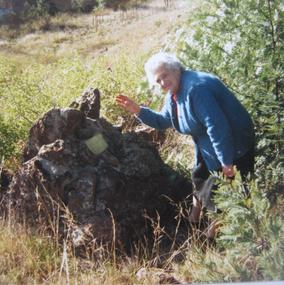
Photograph, The Cairn- Jimmy Melrose's plane crash site, 1988
... During June Jimmy made some charter flights and early in July was engaged by Mr. A.J. Campbell a director of several mining companies from Melbourne to Darwin to commence at Essendon on the4th July. ...During June Jimmy made some charter flights and early in July was engaged by Mr. A.J. Campbell a director of several mining companies from Melbourne to Darwin to commence at Essendon on the4th July. ...Edna Barrie at the cairn, photo received from Graeme Minns in 1988. The cairn marks the site of Jimmy Melrose's plane crash in Melton South. The accident which happened on July 5th 1936. In 1934 Melrose made headlines with a series of spectacular flights. In July of that year, he set around Australia record and in that year established a new solo Australia England record when he flew to England to compete in the MacRoberston race with a De Havilland Puss Moth VH- YQO. The only Australian and the only solo pilot to complete the course within the time limit. He was seventh in finishing order and third in the handicap section making news again during the race with a dramatic landing in Darwin with empty fuel tanks. Late in 1935 Melrose imported the Phoenix for his “Adelaide to Anywhere” Charter Service. The previous year the Heston Aircraft Company had taken over the interests of the well known Comper Aircraft Company, and the first production of the new firm was the Phoenix, a single-engined all wooden five seater machine of sesquiplane configuration. The forward half of the fuselage was a streamlined rectangular section and the rear portion was a monocogue shell; the whole was of plywood fabric covered. The wing was built up of spruce box spars and lattice ribs, ply covered from the leading edge to the front spar and the fabric covered over the remainder. The tail surfaces were of similar construction. The most notable feature of the design was the lower stub wing which ran right across the fuselage embodying two box spars, plywood covered it housed the main undercarriage wheels when retracted and provided a substantial anchorage for the Nu form wing struts. The Dowty undercarriage retracted inwards, operated manually by hydraulic packs, Dual control fitted, with side by side seating for the pilots and three passenger seats behind. Power was a 200 h.p. De Havilland Gipsy VI 6 cylinder inverted in-line air-cooled engine. Six Phoenix were built; five of them registered in Great Britain and one of those was later sold abroad the remaining four were impressed into the R.A.F. in 1940. Specifications were: 40 feet 4 inches length 30 ft 2 ins height, 9ft 7ins, wing area 270 sq ft, Tare weight 2,600lbs loaded weight 3,300lbs; cruising speed 360 m.p.h. landing 50mph ceiling 14,000 ft range 700 miles. Melrose’s machine the first production aircraft was built early in 1936 and test flown of the 24th March. Painted green it carries the words “South Australian Centenary 1936” in silver of the fuselage and the name “Billing on the engine cowling in honor of Melrose’s uncle Noel Pemberton Billing, pioneer designer and founder of the Supermarine Aviation Company. The delivery flight was planned as a goodwill mission to publicise the forthcoming South Australian Centenary celebrations. Melrose left Dympne on the 9th April 1936, and flying via Marseilles, Naples, Athens, Baghdad, Basra, Karachi, Jodphur, Calcutta, Akyab, Penang, Singapore, Lombok, Darwin, Newcastle Waters and Alice Springs reached Adelaide on the 25th of April. Continuing the goodwill flight to other States, he visited Melbourne, Sydney, Newcastle, Grafton, Brisbane, Coff’s Harbour, Sydney again, Launceston, Hobart and Mount Gambier before returning to Adelaide on the 13th May. During June Jimmy made some charter flights and early in July was engaged by Mr. A.J. Campbell a director of several mining companies from Melbourne to Darwin to commence at Essendon on the4th July. However on that day low cloud and steady rain caused the postponement. There was little improvement and Melrose was advised to delay the departure again. However he wished to reach Oodnadatta that night, and when he observed the break in the clouds decided to leave. He planned to climb above the cloud and fly to Adelaide at 3,000 feet. The aircraft was airborne about 8.10 a.m. and was last seen from Essendon climbing above the clouds. At 8.45 people at Melton (30 miles West of Melbourne) heard an approaching aircraft. The engine noise increased abnormally and eye witnesses saw the machine fall out of control from the cloud base about 800 feet and then disintegrate, fragments were scattered for 1½ miles and both occupants were killed. Hand written carbon copy by Edna Barrie.Typed by Wendy Barrie March 2014 Last Flight of Jimmy Melrose by John Burke Parade Magazine July 1972 Page 2 –4 This article gives the take off time of 7.50 am from Essendon Airport Eyewitness account at the time Maisie Arthur’s description. Newspaper article. Edna Barrie at the site of the 'Cairn'local identities, local significant events -
 Mt Dandenong & District Historical Society Inc.
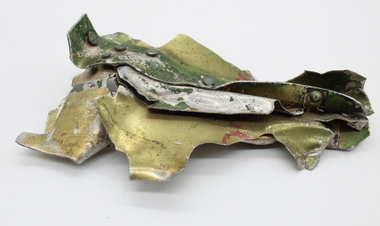
Object, Kyeema Wreckage Fragment, Pre 1938
... flight. The victims were :— THE CREW. CAPTAIN A. C. D. WEBB, 32, pilot, married, of Essendon, Victoria. JUNIOR CAPTAIN ALAN J. STEEN, 25, pilot, married, of Essendon North, Victoria. ELVA JONES, 27, air hostess, single, of Toorak, Victoria. PHILIP D. PRING, about 20, cadet pilot attached to Australian National Airways' Aeronautics School, Sydney. PASSENGERS. CHARLES ALLAN SEYMOUR HAWKER, M.P., 44, single, of Adelaide. LEONARD SYDNEY ABRAHAMS, K.C., 51, married, barrister, of Sydney. SIDNEY HILL SMITH, 41, married, managing director...flight. The victims were :— THE CREW. CAPTAIN A. C. D. WEBB, 32, pilot, married, of Essendon, Victoria. JUNIOR CAPTAIN ALAN J. STEEN, 25, pilot, married, of Essendon North, Victoria. ELVA JONES, 27, air hostess, single, of Toorak, Victoria. PHILIP D. PRING, about 20, cadet pilot attached to Australian National Airways' Aeronautics School, Sydney. PASSENGERS. CHARLES ALLAN SEYMOUR HAWKER, M.P., 44, single, of Adelaide. LEONARD SYDNEY ABRAHAMS, K.C., 51, married, barrister, of Sydney. SIDNEY HILL SMITH, 41, married, managing director ...The Kyeema airline crash took place on 25 October 1938 when the Australian National Airways Douglas DC-2 Kyeema, tail number VH-UYC, flying from Adelaide to Melbourne, commenced final approach to Essendon Airport through heavy fog and crashed into the western slopes of Mount Dandenong, killing all 18 on board instantly. There is strong evidence that the pilots were becoming unsure of their position. According to Macarthur Job's book, Disaster in the Dandenongs, the radio operator had requested the controller at Essendon give them a radio bearing. Essendon had acknowledged and told them to leave their transmitter on, but the signal stopped and no further contact was made. It is thought that this is the moment that Kyeema hit the mountain. There were 18 people on board the DC-2: 14 passengers, the captain, the first officer, an air hostess, and a cadet pilot who operated the radio during the flight. The victims were :— THE CREW. CAPTAIN A. C. D. WEBB, 32, pilot, married, of Essendon, Victoria. JUNIOR CAPTAIN ALAN J. STEEN, 25, pilot, married, of Essendon North, Victoria. ELVA JONES, 27, air hostess, single, of Toorak, Victoria. PHILIP D. PRING, about 20, cadet pilot attached to Australian National Airways' Aeronautics School, Sydney. PASSENGERS. CHARLES ALLAN SEYMOUR HAWKER, M.P., 44, single, of Adelaide. LEONARD SYDNEY ABRAHAMS, K.C., 51, married, barrister, of Sydney. SIDNEY HILL SMITH, 41, married, managing director of S. Smith and Son, of Yalumba, South Australia. ALFRED CECIL GAIN, 42, married, barrister, of Sydney. GORDON H. GODDARD, 30, single, accountant, of North Sydney. LANCELOT WILLIAM SHIRLEY, 27, single, solicitor, of Manly. JAMES IAN MASSIE, 25, single, solicitor, of Sydney. VAUGHAN PATE, 42, refrigeration cabinet manufacturer, married, of Unley, South Australia. THOMAS M. HARDY, 48, married, head of the firm of Thomas Hardy and Sons, vignerons, of Seacliff, South Australia. GEORGE WILLIAM LING, 72, of Kingswood, South Australia, former building inspector of the Municipal Tramways Trust, Adelaide. LOUIS HUGO GRAMP, 43, married, managing director of G. Gramp and Sons, Ltd., vignerons, Rowlands (sic) Flat, South Australia. Mrs. ELIZABETH MARY SCHRADER, 69, widow, of Adelaide. Mr. and Mrs. HANS L. GLOE, of Perth.Small section of the Kyeema DC-2 fuselage made up of 5 pieces of piece of twisted and torn aluminium riveted together. Marking can be seen in red but is indistinct. Aluminium has gold, silver and green colouring.kyeema, a webb, j steen, elva jones, philip pring, charles hawker, leonard abrahams, sidney hill smith, alfred gain, gordon goddard, lancelot shirley, james massie, vaughan pate, thomas hardy, george ling, hugo gramp, elizabeth schrader, mr hans gloe, mrs gloe -
 City of Melbourne Libraries
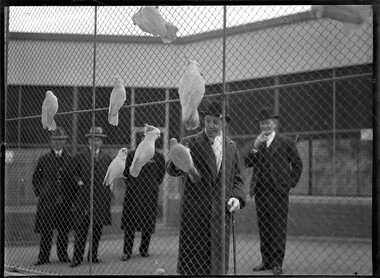
Photograph, Bull, Hugh Jones, 1897-1993, Vice-regal visit to zoo: Governor (Lord Huntingfield) meets the cockatoos
... director, Mr. Andrew Wilkie, introduced them to the cockatoos in the flight aviary. ...director, Mr. Andrew Wilkie, introduced them to the cockatoos in the flight aviary. ...A group of five men dressed in hats and overcoats look at caged cockatoos. Research by project volunteer, Fiona Collyer: On 25 June 1934, new Victorian Governor, His Excellency Lord Huntingfield and his wife Lady Huntingfield made an official visit to the Melbourne Zoological Gardens in order to grant his patronage to the Royal Zoological and Acclimatisation Society. The zoo director, Mr. Andrew Wilkie, introduced them to the cockatoos in the flight aviary. The Argus newspaper reported the visit in the following morning’s issue: "Birds' Greeting To Governor. Visit to Zoological Gardens. "A Very Important Society." "Cheery shouts of "Hullo!" and requests for drinks greeted His Excellency the Governor (Lord Huntingfield) on one of his official visits yesterday morning. Lady Huntingfield, who accompanied him, was asked loudly for a kiss. They were inspecting the huge cockatoo aviary at the Zoological Gardens after Lord Huntingfield had granted his patronage to the Royal Zoological and Acclimatisation Society. Both obviously enjoyed the democratic experience. It was explained to them that most of the cockatoos had been presented by residents of flats, whose neighbours objected to the noise of the birds, while others were protected birds which had been surrendered. Lord Huntingfield recalled that he had taken two Australian cockatoos to England when he left Australia in his youth. One, a galah, had lived in England for many years." In 1929, the Zoo built a commodious new flight aviary at the cost of several thousand pounds and Zoo director, Mr Andrew Wilkie, sent out an appeal published in newspapers Australia-wide for donations of parrots from all states. Many of the parrot species he wanted were protected and a special permit needed for their capture, however Mr Wilkie guaranteed he would obtain authority from the Fisheries and Game Department and that the cost of transit would be borne by the Zoo. The wanted birds were "Parrots - Black-tailed, Rock Pebbler, King, Superb, Grass (all kinds), Swamp or Ground, Mallee or Ringneck" and "Cockatoo[s] - Black, Pink or Major Mitchell, Gang-Gang". The Zoo asked that the birds be sent in boxes large enough to prevent overcrowding, contain food and water and the Zoo notified on the type and number of birds in transit. All boxes were to be addressed to 'The Zoo, Melbourne'. A letter from a reader appeared in the Weekly Times newspaper's popular "Camp-fire Circle" page for "Young Australians", 11 May 1929: "Dear Pal, I am much interested in your page, especially the nature notes. I have a pet parrot, but I don’t like to see it shut up in a cage, so I am giving it to the Melbourne Zoo. It can whistle 'Pretty Joey' and 'What's the Matter with Father' and is just learning to whistle for the dog... Wishing you and the Camp-fire Circle success." - Murray Holmes (Gorae, Vic.) The fate of this talented parrot is unknown, however in 1932, this young naturist, T Murray Holmes, 1912-1947, collected for the first time a type specimen, blue star sun orchid from Gorae (near Portland, Victoria), and it was named in his honour, Thelymitra holmesii. Murray was described by orchid collector W H Nicholls as "a youthful and energetic orchidologist, who added much to our knowledge of the orchids of south-western Victoria." Murray Holmes enlisted in the army in 1941 and fought in the Middle East before being sent to Java. In 1942 he was captured by the Japanese and became a prisoner of war for three years, working on the notorious Thai-Burma railway. Murray's health was undermined though ill treatment and starvation and he returned to Australia after the war, broken and sick. He died aged 35 in 1947. He was intensely interested in the flora and fauna of the Gorae area to the end. Murray's parents received over 200 tributes of respect for their son - too many to answer personally so they put a notice in the Portland Guardian thanking "all kind friends and relatives for letters, cards, floral tributes and personal expressions of sympathy received in their recent sad bereavement - the lamented death of their loved son, Murray." Andrew Arthur Wellesley Wilkie, 1853-1948, was Director of the Melbourne Zoo from 1923 to 1936 and was associated with the zoo for 70 years. He first worked as a horticultural assistant to Government botanist Baron Ferdinand von Mueller at the Botanical Gardens at the age of 13, along with his older brother David. One of Andrew’s jobs was to capture moths for the National Herbarium. In 1857, a group of prominent Melburnians assembled at St. Patrick’s Hall to form the Zoological Society of Victoria, with the aim of introducing animals and plants from overseas. It was conceived, “For the purposes of science and for that of affording the public the advantages of studying the habits of the animal creation in properly arranged zoological gardens.” The Victorian Government granted 32 acres (13 hectares) of land to the Zoological Society at the southern end of Richmond Paddock on the opposite bank to the Botanical Gardens. (This is where AAMI Stadium and Collingwood Football Club now stand.) In 1861, the Zoological Society of Victoria was renamed The Acclimatisation Society of Victoria. Unfortunately the Yarra River frontage was damp, swampy and subject to flooding, so the animals were briefly housed at the Botanical Gardens until in 1862, the City of Melbourne donated 55 acres (22 hectares) of land at Royal Park for the fledgling zoo. Baron von Mueller secured employment at Royal Park for Andrew and David and they helped to lay out the gardens, plant trees and take care of a collection of deer, pheasants, hares and partridges. Initially the zoo was used for the acclimatisation of animals recovering from the long voyage to Australia and for breeding them for sport. In 1872, the zoo bought two lions, a leopard and a cheetah that had been seized from circus showmen Keith and Phillips when they were unable to pay the bill of butcher Mr T K Bennet of Bourke Street. The first zoo director, Mr. Albert Le Souef, negotiated with captains of ships to buy animals at overseas ports they visited and soon a multitude of exotic species arrived, including a ten-year-old Indian elephant in 1878. In 1923, after being head keeper for some years, Andrew was appointed director of the zoo. By 1933, the zoo had 110 different species of animals, 200 species of birds and 72 species of reptiles under Andrew’s care. He had personally planted all but six trees and laid out the garden beds. As director he lobbied authorities for funds to build more humane enclosures for the animals. In June 1928, Table Talk magazine wrote of Andrew Wilkie: “Up at the Zoo there is a humble gentleman who is a lion among the lions, who knows the proper specific to employ when the boa constrictor has chilblains, and who is a friend and confidant of Queenie the elephant. His fount of zoological lore has never been plumbed. It is bottomless, like his good fellowship and geniality. Every day he may be seen somewhere in the grounds of that growing sanctuary for the strange and arresting fauna and creeping things of the world, and I assure you as one who is privy to his passion that that area and its inhabitants are rarely out of his thoughts.” Andrew retired from the zoo in 1936 at the age of 83 and in 1948 died at his home in Brunswick aged 94. He and his wife Josephine had six children. The Victorian Acclimatisation Society was founded in 1861 by Edward Wilson, 1813-1878, then owner and editor of The Argus newspaper. He said that Australian indigenous animals were practically useless, providing only “a little sport and an occasional meal”. The Society believed that Australia’s plants and animals were vastly inferior to those in Europe. They wanted to introduce and acclimatise to Victoria “all innoxious animals, birds, fishes, insects and vegetables, whether useful or ornamental” for sport and for the table, and to spread indigenous animals and plants from the colony around the world. Their motto was “if it lives, we want it”. The Society was primarily responsible for introducing sparrows, starlings, sambar and hog deer, ostriches, brown trout, blackberries, and carp to the Murray River. They released the European songbirds, thrush and blackbird to quell the homesickness of British settlers. The Society also sent Australian animals like platypus, echidnas, kangaroos and koalas to Europe for scientific and novelty purposes. Thomas Austin, a wealthy sheep farmer of Barwon Park, Winchelsea (property now owned by the National Trust) was a member and in 1859 he introduced hares, blackbirds, thrushes and partridges onto his property. He is probably best known for introducing 24 breeding rabbits onto his estate as game for shooting parties. Thomas quipped, “The introduction of a few rabbits could do little harm and might provide a touch of home, in addition to a spot of hunting." In 2022, genomic data confirmed that Australia’s feral rabbit population is entirely descended from these rabbits. Biological control has brought the rabbit population down from an estimated high of 10 billion rabbits in the 1920s to approximately 200 million today, inhabiting 70% of Australian landmass (5.3 million square kilometres). In 1872, the Acclimatisation Society was renamed The Zoological and Acclimatisation Society of Victoria and they focused on importing exotic animals for display purposes to the zoo. In 1937, the Royal Acclimatisation Society of Victoria was recreated as the Zoological Board of Victoria with a focus on research of native animals threatened with extinction. In an editorial for The Argus newspaper, 16 March 1856, Edward Wilson lamented: "...this country has been shamelessly stolen from the blacks. Had they been like the New Zealanders or the North American Indians, we should have bought their land, and supplied them with the means of living when we took it... In less than twenty years we have nearly swept them off the face of the earth. We have shot them down like dogs. In the guise of friendship we have issued corrosion sublimate in their damper, and consigned whole tribes to the agonies of an excruciating death. We have made them drunkards, and infected them with disease which has rotted the bones of their adults, and made such few children as are born amongst them a sorrow and a torture from the very instant of their birth. We have made them outcasts on their own land, and are rapidly consigning them to entire annihilation. There are but a few of them left, comparatively. This is what we would do for that few. We would feed and clothe every one of them.” [Note: this last sentence is italicized in the original newspaper article text]. Lord Huntingfield, (William Charles Arcedeckne Vanneck) 1883-1969, Governor of Victoria 1934-1939, was a British Conservative Party politician and the first ever Australian-born Governor of an Australian state (although he was always considered British). He was patron of the Royal Zoological and Acclimatisation Society of Victoria and was acting Governor-General for six months during the absence of Lord Gowie in 1938. Lady Huntingfield (née Margaret Eleanor Crosby) 1884-1943, his American-born wife showed great interest in social welfare and the advancement of women and children. She was president of the City Newsboys Society and Patroness of the Girls Friendly Society. In 1937, rose breeder Alister Clark named a yellow hybrid tea rose for her. In 1940, the City of Melbourne opened the Lady Huntingfield Free Kindergarten in North Melbourne, now the Lady Huntingfield Early Learning and Family Services Centre. Lady Huntingfield died in London in 1943 after her house was bombed during a German airstrike. The Lady Huntingfield Memorial Scholarship was established after the City of Melbourne raised £1000 in a public appeal conducted in her memory for students undertaking a Social Work degree at the University of Melbourne. It is awarded annually to this day. The Queen Victoria Hospital named a bed in her honour. References: Prominent Personalities ANDREW WILKIE (1928, June 7). Table Talk (Melbourne, Vic. : 1885 - 1939), p. 15. Retrieved August 29, 2024, from http://nla.gov.au/nla.news-article146562949 BIRDS' GREETING TO GOVERNOR (1934, June 26). The Argus (Melbourne, Vic. : 1848 - 1957), p. 6. Retrieved August 19, 2024, from http://nla.gov.au/nla.news-article10950051 Zoo Appealing For Parrots And Cockatoos To Fill Aviary For Children’s Instruction (1929, April 11). The Sun News-Pictorial (Melbourne, Vic. : 1922 - 1954; 1956), p. 31. Retrieved August 23, 2024, from http://nla.gov.au/nla.news-article275757361 LETTERS FROM READERS (1929, May 11). Weekly Times (Melbourne, Vic. : 1869 - 1954), p. 50. Retrieved October 6, 2024, from http://nla.gov.au/nla.news-article223183144 Correspondence. (1929, April 18). Corryong Courier (Vic. : 1894 - 1945), p. 6. Retrieved August 30, 2024, from http://nla.gov.au/nla.news-article269039262 'Edward Wilson (journalist)', Wikipedia, https://en.wikipedia.org/wiki/Edward_Wilson_(journalist) 'Thomas Austin (pastoralist)', Wikipedia, https://en.wikipedia.org/wiki/Thomas_Austin_(pastoralist) 'The Acclimatisation Society was driven by misguided ideals about 'fixing nature' in Australia', ABC News, https://www.abc.net.au/news/2022-11-04/acclimatisation-society-introduced-species-history-listen/101588262? utm_source=abc_news_app&utm_medium=content_shared&utm_campaign=abc_news_app&utm_content=safari Touching Canine Devotion. (1942, September 21). Portland Guardian (Vic. : 1876 - 1953), p. 1 (EVENING). Retrieved October 6, 2024, from http://nla.gov.au/nla.news-article64381989 OBITUARY (1947, August 11). Portland Guardian (Vic. : 1876 - 1953), p. 2 (EVENING). Retrieved August 26, 2024, from http://nla.gov.au/nla.news-article64412155 Family Notices (1947, September 11). Portland Guardian (Vic. : 1876 - 1953), p. 2 (EVENING). Retrieved October 10, 2024, from http://nla.gov.au/nla.news-article64412476 'Thelymitra holmesii', Wikipedia, https://en.wikipedia.org/wiki/Thelymitra_holmesii THE ABORIGINES. (1856, March 16). The Argus (Melbourne, Vic. : 1848 - 1957), p. 4. Retrieved September 28, 2024, from http://nla.gov.au/nla.news-article4833244Photographer notations on slide: "Vice Regal visit to zoo B42".zoos, governors, 1930-1939, cockatoos -
City of Melbourne Libraries
Vice-regal visit to Zoo: Governor (Lord Huntingfield)
... director, Mr. Andrew Wilkie, introduced them to the cockatoos in the flight aviary....director, Mr. Andrew Wilkie, introduced them to the cockatoos in the flight aviary. zoos governors animals royal park Vice-regal visit to Zoo: Governor (Lord Huntingfield) ...zoos, governors, animals, royal parkzoos, governors, animals, royal park
