
Showing 3 items matching "floor obstructions"
-
 Federation University Historical Collection
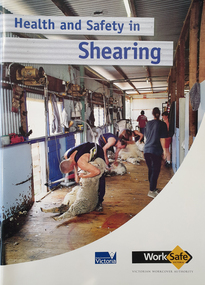
Booklet - Booklet - Safety, Worksafe Victoria, VIOSH: Victorian Workcover Authority; "Health and Safety In Shearing, 2001", 2001
... ...floor obstructions...Shed design was a principal factor with the emphasis on minimising body twisting associated with catching and releasing sheep, removal of floor obstructions along path between pen and release, battens oriented along direction of drag and slope in pens. ...Shed design was a principal factor with the emphasis on minimising body twisting associated with catching and releasing sheep, removal of floor obstructions along path between pen and release, battens oriented along direction of drag and slope in pens. ...Victorian Institute of Occupational Safety and Health (VIOSH) Australia is the Asia-Pacific centre for teaching and research in occupational health and safety (OHS) and is known as one of Australia's leaders on the field. VIOSH has a global reputation for its innovative approach within the field of OHS management. VIOSH had its first intake of students in 1979. At that time the Institution was known as the Ballarat College of Advanced Education. In 1990 it became known as Ballarat University College, then in 1994 as University of Ballarat. It was 2014 that it became Federation University. VIOSH Australia students are safety managers, senior advisors and experienced OHS professionals. They come from all over Australia and industry. Students are taught active research and enquiry; rather than textbook learning and a one-size fits all approach. VIOSH accepts people into the Graduate Diploma of Occupational Hazard Management who have no undergraduate degree - on the basis of extensive work experience and knowledge. A project titled "Reducing Back Injuries and Energy Costs of Shearing Through the Development of Practical Modifications to Shed Layout" was funded by Worksafe Australia. The budget was $101,170. VIOSH Australia collaborated with the School of Human Movement and Sports Science to look for ways to reduce muscle injuries associated with shearing. The study set up a number of focus groups in the Ballarat area, New South Wales and Western Australia to gather different inputs and perspectives on causes of injuries. Groups represented were shearers, doctors, farmers and shearing shed designers. Shed design was a principal factor with the emphasis on minimising body twisting associated with catching and releasing sheep, removal of floor obstructions along path between pen and release, battens oriented along direction of drag and slope in pens. A full set of photographs relating to the is Item 26841.Soft covered booklet featuring the coloured image of a stand of shearers. viosh, viosh australia, occupational health & safety, shearing, workcover, shearing sheds, bob cameron, minister for workcover, 2001, back injury, item 26841, shearers, farmers, doctors, floor obstructions -
 Federation University Historical Collection
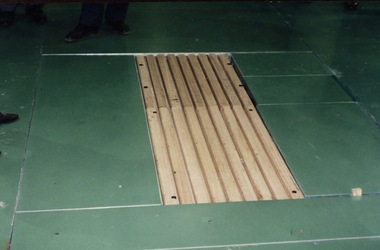
Photograph - Photograph - Colour, VIOSH: Reducing Back Injuries and Energy Costs of Shearing through the Development of Practical Modifications to Shed Layout, 1995-1997
... Shed design was a principal factor with the emphasis on minimising body twisting associated with catching and releasing sheep, removal of floor obstructions along path between pen and release, battens oriented along direction of drag and slope in pens....Shed design was a principal factor with the emphasis on minimising body twisting associated with catching and releasing sheep, removal of floor obstructions along path between pen and release, battens oriented along direction of drag and slope in pens. viosh victorian institute of occupational safety and health worksafe australia back injuries shearing sheds shearers school of human movement and sports science ballarat new south wales western australia doctors farmers shed designers Colour photographs - postcard and A5 - relating to reducing back injuries and Energy Costs of Shearing. ...Victorian Institute of Occupational Safety and Health (VIOSH) Australia is the Asia-Pacific centre for teaching and research in occupational health and safety (OHS) and is known as one of Australia's leaders in the field. VIOSH has a global reputation for its innovative approach within the field of OHS management. VIOSH had its first intake of students in 1979. At that time the Institution was known as the Ballarat College of Advanced Education. In 1990 it became known as Ballarat University College, then in 1994 as University of Ballarat. It was 2014 that it became Federation University. VIOSH Australia students are safety managers, senior advisors and experienced OHS professionals. They come from all over Australia and industry. Students are taught active research and enquiry; rather than textbook learning and a one-size fits all approach. VIOSH accepts people into the Graduate Diploma of Occupational Hazard Management who have no undergraduate degree - on the basis of extensive work experience and knowledge. A project titled "Reducing Back Injuries and Energy Costs of Shearing Through the Development of Practical Modifications to Shed Layout" was funded by Worksafe Australia. The budget was $101,170. VIOSH Australia collaborated with the School of Human Movement and Sports Science to look for ways to reduce muscle injuries associated with shearing. The study set up a number of focus groups in the Ballarat area, New South Wales and Western Australia to gather different inputs and perspectives on causes of injuries. Groups represented were shearers, doctors, farmers and shearing shed designers. Shed design was a principal factor with the emphasis on minimising body twisting associated with catching and releasing sheep, removal of floor obstructions along path between pen and release, battens oriented along direction of drag and slope in pens.Colour photographs - postcard and A5 - relating to reducing back injuries and Energy Costs of Shearing.viosh, victorian institute of occupational safety and health, worksafe australia, back injuries, shearing sheds, shearers, school of human movement and sports science, ballarat, new south wales, western australia, doctors, farmers, shed designers -
 Federation University Historical Collection
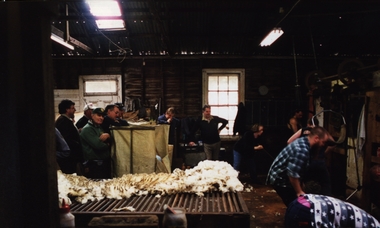
Photograph - Photograph - Colour, VIOSH: Shearing Shed Demonstrations - Collaboration with School of Human Movement and Sports Science; ways to reduce muscle injuries - 1994-1997
... Shed design was a principal factor with the emphasis on minimising body twisting associated with catching and releasing sheep, removal of floor obstructions along path between pen and release, battens oriented along direction of drag and slope in pens....Shed design was a principal factor with the emphasis on minimising body twisting associated with catching and releasing sheep, removal of floor obstructions along path between pen and release, battens oriented along direction of drag and slope in pens. viosh victorian institute of occupational safety and health 1995-1997 shearing shed layout worksafe australia school of human movement and sports science shearers doctors farmers muscle injuries university of ballarat student activity Thirty-one colour photographs on inside a shearing shed VIOSH: Shearing Shed Demonstrations - Collaboration with School of Human Movement and Sports Science; ways to reduce muscle injuries - 1994-1997. ....Victorian Institute of Occupational Safety and Health (VIOSH) Australia is the Asia-Pacific centre for teaching and research in occupational health and safety (OHS) and is known as one of Australia's leaders in the field. VIOSH has a global reputation for its innovative approach within the field of OHS management. VIOSH had its first intake of students in 1979. At that time the Institution was known as the Ballarat College of Advanced Education. In 1990 it became known as Ballarat University College, then in 1994 as University of Ballarat. It was 2014 that it became Federation University. VIOSH Australia students are safety managers, senior advisors and experienced OHS professionals. They come from all over Australia and industry. Students are taught active research and enquiry; rather than textbook learning and a one-size fits all approach. VIOSH accepts people into the Graduate Diploma of Occupational Hazard Management who have no undergraduate degree - on the basis of extensive work experience and knowledge. A project titled "Reducing Back Injuries and Energy Costs of Shearing Through the Development of Practical Modifications to Shed Layout" was funded by Worksafe Australia. The budget was $101,170. VIOSH Australia collaborated with the School of Human Movement and Sports Science to look for ways to reduce muscle injuries associated with shearing. The study set up a number of focus groups in the Ballarat area, New South Wales and Western Australia to gather different inputs and perspectives on causes of injuries. Groups represented were shearers, doctors, farmers and shearing shed designers. Shed design was a principal factor with the emphasis on minimising body twisting associated with catching and releasing sheep, removal of floor obstructions along path between pen and release, battens oriented along direction of drag and slope in pens.Thirty-one colour photographs on inside a shearing shedviosh, victorian institute of occupational safety and health, 1995-1997, shearing shed layout, worksafe australia, school of human movement and sports science, shearers, doctors, farmers, muscle injuries, university of ballarat, student activity
