
Showing 38 items matching "fob watch chains"
-
 Flagstaff Hill Maritime Museum and Village
Watch Chains
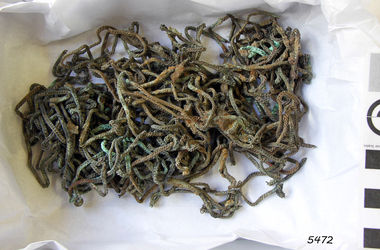
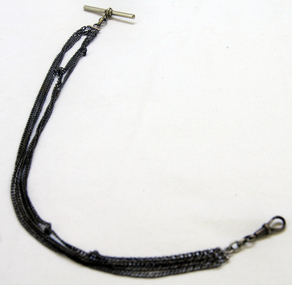
... ...Fob Watch chains...Fob Watch chains retrieved from the Schomberg. Chains are knotted and fragile....It is historically significant for representing aspects of Victoria’s shipping history and for its association with the shipwreck and the ship, which was designed to be fastest and most luxurious of its day flagstaff hill warrnambool shipwrecked-coast flagstaff-hill flagstaff-hill-maritime-museum maritime-museum shipwreck-coast flagstaff-hill-maritime-village Shipwrecked-artefact Schomberg Clipper ship Black Ball line 1855 shipwreck Aberdeen clipper ship Captain Forbes Peterborough shipwreck SS Queen Fob Watch chains Fob Watch chains retrieved from the Schomberg. ...When the ship Schomberg was launched in 1855, she was considered the most perfect clipper ship ever to be built. James Blaine’s Black Ball Line had commissioned her to be built for their fleet of passenger liners. At a cost of £43,103, the Aberdeen builders designed her to sail faster than the quick clippers designed by North American Donald McKay. She was a three masted wooden clipper ship, built with diagonal planking of British oak with layers of Scottish larch. This luxury vessel was designed to transport emigrants to Melbourne in superior comfort. She had ventilation ducts to provide air to the lower decks and a dining saloon, smoking room, library and bathrooms for the first class passengers. At the launch of Schomberg’s maiden voyage, her master Captain ‘Bully’ Forbes, drunkenly predicted that he would make the journey between Liverpool and Melbourne in 60 days. Schomberg departed Liverpool on 6 October 1855 with 430 passengers and 3000 tons cargo including iron rails and equipment intended the build the Geelong Railway and a bridge over the Yarra from Melbourne to Hawthorn. The winds were poor as Schomberg sailed across the equator, slowing her journey considerably. She was 78 days out of Liverpool when she ran aground on a sand-spit near Peterborough, Victoria, on 27 December; the sand spit and the currents were not marked on Forbes’s map. Overnight, the crew launched a lifeboat to find a safe place to land the ship’s passengers. The scouting party returned to Schomberg and advised Forbes that it was best to wait until morning because the rough seas could easily overturn the small lifeboats. The ship’s Chief Officer spotted SS Queen at dawn and signalled the steamer. The master of the SS Queen approached the stranded vessel and all of Schomberg’s passengers were able to disembark safely. The Black Ball Line’s Melbourne agent sent a steamer to retrieve the passengers’ baggage from the Schomberg. Other steamers helped unload her cargo until the weather changed and prevented the salvage teams from accessing the ship. Local merchants Manifold & Bostock bought the wreck and cargo, but did not attempt to salvage the cargo still on board the ship. They eventually sold it on to a Melbourne businessman and two seafarers. After two of the men drowned when they tried to reach Schomberg, salvage efforts were abandoned.32 In 1975, divers from Flagstaff Hill, including Peter Ronald, found an ornate communion set at the wreck. The set comprised a jug, two chalices, a plate and a lid. The lid did not fit any of the other objects and in 1978 a piece of the lid broke off, revealing a glint of gold. As museum staff carefully examined the lid and removed marine growth, they found a diamond ring, which is currently on display in the Great Circle Gallery.33 Flagstaff Hill also holds ship fittings and equipment, personal effects, a lithograph, tickets and photograph from the Schomberg. Most of the artefacts were salvaged from the wreck by Peter Ronald, former director of Flagstaff Hill. The Schomberg, which is on the Victorian Heritage Register (VHR S612), has great historical significance as a rare example of a large, fast clipper ship on the England to Australia run, carrying emigrants at the time of the Victorian gold rush. She represents the technical advances made to break sailing records between Europe and Australia. Flagstaff Hill’s collection of artefacts from the Schomberg is significant for its association with the shipwreck, The collection is primarily significant because of the relationship between the objects, as together they have a high potential to interpret the story of the Schomberg. It is archaeologically significant as the remains of an international passenger Ship. It is historically significant for representing aspects of Victoria’s shipping history and for its association with the shipwreck and the ship, which was designed to be fastest and most luxurious of its day Fob Watch chains retrieved from the Schomberg. Chains are knotted and fragile.flagstaff hill, warrnambool, shipwrecked-coast, flagstaff-hill, flagstaff-hill-maritime-museum, maritime-museum, shipwreck-coast, flagstaff-hill-maritime-village, shipwrecked-artefact, schomberg, clipper ship, black ball line, 1855 shipwreck, aberdeen clipper ship, captain forbes, peterborough shipwreck, ss queen, fob watch chains -
 Clunes Museum
Photograph, HORNBY STUDIO - CLUNES
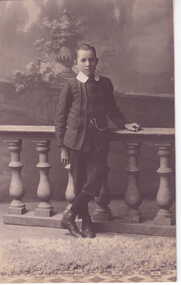
... ORIGINAL PHOTOGRAPH OF YOUNG LAD, DRESSED IN THE SUIT OF THE DAY, WHITE COLLAR - FOB WATCH CHAIN, LEANING AGAINST A BALUSTRADE....local history photography photographs costumes - male child ORIGINAL PHOTOGRAPH OF YOUNG LAD, DRESSED IN THE SUIT OF THE DAY, WHITE COLLAR - FOB WATCH CHAIN, LEANING AGAINST A BALUSTRADE. Photograph PHOTOGRAPH HORNBY STUDIO - CLUNES ...ORIGINAL PHOTOGRAPH OF YOUNG LAD, DRESSED IN THE SUIT OF THE DAY, WHITE COLLAR - FOB WATCH CHAIN, LEANING AGAINST A BALUSTRADE.local history, photography, photographs, costumes - male child -
 Bendigo Historical Society Inc.
Accessory - FOB WATCH CHAIN
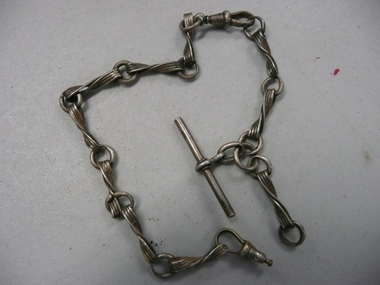
... FOB WATCH CHAIN...Fob watch chain, figure of 8 twists connected with rings, T bar for button hole hallmarked sterling silver, and 2 clasps....Accessory FOB WATCH CHAIN ...Fob watch chain, figure of 8 twists connected with rings, T bar for button hole hallmarked sterling silver, and 2 clasps.F.W.Chorology, watches, chain -
 Clunes Museum
Photograph, CIRCA 1914/18
... BRAY IN CIVILIAN CLOTHES, FEATURED LAPEL POSY POCKET HANDKERCHIEF FOB WATCH CHAIN AND MEDAL...BRAY IN CIVILIAN CLOTHES, FEATURED LAPEL POSY POCKET HANDKERCHIEF FOB WATCH CHAIN AND MEDAL Photograph PHOTOGRAPH ...ORIGINAL PHOTOGRAPH, SEPIA TONED OF PTE. T.H. BRAY IN CIVILIAN CLOTHES, FEATURED LAPEL POSY POCKET HANDKERCHIEF FOB WATCH CHAIN AND MEDALPTE. T.H. BRAY 16 ST BATTALION A.I.F. MISSING IN FRANCE RUTES 182 NO. 2662 RETURN TO SUN" T. H. BRAY 582 ASlocal history, photography, photographs, military -
 Bendigo Historical Society Inc.
Photograph - MALE PORTRAIT
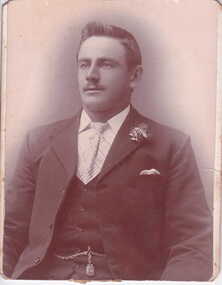
... Photograph : Sepia portrait of a male dressed in a pin striped suit, a double breasted vest, tie, white shirt, wearing a rose button, white hankerchief, wearing a fob watch chain....Photograph : Sepia portrait of a male dressed in a pin striped suit, a double breasted vest, tie, white shirt, wearing a rose button, white hankerchief, wearing a fob watch chain. Photograph MALE PORTRAIT ...Photograph : Sepia portrait of a male dressed in a pin striped suit, a double breasted vest, tie, white shirt, wearing a rose button, white hankerchief, wearing a fob watch chain.photograph, portrait, male in suit., photograph, male portrait, dressed in a suit. -
 Surrey Hills Historical Society Collection
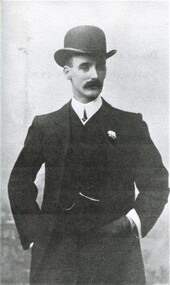
Photograph, David Miller Mair, c1909, c1909
... The original is a formal portrait of him wearing a bowler hat and 3 piece suit, the jacket with flower in the buttonhole and the waistcoat with fob watch chain. He has his hands in his pockets and is looking in part profile at the camera. ...The original is a formal portrait of him wearing a bowler hat and 3 piece suit, the jacket with flower in the buttonhole and the waistcoat with fob watch chain. He has his hands in his pockets and is looking in part profile at the camera. ...David Miller (Dave) Mair (1879-1938) married Lily Vipond Deakin (1890-1945) in 1910. They had 5 children: Geoffrey David (1913-1970), Beryl (1916-1976), Gwynneth (1917-1997), Isabel Lillian (1921-1997) and Shirley Inez (1928-1968). Personal communication from Laurie Newton, Beryl's daughter: Dave and Lily initially lived in East Melbourne after they married. Dave walked across the gardens to work at the MCG. He never drove or owned a car. Geoffrey, Beryl and Gwynneth were born in East Melbourne. They subsequently moved to Louise Avenue, Mont Albert and Isabel may have been born while they were there. Later they purchased 20 Barton Street, Mont Albert. Shirley was born after they moved to Barton Street. Electoral roll details: 1919 1922 24 Louise Avenue, Mont Albert 1924 20 Barton Street, Mont Albert Dave Mair was a very keen sportsman. This is part of a large donation of material from the Deakin, Mair and Young families. The Deakin, Mair and Young families had many connections with Mont Albert and Surrey Hills.A black & white photocopy of a man with a moustache identified as David Miller Mair. The original is a formal portrait of him wearing a bowler hat and 3 piece suit, the jacket with flower in the buttonhole and the waistcoat with fob watch chain. He has his hands in his pockets and is looking in part profile at the camera. On rear in grey lead pencil: "David Millar Mair / 22.4.1879-16.9.1938". david miller mair, dave mair, lily vipond mair, lily vipond deakin -
 Bendigo Historical Society Inc.
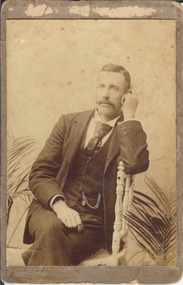
Photograph - MALE PORTRAIT, approx. 1920
... Dressed in pin striped 3 piece suit. Fob watch chain to vest. 2 buttons on sleeve, cravat at neck of shirt with horse shoe pin in knot. ...Dressed in pin striped 3 piece suit. Fob watch chain to vest. 2 buttons on sleeve, cravat at neck of shirt with horse shoe pin in knot. ...sepia toned photo of male seated on cane and wooden chair. Dressed in pin striped 3 piece suit. Fob watch chain to vest. 2 buttons on sleeve, cravat at neck of shirt with horse shoe pin in knot. Signet ring on left hand little finger. Palms beside chair. 467 in lead pencil on back.Yeoman & Co., next to Theatre Royal, Melbourne.person, individual, portrait male -
 Clunes Museum
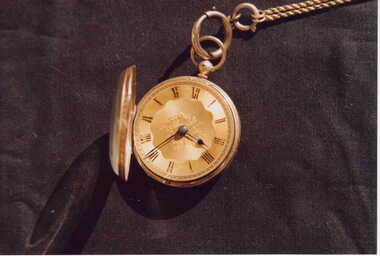
Photograph, KODAK, GOLD FOB WATCH
... .1 - .8 COLLECTION OF EIGHT PHOTOGRAPHS OF GOLD FOB WATCH AND CHAIN PRESENTED TO JEAN DICKSON ON HER 21ST BIRTHDAY 1877 AT CLUNES....CLUNES 2ND FEB. 1877. .1 - .8 COLLECTION OF EIGHT PHOTOGRAPHS OF GOLD FOB WATCH AND CHAIN PRESENTED TO JEAN DICKSON ON HER 21ST BIRTHDAY 1877 AT CLUNES. ...PRESENTATION GIFT TO JEAN DICKSON ON THE OCCASION OF HER 21ST BIRTHDAY 1877..1 - .8 COLLECTION OF EIGHT PHOTOGRAPHS OF GOLD FOB WATCH AND CHAIN PRESENTED TO JEAN DICKSON ON HER 21ST BIRTHDAY 1877 AT CLUNES.PRESENTED TO MISS JEAN DICKSON BY HER FRIENDS AT CLUNES. TO COMMENORATE THIS HER TWENTY FIRST BIRTHDAY. BEING THE FIRST WHITE GIRL BORN HERE. CLUNES 2ND FEB. 1877.photograph gold fob watches, jean dickson -
 Linton and District Historical Society Inc
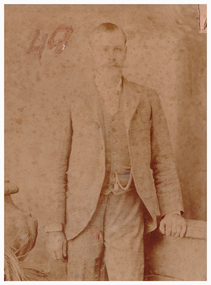
Photograph, Hans Thiesen Steenholdt
... Sepia photograph of a man with moustache wearing suit with fob watch and chain, standing with left arm resting on furniture, right arm by his side....Sepia photograph of a man with moustache wearing suit with fob watch and chain, standing with left arm resting on furniture, right arm by his side. ...Part of Old Lintonian collection ; No. 49Sepia photograph of a man with moustache wearing suit with fob watch and chain, standing with left arm resting on furniture, right arm by his side."Hans Thiesen Steinhold".hans thiesen steinhold, old lintonian collection -
 Stawell Historical Society Inc
Photograph, Mr Chaming & Mrs Eliza Chamings nee Harris from Great Western
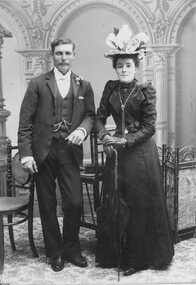
... Corsage in lapel. Fob watch chain across waistcoat. Mrs Camings wearing dark travelling dress. flat beribboned hat. drop necklace. belt. ...Corsage in lapel. Fob watch chain across waistcoat. Mrs Camings wearing dark travelling dress. flat beribboned hat. drop necklace. belt. ...Mr and Mrs Chamings nee Eliza Harris Great Western B/W photo Studio Ornate arches and pillars background chairs and fire screen. Left Mr Chamings Wearing a three piece suit. Corsage in lapel. Fob watch chain across waistcoat. Mrs Camings wearing dark travelling dress. flat beribboned hat. drop necklace. belt. Heart bar brooch. hold folded umbrella in gloved hand both posing in front of chair.Front: Stawell Photographic Co., Main Street, Close Railway. C. Hewitt, Manager. Reverse: Mr and Mrs. Chamings nee Eliza Harris. Stamp Stwell Photographic Co. Close Railway Station C. Hewitt, Manager.stawell -
 Frankston RSL Sub Branch
Medallion
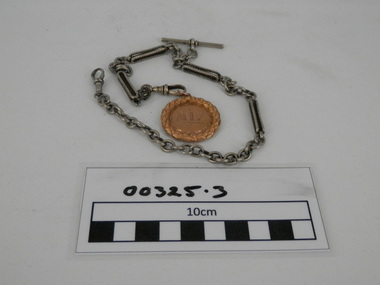
... In this case the medallion is attached to a fob watch chain commonly worn by men when dressed in a jacket. ...In this case the medallion is attached to a fob watch chain commonly worn by men when dressed in a jacket. ...A medallion presented to Private A. C. Hill by the citizens of Frankston, Victoria. These medallions were presented to local men who enlisted for service as they departed to World War 1 by the "Citizens and Patriotic Committee". The medallion has a gold finish and has an olive wreath around the circumference. A small loop is provided to attach the medallion to a chain or similar. In this case the medallion is attached to a fob watch chain commonly worn by men when dressed in a jacket. (refer item 00325).One side of the medallion is inscribed: "A. Hill" "From the citizens of Frankston" and the other is inscribed "A. I. F." -
 Frankston RSL Sub Branch
Medallion
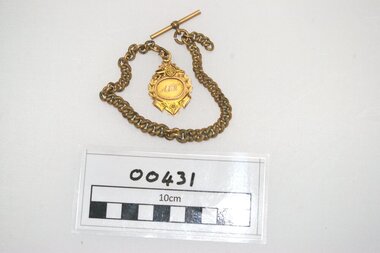
... In this case the medallion is attached to a fob watch chain commonly worn by men when dressed formally. ...In this case the medallion is attached to a fob watch chain commonly worn by men when dressed formally. ...A medallion presented to Private A. C. Wilson by the residents of Broadford, Victoria. These medallions were presented to local men who had enlisted for service as they returned from World War 1 in December 1919. The medallion is made of gold (9 carat) and has an olive wreath around the circumference. A small loop is provided to attach the medallion to a chain or similar. In this case the medallion is attached to a fob watch chain commonly worn by men when dressed formally. The chain is also made of gold. -
 Linton and District Historical Society Inc
Photograph, Mr. and Mrs. McLachlan
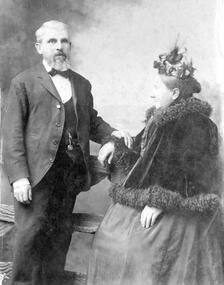
... Sepia photograph of an older bearded gentleman wearing three-piece suit, bow tie and fob watch on chain, standing with right arm by his side, left hand resting on the right arm of a woman wearing long full gown and fur trimmed jacket (collar wrists and hem) and hat, seated with left arm on lap, right arm resting on chair arm...Mr McLachlan Mrs McLachlan Old Lintonian collection Sepia photograph of an older bearded gentleman wearing three-piece suit, bow tie and fob watch on chain, standing with right arm by his side, left hand resting on the right arm of a woman wearing long full gown and fur trimmed jacket (collar wrists and hem) and hat, seated with left arm on lap, right arm resting on chair arm Mr. and Mrs. ...Part of Old Lintonian collection ; No. 111.Sepia photograph of an older bearded gentleman wearing three-piece suit, bow tie and fob watch on chain, standing with right arm by his side, left hand resting on the right arm of a woman wearing long full gown and fur trimmed jacket (collar wrists and hem) and hat, seated with left arm on lap, right arm resting on chair armmr mclachlan, mrs mclachlan, old lintonian collection -
 Stawell Historical Society Inc
Photograph, Giles Family Late 1890's -- Studio Portrait
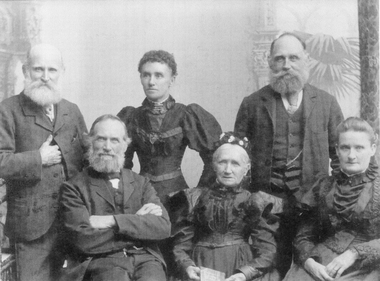
... Arthur wearing three piece suit with Fob watch on chain. Front row Walter sitting down arms folded wearing three piece suit. ...Arthur wearing three piece suit with Fob watch on chain. Front row Walter sitting down arms folded wearing three piece suit. ...Joshua born 1848 dressed in suit with right hand in coat. Agnes or Emily with short curly hair and Leg of Mutton sleeves dress. Arthur wearing three piece suit with Fob watch on chain. Front row Walter sitting down arms folded wearing three piece suit. Anne (mother) hat on head holding card, dress puffed sleeves with tie around waist. Agnes or Emily hair is pulled back, frilled collar and puffed sleeves with embroidered bodice. Both Giles women married Heal Brothers.Writing on back of photo -
 Williamstown Historical Society Inc
Functional object - Fob watch and chain
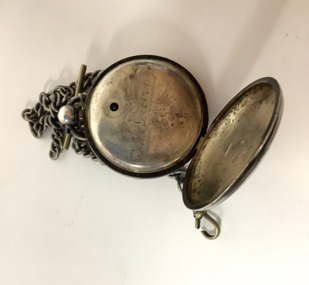
... Fob watch and chain...Men's silver fob watch with chain. Watch has two lids, one opens to reveal the watch face which has black roman numerals on a white background. ...Fob watch Inscription: "T.J. Grieve" three scotch thistles and three clover leaves. Men's silver fob watch with chain. ...This watch belonged to T. J. Grieve, a member of an early Altona/Werribee pioneer familyMen's silver fob watch with chain. Watch has two lids, one opens to reveal the watch face which has black roman numerals on a white background. The protective glass is missing. A smaller minute dial is at the 6 o'clock mark. The second lid opens to reveal an inscription in copperplare writing - 'T. J. Grieve', engraved scotch thistles and three leaf clovers. The heavy silver chain has a clip and a shank. Inscription: "T.J. Grieve" three scotch thistles and three clover leaves. horology, fob watch -
 Bendigo Historical Society Inc.
Accessory - POCKET WATCH AND FOB CHAIN, 1915
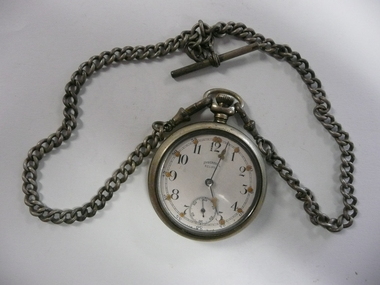
... POCKET WATCH AND FOB CHAIN...Ingersoll eclipse pocket watch and fob chain EPNS case and chain, black numerals with gold dots with separate second hand at bottom. ...HOROLOGY Watches Made in USA Ingersoll Eclipse Ingersoll eclipse pocket watch and fob chain EPNS case and chain, black numerals with gold dots with separate second hand at bottom. ...Ingersoll eclipse pocket watch and fob chain EPNS case and chain, black numerals with gold dots with separate second hand at bottom. Label inside reads Robt.H.Ingersoll & Bro makers Ely place London 15.5.15Made in USA Ingersoll Eclipsehorology, watches -
 Bendigo Historical Society Inc.
Photograph - HARRIS COLLECTION: MALE PHOTO, Ninteenth Century
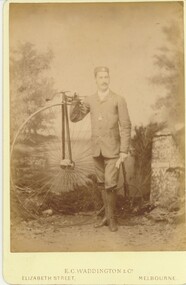
... Double 'Albert' chain & fob watch....Double 'Albert' chain & fob watch. Photograph HARRIS COLLECTION: MALE PHOTO ...Black & white E C Waddington & Co studio portrait of male standing beside penny farthing bicycle. Melbourne Show xxv xxv ? Barely discernible on gate photo right hand side. Male early thirties clothed in jackboots, breeches, buttoned up jacket, turned down collar with pale bow tie, moustache and badged cap. Double 'Albert' chain & fob watch.E C Waddington & Co Elizabetth St Melbourne.photograph, person, male -
 Federation University Historical Collection
Photograph - Black and White, Frank Wright and friend at a sporting event, 1930's?
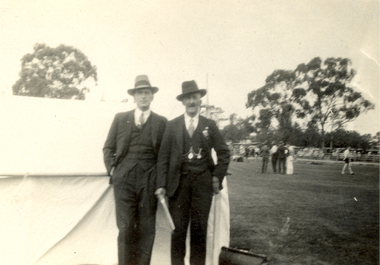
... Black and white photograph of two men dressed in three piece suits, one with a fob chain and watch and both wearing hats. They are standing in front of a white tent and a Gladstone bag is on the ground beside the older man on the right. ...The Frank Wright Medal at the Royal South Street competition is awarded to an individual recognized as making an outstanding contribution to brass music in Australia. frank wright brass band conductor gladstone bag Black and white photograph of two men dressed in three piece suits, one with a fob chain and watch and both wearing hats. They are standing in front of a white tent and a Gladstone bag is on the ground beside the older man on the right. ...Frank Wright was a renown resident of Smeaton, where he was born on 2 August 1901. He lived at Laura Villa, and attended Smeaton State School. His father William was a gold miner and his mother's name was Sarah. Their family won many singing and instrumental awards. Frank was tutored by Percy Code and was awarded a gold medal for the highest marks in the ALCM examinations in the British Colonies at the age of seventeen years. He became the Australian Open Cornet Champion by the age of eighteen. A year later, Frank conducted the City of Ballarat Band, and later the Ballarat Soldiers’ Memorial Band. He formed the Frank Wright Frisco Band and Frank Wright and his Coliseum Orchestra. These bands won many South Street awards, and Frank as conductor won many awards in the Australian Band Championship contest. In 1933 Frank Wright sailed to England to conduct the famous St Hilda’s Band and was later appointed Musical Director of the London County Council, where he organized many amazing concerts in parks, in and around the London district. He was made Professor of Brass and Military Band Scoring and conducted at the Guildhall of Music and Drama. Frank was often invited to adjudicate Brass Band Championships around Europe, in Australia, including South Street and in New Zealand. The Frank Wright Medal at the Royal South Street competition is awarded to an individual recognized as making an outstanding contribution to brass music in Australia.Black and white photograph of two men dressed in three piece suits, one with a fob chain and watch and both wearing hats. They are standing in front of a white tent and a Gladstone bag is on the ground beside the older man on the right. In the background, which is a fenced area of grass, a group of men are standing in a group and another man off to the right appears to be a competitor in some sporting event. The younger man to the left is Frank Wright.frank wright, brass band, conductor, gladstone bag -
 Flagstaff Hill Maritime Museum and Village
Instrument - Fob Watch
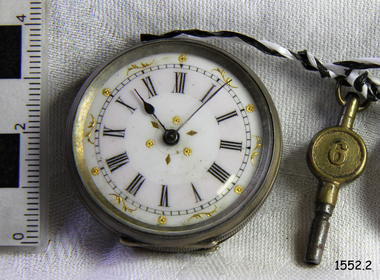
... A fob watch is an instrument for measuring time. It is designed to hang from a chain that is attached to a wearer's waistband or waistcoat. ...A fob watch is an instrument for measuring time. It is designed to hang from a chain that is attached to a wearer's waistband or waistcoat. ...A fob watch is an instrument for measuring time. It is designed to hang from a chain that is attached to a wearer's waistband or waistcoat. The chain keeps the fob watch from being dropped or falling out of a pocket. A person possessing a fob watch or similar instrument in the 18th century would be viewed as someone in a good financial position and often a position of power or respect. It was a social statement as well as a useful object.Silver pocket watch and brass iron winder. Watch has Roman numerals on face and gold flower, floral and diamond shaped motif. Marked "0.800 x/5 115/15 39443" Picture of a bird, flying, griping a painter's pallet and brushes and another separate picture of a bird. There is also a floral pattern on the back of the watch. The winder has a number "6" or "9" on one face and a symbol similar to the "Star of David" on the other.Marked "0.800 x/5 115/15 39443" . The winder has a number "6" or "9" on one face and a symbol similar to the "Star of David" on the other.flagstaff hill, warrnambool, shipwrecked-coast, flagstaff-hill, flagstaff-hill-maritime-museum, maritime-museum, shipwreck-coast, flagstaff-hill-maritime-village, pocket watch, watch, horology, time keeper, fashion accessory -
 Flagstaff Hill Maritime Museum and Village
Instrument - Fob Watch, Moeris watchmakers, Early 1900s
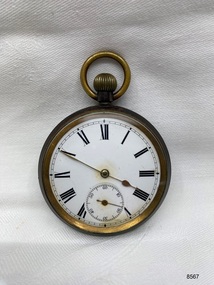
... fob' which could be a chain or made from a variety of materials such as leather. Their popularity peaked in the nineteenth century where they were an important part of middle and lower class society as well. This item is of social significance as fob / pocket watches were valued as an essential object in all levels of society in the late 19th century. For some occupations, such as the railroads, it was a necessary tool of the job. Being dated to the early 1900s gives the watch ...Fob (or pocket) watches were developed in Europe in the 16th century and gained wide usage during the mid 18th century until World War 1 when the wristwatch was invented. These watches were designed to be carried in a small pocket and attached through the means of a 'fob' which could be a chain or made from a variety of materials such as leather. Their popularity peaked in the nineteenth century where they were an important part of middle and lower class society as well.This item is of social significance as fob / pocket watches were valued as an essential object in all levels of society in the late 19th century. For some occupations, such as the railroads, it was a necessary tool of the job. Being dated to the early 1900s gives the watch historical significance as possibly being used during the first World War.Pocket watch with possible gunmetal case and brass winder. The white dial has black Roman numerals on the face (note the use of four lines for the number 4 and no markings for the number 6). The face has a circular insert and hand to show the seconds. All hands are gold coloured with the hour hand having a leaf shape. The case has a back cover, which opens to reveal an inner cover, which protects the workings. Both covers are inscribed with the number 877396. The back cover has the words ACIER GARANTI stamped into it, which means steel guaranteed and may refer to the screws used in the workings.Stamped inside the back cover in an oval shape - ACIER GARANTI with N.F. stamped in between the words. The number 877396 is stamped inside the back cover and again inside the middle cover. There is an indecipherable marking near the number inside the back cover and another scratching on the inside of the back cover which may be letters or numbers. The workings are inscribed with the words SWISS MADE and the manufacturer's circular stamp 'MOERIS'. The markings F, S, A and R are on the workings.flagstaff hill maritime museum and village, warrnambool, great ocean road, shipwreck coast, fob watch, pocket watch, watch, 19th century, horology, time keeper, acier garanti, swiss made, moeris -
 Flagstaff Hill Maritime Museum and Village
Instrument - Fob Watch, 1940-60s
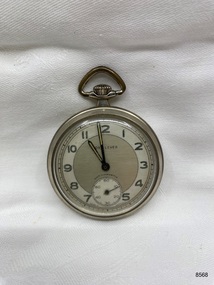
... fob' which could be a chain or made from a variety of materials such as leather. Their popularity peaked in the nineteenth century where they were an important part of middle and lower class society as well. This item is of social significance as fob / pocket watches were valued as an essential object in all levels of society. For some occupations, such as the railroads, it was a necessary tool of the job. Flagstaff Hill Maritime Museum and Village Warrnambool Great Ocean Road Shipwreck Coast fob watch ...Fob (or pocket) watches were developed in Europe in the 16th century and gained wide usage during the mid 18th century until World War 1 when the wristwatch was invented. These watches were designed to be carried in a small pocket and attached through the means of a 'fob' which could be a chain or made from a variety of materials such as leather. Their popularity peaked in the nineteenth century where they were an important part of middle and lower class society as well.This item is of social significance as fob / pocket watches were valued as an essential object in all levels of society. For some occupations, such as the railroads, it was a necessary tool of the job. Steel York Lever open face pocket / fob watch dated between 1940-1960. The dial has an inner pewter circle, outer minute divisions and a circular insert and hand to show the seconds. The numbers are finely edged with a black line and the hands are two coloured. The back of the watch is patterned with fine lines and three rectangle shapes. The words 'ANTIMAGNETIC' are on the front of the watch. Anti-magnetic watches began to be made at the beginning of the 20th century as mechanical watches were affected by magnetic fields. The 'lever' set on watches was a requirement for railroad watches. It required a two step process for the hands to be adjusted. The front dial of the watch has the words 'YORK LEVER', 'ANTIMAGNETIC' and 'MADE IN GERMANY'. flagstaff hill maritime museum and village, warrnambool, great ocean road, shipwreck coast, fob watch, pocket watch, watch, horology, time keeper, york lever, anti-magnetic, made in germany -
 Flagstaff Hill Maritime Museum and Village
Instrument - Fob Watch, 1920-30s
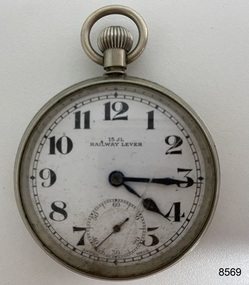
... fob' which could be a chain or made from a variety of materials such as leather. Their popularity peaked in the nineteenth century where they were an important part of middle and lower class society as well. The inclusion of the word RAILWAY on the face of the watch...fob' which could be a chain or made from a variety of materials such as leather. Their popularity peaked in the nineteenth century where they were an important part of middle and lower class society as well. The inclusion of the word RAILWAY on the face of the watch ...Fob (or pocket) watches were developed in Europe in the 16th century and gained wide usage during the mid 18th century until World War 1 when the wristwatch was invented. These watches were designed to be carried in a small pocket and attached through the means of a 'fob' which could be a chain or made from a variety of materials such as leather. Their popularity peaked in the nineteenth century where they were an important part of middle and lower class society as well. The inclusion of the word RAILWAY on the face of the watch suggests a possible use by an employee of the railways. This item is of social significance as fob / pocket watches were valued as an essential object in all levels of society. For some occupations, such as the railroads, it was a necessary tool of the job. Steel Railway Lever open face pocket / fob watch dated 1920s-1930s. The white dial has large black arabic numerals and outer minute divisions around the edge. A circular insert and small hand to show the seconds is at the bottom of the watch face. The hour hand is a rounded leaf shape, and the minute hand a thin diamond shape. Both hands and the small rounded end of the second hand reflect a metallic blue sheen in the right lighting. The words RAILWAY LEVER, 15 JL and SWISS MADE are on the dial. The lever set on watches was a requirement for railroad watches. It required a two step process for the hands to be adjusted. 15 JL refers to the movement being a 15 jewel one.The front dial of the watch has the words 15 JL, RAILWAY LEVER, and SWISS MADE. flagstaff hill maritime museum and village, warrnambool, great ocean road, shipwreck coast, fob watch, pocket watch, watch, horology, time keeper, swiss made, railway lever, 15 jl, 15 jewel -
 Flagstaff Hill Maritime Museum and Village
Instrument - Fob Watch, Mid 20th century
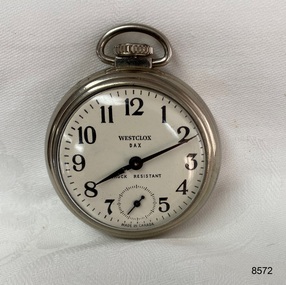
... These watches were designed to be carried in a small pocket and attached through the means of a 'fob' which could be a chain or made from a variety of materials such as leather. This pocket watch was manufactured by the Western Clock Co. ...These watches were designed to be carried in a small pocket and attached through the means of a 'fob' which could be a chain or made from a variety of materials such as leather. This pocket watch was manufactured by the Western Clock Co. ...Fob (or pocket) watches were developed in Europe in the 16th century. These watches were designed to be carried in a small pocket and attached through the means of a 'fob' which could be a chain or made from a variety of materials such as leather. This pocket watch was manufactured by the Western Clock Co. (Westclox) in the mid 20th century. The company was large and manufactured inexpensive watches with this style being an example of their ‘dollar watches’.This item is of social significance as an example of an inexpensive men's watch available during the mid 20th century.Men's silver pocket watch with a white dial, black arabic numerals and outer minute divisions around the edge. A seconds dial is in the place of the number 6. The face of the pocket watch is made from plastic. The word DAX was trademarked by the Western Clock Co. in 1915.The front dial of the watch has the words WESTCLOX, DAX, SHOCK RESISTANT and MADE IN CANADA.flagstaff hill maritime museum and village, warrnambool, great ocean road, shipwreck coast, fob watch, pocket watch, watch, horology, time keeper, made in canada, shock resistant, westclox, dollar watch -
 Flagstaff Hill Maritime Museum and Village
Textile - Waistcoat, circa 1910
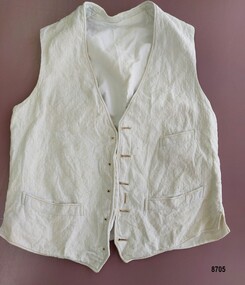
... Some men liked to wear a watch attached to their waistcoat with a fob chain. ...Some men liked to wear a watch attached to their waistcoat with a fob chain. This item is an example of clothing worn by men on special occasions, in the late 19th and early 20th century. ...This item is one of a collection of clothing items that belonged to the Stephenson family who lived at 22 McCracken Street, Kensington, Melbourne. Matthew Stephenson (1861 – 1943) who had grown up on the Bendigo goldfields and shifted to Melbourne in the early 1900’s was a train driver and later, a fireman with the railways. His wife Elizabeth Jane (Betsy) Wigley (1865 – 1953) also grew up on the goldfields around Majorca and Bendigo. They married in 1885 in Bendigo. They had two daughters – Ethel Evelyn Stephenson (1886 – 1956) and Lillian or Lila (1891 – 1977) who were milliners and dressmakers and who continued to live in the family home after the death of their parents. The family are recorded as living at 22 McCracken Street, Kensington, as early as 1914. It is not known who made or owned the clothing that makes up this collection but as it appears to be from the late Victorian and early Edwardian era however the vest was probably made by one of the three ladies of the house, for their husband and father, Matthew Stephenson. During W.W.2, a local Warrnambool couple (Meryl and Tony Everard) boarded with them – Tony was in the airforce training paratroopers to jump into (and survive) enemy territory and his wife Meryl worked in the Methodist baby Home. The Everards developed a close friendship with the Stephensons and were responsible for clearing out the house (and finding this clothing collection) after Lila died in 1977. Although by 1916, men's "ready to wear" clothing were widely available, this waistcoat was handmade (possibly by Matthew's wife or daughters). Men's suits in the early part of the twentieth century were predominantly three piece, consisting of a jacket, vest (or waistcoat) and trousers made from matching fabrics. Some men liked to wear a watch attached to their waistcoat with a fob chain. This item is an example of clothing worn by men on special occasions, in the late 19th and early 20th century.A man's waistcoat with cream cotton weave front pieces and cream cotton lining and back. The left front features five machine worked horizontal buttonholes and one vertical buttonhole (for a fob watch) and two inset pockets. The right hand side has five corresponding stud holes and one inset pocket. The studs or buttons are missing. The lining and back of the waistcoat are made from a plain cream cotton fabric. The back also features a cotton strap with a two pronged metal buckle.flagstaff hill maritime museum and village, great ocean road, shipwreck coast, warrnambool, vest, waistcoat, needlework, sewing, stephenson family, man's waistcoat -
 Orbost & District Historical Society
sovereign case, Early 20th century
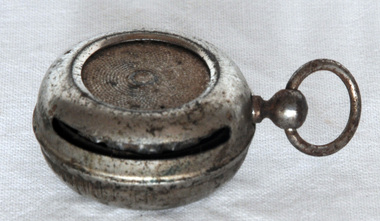
... fob chain. The silver sovereign holder was used for carrying either full or half gold sovereigns. It had the shape of a locket or of a watch and was often worn on a chain and kept by gentlemen in a waist coat pocket. ...Coins are one of the worlds oldest types of currency, though the worlds first coins were very basic . They first began to appear in the ancient world and by the time of the Roman and Greek civilisations, coins were being issued in a range of denominations with quite sophisticated designs. With coins being used instead of older systems such as barter, people needed a way to carry and store their money and the coin holder appeared on the scene. Sovereign cases were small portable boxes usually in cylindrical shape and made from various metals with snap shut covers to contain the coin. This one is kept safe by being attached to a fob chain. The silver sovereign holder was used for carrying either full or half gold sovereigns. It had the shape of a locket or of a watch and was often worn on a chain and kept by gentlemen in a waist coat pocket. This item is an example of a commonly used sovereign case.A small round metal ( nickel plated?) sovereign coin holder. it has a spring opening with a slot for insertion of coin, It has a link attached to top.currency coin sovereign-case personal-effects -
 Orbost & District Historical Society
Functional object - Watch fob
... watch fob...silver chain...Silver-plated watch fob, with two blackened silver double chains connected to a small clasp at base and a t-piece of silver-plated metal at the top for the button hole. ...Mary Gilbert) Owned by a local Orbost woman's family. watch fob silver chain pocket watch 1900s elsie cooke Silver-plated watch fob, with two blackened silver double chains connected to a small clasp at base and a t-piece of silver-plated metal at the top for the button hole. ...From the estate of Elsie Cooke. Elsie Cooke was a librarian in Orbost for many years. She was the daughter of John Cooke early Brodribb settler. Elsie Cooke lived all her life in Gippsland,. She was born at Brodribb in 1895 and died in 1970, Elsie Cooke lived at Bruthen for a short time and, in 1937, moved to live with her aunt, Miss Jean Munro. Miss Cooke was Librarian at the Mechanics Institute for many years. Kindness and consideration for other were Miss Cooke’s attributes and she endeared herself to all who knew her. She was a loyal member of the Presbyterian Church and a stalwart of the Ladies’ Guild, an energetic worker for the Municipal Auxiliary and a member of the Red Cross. (ref. Mary Gilbert) Owned by a local Orbost woman's family. Silver-plated watch fob, with two blackened silver double chains connected to a small clasp at base and a t-piece of silver-plated metal at the top for the button hole. Approximately 20cm in length.watch fob, silver chain, pocket watch, 1900s, elsie cooke -
 Orbost & District Historical Society
fob chain
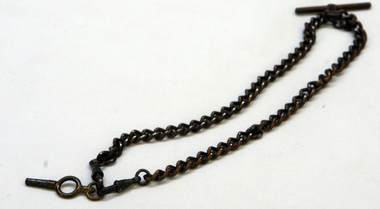
... A pocket watch (or fob watch) is a watch that is made to be carried in a pocket. Watches were also mounted on a short leather strap or fob, when a long chain would have been cumbersome or likely to catch on things. ...Man's double, silver fob chain with key for watch....This item is an example of a popular piece of men's jewellery often considered to be a symbol of importance. chain silver fob-chain jewelry costume-accessories- male On fob chain - GILT Man's double, silver fob chain with key for watch. fob chain ...A pocket watch (or fob watch) is a watch that is made to be carried in a pocket. Watches were also mounted on a short leather strap or fob, when a long chain would have been cumbersome or likely to catch on things. This fob could also provide a protective flap over their face. Watch chains were introduced about 100 years after pocket watches first appeared in the 16th century. This item is an example of a popular piece of men's jewellery often considered to be a symbol of importance.Man's double, silver fob chain with key for watch.On fob chain - GILTchain silver fob-chain jewelry costume-accessories- male -
 City of Moorabbin Historical Society (Operating the Box Cottage Museum)
Watches, small silver plated pocket, c1900
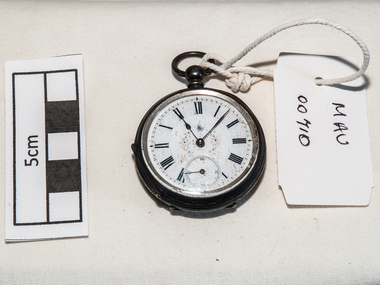
... Gentlemen put their 'Fob' watch in their waistcoat pocket attached to a chain that had a bar that slipped through a button hole. ...Gentlemen put their 'Fob' watch in their waistcoat pocket attached to a chain that had a bar that slipped through a button hole. ...Pocket Watches became popular in the late19th C. Gentlemen put their 'Fob' watch in their waistcoat pocket attached to a chain that had a bar that slipped through a button hole. Ladies attached their Watches by a chain to their chatelaine. Nurses usually used a bar with a pin to attach the pocket watch to their uniform. All Train Conductors had a Fob Watch to keep check of the Train Timetable.This small silver plated pocket watch with a hinged case has a white enamel dial with black Roman numerals, a seconds dial at 6 and black metal hands.unreadable on back of Casebrighton, moorabbin, pioneers, watchmaking, jewellers, market gardeners, early settlers, craftwork, watches, clocks -
 Flagstaff Hill Maritime Museum and Village
Instrument - Fob watch, 1882
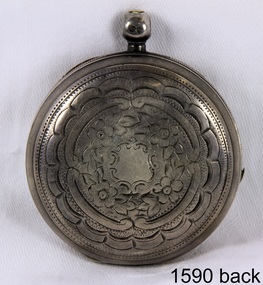
... fob watch Fusee movement face has a white background with black Roman numerals on it. The minute hand is gold coloured with a leaf shape. Seconds dial is inset at position 6, with Arabic numerals around it. Watch has machine engraving flower pattern front and back. The spherical winder has a number and a symbol on the upper face and a hole through the centre, the ring for the chain...fob watch Fusee movement face has a white background with black Roman numerals on it. The minute hand is gold coloured with a leaf shape. Seconds dial is inset at position 6, with Arabic numerals around it. Watch has machine engraving flower pattern front and back. The spherical winder has a number and a symbol on the upper face and a hole through the centre, the ring for the chain ...The watch was given to William James Robe by the captain of the barque Fiji as a token for helping to save his life and that of the crew on September 6th 1891 when the steel barque Fiji had foundered off “wreck beach" near Moonlight Head Warrnambool during a voyage from Hamburg to Melbourne. William or Bill as he was called was the one who had hauled out the last man, the captain, after he had become tangled in the kelp. William along with many other onlookers on the beach at the time had taken it in turns to go into the surf and drag half-drowned seamen to safety. These rescuers along with William James Robe, included Edwin Vinge, Hugh Cameron, Fenelon Mott, Arthur Wilkinson and Peter Carmody. Years later Bill passed the watch on to his brother-in-law Gilbert Hulands as payment of a debt. The grandson of Gilbert Hulands, John Hulands, has donated this watch to Flagstaff Hill Maritime Museum. The Fiji Wreck: The three-masted iron barque Fiji had been built in Belfast, Ireland, in 1875 by Harland and Wolfe for a Liverpool based shipping company. The ship departed Hamburg on 22nd May 1891 bound for Melbourne, under the command of Captain William Vickers with a crew of 25. On September 5th, one hundred days out from Hamburg in squally and boisterous south-west winds the Cape Otway light was sighted on a bearing differing from Captain Vickers' calculation of his position. At about 2:30 am, Sunday 6th September 1891 land was reported 4-5 miles off the port bow. The captain tried to put the ship on the other tack, but she would not respond. He then tried to turn her the other way but just as the manoeuvre was being completed Fiji struck rock only 274 metres from shore. The place is known as Wreck Bay, Moonlight Head. Blue lights were burned and rockets fired whilst an effort was made to lower boats but all capsized or swamped and smashed to pieces. Two of the younger crewmen volunteered to swim for the shore, taking a line. One, a Russian named Daniel Carkland, drowned after he was swept away when the line broke. The other, 17-year-old able seaman Julius Gebauhr, a German, reached shore safely on his second attempt but without the line, which he had cut loose with his sheath-knife when it becomes tangled in kelp. He rested on the beach a while then climbed the cliffs in search of help. At about 10 am on Sunday a party of land selectors - including F. J. Stanmore, Leslie Dickson (or Dixon) and Mott - found Gebauhr. They were near Ryans Den, on their travels on horseback from Princetown towards Moonlight Head, and about 5km from the wreck. They found Gebauhr lying in scrub and a poor state, bleeding and scantly dressed and with a sheath-knife. At first, they were concerned about his appearance and gibberish speech, taking him to be an escaped lunatic. They were reassured after Gebauhr threw his knife away realising he was speaking half-English, half-German. They gave him food and brandy and some clothing and were then able to gain information about the wreck. Some of the men took him to Rivernook, a nearby guest house owned by John Evans, where he was cared for. Stansmore and Dickson rode off to try and summon help. Others went down to the site of the wreck. Messages for rescuing the rest of the crew were sent both to Port Campbell for the rocket rescue crew and to Warrnambool for the lifeboat. The S.S. Casino sailed from Portland towards the scene. After travelling the 25 miles to the scene, half of the Port Campbell rocket crew and equipment arrived and set up the rocket tripod on the beach below the cliffs. By this time the crew of Fiji had been clinging to the jib-boom for almost 15 hours, calling frantically for help. Mr Tregear from the Rocket Crew fired the line. The light line broke and the rocket was carried away. A second line was successfully fired across the ship and made fast. The anxious sailors then attempted to come ashore along the line but, with as many as five at a time, the line sagged considerably and some were washed off. Others, nearly exhausted, had to then make their way through masses of seaweed and were often smothered by waves. Only 14 of the 24 who had remained on the ship made it to shore. Many onlookers on the beach took it in turns to go into the surf and drag half-drowned seamen to safety. One of the rescuers Arthur Wilkinson, a 29-year-old land selector, swam out to the aid of one of the ship's crewmen, a carpenter named John Plunken who was attempting to swim to shore. Two or three times both men almost reached the shore but were washed back to the wreck, a line was thrown to them. It was thought that Wilkinson had struck his head on the anchor during the rescue and had remained unconscious, the carpenter survived this ordeal but Wilkinson died and his body was washed up the next day. The wreck of Fiji smashed apart within 20 minutes of the captain being brought ashore, and it finally settling in 6m of water. Of the 26 men on Fiji, 11 in total lost their lives. The remains of 7 bodies were washed onto the beach. They were buried on the clifftop above the wreck. Captain Vickers was severely reprimanded for his mishandling of the ship and his is Masters Certificate was suspended for 12 months. At the time there was also a great deal of public criticism at the slow and disorganised rescue attempt to save those on board. The important canvas ‘breech buoy’ or ‘bucket chair’ and the heavy line from the Rocket Rescue was in the half of the rocket outfit that didn’t make it in time for the rescue: they had been delayed at the Gellibrand River ferry. Communications to Warrnambool were down so the call for help didn’t get through on time and the two or three boats that had been notified of the wreck failed to reach it in time. Much looting occurred of the cargo that washed up on the shore, with nearly every visitor leaving the beach with bulky pockets. One looter was caught with a small load of red and white rubber balls, which were duly confiscated and he was 'detained' for 14 days. The essence of peppermint mysteriously turned up in many settlers homes. Sailcloth was salvaged and used for horse rugs and tent flies. Soon after the wreck "Fiji tobacco" was being advertised around Victoria. A Customs officer, trying to prevent some of the looting, was assaulted by looters and thrown over a cliff. He managed to cling to a bush lower down until rescued. Seaman Julius Gebauhr later gave his knife, in its hand crafted leather sheath, to F. J. Stansmore for caring for him when he came ashore. Flagstaff Hill’s Fiji collection is of historical significance at a State level because of its association with the wreck Fiji, which is on the Victorian Heritage Register (S 259). The collection also represents key aspects of Victoria’s shipping history and its items offer the potential to interpret maritime historical events and social history of the time. Along with the potential to yield information that will contribute to an understanding of Victoria’s cultural history.Sterling silver fob watch Fusee movement face has a white background with black Roman numerals on it. The minute hand is gold coloured with a leaf shape. Seconds dial is inset at position 6, with Arabic numerals around it. Watch has machine engraving flower pattern front and back. The spherical winder has a number and a symbol on the upper face and a hole through the centre, the ring for the chain is missing. Back of a the watch opens to reveal a concave cover with a winding hole, which has a border of overlapping crescent-shapes. Inside cover a diamond with initials “JR”(John Rotherham) inside, a date letter “G” (1882) with a Lion Passant (Sterling Silver) also 3 numbers “8 1 9“embossed beside each other. The clock face has “Rotherhams / London” printed on it. The winder is also marked with a maker and sterling silver mark. “Y” and numbers “688” “3 CI A” “3309” “819” “555 A” and other numbers including a set engraved around the edge possibly jewelers marks who did repairs or maintenance on the item over the years.1891, shipwrecked coast, flagstaff hill, flagstaff hill maritime museum, maritime museum, shipwrecked artefact, flagstaff hill maritime village, shipwreck coast, warrnambool, fiji, pocket watch, william vickers, william robe, bill robe, fiji watch -
 Bendigo Historical Society Inc.
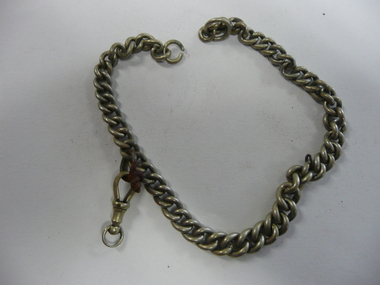
Accessory - FOB CHAIN
... Nickel plated fob chain for pocket watch....HOROLOGY Watches Nickel plated fob chain for pocket watch. Accessory FOB CHAIN ...Nickel plated fob chain for pocket watch.horology, watches
