
Showing 58 items matching "food safes"
-
 Flagstaff Hill Maritime Museum and Village
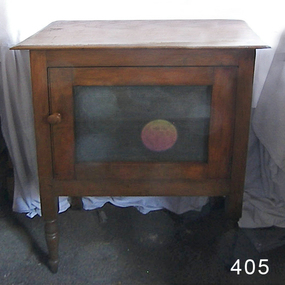
Functional object - Food Safe, 1890 to 1925
... Food Safe......food safes...The Frigidaire and Kelvinator brands date from 1918 when the first self-contained fridges were sold. Before this food safes were used as well to keep food away from flies and to keep items cool....Functional object Food Safe ...The first commercially available, Australian-made domestic refrigerator to operate without ice was produced by Edward Hallstrom in 1923. It used kerosene as a power source and was promoted as ideal for outback stations where ice was not available. According to Museum Victoria, Hallstrom introduced the 'Silent Night' which ran on electricity or gas in 1935. However, Hailstorm's great-grandson, stated that the Silent Night refrigerator was introduced in 1928. Although Australians were among the pioneers of refrigeration in the 1850s, the technology wasn't adapted for domestic use until many decades later. The first domestic electric refrigerator was sold in America in 1913. It had an air-cooled refrigeration unit mounted on top of an ice box. The Frigidaire and Kelvinator brands date from 1918 when the first self-contained fridges were sold. Before this food safes were used as well to keep food away from flies and to keep items cool.A significant item used from the late Victorian era until around 1940 when people were beginning to be able to afford domestic refrigerators. After the second world war, most households had replaced their food storage cupboards or safes with refrigerators. The subject item gives a snapshot of domestic life from this time.Wooden kitchen safe with 3 metal perforated panels & 2 shelves inside. Was painted light Green but has been restoredflagstaff hill, warrnambool, shipwrecked-coast, flagstaff-hill, flagstaff-hill-maritime-museum, maritime-museum, shipwreck-coast, flagstaff-hill-maritime-village, refrigeration, refrigerator, food storage, food safes, edward hallstrom -
 Orbost & District Historical Society
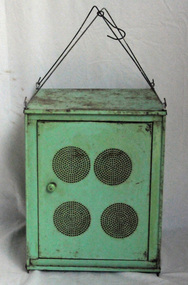
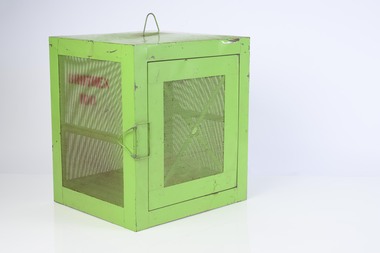
food safe, from the 1890s until the mid 20th century
... food safe...domestic food-preservation food-safe...A food safe was a piece of domestic equipment widely used in Australia before refrigeration to preserve perishable food in summer. ...A rectangular tin food safe. It is painted green and has thin wire bent into a triangular shape for hanging.Inside is a cream coloured painted shelf. ...A food safe was a common domestic item widely used in rural Victoria before cheap refrigeration was available. domestic food-preservation food-safe A rectangular tin food safe. ...A food safe was a piece of domestic equipment widely used in Australia before refrigeration to preserve perishable food in summer. A food safe was a common domestic item widely used in rural Victoria before cheap refrigeration was available.A rectangular tin food safe. It is painted green and has thin wire bent into a triangular shape for hanging.Inside is a cream coloured painted shelf. It has six circular air vents on three sides and four on the door.domestic food-preservation food-safe -
 Flagstaff Hill Maritime Museum and Village
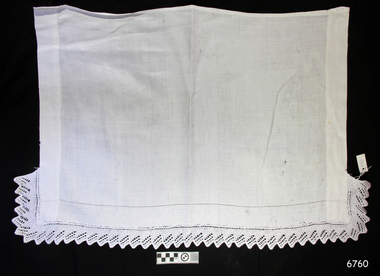
Textile - Food Safe Cover, Mary Jane Giles (Mrs Harry Giles), Late 19th to Early 20th Century
... Food Safe Cover...This food safe cover is one of many 19th century items of furniture, linen and crockery donated to Flagstaff Hill Maritime Village by, Vera and Aurelin Giles. ...Food safe cover, white with knitted lace on the front and part of the two sides....Textile Food Safe Cover Mary Jane Giles (Mrs Harry Giles) ...This food safe cover is one of many 19th century items of furniture, linen and crockery donated to Flagstaff Hill Maritime Village by, Vera and Aurelin Giles. The items are associated with Warrnambool and the Giles Family history. Items donated by the family have come to be known as the “Giles Collection”. Many items in the Lighthouse Keeper’s Cottage were donated by Vera and Aurelin Giles and mostly came from the home of Vera’s parents-in-law, Henry Giles and his wife Mary Jane (nee Freckleton) who married in 1880 and whose photos are on display in the parlour. Henry was born at Tower Hill in 1858, and was a labourer on the construction of the Warrnambool Breakwater before leaving in 1895 for around seven years to build bridges in NSW. Mary Jane was born in 1860 at Cooramook and she attended Mailor’s Flat State School and where she eventually was to become a student teacher. After which she became a governess at “Injemiara” where her grandfather, Francis Freckleton, had once owned land. Henry and Mary’s family consisted of six, some of the children were born at Mailor’s Flat and later some children at Wangoom. They lived with their parents at Wangoom and Purnim west, and this is where Henry died in 1933 and Mary Jane in 1940. The Giles family collection is of social and historical significance at a local level, because it not only illustrates the level of material support the Warrnambool community gave to Flagstaff Hill during it’s establishment. But the Giles collection also gives us today a snapshot into what domestic life was like in early colonial times prior to Federation.Food safe cover, white with knitted lace on the front and part of the two sides.Noneflagstaff hill, warrnambool, shipwrecked-coast, flagstaff-hill-maritime-museum, flagstaff-hill-maritime-village, safe cover, giles collection, henry giles, tower hill, cooramook, mailor’s flat, wangoom, 19th century household goods -
 Flagstaff Hill Maritime Museum and Village
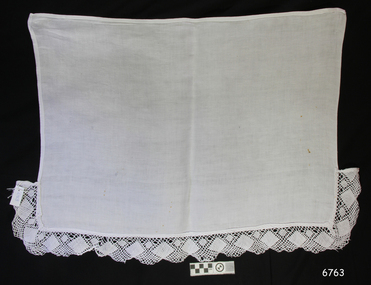
Textile - Safe Cover, Mary Jane Giles (Mrs Harry Giles), Late 19th to Early 20th Century
... This food safe cover is one of many 19th century items of furniture, linen and crockery donated to Flagstaff Hill Maritime Village by, Vera and Aurelin Giles. ...Food safe cover, white with knitted lace on the front and part of the two sides....This food safe cover is one of many 19th century items of furniture, linen and crockery donated to Flagstaff Hill Maritime Village by, Vera and Aurelin Giles. ...This food safe cover is one of many 19th century items of furniture, linen and crockery donated to Flagstaff Hill Maritime Village by, Vera and Aurelin Giles. The items are associated with Warrnambool and the Giles Family history. Items donated by the family have come to be known as the “Giles Collection”. Many items in the Lighthouse Keeper’s Cottage were donated by Vera and Aurelin Giles and mostly came from the home of Vera’s parents-in-law, Henry Giles and his wife Mary Jane (nee Freckleton) who married in 1880 and whose photos are on display in the parlour. Henry was born at Tower Hill in 1858, and was a labourer on the construction of the Warrnambool Breakwater before leaving in 1895 for around seven years to build bridges in NSW. Mary Jane was born in 1860 at Cooramook and she attended Mailor’s Flat State School and where she eventually was to become a student teacher. After which she became a governess at “Injemiara” where her grandfather, Francis Freckleton, had once owned land. Henry and Mary’s family consisted of six, some of the children were born at Mailor’s Flat and later some children at Wangoom. They lived with their parents at Wangoom and Purnim west, and this is where Henry died in 1933 and Mary Jane in 1940.The Giles family collection is of social significance at a local level, because it not only illustrates the level of material support the Warrnambool community gave to Flagstaff Hill during it’s establishment. But the Giles collection also gives us today a snapshot into what domestic life was like in early colonial times prior to Federation.Food safe cover, white with knitted lace on the front and part of the two sides.Nonewarrnambool, shipwrecked-coast, flagstaff-hill, flagstaff-hill-maritime-museum, shipwreck-coast, flagstaff-hill-maritime-village, safe cover, giles collection, henry giles, tower hill, cooramook, mailor’s flat, wangoom, 19th century household goods, textile -
 Department of Energy, Environment and Climate Action
Metal Food safe
... Metal Food safe...Metal food safe Common before refrigeration was available in the bush...used at fire camps Forests Commission Victoria (FCV) Bushfire Camping Equipment Bruthen 100 Metal food safe Common before refrigeration was available in the bush Metal Food safe ...used at fire campsMetal food safe Common before refrigeration was available in the bushBruthen 100forests commission victoria (fcv), bushfire, camping equipment -
 Greensborough Historical Society
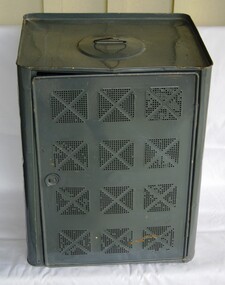
Domestic object - Meat Safe, 1920-1950
... ...food safes...Used to store meat and other perishables, often with wetted cloth covers to keep contents cool where refrigeration was not available. meat safes food safes Grey painted ventilated meat safe with centre shelf Domestic object Meat Safe ...Used to store meat and other perishables, often with wetted cloth covers to keep contents cool where refrigeration was not available.Grey painted ventilated meat safe with centre shelfmeat safes, food safes -
 Cheese World Museum
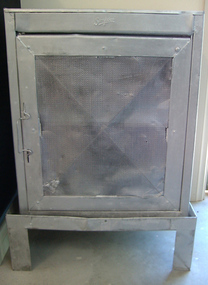
Safe, food, Coolgardie safe
... Safe, food......food safes...Coolgardie safe Safe, food ...Coolgardie safes were invented in the 1890s by Patrick McCormick in the Western Australian town of Coolgardie. Coolgardie safes were usually placed in a draughty areas, often under verandas. The hessian was placed in the water and draped around the sides and the draft cooled the contents of the safe. The legs could be stood in another tray of water to deter ants. This safe was bought at an auction at Orford by Laurie Gunnulson.Coolgardie safe has a box-shaped frame with wire mesh on the sides for air circulation. A four-legged tray for water is at the bottom. A piece of hessian hangs on one side (for demonstration purposes). The safe opens by a hinged door with a wire handle and there is a maker's name on the front. Inside it has a shelf in the middle. The safe is painted with Silvafros.Simpsonallansford, food storage, simpson, coolgardie safes, food safes, orford -
 Mont De Lancey
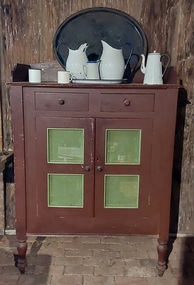
Furniture - Meat Safe, mid 19th C
... ...Food safes...A vintage meat safe cabinet is a traditional freestanding food storage unit from the 1800s to the mid-19th/20th century featuring perforated metal mesh or wire panels. ...Kitchen equipment Kitchen furniture Food safes Meat safes A vintage brown painted wooden meat safe with two drawers at the top with round brown knobs.There are two doors below, which each have two square green painted mesh ventilation panels. ...A vintage meat safe cabinet is a traditional freestanding food storage unit from the 1800s to the mid-19th/20th century featuring perforated metal mesh or wire panels. These panels allowed vital air circulation while keeping flies and pests away from fresh meat and perishables before domestic refrigerators became common.A vintage brown painted wooden meat safe with two drawers at the top with round brown knobs.There are two doors below, which each have two square green painted mesh ventilation panels. On both sides are two green mesh ventilation panels. Inside is a shelf, with the underneath section divided into two partitions vertically. It has four turned brown wooden legs. The top of the safe has added shaped wooden sides to stop items falling off.kitchen equipment, kitchen furniture, food safes, meat safes -
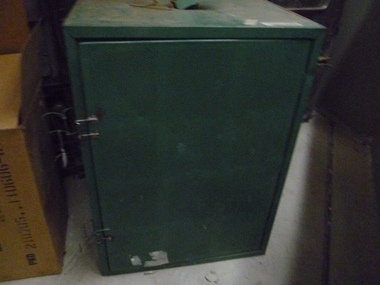 National Vietnam Veterans Museum (NVVM)
Equipment - Equipment, Army, Food Safe
... Food Safe...Food safe...Green coloured metal ventilated food safe with removable shelves and food hanging hooks....Food Safe Equipment Equipment, Army ...Green coloured metal ventilated food safe with removable shelves and food hanging hooks.7330-066-028-6019food safe, army equipment -
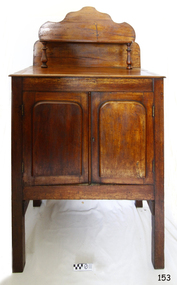 Flagstaff Hill Maritime Museum and Village
Functional object - Food Safe, 1920s
... Food Safe......food safe...The Frigidaire and Kelvinator brands date from 1918 when the first self-contained fridges were sold. Before this food safes were used as well to keep food away from flies and to keep items cool....Wooden kitchen food safe, 2 door with wire mesh at sides. Raised back panel has shaped edges and includes a shelf above bench area that has turned legs. ...Functional object Food Safe ...The first commercially available, Australian-made domestic refrigerator to operate without ice was produced by Edward Hallstrom in 1923. It used kerosene as a power source and was promoted as ideal for outback stations where ice was not available. According to Museum Victoria, Hallstrom introduced the 'Silent Night' which ran on electricity or gas in 1935. However, Hailstorm's great-grandson, stated that the Silent Night refrigerator was introduced in 1928. Although Australians were among the pioneers of refrigeration in the 1850s, the technology wasn't adapted for domestic use until many decades later. The first domestic electric refrigerator was sold in America in 1913. It had an air-cooled refrigeration unit mounted on top of an ice box. The Frigidaire and Kelvinator brands date from 1918 when the first self-contained fridges were sold. Before this food safes were used as well to keep food away from flies and to keep items cool.A significant item used from the late Victorian era until around 1940 when people were beginning to be able to afford domestic refrigerators. After the second world war, most households had replaced their food storage cupboards or safes with refrigerators. The subject item gives a snapshot of domestic life from this time.Wooden kitchen food safe, 2 door with wire mesh at sides. Raised back panel has shaped edges and includes a shelf above bench area that has turned legs. The safe has 4 plain legs.Noneflagstaff hill, warrnambool, flagstaff hill maritime museum, maritime museum, shipwreck coast, flagstaff hill maritime village, great ocean road, food safe, kitchen safe, kitchen furniture, food storage -
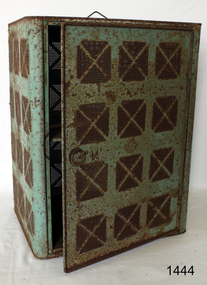 Flagstaff Hill Maritime Museum and Village
Domestic object - Food Safe, Willow Ware Pty Ltd, 1920s -1950
... Food Safe......food safe...Safe metal kitchen food safe with 2 shelves, a hinged door and latch and a small swivel wire handle at the top. ...Domestic object Food Safe Willow Ware Pty Ltd ...Willow started business in 1887 as a metal working company based in Melbourne Australia, making tinned biscuit and tea canisters. The outbreak of the First World War saw their manufacturing change to making armaments and essential packaging for the war effort. In the early 1920’s, the Willow brand was established. Making tin plated canisters and baking pans with the well-known Willow pattern, imprinted on them. Some other items in production at this time include billies, boilers, basins and Coolgardie safes. In the late 1950’s, the company ventured into plastics production. Stepping away from its very successful tin plating industry of more than 50 years. In 1965, the company name changed to Willow Ware Pty Ltd, to be more closely linked to its Willow brand. Willow Ware is still in business today. A food safe known as a “Coolgardie” meat storage made by an emerging Australian company no longer in bushiness. This item gives a snapshot into early Australian manufacturing specifically aimed at the Australian market.Safe metal kitchen food safe with 2 shelves, a hinged door and latch and a small swivel wire handle at the top. Painted light green, rusting.Willowwarrnambool, shipwrecked-coast, flagstaff-hill, flagstaff-hill-maritime-museum, maritime-museum, shipwreck-coast, flagstaff-hill-maritime-village, safe, food safe, meat safe, coolgardie safe, domestic object, kitchen object, willow ware, food preservation, kitchen safe -
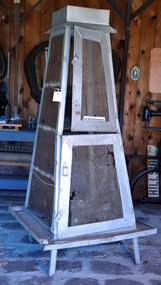 City of Moorabbin Historical Society (Operating the Box Cottage Museum)
Functional object - Kitchen Equipment, Coolgardie Safe, c1900
... As fresh food was a valuable commodity there was incentive to preserve it, and keep it out of reach of scavengers such as birds, dingos, dogs, ants, and flies. It was in an effort to do this, in the extreme heat of the Australian Interior, that McCormick came up with his design for the Coolgardie Safe. ...A metal framed, 4 sided structure standing on 4 legs with 2 hinged doors on one side, a metal tray at base of food safe and a metal cover over top. Ridges on which to rest trays carrying food are inside safe. ...A metal framed, 4 sided structure standing on 4 legs with 2 hinged doors on one side, a metal tray at base of food safe and a metal cover over top. Ridges on which to rest trays carrying food are inside safe. ...The invention of the Coolgardie Safe is credited to Arthur Patrick McCormick, a contractor in Coolgardie, and later the Mayor of Narrogin. Coolgardie is in the Eastern Goldfields region of Western Australia. Gold was first discovered there in 1892; the townsite became a municipality in 1894, and by 1898 its population of 15,000 made it the third largest town in Western Australia after Perth and Fremantle. In the last decade of the 19th century, Coolgardie was the capital of the West Australian goldfields. Being 180 kilometres from the nearest civilisation, food supplies were initially scarce and expensive. As fresh food was a valuable commodity there was incentive to preserve it, and keep it out of reach of scavengers such as birds, dingos, dogs, ants, and flies. It was in an effort to do this, in the extreme heat of the Australian Interior, that McCormick came up with his design for the Coolgardie Safe. McCormick noticed that a wet bag placed over a bottle cooled its contents. He further noted that if this bottle was placed in a breeze, the bag would dry out more quickly, but the bottle would get colder. What McCormick had discovered was the principle of evaporation: ‘to change any liquid into a gaseous state requires energy. This energy is taken in the form of heat from its surroundings.’ Employing this principle, McCormick made a box for his provisions which he covered with a wet hessian bag. He then placed a tray on top, into which he poured water twice daily. He hung strips of flannel from the tray so that water would drip down onto the hessian bag, keeping it damp. As the water evaporated, the heat dissipated, keeping the food stored inside cool and fresh. The success of McCormick’s invention would not have worked without a steady supply of water. Fresh water was scarce in the eastern goldfields at this time but the demand for water from a steadily growing population encouraged innovation. The solution was to condense salt water. Heating salt water in tanks produced steam that was condensed in tall cylinders, cooled and then collected in catchment trays. By 1898 there were six companies supplying condensed water to the goldfields, the largest company producing 100,000 gallons of water a day. In the early 20th century, Coolgardie Safes were also manufactured commercially. These safes incorporated shelving and a door, had metal or wooden frames and hessian bodies. The feet of the safe were usually placed in a tray of water to keep ants away. (MAV website) The early settlers of Moorabbin Shire depended on this type of Food Safe to protect their food from flies and vermin as they established market gardens in the fertile area around the notorious Elster Creek A metal framed, 4 sided structure standing on 4 legs with 2 hinged doors on one side, a metal tray at base of food safe and a metal cover over top. Ridges on which to rest trays carrying food are inside safe. The Safe is enclosed by fly-wire mesh.'...IN.....GEELONG' A manufacturer's oval metal plate is embossed on one side of Safe but it is illegible.elster creek, moorabbin, brighton, dendy's special survey 1841, market gardens, infant mortality, disease, cemeteries, fruit, vegetables, pioneers, coolgardie safe, mccormick arthur patrick, dendy henry, vaccination, jones martha, jones ethel may -
 Orbost & District Historical Society
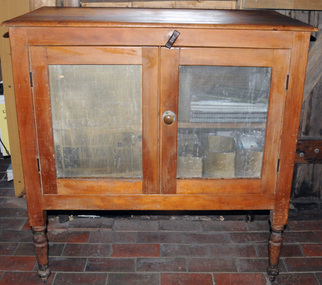
cabinet
... furniture-domestic cabinet food-safe...Food safes / cabinets are used principally to keep food safe (from flies and other pests), clean and cool. ...Food safes / cabinets are used principally to keep food safe (from flies and other pests), clean and cool. ...Food safes / cabinets are used principally to keep food safe (from flies and other pests), clean and cool. They have been used to store perishable foodstuffs for centuries, and are still made and used today. They are usually placed in a well ventilated area to allow for air flow, thus ensuring the produce is kept cool. This was a normal household item before iceboxes came into regular use.This was a normal household item before iceboxes came into regular use.A wooden cabinet / safe. It has two doors and zinc mesh insets on the sides and front. Inside are two shelves. The back and top are closed. The knob fittings are brass. It has four turned wooden legs and the doors are hinged.furniture-domestic cabinet food-safe -
 Friends of Westgarthtown
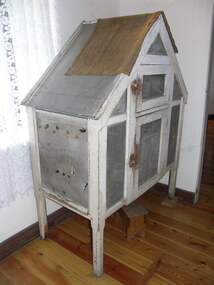
Functional object - Coolgardie Safe, Carl Ziebell, direct descendant, c. 1915
... ...food...safe...Handmade food safe with white painted wooden frame and perforated zinc screen panels. ... storage and preservation food safe storage pantry carl ziebell No visible markings Handmade food safe with white painted wooden frame and perforated zinc screen panels. ...This Coolgardie safe is a significant example of late-19th-century Australian ingenuity and domestic adaptation in response to the challenges of life in remote and harsh environments. Invented in the late 1890s by Arthur Patrick McCormick at Coolgardie, then the center of a major Western Australian gold rush, the safe represents an important technological response to the need for preserving perishable foods in extreme heat before the availability of mechanical refrigeration. Using the same evaporative principles employed by explorer’s canvas water bags, the Coolgardie safe utilised a timber frame, zinc metal sheets, wire mesh panels and wet hessian cloth to create a naturally cooled storage chamber. When placed in a draught or breeze, evaporation lowered the internal temperature, allowing miners, settlers and later rural households to keep meat, dairy and vegetables safe for longer periods. Sylvia Schultz (nee Ziebell) remembers the Coolgardie safe at Ziebell’s Farmhouse “was always positioned in the pantry where it is today, near the window to allow the breeze in”. Items the Ziebell’s stored in the safe included meats, milk and cream, and home-made goods. This object embodies a pivotal moment in Australia’s social and technological history, illustrating resourcefulness, adaptation to climate, and the lived realities of those who settled and worked in remote regions. As an early form of sustainable refrigeration, it contributes valuable interpretive depth to domestic, rural and goldfields history. Handmade food safe with white painted wooden frame and perforated zinc screen panels. Galvanised sheet roof. Raised four beveled legs. Two rectangular doors, bottom door large, opens to main area with one shelf. top door small, opens to triangular roof section. Movable latches of wood on both doors.No visible markingsdomestic items, food storage and preservation, food, safe, storage, pantry, carl ziebell -
 Wodonga & District Historical Society Inc
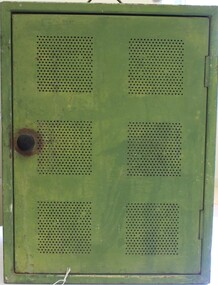
Domestic object - Meat Safe known as a "Coolgardie Safe", Early 1900s
... Coolgardie safe...Food...The wire grid kept the food safe from vermin and allowed breeze to blow through. ...The safe would often be covered by wet hessian to promote further cooling and preservation of foods such as milk, butter and meat....The wire grid kept the food safe from vermin and allowed breeze to blow through. ...The Coolgardie safe was invented in the late 1890s on the Western Australian goldfields. Its invention was credited to a local contractor named Arthur Patrick McCormick. It was a practical system to preserve food prior to modern refrigeration. The wire grid kept the food safe from vermin and allowed breeze to blow through. It was often covered with wet hessian so that as the breeze circulated the water evaporated, creating the same concept as coolant in modern refrigerators and ice boxes. In most respects it was a variation of the bushman’s hessian bag hanging in a tree. In larger towns and cities during this time period large "ice works" could deliver block ice to areas that required a form of refrigeration. These ice blocks where held in early refrigerators to keep perishables cool. In isolated or rural households, the Coolgardie or meat safe was the next best, practical solution for food preservation. This safe was used in the home of the Conway family in Wodonga.This item is very significant to the Wodonga region as it represents the initiative and problem solving skills of the early settlers. It also reflects the primitive conditions in which they lived before the arrival of more modern services such as electricity.Meat safe or Coolgardie safe manufactured in Australia. This safe is made from metal and has been painted in green paint. 2 sides of the safe have a pattern of 6 squares of holes to allow for ventilation and air flow. The holes would also guard against insects and other vermin. There is one shelf inside, dividing it into 2 sections. The safe has a hook attached so that it can be suspended, often from a tree or on a verandah to increase air flow. The safe would often be covered by wet hessian to promote further cooling and preservation of foods such as milk, butter and meat.coolgardie safe, food preservation, pioneers innovation -
 Flagstaff Hill Maritime Museum and Village
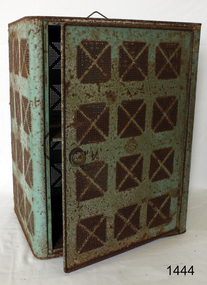
Domestic object - Food Safe, Willow Ware Pty Ltd, 1950s to 70s
... Food Safe......food safe...This food safe is a mass-produced item made for domestic use by Willow Manufacturing in Australia fin the mid-20th century. ...Domestic object Food Safe Willow Ware Pty Ltd ...This food safe is a mass-produced item made for domestic use by Willow Manufacturing in Australia fin the mid-20th century. Willow started a business in 1887 as a metalworking company based in Melbourne Australia, making tinned biscuit and tea canisters. In the First World War, the company began manufacturing armaments and essential packaging for the war effort. In the early 1920s, Willow produced domestic kitchen bakeware such as tin-plated canisters and baking pans labelled with the well-known Willow brand. Other items at this time include billies, boilers, basins and Coolgardie safes. In the late 1950s, the company ventured into plastics production. and in 1965, the name changed to Willow Ware Pty Ltd, to be more closely linked to its Willow brand. Willow Ware is still in business today.The Australian food safe is an example of domestic food storage and preservation in Australian homes from the mid-19th century and early 20th centuries. It is part of the evolution of food preservation methods leading up to our modern electric appliances. The maker, Willow, has a name associated with practical and reliable domestic products.Metal kitchen safe with two shelves, a hinged door and latch and a small swivel wire handle at the top. Painted light green. Airflow holes have been formed in each side panel. Made by Willow, Australia.Marked "Made in Australia" "Willow"flagstaff hill, warrnambool, flagstaff hill maritime museum, shipwreck coast, flagstaff hill maritime village, great ocean road, food storage, food preservation, willow, willow manufacturing, willow australia, kitchen storage, food care, 19th century, 20th century, willow ware, domestic item, coolgardie meat safe, meat safe, food safe, coolgardie -
 Federation University Historical Collection
Book, University of Ballarat Research + Innovation Digest
... Contents include: * Technologies that combat climate change by Alberto Boretti * Case Studies in keeping food safe by Benu Adhikari * Learning to lead - leading to learn by Neil Trivett * Depression, diabetes and motivation by Mirella di Benedetto * Valueing Lake Wendouree by Julian Lowe * What's in a Name by Laura Kostanski * Optimizing regional and international research by John Yerwood * Sport, physical activity and health research by Warren paynbe * Climate secrets in sediments by Peter Gell * UB Sports Injuty Centre supported by IOC * Men's Sheds and other learning places by Barry Golding * New economy, new work, new qualificatins by Erica Smith * Cross-Cultural communications in a shrinking world by Georgina Tsoldis * Child Protection and family services reform by Angela Murphy * Making a difference for older Victorians by Sally Wellard * Making good (and goodly) profits by Jackie Tuck * Not too much 'ordinary' about The Ordinary by Lorraine Sim * Gaming machines and regional gamblers by John McDonald * Toe nail clippings reveal their secrets by Kim Dowling * Magnificently preserves magafauna trackways in the Victorian volcanic plains * A stuttering start for a stunning outcome * Supporting patients and theor carers * Out od Africa and beyond * Taking a hard lok to avaid hard knocks * Skilling people for business success by Andy Smith * Promoting risk awareness in industry by David Borys * Researching China's rise and ris by Mike Willis * Sex hormones link to heart disease by Fadi Charchar * Human Factors in computer security * Are our rivers up the creek by Peter Gell * Wmen as managers and entrepreneurs by Glenice Wood * Revisioning values and norms by Jane Mummery * 'Wimmera' - an Epic Poem by Homer Rieth * Recycling, consumerism, climate change and art practice by Marie Purtill * Investing in ecologically sustainable development by jerry Courvisanos * Indigenous peoples of the goldfields * Astists install images of sustanability by Jill Orr "Addressing disadvantage and nequality with passion by John Smyth * Breaking up insulin hexamers by Mark Myers ...Contents include: * Technologies that combat climate change by Alberto Boretti * Case Studies in keeping food safe by Benu Adhikari * Learning to lead - leading to learn by Neil Trivett * Depression, diabetes and motivation by Mirella di Benedetto * Valueing Lake Wendouree by Julian Lowe * What's in a Name by Laura Kostanski * Optimizing regional and international research by John Yerwood * Sport, physical activity and health research by Warren paynbe * Climate secrets in sediments by Peter Gell * UB Sports Injuty Centre supported by IOC * Men's Sheds and other learning places by Barry Golding * New economy, new work, new qualificatins by Erica Smith * Cross-Cultural communications in a shrinking world by Georgina Tsoldis * Child Protection and family services reform by Angela Murphy * Making a difference for older Victorians by Sally Wellard * Making good (and goodly) profits by Jackie Tuck * Not too much 'ordinary' about The Ordinary by Lorraine Sim * Gaming machines and regional gamblers by John McDonald * Toe nail clippings reveal their secrets by Kim Dowling * Magnificently preserves magafauna trackways in the Victorian volcanic plains * A stuttering start for a stunning outcome * Supporting patients and theor carers * Out od Africa and beyond * Taking a hard lok to avaid hard knocks * Skilling people for business success by Andy Smith * Promoting risk awareness in industry by David Borys * Researching China's rise and ris by Mike Willis * Sex hormones link to heart disease by Fadi Charchar * Human Factors in computer security * Are our rivers up the creek by Peter Gell * Wmen as managers and entrepreneurs by Glenice Wood * Revisioning values and norms by Jane Mummery * 'Wimmera' - an Epic Poem by Homer Rieth * Recycling, consumerism, climate change and art practice by Marie Purtill * Investing in ecologically sustainable development by jerry Courvisanos * Indigenous peoples of the goldfields * Astists install images of sustanability by Jill Orr "Addressing disadvantage and nequality with passion by John Smyth * Breaking up insulin hexamers by Mark Myers University of Ballarat Research + Innovation Digest Book Book ...Black soft covered book of 48 pages. Contents include: * Technologies that combat climate change by Alberto Boretti * Case Studies in keeping food safe by Benu Adhikari * Learning to lead - leading to learn by Neil Trivett * Depression, diabetes and motivation by Mirella di Benedetto * Valueing Lake Wendouree by Julian Lowe * What's in a Name by Laura Kostanski * Optimizing regional and international research by John Yerwood * Sport, physical activity and health research by Warren paynbe * Climate secrets in sediments by Peter Gell * UB Sports Injuty Centre supported by IOC * Men's Sheds and other learning places by Barry Golding * New economy, new work, new qualificatins by Erica Smith * Cross-Cultural communications in a shrinking world by Georgina Tsoldis * Child Protection and family services reform by Angela Murphy * Making a difference for older Victorians by Sally Wellard * Making good (and goodly) profits by Jackie Tuck * Not too much 'ordinary' about The Ordinary by Lorraine Sim * Gaming machines and regional gamblers by John McDonald * Toe nail clippings reveal their secrets by Kim Dowling * Magnificently preserves magafauna trackways in the Victorian volcanic plains * A stuttering start for a stunning outcome * Supporting patients and theor carers * Out od Africa and beyond * Taking a hard lok to avaid hard knocks * Skilling people for business success by Andy Smith * Promoting risk awareness in industry by David Borys * Researching China's rise and ris by Mike Willis * Sex hormones link to heart disease by Fadi Charchar * Human Factors in computer security * Are our rivers up the creek by Peter Gell * Wmen as managers and entrepreneurs by Glenice Wood * Revisioning values and norms by Jane Mummery * 'Wimmera' - an Epic Poem by Homer Rieth * Recycling, consumerism, climate change and art practice by Marie Purtill * Investing in ecologically sustainable development by jerry Courvisanos * Indigenous peoples of the goldfields * Astists install images of sustanability by Jill Orr "Addressing disadvantage and nequality with passion by John Smyth * Breaking up insulin hexamers by Mark Myers david battersby, research, frank stagnitti, jill orr, john smyth, fred cahir, peter gell, andy smith, grant meredith, stuttering, kim dowling, stephen carey, megafauna, john mcdonaldgaming machines, men's sheds, barry golding -
 Sunshine and District Historical Society Incorporated
Archive - City of Sunshine Health Act Registration Schedule 1977, City of Sunshine, 1977
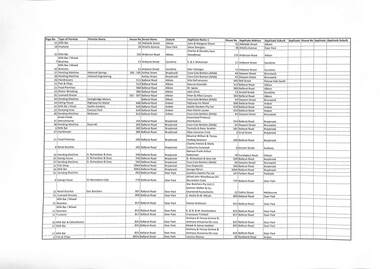
... Their duties included inspecting food premises such as: - Restaurants - Cafés - Takeaway shops - Milk bars - Supermarkets - Food vans - Market stalls They checked for: - Safe food handling practices - Correct storage temperatures (hot and cold holding) - Cleanliness of food preparation areas - Pest control and vermin prevention - Staff hygiene and hand‑washing facilities - Proper waste and grease‑trap management These inspections were carried out under the Food Act and local by‑laws. ...Their duties included inspecting food premises such as: - Restaurants - Cafés - Takeaway shops - Milk bars - Supermarkets - Food vans - Market stalls They checked for: - Safe food handling practices - Correct storage temperatures (hot and cold holding) - Cleanliness of food preparation areas - Pest control and vermin prevention - Staff hygiene and hand‑washing facilities - Proper waste and grease‑trap management These inspections were carried out under the Food Act and local by‑laws. ...The City of Sunshine Health Inspector had a broad mandate to protect public health across the municipality. Their duties included inspecting food premises such as: - Restaurants - Cafés - Takeaway shops - Milk bars - Supermarkets - Food vans - Market stalls They checked for: - Safe food handling practices - Correct storage temperatures (hot and cold holding) - Cleanliness of food preparation areas - Pest control and vermin prevention - Staff hygiene and hand‑washing facilities - Proper waste and grease‑trap management These inspections were carried out under the Food Act and local by‑laws. This list of businesses in the City of Sunshine is an extract from a report by the City of Sunshine Health Inspector in 1977.This report records the business name, type of business and address of businesses operating in the City of Sunshine in 1977.Milk Bar 62 Adelaide Street Albion Fruiterer 26 Amelia Avenue Deer Park Milk Bar 133 Anderson Road Albion Milk Bar / Mixed Business 11 Ardoyne Street Sunshine Milk Bar / Mixed Business 11 Ardoyne Street Sunshine Vending Machine National Springs 185 - 195 Ashley Street Braybrook Vending Machine Harland Engineering Ashley Street Braybrook Hairdressers 511 Ballarat Road Albion Fish & Chips 513 Ballarat Road Albion Food Premises 580 Ballarat Road Albion Motor Wrecking 584 Ballarat Road Albion Licensed Grocer 501 - 507 Ballarat Road Albion Vending Machine Swingbridge Motors Ballarat Road Albion Eating House Highway Inn Motel 608 Ballarat Road Ardeer Milk Bar / Kiosk Apollo Gardens 610 Ballarat Road Ardeer Camping Area Caravan Park 610 Ballarat Road Ardeer Vending Machine McEwans 614 Ballarat Road Ardeer Snack Foods Manufacturer 254 Ballarat Road Braybrook Vending Machine Dyecraft 265 Ballarat Road Braybrook Milk Bar 282 Ballarat Road Braybrook Hairdresser 284 Ballarat Road Braybrook Food Premises 290 Ballarat Road Braybrook Retail Butcher 292 Ballarat Road Braybrook Vending Machine D. Richardson & Sons 330 Ballarat Road Braybrook Eating House D. Richardson & Sons 330 Ballarat Road Braybrook Vending Machine D. Richardson & Sons 330 Ballarat Road Braybrook Fish Shop 306A Ballarat Road Braybrook Milk Bar 306A Ballarat Road Braybrook Vending Machine 463 Ballarat Road Deer Park Eating House ICI Recreation Club 770 Ballarat Road Deer Park Retail Butcher Star Butchers 807 Ballarat Road Deer Park Licensed Grocery 809 Ballarat Road Deer Park Milk Bar / Mixed Business 813 Ballarat Road Deer Park Milk Bar / Mixed Business 815 Ballarat Road Deer Park Fruiterer 817 Ballarat Road Deer Park Milk Bar & Delicatessen 825 Ballarat Road Deer Park Milk Bar 825 Ballarat Road Deer Park Milk Bar 825 Ballarat Road Deer Park Fish & Chips 801A Ballarat Road Deer Park Fish & Chip Shop 801A Ballarat Road Deer Park Eating House 801B Ballarat Road Deer Park Fruit Shop 807A Ballarat Road Deer Park Vending Machine Goldern Fleece Service Station Ballarat Road Deer Park Hairdressers 5 Ballarat Road Maidstone Mixed Business 83 Ballarat Road Maidstone Butcher's Shop 151 Ballarat Road Maidstone Mixed Business 154 Ballarat Road Maidstone Mixed Business 193 Ballarat Road Maidstone Grocery Retail 129 - 131 Ballarat Road Maidstone Milk Bar 49A Ballarat Road Maidstone Food Premises 361 Ballarat Road Sunshine Mens Hairdresser Shop 363 Ballarat Road Sunshine Vending Machine B.P. Westbound 439 Ballarat Road Sunshine Eating House 459 Ballarat Road Sunshine Milk Bar / Mixed Business 469 Ballarat Road Sunshine Fish Shop 471 Ballarat Road Sunshine Mixed Business Food 473 Ballarat Road Sunshine Wholesale Egg Store 479 Ballarat Road Sunshine Vending Machine Sunshine Cabinet Works 503 Ballarat Road Sunshine Apartment House Caravan Park 610 Ballarat Road Sunshine Take Away Food Kentucky Fried Chicken 429A Ballarat Road Sunshine Vending Machine Mobil Service Station 432 Ballarat Road Sunshine North Vending Machine Spaldings 480 Ballarat Road Sunshine North Vending Machine Ajax Nettlefolds 484 Ballarat Road Sunshine North Eating House Ajax Nettlefolds 484 Ballarat Road Sunshine North Vending Machine National Food Service Nettlefolds 484 Ballarat Road Sunshine North Vending Machine Nettlefolds 484 Ballarat Road Sunshine North Eating House McDonalds 400 - 402 Ballarat Road Sunshine North Motor Wrecking Ballarat Road Cnr Carrington Drive Albion Mixed Business Ballarat Road Cnr Churchill Avenue Maidstone Eating House Ballarat Road Cnr Holt Street Ardeer Mixed Business 23 Beachley Street Braybrook Milk Bar 31 Beachley Street Braybrook Fish Shop 33 Beachley Street Braybrook Fish & Chips 3 Bell Street Sunshine West Greengrocer 1A Bell Street Sunshine West Butchers 1D Bell Street Sunshine West Milk Bar 61 Berkshire Road Sunshine North Vending Machine Rockwell Axles Berkshire Road Sunshine North Bulk Tallow Plant Burke Road Braybrook Soap Manufacturing Pennell 43 - 45 Burke Street Braybrook Vending Machine G.U.D. Burton Crescent Maribyrnong Motor Wrecking 18 Carrington Drive Albion Butcher 162 Churchill Avenue Braybrook Bakery & Shop 166 Churchill Avenue Braybrook Ladies Hairdressers 174 Churchill Avenue Braybrook Fish & Chip Shop 176 Churchill Avenue Braybrook Licenced Grocery 158 - 160 Churchill Avenue Braybrook Milk Bar / Mix Business 170 - 172 Churchill Avenue Braybrook Fishmonger 8 City Place Sunshine Butcher's Shop S.S. Meats 11 City Place Sunshine Retail Fish Sunshine Market 13 City Place Sunshine Retail Health Foods Sunshine Market 13 City Place Sunshine Retail Fruit / Eggs Stalls 3, 10 & 11 Sunshine Market 15 City Place Sunshine Delicatessen Sunshine Market 17 City Place Sunshine Supermarket Safeway 7 Clarke Street Sunshine Vending Machine Safeway 7 Clarke Street Sunshine Butcher 8 Clarke Street Sunshine Butcher Storeroom / Factory 11 Clarke Street Sunshine Hairdresser Room 7 2A Clarke Street Sunshine Milk Bar 1 Commercial Street Maidstone Hairdressers 7 Commercial Street Maidstone Chiropodist Corio Street Sunshine Chiropodist 39 Cornwall Road Sunshine North Gut Cleaning 37 Cranwell Street Braybrook Fat Extracting 37 Cranwell Street Braybrook Boiling Down 37 Cranwell Street Braybrook Piggery 37 Cranwell Street Braybrook Storage Canned Food 37 Cranwell Street Braybrook Packaging Food Products Cranwell Street Cnr Errol Street Braybrook Food Packing Southern Packages Cranwell Street Cnr Errol Street Braybrook Milk Bar / Mixed Business 24 Cypress Avenue Brooklyn Milk Bar 24 Cypress Avenue Brooklyn Vending Machine Steelcraft Baby Carriages 99 Derby Road Sunshine Ladies Hairdressers 110 Derby Road Sunshine Vending Machine Raleigh Nursery Derby Road Cnr Thorpe Street Sunshine Eating House Raleigh Nursery Derby Road Cnr Thorpe Street Sunshine Vending Machine Massey Ferguson 2 Devonshire Road Sunshine Vending Machine Sunshine Post Office 5 Devonshire Road Sunshine Milk Bar / Mixed Business 100 Devonshire Road Sunshine Vending Machine Massey Ferguson Devonshire Road Sunshine Milk Bar 5 Dickson Street Sunshine Fruit Shop 15 Dickson Street Sunshine Food Premises 27 Disraeli Street St. Albans Hairdressers 69 Dumfries Street Deer Park Fish Shop 71 Dumfries Street Deer Park Milk Bar 73 Dumfries Street Deer Park Butcher 75 Dumfries Street Deer Park Coffee 113 Durham Road Sunshine Hairdresser Shop 1 117 Durham Road Sunshine Drinks Lot 1 Emu Road Maidstone Vending Machine Pridhams Sociel Club 11 Evans Street Braybrook Processing & Pack Dripping Pridhams 21 Evans Street Braybrook Gut Cleaning Pridhams 21 Evans Street Braybrook Rendering Works Pridhams 21 Evans Street Braybrook Storage & Soft Drink Sales 16 - 20 First Avenue Sunshine Sandwich Bar 30A First Avenue Sunshine Milk & Snack Bar 30A First Avenue Sunshine Vending Machine 106 Fitzgerald Road Sunshine West Mixed Business Lot 458 Fitzgerald Road Sunshine West Mixed Business Fitzgerald Road Sunshine West Butcher's Shop 26 Fiurlong Road Sunshine North Milk Bar / Mixed Business 154 Forrest Street Ardeer Milk Bar / Fish & Chips 222 Forrest Street Ardeer Milk Bar / Fish & Chips 222 Forrest Street Ardeer Vending Machine I.C.I. Detonating Fuse Factory Forrest Street Ardeer Vending Machine Connor-Shea 25 Fourth Avenue Sunshine Abattoir Thomas Borthwick & Sons 405 Francis Street Brooklyn Butcher's Shop Thomas Borthwick & Sons 405 Francis Street Brooklyn Eating House Borthwicks 405 Francis Street Brooklyn Abattoirs & Skaughterhouse Borthwicks 405 Francis Street Brooklyn Skin Store & Hide Treatment, Storage & Packing Borthwicks 405 Francis Street Brooklyn Boiling Down Meal, Dried Blood & Offals Borthwicks 405 Francis Street Brooklyn Fat Rendering Borthwicks 405 Francis Street Brooklyn Gut Rendering Borthwicks 405 Francis Street Brooklyn Vending Machine Dalgetys & Co 4 Frederick Street Brooklyn Take Away Food 28 Furlong Road Sunshine North Milk Bar / Mix Business 42 Furlong Road Sunshine North Vending Machine Parkhill Supermarket 18 - 22 Furlong Road Sunshine North Vending Machine Parkhill Supermarket 18 - 22 Furlong Road Sunshine North Supermarket & Storage Parkhill Supermarket 18 - 22 Furlong Road Sunshine North Vending Machine Tasman U.E.B. Industries 512 Geelong Road Brooklyn Take Away Food 553 Geelong Road Brooklyn Pizza 555 Geelong Road Brooklyn Warehouse Halfcase Warehouse 564 Geelong Road Brooklyn Vending Machine D.H. Opperman 568 Geelong Road Brooklyn Abattoirs J.H. Ralph & Sons 690 Geelong Road Brooklyn Boling Down Works J.H. Ralph & Sons 690 Geelong Road Brooklyn Piggery J.H. Ralph & Sons 690 Geelong Road Brooklyn Take Away Food 710 Geelong Road Brooklyn Vending Machine Internatioal Harvester Geelong Road Cnr McDonalds Road Brooklyn Milk Bar / Mixed Business 72 Glengala Road Sunshine West Hot Bread Shop Western & Continental Bread 78 Glengala Road Sunshine West Licenced Grocer 79 Glengala Road Sunshine West Milk Bar / Mixed Business 83 Glengala Road Sunshine West Milk Bar 85 Glengala Road Sunshine West Ladies Hairdressers 89 Glengala Road Sunshine West Eating House 93 Glengala Road Sunshine West Catering & Pastry Cook St. Albans Catering Service 95 Glengala Road Sunshine West Food Premises 142 Glengala Road Sunshine West Mixed Business 36 Hampshire Road Sunshine Eating House 44 Hampshire Road Sunshine Milk Bar 72 Hampshire Road Sunshine Hairdressers 76 Hampshire Road Sunshine Butcher 78 Hampshire Road Sunshine Fat Rendering 78 Hampshire Road Sunshine Fruit Shop 84 Hampshire Road Sunshine Fish Shop 86 Hampshire Road Sunshine Fish & Chip Shop 86 Hampshire Road Sunshine Eating House 90 Hampshire Road Sunshine Eating House 90 Hampshire Road Sunshine Vending Machine Shell Service Station 130 Hampshire Road Sunshine Pizza Restaurant 197 Hampshire Road Sunshine Eating House 209 Hampshire Road Sunshine Hot Bread Shop 217 Hampshire Road Sunshine Eating House 235 Hampshire Road Sunshine Butchery 244 Hampshire Road Sunshine Food Premises Caprile Meat Supply 244 Hampshire Road Sunshine Retail Liquor Sunshine Cellars 246 Hampshire Road Sunshine Delicatessen 252 Hampshire Road Sunshine Pie Manufacturer & Slaes 260 Hampshire Road Sunshine Milk Bar 266 Hampshire Road Sunshine Mens Hairdresser Shop Shop 7 Kontek Arcade 266 Hampshire Road Sunshine Vending Machine 266 Hampshire Road Sunshine Fruit Shop 268 Hampshire Road Sunshine Fruit & Vegetables 268 Hampshire Road Sunshine Hairdresser 277 Hampshire Road Sunshine Vending Machine Woolworths 282 Hampshire Road Sunshine Vending Machine Woolsworths Variety Store 282 Hampshire Road Sunshine Supermarket S.E. Dickens 294 Hampshire Road Sunshine Vending Machine 294 Hampshire Road Sunshine Butchery 252A Hampshire Road Sunshine Vending Machine G.J. Coles 254 - 258 Hampshire Road Sunshine Retail / Variety Store Coles 254 - 258 Hampshire Road Sunshine Vending Machine Coles 254 - 258 Hampshire Road Sunshine Vending Machine Coles Variety Store 254 - 258 Hampshire Road Sunshine Variety / Confectionary Woolworths 282 - 286 Hampshire Road Sunshine Vending Machine Dickens Supermarket 294 - 296 Hampshire Road Sunshine Vending Machine New World 294 - 296 Hampshire Road Sunshine Vending Machine Target Hampshire Road Sunshine Warehouse 7 Hampstead Road Maidstone Wholesale & Retail Selling Ernie's Supermarket 8 Hampstead Road Maidstone Vending Machine Ernie's Fruit Market 8 Hampstead Road Maidstone Vending Machine Ralph McKay Social Club 36 Hampstead Road Maidstone Food Premises 34A Hampstead Road Maidstone Mixed Business 110 Hertford Road Sunshine Warehouse 12 - 14 Hertford Road Sunshine Catering Service 45 Holt Street Ardeer Licenced Grocery / Milk Bar / Sub News / Post Office 49 Holt Street Ardeer Continental Butcher 51 Holt Street Ardeer Fish & Chips 59 Holt Street Ardeer Mixed Business 61 Holt Street Ardeer Fruit & Vegetables 51A Holt Street Ardeer Eating House W.L. Allen Foundry 3 Hulett Street Albion Mixed Business 56 King Edward Avenue Albion Milk Bar / Mixed Business 8 King Street Braybrook Milk Bar / Mixed Business 50 Links Street Sunshine West Milk Bar / Mixed Business 50 Links Street Sunshine West Ladies Hairdressers Shop 7 St. Albans Arcade 323 Main Road East St. Albans Ladies Hairdressers St. Albans Arcade 323 Main Road East St. Albans Mens Hairdresser Shop Shop 6 St. Albans Arcade 323 Main Road East St. Albans Vending Machine Woolworths 329 Main Road East St. Albans Mixed Business 57 Main Road West St. Albans Greengrocer 61 Main Road West St. Albans Butcher Shop / Smallgoods Manufacturer 75 Main Road West St. Albans Eating House 85 Main Road West St. Albans Hairdressing Salon 111 Main Road West St. Albans Milk Bar / Mix Business 113 Main Road West St. Albans General Store 171 Main Road West St. Albans Food Premises 173 Main Road West St. Albans Milk Bar / Mixed Business 179 Main Road West St. Albans Butcher / Continental Delicatessen 323 Main Road West St. Albans Mixed Business 175 - 177 Main Road West St. Albans Butcher's Shop 177A Main Road West St. Albans Ladies Hairdressers 61 - 63 Main Road West St. Albans Fruit & Vegetables 7 Market Place Braybrook Milk Bar 9 Market Place Braybrook Butcher Shop 11 Market Place Braybrook Butcher's Shop 11 Market Place Braybrook Fish Shop 15 Market Place Braybrook Eating House 1 Market Road Sunshine Food Premises 1 Market Road Sunshine Vending Machine R.M.D. Press 8 Market Road Sunshine Food Premises Wholesale Self Service 20 Market Road Sunshine Butcher Shop 29 Maxwell Street Ardeer Milk Bar / Post Office / Sub News 31 Maxwell Street Ardeer Mixed Business 31 Maxwell Street Ardeer Butcher / Delicatessen 52 Maxwell Street Ardeer Mixed Business 58 Maxwell Street Ardeer Butcher's Shop 29A Maxwell Street Ardeer Greengrocer 29B Maxwell Street Ardeer Licensed Grocery 31A Maxwell Street Ardeer Refrigerated Storage Sascol 41 McDonald Road Brooklyn Eating House McDonald Road Brooklyn Vending Machine Wunderlich 47 McIntyre Road Sunshine Vending Machine Taubmans Paints 51 McIntyre Road Sunshine North Milk Bar / Mixed Business 59 McIntyre Road Sunshine North Ladies Hairdressers 63 McIntyre Road Sunshine North Hairdressers 65 McIntyre Road Sunshine North Milk Bar 67 McIntyre Road Sunshine North Food Premises 69 McIntyre Road Sunshine North Fish & Chips 69 McIntyre Road Sunshine North Butcher Shop / Retail 75 McIntyre Road Sunshine North Greengrocer 81 McIntyre Road Sunshine North Milk Bar 83 McIntyre Road Sunshine North Food Factory Routley 119 McIntyre Road Sunshine North Bakery 119 McIntyre Road Sunshine North Eating House 129 McIntyre Road Sunshine North Vending Machine Sankey Benson McIntyre Road Sunshine North Ladies Hairdressers 57 Metherall Street Sunshine North Mixed Business 30 Millers road Brooklyn Milk Bar Millers Road Cnr Francis Street Brooklyn Dairy 6 Mitchell Street Maidstone Vending Machine Repco Dynamics 85 Mitchell Street Maidstone Vending Machine Repco Equipment 85 Mitchell Street Maidstone Take Away Food 124 Mitchell Street Maidstone Fish & Chips 130 Mitchell Street Maidstone Retail Butcher 132 Mitchell Street Maidstone Milk Bar 138 Mitchell Street Maidstone Ice Manufacturer Maidstone Ice Works 162 Mitchell Street Maidstone Milk Bar / Sub News / Mixed Business 1 Monash Street Sunshine Vending Machine 1 Monash Street Sunshine Milk Bar / Mixed Business 48 Monash Street Sunshine Vending Machine 48 Monash Street Sunshine Fish & Chips 50 Monash Street Sunshine Fish & Chips 50 Monash Street Sunshine Milk Bar / Grocery 106 Monash Street Sunshine Milk Bar / Mixed Business 106 Monash Street Sunshine Food Premises Slade Soft Drinks 54 - 56 Monash Street Sunshine Hairdresser's Shop 58A Monash Street Sunshine Mixed Business 4 Mulhall Drive St. Albans Milk Bar 79 Mulhall Drive St. Albans Milk Bar 79 Mulhall Drive St. Albans Mixed Business / Sub News 5 Northumberland Road Sunshine North Greengrocer 9 Northumberland Road Sunshine North Mixed Business 13 Northumberland Road Sunshine North Vending Machine 13 Northumberland Road Sunshine North Milk Bar 61 Northumberland Road Sunshine North Licenced Grocer 15 - 17 Northumberland Road Sunshine North Butcher's Shop 21A Northumberland Road Sunshine North Hairdresser's Shop 23A Northumberland Road Sunshine North Hairdressing Salon 23A Northumberland Road Sunshine North Fish & Chips 23B Northumberland Road Sunshine North Chiropodist 25 Norwood Street Albion Eating House Medway Golf Club 57 Omar Street Maidstone Vending Machine British Leyland Paramount Road Footscray West Hairdresser 35 Perth Avenue Albion Greengrocer 37 Perth Avenue Albion Retail Butcher 41 Perth Avenue Albion Mixed Business 43 Perth Avenue Albion Mixed Business 1 Porter Court Deer Park Milk Bar / Mixed Business / Sub News 42 Raleigh Road Maribyrnong Eating House Maribrnong R.S.L. 56 Raleigh Road Maribyrnong Milk Bar / Mixed Business 85 Raleigh Road Maribyrnong Milk Bar / Mixed Business 42 - 44 Raleigh Road Maribyrnong Eating House Sunshine Golf Club Ralph Street Sunshine West Vending Machine Sunshine Golf Club Ralph Street Sunshine West Vending Machine Law Somner (Hortico) Raymond Road Brooklyn Milk Bar / Food Premises 39 Rhodes Street St. Albans Vending Machine Maribyrnong High School 2 River Street Maribyrnong Supermarket S.E. Dickens 1 Rosamond Road Maidstone Vending Machine New World 1 Rosamond Road Maidstone Milk Bar 31 Rosamond Road Maidstone Butchers 77 Rosamond Road Maidstone Milk Bar 99 Rosamond Road Maidstone Food Premises 99 Rosamond Road Maidstone Eating House 101 Rosamond Road Maidstone Fish & Chip Shop 103 Rosamond Road Maidstone Milk Bar / Mixed Business 123 Rosamond Road Maidstone Vending Machine Dickens Supermarket 1 - 7 Rosamond Road Maidstone Vending Machine Dickens Supermarket 1 - 7 Rosamond Road Maidstone Fish & Chip Shop 103 Rosamond Road Maribyrnong Fruit & Vegetables 151 Rosamond Road Maribyrnong Vending Machine Vickers Hydraulics 160 Rosamond Road Maribyrnong Eating House Sperry Victers 169 Rosamond Road Maribyrnong Eating House Sunset Drive In 179 Rosamond Road Maribyrnong Vending Machine Sperry Victers 189 Rosamond Road Maribyrnong Fruit Shop 224 Rosamond Road Maribyrnong Retail Supermarket Target Highpoint West Shopping Centre 120 - 200 Rosamond Road Maribyrnong Cakes & Takeaway Food Shop 97 Highpoint West Shopping Centre 120 - 200 Rosamond Road Maribyrnong Butcher's Shop Shop 23 Level 2 Highpoint West Shopping centre 120 - 200 Rosamond Road Maribyrnong Eating House Shop 222 Highpoint West Shopping Centre 120 - 200 Rosamond Road Maribyrnong Food Premises Shop 97 Highpoint West Shopping Centre 120 - 200 Rosamond Road Maribyrnong Eating House Shop 85 Highpoint West Shopping Centre 120 - 200 Rosamond Road Maribyrnong Retail Butcher Gilbertons Shop 25 Highpoint City Shopping Centre 120 - 200 Rosamond Road Maribyrnong Retail Butcher Gilbertons Shop 39 Highpoint City Shopping Centre 120 - 200 Rosamond Road Maribyrnong Food Premises Shop B212 Highpoint City Shopping Centre 120 - 200 Rosamond Road Maribyrnong Confectionary / Variety Woolworths 120 - 200 Rosamond Road Maribyrnong Eating House Myers High Highpoint West Shopping Centre 120 - 200 Rosamond Road Maribyrnong Eating House McDonalds High Highpoint West Shopping Centre 120 - 200 Rosamond Road Maribyrnong Supermarket Safeway Highpoint West Shopping Centre 120 - 200 Rosamond Road Maribyrnong Eating House Target Highpoint West Shopping Centre 120 - 200 Rosamond Road Maribyrnong Eating House Shop 222 Highpoint West Shopping Centre 120 - 200 Rosamond Road Maribyrnong Hairdressers Myers High Highpoint West Shopping Centre 120 - 200 Rosamond Road Maribyrnong Retail Food Sales Myers High Highpoint West Shopping Centre 120 - 200 Rosamond Road Maribyrnong Vending Machine Target Highpoint West Shopping Centre 120 - 200 Rosamond Road Maribyrnong Vending Machine Target Highpoint West Shopping Centre 120 - 200 Rosamond Road Maribyrnong Vending Machine Woolsworths Highpoint City West Shopping Centre 120 - 200 Rosamond Road Maribyrnong Milk Bar / Mixed Business 1 Rowe Street Maidstone Kiosk Sunshine Swimming Pool 13 Service Street Sunshine Vending Machine Maidstone Police Station 8 Short Street Maidstone Eating House Drive In 2 Somers Street Sunshine Vending Machine Collins Davey Motors 410 Somerville Road Brooklyn Storage Woodsheds 53, 54, 55, 56, 57 & 58 422 - 426 Somerville Road Brooklyn Vending Machine P. & S. Seigal Somerville Road Brooklyn Eating House Monsanto 423 Somerville Road Footscray West Vending Machine Monsanto Chemicals 423 Somerville Road Footscray West Eating House Australia National Forge (ANI) 465 Somerville Road Footscray West Food Cannery S.C.I. Meat & Paper 433 - 451 Somerville Road Footscray West Wholesale Meat Depot S.C.I. Meat & Paper 433 - 451 Somerville Road Footscray West Wholesale Meat Depot J.A. Mason 433 - 451 Somerville Road Footscray West Abattiors S.C.I. Meat & Paper 433 - 451 Somerville Road Footscray West Skin Store S.C.I. Meat & Paper 433 - 451 Somerville Road Footscray West Boling Down Works - Blood, Bones & Offal S.C.I. Meat & Paper 433 - 451 Somerville Road Footscray West Vending Machine Nestles Shed 58 Somerville Road Footscray West Eating House Somerville Road Footscray West Vending Machine Industrial Engineering 6 South Road Braybrook Eating House Invicta Mills 38 South Road Braybrook Vending Machine Invicta Mills 38 South Road Braybrook Milk Bar 105 South Road Braybrook Milk Bar / Delicatessen 105 South Road Braybrook Greengrocer 107 South Road Braybrook Fish Shop 109 South Road Braybrook Milk Bar 111 South Road Braybrook Milk Bar 111 South Road Braybrook Hairdresser Shop 121 South Road Braybrook Self Service Grocery 125 South Road Braybrook Retail Butcher 127 South Road Braybrook Retail Greengrocery 129 South Road Braybrook Hairdresser / Beautry Parlour 131 South Road Braybrook Bakery 133 South Road Braybrook Milk Bar 125A South Road Braybrook Preparked Grocery Foods Stall 22 - 23 St. Albans Market 3 St. Albans Road St. Albans Poultry Stall 4 St. Albans Market 3 St. Albans Road St. Albans Fruit & Vegetables Stalls 31 & 32 St. Albans Market 3 St. Albans Road St. Albans Eating House Stall 13 St. Albans Market 3 St. Albans Road St. Albans Eating House Stall 14 St. Albans Market 3 St. Albans Road St. Albans Delicatessen Stall 15 St. Albans Market 3 St. Albans Road St. Albans Butcher Stall 3 St. Albans Market 3 St. Albans Road St. Albans Food Retailers Shop 9 St. Albans Market 3 St. Albans Road St. Albans Food Retailers Shops 5 & 6 St. Albans Market 3 St. Albans Road St. Albans Retail Fish Store Stall 2 St. Albans Market 3 St. Albans Road St. Albans Delicatessen Stalls 11 & 12 St. Albans Market 3 St. Albans Road St. Albans Butchery Stall 1 St. Albans Market 3 St. Albans Road St. Albans Vending Machine Big Sams Market Shop 13 St. Albans 3 St. Albans Road St. Albans Eating House 57 St. Albans Road St. Albans Pizza Parlour 57 St. Albans Road St. Albans Vending Machine 59 St. Albans Road St. Albans Mixed Business 61 St. Albans Road St. Albans Vending Machine 272 St. Albans Road St. Albans Eating House 22 - 26 St. Albans Road St. Albans Snack Bar St. Albans Market 5A St. Albans Road St. Albans Vending Machine Vinidex Tubemakers 231 - 245 St. Albans Road Sunshine North Vending Machine Tubemakers 231 - 245 St. Albans Road Sunshine North Vending Machine Lysaght Steel 323 - 325 St. Albans Road Sunshine North Hairdressers 52 Station Place Sunshine Eating House 54 - 56 Station Place Sunshine Hairsdresser's Shop 75 Station Road Deer Park Dairy Dairy 78 Station Road Deer Park Butcher Retail 87 Station Road Deer Park Fish Shop 94 Station Road Deer Park Mixed Business 98 Station Road Deer Park Vending Machine 98 Station Road Deer Park Vending Machine 100 Station Road Deer Park Vending Machine Deer Park Swimming Pool 119 Station Road Deer Park Piggery University of Melbourne 475 Station Road Deer Park Hairdresser Shop 87A Station Road Deer Park Ladies Hairdressers 93A Station Road Deer Park Vending Machine Nylex Corporation Station Road Deer Park Vending Machine ICI of A&NZ Station Road Deer Park Vending Machine Nylex Corporation Station Road Deer Park Hairdressers 41 Stradbroke Drive St. Albans Milk Bar / Mixed Business 44 Stradbroke Drive St. Albans Milk Bar 52 Stradbroke Drive St. Albans Fish & Chips 54 Stradbroke Drive St. Albans Milk Bar 24 Studley Street Maidstone Milk Bar / Post Office 15 Suffolk Road Sunshine North Licenced Grocer 17 Suffolk Road Sunshine North Hairdresser Shop 19 Suffolk Road Sunshine North Fruit Shop 21 Suffolk Road Sunshine North Mixed Business 35 Suffolk Road Sunshine North Butcher's Shop 15A Suffolk Road Sunshine North Retail Butchery 15A Suffolk Road Sunshine North Grocery / Delicatessen 23A Suffolk Road Sunshine North Mixed Businss 74 Suffolk Street Maidstone Vending Machine 25 Suffolk Street Sunshine Mens Hairdresser Shop 11 Sun Crescent Sunshine Eating House 19 Sun Crescent Sunshine Eating House 21 Sun Crescent Sunshine Retail Fruit & Vegetable Shop 23 Sun Crescent Sunshine Licensed Grocery 27 Sun Crescent Sunshine Sale of Coffee 21A Sun Crescent Sunshine Vending Machine Sunshine Police Station Sun Crescent Sunshine Supermarket Sims Markette 20 Sun Crescent Sunsnine Camping Area Sunshine Caravan Park 280 Sunshine Road Sunshine Hairdresser 169 Sunshine Road Tottenham Licensed Grocery Sales 171 Sunshine Road Tottenham Retail Butcher 175 Sunshine Road Tottenham Milk Bar & Mixed Business 177 Sunshine Road Tottenham Hairdressers Shop 179 Sunshine Road Tottenham Ladies Hairdressers 183 Sunshine Road Tottenham Eating House 193 Sunshine Road Tottenham Vending Machine Olex Cables 207 Sunshine Road Tottenham Eating House Olex Cables 207 Sunshine Road Tottenham Vending Machine Olex Cables 207 Sunshine Road Tottenham Vending Machine Wiltshire Files 213 Sunshine Road Tottenham Eating House McPherson's / Ajax Pumps 217 Sunshine Road Tottenham Pizza Eating House 179A Sunshine Road Tottenham Vending Machine Quaker Foods Sunshine Road Tottenham Milk Bar 21 Sydney Street Albion Milk Bar / Food Premises 32 Sydney Street Albion Mixed Business 67 Sydney Street Albion Flour Milliing & Packaging John Darling & Son 74 Sydney Street Albion Butcher 30A Sydney Street Albion Fish & Chips / Pizza Take Away Food Shop 7 2 - 16 Tallintyre Road Sunshine West Mil Bar / Mixed Business 2 - 16 Tallintyre Road Sunshine West Supermarket & Butcher Shop 2 - 16 Tallintyre Road Sunshine West Eating House Sunshine Baseball Club 5 Talmage Street Albion Eating House Sunshine City Club 24 Talmage Street Albion Mixed Business 28 Thomson Street Maidstone Hairdressers 28A Thomson Street Maidstone Canned Meat Storaage S.C.I. Meat & Paper Warehouses 1, 2 & 3 3 Victoria Drive Footscray West Vending Machine Cargo Newpack Industries Victoria Drive Footscray West Dairy Richards Dairy 39 Wallace Street Maidstone Milk Bar 68 Warwick Road Sunshine North Butcher's Shop 70 Warwick Road Sunshine North Hairdressers 72 Warwick Road Sunshine North Milk Bar / Business 76 Warwick Road Sunshine North Milk Bar 76 Warwick Road Sunshine North Fish & Chips 78 Warwick Road Sunshine North Butcher 80 Warwick Road Sunshine North Licenced Food Store 82 Warwick Road Sunshine North Hairdresser Shop 7 Durham Road Watt Street Sunshine Vending Machine Westbury Timber 18 Williamson Road Maribyrnong Milk Bar 91 Wright Street Sunshine -
Federation University Historical Collection
Book, University of Ballarat Research + Innovation Digest
... Contents include: * Case studies in keeping food safe, Benu Adhikari * technologies that combat climate change - Alberto Boretti *Learning t lead- leading to learn, Neil Trivett * Depression, diabities and motivation, Mirella Di Benedetto * Valuing Lake Wendouree, Julian Lowe * What's in a name, Laura Kostanski * Optimizing Regional & International Research, John Yearwood * Sport, physical activity and health research, Warren Payne * Climate secrets in the sediments, Peter Gell * Injury prevention and saftey promotion research theme, UB Sports injury centre, Caroline Finch, Men's Sheds & other learning places, Barry Golding * New economy, new work, new qualifications, Erica Smith * Cross-cultural communication in a shrinking world, Georgina Tsolidis * Child Protection & family services reform, Angela Murphy * making a difference for older Victorians, Sally Wellard * Making good (and goodly) profits, jackie tuck * Not too much 'ordinary' about Teh Ordinry, Lorraine Sim * Gaming Machines & regional gamblers * Toe nail clippings revel their secrets, Kim Dowling * Magnificently preserved megafaunal trackways in the Victorian volcanic plans, Stephen Carey * A stuttering start for a stunning outcome, Grant Meridith * Supporting patients & their careres, Anthony Love * Out of Africa and beyond, James O'Meara * Taking a hard look to avoid hard knocks, Caroline Finch and Dara Twomey * Skilling people for business success, Andy Smith * Promoting risk awareness in industry, David Borys * researching China's Rise & Rise, Mike Willis *Sex hormones link to heart disease, Fadi Charchar * Human factors in computer security, Paul watters * Are our rivers up the creek, Peter Gell * Women as managers7 entrepreneurs, Glenice Wood * Revisoning values and norms, Jane Mummery * 'Wimmera" - an epic Poem, Homer Rieth * Recycling, consumerism, climate change and art peactice, marie Purtill * Investing in ecologically sustainable development, Jerry Coursisanos * Indigenous peoples of the goldfields, Fred Cahir * Artists install images of sustainability, Jill Orr * addresing disadvantage& inequality with passion, John Smyth * Breaking up insulin haxamers, Mark Myers...Contents include: * Case studies in keeping food safe, Benu Adhikari * technologies that combat climate change - Alberto Boretti *Learning t lead- leading to learn, Neil Trivett * Depression, diabities and motivation, Mirella Di Benedetto * Valuing Lake Wendouree, Julian Lowe * What's in a name, Laura Kostanski * Optimizing Regional & International Research, John Yearwood * Sport, physical activity and health research, Warren Payne * Climate secrets in the sediments, Peter Gell * Injury prevention and saftey promotion research theme, UB Sports injury centre, Caroline Finch, Men's Sheds & other learning places, Barry Golding * New economy, new work, new qualifications, Erica Smith * Cross-cultural communication in a shrinking world, Georgina Tsolidis * Child Protection & family services reform, Angela Murphy * making a difference for older Victorians, Sally Wellard * Making good (and goodly) profits, jackie tuck * Not too much 'ordinary' about Teh Ordinry, Lorraine Sim * Gaming Machines & regional gamblers * Toe nail clippings revel their secrets, Kim Dowling * Magnificently preserved megafaunal trackways in the Victorian volcanic plans, Stephen Carey * A stuttering start for a stunning outcome, Grant Meridith * Supporting patients & their careres, Anthony Love * Out of Africa and beyond, James O'Meara * Taking a hard look to avoid hard knocks, Caroline Finch and Dara Twomey * Skilling people for business success, Andy Smith * Promoting risk awareness in industry, David Borys * researching China's Rise & Rise, Mike Willis *Sex hormones link to heart disease, Fadi Charchar * Human factors in computer security, Paul watters * Are our rivers up the creek, Peter Gell * Women as managers7 entrepreneurs, Glenice Wood * Revisoning values and norms, Jane Mummery * 'Wimmera" - an epic Poem, Homer Rieth * Recycling, consumerism, climate change and art peactice, marie Purtill * Investing in ecologically sustainable development, Jerry Coursisanos * Indigenous peoples of the goldfields, Fred Cahir * Artists install images of sustainability, Jill Orr * addresing disadvantage& inequality with passion, John Smyth * Breaking up insulin haxamers, Mark Myers University of Ballarat Research + Innovation Digest Book Book ...Black, soft covered book of 48 pages outlining research at the University of Ballarat. Contents include: * Case studies in keeping food safe, Benu Adhikari * technologies that combat climate change - Alberto Boretti *Learning t lead- leading to learn, Neil Trivett * Depression, diabities and motivation, Mirella Di Benedetto * Valuing Lake Wendouree, Julian Lowe * What's in a name, Laura Kostanski * Optimizing Regional & International Research, John Yearwood * Sport, physical activity and health research, Warren Payne * Climate secrets in the sediments, Peter Gell * Injury prevention and saftey promotion research theme, UB Sports injury centre, Caroline Finch, Men's Sheds & other learning places, Barry Golding * New economy, new work, new qualifications, Erica Smith * Cross-cultural communication in a shrinking world, Georgina Tsolidis * Child Protection & family services reform, Angela Murphy * making a difference for older Victorians, Sally Wellard * Making good (and goodly) profits, jackie tuck * Not too much 'ordinary' about Teh Ordinry, Lorraine Sim * Gaming Machines & regional gamblers * Toe nail clippings revel their secrets, Kim Dowling * Magnificently preserved megafaunal trackways in the Victorian volcanic plans, Stephen Carey * A stuttering start for a stunning outcome, Grant Meridith * Supporting patients & their careres, Anthony Love * Out of Africa and beyond, James O'Meara * Taking a hard look to avoid hard knocks, Caroline Finch and Dara Twomey * Skilling people for business success, Andy Smith * Promoting risk awareness in industry, David Borys * researching China's Rise & Rise, Mike Willis *Sex hormones link to heart disease, Fadi Charchar * Human factors in computer security, Paul watters * Are our rivers up the creek, Peter Gell * Women as managers7 entrepreneurs, Glenice Wood * Revisoning values and norms, Jane Mummery * 'Wimmera" - an epic Poem, Homer Rieth * Recycling, consumerism, climate change and art peactice, marie Purtill * Investing in ecologically sustainable development, Jerry Coursisanos * Indigenous peoples of the goldfields, Fred Cahir * Artists install images of sustainability, Jill Orr * addresing disadvantage& inequality with passion, John Smyth * Breaking up insulin haxamers, Mark Myersaborigines, mens shed, wimmera, gambling, megafauna, gell, golding, carey, cahir, purtill -
 Flagstaff Hill Maritime Museum and Village
Domestic object - Ice Chest, 1927
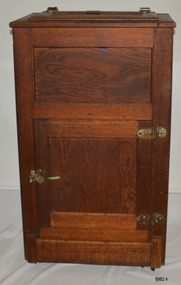
... safe. The non-mechanical ice chest allowed perishable food to be kept fresh for longer than the food-safe or ‘Coolgardie’ used in colonial days in Australia. ...safe. The non-mechanical ice chest allowed perishable food to be kept fresh for longer than the food-safe or ‘Coolgardie’ used in colonial days in Australia. ...This particular small ice chest was once part of the domestic furniture of Dr W.R. Angus and his young family in 1927 when they lived in the Nhill and Ballarat districts. The family relocated to Warrnambool in 1939 and brought the ice chest with them. An ice chest, also called an icebox or refrigerator, was invented by Thomas Moore in 1802 and had become a common home appliance from the mid-1800s until around the 1930s, when electric refrigerators became affordable and safe. The non-mechanical ice chest allowed perishable food to be kept fresh for longer than the food-safe or ‘Coolgardie’ used in colonial days in Australia. It required the use of ice blocks, which were delivered to households by the ‘iceman' and his horse and cart. The ice man would use an ice pick to cut the blocks into the right size for the buyer’s ice chest. The ice came from an ‘ice house’, a factory where the ice was made. The ice chest required a block of ice to be placed into the insulated top section on top of the corrugated iron stand. The ice would cool the air and the cool air would flow downwards through the oval hole under the stand and into the refrigerator compartment below. The water from the melted ice would drain from the sloping floor of the top compartment and into the hooded pipe. The pipe went through the refrigerator and ended below its floor, where the drained water would be collected in the metal bowl placed there for that purpose. The lip on the bowl allowed it to be easily removed and emptied at regular intervals before it overflowed. W.R. Angus Collection- The W R Angus Collection spans from 1885 to the mid-1900s and includes historical medical and surgical equipment and instruments from the doctors Edward and Thomas Ryan of Nhill, Victoria. Dr Angus married Gladys in 1927 at Ballarat, the nearest big city to Nhill where he began as a Medical Assistant. He was also Acting House surgeon at the Nhill hospital where their two daughters were born. He and his family moved to Warrnambool in 1939, where Dr Angus operated his own medical practice. He later added the part-time Port Medical Officer responsibility and was the last person appointed to that position. Dr Angus and his wife were very involved in the local community, including the early planning stages of the new Flagstaff Hill, where they contributed to the layout of the gardens. Dr Angus passed away in March 1970.This ice chest is significant for representing a method of refrigeration and food preservation used in the 19th to mid-20th centuries when people were beginning to afford powered domestic refrigerators. After the second world war, most households replaced their food storage cupboards and ice chests with refrigerator appliances. The ice chest is also significant for its connection with the domestic furniture of Dr W.R. Angus and his family, and its inclusion in the W.R. Angus Collection.Ice chest; single front wooden cabinet with two doors and a flap, and three accessories. The top door is a lid with a metal handle at the front and two metal hinges along the back. The front door has two metal hinges on the right-hand side and has a metal lever catch. A hinged flap fits between the front legs at bottom of the ice chest and swings upwards. The front legs have wheels. The insulated top compartment has a metal lining and its floor slopes towards the centre of the back wall. In the floor are a formed oval air-flow hole and the open end of a pipe that has a hood partly covering it. The front compartment is an insulated metal-lined cupboard with a vertical pipe down the centre of the back wall and horizontal rails in the centre of each side wall. The accessories are a rectangular corrugated iron stand, a rectangular wire grid shelf and a round aluminium bowl with a lip and two sides pushed in. The ice chest was made circa 1927 and is part of the W.R. Angus Collection.flagstaff hill, warrnambool, maritime village, maritime museum, shipwreck coast, great ocean road, dr w r angus, dr roy angus, dr ryan, doctor angus, dr angus, ice chest, ice box, antique, food preservation, refrigeration, domestic equipment, kitchen appliance, refrigerator, non-electric refrigerator, non-mechanical refrigerator, w.r. angus collection -
Upper Yarra Museum
Food Safe, Untitled
... Food Safe...kitchen galvanised iron coolgardie safe hessian food preservation pest control water...It was named after the place where it was invented — the small mining town of Coolgardie, Western Australia, near Kalgoorlie-Boulder. http://www.biggles.com.au/ The Coolgardie Safe was simply a wire framed box with wheat sack strips hanging down the sides, which were kept wet by the process of osmosis from a dish or small tank of water. The food...The tray assists with pest control as it was filled with water. Food Safe Untitled ...http://museumvictoria.com.au/discoverycentre/infosheets/the-coolgardie-safe/ http://en.wikipedia.org/wiki/Coolgardie_safe The Coolgardie Safe is a low-tech refrigeration unit which uses the heat transfer which occurs during evaporation of water. It was named after the place where it was invented — the small mining town of Coolgardie, Western Australia, near Kalgoorlie-Boulder. http://www.biggles.com.au/ The Coolgardie Safe was simply a wire framed box with wheat sack strips hanging down the sides, which were kept wet by the process of osmosis from a dish or small tank of water. The food inside the Safe was kept cool due to the principle that evaporation takes away heat; the wet hessian strips experience evaporation from the wind and the sun and thus you have a refrigerator. http://www.whitehat.com.au/australia/Inventions/InventionsA.html Coolgardie Safe made from galvanised iron with hessian drapped over 4 sides, rectangular on 4 legs. 2 trays inside, 3rd tray inserted in top as cover, metal meshing on callapsable sides and door. Stands in tray. The tray assists with pest control as it was filled with water.kitchen galvanised iron coolgardie safe hessian food preservation pest control water -
Glen Eira Historical Society
Book - GLEN EIRA GUIDE
... The third section, titled City of Glen Eira Safe Food Guide, consists of a list of food venues nominated by the Glen Eira City Council Environmental Health Services Department for their commendable level of hygiene. ...The third section, titled City of Glen Eira Safe Food Guide, consists of a list of food venues nominated by the Glen Eira City Council Environmental Health Services Department for their commendable level of hygiene. ...This file contains one item: 1/A copy of the 1999 edition of the Glen Eira guide. This magazine aims to provide readers with useful information for living and working within the City of Glen Eira. It is divided into five principal sections. The first section, titled Glen Eira City Council Information, provides information pertaining to the local government. It includes information about Council meetings, the names and contact details of the six members of the Council, information about services offered by the Glen Eira Service Centre, the contact details for particular services offered by the Glen Eira City Council, information about rates and valuations, information about the building permit application process, information about waste management, and federal and state electoral maps. The second section, titled Council and Community Resource Guide, consists of a list of the various local community facilities and organizations. The third section, titled City of Glen Eira Safe Food Guide, consists of a list of food venues nominated by the Glen Eira City Council Environmental Health Services Department for their commendable level of hygiene. The fourth section, titled City of Glen Eira Business Development Unit, provides information about the eponymous local government department, which is aimed at providing aid to local businesses. The fifth and final section, titled ‘Think Local, BUY LOCAL’ Guide, consists of a list of local businesses, grouped according to industry, to try and encourage the support thereof.glen eira, city of glen eira, glen eira city council, local government, local officials and employees, kennedy norman cr, mayors, public utilities, community services, local government departments, rates, local government, building permits, waste disposal, community groups, cultural structures and establishments, law and order, libraries, education, educational and research establishments, religious groups, clubs and associations, community centres, food, restaurants, businesses -
 Flagstaff Hill Maritime Museum and Village
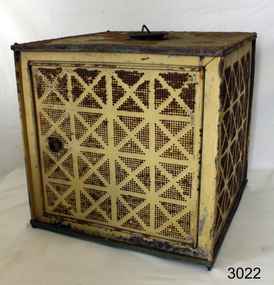
Domestic object - Food Safe, Willow Ware Pty Ltd, 1920-1950
... Food Safe......food safe...Domestic object Food Safe Willow Ware Pty Ltd ...Willow started business in 1887 as a metal working company based in Melbourne Australia, making tinned biscuit and tea canisters. The outbreak of the First World War saw their manufacturing change to making armaments and essential packaging for the war effort. In the early 1920’s, the Willow brand was established. Making tin plated canisters and baking pans with the well-known Willow pattern, imprinted on them. Some other items in production at this time include billies, boilers, basins and Coolgardie safes. In the late 1950’s, the company ventured into plastics production. Stepping away from its very successful tin plating industry of more than 50 years. In 1965, the company name changed to Willow Ware Pty Ltd, to be more closely linked to its Willow brand. Willow Ware is still in business today. A food safe known as a “Coolgardie” meat storage made by an emerging Australian company no longer in bushiness. This item gives a snapshot into early Australian manufacturing specifically aimed at the Australian market. Safe metal kitchen safe with two shelves, a hinged door and latch and a small swivel wire handle at the top. cream colour . "Made in Australia" "Willow" warrnambool, shipwrecked-coast, flagstaff-hill, flagstaff-hill-maritime-museum, shipwreck-coast, flagstaff-hill-maritime-village, willow ware, domestic item, coolgardie meat safe, meat safe, food safe, food preservation -
 Flagstaff Hill Maritime Museum and Village
Photograph, C. 1915 - 09/07/1917
... There they filled the tanks with ample benzene for the task ahead (impossible to do at sea at the time), took in food and brought on board the Robe Harbour Master, Mr Sneath. The Harbour Master was then able to safely pilot the lifeboat to Cape Jaffa in the smoother coastal waters, saving very much time, but by the time they arrived at Cape Jaffa the 2 survivors had already been taken to the lighthouse on the mainland. ...There they filled the tanks with ample benzene for the task ahead (impossible to do at sea at the time), took in food and brought on board the Robe Harbour Master, Mr Sneath. The Harbour Master was then able to safely pilot the lifeboat to Cape Jaffa in the smoother coastal waters, saving very much time, but by the time they arrived at Cape Jaffa the 2 survivors had already been taken to the lighthouse on the mainland. ...This black and white photograph of the tugboat NYORA towing the steam ship INVERNESS-SHIRE was taken between 1915, when the INVERNESS-SHIRE was dis-masted, and 9the July 1917, when NYORA tragically sank. The sailing ship INVERNESS-SHIRE was a four masted steel barque built in 1894 by Robert Duncan & Co. Limited, Glasgow, U.K. (The supervising engineer during the building was William Cumming. He accompanied every ship he’d built on their maiden voyages from UK to Melbourne.) In 1916 she was purchased by A/S Christiansand (Sven O. Stray), Kristiansand, Norway and renamed SVARTSKOG. In October 1920 she disappeared at sea, carrying a cargo of coal, and all hands were lost. The steam powered NYORA was a powerful tugboat and a salvage vessel built by J.P. Rennoldson & Sons Ltd, South Shields, Tyne and Wear, UK. She was originally launched with the name NEPEAN in May 1909, then as NYORA in August 1909 and registered in Melbourne in November 1909 by owners Huddart Parker Pty Ltd. She was made of steel, had triple-compounded steam engines, and her dimensions were 306 ton, 135.0 x 25.1 x 13.6ft. The Melbourne tug NYORA was known as “one of the best known tugs in Victoria, and carried the latest appliances for firefighting and salvage purposes.” She serviced the Port of Melbourne for most of her career. In July 1917 NYORA was towing the American schooner ASTORIA from Port Pirie to Sydney, because ASTORIA’s engines had broken down; she had been delivering a large cargo of timber. On July 9th the vessels were two days out from Port Pirie. At 10:30am NYORA foundered after casting off at Cape Jaffa, 50 miles south of Kingston, South Australia, and sank. Only 2 of the 16 crew survived; NYORA’s Master, Captain W.M. McBain (William Murray) and helmsman, able seaman Gordon Lansley. They were rescued by the two Cape Jaffa light keepers, Jamieson & Clark, who launched the rescue from the Cape Jaffa lighthouse on Margaret Brock Reef. Both men were brought to the lighthouse keeper’s cottage where they recuperated after their long exposure to the rough. (The Queenscliff Sentinal of 14th July 1917 noted that both saved men originated from the same district; Gordon Lansley was from Queenscliff and Captain McBain formerly from Point Lonsdale.) The ASTORIA was “in a very dangerous position ten miles west of the Margaret Brock reef near the Cape Jaffa lighthouse, setting towards the land.” Captain Solly from Beachport later said “Owing to the position … the ship was very fortunate in making Guichen Bay in safety, as she did” (Guichen Bay is south of Robe). Captain Bull, manager of Huddart Packer Pty Ltd, NYORA’s owner, was unable to see any reason for the foundering, as the NYORA was well known for its seaworthiness. At a hearing later on, the Marine Board could blame on no-one either, but found that the ship had been swamped by heavy seas, and had listed to one side when a load of 40 tons of coal in sacks on her deck shifted. The tow line to the ASTORIA was cut to try and save the tug but a huge wave swamped her, crashed open the engine room door and flooded the compartment. It was impossible to launch the lifeboats due to the listing of the sea and NYORA sank within 15 minutes. There was some criticism of the length of time it took Captain Solly and the lifeboat crew to get from Beachport to Cape Jaffa to help with the rescue. However, they had great difficulty in the very strong seas, taking 9 hours just to reach Robe, which was only 32 miles away. There they filled the tanks with ample benzene for the task ahead (impossible to do at sea at the time), took in food and brought on board the Robe Harbour Master, Mr Sneath. The Harbour Master was then able to safely pilot the lifeboat to Cape Jaffa in the smoother coastal waters, saving very much time, but by the time they arrived at Cape Jaffa the 2 survivors had already been taken to the lighthouse on the mainland. There was also a question as to the chances of the ship ASTORIA lowering a lifeboat to help with the disaster. Captain Solly explained that it would have been impossible without sacrificing the lives of the lifeboat crew , due to the great height of the ship out of the water and the roughness of the sea. Captain Svenson, of the ASTORIA, said himself “We are ourselves in a helpless position” and “"Cannot see anything of lifeboats”. One of the 14 lost crew of the NYORA was Hugh Edwards, whose body was not recovered. The descendants of Captain William McBain have continued the seafaring heritage. His son was also a tugboat captain (Captain Norman Clive McBain), working mostly from Reid Street Pier, Williamstown, who would often take his own grandson out to sea to spend time with him on his tugboat. Now that grandson has built a tugboat in memory of his heritage and spends time in it with his own grandson. The Cape Jaffa original lighthouse has been dismantled and moved to Kingston and is now a Lighthouse Museum. The attached photographs of Margaret Brock Reef, and the Cape Jaffa Lighthourse keeper's cottage (now in ruins) is courtesy of Capt. William McBain's great grandson, who visited the area in 2015. There is a model of the NYORA in Museum Victoria, donated by Huddart Packer & Co Ltd. in 1937. This photograph is significant for its association with the tugboat NYORA, that is part of the seafaring history of the Port of Melbourne and associated Victorian ports. Black and White photograph of the tugboat NYORA and steam ship INVERNESS-SHIRE. C. 1915-1917.flagstaff hill, warrnambool, shipwrecked-coast, flagstaff-hill, flagstaff-hill-maritime-museum, maritime-museum, shipwreck-coast, flagstaff-hill-maritime-village, historic maritime photograph, lighthouses, shipwrecks, steamships, j.p. rennoldson & sons ltd, huddart parker pty ltd, nepean, nyora, inverness-shire, astoria, captain w.m. mcbain, william cummings supervising engineer, cape jaffa lighthouse, beachport lifeboat, captain solly, captain svenson, margaret brock reef -
 Flagstaff Hill Maritime Museum and Village
Cap Liner, Between 1870 and 1908
... safe preserving and storage of perishable foodstuffs in an age when refrigeration was generally unavailable. These round, coarse-glass inserts formed part of the screw lids used with the Ball Mason style of canning fruit jars. The liner was placed inside the zinc cap to stop the contents of the jar reacting with the zinc. It prevented the metallic tainting of food...safe preserving and storage of perishable foodstuffs in an age when refrigeration was generally unavailable. These round, coarse-glass inserts formed part of the screw lids used with the Ball Mason style of canning fruit jars. The liner was placed inside the zinc cap to stop the contents of the jar reacting with the zinc. It prevented the metallic tainting of food ...This Zinc Cap Porcelain Liner was recovered from the (1908) shipwreck site of the FALLS OF HALLADALE. The purpose of cap liners was to assist with the safe preserving and storage of perishable foodstuffs in an age when refrigeration was generally unavailable. These round, coarse-glass inserts formed part of the screw lids used with the Ball Mason style of canning fruit jars. The liner was placed inside the zinc cap to stop the contents of the jar reacting with the zinc. It prevented the metallic tainting of food as well as the corrosion of the metallic lid. On March 30, 1869, Lewis R Boyd was issued with patent # 88439 for an “Improved Mode of Preventing Corrosion in Metallic Caps”. From the 1870s to the 1950s, large quantities of these liners were produced by a number of glass manufacturing companies. They are consequently difficult to date or identify. “It is assumed that most of the earlier versions of these liners have the name ‘BOYD’S’ or ‘BOYD’ embossed on them. Later versions may or may not have the name included in the lettering”. (http://www.glassbottlemarks.com). Only a few were made of porcelain, the great majority being made first of transparent and later of translucent or opaque glass. The different emblems of triangles, circles, and crosses embossed on the front face of the liners are assumed to signify mould or model types rather than the company that produced them. This particular artefact is one of 14 cap liners that were retrieved from the shipwreck site and are now part of the Flagstaff Hill Maritime Village collection. The Maltese Cross and “BOYD’S GENUINE PORCELAIN LINED” lettering are unique to this piece. However, it is evident from the markings and materials of the other cap liners, that they originally formed sets or series. Six are larger (8 mm depth x 85mm diameter), of greenish hue with ground glass texture, and support the raised emblem of a compass needle. Two are medium-sized (75mm diameter) with two raised dots in a central circle and the lettering “Patd. APR 25.82”. This particular cap liner is likely to have also been one of a mass-produced line being imported from America. The iron-hulled sailing ship FALLS OF HALLADALE was a bulk carrier of general cargo en route from New York to Melbourne and Sydney. In her hold, along with 56,763 tiles of unusual beautiful green American slates (roofing tiles), 5,673 coils of barbed wire, 600 stoves, 500 sewing machines, 6500 gallons of oil, 14400 gallons of benzene, and many other manufactured items, were 117 cases of crockery and glassware. The FALLS OF HALLADALE came aground on a reef off the Peterborough headland at 3 am on the morning of the 15th of November, 1908. The captain and 29 crew members all survived, but her valuable cargo was largely lost, despite two salvage attempts in1908-09 and 1910. The iron-hulled, four-masted barque, the Falls of Halladale, was a bulk carrier of general cargo. She left New York in August 1908 on her way to Melbourne and Sydney. In her hold, along with 56,763 tiles of unusual beautiful green American slates (roofing tiles), 5,673 coils of barbed wire, 600 stoves, 500 sewing machines, 6500 gallons of oil, 14400 gallons of benzene, and many other manufactured items, were 117 cases of crockery and glassware. Three months later and close to her destination, a navigational error caused the Falls of Halladale to be wrecked on a reef off the Peterborough headland at 3 am on the morning of the 15th of November, 1908. The captain and 29 crew members all survived, but her valuable cargo was largely lost, despite two salvage attempts in 1908-09 and 1910. ABOUT THE ‘FALLS OF HALLADALE’ (1886 - 1908) Built: in1886 by Russell & Co., Greenock shipyards, River Clyde, Scotland, UK. The company was founded in 1870 (or 1873) as a partnership between Joseph Russell (1834-1917), Anderson Rodger and William Todd Lithgow. During the period 1882-92 Russell & Co., they standardised designs, which sped up their building process so much that they were able to build 271 ships over that time. In 1886 they introduced a 3000 ton class of sailing vessel with auxiliary engines and brace halyard winches. In 1890 they broke the world output record. Owner: Falls Line, Wright, Breakenridge & Co, 111 Union Street, Glasgow, Scotland. Configuration: Four masted sailing ship; iron-hulled barque; iron masts, wire rigging, fore & aft lifting bridges. Size: Length 83.87m x Breadth 12.6m x Depth 7.23m, Gross tonnage 2085 ton Wrecked: the night of 14th November 1908, Curdies Inlet, Peterborough south west Victoria Crew: 29 The Falls of Halladale was a four-masted sailing ship built-in 1886 in Glasgow, Scotland, for the long-distance cargo trade and was mostly used for Pacific grain trade. She was owned by Wright, Breakenridge & Co of Glasgow and was one of several Falls Line ships, all of which were named after waterfalls in Scotland. The lines flag was of red, blue and white vertical stripes. The Falls of Halladale had a sturdy construction built to carry maximum cargo and able to maintain full sail in heavy gales, one of the last of the ‘windjammers’ that sailed the Trade Route. She and her sister ship, the Falls of Garry, were the first ships in the world to include fore and aft lifting bridges. Previous to this, heavily loaded vessels could have heavy seas break along the full length of the deck, causing serious injury or even death to those on deck. The new, raised catwalk-type decking allowed the crew to move above the deck stormy conditions. This idea is still used today on the most modern tankers and cargo vessels and has proved to be an important step forward in the safety of men at sea. On 4th August 1908, with new sails, 29 crew, and 2800 tons of cargo, the Falls of Halladale left New York, bound for Melbourne and Sydney via the Cape of Good Hope. The cargo on board was valued at £35,000 and included 56,763 tiles of American slate roofing tiles (roof slates), 5,673 coils of barbed wire, 600 stoves, 500 sewing machines, 6,500 gallons of oil, 14,400 gallons of benzene, plumbing iron, 117 cases of crockery and glassware and many other manufactured items. The Falls of Halladale had been at sail for 102 days when, at 3 am on the night of 14th November 1908, under full sail in calm seas with a six knots breeze behind and misleading fog along the coast, the great vessel rose upon an ocean swell and settled on top of a submerged reef near Peterborough on south-west Victoria’s coast. The ship was jammed on the rocks and began filling with water. The crew launched the two lifeboats and all 29 crew landed safely on the beach over 4 miles away at the Bay of Islands. The postmistress at Peterborough, who kept a watch for vessels in distress, saw the stranding and sent out an alert to the local people. A rescue party went to the aid of the sailors and the Port Campbell rocket crew was dispatched, but the crew had all managed to reach shore safely by the time help arrived. The ship stayed in full sail on the rocky shelf for nearly two months, attracting hundreds of sightseers who watched her slowly disintegrate until the pounding seas and dynamiting by salvagers finally broke her back, and her remains disappeared back into deeper water. The valuable cargo was largely lost, despite two salvage attempts in 1908-09 and 1910. Further salvage operations were made from 1974-1986, during which time 22,000 slate tiles were recovered with the help of 14 oil drums to float them, plus personal artefacts, ship fittings, reams of paper and other items. The Court of Marine Inquiry in Melbourne ruled that the foundering of the ship was entirely due to Captain David Wood Thomson’s navigational error, not too technical failure of the Clyde-built ship. The shipwreck is a popular site for divers, about 300m offshore and in 3 – 15m of water. Some of the original cargo can be seen at the site, including pieces of roof slate and coils of barbed wire. The Falls of Halladale shipwreck is listed on the Victorian Heritage Register (No. S255). She was one of the last ships to sail the Trade Routes. She is one of the first vessels to have fore and aft lifting bridges. She is an example of the remains of an International Cargo Ship and also represents aspects of Victoria’s shipping industry. The wreck is protected as a Historic Shipwreck under the Commonwealth Historic Shipwrecks Act (1976). A circular translucent glass disc in good condition with raised upper case lettering around 8mm rim – “BOYD’S GENUINE PORCELAIN LINED” - and a raised central emblem of a Maltese Cross. On the reverse face in the centre of the disc, there is a raised numeral “3”. falls of halladale, wright, breakenridge & co of glasgow, unusual beautiful green american slates (roofing tiles), warrnambool, shipwrecked-coast, flagstaff-hill, flagstaff-hill-maritime-museum, maritime-museum, shipwreck-coast, flagstaff-hill-maritime-village, shipwrecked-artefact, zinc cap porcelain liner, boyd’s genuine porcelain lined, glass lid, opaque disc, food preserving, fruit bottling, cap liner, shipwrecked coast, flagstaff hill maritime museum, shipwreck artefact, 1908 shipwreck -
 Flagstaff Hill Maritime Museum and Village
Domestic object - Cooking Pot, T & C Clarke and Co Ltd, 1880-1900
... The item is significant as it was used as a domestic kitchen item to cook food safely without the concern that the metal may contain lead or arsenic as earlier cooking utensils had. flagstaff hill warrnambool shipwrecked coast flagstaff hill maritime museum flagstaff hill maritime village great ocean road cooking pot iron cooking pot cook ware saucepan kitchen utensil cast iron enamel ware On base "T&C Clark and Co Ltd, RD455270 First Quality" Cast Iron cooking pot with lid separate Straight rod handle painted black. ...T. & C. Clark & Company Limited was based at Shakespeare Foundry in Wolverhampton England and was founded in 1795 by Thomas and Charles Clark. The company grew to be one of the largest iron foundries in Wolverhampton and were pioneering in the manufacture of enamelled cast iron cookware and sanitary wares. The company's product range included thousands of items, both domestic and industrial. T. & C. Clark were pioneers in the use of enamelled cast ironware, after taking out a patent in 1839 guaranteeing their products to be free of lead or arsenic. The company became the largest employer in Wolverhampton employing between 600 to 700 people.The item is significant as it was used as a domestic kitchen item to cook food safely without the concern that the metal may contain lead or arsenic as earlier cooking utensils had.Cast Iron cooking pot with lid separate Straight rod handle painted black.On base "T&C Clark and Co Ltd, RD455270 First Quality"flagstaff hill, warrnambool, shipwrecked coast, flagstaff hill maritime museum, flagstaff hill maritime village, great ocean road, cooking pot, iron cooking pot, cook ware, saucepan, kitchen utensil, cast iron enamel ware -
 Flagstaff Hill Maritime Museum and Village
Domestic object - Pressure Cooker, T & C Clarke and Co Ltd, Late 19th to early 20th century
... The item is significant as it was used as a domestic kitchen item to cook food safely without the concern that the metal interior may contain lead or arsenic as earlier cooking utensils had. flagstaff hill warrnambool shipwrecked coast flagstaff hill maritime museum maritime museum shipwreck coast flagstaff hill maritime village great ocean road pressure cooker cook ware cooking pot clarke and co T & C Clarke and Co. on base & size 2 1/2 gallon Pressure cooker, cast iron , pressure vent on top. ...T. & C. Clark & Company Limited was based at Shakespeare Foundry in Wolverhampton England and was founded in 1795 by Thomas and Charles Clark. The company grew to be one of the largest iron foundries in Wolverhampton and were pioneering in the manufacture of enamelled cast iron cookware and sanitary wares. The company's product range included thousands of items, both domestic and industrial. T. & C. Clark were pioneers in the use of enamelled cast ironware, after taking out a patent in 1839 guaranteeing their products to be free of lead or arsenic. The company became the largest employer in Wolverhampton employing between 600 to 700 people.The item is significant as it was used as a domestic kitchen item to cook food safely without the concern that the metal interior may contain lead or arsenic as earlier cooking utensils had. Pressure cooker, cast iron , pressure vent on top. Removable lid held down by 3 riveted heart shaped clips where they join the base. Metal drop down carry handle.T & C Clarke and Co. on base & size 2 1/2 gallonflagstaff hill, warrnambool, shipwrecked coast, flagstaff hill maritime museum, maritime museum, shipwreck coast, flagstaff hill maritime village, great ocean road, pressure cooker, cook ware, cooking pot, clarke and co -
 Flagstaff Hill Maritime Museum and Village
Domestic object - Cooking pot and lid, T & C Clark, 1880-1910
... The item is significant as it was used as a domestic kitchen or camp fire item used to cook food safely without the concern that the metal may contain lead or arsenic as earlier cooking utensils had. ...T & C Clark & Company Limited, based at Shakespeare Foundry, was founded in 1795 by Thomas and Charles Clark and grew to be one of the largest iron foundries in Wolverhampton. The firm was the pioneers of Enamelled Cast ironware and the founder Charles Clerk went on to became mayor of Wolverhampton in 1860 after also serving as a Councilor, Alderman, and later Chief Magistrate. The company exhibited many products at the International Exhibition of 1862 at South Kensington, alongside the gardens of the Royal Horticultural Society. The company was also awarded the silver medal for its products at the International Paris Exhibition in 1878. The company's product range included thousands of items, both domestic and industrial. T & C Clark pioneered the use of enamelled cast ironware, after taking out a patent in 1839 guaranteed to be free of lead or arsenic. In the late 1940s and 1950s the company produced acid-resisting enamelled cast iron boiling pans; steam-jacketed pans; stills; square and rectangular tanks; open and closed mixing vessels; flanged pipes; bends and tees; laboratory equipment; small scale plant; evaporating bowls; beakers; sulphonates; and glass-lined mild steel tanks for beer, mineral water, and food. The company is listed as enamelled chemical plant manufacturers in Kelly's 1962 Wolverhampton Directory, but within a few years, the company had ceased trading.The item is significant as it was used as a domestic kitchen or camp fire item used to cook food safely without the concern that the metal may contain lead or arsenic as earlier cooking utensils had. T C Clark innervates the first manufacturing process of cast iron cook ware to have enamel lining in his products to alleviate the possibility of lead or arsenic contamination of food.Oval cast iron boiler or cooking pot, with lid, pot is oval shaped lid is dented and handle buckled.Inscription on base "Clark & Co Patent", "Best Quality", "9 Gallons" and a Trade Mark of a "C" inside two triangles to side of potflagstaff hill, warrnambool, shipwrecked coast, flagstaff hill maritime museum, flagstaff hill maritime village, great ocean road, cooking pot, stew pot, food, kitchen utensil, shakespeare foundry, tc clark -
 Flagstaff Hill Maritime Museum and Village
Domestic object - Cooking Pot, T & C Clarke and Co Ltd, 1840 to 1900
... The items are significant as they were used as domestic kitchen items to cook food safely without the concern that the metal may contain lead or arsenic as earlier cooking utensils had. ...T. & C. Clark & Company Limited was based at Shakespeare Foundry in Wolverhampton England and was founded in 1795 by Thomas and Charles Clark. The company grew to be one of the largest iron foundries in Wolverhampton and were pioneering in the manufacture of enamelled cast iron cookware and sanitary wares. The company's product range included thousands of items, both domestic and industrial. T. & C. Clark were pioneers in the use of enamelled cast ironware, after taking out a patent in 1839 guaranteeing their products to be free of lead or arsenic. The company became the largest employer in Wolverhampton employing between 600 to 700 people.The items are significant as they were used as domestic kitchen items to cook food safely without the concern that the metal may contain lead or arsenic as earlier cooking utensils had. This is due to the enamel lining pioneered by TC Clark Pot set; set of three pots. Iron pots, enamelled on the inside with a pouring lip and capacity label on each pot. Pot set a capacity label on each pot. Three pots in set labelled 17 qts and 14 qts on base and flat spot opposite lip - handle for pouring. 12 qts is missing flagstaff hill, warrnambool, shipwrecked coast, flagstaff hill maritime museum, maritime museum, shipwreck coast, flagstaff hill maritime village, great ocean road, pot set, cooking pot, pouring pot, cook ware -
 Flagstaff Hill Maritime Museum and Village
Domestic object - Bread Board
... safe, clean surface on which to prepare meals for their friends and family members. https://www.woodcuttingboards.com/news/quick-history-of-the-cutting-board-47.aspx The bread board is an example of kitchen equipment used during Victorian times and similar to those used today. Flagstaff Hill Warrnambool Shipwrecked-coast Flagstaff-Hill Flagstaff-Hill-Maritime-Museum Maritime-Museum Shipwreck-coast Flagstaff-Hill-Maritime-Village bread board cutting board pastry board kitchen utensil kitchen equipment baking equipment food preparation None. ...In the high tech, fast paced society that we live in, it’s easy to take some things for granted. Case in point: the wood cutting board on which you’ll probably be preparing the evening’s dinner. Have you ever taken the time to think about the history of the cutting board? Where did it come from, and what did ancient civilizations use to cut their meats, fruits and vegetables? Wood throughout the ages Since the dawn of time, wood has been one of the most available materials used by mankind to build tools and lodgings, so it’s not really surprising to know that wood has been used in the preparation of food since the prehistoric ages. Of course, back then, cavemen probably used an unpolished slab of tree trunk to cut the kill of the day on and they probably didn’t think twice about saving it once the meal was over. Chances are they probably threw it in the fire with the rest of the wood needed to kindle it. Advances in technology Throughout the centuries, mankind evolved and started creating machines from steam, electricity and metal. When the circular saw was invented, nicer, cleaner slabs of wood were cut and used as cutting boards. Since soft wood was the most available type of wood at the time, it was the material of choice for to be used for cutting boards. Boards were made smaller since the slab of wood could now be cut to any desired size. Since they were made smaller, they were also used to eat off of and some people referred to them as trenchers. Trenchers were originally pieces of stale hard bread that were used as substitute plates. Wood trenchers quickly became the replacements of the eatable dinnerware. The butcher block: the cutting board’s larger cousin In the industrial ages, many industries rapidly developed, and the butchery industry followed this trend as well. Before the invention of the cutting board, butchers used tree rounds to carve their meat on. The rounds were often too soft and they rapidly became unsanitary. Hard maple wood butcher blocks were the preferred choice of the industry. They were made to be extremely thick and durable, so durable in fact, that a butcher could use the same block for almost his entire career. Cutting boards around the world As cutting boards began to be more and more used in kitchens around North America, the rest of the world crafted such boards from different materials. The East used thick bamboo as their material of choice. Despite its frail appearance, bamboo is quite strong and made durable cutting boards and butcher blocks. Europe used maple in the crafting of their cutting boards while Persia used flat pieces of polished wood in their kitchens. The world then saw cutting boards that were being made from other materials like plastic and they came in all shapes and sizes, but they always served the same purpose, to provide a household with a safe, clean surface on which to prepare meals for their friends and family members. https://www.woodcuttingboards.com/news/quick-history-of-the-cutting-board-47.aspxThe bread board is an example of kitchen equipment used during Victorian times and similar to those used today.Bread board. Wooden, octagonal, plain sanded light wood. Has decoration around edge and indented circular line to delineate round cutting board section.None.flagstaff hill, warrnambool, shipwrecked-coast, flagstaff-hill, flagstaff-hill-maritime-museum, maritime-museum, shipwreck-coast, flagstaff-hill-maritime-village, bread board, cutting board, pastry board, kitchen utensil, kitchen equipment, baking equipment, food preparation
