
Showing 14 items matching "footscray general hospital"
-
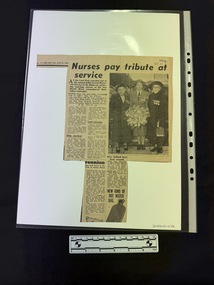 Returned Nurses RSL Sub-branch
Newspaper - Newspaper clipping, [The Sun], 'Nurses pay tribute at service', 'Mrs. Selleck lays first wreath', '[?] reunion', 'Marching women: Good as gold - Colonel Sage' and 'Korea 'veteran'', Tuesday, April 26 1955
... ...Footscray General Hospital...Edith Cavell Memorial Ida O'Dwyer Agnes Betty Jeffrey Mary Lougron Royal Red Cross Mrs A T Noy Kathleen Rogers Margaret Grace Caterson Helene Joyce Wilding British Commonwealth Occupation Forces Japan Korea Lou Marshall Royal Australian Air Force Nursing Service Annie Moriah Sage Frank Selleck Frances Johns Gertrude Brindley MJ Hanna Alfred Hospital Ruth Meaney Royal Women's Hospital Betty Lawson Eye and Ear Hospital Mavis Mitchell Footscray General Hospital M Holding J Veitch Camp Hospital Puckapunyal Ann Swinton MBE Warrnambool Hospital Alice Adcock Margaret Coles Maternity Hospital Queen Alexandra Imperial Military Nursing Service Royal Melbourne Hospital Euraope Middle East Auxiliary Territorial Service Belle Tresize Edith Curley Women's Auxiliary Air Force Britain M Caterson RAAMC RAAMC School of Army Health Healesville Royal Australian Army Medical Corps Kure HJ Wilding MA Bennet RAAFNS Darwin RAAF Royal Australian Air Force New Zealand Women's Auxuluary Army Corps MA Moorhead Auckland WAAC Women's Auxiliary Corps St Kilda Rd Egypt France England Caulfield Military Hospital AANS Australian Army Nursing Service Vyner Brooke Singapore Returned Nurses' Club Anzac House Tasmania POW Prisoner of war Nesta James Nesta Noy St Mary's Church Caulfield 2nd 10th AGH Australian General Hospital No. 1 Unit Salonika Heidelberg Repatriation Hospital AE Coates Edith Cavell Trust Fund 'NC9' [crossed out in blue ink top right hand corner] 'NC11' [blue ink top right hand corner] Newspaper clipping of articles on both sides, with some parts missing. ...Articles all concerned with various ANZAC Day services in Melbourne as part of newspapers '4 pages for women' section.Newspaper clipping of articles on both sides, with some parts missing. One side has a black and white photograph of three woman wearing medals and holding a floral tribute. The other side has a black and white photograph of two women in Army nursing uniforms looking at the camera. There are a range of articles on both sides.'NC9' [crossed out in blue ink top right hand corner] 'NC11' [blue ink top right hand corner]edith cavell memorial, ida o'dwyer, agnes betty jeffrey, mary lougron, royal red cross, mrs a t noy, kathleen rogers, margaret grace caterson, helene joyce wilding, british commonwealth occupation forces, japan, korea, lou marshall, royal australian air force nursing service, annie moriah sage, frank selleck, frances johns, gertrude brindley, mj hanna, alfred hospital, ruth meaney, royal women's hospital, betty lawson, eye and ear hospital, mavis mitchell, footscray general hospital, m holding, j veitch, camp hospital puckapunyal, ann swinton, mbe, warrnambool hospital, alice adcock, margaret coles maternity hospital, queen alexandra imperial military nursing service, royal melbourne hospital, euraope, middle east, auxiliary territorial service, belle tresize, edith curley, women's auxiliary air force, britain, m caterson, raamc, raamc school of army health, healesville, royal australian army medical corps, kure, hj wilding, ma bennet, raafns, darwin, raaf, royal australian air force, new zealand women's auxuluary army corps, ma moorhead, auckland, waac, women's auxiliary corps, st kilda rd, egypt, france, england, caulfield military hospital, aans, australian army nursing service, vyner brooke, singapore, returned nurses' club, anzac house, tasmania, pow, prisoner of war, nesta james, nesta noy, st mary's church, caulfield, 2nd 10th agh, australian general hospital, no. 1 unit, salonika, heidelberg repatriation hospital, ae coates, edith cavell trust fund -
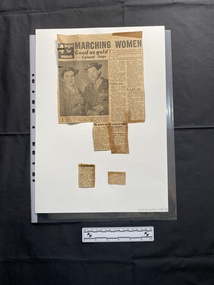 Returned Nurses RSL Sub-branch
Newspaper - Newspaper clipping, [The Sun News-Pictorial], 'Marching women: Good as gold - Colonel Sage', 'Korea 'veteran', 'Nurses pay tribute at service', 'Mrs. Selleck lays first wreath', 'Lunch reunion', Tuesday, April 26 1955
... ...Footscray General Hospital...Edith Cavell Memorial Ida O'Dwyer Agnes Betty Jeffrey Mary Lougron Royal Red Cross Mrs A T Noy Kathleen Rogers Margaret Grace Caterson Helene Joyce Wilding British Commonwealth Occupation Forces Japan Korea Lou Marshall Royal Australian Air Force Nursing Service Annie Moriah Sage Frank Selleck Frances Johns Gertrude Brindley MJ Hanna Alfred Hospital Ruth Meaney Royal Women's Hospital Betty Lawson Eye and Ear Hospital Mavis Mitchell Footscray General Hospital M Holding J Veitch Camp Hospital Puckapunyal Ann Swinton MBE Warrnambool Hospital Alice Adcock Margaret Coles Maternity Hospital Queen Alexandra Imperial Military Nursing Service Royal Melbourne Hospital Euraope Middle East Auxiliary Territorial Service Belle Tresize Edith Curley Women's Auxiliary Air Force Britain M Caterson RAAMC RAAMC School of Army Health Healesville Royal Australian Army Medical Corps Kure HJ Wilding MA Bennet RAAFNS Darwin RAAF Royal Australian Air Force New Zealand Women's Auxuluary Army Corps MA Moorhead Auckland WAAC Women's Auxiliary Corps St Kilda Rd Egypt France England Caulfield Military Hospital AANS Australian Army Nursing Service Vyner Brooke Singapore Returned Nurses' Club Anzac House Tasmania POW Prisoner of war Nesta James Nesta Noy St Mary's Church Caulfield 2nd 10th AGH Australian General Hospital No. 1 Unit Salonika Heidelberg Repatriation Hospital AE Coates Edith Cavell Trust Fund Newspaper clipping of articles on both sides, with some parts becoming seperated. ...Articles all concerned with various ANZAC Day services in Melbourne as part of newspapers '4 pages for women' section.Newspaper clipping of articles on both sides, with some parts becoming seperated. One side has a black and white photograph of three woman wearing medals and holding a floral tribute. The other side has a black and white photograph of two women in Army nursing uniforms looking at the camera. There are a range of articles on both sides.edith cavell memorial, ida o'dwyer, agnes betty jeffrey, mary lougron, royal red cross, mrs a t noy, kathleen rogers, margaret grace caterson, helene joyce wilding, british commonwealth occupation forces, japan, korea, lou marshall, royal australian air force nursing service, annie moriah sage, frank selleck, frances johns, gertrude brindley, mj hanna, alfred hospital, ruth meaney, royal women's hospital, betty lawson, eye and ear hospital, mavis mitchell, footscray general hospital, m holding, j veitch, camp hospital puckapunyal, ann swinton, mbe, warrnambool hospital, alice adcock, margaret coles maternity hospital, queen alexandra imperial military nursing service, royal melbourne hospital, euraope, middle east, auxiliary territorial service, belle tresize, edith curley, women's auxiliary air force, britain, m caterson, raamc, raamc school of army health, healesville, royal australian army medical corps, kure, hj wilding, ma bennet, raafns, darwin, raaf, royal australian air force, new zealand women's auxuluary army corps, ma moorhead, auckland, waac, women's auxiliary corps, st kilda rd, egypt, france, england, caulfield military hospital, aans, australian army nursing service, vyner brooke, singapore, returned nurses' club, anzac house, tasmania, pow, prisoner of war, nesta james, nesta noy, st mary's church, caulfield, 2nd 10th agh, australian general hospital, no. 1 unit, salonika, heidelberg repatriation hospital, ae coates, edith cavell trust fund -
 Sunshine and District Historical Society Incorporated
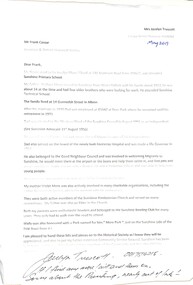
Letter - Wallace 'Wal/Wally' More Collection
... The death of the Queen These are the highlights of This Magnificent Motion Picture|3 Notice paper for Centenary Commemoration meeting of the Council Wednesday 18th May 1960|Religious Program for City of Sunshine who were celebrating the Centenary Civic Thanksgiving Service 1860 - 1960 at the Town Hall Sunshine 1st May 1960 in the presence of His Worship the Mayor Cr D B Dempster JP Address by The Right Reverend Doctor A C Watson Moderator General of the Presbyterian Church of Australia|Typed Report City of Sunshine Mayors Report 1962 to 1963 Cr D F Thompson JP Mayor 2 September 1963|Typed Report City of Sunshine Mayors Report 1955 to 1956 Cr Henry B Dempster JP|Newspaper Article Footscray and District Hospital Annual Report 1972|Newspaper Article Its hard times for the kind ladies of Sunshine Sunshine Ladis Benevolent Society members Flo Morley Glad Crick Sadie Parsons and Connie Parsons With remaining members Edna Hopkins and Violet More the women have given a total of 130 years service to Sunshine's needy|Newspaper Article The Sun 30 June 1981 Baby Di|Newspaper Article Sunshine Advocate 31 August 1956 Who will be Mayor?...The death of the Queen These are the highlights of This Magnificent Motion Picture|3 Notice paper for Centenary Commemoration meeting of the Council Wednesday 18th May 1960|Religious Program for City of Sunshine who were celebrating the Centenary Civic Thanksgiving Service 1860 - 1960 at the Town Hall Sunshine 1st May 1960 in the presence of His Worship the Mayor Cr D B Dempster JP Address by The Right Reverend Doctor A C Watson Moderator General of the Presbyterian Church of Australia|Typed Report City of Sunshine Mayors Report 1962 to 1963 Cr D F Thompson JP Mayor 2 September 1963|Typed Report City of Sunshine Mayors Report 1955 to 1956 Cr Henry B Dempster JP|Newspaper Article Footscray and District Hospital Annual Report 1972|Newspaper Article Its hard times for the kind ladies of Sunshine Sunshine Ladis Benevolent Society members Flo Morley Glad Crick Sadie Parsons and Connie Parsons With remaining members Edna Hopkins and Violet More the women have given a total of 130 years service to Sunshine's needy|Newspaper Article The Sun 30 June 1981 Baby Di|Newspaper Article Sunshine Advocate 31 August 1956 Who will be Mayor? ...Wallace 'Wal/Wally' More documents from when he served as an independant Councillor for the City of Sunshine (Elected 1956). He lived at 14 Gunnedah Street Albion. More Park Ardeer is named after him. These documents were donated to the Society by his daughter Jocelyn TruscottLetter to Frank Cassar from Jocelyn Truscott nee More May 2019|Program of Gala Performance Sixty glorious Years The Barclay Theatre Melbourne 16th April 1972 Synopsis The film opens with Queen Victoria's announcement of her betrothal to Prince Albert a pronouncement far from enthusiastically received by Parliament Thence to Englands antipathy towards the Prince Consort. The birth of the Princess Royal. The opening of the Great Exhibition at Crystal Palace. The Charge of the Light Brigade at Balaclava. The death of the Prince Consort. The poignancy of Victoria's protracted retirement from public life. The misguided honour of her husband's memory. Later in happier circumstances during her Diamond Jubilee Celebrations. The control of the Suez Canal by Disraeli. The assassination of General Gordon Kitchener's conquest of Khartoum. The death of the Queen These are the highlights of This Magnificent Motion Picture|3 Notice paper for Centenary Commemoration meeting of the Council Wednesday 18th May 1960|Religious Program for City of Sunshine who were celebrating the Centenary Civic Thanksgiving Service 1860 - 1960 at the Town Hall Sunshine 1st May 1960 in the presence of His Worship the Mayor Cr D B Dempster JP Address by The Right Reverend Doctor A C Watson Moderator General of the Presbyterian Church of Australia|Typed Report City of Sunshine Mayors Report 1962 to 1963 Cr D F Thompson JP Mayor 2 September 1963|Typed Report City of Sunshine Mayors Report 1955 to 1956 Cr Henry B Dempster JP|Newspaper Article Footscray and District Hospital Annual Report 1972|Newspaper Article Its hard times for the kind ladies of Sunshine Sunshine Ladis Benevolent Society members Flo Morley Glad Crick Sadie Parsons and Connie Parsons With remaining members Edna Hopkins and Violet More the women have given a total of 130 years service to Sunshine's needy|Newspaper Article The Sun 30 June 1981 Baby Di|Newspaper Article Sunshine Advocate 31 August 1956 Who will be Mayor?more -
 Royal District Nursing Service (now known as Bolton Clarke)
Photograph - Photograph, black and white, Barry Sutton, 01.05.1974
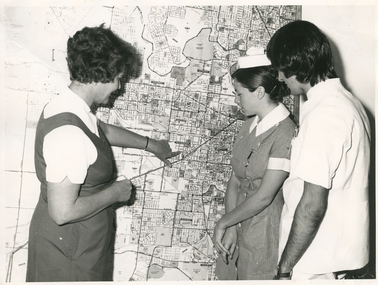
... Footscray Centre. She is wearing her RDNS uniform of a short sleeve white blouse under a royal blue V neck tunic style dress. Sr. Anderson is showing two Student nurses from Western General Hospital the map with the areas covered by Footscray Centre. ...Footscray Centre. She is wearing her RDNS uniform of a short sleeve white blouse under a royal blue V neck tunic style dress. Sr. Anderson is showing two Student nurses from Western General Hospital the map with the areas covered by Footscray Centre. ...Sister Ellen Anderson is the Supervisor of the Royal District Nursing Service, (RDNS) Footscray Centre. She is wearing her RDNS uniform of a short sleeve white blouse under a royal blue V neck tunic style dress. Sr. Anderson is showing two Student nurses from Western General Hospital the map with the areas covered by Footscray Centre. The map had different colour pins to identify streets where patients lived who were currently receiving nursing care from RDNS Sisters working in these areas (districts).During their training, Student nurses from several hospitals either attended the Royal District Nursing Service (RDNS), Education Department, or, a RDNS Nurse Educator travelled to the appropriate hospital’s Education Department to educate the Trainees on District nursing through the RDNS Community Nursing Program. Following the lectures Students went to a RDNS Centre and each Student accompanied a Trained nurse (Sister) for a week observing and gaining knowledge of all facets of nursing care in the home. This gave them an insight into the home conditions and situations patients faced after discharge from hospital. During 1971 there were 584 Student nurses who received field experience with RDNS. From its inception as Melbourne District Nursing Society (MDNS), in 1885, their Trained nurses (Nurses) worked in specific areas, 'districts'. The first Nurse worked east and west, between Victoria Parade and Flinders Street and, north and south, between Spencer Street and Spring Street. When a second Nurse was employed they divided this area at Elizabeth Street so each Nurse could attend to patients in the same area giving continuity of care. As the Society expanded, becoming Melbourne District Nursing Service, then, with Royal patronage, Royal District Nursing Service (RDNS) many Centres were opened throughout the Melbourne Metropolitan area and outer suburbs. The District nurse's areas (districts) grew and were divided within Shire boundaries for e.g. Knox 1, Knox 2, Knox 3, Knox 4, within the area of the Shire of Knox. A map covering the Centre’s Districts was attached to a wall, and its different colour pins identified streets where patients lived who were currently receiving nursing care from the RDNS Trained nurses (Sisters) working in these areas (districts).On the left of this black and white photograph is Royal District Nursing Service (RDNS), Sister Ellen Anderson, who has short dark curly hair and is wearing her RDNS uniform of a short sleeve white blouse under a dark V neck tunic style frock. She is standing side-on, towards the right of the photograph, and with her left hand is pointing to an area on a large map attached to the wall in the background. To her right, is a Student nurse who is facing Sr. Anderson, and looking at the area on the map. Under her white nurses cap, she has her long dark hair drawn back, and is wearing her hospital uniform of a short sleeve checked dress with white collar and cuffs; a nursing watch is attached to its upper left; her hands are clasped in front of her. To her right, is a male Student nurse who has collar length straight dark hair, and is wearing white trousers and a short sleeve white top with pens in the left upper pocket. He is looking at the areas on the map.. Barry Sutton MA 77 informationroyal district nursing service, rdns, rdns education, rdns centre, rdns district map, sister ellen anderson -
 Royal District Nursing Service (now known as Bolton Clarke)
Photograph - Photograph, black and white, Barry Sutton, 01.05.1974
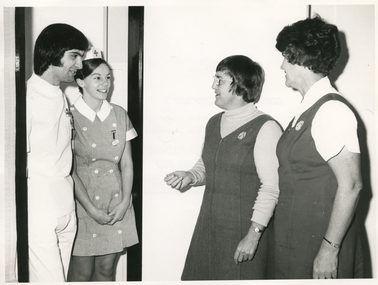
... General Hospital. Royal District Nursing Service (RDNS) Nurse Educator, Sister Nan Deakin, after teaching the RDNS Community Nursing Education program to the Western General's two Student nurses is introducing them to Sister Ellen Anderson, Supervisor of the RDNS Footscray Centre. ...General Hospital. Royal District Nursing Service (RDNS) Nurse Educator, Sister Nan Deakin, after teaching the RDNS Community Nursing Education program to the Western General's two Student nurses is introducing them to Sister Ellen Anderson, Supervisor of the RDNS Footscray Centre. ...The photograph is taken at Western General Hospital. Royal District Nursing Service (RDNS) Nurse Educator, Sister Nan Deakin, after teaching the RDNS Community Nursing Education program to the Western General's two Student nurses is introducing them to Sister Ellen Anderson, Supervisor of the RDNS Footscray Centre. Sr. Anderson will arrange for the Students to go on District nursing visits with RDNS Trained nurses (Sisters) from Footscray Centre who administer nursing care in the community. Sister Deakin is wearing the RDNS winter uniform of a blue/grey skivvie under a blue/grey V neck tunic style frock made of herringbone winter material. Sister Anderson is wearing the RDNS summer uniform of a white short sleeve blouse under a royal blue V neck tunic style frock. The RDNS logo is seen on the upper left on both uniforms.During their training, Student nurses from several hospitals either attended the Royal District Nursing Service (RDNS), Education Department, or, a RDNS Nurse Educator travelled to the appropriate hospital’s Education Department to educate the Trainees on District nursing through the RDNS Community Nursing Program. Following the lectures Students went to an RDNS Centre and each Student accompanied a Trained nurse (Sister) for a week observing and gaining knowledge of all facets of nursing care in the home. This gave them an insight into the home conditions and situations patients faced after discharge from hospital. During 1971 there were 584 student nurses who received field experience with RDNS. From its inception as Melbourne District Nursing Society (MDNS), in 1885, their Trained nurses (Nurses) worked in specific areas, 'districts'. The first Nurse worked east and west, between Victoria Parade and Flinders Street and, north and south, between Spencer Street and Spring Street. When a second Nurse was employed they divided this area at Elizabeth Street so each Nurse could attend to patients in the same area giving continuity of care. As the Society expanded, becoming Melbourne District Nursing Service, then, with Royal patronage, Royal District Nursing Service (RDNS) many Centres were opened throughout the Melbourne Metropolitan area and outer suburbs. The District nurse's areas (districts) grew and were divided within Shire boundaries for e.g. Knox 1, Knox 2, Knox 3, Knox 4, within the area of the Shire of Knox. A map covering the Centre’s Districts was attached to a wall, and its different colour pins identified streets where patients lived who were currently receiving nursing care from the RDNS Trained nurses (Sisters) working in these areas (districts).On the far left of this black and white photograph is a male Student nurse, who has collar length, straight dark hair. He is wearing his hospital uniform of white trousers and top. To his right, is a Student nurse who is wearing her white nursing cap, with motif in the centre front, over her long drawn back dark hair. and her short sleeve uniform checked frock, with white two breasted buttons down it, and with white collar and cuffs. A nursing watch is attached to its upper left. Both are standing in the dark framed doorway of a room and are looking to the right and smiling at Royal District Nursing Service (RDNS), Nurse Educator, Sister Nan Deakin. She has short dark hair; is wearing glasses, and is wearing her RDNS uniform of a light grey skivvie under a darker V neck tunic style frock. To the right of her, is RDNS Sister Ellen Anderson who has short curly dark hair and is wearing her RDNS uniform of a white short sleeve blouse, under a dark V neck tunic style frock. They are standing side-on facing the Students. Barry Sutton MA 78royal district nursing service, rdns, rdns education, western general hospital students, sister nan deakin, sister ellen anderson -
 Royal District Nursing Service (now known as Bolton Clarke)
Photograph - Photograph, black and white, c.1980
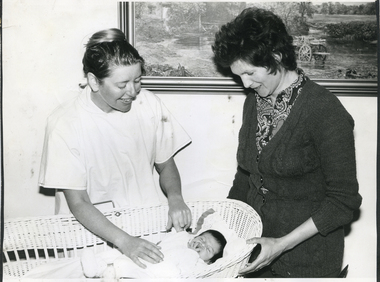
... In 1964 MDNS commenced a Post-Natal service with General and Midwifery trained MDNS Sisters working from a room on the ground floor at the Footscray Hospital Nurses quarters, and visiting early discharged Footscray Hospital maternity cases at home. ...This photograph is taken in the home of the Mother and babe and shows a RDNS Sister who is visiting to give the mother and babe Post-natal care. Royal District Nursing Service (RDNS) had a Domiciliary Infant and Maternal Care (DIMC) service which gave Post-natal care to new born mothers and babes in their homes following their early discharge from hospital, or if required for other reasons. In August 1893 Melbourne District Nursing Society (MDNS), commenced a Midwifery Service with Nurse Fowler, who was trained in General nursing and Midwifery nursing, being the first Midwife employed. Mothers were assessed for suitability of a home birth or if they required delivery at the Women’s Hospital. The Midwife worked in conjunction with the Doctors at the Women’s Hospital and if a complication arose before or after birth the patient was transferred to their care. Following birth, the Midwife gave Post-Natal care to both the mother and babe commencing with visits twice a day. In 1898 the service ceased due to lack of funds but recommenced in 1906, and in the August 1925 Annual Report the number of MDNS home births was recorded at 478. MDNS built the After-Care Home and a pioneering Anti-Natal Clinic was opened in 1930. The last Ante-Natal clinic was held there in December 1951 and the MDNS Midwifery service ceased in February 1952. In 1964 MDNS commenced a Post-Natal service with General and Midwifery trained MDNS Sisters working from a room on the ground floor at the Footscray Hospital Nurses quarters, and visiting early discharged Footscray Hospital maternity cases at home. Later, as Royal District Nursing Service (RDNS), this service was extended and renamed as Domiciliary Infant and Maternal Care, (DIMC) service operating from most Centres and visiting early discharged, often 24 hours after birth, maternity cases from hospitals to give Post-natal care to the mother and babe. Many of the RDNS Sisters who worked in DIMC also had their Infant Welfare Certificate, though Midwifery trained nurses also visited. Black and white photograph showing, to the left, a Royal District Nursing (RDNS) Domiciliary Postnatal Sister, with long hair drawn up, and wearing a white gown. She is attending to a new born baby in her wicker bassinet at the baby's home. The Sister is smiling and has her left hand by the shoulder of the wrapped babe, and her right hand is resting lower on the baby. The baby's mother, who has curly short dark hair, is dressed in a floral blouse and dark cardigan. She is standing to the right of the Sister and behind the bassinet, and is looking down at her babe and smiling. Her left hand is resting on the bassinet. The baby has dark hair and has her hand partly covering her mouth. Part of a picture is seen on the wall behind the mother.rdns, royal district nursing service, rdns domiciliary post natal service, rdns domiciary infant and maternal care, rdns dimc -
 Royal District Nursing Service (now known as Bolton Clarke)
Photograph - Photograph, black and white, c.1980
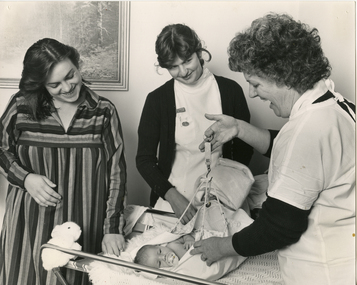
... In 1964 MDNS commenced a Post-Natal service with General and Midwifery trained MDNS Sisters working from a room on the ground floor at the Footscray Hospital Nurses quarters, and visiting early discharged Footscray Hospital maternity cases at home. ...This photograph depicts a Royal District Nursing Service (RDNS) Sister (Sr.) visiting Mrs. Hodginson and babe in their home. Sr. Wan is weighing baby Tamara as part of the Post-Natal care she is giving. A nurse who is doing her Hospital training is visiting with the Sister and observing. RDNS had a Domiciliary Infant and Maternal Care, (DIMC) service operating from most Centres which visited early discharged, often 24 hours after birth, maternity cases from hospitals to give Post-natal care to the mother and babe. Sr. Wan is wearing her RDNS summer uniform of a short sleeve white blouse under a royal blue V neck tunic style frock and a dark blue cardigan. In August 1893 Melbourne District Nursing Society (MDNS), commenced a Midwifery Service with Nurse Fowler, who was trained in a hospital in General nursing and Midwifery nursing, being the first Midwife employed. Mothers were assessed for suitability of a home birth or if they required delivery at the Women’s Hospital. The Midwife worked in conjunction with the Doctors at the Women’s Hospital and if a complication arose before or after birth the patient was transferred to their care. Following birth, the Midwife gave Post-Natal care to both the mother and babe commencing with visits twice a day. In 1898 the service ceased due to lack of funds but recommenced in 1906, and in the August 1925 Annual Report the number of MDNS home births was recorded at 478. MDNS built the After-Care Home and a pioneering Anti-Natal Clinic was opened in 1930. The last Ante-Natal clinic was held there in December 1951 and the MDNS Midwifery service ceased in February 1952. In 1964 MDNS commenced a Post-Natal service with General and Midwifery trained MDNS Sisters working from a room on the ground floor at the Footscray Hospital Nurses quarters, and visiting early discharged Footscray Hospital maternity cases at home. Later, as Royal District Nursing Service (RDNS), this service was extended and renamed as Domiciliary Infant and Maternal Care, (DIMC) service operating from most Centres and visiting early discharged, often 24 hours after birth, maternity cases from hospitals to give Post-natal care to the mother and babe. Many of the RDNS Sisters who worked in DIMC also had their Infant Welfare Certificate, though Midwifery trained nurses also visited. On the right of the black and white photograph is Royal District Nursing Service (RDNS) DIMC Sister J. Wan, who has short dark curly hair and is wearing a white gown over her uniform, with the white collar and sleeves of her dark cardigan seen. She is laughing as she holds the top ring of hand held baby scales in her right hand; the bottom of the scale has a metal hook which has a sling attached to it with four cotton 'ropes'. Baby Tamara is supported in the sling which is just resting on a sheep skin and bunny rug covered metal framed change table. Sr. Wan has her left hand on the sling. To the left of the photograph is Tamara's smiling mother, Mrs. Lynda Hodginson, and in the centre of the photograph is observer Nurse Sheehan. Mrs. Hodginson is wearing a striped dress with a V neck, and has dark shoulder length hair. Nurse Sheehan has short dark hair and is wearing a white uniform and dark cardigan. A nursing watch is attached to the right hand side of her uniform. Part of a landscape picture can be seen on the wall behind her. A small white fluffy rabbit sits on the left hand side of the change table. Baby Tamara has sparse dark hair and is sucking on a dummy.Photographer's stampmdns, melbourne district nursing society, melbourne district nursing service, royal district nursing service, rdns, mdns midwifery, rdns domiciliary postnatal service, dimc, tamara hodginson, nurse sheehan, sister j. wan, mrs lynda hodginson -
 Royal District Nursing Service (now known as Bolton Clarke)
Photograph - Photograph, black and white, c. 1967
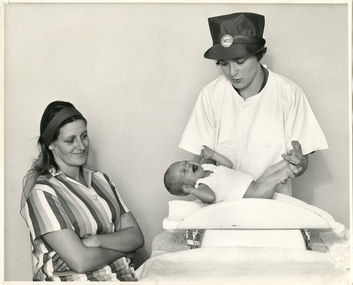
... In 1964 MDNS commenced a Post-Natal service with General and Midwifery trained MDNS Sisters working from a room at Footscray Hospital, and visiting early discharged Footscray Hospital maternity cases at home. ...This photograph depicts Post-Natal care being given by a Royal District Nursing Service (RDNS), Sister who is working in the RDNS Domiciliary Infant and Maternal Care (DIMC) section of the Service. The photograph is taken in the home of the mother and baby and the Sister is in the process of putting the baby onto the Baby scales to ascertain the babe's weight. Sisters employed in the DIMC section of RDNS gave Post-natal care to both the mother and her newly born babe when they were discharged early from hospital. This photograph was taken in the year following Melbourne District Nursing Service (MDNS) being granted Royal patronage in 1966 and becoming Royal District Nursing Service. The Sister is wearing the the same grey uniform frock used by MDNS but the badge on her peaked cap has changed from a red Maltese cross to a metal round silver badge with a royal blue circle around the edge with the words 'Royal District Nursing Service' in white capital letters running inside the blue circle.The centre of the badge is divided into three sections; a silver rising sun top and bottom, and a thick royal blue horizontal central strip with 'RDNS' written in large white capital letters. This uniform continued to be worn until 1971 when it changed colour and style. In August 1893 Melbourne District Nursing Society (MDNS), commenced a Midwifery Service with Nurse Fowler, who trained in a Hospital and was qualified in General nursing and Midwifery nursing, being the first Midwife employed. Mothers were assessed for suitability of a home birth, or if they required delivery at the Women’s Hospital. The Midwife worked in conjunction with the Doctors at the Women’s Hospital and if a complication arose the patient was transferred to their care. Following birth they gave Post-Natal care to both the mother and babe. In 1898 the service ceased due to lack of funds but recommenced in 1906, and in the August 1925 Annual Report the number of MDNS home births was recorded at 478. MDNS built the After-Care Home and an Anti-Natal Clinic was opened in 1930. The last Ante-Natal clinic was held there in December 1951 and the MDNS Midwifery service ceased in February 1952. In 1964 MDNS commenced a Post-Natal service with General and Midwifery trained MDNS Sisters working from a room at Footscray Hospital, and visiting early discharged Footscray Hospital maternity cases at home. Now as Royal District Nursing Service (RDNS), this service was extended to a Domiciliary Infant and Maternal Care, (DIMC) service operating from most Centres and visiting early discharged, often 24 hours after birth, maternity cases from hospitals to give post-natal care to the mother and babe. Many Sisters working in this area had a Certificate in Infant Welfare as well as their General and Midwifery Certificates.In the right rear of this black and white photograph is a Royal District Nursing Service, (RDNS), Sister who is wearing a white gown over her uniform, and wearing her grey peaked hat with the RDNS badge visible, looking down at a baby she is about to weigh. The baby has sparse dark hair, is wearing a white singlet and is crying. The Baby scales, which are sitting on a table in front of the Sister, are white with a rectangular base and curved sided tray on the top. The Sister is standing behind the scales, and is supporting the babe's body with her right hand and holding baby's legs with her left hand as she lowers babe fully onto the scales. On the left of the photograph, the mother, who has long dark hair with a hair scarf holding it back, and is wearing a striped frock, is siting on a chair with her arms crossed at her waist, and is smiling at her babe as she observes proceedings.. Photographers Stampmdns, melbourne district nursing society, melbourne district nursing service, rdns, royal district nursing service, rdns domiciliary postnatal service, dimc -
 Royal District Nursing Service (now known as Bolton Clarke)
Photograph - Photograph, black and white, 09 05 1967
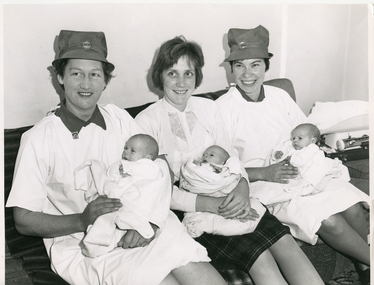
... In 1964 MDNS commenced a Post-Natal service with General and Midwifery trained MDNS Sisters working from a room at Footscray Hospital, and visiting early discharged Footscray Hospital maternity cases at home. ...In 1964 Melbourne District Nursing Service (MDNS) commenced a Domiciliary Postnatal Service, later called Domiciliary Infant and Maternal.Care (DIMC), when Royal patronage was granted in 1966 (RDNS). The Sisters gave Post-natal care to the mother and babes and visited for support and advice as long as needed. The central RDNS badges on the Sisters hats is made of metal and has 'Royal District Nursing Service' written in the outside royal blue circle. The inner area is divided in three parts, the top and bottom sections are a silver rising sun and the central royal blue horizontal band has the letters 'RDNS' written white capital letters.In August 1893 Melbourne District Nursing Society (MDNS), commenced a Midwifery Service with Nurse Fowler, who was Hospital trained in General nursing and Midwifery nursing, being the first Midwife employed. Mothers were assessed for suitability of a home birth, or if they required delivery at the Women’s Hospital. The Midwife worked in conjunction with the Doctors at the Women’s Hospital and if a complication arose the patient was transferred to their care. Following birth they gave Post-Natal care to both the mother and babe. In 1898 the service ceased due to lack of funds but recommenced in 1906, and in the August 1925 Annual Report the number of MDNS home births was recorded at 478. MDNS built the After-Care Home and an Anti-Natal Clinic was opened in 1930. The last Ante-Natal clinic was held there in December 1951 and the MDNS Midwifery service ceased in February 1952. In 1964 MDNS commenced a Post-Natal service with General and Midwifery trained MDNS Sisters working from a room at Footscray Hospital, and visiting early discharged Footscray Hospital maternity cases at home. Later, as Royal District Nursing Service (RDNS), this service was extended to a Domiciliary Infant and Maternal Care (DIMC), service operating from most Centres and visiting early discharged, often 24 hours after birth, maternity cases from hospitals to give post-natal care to the mother and babe. Many of the RDNS Sisters who did DIMC had their Triple Certificate (Infant Welfare), though Midwifery trained nurses also visited. Black and white photograph showing two Royal District Nursing Service, (RDNS), Postnatal Service Sisters visiting a mother and her triplets in their home. Both Sisters and the mother are smiling and sitting on a dark coloured couch with each holding one of the babes who are wrapped in light coloured bunny rugs. The Sister on the left is wearing a white gown, with the grey peaks of her uniform showing; her nursing badge is attached to the right hand peak of her uniform. She is wearing her grey peaked hat, with central attached RDNS badge, over her short dark curled hair. To her right is the mother, who has short straight dark hair, and is wearing a white blouse and dark tartan skirt. On the far right is Sister Barbara Weisart, wearing a white gown; with the grey peaks of her uniform showing, and wearing her grey peaked hat with central RDNS badge over her short dark straight hair. A set of white baby scales are seen to her rightPhotographers Stamp. Quote No. GE 13mdns, melbourne district nursing society, melbourne district nursing service, royal district nursing service, rdns, rdns domiciliary postnatal service, dimc, sister barbara weisart -
 Royal District Nursing Service (now known as Bolton Clarke)
Photograph - Photograph, black and white, Barry Sutton, 23.02.1978
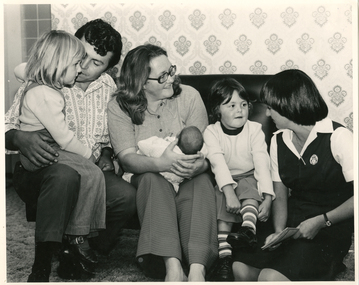
... In 1964 MDNS commenced a Post-Natal Service with general and midwifery trained MDNS nurses working from a room at Footscray Hospital, and visiting early discharged Footscray Hospital maternity cases at home. ...The RDNS Sister is giving Post Natal care to the Mother and babe. She is wearing her RDNS summer uniform which is a white short sleeve blouse under a royal blue V necked tunic dress with the RDNS insignia emblazoned on the upper left.In August 1893 Melbourne District Nursing Society (MDNS), commenced a Midwifery Service with Nurse Fowler, who was trained in General nursing and Midwifery nursing, being the first Midwife employed. Mothers were assessed for suitability of a home birth or if they required delivery at the Women’s Hospital. The Midwife worked in conjunction with the Doctors at the Women’s Hospital and if a complication arose the patient was transferred to their care. Following birth they gave Post-Natal care to both the mother and babe. In 1898 the service ceased due to lack of funds but recommenced in 1906, and in the August 1925 Annual Report the number of MDNS home births was recorded at 478. MDNS built the After-Care Home and an Anti-Natal Clinic was opened in 1930. The last Ante-Natal clinic was held there in December 1951 and the MDNS Midwifery service ceased in February 1952. In 1964 MDNS commenced a Post-Natal Service with general and midwifery trained MDNS nurses working from a room at Footscray Hospital, and visiting early discharged Footscray Hospital maternity cases at home. Now as Royal District Nursing Service (RDNS), this service was extended to a Domiciliary Infant and Maternal Care, (DIMC) service operating from most Centres and visiting early discharged, often 24 hours after birth, maternity cases from hospitals to give post-natal care to the mother and babe.Black and white photograph of a Royal District Nursing Service (RDNS), Sister visiting a family in their home. The family are sitting on a dark coloured couch. From left to right:- The father, who has short dark hair and is wearing a light coloured patterned shirt and dark pants, is looking at his young blond haired daughter who is sitting on his right knee. She is wearing a light coloured top and darker coloured bib and brace pants. The mother, who has long dark hair and wears glasses,.is next to him and is smiling and looking towards the RDNS Sister. She is wearing a long sleeve buttoned grey top and darker coloured slacks, and is holding her babe in her lap with both hands supporting the baby's head. The babe has sparse dark hair and is wrapped in a white bunny rug. Next is a young girl, who has short dark hair and is wearing a light coloured top, darker coloured slacks and has her hands on the top of her left striped sock. Seated on the far right is the RDNS Sister, who has short straight dark hair, and has her face turned towards the child and mother. She is wearing her RDNS uniform of a short sleeve white blouse under a dark V neck tunic style dress which has the RDNS insignia on its upper left. The Sister has a pen attached to the V neck of the tunic and is holding a note book in her hands. She has a watch with a dark band attached to her left wrist. In the background part of a wooden and glass door can be seen and a patterned wallpapered adorns the wall behind the couch.Photographer stamp. Quote No EA 28melbourne district nursing society, mdns, royal district nursing service, rdns, dimc, mdns midwifery, rdns domiciliary infant and maternal care -
 Royal District Nursing Service (now known as Bolton Clarke)
Photograph - Photograph, black and white, Barry Sutton, 23.02.1978
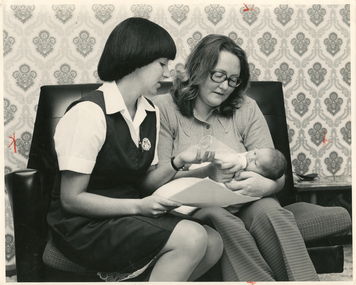
... In 1964 MDNS commenced a Post-Natal service with general and midwifery trained MDNS Sisters working from a room on the ground floor in the Footscray Hospital Nurses quarters, and visiting early discharged Footscray Hospital maternity cases at home. ...General and Midwifery trained RDNS Sister Kaye Pilmore is supervising a Mother feeding her new born infant in their home. Sister Pilmore is wearing her RDNS summer uniform, which was a royal blue V neck tunic style dress, with the RDNS badge emblazoned on the upper left, worn over a short sleeve white blouse. In August 1893 Melbourne District Nursing Society (MDNS), commenced a Midwifery Service with Nurse Fowler, who was trained in General nursing and Midwifery nursing, being the first Midwife employed. Mothers were assessed for suitability of a home birth or if they required delivery at the Women’s Hospital. The Midwife worked in conjunction with the Doctors at the Women’s Hospital and if a complication arose before or after birth the patient was transferred to their care. Following birth, the Midwife gave Post-Natal care to both the mother and babe commencing with visits twice a days. In 1898 the service ceased due to lack of funds but recommenced in 1906, and in the August 1925 Annual Report the number of MDNS home births was recorded at 478. MDNS built the After-Care Home and an Anti-Natal Clinic was opened in 1930. The last Ante-Natal clinic was held there in December 1951 and the MDNS Midwifery service ceased in February 1952. In 1964 MDNS commenced a Post-Natal service with general and midwifery trained MDNS Sisters working from a room on the ground floor in the Footscray Hospital Nurses quarters, and visiting early discharged Footscray Hospital maternity cases at home. Later, as Royal District Nursing Service (RDNS), this service was extended and renamed as the Domiciliary Infant and Maternal Care, (DIMC) service operating from most Centres and visiting early discharged, often 24 hours after birth, maternity cases from hospitals to give Post-natal care to the mother and babe. Many of the RDNS Sisters who worked in the DIMC section also had their Triple Certificate in Infant Welfare, though double certificate Midwifery trained nurses also made DIMC visits. Black and white photograph showing a Royal District Nursing Service (RDNS), Sister sitting to the left of a mother who is holding her babe whilst she feeds her with a bottle. The Sister has short straight dark hair and is wearing her RDNS uniform of a dark V neck tunic style dress, with the RDNS badge emblazoned on the upper left, over a short sleeve white blouse. She is turned towards the babe and mother and is holding a sheet of white paper in her right hand and her left hand is supporting the end of the glass feeding bottle. The mother, who has long dark hair and is wearing glasses, and a grey long sleeve top and darker coloured slacks, has her baby across her knees with her left arm bent at the elbow and her arm and hand supporting her baby's head and neck. She is holding the feeding bottle with her right hand and the teat of the bottle is in the baby's mouth. The babe has sparse dark hair and is wrapped in a white bunny rug. They are sitting on a dark coloured couch with check cushions on the seat. A small low table is to the right of the couch against the wall. Patterned wallpaper can be seen on the wall behind the couch and table.Photographer stamp.Quote No. EA 35melbourne district nursing society, mdns, royal district nursing service, rdns, mdns midwifery, dimc, mdns post-natal care, rdns dimc, sister kaye pilmore -
 Royal District Nursing Service (now known as Bolton Clarke)
Photograph - Photograph, black and white, Barry Sutton, 02.08.1973
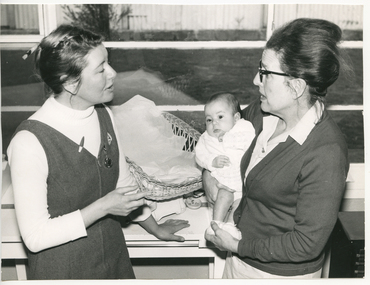
... In 1964 MDNS commenced a Post-Natal service with General and Midwifery trained MDNS Sisters working from a room on the ground floor in the Footscray Hospital Nurses quarters, and visiting early discharged Footscray Hospital maternity cases at home. ...This photograph shows an RDNS Sister doing Liaison work at a Hospital. She will pass the information given about the babe to the RDNS Domiciliary Infant and Maternal Care (DIMC) Sister who will be visiting the baby and her family in their home. Sr. Schofield is wearing the RDNS winter uniform of a blue/grey skivvie under a V neck tunic style frock made of herringbone winter material.Liaison had occurred between Doctors and the Trained nurses (Nurses) of the Melbourne District Nursing Society (MDNS), from its inception in 1885. This increased when Midwifery was introduced in August 1893 with close liaising with the Women’s Hospital. As District nursing grew it was recognized that closer liaising between many Public Hospitals would be beneficial, for not only the MDNS, later called Royal District Nursing Service (RDNS) Trained nurses (Sisters), but also for the patients and the hospitals. In August 1964 a Liaison Officer commenced at the Alfred Hospital. This soon increased to Liaison Officers working full time at several Public Hospitals. They facilitated the smooth transition from hospital to home for many patients who required ongoing nursing care. Liaison Sisters regularly attended discharge planning meetings, interviewed prospective patients, co-ordinated discharge, and booked the first visit by the visiting RDNS Sister. At the time of a patient’s discharge, the Liaison Sister forwarded information on their diagnosis and instructions regarding the care required at home to the appropriate RDNS Centre, and in turn the attending District Sister wrote a report of progress and any queries to the Hospital Doctor, via the Liaison Sister, at the time the patient was attending outpatients. Any new instructions were then sent back to the District Sister. Liaising also occurred between District Sisters and Doctors when patients were referred by General Practitioners and did not attend a hospital. In August 1893 Melbourne District Nursing Society (MDNS), commenced a Midwifery Service with Nurse Fowler, who was trained in General nursing and Midwifery nursing, being the first Midwife employed. Mothers were assessed for suitability of a home birth or if they required delivery at the Women’s Hospital. The Midwife worked in conjunction with the Doctors at the Women’s Hospital and if a complication arose before or after birth the patient was transferred to their care. Following birth, the Midwife gave Post-Natal care to both the mother and babe commencing with visits twice a day. In 1898 the service ceased due to lack of funds but recommenced in 1906, and in the August 1925 Annual Report the number of MDNS home births was recorded at 478. MDNS built the After-Care Home and a pioneering Anti-Natal Clinic was opened in 1930. The last Ante-Natal clinic was held there in December 1951 and the MDNS Midwifery service ceased in February 1952. In 1964 MDNS commenced a Post-Natal service with General and Midwifery trained MDNS Sisters working from a room on the ground floor in the Footscray Hospital Nurses quarters, and visiting early discharged Footscray Hospital maternity cases at home. Later, as Royal District Nursing Service (RDNS), this service was extended and renamed as Domiciliary Infant and Maternal Care, (DIMC) service operating from most Centres and visiting early discharged, often 24 hours after birth, maternity cases from hospitals to give Post-natal care to the mother and babe. Many of the RDNS Sisters who worked in DIMC also had their triple Infant Welfare Certificate, though double certificate Midwifery trained Sisters also visited. On the left of this black and white photograph is Royal District Nursing Service (RDNS) Sister Margaret Schofield, who has her long dark hair drawn back, and is smiling as she looks down at a baby being held in the arms of a Hospital Sister. Sr. Schofield is wearing a light grey skivvie under a V neck dark tunic style frock. She has a pen in the V of her tunic, and has a watch hanging under the RDNS logo on its left hand side. Her left hand is resting on a white table which has baby scales with a wicker basket on it. To the right, is the Hospital Sister, who is side-on and facing Sr. Schofield. She is wearing dark rimmed glasses; has her long dark hair drawn back and is wearing a dark cardigan over her white uniform. She has her right arm under the baby with her hand on babe's right leg; her left hand is holding the baby's feet. The baby has sparse dark hair and is wearing a white patterned jacket. Part of a dark filing cabinet is on the right of the photograph and behind the Sisters is a large window, then grass, small shrubs and part of a corrugated clad building can be seen beyond.Barry Sutton LP 43royal district nursing service, rdns, rdns dimc, rdns uniform, sister margaret schofield -
 Royal District Nursing Service (now known as Bolton Clarke)
Photograph - Photograph, black and white, Barry Sutton, 17.10.1973
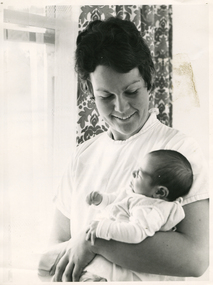
... In 1964 MDNS commenced a Post-Natal service with General and Midwifery trained MDNS Sisters working from a room on the ground floor at the Footscray Hospital Nurses quarters, and visiting early discharged Footscray Hospital maternity cases at home. ...Sister Snyders is based at RDNS Essendon Centre. She is a trained midwife working in the RDNS Domiciliary Infant and Maternal Care (DIMC), section and is attending a recently born baby in her home to give Post-Natal care. Often mothers and babes came home early from hospital, many after 24 hours of birth, and RDNS Sisters attended for several days to check babies progress, including - colour, feeding regime, weight, take a PKU test and give any advise needed to the mother. They also gave Post-Natal care to the mother. In August 1893 Melbourne District Nursing Society (MDNS), commenced a Midwifery Service with Nurse Fowler, who was trained in General nursing and Midwifery nursing, being the first Midwife employed. Mothers were assessed for suitability of a home birth or if they required delivery at the Women’s Hospital. The Midwife worked in conjunction with the Doctors at the Women’s Hospital and if a complication arose before or after birth the patient was transferred to their care. Following birth, the Midwife gave Post-Natal care to both the mother and babe commencing with visits twice a day. In 1898 the service ceased due to lack of funds but recommenced in 1906, and in the August 1925 Annual Report the number of MDNS home births was recorded at 478. MDNS built the After-Care Home and a pioneering Anti-Natal Clinic was opened in 1930. The last Ante-Natal clinic was held there in December 1951 and the MDNS Midwifery service ceased in February 1952. MDNS established Melbourne's first Family Planning Clinic in 1934. In 1964 MDNS commenced a Post-Natal service with General and Midwifery trained MDNS Sisters working from a room on the ground floor at the Footscray Hospital Nurses quarters, and visiting early discharged Footscray Hospital maternity cases at home. Later, as Royal District Nursing Service (RDNS), this service was extended and renamed as Domiciliary Infant and Maternal Care, (DIMC) service operating from most Centres and visiting early discharged, often 24 hours after birth, maternity cases from hospitals to give Post-natal care to the mother and babe. Many of the RDNS Sisters who carried out DIMC visits also had their Triple i.e. Infant and Child Welfare Certificate, though Midwifery trained nurses also made visits. This black and white photograph shows a close up view of Sister (Sr.) Mary-Ann Snyders from Royal District Nursing Service (RDNS), who is standing and cradling a recently born baby in the crook of her left arm; her supporting arm extends along the babe and her right arm is under babe. Sr. Snyders has short dark hair and is wearing a white gown over her uniform. She is smiling down at the babe, who has dark hair and is wearing a check bib over a white nightdress. To the left, voile curtains are seen over a window and in the background, part of an open patterned curtain is seen.Barry Sutton LW 4royal district nursing service, rdns, rdns dimc, sister mary-ann snyders -
 Musculoskeletal Health Australia (now held by the Glen Eira Historical Society)
Photograph - Solo photo, Ben Baxter, 27/05/1978
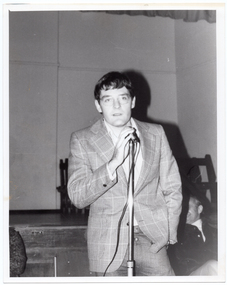
... Footscray. The exhibition, (the first of which had been held at Brighton's St Andrew's Parish Hall in May), was an educational and fundraising event in support of the Rheumatism and Arthritis Association of Victoria (RAAV). In this photo, Mr David Butler, physiotherapist at Western and General Hospital...[Handwritten in pencil] Footscray Exhibition, 1978 [Handwritten in pale blue ink] Page 4 [circled] Mr. David Butler [Handwritten in black ink] physio, Western & General Hospital...General Hospital. Photo - Elsmaree & Ben Baxter." rheumatism and arthritis association of victoria raav living with arthritis aids to daily living art and craft exhibition fundraising panel discussion david butler physiotherapist news review 1978 [Handwritten in pencil] Footscray Exhibition, 1978 [Handwritten in pale blue ink] Page 4 [circled] Mr. ...On the 28th & 29th of July, 1978, a second "Living with Arthritis - Aids to Daily Living" exhibition was held at the Peter Fraser Memorial Hall in Barkly St, Footscray. The exhibition, (the first of which had been held at Brighton's St Andrew's Parish Hall in May), was an educational and fundraising event in support of the Rheumatism and Arthritis Association of Victoria (RAAV). In this photo, Mr David Butler, physiotherapist at Western and General Hospital, addresses the audience at the exhibition. Seated behind him is Dr Leslie Koadlow (partially obscured). A severely cropped version of this photo appears on page 4 of the Vol 10, September 1978 edition of RAAV's quarterly newsletter, News Review. It is captioned: "Mr David Butler, Physiotherapist from Western & General Hospital. Photo - Elsmaree & Ben Baxter."B&W photo of a man standing on the floor in front of a stage. He is speaking into a microphone on a stand. He is wearing eye glasses, and a checked jacket over a shirt and trousers. Behind him, there are two people (partially obscured) sitting on chairs. One of them is smiling broadly while turning his head to the side towards the other person. He is wearing a corduroy jacket and trousers. In the background, there are some wooden benches stacked close to one another on the stage.[Handwritten in pencil] Footscray Exhibition, 1978 [Handwritten in pale blue ink] Page 4 [circled] Mr. David Butler [Handwritten in black ink] physio, Western & General Hospitalrheumatism and arthritis association of victoria, raav, living with arthritis, aids to daily living, art and craft, exhibition, fundraising, panel discussion, david butler, physiotherapist, news review, 1978
