
Showing 12 items matching "forced landings with "
-
 Moorabbin Air Museum
Book - Flight briefings, Flight Briefing for Pilots Volume 1
... landing...First solo...Advanced turning...Operation at minimum level...Forced...Flight briefings Fundamentals of flight Aircraft familiarization Flight preparation Air experience Effects of controls Taxying Straight & level flight Climbing Descending Turning Stalling Spinning Approach and landing First solo Advanced turning Operation at minimum level Forced landings with & without power Air Navigation Introduction to flying training, with air instruction, circa 1970 Flight Briefing for Pilots Volume 1 Book Flight briefings ...Introduction to flying training, with air instruction, circa 1970non-fictionIntroduction to flying training, with air instruction, circa 1970fundamentals of flight, aircraft familiarization, flight preparation, air experience, effects of controls, taxying, straight & level flight, climbing, descending, turning, stalling, spinning, approach and landing, first solo, advanced turning, operation at minimum level, forced landings with & without power, air navigation -
 Flagstaff Hill Maritime Museum and Village
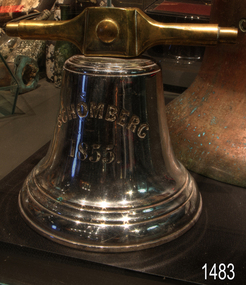
Functional object - Bell, Schomberg 1855, Before 1855
... landing spot for the passengers. The scouting party advised Forbes to wait until morning, as rough seas posed a danger to the lifeboats. At dawn, the ship’s Chief Officer spotted the SS Queen and signalled for help. The master of the Queen brought his vessel alongside, and all passengers and crew disembarked safely. The Black Ball Line’s Melbourne agent sent another steamer to collect the passengers’ baggage, and other steamers assisted with cargo salvage until worsening weather forced...landing spot for the passengers. The scouting party advised Forbes to wait until morning, as rough seas posed a danger to the lifeboats. At dawn, the ship’s Chief Officer spotted the SS Queen and signalled for help. The master of the Queen brought his vessel alongside, and all passengers and crew disembarked safely. The Black Ball Line’s Melbourne agent sent another steamer to collect the passengers’ baggage, and other steamers assisted with cargo salvage until worsening weather forced ...The Rescue and Journey of the Schomberg Bells: This bell was the smaller of two rescued by the crew of the Schomberg following the ship’s wreck in 1855. While the specific purpose of the smaller bell is unknown, it may have served to assemble the crew or signal mealtimes on board. After surviving the shipwreck, the crew carried both bells as they made their way along the coastline. Their journey eventually led them to the home of settler John Manning, located at Hopkins Point near Warrnambool. Manning took possession of the bells and subsequently presented them to two churches in Warrnambool. The smaller bell went to St Joseph’s Catholic Church, while the larger bell went to St John’s Presbyterian Church. After around a year, the small bell at St Joseph’s developed a crack and became unusable. Thomas Manifold imported a replacement bell for the church, and the damaged bell was stored at his farm. Years later, when the property was sold to John Logan, the discarded bell was donated to the old Warrnambool Museum upon its opening in 1886. The Curator, Joseph Archibald, placed the bell on display in the entry. In 1975, it was transferred from the Warrnambool Art Gallery to Flagstaff Hill. The ’Mystery’ of the small bell solved: Despite numerous attempts by the staff at Flagstaff Hill to restore the bell’s lustre, the bell remained dull and tarnished. In October 1986, Director Peter Ronald decided to send the bell for professional advice. The bell was entrusted to Briggs Marine Products, a renowned brass founder established in 1912. Upon examination, the specialists at Briggs discovered the reason behind the bell’s persistent lack of shine: it had originally been silver-plated, but most of the plating had worn away over time. The experts at Briggs then undertook the task of restoring the bell, successfully returning it to a gleaming silver surface. The Sailing Ship Schomberg: Launched in 1855, the Schomberg was regarded as the “Noblest” ship afloat at the time. Owned by the Black Ball Line, it was built for their passenger fleet by Alexander Hall of Aberdeen at a cost of £43,103. The construction featured three skins: one planked fore and aft and two diagonally planked, all fastened with screw-threaded trunnels (wooden rails). The ship’s First Class accommodation was luxurious, boasting velvet pile carpets, large mirrors, rosewood, birds-eye maple and mahogany timbers, satin damask soft furnishings, and an oak-lined library with a piano. Schomberg had a capacity for 1,000 passengers. The ship’s master, Captain James Nicol Forbes—also known as ‘Bully’ Forbes—was only 34 years old at the launch. He had a reputation for setting and breaking speed records on the Black Ball Line’s Marco Polo and Lightning. In 1852, Forbes completed the London to Melbourne journey on the Marco Polo in 68 days, a record at the time, though 53 passengers died during the voyage. In 1854, he sailed the Lightning to Melbourne in 76 days and returned in only 63 days—a record that stood among sailing ships. Forbes was known for driving his ship and crew to their limits, often prioritising speed over passenger comfort. Determined to set new records, he promised to reach Melbourne in sixty days, declaring he would do so “with or without the help of God.” The Maiden Voyage and the Wreck: Schomberg departed Liverpool on 6th October 1855, flying a banner that read “Sixty Days to Melbourne”. The vessel carried 430 passengers and 3,000 tons of cargo, including materials to build the Melbourne to Geelong Railway and a bridge over the Yarra River. Among the cargo were a cow for fresh milk, pens for fowls and pigs, and 90,000 gallons of water for drinking and washing. Additionally, it transported 17,000 letters and 31,800 newspapers. The ship and cargo were insured for $300,000, a considerable sum for the era. Poor winds while crossing the equator delayed Schomberg’s progress. Land was first sighted on Christmas Day at Cape Bridgewater near Portland. Captain Forbes followed the coastline towards Melbourne, but was reportedly playing cards when the third mate, Henry Keen, reported land only three miles away. The ship ran aground on a sand spit near Curdie’s Inlet (approximately 56 km west of Cape Otway) on 26th December 1855, after 78 days at sea. The sand spit and nearby currents were not marked on Forbes’s map. During the night, the crew launched a lifeboat to search for a safe landing spot for the passengers. The scouting party advised Forbes to wait until morning, as rough seas posed a danger to the lifeboats. At dawn, the ship’s Chief Officer spotted the SS Queen and signalled for help. The master of the Queen brought his vessel alongside, and all passengers and crew disembarked safely. The Black Ball Line’s Melbourne agent sent another steamer to collect the passengers’ baggage, and other steamers assisted with cargo salvage until worsening weather forced operations to cease. Notably, a plunderer later recovered a case of Wellington boots, but all were for the left foot. The wreck and its cargo were sold to local merchants Manifold & Bostock, who did not attempt further salvage. They later sold their interest to a Melbourne businessman and two seafarers. In 1864, after two men drowned in their attempt to reach the Schomberg, salvage efforts were abandoned. By 1870, parts of the ship had washed ashore on New Zealand’s South Island. Today, the wreck is about nine metres below the surface. Although most woodwork has disintegrated, the vessel’s shape remains discernible due to the railway irons, girders, and framework. Various goods and materials from the ship are scattered nearby. The bell is particularly significant in that along with other items from the wreck helped in part to having the legislation changed to protect shipwrecks, with far tighter controls being employed to oversee the salvaging of wreck sites. This bell forms part of the Schomberg collection at Flagstaff Hill maritime museum. The collection as a whole is of historical and archaeological significance at a State level. Flagstaff Hill’s collection of artefacts from the Schomberg is also significant for its association with the Victorian Heritage Registered Schomberg shipwreck (VHR S 612). The collection is of additional significance because of the relationship between the objects salvaged, as together they help us to interpret the story of the Schomberg. The collection as a whole is historically significant for representing aspects of Victoria's maritime history and its potential to interpret social and historical themes from society at the time of the wreck. A small ship’s bell. The silver-plated metal bell bears the ship’s name and year of construction on one side and the name and address of the ship’s builders on the other. These details are deeply engraved into the metal and formed in bold, upper-case lettering. The bell has two bell stands: the left and the right. Both stands have an Iron pipe bent into an inverted ‘Y’ shape, with a hole along its length and feet attached to a rectangular metal plate at the other two ends. Feet are bolted to a timber base that has a hole drilled through the centre for mounting. Bell's front; “SCHOMBERG” with “1855” below. Bell's back “HALL & SONS (crack splits letter “N”) / BUILDERS (in italics) / ABERDEEN” (crack splits letter “B”).flagstaff hill, flagstaff hill maritime museum and village, warrnambool, maritime museum, maritime village, great ocean road, shipwreck coast, schomberg, silver plated bell, mess bell, bell stands, captain ‘bully’ forbes, alexander hall and son, james baines and company, liverpool’s black ball line, bell, schomberg bell, ship's bell, small bell, st joseph's church, briggs marine, john manning, john logan, warrnambool museum, briggs foundry, silver bell -
 National Vietnam Veterans Museum (NVVM)
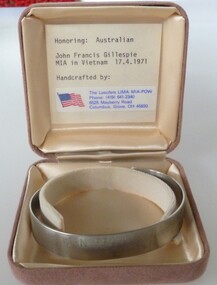
Ceremorial Object - MIA Bracelet - L/Cpl John Francis Gillespie, The Laeufers LIMA MIA-POW
... landing zone. The caves and dense timber of the Long Hais had long harboured a major Viet Cong base area and the dustoff operation required the protection of helicopter gunships. As the first wounded soldier was being winched up, the hovering helicopter was hit by enemy machine-gun fire. It crashed to the ground and burst into flames. Although the crew escaped, Lance Corporal Gillespie and three other soldiers were engulfed in the fireball. A helicopter crewman, Corporal Robert Stephens, repeatedly entered the burning aircraft and tried in vain to rescue Gillespie, until being forced...landing zone. The caves and dense timber of the Long Hais had long harboured a major Viet Cong base area and the dustoff operation required the protection of helicopter gunships. As the first wounded soldier was being winched up, the hovering helicopter was hit by enemy machine-gun fire. It crashed to the ground and burst into flames. Although the crew escaped, Lance Corporal Gillespie and three other soldiers were engulfed in the fireball. A helicopter crewman, Corporal Robert Stephens, repeatedly entered the burning aircraft and tried in vain to rescue Gillespie, until being forced ...The last Australian soldier to be listed as missing in action was Lance Corporal John Francis Gillespie of 8 Field Ambulance. On 17 April 1971 Gillespie was serving as a helicopter medic during a 'dustoff' (helicopter medical evacuation) operation in the Long Hai hills in Phuoc Tuy province. Four South Vietnamese Regional Force soldiers had been injured by a mine explosion and the difficult terrain demanded a helicopter evacuation. But the Long Hai hills were an insecure landing zone. The caves and dense timber of the Long Hais had long harboured a major Viet Cong base area and the dustoff operation required the protection of helicopter gunships. As the first wounded soldier was being winched up, the hovering helicopter was hit by enemy machine-gun fire. It crashed to the ground and burst into flames. Although the crew escaped, Lance Corporal Gillespie and three other soldiers were engulfed in the fireball. A helicopter crewman, Corporal Robert Stephens, repeatedly entered the burning aircraft and tried in vain to rescue Gillespie, until being forced back by the flames. Stephens was later awarded the British Empire Medal for his courage. Gillespie's body could not be recovered from the burning wreckage which was reduced to slag by the fire. Private Gillespie was listed as missing in action, apparently on a technicality because his remains could not be found. The classification was subsequently altered to killed in action.Stainless steel open ended bracelet with missing serviceman's full name and date missing. In a buff square satin lined box.MIA John Francis Gillespie 17/04/71mia, john francis gillespie, l/cpl john francis gillespie, 3170244, royal australian army medical corps, 8th field ambulance, cpl robert stephens, killed in action -
Moorabbin Air Museum
Book - Aviation training, Flight Training
... Aviation training Flight training Flight preparation & familiarisation Effects of controls Straight & level Climbing Descending Turns Stalling Take offs & landings Low flying Forced landings Instrument flying Pilot navigation & map reading Night flying Flight instructor's briefing notes & student's guide to flight training, circa 1977 Flight Training Book Aviation training ...Flight instructor's briefing notes & student's guide to flight training, circa 1977non-fictionFlight instructor's briefing notes & student's guide to flight training, circa 1977flight training, flight preparation & familiarisation, effects of controls, straight & level, climbing, descending, turns, stalling, take offs & landings, low flying, forced landings, instrument flying, pilot navigation & map reading, night flying -
Moorabbin Air Museum
Book - Flight briefings, Flight Briefing for Pilots 1
... Flight training Familiarization with aircraft Preparation Air experience Effects of controls Taxying Straight & level flight Climbing Descending Turning Stalling Spinning Take off & ciruits Forced landings Navigation Instrument approach Introductory manual of flying training with air instruction, circa 1978 Flight Briefing for Pilots 1 Book Flight briefings ...Introductory manual of flying training with air instruction, circa 1978non-fictionIntroductory manual of flying training with air instruction, circa 1978familiarization with aircraft, preparation, air experience, effects of controls, taxying, straight & level flight, climbing, descending, turning, stalling, spinning, take off & ciruits, forced landings, navigation, instrument approach -
Moorabbin Air Museum
Booklet - Private pilot training, Flying Training (Pre-flight Briefings to Cover the Complete Private Pilot Syllabus)
... Private pilot training Preparation Handling the propeller Taxying Controls Straight & level flight Climbing Descending Turning Stalling Circuits Forced landings Glide approach Crosswind circuits Fire drill Instrument flying Study reference for private pilots circa 1977 Flying Training (Pre-flight Briefings to Cover the Complete Private Pilot Syllabus) Booklet Private pilot training ...Study reference for private pilots circa 1977non-fictionStudy reference for private pilots circa 1977preparation, handling the propeller, taxying, controls, straight & level flight, climbing, descending, turning, stalling, circuits, forced landings, glide approach, crosswind circuits, fire drill, instrument flying -
Moorabbin Air Museum
Manual - Ansett Boeing 767 operating manuals, Boeing 767 Operating Manual Chapter 3 Non-Normal Procedures February 1986
... Ansett Boeing 767 operating manuals Engine failure & fires Air conditioning/pressurisation & pneumatics APU & engines Autoflight Communications Flight instruments & navigation Cargo fire Evacuation Bomb threats & unlawful seizure Forced landings & ditching Fuel Ice & rain Warning systems Abnormal flight patterns & maneuvers Overview of procedures for dealing with abnormal situations, circa 1986 Spiral bound book form manual Boeing 767 Operating Manual Chapter 3 Non-Normal Procedures February 1986 Manual Ansett Boeing 767 operating manuals ...Overview of procedures for dealing with abnormal situations, circa 1986Spiral bound book form manualnon-fictionOverview of procedures for dealing with abnormal situations, circa 1986engine failure & fires, air conditioning/pressurisation & pneumatics, apu & engines, autoflight, communications, flight instruments & navigation, cargo fire, evacuation, bomb threats & unlawful seizure, forced landings & ditching, fuel, ice & rain, warning systems, abnormal flight patterns & maneuvers -
Moorabbin Air Museum
Manual - Boeing 767 operating manuals, Boeing 767 Operating Manual Volume 1 Chapter 3 Non-Normal Procedures December 1993
... Boeing 767 operating manuals Engine failure & fires Air conditioning/pressurisation & pneumatics APU & engines Autoflight Communications Flight instruments & navigation Bomb threats & unlawful seizure Forced landings & ditching Electrical Ice & rain protection Abnormal flight patterns & maneuvers Overview of procedures for coping with abnormal situations , circa 1993 Spiral bound book type manual Boeing 767 Operating Manual Volume 1 Chapter 3 Non-Normal Procedures December 1993 Manual Boeing 767 operating manuals ...Overview of procedures for coping with abnormal situations , circa 1993Spiral bound book type manualnon-fictionOverview of procedures for coping with abnormal situations , circa 1993engine failure & fires, air conditioning/pressurisation & pneumatics, apu & engines, autoflight, communications, flight instruments & navigation, bomb threats & unlawful seizure, forced landings & ditching, electrical, ice & rain protection, abnormal flight patterns & maneuvers -
Moorabbin Air Museum
Manual - Ansett Boeing 727 operating manuals, Boeing 727 Operating Manual Section 4 Emergency & Abnormal Procedures April 1988
... Landing Gear...Pneumatics...Air conditioning & pressurization...Fuselage fires...Cockpit window failure...Door lights...Abnormal or forced...Ansett Boeing 727 operations manual Engine failure & fires Fuel Electrical Hydraulics Flight controls Landing Gear Pneumatics Air conditioning & pressurization Fuselage fires Cockpit window failure Door lights Abnormal or forced landings Passenger evacuation Ditching Emergency descent & landing Emergency equipment Overview of emergency & abnormal flight procedures in Boeing 727, circa 1988 Spiral bound book type manual Boeing 727 Operating Manual Section 4 Emergency & Abnormal Procedures April 1988 Manual Ansett Boeing 727 operating manuals ...Overview of emergency & abnormal flight procedures in Boeing 727, circa 1988Spiral bound book type manual non-fictionOverview of emergency & abnormal flight procedures in Boeing 727, circa 1988engine failure & fires, fuel, electrical, hydraulics, flight controls, landing gear, pneumatics, air conditioning & pressurization, fuselage fires, cockpit window failure, door lights, abnormal or forced landings, passenger evacuation, ditching, emergency descent & landing, emergency equipment -
Moorabbin Air Museum
Book - Flight training - general aviation, The Flying Training Manual
... landing...First solo...Steep turns & unusual attitudes...Forced...Flight training - general aviation Aircraft familiarization Flight preparation & communications Engine operations / taxiing & post flight actions Aircraft control Straight & level flight Climbing Descending Turning Low speed flight & stalling Spinning Approach and landing First solo Steep turns & unusual attitudes Forced landings & side slipping Advanced take off & landing Low level flying Navigation Precautionary search & landing Instrument flight Flight training overview , circa 2004 The Flying Training Manual Book Flight training - general aviation ...Flight training overview , circa 2004non-fictionFlight training overview , circa 2004aircraft familiarization, flight preparation & communications, engine operations / taxiing & post flight actions, aircraft control, straight & level flight, climbing, descending, turning, low speed flight & stalling, spinning, approach and landing, first solo, steep turns & unusual attitudes, forced landings & side slipping, advanced take off & landing, low level flying, navigation, precautionary search & landing, instrument flight -
Moorabbin Air Museum
Book - Flight training, Let's Learn to Fly
... landing...Control of the approach path...Spinning...Forced...Flight training The sea of air The four forces Turning Climbing & descending Straight & level flight Stalling Air speed & ground speed Take off & landing Control of the approach path Spinning Forced landings The first solo flight Overview of the principles of flight for pupils, circa 1956 Let's Learn to Fly Book Flight training ...Overview of the principles of flight for pupils, circa 1956non-fictionOverview of the principles of flight for pupils, circa 1956the sea of air, the four forces, turning, climbing & descending, straight & level flight, stalling, air speed & ground speed, take off & landing, control of the approach path, spinning, forced landings, the first solo flight -
 Ballarat Heritage Services
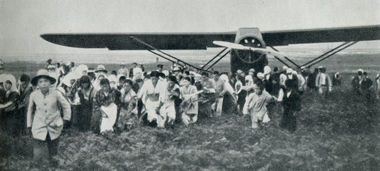
Image - Black and White, Fisher-folk haul a plan to a take-off after a forced landing on a sandhill
... Fisher-folk haul a plan to a take-off after a forced landing on a sandhill...Fisher-folk haul a plan to a take-off after a forced landing on a sandhill Image - Black and White ...An early aeroplane taking off from a sandhill.flight, aeroplane, fisher-folk, pioneer aviation
