
Showing 93 items matching "furniture and finishes."
-
 Bialik College
Textile - Fabric swatches for library redevelopment, 2009-2010, 2009-2010
... Fabric samples and options for library redevelopment, Ron Unger Architects with Genevieve Johnstone Interior Design, 2009-2010. Includes furniture fabrics and internal finishes samples. ...Fabric samples and options for library redevelopment, Ron Unger Architects with Genevieve Johnstone Interior Design, 2009-2010. Includes furniture fabrics and internal finishes samples. ...Fabric samples and options for library redevelopment, Ron Unger Architects with Genevieve Johnstone Interior Design, 2009-2010. Includes furniture fabrics and internal finishes samples. Please contact [email protected] to request access to this record.2000s, buildings -
 Flagstaff Hill Maritime Museum and Village
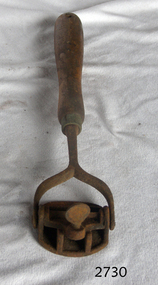
Tool - Cabinet Scraper, 1945-1955
... A cabinet scraper (sometimes called a ‘card scraper’) is a woodworking tool used for shaping and finishing furniture. The name ‘cabinet’ is used because scrapers are versatile and important tools for cabinet makers to provide a smooth surface to a finished cabinet. ...A cabinet scraper (sometimes called a ‘card scraper’) is a woodworking tool used for shaping and finishing furniture. The name ‘cabinet’ is used because scrapers are versatile and important tools for cabinet makers to provide a smooth surface to a finished cabinet. ...A cabinet scraper (sometimes called a ‘card scraper’) is a woodworking tool used for shaping and finishing furniture. The name ‘cabinet’ is used because scrapers are versatile and important tools for cabinet makers to provide a smooth surface to a finished cabinet. The body and the cutting edges of most cabinet scrapers are formed from a single piece of material. The blades are created on each edge of the body. Also, a scraper can have adjustable blades and a wooden handle these are two-handled cabinet scrapers. Cabinet scrapers are used manually to scrape small amounts of material from the surface of the wood to smooth it, shape it, or remove an old finish such as varnish from its surface. They are commonly used on furniture and musical instruments such as guitars and violins. The tools can be used on hardwood or softwood but when using a cabinet scraper on any wood, you should generally work along the grain.A tool used to finish timber to give a smooth finish and a important tool for a cabinet maker that has been in use for many hundreds of years in different design formsBox scraper adjustable with long wooden handle.Noneflagstaff hill, warrnambool, flagstaff hill maritime museum, maritime museum, shipwreck coast, flagstaff hill maritime village, great ocean road, box scraper, scraper, woodwork tool, cabinet scraper, furniture finishing -
 Melbourne Tram Museum
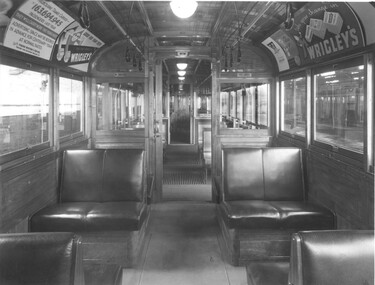
Photograph - interior of tram W4 671, c1940
... Possibly a MMTB Official photograph showing the seating layout and the interior finishes. Has internal adverts for Frank Mason for advertising on tramcars, Wrigley's chewing gum, No-dusta furniture polish and small advert for possibly a lottery of 100,000 pounds prize. ...Possibly a MMTB Official photograph showing the seating layout and the interior finishes. Has internal adverts for Frank Mason for advertising on tramcars, Wrigley's chewing gum, No-dusta furniture polish and small advert for possibly a lottery of 100,000 pounds prize. ...Photograph shows the interior of W4 class, tram 671 at a depot. Possibly a MMTB Official photograph showing the seating layout and the interior finishes. Has internal adverts for Frank Mason for advertising on tramcars, Wrigley's chewing gum, No-dusta furniture polish and small advert for possibly a lottery of 100,000 pounds prize. The tram is now part of the Ballarat Tramway Museum operational collection.Yields information about the interior of tram 671. Black and White photograph, with a piece of card glued to the rear.tramcars, w4 class, tram 671, advertisements -
 Flagstaff Hill Maritime Museum and Village
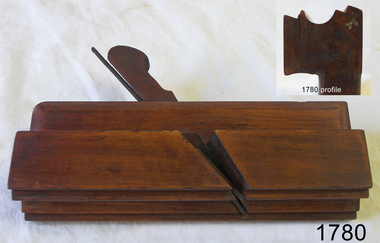
Tool - Complex Moulding Plane, Joseph Gleave & Sons, Late 19th to Early 20th Century
... A vintage tool made by a known maker, this item was made commercially for firms and individuals that worked in wood and needed a tool that could produce an ornamental finish to timber. The tool was used before routers and spindle moulders came into general use after World War ll, a time when to produce a decorative moulding for a piece of furniture, door trims, etc. or other items had to be accomplished using hand tools and in particular one of these types of planes. ...It gives us a snapshot of how furniture and other decorative finishes were created on timber by the use of hand tools. ...Joseph Gleave & Sons was working as a plane maker in Manchester from 1832 and was at Oldham Street from 1854 to 1868 and (as Joseph Gleave & Son) from 1868 to 1913. The company made complex wood planes of which the subject item is an early example. The company sold tools from other makers as well and was based in Oldham Street Manchester. Since that time the company has adapted and mutated and is still buying and selling tools and industrial supplies to this day. However the company stopped making complex wood planes in 1926. A vintage tool made by a known maker, this item was made commercially for firms and individuals that worked in wood and needed a tool that could produce an ornamental finish to timber. The tool was used before routers and spindle moulders came into general use after World War ll, a time when to produce a decorative moulding for a piece of furniture, door trims, etc. or other items had to be accomplished using hand tools and in particular one of these types of planes. These profiled planes came in various shapes and sizes to achieve a decorative finish.A significant tool from the late 19th to early 20th century that today is quite rare and sought after by collectors. It gives us a snapshot of how furniture and other decorative finishes were created on timber by the use of hand tools. Tools that were themselves handmade shows the craftsmanship used during this time not only to make a tool such as the subject item but also the craftsmanship needed to produce a decorative finish that was needed to be made for any decorative timber item.Complex Moulding Plane, Torus Bead. Stamped J. Gleave (Maker), No 7 & T. Moody (owner)flagstaff hill, warrnambool, flagstaff-hill, flagstaff-hill-maritime-museum, maritime-museum, shipwreck-coast, flagstaff-hill-maritime-village, josphe, joseph gleave & sons, complex plane makers, carpenders tools, woodworking tool -
 Sunshine and District Historical Society Incorporated
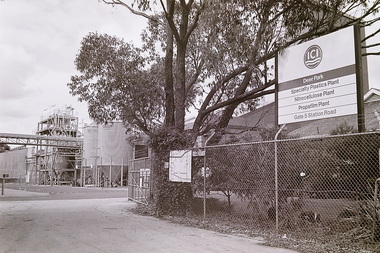
Photograph - I.C.I. Nitrocellulose Plant Station Road Entrance Deer Park 1989 Photograph, C. McGee, 14th April 1989
... It was used for Explosives (historical origin of the Deer Park site), Aircraft fabric dope (WWI–WWII aviation coatings), Waterproof cloth and coated textiles and Leathercloth (ICI’s trade name for nitrocellulose‑coated fabric used in cars, furniture, bags, and industrial goods). The Station Road plant specialised in the nitrocellulose coating and finishing processes, not explosives manufacture....It was used for Explosives (historical origin of the Deer Park site), Aircraft fabric dope (WWI–WWII aviation coatings), Waterproof cloth and coated textiles and Leathercloth (ICI’s trade name for nitrocellulose‑coated fabric used in cars, furniture, bags, and industrial goods). The Station Road plant specialised in the nitrocellulose coating and finishing processes, not explosives manufacture. ...The I.C.I. Nitrocellulose Plant on Station Road, Deer Park was part of the ICI Leathercloth Factory, a major industrial complex producing nitrocellulose‑based coated fabrics “Leathercloth”. It operated as a specialised chemical works linked to explosives, aircraft fabric coatings, and waterproof materials. Nitrocellulose (guncotton reacted with nitric acid) was one of the earliest multi‑use synthetic materials. It was used for Explosives (historical origin of the Deer Park site), Aircraft fabric dope (WWI–WWII aviation coatings), Waterproof cloth and coated textiles and Leathercloth (ICI’s trade name for nitrocellulose‑coated fabric used in cars, furniture, bags, and industrial goods). The Station Road plant specialised in the nitrocellulose coating and finishing processes, not explosives manufacture.The history of the Nitrocellulose Plant is tightly connected to the evolution of the Deer Park explosives precinct and the wider ICI industrial township.I.C.I. Nitrocellulose Plant Station Road Deer Park 893.1i.c.i., station road, deer park -
 Flagstaff Hill Maritime Museum and Village
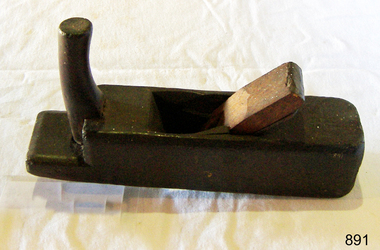
Tool - Wood Smoothing Plane, Late 18th to Early 19th Century
... A block, jack or smoothing plane is used for making a smooth finish to timber that is used to make furniture or other wooden objects. ...A block, jack or smoothing plane is used for making a smooth finish to timber that is used to make furniture or other wooden objects. ...A block, jack or smoothing plane is used for making a smooth finish to timber that is used to make furniture or other wooden objects. Traditionally, wood planes were blocks of wear-resistant hardwood, often beech or maple, which were worked to the intended shape of the item being worked on. The blade or iron was likewise formed to a flat shape and secured in the body of the plane with a wooden wedge. A traditional cabinetmakers' shop might have many, perhaps hundreds, of smoothing and moulding planes for the full range of work to be performed. Large crown mouldings required planes of six or more inches in width, which demanded great strength to push and often had additional peg handles on the sides, allowing the craftsman's apprentice or other workers to pull the plane ahead of the master who guided it. A vintage tool by an unknown maker, this item was made for cabinet-making firms and individuals that worked in wood and needed a tool that could remove large amounts of timber. These jack, block or dressing planes as they were known came in various shapes and sizes to achieve a flat and even finish to timber surfaces before the use of mechanical smoothing planes and came in many sizes. A significant tool from the late 18th to early 19th century that's pattern or shape is still in use today. Early models of this type of woodworking plane are sought after by collectors today. This tool gives us a snapshot of how furniture and other finishes were created on timber by the use of cutting-edged hand tools used by craftsmen of the time. Tools that were themselves handmade, demonstrating the craftsmanship used during this time not only to make a tool such as the subject item but also the craftsmanship needed to produce either a decorative or even finish for timber items. Smoothing Plane blade and wedge present. Raised handle at front end. Right-hand wedge guide broken away. Noneflagstaff hill, warrnambool, flagstaff-hill, flagstaff-hill-maritime-museum, maritime-museum, shipwreck-coast, flagstaff-hill-maritime-village, plane, wood plane, cabinet makers tools, furniture making -
 Flagstaff Hill Maritime Museum and Village
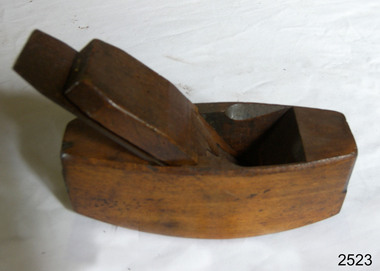
Tool - Wood smoothing plane, G Davis, 1821-1876
... A smoothing plane used for making a flat and smooth finish to timber items predominantly used in furniture or cabinet work or other wooden objects. ...A smoothing plane used for making a flat and smooth finish to timber items predominantly used in furniture or cabinet work or other wooden objects. ...A smoothing plane used for making a flat and smooth finish to timber items predominantly used in furniture or cabinet work or other wooden objects. Traditionally, planes were blocks of wear resistant hardwood, often beech or maple, which were worked to the shape of the intended moulding. The blade, or iron was likewise formed to the intended moulding profile or a flat and smooth finish with the blade secured in the body of the plane with a wooden wedge. A traditional cabinetmakers shop might have many, perhaps hundreds, of smoothing and moulding planes for the full range of work to be performed. For example large crown mouldings required planes of six or more inches in width, which demanded great strength to push and often had additional peg handles on the sides, allowing the craftsman's apprentice or other worker to pull the plane ahead of the master who guided it. All we known about George Davis is he and his successors made planes in Birmingham, England, from about 1821 to 1876. There are many of his tools including smoothing and decorative moulding planes of all sizes and designs for sale around the world and that his wood working planes are well sought after by collectors of vintage tools. A vintage tool made by a known maker, this item was made commercially for firms and individuals who worked in wood and needed a tool that could produce a smooth finish to timber. These types of planes came in various shapes and sizes to achieve the required finish. This item is a significant tool from the mid to late 19th century that today is quite rare and sought after by collectors. It gives us a snapshot of how furniture and other decorative finishes were created on timber by the use of hand tools. Smoothing plane known as a coffin plane due to it's shapeStamped GM inside W (owner) maker possibly G Davisflagstaff hill, warrnambool, shipwrecked-coast, flagstaff-hill, flagstaff-hill-maritime-museum, maritime-museum, shipwreck-coast, flagstaff-hill-maritime-village, plane, moulding, single bead reeding plane -
 Flagstaff Hill Maritime Museum and Village
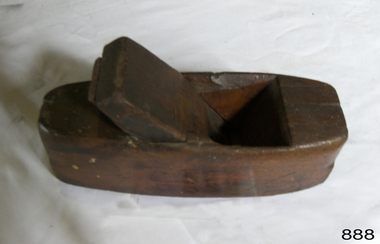
Tool - Wood smoothing plane coffin pattern, 18th to early 19th century
... This item would have been made for individuals or cabinet makers that worked in wood and needed a tool that could produce a flat smooth finish to timber. These tools were used before routers and spindle moulders came into use in the late 19th and early 20th centuries before this time producing either a decorative moulding or a smooth finish to furniture timber, door trims etc had to be accomplished using hand planing tools and in particular one of these types of planes. ...It gives us a snapshot of how furniture and other decorative finishes were created on timber by the use of hand tools. ...Being smaller than other bench planes, the coffin-shaped smoothing plane is better able to work on smaller work pieces and around obstructions. Since the 1700s wooden smoothing planes have predominantly been 'coffin shaped' wider in the middle and slightly rounded making them more manoeuvrable. A vintage tool made by an unknown 18th or early 19th-century woodworking tool maker. This item would have been made for individuals or cabinet makers that worked in wood and needed a tool that could produce a flat smooth finish to timber. These tools were used before routers and spindle moulders came into use in the late 19th and early 20th centuries before this time producing either a decorative moulding or a smooth finish to furniture timber, door trims etc had to be accomplished using hand planing tools and in particular one of these types of planes. Traditionally wood planes were blocks of wear-resistant hardwood, often beech or maple, which were worked to the shape of the intended moulding or had a flat blade used for achieving a flat and smooth finish to timber. The blade or iron was likewise formed to the intended moulding profile or for smoothing and secured in the body of the plane with a wooden wedge. A traditional cabinetmakers' shop might have many, perhaps hundreds, of moulding and flat-bladed planes for a full range of work to be performed. Large crown mouldings required planes of six or more inches in width, which demanded great strength to push and often had additional peg handles on the sides, allowing the craftsman's apprentice or other workers to pull the plane ahead of the master who guided it. These vintage planes are well sought after by collectors of antique tools due to their rarity. A significant tool from the 18th to early 19th century by an unknown maker that today is quite rare and sought after by collectors. It gives us a snapshot of how furniture and other decorative finishes were created on timber by the use of hand tools. Tools that were themselves handmade show the craftsmanship used during this time not only to make a tool such as the subject item but also the craftsmanship needed to produce a decorative finish that was needed to be made for any timber furniture item. Smoothing Plane Coffin type. Stamped GM inside "W" indicating sizeflagstaff hill, warrnambool, shipwrecked-coast, flagstaff-hill, flagstaff-hill-maritime-museum, maritime-museum, shipwreck-coast, flagstaff-hill-maritime-village -
 Flagstaff Hill Maritime Museum and Village
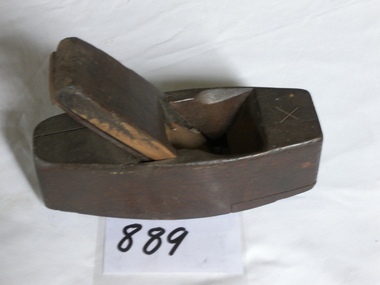
Tool - Smoothing Wood Plane Coffin Pattern, 18th to Early 19th Centuries
... This item would have been made for individuals or cabinet makers that worked in wood and needed a tool that could produce a flat smooth finish to timber. These tools were used before routers and spindle moulders came into use in the late 19th and early 20th centuries before this time to produce either a decorative moulding or a smooth finish to furniture timber, door trims etc had to be accomplished using hand planing tools and in particular one of these types of planes. ...It gives us a snapshot of how furniture and other decorative finishes were created on timber by the use of hand tools. ...Being smaller than other bench planes, the coffin shaped smoothing plane is better able to work on smaller work pieces and around obstructions. Since the 1700s wooden smoothing planes have predominantly been 'coffin shaped' wider in the middle and slightly rounded making them more manoeuvrable. A vintage tool made by an unknown 18th or early 19th century woodworking tool maker. This item would have been made for individuals or cabinet makers that worked in wood and needed a tool that could produce a flat smooth finish to timber. These tools were used before routers and spindle moulders came into use in the late 19th and early 20th centuries before this time to produce either a decorative moulding or a smooth finish to furniture timber, door trims etc had to be accomplished using hand planing tools and in particular one of these types of planes. Traditionally wood planes were blocks of wear resistant hardwood, often beech or maple, which were worked to the shape of the intended moulding or had a flat blade use for achieving a flat and smooth finish to timber. The blade, or iron was likewise formed to the intended moulding profile or for smoothing and secured in the body of the plane with a wooden wedge. A traditional cabinetmakers shop might have many, perhaps hundreds, of moulding and flat bladed planes for a full range of work to be performed. Large crown mouldings required planes of six or more inches in width, which demanded great strength to push and often had additional peg handles on the sides, allowing the craftsman's apprentice or other worker to pull the plane ahead of the master who guided it. These vintage planes are well sought after by collectors of antique tools due to their rarity. A significant tool from the 18th to early 19th century that today is quite rare and sought after by collectors. It gives us a snapshot of how furniture and other decorative finishes were created on timber by the use of hand tools. Tools that were themselves hand made shows the craftsmanship used during this time not only to make a tool such as the subject item but also the craftsmanship needed to produce a decorative finish that was needed to be made for any timber furniture item. Wood smoothing plane known as a coffin plane due to it's shape, wood insert screwed on front of base. Stamped "MILLER". Inscribed "X" (probably the size)flagstaff hill, warrnambool, flagstaff-hill, flagstaff-hill-maritime-museum, maritime-museum, shipwreck-coast, flagstaff-hill-maritime-village, cabinet makers tools, woodworking tools, wood plane, smoothing plane, timber finishing, furniture manufacture -
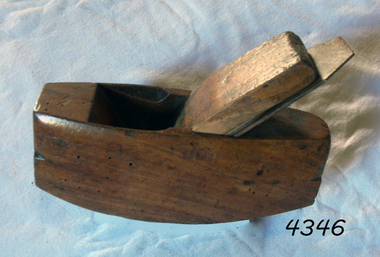 Flagstaff Hill Maritime Museum and Village
Tool - Smoothing Wood Plane, John Welsh & Co, 1845-1850
... This item would have been made commercially for firms and individuals that worked in wood and needed a tool that could produce a flat smooth finish to timber. These tools were used before routers and spindle moulders came into use in the late 19th and early 20th centuries before this time to produce a decorative moulding or to smooth a piece of furniture timber, door trims etc. had to be accomplished using hand tools and in particular one of these types of planes. ...It gives us a snapshot of how furniture and other decorative finishes were created on timber by the use of hand tools. ...A vintage tool made by a obscure early 19th century woodworking Scottish tool maker. This item would have been made commercially for firms and individuals that worked in wood and needed a tool that could produce a flat smooth finish to timber. These tools were used before routers and spindle moulders came into use in the late 19th and early 20th centuries before this time to produce a decorative moulding or to smooth a piece of furniture timber, door trims etc. had to be accomplished using hand tools and in particular one of these types of planes. The subject item is a smoothing plane Known as a Coffin Plane due to its shape. Traditionally wood planes were blocks of wear resistant hardwood, often beech or maple, which were worked to the shape of the intended moulding or had a flat blade use for achieving a flat and smooth finish to timber. The blade, or iron was likewise formed to the intended moulding profile or for smoothing and secured in the body of the plane with a wooden wedge. A traditional cabinetmakers shop might have many, perhaps hundreds, of moulding and flat bladed planes for a full range of work to be performed. Large crown mouldings required planes of six or more inches in width, which demanded great strength to push and often had additional peg handles on the sides, allowing the craftsman's apprentice or other worker to pull the plane ahead of the master who guided it. All we known about John Welsh is that he was a tool maker and possibly a retailer that operated a business in Dundee Scotland between 1845-1850. This is the only record we have to date that he existed and is from the Master Catalogue of Scottish woodworking tool makers. His tools in particular moulding planes are well sought after by collectors of vintage tools due to their rarity. A significant tool from the mid to late 19th century that today is quite rare and sought after by collectors. It gives us a snapshot of how furniture and other decorative finishes were created on timber by the use of hand tools. Tools that were themselves handmade shows the craftsmanship used during this time not only to make a tool such as the subject item but also the craftsmanship needed to produce a decorative finish that was needed to be made for any timber item. Wood Plane Rounded base, blade attached. Owner J Huband Marked J Welsh, Dundee maker and "J Huband" (Owner)flagstaff hill, warrnambool, shipwrecked coast, flagstaff hill maritime museum, maritime museum, shipwreck coast, flagstaff hill maritime village, great ocean road, plane, compass plane, j welsh, j huband -
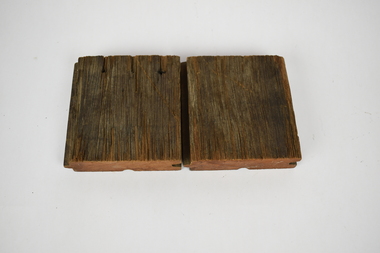 National Wool Museum
Functional object - Floorboards, 1994
... Bright colours and industrial finishes identify the new insertions....Bright colours and industrial finishes identify the new insertions. Deakin University Dalgety Wool Store Red Gum Square sections of redgum lumber cut into floorboards. ...Two short sections of flooring cut for distribution during Deakin Universities ‘Open Day’ in December 1994. This was during the conversion of Dalgety Wool Store to Deakin University’s Woolstore Campus. These small pieces of timber are part of Geelong’s history and were salvaged from the Dalgety Woolstores during the renovations. Hundred of meters of ironbark, red gum, pine and other timbers, some more than a century old, were reclaimed from the site and have been recycled as furniture and featured building materials for the woolstore campus. The old brick stores, located on a formerly neglected section of the Corio Bay shoreline, now house the administration and chancellery, architecture and building schools, information technology services, the student union, a cafeteria and, as the focal facility, a Great Hall seating 1500 people and acoustically tuned for symphony orchestras. The refit was developed from the existing grid of substantial timber columns and beams extending over 52,000 square metres. This framework was filled with lightweight panels to enclose workplaces and removed in some parts to establish courtyards, atriums and streets. The brick facades were redefined with new doors and double-glazed windows in proportion to original fenestration. Bright colours and industrial finishes identify the new insertions.Square sections of redgum lumber cut into floorboards. The sides of the lumber have a grove cut on one side and a matching section to fit within this groove on the other side. This has been done to ensure the floorboards have a tight and consistent fit with one another. The bottom of the lumber also has an additional grove running through the middle of the redgum. On top, one of the sections of lumber has three nail holes, which travel all the way through to the bottom of the wood.deakin university, dalgety wool store, red gum -
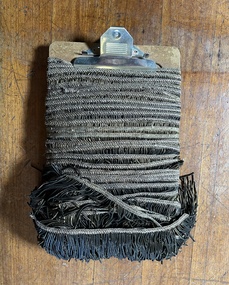 Villa Alba Museum
Decorative object - Gilt metal fringe for furnishings - detached
... Board wrapped w c.17m of heavy gilt metal fringe (known as bullion fringe) in several pieces, evidently detached from curtains, and/or furniture items. (No sign of it having been attached to the curtains). ...Interior decoration - history Board wrapped w c.17m of heavy gilt metal fringe (known as bullion fringe) in several pieces, evidently detached from curtains, and/or furniture items. (No sign of it having been attached to the curtains). ...It is not clear that this fringe was ever attached to the curtain suite; it may have come from an associated part of the original ensemble (eg pelmet) or from associated furniture. However, it is certainly connected to the fringe on the tieback tassels, whose tassels are finished with the same product. The detached gilt metal fringe has aesthetic significance as specimen of an opulent furnishing decoration in very lavish contexts, such as gold rush Victoria. Part of it still preserves the original bright gold metal, ie is untarnished; this is probably quite rare in Australian collections.Board wrapped w c.17m of heavy gilt metal fringe (known as bullion fringe) in several pieces, evidently detached from curtains, and/or furniture items. (No sign of it having been attached to the curtains). The fringe is composed of metallic thread very tightly wound over a cotton/linen thread, attached to a narrow header braid with an ornamental design worked in metallic gimp cord. The colour was originally gold, now tarnished on all parts exposed to air, but sections of the fringe under the top layers retain the luxurious gold finish. Westman (2019: 242) explains that 'gold thread' was made of gold fired onto silver bars from which thin, flat or round wires were cut to wrap around a core linen thread for use in trimmings. Shen notes that the very thin layer of gold often wears away, exposing the silver which tarnishes. Bullion fringe: fringe made of bullion, in the sense of precious metal, used for prestigious royal, ecclesiastical and military garments and furnishings. Westman (2019: 193, 240) says that by the 19thC, the name was also used for twisted thread long fringe made of wool, silk, cotton or a mix, as it is today. In this form, 'bullion fringe' became a lavish edge-trim in the early-mid-19thC wherever its vertical look could add richness to drapery. interior decoration - history -
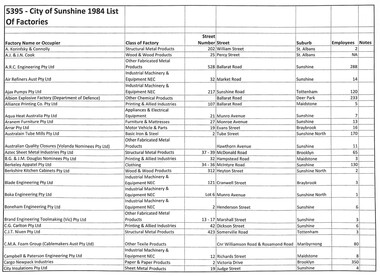 Sunshine and District Historical Society Incorporated
Archive - City of Sunshine 1984 List Of Factories, K.G. Wilson, L.R. Dryer & R.A. Scaramella, 1984
... Windows Pty Ltd K.C. Furniture & Cabinets K.D.S. Manufacturing K.M. ...Windows Pty Ltd K.C. Furniture & Cabinets K.D.S. Manufacturing K.M. ...This list of factories in the City of Sunshine is an extract from a report by K.G. Wilson, L.R. Dryer & R.A. Scaramella, prepared for the Melbourne Western Region Commission (WRC). The Melbourne Western Region Commission was a major inter‑municipal planning and advocacy body operating across Melbourne’s western suburbs in the late 1970s and 1980s. It coordinated planning, heritage studies, and regional development across multiple councils. The Commission brought together a broad sweep of western-region councils City of Altona, City of Essendon, City of Footscray, City of Keilor, City of Sunshine, City of Williamstown, Shire of Bacchus Marsh, Shire of Melton & Shire of Werribee. The Melbourne Western Region Commission was one of the most important institutional predecessors to the region’s later heritage, planning, and community‑development frameworks.This report records the business name, type of industry and address of businesses operating in the City of Sunshine in 1984.Factory Name or Occupier A. Korinfsky & Connolly A.J. & J.N. Cook A.R.C. Engineering Pty Ltd Air Refiners Aust Pty Ltd Ajax Pumps Pty Ltd Albion Explosive Factory (Department of Defence) Alliance Printing Co. Pty Ltd Aqua Heat Australia Pty Ltd Aranem Furniture Pty Ltd Arrar Pty Ltd Australain Tube Mills Pty Ltd Australian Quality Closures (Volanda Nominees Pty Ltd) Aztec Sheet Metal Industries Pty Ltd B.G. & J.M. Douglas Nominees Pty Ltd Berkeley Appatel Pty Ltd Berkshire Kitchen Cabinets Pty Ltd Blade Engineering Pty Ltd Boka Engineering Pty Ltd Boneham Engineering Pty Ltd Brand Engineering Toolmaking (Vic) Pty Ltd C.G. Carlton Pty Ltd C.J.T. Niven Pty Ltd C.M.A. Foam Group (Cablemakers Aust Pty Ltd) Campbell & Paterson Engineering Pty Ltd Cargo Newpack Industries City Insulations Pty Ltd Classic Garage Construction Cliff Poole Industries Pty Ltd Collie Cooke Consolidated Conlo Constructions Pty Ltd Connor Shea & Co. Pty Ltd Consolidated Partition Industries Holding Pty Ltd Cosmoplitan Clothing Manfacturers Crea Fashions Pty Ltd Currie Furniture Manufacturing Pty Ltd D. Richardson & Son Ltd Dalco Hardware (Dalco Pty Ltd) Daveyduke Industries (Mimvic Nominees Pty Ltd) Debora Downs Pty Ltd Deer Park Engineering Pty Ltd Deer Park Flyscreens (Azzopardi & Associates Pty Ltd) Dieselflex Pty Ltd Donald Minahan Pty Ltd Drava Continental Butchers & Smallgoods Manufacturer Drilling Equipment (Van Dyke Pty Ltd) Dunham Welding Engineering Pty Ltd E. & F. Industries Pty Ltd E.P. Morrisey & Co. Pty Ltd Elite-Built Holdings Ltd Englehold Engineering Pty Ltd Everlast Steel Products Explosive Factory (Department of Defence Support) Extruded Metals Pty Ltd Exy-Fit Screens F. & D.M. Costa Pty Ltd F. & I. Pfeffer Holdings Pty Ltd F.J. Humphrey Pty Ltd Fallshaw Holdings Pty Ltd Ferrous Forgings Pty Ltd Fleet Engineering Pty Ltd Fletcher Chemical Co. Ltd Franklin Printing & Lithographic Co. Pty Ltd Fraser Cabinets Pty Ltd G. & L. Stone Pty Ltd G.A.M. Engineering Industries Pty Ltd G.P.I. Automotive Products Pty Ltd G.U.D. Manufacturing Co. Pty Ltd G.W. Gregory Engineering (Aust) Pty Ltd General Printing Ink (Aust) Pty Ltd George Press Pty Ltd Griffiths & Beeren Pty Ltd Gubbata Nominess Pty Ltd Harkrome Electroplaters Pty Ltd Hills & Mason Pty Ltd Hydraulic Equipment & Cylinder Service Pty Ltd Hy-Du-Ex I.C.I. Australia Operations Pty Ltd I.H. Mono & Co. Idea General Engineering Industrial Engineering Invicta Group Industries Pty Ltd K. & B. Windows Pty Ltd K.C. Furniture & Cabinets K.D.S. Manufacturing K.M. Tubular Industries (Aust) Pty Ltd K.P.T. Clothing Manufacturers (K.T.P. Fashions Pty Ltd) Kanga Engineering Pty Ltd Keilor Footwear Pty Ltd Kelgrif Patterns Pty Ltd Klipspringer Pty Ltd Krueger Transports Equipment Pty Ltd Langmar Pty Ltd Layton Granite Industries Pty Ltd Lesvos General Products (Gabbia Pty Ltd) Lewis Foundry Lysaght Durham Chemical Company (Austram Corporation Ltd) M.C.I. (Aust) Pty Ltd M.J. Billings M.S.M. Cabinets Pty Ltd Maidstone Cabinet Works Marble Art Company Marib Cutter Sharpening Service Massey-Ferguson (Aust) Ltd McIntyre Steel Industries (Vic) Pty Ltd Midway Press Business Forms Mirna Cabinets Manufacturers Pty Ltd Monsanto Aust Ltd Morgan Cabinets Morris Structural & Engineering Newroll Industries Pty Ltd North Sunshine Cases Novio Insulation (Vic) Pty Ltd Olex Cables (Dunlop Olympic Ltd) Ordnance Factory (Department of Defence Support) P. & S. Siegel Pty Ltd P.S. Fenech Pty Ltd Pacific Carpets Internations Pty Ltd Pattern Productions Pauls Woodworking Pty Ltd Penthouse Furniture Co. Pty Ltd Peter Bouris General Steel Work Pomona Printers Pty Ltd Presstool Manufacturing & Grinding R.E.M. Constructions Pty Ltd R.J. Thompson Nominees Pty Ltd R.M.D. Press Co. Pty Ltd Ralph McMay Ltd Reeco Industries Pty Ltd Regina Terrazzo Tile Robcliff Printing Rockwell Standard of Australia Ltd Saturn Quality Trailers Pty Ltd Sedco Pty Ltd & Sunshine Extrusion Die Co. Pty Ltd Sign City Pty Ltd Smithweld Pty Ltd Smorgan Consolidated Industries Solo Signs Spafco Pty Ltd Stafford Engineering Pty Ltd Star of Paris Pty Ltd Steel Improvement Pty Ltd Sunset Joinery Pty Ltd Sunshine Engineering Pty Ltd Sunshine Group Industries Pty Ltd Sunshine Joinery Pty Ltd Sunshine Metal Polishing Pty Ltd Sunshine Trailers Sunshine Vitreous Enamellers Pty Ltd Sunshine Wrought Iron Super Cartridge Superstyle Tubular Manufacturers Pty Ltd Talkprint Pty Ltd Tenderfoot Shoes Treble Printing Co. Trifoleum Pty Ltd Ultra Scales Pty Ltd United Scales Pty Ltd V.P. Hawthorne Nominees Pty Ltd Vinidex Tubemakers Pty Ltd Vitas Engineering W. & H. General Engineering Pty Ltd W. Pridham (Aust) (Peerless Processing Co Pty Ltd) W.G. Engels Pty Ltd W.L. Allen Foundry Co. Pty Ltd Wakefield Repetition & General Engineers Warren & Brown Co. (Repco Ltd) Westbury Joinery Co. Holdings Pty Ltd Western Containers Pty Ltd & Chanel Press Pty Ltd Westgate Engineering Westside Joinery Pty Ltd (The Bulman Family Trust) Westwork Industries Wiltshire Tools Pty Ltd Worsted Finishers (Aust) Pty Ltd melbourne western region commission -
 City of Melbourne Libraries
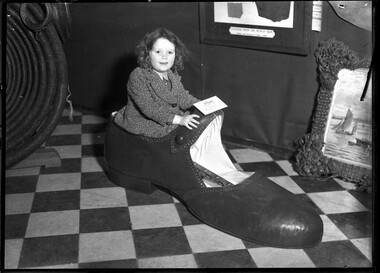
Photograph, Bull, Hugh Jones, 1897-1993, Leather Exhibition, Melbourne Town Hall
... Motor-trimming leather is said to be more durable and hygienic than fabric materials, and cheaper. The neat finish of the material, its excellent appearance, certainly make a very favourable impression. ...Motor-trimming leather is said to be more durable and hygienic than fabric materials, and cheaper. The neat finish of the material, its excellent appearance, certainly make a very favourable impression. ...Photographer notations on slide: At the Leather Exhib. at T. Hall Melb 1933 Age Published: Age (Melbourne, Vic.: 1854- ), 1933 THE EXHIBITS. (1933, September 20). The Age (Melbourne, Vic. : 1854 - 1954), p. 16. Retrieved January 25, 2026, from http://nla.gov.au/nla.news-article205109730 Published title: THE EXHIBITS. A COMPREHENSIVE RANGE. Curios, Novelties, Working Displays Published Caption: ONE OF THE NOVELTIES – AN OUTSIZE IN SHOES Research by Project Volunteer, Louise McKenzie: Our photo is dated 20 September 1933, and shows a happy, chubby-faced young girl sitting in a very over-sized girl’s shoe. It is labelled – “Shoe, An Out Size, loaned by Messrs Blackman & Rose”. (1) It is an effective way to capture the attention of the readership and alert them to the Melbourne Leather Show 1933. This show was designed to be a drawcard of extraordinary proportion, and there is no doubt that this leather exhibition was a really big deal for Melbourne. It completely took over the Melbourne Town Hall, and was open from 10.30 am until 10.30 pm. It seemed to contain something for everyone – the military, the man about town, the home handyman, the housewife, the child, the sporting types, the domestic workers, the outdoor enthusiasts, the horseracing fans, car enthusiasts, those wishing to show off the latest fashion – both men and women - and those just intrigued by a lot of fascinating and wide ranging exhibits. One of the most comprehensive descriptions of the Exhibition accompanies the photograph, and is worth quoting in full: “PROMINENT among exhibits which first attract attention in the foyer of the Town Hall is a comprehensive display of leather articles used by the defence forces. A conspicuous legend states that leather plays an important part in national defence, being used for saddlery, tool containers, holdalls, range-finding, surveying and signalling equipment, explosives factories, harness accoutrement, bandsmen's equipment and clothing. Three models of horses and several figures of soldiers wearing leather equipment illustrate the lesson, and a great range of leather goods used in military training and work variegate the display. Nearby are Texas cowboy, buckjumping and breaking-in saddles; whips, a walking stick, made of leather and numerous other curios. The general exhibition occupies the whole floor space of the main Town Hall, and is subdivided by partitions running most of the length of the hall. A bewildering variety, of leather goods presses for close and leisured inspection. Here and there operatives in charge of working machinery give practical demonstrations of factory processes in the production of footwear. Polishing materials are well represented. One attractive exhibit includes two bush huts constructed of leather, with wattle bark for roofing. Opossums, rosellas and a kookaburra add touches of bush realism. Adjacent exhibits include bags, fishing boots, leggings, leather covers in all colours. Factory Processes. One exhibitor has installed an automatic cinema apparatus and screen, which projects various factory processes in making a shoe, the operator being shown at work. Elsewhere an interesting exhibit depicts the five stages in the manufacture of sole leather, and the tanning materials employed. "Very handsome effects are achieved in the interior appointments of motor cars, which are attended by figures of smart chauffeurs in leather coats. Motor-trimming leather is said to be more durable and hygienic than fabric materials, and cheaper. The neat finish of the material, its excellent appearance, certainly make a very favourable impression. It takes the hides of three beasts to cover the cushions, squabs and door panels of a full-sized sedan, while to finish the entire interior, including quarter-panels and head linings would take four or even five. Special Exhibits. Amongst the special sections the display arranged by the handicrafts and home industries- committee of the Country Women's Association of Victoria is a notable one. In all there are about 130 entries which are in four classifications, viz., hand-tooled or embossed leathers, suede, hand-made gloves and undecorated leather. The glove section attracted the most numerous entries, a number being the work of members and craft subscribers of the Country Women's Association. In the leathercraft competition, organised by the Country Women's Association, the judges yesterday awarded the first prize for bookbinding (the only prize given in this division) to Miss M. Alston, of South Yarra. There is also a creditable display of exhibits submitted by boys of the orthopaedic section of the Children's Hospital at Frankston. Amongst the novelties on view in other portions of the exhibition were the following: — Leather coats worn by Sir C. Kingsford Smith on his Atlantic flight. Model Wellington boot, Phar Lap's saddle. Melbourne Cup winner's saddle. Longest whip in world, 108 feet long. (33 metres) [See our photo, to left of Girl in Shoe] Diminutive shoes. Pair of shoes 65 years old. Pair of men's working boots 75 years old. Larwood's, Tate’s and Pataudi’s cricket boots. [Three internationally revered cricketers of the day] (2) Picture frame made of leather bought 63 years ago. [See our photo, to right of Girl in Shoe] Leather frame, powder bowl, &c. Saddle used by world's champion buckjumper in U.S.A. Mexican cowboy outfit. Miniature saddle and bridle. A fireman's helmet made of sole leather. (3) Sample of the leather hat worn by porters at the Billingsgate Fish Market, London. (4) From South Australia there have been obtained sets of harness for donkeys, goats and camels, the equipment being displayed to good advantage on stuffed representations of the animals mentioned. Close to the platform is a glass case containing snow shoes and coats which have been used in Antarctic exploration work. Trade Display. Amongst the trade exhibits may be seen in operation a slipper turn shoe sewing machine, with heeling and channelling facilities, and the various stages in the production of ladies' sandals are shown. There is a wide contrast between sole leather of varying degrees of thickness on view in one stall and the choice samples of ladies' footwear in another — footwear, by the way, which could almost be used as ornaments, so dainty in colour and production are they. Again, there are displays of upholstering leathers of such soft texture that they could he readily mistaken for some of the finest cloth. Those who may be particularly interested in the production of chamois leather may gain an insight into the materials and chemicals used in the "working up” of this variety of leather. Supplies of glace kid (5) are tastefully arranged, and there may also be seen bags of all shapes and sizes, including satchels, suit cases and "sporting" cases, and bags for tennis players and golfers. Further variety is given to the exhibition by the display of antique hides, brightly coloured, with punching balls, boxing gloves and batsman's pads. There are crocodile skins and snake skins so cleverly "Worked up" that one could be almost pardoned for betraying an affection for such unpopular creatures.” “ Another wonderful article on this Exhibition, published the same day in one of the opposition daily newspapers, The Argus, is in the weekly article “Women to Women”, entitled “A Great Victorian Industry: Many Uses for Leather”. This weekly column was penned by Vesta, and she writes, with much purpose: “Yesterday afternoon I paid a hurried visit to the Leather Exhibition now being held in the Melbourne Town Hall and I was disappointed to find that the early visitors to the main exhibition were almost all men. Women, I think, should make a point of seeing every exhibition of our great industries, for women are the buyers of household requisites and goods for their own use and their tastes, and opinion influence also, to a large extent, the purchases of men. So, the welfare of industries is more or less in their hands and it becomes a duty for them to inform themselves fully of the extent and the quality of the manufacturing that is done here. The value of the output of the Australian boot and shoe factories alone was in 1930-31, the latest year for which the figures are given, Stg 3,750,000. Fully two thirds of that amount must have been spent by women on boots and shoes for themselves and their children. In a host of other directions, in the purchase of handbags, travelling bags, belts and straps, cushions, furniture coverings, purses, notebooks, spectacle cases, their annual expenditure must be very high. Their interest, therefore, in this industry is practical, and their support of it should be governed by knowledge of comparable values and qualities of the goods they buy. From the point of view of women, however, the exhibition itself is rather disappointing. There is an amazing collection of good stuff on show, but most of it is not displayed in a fashion that attracts attention. I was surprised, for example, at the range and quality of the leathers displayed, the suppleness of the finer qualities, and the varied range of colours and designs. But they are shown in such a fashion that if one set out deliberately to look for them it would be quite easy to miss most of them.” …It was surprising, too, that no one seemed to have taken advantage of the present fashion of wearing coloured gloves, or the cult of glove making, which the Country Women’s Association has fostered so successfully. Outside the collection of chamois leathers I saw no skins which were suitable to glove making. (6) However, it is perhaps a little unfair to be highly critical of the exhibition, inasmuch as it is the first of its kind. The material is there, undoubtedly, for a splendid show of every phase of this enterprising industry, and I am confident that experience will prove to those concerned that it will be worth while next time to devote a great deal of attention of the method of display.” With further research, it transpires that “Vera” is in fact NZ born Stella May Allen (nee Henderson) (1871-1962), a journalist, the first woman in NZ to begin a law course, in 1890-91). She later worked at a law firm while she completed her degree. Study of the law had always been open to women in NZ, but its practice was still barred to them. Her case “…led to amending legislation in 1896 allowing women to practise as barristers or solicitors. However, on gaining her LL.B. in November 1897 she did not apply for admission to the Bar. Instead, she became the Wellington-based correspondent and leader-writer for the Lyttelton Times. Her appointment, the first for a woman, was not welcomed by the all-male Press Gallery, and special permission had to be obtained from a subcommittee of the House before her presence was accepted. In 1900 she married Edwin Allen, a senior leader-writer for the Wellington Evening Post, and they moved to Australia in 1903 when Edwin Allen took up the post of foreign affairs leader-writer and parliamentary man for the Melbourne Argus. As Patricia Keep notes in her excellent entry of Stella Allan in the Australian Dictionary of Biography: “In 1907 The Argus commissioned her to write a series of articles on the first Australian Women's Work Exhibition held in October. They aroused much interest and next year The Argus invited her to join its full-time staff and begin a weekly section on the particular interests of women. She adopted the nom de plume 'Vesta' and called the column 'Women to Women'. Her work was unique in an Australian daily paper at that time. Her pages extended to cover every aspect of women's affairs, children's interests and community welfare, and 'Vesta' became a household word for authoritative information and advice on such matters. An excellent needlewoman and first-rate cook herself, she thoroughly tutored her staff in the work and needs of women in both country and city, as well as providing the usual training for cadet journalists. She conducted interviews and also visited the country to see at first hand the results of bushfires, mouse plagues, droughts and floods. In 1910 she was one of three women foundation members of the Australian Journalists' Association. “…she found time to become deeply involved in community affairs. She was an original committee-member of the Victorian Association of Crèches and of the Free Kindergarten Union of Victoria, and had much to do with the early days of the Victorian Bush Nursing Association, the Baby Health Centres Association and the Queen Victoria Hospital. She was a member of the National Council of Women, first in New Zealand and then in Melbourne, and of the Country Women's Association from its inception. … in 1924 she was appointed substitute delegate for Australia to the fifth assembly of the League of Nations at Geneva and was a delegate to the second Pan Pacific Women's Conference in Hawaii in 1930. A meeting held in the Melbourne Town Hall in 1938 by representatives of all the main Victorian women's organizations paid special tribute to her work and influence. She retired next year to England where she continued to write for the Argus, contributing articles on the experiences of women and children in wartime.” It is little wonder that “Vesta” was unafraid to take to task both the women of Victoria, and those who created the exhibition! One item which appears to have gone unnoticed, or at least unreported, is a framed article in the background of the photo of the chubby girl in the shoe. The display frame is labelled “Leather from the Human Skin, Tanned and Dressed by French artists.” The exhibition was certainly a cabinet of curiosities! A charming article in The Argus is a nice note on which to end. It gives a quick history and overview of the Australian leather industry and its unprecedented, and possibly unexpected, development and success, and states with pride: “Though Victoria is the largest leather producer in the Commonwealth all tanners in the Commonwealth can look back with pride on the long march of progress.” Footnotes: (1) “Blackman and Rose”. Messrs Blackman and Rose were shoe manufacturers, from 1927 located at 200 Noone Street, Clifton Hill. The Melbourne Circle describes their building as a “fine-looking building in the Federation ‘blood and bandage’ style.” It was built around 1912 for Puttifoot and Bloom, boot manufacturers, and today the building is apartments. (2) These cricketers were household names in the day: Tate: Maurice Tate, “English cricketer of the 1920s and 1930s, and leader of England’s Test bowling attack for a long time during this period. The founder of modern seam bowling. “ Larwood: Harold Larwood, “English right-arm fast bowler and the main exponent of the bowling style known as “bodyline”. Used to considerable effect in the 1932-33 Test series in Australia. Pataudi: Iftikhar A K Pataudi, “an Indian prince who in the 1930s played Test cricket for England, and in the 1940s played Test cricket for India (as Captain) – the only test cricketer to have played for both India and England. (3) “sole” leather “… is the thickest and most resistant material existing in the tanning industry … made from vegetable tanned leathers, usually bovine butts, processed in a special way to make them the hardest type of leather in existence.” (4) The hats worn by porters at Billingsgate Fish Market were also known as a “Bobbin” and look quite squat and rather unsophisticated. They were made of wood and tarred leather, with a “flat, hardened top designed to support large rectangular boxes of fish. The upturned brim protected the porter’s head against fish juice draining from the boxes of fish which would be carried on top of the hat. Some hats featured a small drain hole at the rear to allow this collected juice to drain down the back of the carrier. The hats were made using the ‘cuir bouilli’ technique. The leather was immersed in water which was heated until the leather began to shrink. It was then removed and put on a wooden former. The leather was stitched together to make the hat while still wet, and then held in place until dry.” (See article and photo on the London Museum website) (5) Glace kid – described on the Boston Museum of Fine Arts’ Cameo database as “A smooth glossy leather originally prepared from goat or sheepskin. Early glace kid had a shiny surface that was originally prepared by tawing the skin in a mixture of alum, table salt, flour, and egg yolk. Today, glace kid is prepared from many types of vegetable or chrome tanned leathers. The smooth polished surface is obtained mechanically by shaving, glazing, ironing, and/or rolling the dry leather.” (6) In the 1930s, Melbourne’s glovemaking industry was characterised by local manufacturing, with key producers like Simpson’s Gloves Pty Ltd in Richmond and the Stagg Glove Company in Clifton Hill leading the market. These factories produced high-quality leather gloves, handbags, and specialty gear, often employing a clear gendered division of labour and training young, local women. Museum Victoria holds the Simpson’s Gloves Collection, comprising over 1200 items, and the University of Melbourne Archives holds the company’s business records. References: THE EXHIBITS. (1933, September 20). The Age (Melbourne, Vic. : 1854 - 1954), p. 16. Retrieved January 25, 2026, from http://nla.gov.au/nla.news-article205109730 EXPORT LEATHER. (1929, September 17). The Argus (Melbourne, Vic. : 1848 - 1957), p. 17. Retrieved January 19, 2026, from http://nla.gov.au/nla.news-article4037647 LEATHER EXHIBITION (1933, September 18). The Argus (Melbourne, Vic. : 1848 - 1957), p. 10. Retrieved January 19, 2026, from http://nla.gov.au/nla.news-article11693362 (1933, September 23). The Argus (Melbourne, Vic. : 1848 - 1957), p. 21. Retrieved January 19, 2026, from http://nla.gov.au/nla.news-page522766 WOMEN TO WOMEN (1933, September 20). The Argus (Melbourne, Vic. : 1848 - 1957), p. 13. Retrieved January 19, 2026, from http://nla.gov.au/nla.news-article11694034 Australian Dictionary of Biography, Stella May Allan (1871–1962) https://adb.anu.edu.au/biography/allan-stella-may-4998 WOMEN TO WOMEN (1930, January 22). The Argus (Melbourne, Vic. : 1848 - 1957), p. 13. Retrieved January 19, 2026, from http://nla.gov.au/nla.news-article4063888 Museums Victoria, Simpson’s Gloves, 486-496 Victoria Street, North Richmond, VIC, Australia https://collections.museumsvictoria.com.au/articles/2702 The Argus. (1927, October 31). The Argus (Melbourne, Vic. : 1848 - 1957), p. 20. Retrieved February 7, 2026, from http://nla.gov.au/nla.news-article3888451 Melbourne Circle: stories from the suburbs: “Boots and all in Clifton Hill” https://melbournecircle.net/2015/11/20/bootmakers-of-clifton-hill/ Wikipedia, Maurice Tate, https://en.wikipedia.org/wiki/Maurice_Tate Wikipedia, Harold Larwood, https://en.wikipedia.org/wiki/Harold_Larwood Wikipedia, Iftikhar Ali Khan Pataudi, https://en.wikipedia.org/wiki/Iftikhar_Ali_Khan_Pataudi Buy Leather Online Italy, Sole leather: https://buyleatheronline.com/en/blog/outsole-and-insole-leather-n7 London Museum, Porters hats, https://www.londonmuseum.org.uk/collections/v/object-731122/hat-porters-hat/ Cameo Database, Museum of Fine Arts, Boston, Glace Kid, https://cameo.mfa.org/wiki/Glac%C3%A9_kid VICTORIAN LEATHER HAS WON RENOWN (1937, September 22). The Argus (Melbourne, Vic. : 1848 - 1957), p. 31 (March of Progress Supplement). Retrieved February 7, 2026, from http://nla.gov.au/nla.news-article1108704 Photographer notations on slide: "At the Leather Exhib. at T. Hall Melb 1933 Age B5".displays, melbourne town hall, leather, children, shoes, 1930-1939, industry, hats, gloves -
Southern Sherbrooke Historical Society Inc.
Textile - Helen Gibson collection - material, cottons, etc
... Both have raw edges on one side. -1 remains of furniture material- bone coloured with floral decorations. ...Both have raw edges on one side. -1 remains of furniture material- bone coloured with floral decorations. ... -
 Flagstaff Hill Maritime Museum and Village
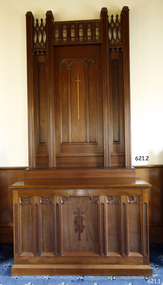
Furniture - Altar and Reredos, Hadwen and Houghton, ca 1944
... The altar is part of the St Nicholas Seamen's Church collection. Furniture Altar and Reredos Hadwen and Houghton ...This altar and rear reredos were part of the original furnishings of the St Nicholas' Mission to Seamen's Church at 139 Nelson Place, Williamstown, Victoria. The Mission to Seamen organisation operated the Church. The reredos was donated to the Williamstown chapel by Miss. M. Breaks, in memoriam Miss. L.A. Breaks, who served a very active part in the Seamen's Mission, and the altar was donated by Mrs and Miss J R Schutt. THE MISSIONS TO SEAMEN (Brief History): - The Missions to Seamen was an Anglican charity in Great Britain that has served the world's seafarers since 1856. Its symbol is a Flying Angel, inspired by a Bible verse. Today, there are centres in over 200 ports worldwide where seamen of all backgrounds are offered a warm welcome and provided with a wide range of facilities. In Victoria, the organisation began in Williamstown in 1857 as a Sailors’ Church, also known as ‘Bethel’ or the ‘Floating Church’ in an old hulk floating in Hobson’s Bay, Port of Melbourne. It soon became part of the Missions to Seamen, Victoria. In 2000, the organisation, now named Mission to Seafarers, still operated locally in Melbourne, Portland, Geelong and Hastings. The Ladies’ Harbour Lights Guild was formed in 1906 to support the Missions to Seamen in Melbourne and other centres, such as Williamstown. Two of the most significant ladies of the Guild were founder Ethel Augusta Godfrey and foundation member Alice Sibthorpe Tracy (who established a branch of the Guild in Warrnambool in 1920). The Guild continued its work until the 1960s. In 1943, a former Williamstown bank was purchased for the Missions to Seamen Club. The chapel was named St Nicholas’ Seamen’s Church and was supported by the Ladies’ Harbour Lights Guild, the Williamstown Lightkeepers’ Auxiliary and the League of Soldiers’ and Sailors’ Friends. It ceased operation in 1966. A Missions to Seamen Chapel and Recreation Room was a significant feature of ports during the late 1800s and 1900s. It seemed appropriate for Flagstaff Hill to include such a representation within the new Maritime Village, and the Melbourne Board of Management of Missions to Seamen Victoria gave its permission on 21st May 1979 for the entire furnishings of the Williamstown chapel to be transferred to Flagstaff Hill. The St Nicholas Seamen’s Church was officially opened on October 11, 1981, and resembles the Williamstown chapel.This altar and reredos are significant historically for its origin in the St Nicholas Mission to Seamen's Church in Williamstown, established in 1857 to cater for the physical, social, and spiritual needs of seafarers. It originated in Bristol, England when a Seamen's Mission was formed in 1837. They are historically significant for their connection to the Ladies Lightkeepers’ Auxiliary, an organisation of women, formed to support seafarers. The connection of this furniture to the Mission to Seamen and to the Ladies Lightkeepers’ Auxiliary highlights the strong community awareness of the life of people at sea, their dangers and hardships, and their need for physical, financial, spiritual and moral support. Altar and reredos or altar panel, wooden. The timber is panelled, stained and has a varnished finish. The base has a detachable vertical panel with the decoration of a sword and two anchors, the reredos has a cross on a panel. It was made by Hadwen and Houghton, Malvern, Victoria. A plaque at the bottom right edge is marked with the maker's name. The altar is part of the St Nicholas Seamen's Church collection.On removable panel; logo of [sword and two anchors] On bottom right of base: "Hadwen and Houghton, Malvern"flagstaff hill maritime museum and village, flagstaff hill, warrnambool, maritime museum, maritime village, shipwreck coast, great ocean road, religion, religious service, st nicholas seamen’s church, williamstown, missions to seamen victoria, altar, reredos, church furniture, religious furniture, miss m breaks, miss l a breaks, worship service, mrs and miss j.r. schutt -
 Flagstaff Hill Maritime Museum and Village
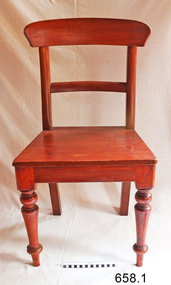
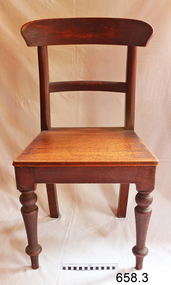
Furniture - Chair, 1880s
... Furniture Chair Sailors' Rest St Nicholas Seamen's Church ...This chair is one of a set of four chairs from the St. Nicholas Seamen’s Church, 139 Nelson Place, Williamstown, Victoria, during religious services there. The Church was operated by the Mission to Seamen organisation. * for more detailed history please see our Registration Number 658, Set of chairs This set of chairs is significant historically for its origin in the St Nicholas Mission to Seamen's Church in Williamstown, established in 1857 to cater for the physical, social, and spiritual needs of seafarers. It originated in Bristol, England when a Seamen's Mission was formed in 1837. The set of chairs is historically significant for its connection to the Ladies Lightkeepers’ Auxiliary, an organisation of women, formed to support seafarers. The connection of this set of chairs to the Mission to Seamen and to the Ladies Lightkeepers’ Auxiliary highlights the strong community awareness of the life of people at sea, their dangers and hardships, and their need for physical, financial, spiritual and moral support. Chair: Australian Colonial rail back dining chair. Chair is one of a set of four (4) cedar wood chairs. Each chair has a rounded rail back, flat cross rail, flat solid wood seat, curved back legs and colonial turned front legs. Mid-brown colour, veneer finish. The set of chairs is part of the St Nicholas Seamen's Church Williamstown Collection. flagstaff hill, warrnambool, shipwrecked coast, flagstaff hill maritime museum, maritime museum, shipwreck coast, flagstaff hill maritime village, great ocean road, religion, religious service, sailors rest, sailors’ church, bethel sailors’ church, bethel floating church, ladies harbour light guild, lightkeepers’ auxiliary, missions to seamen victoria, mission to seafarers, flying angel’s club, ann street williamstown, st nicholas seaman’s church williamstown, st nicholas mission to seamen church williamstown, mission to seamen williamstown, st nicholas seamen’s church flagstaff hill, 139 nelson place williamstown, church furniture, religious furniture, religious worship, anglican church, chair, dining chair, kitchen chair, domestic furniture, colonial chair, australian colonial period, cedar chair -
 Flagstaff Hill Maritime Museum and Village
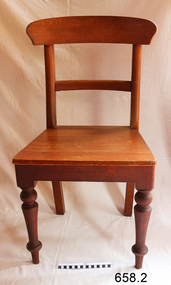
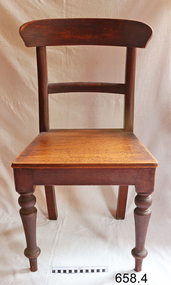
Furniture - Chair, 1880s
... Furniture Chair Sailors' Rest St Nicholas Seamen's Church ...This chair is one of a set of four chairs from the St. Nicholas Seamen’s Church, 139 Nelson Place, Williamstown, Victoria, during religious services there. The Church was operated by the Mission to Seamen organisation. * for more detailed history please see our Registration Number 658, Set of chairs This set of chairs is significant historically for its origin in the St Nicholas Mission to Seamen's Church in Williamstown, established in 1857 to cater for the physical, social, and spiritual needs of seafarers. It originated in Bristol, England when a Seamen's Mission was formed in 1837. The set of chairs is historically significant for its connection to the Ladies Lightkeepers’ Auxiliary, an organisation of women, formed to support seafarers. The connection of this set of chairs to the Mission to Seamen and to the Ladies Lightkeepers’ Auxiliary highlights the strong community awareness of the life of people at sea, their dangers and hardships, and their need for physical, financial, spiritual and moral support. Chair: Australian Colonial rail back dining chair. Chair is one of a set of four (4) cedar wood chairs. Each chair has a rounded rail back, flat cross rail, flat solid wood seat, curved back legs and colonial turned front legs. Mid-brown colour, veneer finish. The set of chairs is part of the St Nicholas Seamen's Church Williamstown Collection. flagstaff hill, warrnambool, shipwrecked coast, flagstaff hill maritime museum, maritime museum, shipwreck coast, flagstaff hill maritime village, great ocean road, religion, religious service, sailors rest, sailors’ church, bethel sailors’ church, bethel floating church, ladies harbour light guild, lightkeepers’ auxiliary, missions to seamen victoria, mission to seafarers, flying angel’s club, ann street williamstown, st nicholas seaman’s church williamstown, st nicholas mission to seamen church williamstown, mission to seamen williamstown, st nicholas seamen’s church flagstaff hill, 139 nelson place williamstown, church furniture, religious furniture, religious worship, anglican church, chair, dining chair, kitchen chair, domestic furniture, colonial chair, australian colonial period, cedar chair -
 Flagstaff Hill Maritime Museum and Village
Furniture - Chair, 1880s
... Furniture Chair Sailors' Rest St Nicholas Seamen's Church ...This chair is one of a set of four chairs from the St. Nicholas Seamen’s Church, 139 Nelson Place, Williamstown, Victoria, during religious services there. The Church was operated by the Mission to Seamen organisation. * for more detailed history please see our Registration Number 658, Set of chairs This set of chairs is significant historically for its origin in the St Nicholas Mission to Seamen's Church in Williamstown, established in 1857 to cater for the physical, social, and spiritual needs of seafarers. It originated in Bristol, England when a Seamen's Mission was formed in 1837. The set of chairs is historically significant for its connection to the Ladies Lightkeepers’ Auxiliary, an organisation of women, formed to support seafarers. The connection of this set of chairs to the Mission to Seamen and to the Ladies Lightkeepers’ Auxiliary highlights the strong community awareness of the life of people at sea, their dangers and hardships, and their need for physical, financial, spiritual and moral support. Chair: Australian Colonial rail back dining chair. Chair is one of a set of four (4) cedar wood chairs. Each chair has a rounded rail back, flat cross rail, flat solid wood seat, curved back legs and colonial turned front legs. Mid-brown colour, veneer finish. The set of chairs is part of the St Nicholas Seamen's Church Williamstown Collection. flagstaff hill, warrnambool, shipwrecked coast, flagstaff hill maritime museum, maritime museum, shipwreck coast, flagstaff hill maritime village, great ocean road, religion, religious service, sailors rest, sailors’ church, bethel sailors’ church, bethel floating church, ladies harbour light guild, lightkeepers’ auxiliary, missions to seamen victoria, mission to seafarers, flying angel’s club, ann street williamstown, st nicholas seaman’s church williamstown, st nicholas mission to seamen church williamstown, mission to seamen williamstown, st nicholas seamen’s church flagstaff hill, 139 nelson place williamstown, church furniture, religious furniture, religious worship, anglican church, chair, dining chair, kitchen chair, domestic furniture, colonial chair, australian colonial period, cedar chair -
 Flagstaff Hill Maritime Museum and Village
Furniture - Chair, 1880s
... Furniture Chair Sailors' Rest St Nicholas Seamen's Church ...This chair is one of a set of four chairs from the St. Nicholas Seamen’s Church, 139 Nelson Place, Williamstown, Victoria, during religious services there. The Church was operated by the Mission to Seamen organisation. * for more detailed history please see our Registration Number 658, Set of chairs This set of chairs is significant historically for its origin in the St Nicholas Mission to Seamen's Church in Williamstown, established in 1857 to cater for the physical, social, and spiritual needs of seafarers. It originated in Bristol, England when a Seamen's Mission was formed in 1837. The set of chairs is historically significant for its connection to the Ladies Lightkeepers’ Auxiliary, an organisation of women, formed to support seafarers. The connection of this set of chairs to the Mission to Seamen and to the Ladies Lightkeepers’ Auxiliary highlights the strong community awareness of the life of people at sea, their dangers and hardships, and their need for physical, financial, spiritual and moral support. Chair: Australian Colonial rail back dining chair. Chair is one of a set of four (4) cedar wood chairs. Each chair has a rounded rail back, flat cross rail, flat solid wood seat, curved back legs and colonial turned front legs. Mid-brown colour, veneer finish. The set of chairs is part of the St Nicholas Seamen's Church Williamstown Collection. flagstaff hill, warrnambool, shipwrecked coast, flagstaff hill maritime museum, maritime museum, shipwreck coast, flagstaff hill maritime village, great ocean road, religion, religious service, sailors rest, sailors’ church, bethel sailors’ church, bethel floating church, ladies harbour light guild, lightkeepers’ auxiliary, missions to seamen victoria, mission to seafarers, flying angel’s club, ann street williamstown, st nicholas seaman’s church williamstown, st nicholas mission to seamen church williamstown, mission to seamen williamstown, st nicholas seamen’s church flagstaff hill, 139 nelson place williamstown, church furniture, religious furniture, religious worship, anglican church, chair, dining chair, kitchen chair, domestic furniture, colonial chair, australian colonial period, cedar chair -
 Flagstaff Hill Maritime Museum and Village
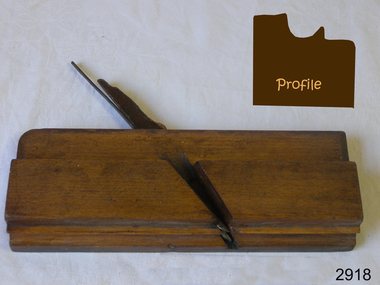
Tool - Plane, Richard Routledge, Late 19th to early 20th century
... It gives us a snapshot of how furniture and other decorative finishes were created on timber by the use of hand tools. flagstaff hill warrnambool shipwrecked-coast flagstaff-hill flagstaff-hill-maritime-museum maritime-museum shipwreck-coast flagstaff-hill-maritime-village Maker R Routledge Birmingham also marked Owner Jas Burden Rebate Moulding plane Size 1/2" Tool Plane Richard Routledge ...A moulding plane is a specialised plane used for making the complex shapes found in wooden mouldings that are used to decorate furniture or other wooden object. Traditionally, moulding planes were blocks of wear resistant hardwood, often beech or maple, which were worked to the shape of the intended moulding. The blade, or iron was likewise formed to the intended moulding profile and secured in the body of the plane with a wooden wedge. A traditional cabinetmakers shop might have many, perhaps hundreds, of moulding planes for the full range of work to be performed. Large crown mouldings required planes of six or more inches in width, which demanded great strength to push and often had additional peg handles on the sides, allowing the craftsman's apprentice or other worker to pull the plane ahead of the master who guided it. All we known about Richard Routledge is that he was a tool maker and retailer that operated a business at either 23 or 64 Bull St Birmingham between 1869 to sometime in the early 20th century. There are many of his tools including decorative moulding planes of all sizes and designs for sale around the world and that his tools in particular moulding planes are well sought after by collectors of vintage tools. A vintage tool made by a known maker, this item was made commercially for firms and individuals that worked in wood and needed a tool that could produce a ornamental finish to timber. The tool was used before routers and spindle moulders came into use to produce a decorative moulding for a piece of furniture, door trims etc, or other timber items that had to be accomplished by using hand tools and in particular one of these types of planes. Profiled planes came in various shapes and sizes to achieve the required decorative finish. A significant tool from the mid to late 19th century that today is sought after by collectors. It gives us a snapshot of how furniture and other decorative finishes were created on timber by the use of hand tools. Rebate Moulding plane Size 1/2"Maker R Routledge Birmingham also marked Owner Jas Burdenflagstaff hill, warrnambool, shipwrecked-coast, flagstaff-hill, flagstaff-hill-maritime-museum, maritime-museum, shipwreck-coast, flagstaff-hill-maritime-village -
 Flagstaff Hill Maritime Museum and Village
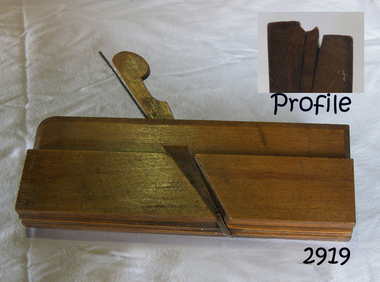
Tool - Plane, Richard Routledge, Late 19th to early 20th century
... It gives us a snapshot of how furniture and other decorative finishes were created on timber by the use of hand tools. flagstaff hill warrnambool shipwrecked-coast flagstaff-hill flagstaff-hill-maritime-museum maritime-museum shipwreck-coast flagstaff-hill-maritime-village Maker stamped R Routledge & JAS Burden (owner) Plane Moulding type size 1/8" Tool Plane Richard Routledge ...A moulding plane is a specialised plane used for making the complex shapes found in wooden mouldings that are used to decorate furniture or other wooden object. Traditionally, moulding planes were blocks of wear resistant hardwood, often beech or maple, which were worked to the shape of the intended moulding. The blade, or iron was likewise formed to the intended moulding profile and secured in the body of the plane with a wooden wedge. A traditional cabinetmakers shop might have many, perhaps hundreds, of moulding planes for the full range of work to be performed. Large crown mouldings required planes of six or more inches in width, which demanded great strength to push and often had additional peg handles on the sides, allowing the craftsman's apprentice or other worker to pull the plane ahead of the master who guided it. All we known about Richard Routledge is that he was a tool maker and retailer that operated a business at either 23 or 64 Bull St Birmingham between 1869 to sometime in the early 20th century. There are many of his tools including decorative moulding planes of all sizes and designs for sale around the world and that his tools in particular moulding planes are well sought after by collectors of vintage tools. A vintage tool made by a known maker, this item was made commercially for firms and individuals that worked in wood and needed a tool that could produce a ornamental finish to timber. The tool was used before routers and spindle moulders came into use to produce a decorative moulding for a piece of furniture, door trims etc. or other timber items that had to be accomplished by using hand tools and in particular one of these types of planes. Profiled planes came in various shapes and sizes to achieve the required decorative finish. A significant tool from the mid to late 19th century that today is sought after by collectors. It gives us a snapshot of how furniture and other decorative finishes were created on timber by the use of hand tools. Plane Moulding type size 1/8" Maker stamped R Routledge & JAS Burden (owner)flagstaff hill, warrnambool, shipwrecked-coast, flagstaff-hill, flagstaff-hill-maritime-museum, maritime-museum, shipwreck-coast, flagstaff-hill-maritime-village -
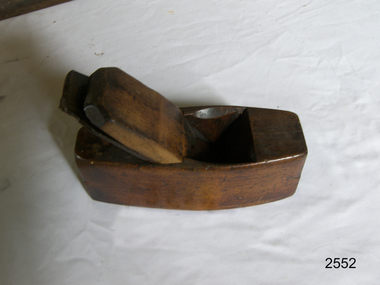 Flagstaff Hill Maritime Museum and Village
Tool - Wood smoothing plane, 1850-1890
... It gives us a snapshot of how furniture and other decorative finishes were created on timber by the use of hand tools only. flagstaff hill warrnambool shipwrecked-coast flagstaff-hill flagstaff-hill-maritime-museum maritime-museum shipwreck-coast flagstaff-hill-maritime-village plane None Smoothing Plane Coffin type Tool Wood smoothing plane ...A smoothing plane is a wood plane used for making a smooth surface to wood surfaces traditionally, these planes were blocks of wear resistant hardwood, often beech or maple, which were worked to the shape or size required. The blade, or iron was likewise formed to the intended flat or level profile and secured in the body of the plane with a wooden wedge. A traditional cabinetmakers shop might have many, perhaps hundreds, of moulding and smoothing planes for the full range of work to be performed. Large crown mouldings or smoothing plane surfaces required planes of six or more inches in width, which demanded great strength to push and often had additional peg handles on the sides, allowing the craftsman's apprentice or other worker to pull the plane ahead of the master who guided it. This plane is a coffin pattern smoothing plane and is unmarked so the maker is unknown however it's design and patina indicate it was probably made in the mid to late 19th century and would be regarded as a vintage or antique item sought after today by collectors of vintage tools. A vintage tool made by an unknown maker, that was made commercially for firms and individuals who worked in wood and needed a tool that could produce a flat or level finish to timber. These types of planes came in various shapes and sizes to achieve the required finish to timber surfaces used in cabinet making. This item is a significant tool from the mid to late 19th century that today is quite rare and sought after by collectors. It gives us a snapshot of how furniture and other decorative finishes were created on timber by the use of hand tools only. Smoothing Plane Coffin type Noneflagstaff hill, warrnambool, shipwrecked-coast, flagstaff-hill, flagstaff-hill-maritime-museum, maritime-museum, shipwreck-coast, flagstaff-hill-maritime-village, plane -
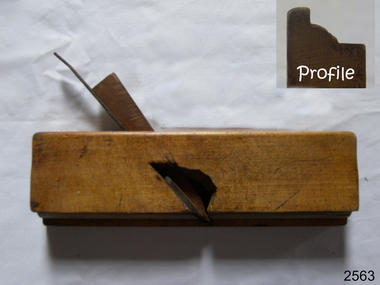 Flagstaff Hill Maritime Museum and Village
Tool - Moulding Plane
... It gives us a snapshot of how furniture and other decorative finishes were created on timber by the use of hand tools. flagstaff hill warrnambool shipwrecked-coast flagstaff-hill flagstaff-hill-maritime-museum maritime-museum shipwreck-coast flagstaff-hill-maritime-village None Moulding Plane, concave cut. ...A moulding plane is a specialised plane used for making the complex shapes found in wooden mouldings that are used to decorate furniture or other wooden object. Traditionally, moulding planes were blocks of wear resistant hardwood, often beech or maple, which were worked to the shape of the intended moulding. The blade, or iron was likewise formed to the intended moulding profile and secured in the body of the plane with a wooden wedge. A traditional cabinetmakers shop might have many, perhaps hundreds, of moulding planes for the full range of work to be performed. Large crown mouldings required planes of six or more inches in width, which demanded great strength to push and often had additional peg handles on the sides, allowing the craftsman's apprentice or other worker to pull the plane ahead of the master who guided it. A vintage tool made by an unknown maker, this item was made commercially for firms and individuals who worked in wood and needed a tool that could produce a ornamental finish to timber. These profiled planes came in various shapes and sizes to achieve a decorative finish. This item is a significant tool from the mid to late 19th century that today is quite rare and sought after by collectors. It gives us a snapshot of how furniture and other decorative finishes were created on timber by the use of hand tools. Moulding Plane, concave cut.Noneflagstaff hill, warrnambool, shipwrecked-coast, flagstaff-hill, flagstaff-hill-maritime-museum, maritime-museum, shipwreck-coast, flagstaff-hill-maritime-village -
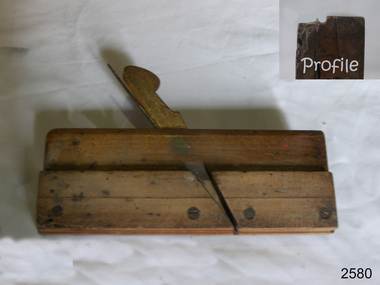 Flagstaff Hill Maritime Museum and Village
Tool - Wood Moulding Plane
... It gives us a snapshot of how furniture and other decorative finishes were created on timber by the use of hand tools. flagstaff hill warrnambool shipwrecked-coast flagstaff-hill flagstaff-hill-maritime-museum maritime-museum shipwreck-coast flagstaff-hill-maritime-village J Allin GN stamped inside W size 16 one end and Inglis R F Sharp on other end. ...A moulding plane is a specialised plane used for making the complex shapes found in wooden mouldings that are used to decorate furniture or other wooden object. Traditionally, moulding planes were blocks of wear resistant hardwood, often beech or maple, which were worked to the shape of the intended moulding. The blade, or iron was likewise formed to the intended moulding profile and secured in the body of the plane with a wooden wedge. A traditional cabinetmakers shop might have many, perhaps hundreds, of moulding planes for the full range of work to be performed. Large crown mouldings required planes of six or more inches in width, which demanded great strength to push and often had additional peg handles on the sides, allowing the craftsman's apprentice or other worker to pull the plane ahead of the master who guided it. A vintage tool made by an unknown maker, this item was made commercially for firms and individuals that worked in wood and needed a tool that could produce a ornamental finish to timber. The tool was used before routers and spindle moulders came into use to produce a decorative moulding for a piece of furniture, door trims etc, or other timber items that had to be accomplished by using hand tools and in particular one of these types of planes. Profiled planes came in various shapes and sizes to achieve the required decorative finish. A significant tool from the mid to late 19th century that today is sought after by collectors. It gives us a snapshot of how furniture and other decorative finishes were created on timber by the use of hand tools. Moulding Plane W size has 4 screws holding side together (repair)J Allin GN stamped inside W size 16 one end and Inglis R F Sharp on other end.flagstaff hill, warrnambool, shipwrecked-coast, flagstaff-hill, flagstaff-hill-maritime-museum, maritime-museum, shipwreck-coast, flagstaff-hill-maritime-village -
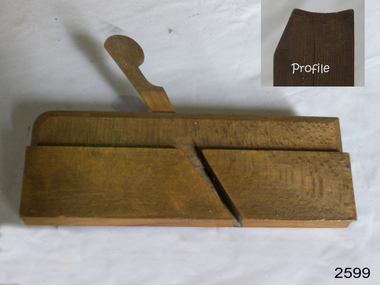 Flagstaff Hill Maritime Museum and Village
Tool - Moulding Plane, J Budd, Mid 19th Century
... It gives us a snapshot of how furniture and other decorative finishes were created on timber by the use of hand tools. ...A moulding plane is a specialised plane used for making complex shapes found in wooden mouldings that are used to decorate furniture or other wooden objects. Traditionally, moulding planes were blocks of wear-resistant hardwood, often beech or maple, which were worked to the shape of the intended moulding. The blade or iron was likewise formed to the intended moulding profile and secured in the body of the plane with a wooden wedge. A traditional cabinetmaker's shop might have many, perhaps hundreds, of moulding planes for the full range of work to be performed. Large crown mouldings required planes of six or more inches in width, which demanded great strength to push and often had additional peg handles on the sides, allowing the craftsman's apprentice or other workers to pull the plane ahead of the master who guided it. All we know about J Budd is that he was a toolmaker and retailer that operated a business in London between 1832 to 1864. There are many of his tools including decorative moulding planes of all sizes and designs for sale around the world and that his tools in particular moulding planes are well sought after by collectors of vintage tools.A vintage tool believed to have been made by a known maker, J Budd given the inscription on the item of "JB" this item was made commercially for firms and individuals that worked in wood and needed a tool that could produce an ornamental finish to timber. The tool was used before routers and spindle moulders came into use after World War ll a time when to produce a decorative moulding for a piece of furniture, door trims, etc. or other items had to be accomplished using hand tools and in particular one of these types of planes. These profiled planes came in various shapes and sizes to achieve a decorative finish. A significant tool from the early to mid 18th century that today is quite rare and sought after by collectors. It gives us a snapshot of how furniture and other decorative finishes were created on timber by the use of hand tools. Tools that were themselves hand made shows the craftsmanship used during this time not only to make a tool such as the subject item but also the craftsmanship needed to produce a decorative finish that was needed to be made for any timber item. Plane, Moulding, Ogee- PlainStamped JB No 6flagstaff hill, warrnambool, shipwrecked-coast, flagstaff-hill, flagstaff-hill-maritime-museum, maritime-museum, shipwreck-coast, flagstaff-hill-maritime-village -
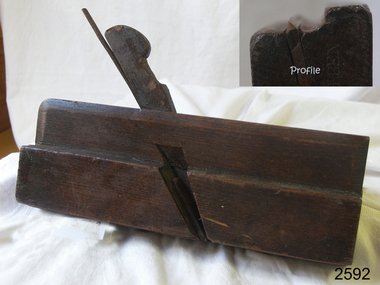 Flagstaff Hill Maritime Museum and Village
Tool - Moulding Plane, Charles Nurse, 1860-1900
... It gives us a snapshot of how furniture and other decorative finishes were created on timber by the use of hand tools only. flagstaff hill warrnambool shipwrecked-coast flagstaff-hill flagstaff-hill-maritime-museum maritime-museum shipwreck-coast flagstaff-hill-maritime-village Maker Charles and Co 1863 Stamped W. ...The original Nurse family business began in 1841 in Maidstone Kent until 1861 where they were plane makers, moving to London in 1887 the company became C Nurse & Co. And continued until 1937 under that name at the (Invicta works). The majority of their plane making was done in London but there are Sheffield and Brighton marks on their tools as well. The company was not only wood plane makers but tool makers in general with the Charles Nurse & Co catalogue having 350 pages of tools for sale of varying types for different building trades and over 138 pages dedicated to woodworking tools. Records show that the company was at 182 Walworth Road London from 1887-1949. However, they had several retail outlets before this time and records indicate before 1887 Charles Nurse was at 32 Mill St Maidstone Kent, from 1844 -1860 but were in business before then. Also in Brighton at 135 Queens Road from 1865 -1871 and at 3 Mill Street Maidstone, again from 1872 - 1889 listed on records of the time as “plane and tool makers.”A vintage item made by a significant tool maker and retailer from the middle of the nineteenth century and into the first half of the twentieth century. These items were made commercially for firms and individuals that worked in wood and needed a tool that could produce an ornamental finish to timber. The tool was used before electric or mechanical routers or spindle moulders came into use. They were used by craftsmen to produce decorative mouldings by hand. These profiled planes came in various shapes and sizes. A significant tool that today is quite rare and sought after by collectors. It gives us a snapshot of how furniture and other decorative finishes were created on timber by the use of hand tools only. Moulding plane Side Bead - Single Box Size 5/16 Maker Charles and Co 1863 Stamped W. Burden (previous owner)flagstaff hill, warrnambool, shipwrecked-coast, flagstaff-hill, flagstaff-hill-maritime-museum, maritime-museum, shipwreck-coast, flagstaff-hill-maritime-village -
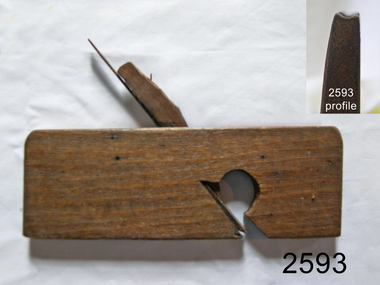 Flagstaff Hill Maritime Museum and Village
Tool - Wood moulding Plane, 1890-1920
... It gives us a snapshot of how furniture and other decorative finishes were created on timber by the use of hand tools. ...A moulding plane is a specialised plane used for making the complex shapes found in wooden mouldings that are used to decorate furniture or other wooden object. Traditionally, moulding planes were blocks of wear resistant hardwood, often beech or maple, which were worked to the shape of the intended moulding. The blade, or iron was likewise formed to the intended moulding profile and secured in the body of the plane with a wooden wedge. A traditional cabinetmakers shop might have many, perhaps hundreds, of moulding planes for the full range of work to be performed. Large crown moulding required planes of six or more inches in width, which demanded great strength to push and often had additional peg handles on the sides, allowing the craftsman's apprentice or other worker to pull the plane ahead of the master who guided it.A vintage tool made by an unknown company, this item was made commercially for firms and individuals that worked in wood and needed a tool that could produce a ornamental finish to timber. The tool was used before routers and spindle moulders came into use after World War ll, a time when to produce a decorative moulding for a piece of furniture, door trims etc. or other items had to be accomplished using hand tools and in particular one of these types of planes. These profiled planes came in various shapes and sizes to achieve a decorative finish. A significant tool from the mid to late 19th century that today is quite rare and sought after by collectors. It gives us a snapshot of how furniture and other decorative finishes were created on timber by the use of hand tools. Tools that were themselves hand made shows the craftsmanship used during this time not only to make a tool such as the subject item but also the craftsmanship needed to produce a decorative finish that was needed to be made for any timber item. Wood Moulding, plane Rabbet Hollow type Noneflagstaff hill, warrnambool, shipwrecked-coast, flagstaff-hill, flagstaff-hill-maritime-museum, maritime-museum, shipwreck-coast, flagstaff-hill-maritime-village -
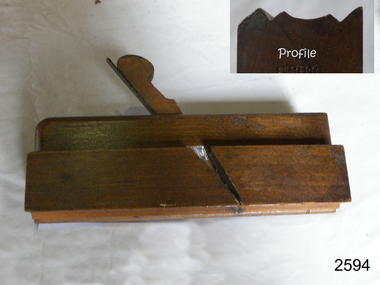 Flagstaff Hill Maritime Museum and Village
Tool - Wood moulding Plane, Christopher Gabriel, 18th Century
... The tool gives us a snapshot of how furniture and other finishes were created on timber by the use of cutting edged hand tools. ...The story of Christopher Gabriel born on April 2, 1746, in Falmouth England is a tale of a poor boy who made good. Shortly before he turned thirteen years of age in 1759 he was apprenticed to a local master carpenter, recorded as a Mr Barnicot the master trained his apprentice well as we can assume by Christopher's later successes. The apprenticeship ended in 1766 after seven years when Christopher reached twenty. Then in 1768, he relocated to London walking the two hundred miles from Falmouth carrying his possessions in a sack. He no sooner arrived in London when he met Alice Trowell who became his wife in March 1769. They set up house on Albermarie Street Clerkenwell and by the first of 1770, Gabriel had begun his business of plane making. It has been speculated that Gabriel took over the shop of John Cogdell aided with an investment from his in-laws of 131 pounds. He went on to prosper as a plane maker and lumber merchant over the next forty years. His business did well and in 1774 Gabriel moved to a house in Golden Lane, London and 1779 moved again to a home in Ould Street London. By now Gabriel was making a name for himself and his business at this time was located at 32 Banner Street Golden Lane, the following year he purchased another home in Banner Street and 1793 purchased the house next door. At the time of his death in 1808, he owned twenty-seven houses and commercial building. Christopher Gabriel s descendants became quite prominent in England and his grandson, Sir Thomas Gabriel became the Sheriff of London and Middlesex in 1859 and the Lord Mayor of London 1866 and 1867. Gabriel was an extremely prolific plane maker with a lot of examples made in the 18th century can still be found today. He made good quality tools and was an innovator of several new plane designs. A vintage tool made by a well-known plane maker, this item was made commercially for firms and individuals that worked in wood and needed a tool that could give a decorative finish to timber. These planes came in various shapes and sizes to achieve a finish to timber surfaces and came in many sizes. A significant Christopher Gabriel plane from the mid to late 18th century that after 200 years can still be used today. Planes made by Gabriel are eagerly sought after by collectors. The tool gives us a snapshot of how furniture and other finishes were created on timber by the use of cutting edged hand tools. Tools that were themselves hand made shows the craftsmanship used during this time not only to make a tool such as the subject item but also the craftsmanship needed to produce a decorative or even finish that was needed for the finishing of timber items. Plane Moulding Reverse Ogee with two squares type Maker stamped Gabriel also stamped JB & No 9flagstaff hill, warrnambool, shipwrecked-coast, flagstaff-hill, flagstaff-hill-maritime-museum, maritime-museum, shipwreck-coast, flagstaff-hill-maritime-village -
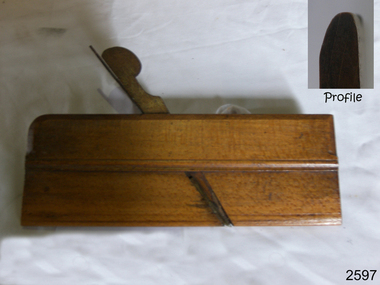 Flagstaff Hill Maritime Museum and Village
Tool - Moulding wood Plane, Richard Routledge, Mid 19th to early 20th Century
... A vintage tool made by a little known maker, this item would have been made commercially for firms and individuals that worked in wood and needed a tool that could produce a ornamental finish to timber. At a time when to produce a decorative moulding for a piece of furniture, door trims etc. had to be accomplished using hand tools and in particular one of these types of planes. ...A moulding plane is a specialised plane used for making the complex shapes found in wooden mouldings that are used to decorate furniture or other wooden object. Traditionally, moulding planes were blocks of wear resistant hardwood, often beech or maple, which were worked to the shape of the intended moulding. The blade, or iron was likewise formed to the intended moulding profile and secured in the body of the plane with a wooden wedge. A traditional cabinetmakers shop might have many, perhaps hundreds, of moulding planes for the full range of work to be performed. Large crown mouldings required planes of six or more inches in width, which demanded great strength to push and often had additional peg handles on the sides, allowing the craftsman's apprentice or other worker to pull the plane ahead of the master who guided it. All we known about Richard Routledge is that he was a tool maker and retailer that operated a business at either 23 or 64 Bull St Birmingham between 1869 to sometime in the early 20th century. There are many of his tools including decorative moulding planes of all sizes and designs for sale around the world and that his tools in particular moulding planes are well sought after by collectors of vintage tools. A vintage tool made by a little known maker, this item would have been made commercially for firms and individuals that worked in wood and needed a tool that could produce a ornamental finish to timber. At a time when to produce a decorative moulding for a piece of furniture, door trims etc. had to be accomplished using hand tools and in particular one of these types of planes. These profiled planes came in various shapes and sizes to achieve a decorative finish. A significant tool from the mid to late 19th century that today is quite rare and sought after by collectors. It gives us a snapshot of how furniture and other decorative finishes were created on timber by the use of hand tools. Moulding plane round type Marked Routledge 64 Bull Street also stamped (JAS Burden owner)flagstaff hill, warrnambool, shipwrecked-coast, flagstaff-hill, flagstaff-hill-maritime-museum, maritime-museum, shipwreck-coast, flagstaff-hill-maritime-village
