
Showing 5 items matching "gallipoli peninsula (turkey) - history"
-
 National Vietnam Veterans Museum (NVVM)
Book, A 'duty clear before us': North Beach and the Sari Bair Range
... ...Gallipoli Peninsula (Turkey) - History...World War 1914-1918 - Australia Gallipoli Peninsula (Turkey) - History Military A 'duty clear before us': North Beach and the Sari Bair Range Book Book Reid, Richard ...world war, 1914-1918 - australia, gallipoli peninsula (turkey) - history, military -
 Monbulk RSL Sub Branch
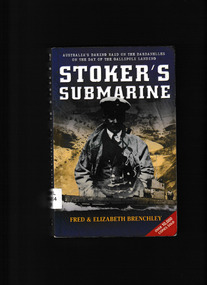
Book, Harper Collins et al, Stoker's submarine, 2003
... Gallipoli - Lieutenant Commander Dacre Stoker set out as captain of the Australian submarine AE2 on a mission to breach the treacherous Dardanelles Strait with the intention of disrupting Turkish supply lines to the isolated Gallipoli peninsula. Facing dangerous currents, mines and withering enemy fire, Stoker and his men succeeded where British and French submarines had come to grief." "Stoker's achievement meant much in military terms, and even more emotionally in boosting the morale of embattled Allied troops. But what was proclaimed at the time as 'the finest feat in submarine history ...On 25 April 1915 - the day the Anzacs landed at Gallipoli - Lieutenant Commander Dacre Stoker set out as captain of the Australian submarine AE2 on a mission to breach the treacherous Dardanelles Strait with the intention of disrupting Turkish supply lines to the isolated Gallipoli peninsula. Facing dangerous currents, mines and withering enemy fire, Stoker and his men succeeded where British and French submarines had come to grief." "Stoker's achievement meant much in military terms, and even more emotionally in boosting the morale of embattled Allied troops. But what was proclaimed at the time as 'the finest feat in submarine history' has since sunk into oblivion. Few Australians even know their country had a submarine at Gallipoli, much less that it achieved daring feats, sank an enemy craft, and possibly played a pivotal role in Anzac troops staying on the beachhead for eight months." "Now, finally, Stoker's Submarine tells the story of a remarkable naval hero and the men under his command. And the AE2 itself, still lying intact on the floor of the Sea of Marmara, is celebrated as the most tangible relic of Australia's role at Gallipoli, the crucible of nationhood.Index, bibliography, notes, ill. (some col.), maps, ports, p.318.non-fictionOn 25 April 1915 - the day the Anzacs landed at Gallipoli - Lieutenant Commander Dacre Stoker set out as captain of the Australian submarine AE2 on a mission to breach the treacherous Dardanelles Strait with the intention of disrupting Turkish supply lines to the isolated Gallipoli peninsula. Facing dangerous currents, mines and withering enemy fire, Stoker and his men succeeded where British and French submarines had come to grief." "Stoker's achievement meant much in military terms, and even more emotionally in boosting the morale of embattled Allied troops. But what was proclaimed at the time as 'the finest feat in submarine history' has since sunk into oblivion. Few Australians even know their country had a submarine at Gallipoli, much less that it achieved daring feats, sank an enemy craft, and possibly played a pivotal role in Anzac troops staying on the beachhead for eight months." "Now, finally, Stoker's Submarine tells the story of a remarkable naval hero and the men under his command. And the AE2 itself, still lying intact on the floor of the Sea of Marmara, is celebrated as the most tangible relic of Australia's role at Gallipoli, the crucible of nationhood.world war 1914-1918 - campaigns - gallipoli, gallipoli campaign - naval operations, submarine ae2 -
 Monbulk RSL Sub Branch
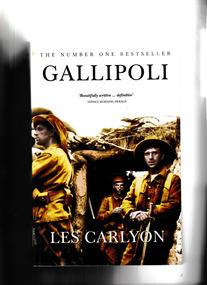
Book, Les Carlyon, Gallipoli, 2002
... world war 1914-1918 - gallipoli campaign - history anzac Examines the experiences of the soldiers of all nationalities who fought at the Gallipoli Peninsula, Turkey, in 1915, during World War I, as well as the men who led them. ...Examines the experiences of the soldiers of all nationalities who fought at the Gallipoli Peninsula, Turkey, in 1915, during World War I, as well as the men who led them. Recounts the details of the Gallipoli campaign, from the grand military and political strategies to the squalid realities of the front line.Index, bibliography, notes, ill, maps, p.543.non-fictionExamines the experiences of the soldiers of all nationalities who fought at the Gallipoli Peninsula, Turkey, in 1915, during World War I, as well as the men who led them. Recounts the details of the Gallipoli campaign, from the grand military and political strategies to the squalid realities of the front line.world war 1914-1918 - gallipoli campaign - history, anzac -
 Monbulk RSL Sub Branch
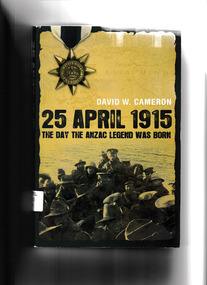
Book, David W Cameron, 25 April 1915: The day the ANZAC legend was born, 2007
... world war 1914-1918 - campaigns - gallipoli australian army - anzac corps A detailed account of what happened to the Australian, New Zealand and Turkish troops on the beaches and hills of the Gallipoli peninsula on that fateful day - the day the ANZAC legend was born. On the 25th of April 1915 Australian troops landed on the Gallipoli Peninsula in what is now called Anzac Cove. They rushed from the beach up to Plugge's Plateau into Australian military history ...A detailed account of what happened to the Australian, New Zealand and Turkish troops on the beaches and hills of the Gallipoli peninsula on that fateful day - the day the ANZAC legend was born. On the 25th of April 1915 Australian troops landed on the Gallipoli Peninsula in what is now called Anzac Cove. They rushed from the beach up to Plugge's Plateau into Australian military history suffering many casualties on the way. Just after midday troops from New Zealand landed at Gallipoli and together the Australians and New Zealanders created the Anzac legend. It was the events of this first day that set the course of the whole battle leading to the evacuation of the Anzac troops in December 1915. This is the story of that day telling the Australian, New Zealand and Turkish side of what was to become a tragedy for all three countries and an ultimate triumph for Turkey. It concludes with the visit of Charles Bean, the official Australian war correspondent, to the peninsula in 1919 as part of the Australian Historical mission to organise the burial of the dead that had lain exposed to the elements for the last four years, and to the formation of the cemeteries that are today visited by thousands. About the Author : Dr David Cameron is a biological anthropologist who has written several books. In early 2003 he conducted a preliminary survey of the Anzac Gallipoli battlefields and held numerous discussions with Turkish and Australian government officials about conservation issues relating to the Anzac area. He became interested in the actual landing and decided to write this book.--publisher. A detailed account of what happened to the Australian, New Zealand and Turkish troops on the beaches and hills of the Gallipoli peninsula on that fateful day - the day the ANZAC legend was born.Index, bibliography, notes, maps, ill, p.324.non-fictionA detailed account of what happened to the Australian, New Zealand and Turkish troops on the beaches and hills of the Gallipoli peninsula on that fateful day - the day the ANZAC legend was born. On the 25th of April 1915 Australian troops landed on the Gallipoli Peninsula in what is now called Anzac Cove. They rushed from the beach up to Plugge's Plateau into Australian military history suffering many casualties on the way. Just after midday troops from New Zealand landed at Gallipoli and together the Australians and New Zealanders created the Anzac legend. It was the events of this first day that set the course of the whole battle leading to the evacuation of the Anzac troops in December 1915. This is the story of that day telling the Australian, New Zealand and Turkish side of what was to become a tragedy for all three countries and an ultimate triumph for Turkey. It concludes with the visit of Charles Bean, the official Australian war correspondent, to the peninsula in 1919 as part of the Australian Historical mission to organise the burial of the dead that had lain exposed to the elements for the last four years, and to the formation of the cemeteries that are today visited by thousands. About the Author : Dr David Cameron is a biological anthropologist who has written several books. In early 2003 he conducted a preliminary survey of the Anzac Gallipoli battlefields and held numerous discussions with Turkish and Australian government officials about conservation issues relating to the Anzac area. He became interested in the actual landing and decided to write this book.--publisher. A detailed account of what happened to the Australian, New Zealand and Turkish troops on the beaches and hills of the Gallipoli peninsula on that fateful day - the day the ANZAC legend was born. world war 1914-1918 - campaigns - gallipoli, australian army - anzac corps -
Canterbury History Group
Book, Fiona Poulton et al, Boroondara Remembers: Stories of World War I, 2015
... On 25 April 2015, Australia and New Zealand commemorated the centenary of the Anzac landings on the Gallipoli Peninsula in Turkey. . . .To mark this significant occasion, [City of Boroondara] partnered with the Gallipoli and Beyond Committee to deliver Gallipoli and Beyond 2015 – a program of events and activities throughout 2015 to promote the historical, social and cultural understanding of the centenary. The program included:"Boroondara Remembers: Stories of World War 1" – a local account of the impact of the war on the community of the time. Winner: Local History...On 25 April 2015, Australia and New Zealand commemorated the centenary of the Anzac landings on the Gallipoli Peninsula in Turkey. . . .To mark this significant occasion, [City of Boroondara] partnered with the Gallipoli and Beyond Committee to deliver Gallipoli and Beyond 2015 – a program of events and activities throughout 2015 to promote the historical, social and cultural understanding of the centenary. The program included:"Boroondara Remembers: Stories of World War 1" – a local account of the impact of the war on the community of the time. Winner: Local History ...This brings to life the stories of the Boroondara residents who were impacted by WWI, both at home and overseas, by evocatively capturing the stories of Boroondara families and individuals whose lives were irreversibly changed by WWI. It follows the Boroondara ANZACs and their passage to war and details life at the time on the Home Front. The publication acts as a lasting legacy and provides a valuable resource for future generations.Includes photographs, notes, bibliography, archival sources and index. 211 pagesnon-fictionThis brings to life the stories of the Boroondara residents who were impacted by WWI, both at home and overseas, by evocatively capturing the stories of Boroondara families and individuals whose lives were irreversibly changed by WWI. It follows the Boroondara ANZACs and their passage to war and details life at the time on the Home Front. The publication acts as a lasting legacy and provides a valuable resource for future generations. world war 1914-1918, boroondara, oral history, personal histories, australian society
