
Showing 21 items matching "garment construction"
-
 Federation University Historical Collection
Costume, Dressmaking Samples
... garment construction...Two samples of garment construction using calico .1) sample collar with looped buttonholes, bodice includes gathering and smocking. .2) sample Peter Pan collar ...These samples are thought to have been made by students of Dressmaking at the Ballarat Technical Art School. garment construction needlework costume dressmaking textiles ballarat technical art school Two samples of garment construction using calico .1) sample collar with looped buttonholes, bodice includes gathering and smocking. .2) sample Peter Pan collar Dressmaking Samples Costume Costume ...These samples are thought to have been made by students of Dressmaking at the Ballarat Technical Art School.Two samples of garment construction using calico .1) sample collar with looped buttonholes, bodice includes gathering and smocking. .2) sample Peter Pan collar garment construction, needlework, costume, dressmaking, textiles, ballarat technical art school -
 Federation University Historical Collection
Costume, Dressmaking samples, 1947-49
... garment construction...Four samples of garment construction using calico .1) sample partial bodice with a neckline made with an outside facing finish turned at the edge and machine stitched, french seams at shoulder and darts from shoulder. .2) sample sleeve with two different cuffed ends. .3) sample sleeve with turned under bias facing and split at cuff end and four darts at shoulder. .4) sample of three pocket finishes, four covered buttonhole finishes, pintucks and seams with three different methods of finishing the raw edges, all on a sample bound by using two different methods and with one edge scalloped. .5) sample of a partial bodice with shoulder french seams, pintucks and a collar with a placket opening. ...These samples were made by Beverley Lette who was a student of Dressmaking at the Ballarat Technical Arts School. garment construction needlework costume dressmaking textiles ballarat technical art school beverley lette beverley mcbride samples Four samples of garment construction using calico .1) sample partial bodice with a neckline made with an outside facing finish turned at the edge and machine stitched, french seams at shoulder and darts from shoulder. .2) sample sleeve with two different cuffed ends. .3) sample sleeve with turned under bias facing and split at cuff end and four darts at shoulder. .4) sample of three pocket finishes, four covered buttonhole finishes, pintucks and seams with three different methods of finishing the raw edges, all on a sample bound by using two different methods and with one edge scalloped. .5) sample of a partial bodice with shoulder french seams, pintucks and a collar with a placket opening. ...These samples were made by Beverley Lette who was a student of Dressmaking at the Ballarat Technical Arts School.Four samples of garment construction using calico .1) sample partial bodice with a neckline made with an outside facing finish turned at the edge and machine stitched, french seams at shoulder and darts from shoulder. .2) sample sleeve with two different cuffed ends. .3) sample sleeve with turned under bias facing and split at cuff end and four darts at shoulder. .4) sample of three pocket finishes, four covered buttonhole finishes, pintucks and seams with three different methods of finishing the raw edges, all on a sample bound by using two different methods and with one edge scalloped. .5) sample of a partial bodice with shoulder french seams, pintucks and a collar with a placket opening. garment construction, needlework, costume, dressmaking, textiles, ballarat technical art school, beverley lette, beverley mcbride, samples -
Federation University Historical Collection
Book, Ballarat School of Mines & Industries Tertiary Orientation Programmes, 1981, 1981
... ...garment construction...Ballarat School of Mines is a predecessor institution of Federation University Australia. ballarat school of mines Tertiary orientation program TOP English Expression Applied Mathematics pure mathematics chemistry physics Ballarat College of Advanced Educaiton accreditation general mathematics home economics engineering computer science business typewriting secretarial studies Australian History World history psychology behavioural studies english literature biology Australian Media Drama film studies music Art and Design art appreciation ceramics Drawing graphic design printmaking sculpture photography painting craft Fashion economics garment construction Blue soft covered booklet outlining Tertiary Orientation Programs at the Ballarat School of Mines. ...Ballarat School of Mines is a predecessor institution of Federation University Australia.Blue soft covered booklet outlining Tertiary Orientation Programs at the Ballarat School of Mines.ballarat school of mines, tertiary orientation program, top, english expression, applied mathematics, pure mathematics, chemistry, physics, ballarat college of advanced educaiton accreditation, general mathematics, home economics, engineering, computer science, business, typewriting, secretarial studies, australian history, world history, psychology, behavioural studies, english literature, biology, australian media, drama, film studies, music, art and design, art appreciation, ceramics, drawing, graphic design, printmaking, sculpture, photography, painting, craft, fashion, economics, garment construction -
 Tennis Australia
Garment pattern, 1999
... A garment construction pattern entitled: '1898 TENNIS GOWN' from the pattern series 'AGELESS PATTERNS: VINTAGE PATTERNS FOR THEATRICAL COSTUMES'. ...Tennis A garment construction pattern entitled: '1898 TENNIS GOWN' from the pattern series 'AGELESS PATTERNS: VINTAGE PATTERNS FOR THEATRICAL COSTUMES'. ...A garment construction pattern entitled: '1898 TENNIS GOWN' from the pattern series 'AGELESS PATTERNS: VINTAGE PATTERNS FOR THEATRICAL COSTUMES'. Materials: Paper, Inktennis -
Federation University Historical Collection
Book, Ballarat School of Mines Tertiary Orientation Programs, 1980, 1980
... The courses offered were TOP Biology, Chemistry, Computer Science, Workshop Practice and Drawing, Home Economics, Applied MAthematics, General Mathematics (Computing Option), Pure Mathematics, Physical Education, Physics, Craft, Ceramics and Sculpture, Garment Construction, Graphic Communication, Graphic Design (including Design Studies and Printmaking), History of Art, Painting and Drawing, Drawing, Photography, Accounting, Advanced Typewriting, Economics, Legal Studies, Secretarial Studies, 19th Century Australian History, 20th Century Australian History, Australian Media, Behavioural Studies, Drama, English Expression, Field Studies, Film Studies, Introduction to Psychology, Literature, Music, Political Studies and Sociology. ...The courses offered were TOP Biology, Chemistry, Computer Science, Workshop Practice and Drawing, Home Economics, Applied MAthematics, General Mathematics (Computing Option), Pure Mathematics, Physical Education, Physics, Craft, Ceramics and Sculpture, Garment Construction, Graphic Communication, Graphic Design (including Design Studies and Printmaking), History of Art, Painting and Drawing, Drawing, Photography, Accounting, Advanced Typewriting, Economics, Legal Studies, Secretarial Studies, 19th Century Australian History, 20th Century Australian History, Australian Media, Behavioural Studies, Drama, English Expression, Field Studies, Film Studies, Introduction to Psychology, Literature, Music, Political Studies and Sociology. ...148 page yellow covered book outlining the Tertiary Orientation Programs offered by the Ballarat School of Mines in 1980. The courses offered were TOP Biology, Chemistry, Computer Science, Workshop Practice and Drawing, Home Economics, Applied MAthematics, General Mathematics (Computing Option), Pure Mathematics, Physical Education, Physics, Craft, Ceramics and Sculpture, Garment Construction, Graphic Communication, Graphic Design (including Design Studies and Printmaking), History of Art, Painting and Drawing, Drawing, Photography, Accounting, Advanced Typewriting, Economics, Legal Studies, Secretarial Studies, 19th Century Australian History, 20th Century Australian History, Australian Media, Behavioural Studies, Drama, English Expression, Field Studies, Film Studies, Introduction to Psychology, Literature, Music, Political Studies and Sociology. Programs were offered in Applied Science, Nursing, Physical Education, Home Economics, Engineering, Computer Science, Accounting, Secretarial, Humanities and Social Sciences, Art & Design and Fashion and Design.ballarat school of mines, tertiary orientation program, top, courses -
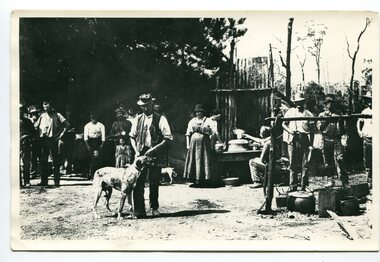 Orbost & District Historical Society
black and white photograph, C1914
... construction works at Hagen's Cutting, about two miles from Orbost, three men being killed. The victims were John Carroll, con- tractor, his son, Peter Carroll, and John Sullivan, a navvy. The gang had just finished work, and the three stayed behind to draw a blasting charge, which had missed fire yesterday. J. Carroll was using a pick, and it is presumed that the tool struck a percussion cap, and fired the charge. He and Sullivan were killed instantly, Carroll being literally blown to pieces. Fragments of his body and garments...construction works at Hagen's Cutting, about two miles from Orbost, three men being killed. The victims were John Carroll, con- tractor, his son, Peter Carroll, and John Sullivan, a navvy. The gang had just finished work, and the three stayed behind to draw a blasting charge, which had missed fire yesterday. J. Carroll was using a pick, and it is presumed that the tool struck a percussion cap, and fired the charge. He and Sullivan were killed instantly, Carroll being literally blown to pieces. Fragments of his body and garments ...This is a photograph of a railway camp, set up to house workers and their families when building the Bairnsdale to Orbost Railway from 1914-1916. The man in the foreground was one of three men killed in an explosion "noon on the railway construction works at Hagen's Cutting, about two miles from Orbost, three men being killed. The victims were John Carroll, con- tractor, his son, Peter Carroll, and John Sullivan, a navvy. The gang had just finished work, and the three stayed behind to draw a blasting charge, which had missed fire yesterday. J. Carroll was using a pick, and it is presumed that the tool struck a percussion cap, and fired the charge. He and Sullivan were killed instantly, Carroll being literally blown to pieces. Fragments of his body and garments were recovered from the surrounding bush, and the main portion of the trunk, with leg attached, was hurled a distance of 200 yards. Peter Carroll was terribly- injured, and he died before medical aid arrived." (from The Mercury Saturday March 114 1914) The Bairnsdale-Orbost railway was opened in 1916 to serve the agricultural and timber industry. Because of the decline in traffic and heavy operating costs, the line was finally closed in August, 1987. Orbost Railway Station was opened on Monday 10 April 1916 as the terminus of the Orbost railway line, and closed in 1987. The station was located on the west side of the Snowy River despite the town of Orbost being on the east side of the river, in order to save on the costs of a bridge over the river, which at the time had highly variable levels. This item is associated with the history of the Orbost-Bairnsdale railway line and therefore reflects the role that the rail line played in the social and economic history of Orbost.A black / white photograph of a campsite. There is a kitchen outside a rough construction. Men and women are standing in the backgroundd with one man and a dog in the foreground.on back - "Man with dog killed in explosion"orbost-railway transport railway-bairnsdale-orbost explosion-railway -
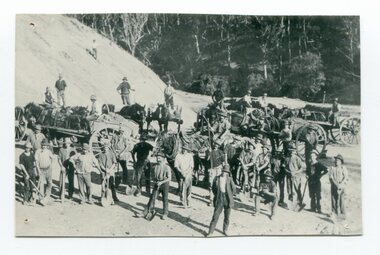 Orbost & District Historical Society
black and white photograph, C1914
... construction works at Hagen's Cutting, about two miles from Orbost, three men being killed. The victims were John Carroll, contractor, his son, Peter Carroll, and John Sullivan, a navvy. The gang had just finished work, and the three stayed behind to draw a blasting charge, which had missed fire yesterday. J. Carroll was using a pick, and it is presumed that the tool struck a percussion cap, and fired the charge. He and Sullivan were killed instantly, Carroll being literally blown to pieces. Fragments of his body and garments...construction works at Hagen's Cutting, about two miles from Orbost, three men being killed. The victims were John Carroll, contractor, his son, Peter Carroll, and John Sullivan, a navvy. The gang had just finished work, and the three stayed behind to draw a blasting charge, which had missed fire yesterday. J. Carroll was using a pick, and it is presumed that the tool struck a percussion cap, and fired the charge. He and Sullivan were killed instantly, Carroll being literally blown to pieces. Fragments of his body and garments ...This photograph shows men working in the gravel pit at Newmerella just outside Orbost. Not long after this photograph was taken an accidental explosion killed three workers. In the newspaper, The Hobart Mercury on Saturday March 1914, There was this report: "EXPLOSION OF BLASTING CHARGE. THREE MEN KILLED. MELBOURNE, March 13 A fatal accident occurred this after- noon on the railway construction works at Hagen's Cutting, about two miles from Orbost, three men being killed. The victims were John Carroll, contractor, his son, Peter Carroll, and John Sullivan, a navvy. The gang had just finished work, and the three stayed behind to draw a blasting charge, which had missed fire yesterday. J. Carroll was using a pick, and it is presumed that the tool struck a percussion cap, and fired the charge. He and Sullivan were killed instantly, Carroll being literally blown to pieces. Fragments of his body and garments were recovered from the surrounding bush, and the main portion of the trunk, with leg attached, was hurled a distance of 200 yards. Peter Car roll was terribly- injured, and he died before medical aid arrived. ' This is a pictorial record of construction workers associated with the Orbost - Bairnsdale railway. This item is associated with the history of the Orbost-Bairnsdale railway line and therefore reflects the role that the rail line played in the social and economic history of Orbost. The Bairnsdale-Orbost railway was opened in 1916 to serve the agricultural and timber industry. Because of the decline in traffic and heavy operating costs, the line was finally closed in August, 1987. A black / white photograph of a large group of men with horses and wagons. Most are holding tools - picks, spades and shovels. Some of the wagons are loaded with soil.railway-construction east-gippsland-railway orbost-railway quarry-gravel-newmerella -
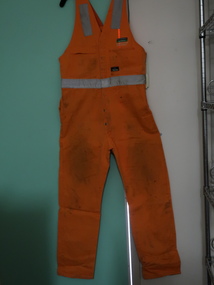 Kiewa Valley Historical Society
Clothes - Workmen - overalls and coat
... construction of a new underground Hydro Electric Hydro Electric Power Station. It is the largest Hydro Power project constructed in Australia in 25 years. Bogong Power Development created a new power station extending the Kiewa Hydro Electric Scheme and increasing the generation of renewable energy. Workman's clothes Bogong Power Development McConnell Dowell High Visibility garment ...Work clothes are made of durable fabric and the reflective tape enables it to be safe day and night. McConnell Dowell construcion company: Remote resources and energy projects - building, civil, electrical, fabrication, marine, mechanics, pipelines, rail, tunnel and underground construction. Founded in New Zealand in 1961. In 2003 it became wholly owned subsidiary of Aveng (Sth Africa). It expanded to Australia, Asia and the Middle East in he 1970s. Bogong Power Development consisting of tunnels and shafts and the construction of a new underground Hydro Electric Hydro Electric Power Station. It is the largest Hydro Power project constructed in Australia in 25 years.Bogong Power Development created a new power station extending the Kiewa Hydro Electric Scheme and increasing the generation of renewable energy.1. Overalls: Bright orange cotton gabardine overalls with 6 heavy duty studs down the front and retro reflective tape. Straps over the shoulders. The back has a large pocket sewn dividing it into 2 compartments. The front has 2 side pockets at the hip and 2 pockets at the chest. 2. Coat: Reversible red/grey coat. Sleeveless zip at the front. Pockets on each side of each layer - zip on one side and zipless on the other of each side. Waterproof grey material on one side and red warm materialo on the other. Sewn patches on the outside ".92R Yakka" "McConnell/Dowell/Bogong Power/ Development/ Safety Award/ 1 year/ 250,000" in white and green and on the grey side. "Aurora Australia/ picture/ Tunnel Boring machine"1. Black texta print 'Wiffen' and washing instructions label. workman's clothes, bogong power development, mcconnell dowell, high visibility garment -
 Bendigo Historical Society Inc.
Clothing - MAGGIE BARBER COLLECTION: LADIES FULL LENGTH BLACK SKIRT-DAMAGED, Late 1900's
... This garment is severely damaged, but it does still give insight into the inner construction of the garment. ...This garment is severely damaged, but it does still give insight into the inner construction of the garment. ...Clothing. This garment has been severely damaged - the waistband has been removed, and a 45 cm diameter circle has been cut from the polished cotton lining. There is also fabric damage adjacent to the internal side pocket seam, velvet binding at hem, stiffened linen lines the inside at the hemline - 20 cm deep, and a narrow binding of black velvet encircles the lower hemline. While the waistband has been partly removed, the original two metal hooks, and three metal eyes are still in place. This garment is severely damaged, but it does still give insight into the inner construction of the garment. Ten ''gores'' or sections make up the circle of this skirt.costume, female, full length black skirt -
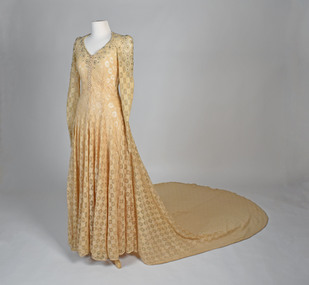 National Wool Museum
Textile - Dress
... garments by the Legacy Wives Association. This particular gown won an award (Wool Award/Gown of the Year?) in c.1957 and was on display in the window of the Georges department store in Melbourne. Fashion Australian Wool Board Lace AC / AUST WOOL BOARD Long coffee coloured wool lace evening gown with long sleeves and train. Slip under coffee coloured lace dress. Detail of bodice of coffee coloured lace dress. Photograph from C of A: Ministry of Post War Construction ...Long coffee coloured wool lace evening gown with long sleeves and train. According to the donor (see correspondence in supp. file), this gown was made from Australian wool woven in Bradford and made up in Paris. It was given to the Melbourne Legacy Wives Association by Mr Ken Clarke (former head of the Wool Board and a Legatee) for use in a parade of garments by the Legacy Wives Association. This particular gown won an award (Wool Award/Gown of the Year?) in c.1957 and was on display in the window of the Georges department store in Melbourne.Long coffee coloured wool lace evening gown with long sleeves and train. Slip under coffee coloured lace dress. Detail of bodice of coffee coloured lace dress. Photograph from C of A: Ministry of Post War Construction Report c1945 "Wool"AC / AUST WOOL BOARDfashion, australian wool board, lace -
 Embroiderers Guild, Victoria
Clothing - Christening Gown, Late 19th C
... Garments Irish christening gown. Cotton machine made broderie anglais which includes horse shoes, one section of which is upside down for luck. There is a drawstring at the neck and tie at the back waist. Machine construction ...Irish christening gown. Cotton machine made broderie anglais which includes horse shoes, one section of which is upside down for luck. There is a drawstring at the neck and tie at the back waist. Machine construction and pintucks in two bunches on the skirt.embroidery, irish, broderie anglais, christening gown, garments -
 National Wool Museum
Textile - Australian Open Sportwool Top, CSIRO Division of Textile and Fibre Technology, c. 2000s
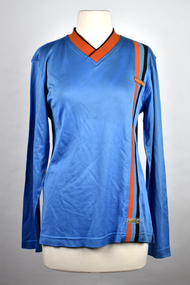
... As a result of this construction: - the wearer feels cooler more quickly and formation of liquid sweat is delayed - liquid sweat is carried away from the skin to the outside of the fabric, leaving - the inside dry and resulting in less ‘clammy’ garment cling - the wearer stays cooler when exercising - ‘post-exercise chill’ is reduced. ...As a result of this construction: - the wearer feels cooler more quickly and formation of liquid sweat is delayed - liquid sweat is carried away from the skin to the outside of the fabric, leaving - the inside dry and resulting in less ‘clammy’ garment cling - the wearer stays cooler when exercising - ‘post-exercise chill’ is reduced. ...Sportwool® was developed to combine the physical performance attributes of synthetics with the comfort and breathability of a natural fibre. It is a lightweight, composite fabric consisting of a layer of machine-washable superfine Merino wool next to the skin and a layer of tough, easy-care polyester on the outside. As a result of this construction: - the wearer feels cooler more quickly and formation of liquid sweat is delayed - liquid sweat is carried away from the skin to the outside of the fabric, leaving - the inside dry and resulting in less ‘clammy’ garment cling - the wearer stays cooler when exercising - ‘post-exercise chill’ is reduced. In addition, Sportwool® is elastic, provides UV protection and does not retain odours. Sportwool® is constructed in weights ranging from ultra-light for jogging, to thicker, heavy-duty fabric for football jerseys. It is easily printed in bright colours and designs, including information about sponsors and players. Sportwool® can also be dyed in solid colours. The development of Sportwool® was funded by The Woolmark Company (now Australian Wool Innovation Limited). Source: https://csiropedia.csiro.au/sportwool/9095.1 - Long sleeve blue sports top with with orange and navy striped detail. 9095.2 - Clothing label tag featuring a black silhouette of a tennis player, with organe and white text and orange and blue graphics on a black background. 9095.3 - Four page fold out clothing label tag, front features printed text, silhouette sports graphics and a background of an orange and blue landscape.9095.1 Australian Open / Sportwool / Sportwool 9095.2 - front: [printed] Australian Open / OFFICIAL / LICENSED / PRODUCT 9095.3 - front: [printed] SPORTWOOL / Vapour Management Technology / www.sportwool.comsportswool, australian open, athletes, clothing, the woolmark company, csiro division of textile and fibre technology, uniforms -
 Brighton Historical Society
Swimsuit, circa 1950s
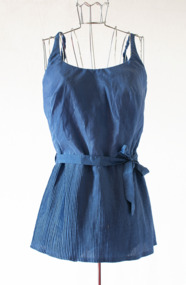
... garments. When the company began introducing padded bras, such as the one in this swimsuit, Ada insisted on using lacy floral lining and a small ribbon rosette in the centre gore, to give women a sense of quality, femininity and care in construction....garments. When the company began introducing padded bras, such as the one in this swimsuit, Ada insisted on using lacy floral lining and a small ribbon rosette in the centre gore, to give women a sense of quality, femininity and care in construction. swimwear brighton dendy street beach ada of california ada murkies toni murkies joyce fuller joyce harries Label: "Ada / OF CALIFORNIA / 38" Blue one-piece swimsuit with waist tie and short finely pleated overskirt. ...This swimsuit belonged to Brighton local Joyce Fuller, nee Harries (1920-2018), who wore it at Dendy Beach in the 1950s. Ada of California was a Melbourne swimwear company founded in the early 1950s by Brighton locals Ada and Toni Murkies. Born in Poland in 1922, Ada was 17 when the Second World War reached her doorstep. She and her family were torn from their home by Soviet soldiers and sent to a brutal labour camp in Siberia as part of a series of mass deportations. In order to escape the horrific conditions of the camp, Ada and her sister Barbara joined the Soviet-backed Polish Army. During her time in the military she became close with a handsome young Jewish officer, Lieutenant Antoni Murkies, who later became her husband. After the war Toni was awarded 15 medals including the highest Polish military honour, the Virtuti Militari. Ada was awarded 10 medals, including the Order of the Cross of Grunwald. Emigrating to Australia as postwar refugees in 1948, Ada and Toni arrived in Melbourne with little to their name. Working initially in garment factories and building their connections, by the mid-1950s the couple were able to start a company of their own, with Ada designing the garments and Toni managing the business. Within ten years, Ada of California swimwear was being sold in department stores throughout Australia, and the Murkies family were able to build a permanent home of their own in Brighton. By the early 1980s they had acquired several other major labels, including Watersun. Visiting Brighton Historical Society in 2019, Ada recalled this particular swimsuit style to be a popular one, particularly with older women, as the cinched waist and pleated modesty skirt suited many body types. This was important to her, as she wanted women of all ages and sizes to look and feel good in her swimwear, and she devoted much time and attention to the fit and finish of the garments. When the company began introducing padded bras, such as the one in this swimsuit, Ada insisted on using lacy floral lining and a small ribbon rosette in the centre gore, to give women a sense of quality, femininity and care in construction.Blue one-piece swimsuit with waist tie and short finely pleated overskirt. Sleeveless with thin elasticised straps. Inbuilt padded underwire bra with label and pale pink ribbon rosette on centre gore. Fastens with back zip.Label: "Ada / OF CALIFORNIA / 38"swimwear, brighton, dendy street beach, ada of california, ada murkies, toni murkies, joyce fuller, joyce harries -
 Embroiderers Guild, Victoria
Clothing - Irish Child's Smock, Late 19th century
... Embroidery Garments - childrens Smocking Late 19th century Ireland Based on traditional smock construction and design, made of satin jean, an Irish made cotton fabric, as is the red embroidery, a colour found rarely on smocks not of Irish origin. ...Based on traditional smock construction and design, made of satin jean, an Irish made cotton fabric, as is the red embroidery, a colour found rarely on smocks not of Irish origin.embroidery, garments - childrens, smocking, late 19th century, ireland -
 Embroiderers Guild, Victoria
Clothing - Child's Smocked Dress, Mid 19th century
... This dress is based on the traditional English smock which uses squares as a basis for the construction. Embroidery Smocking Garments - childrens Mid 19th Century England Natural coloured linen with self coloured embroidery, feather, twisted chain, cretan and buttonhole stitches used. ...This dress is based on the traditional English smock which uses squares as a basis for the construction.Natural coloured linen with self coloured embroidery, feather, twisted chain, cretan and buttonhole stitches used. Front and back are smocked with decoration on cuffs, collar and sleeves.embroidery, smocking, garments - childrens, mid 19th century, england -
 Friends of Westgarthtown
Clothing - Silk Jacket
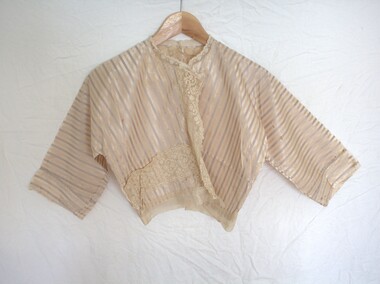
... Designed as a decorative outer garment, the jacket features delicate textile embellishments and fine construction typical of women's dresswear. ...Designed as a decorative outer garment, the jacket features delicate textile embellishments and fine construction typical of women's dresswear. ...Women's lightweight jacket made from silk, lace and cotton with an organza lining. Designed as a decorative outer garment, the jacket features delicate textile embellishments and fine construction typical of women's dresswear. Passed down to Janet Hubbard by her grandmother, Annie Ziebell, and later donated to Ziebell's Farmhouse Museum -
 Kew Historical Society Inc
Coat dress, Kenneth Pirrie, 1967-8
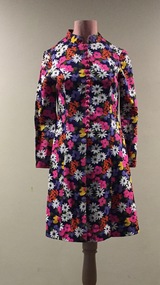
... The piece demonstrates the high-caliber printmaking and structured garment construction that earned Kenneth Pirrie national acclaim. ...This garment reflects the apex of the Australian "Youthquake" movement between 1967 and 1968. During this tight window, international mod influences from London's Carnaby Street fused heavily with local Australian manufacturing. Melbourne emerged as the absolute epicenter of the nation's revolutionary ready-to-wear "rag trade," led by visionary young designers who rebelled against traditional haute couture. Kenneth Pirrie, starting his label in 1959, became a crucial vanguard of this shift. By 1967, Pirrie was heavily commissioning his own exclusive textile prints—capitalizing on newly popularized, easy-to-launder synthetic crepes, crimplenes, and lightweight blends that mirrored the fast-paced, modern lifestyles of younger working women. The high collar and structured button-front design seen here explicitly capture the brief design transition where military tailoring elements met bright, counter-culture psychedelia.This coat dress stands as a stellar, physically intact index of mid-century Australian fashion innovation. It documents a pivotal socio-cultural era when locally manufactured ready-to-wear labels successfully captured and redirected global youth subcultures specifically for the domestic market. The piece demonstrates the high-caliber printmaking and structured garment construction that earned Kenneth Pirrie national acclaim. It provides an excellent material baseline of the late-1960s shift away from structural, monochromatic mod toward organic, vivid flower-power palettes. The dress, owned by Melbourne architect, Dione McIntyre, possesses exceptional local provenance. It highlights the local domestic and commercial history of Kew and greater Melbourne, recording what the fashion-conscious public actually bought, wore, and preserved during a period of massive industry transformationAn A-line, knee-length woman’s garment designed to function as a standalone dress or light structured coat. The piece is constructed from a dark base fabric featuring a densely populated, screen-printed psychedelic floral motif. The pattern exhibits stylized white, pink, magenta, and purple blossoms with golden-yellow centers, typifying the iconic "flower power" aesthetic of the late sixties. The garment features a structured, high Nehru collar closing directly down a central front-button placket. It has tailored, long inset sleeves terminating in clean cuffs, a fitted torso that gently flares outward from the hips into a minimalist A-line skirt, and an overall sharp, geometric silhouette.Label: Kenneth Pirriekenneth pirrie, women's clothing, australian fashion - 1970s, mcintyre collection, day wear, coat dresses -
 National Wool Museum
Clothing - Knitted Outfit, Inge Cammans, 1998
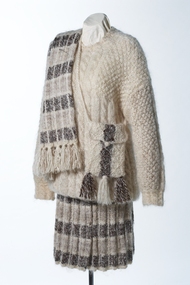
... She would take the fleece to spin and then design and knit, crochet or latch hook every item from scratch, often inspired by techniques from dressmaking, and make knitted garments appear or behave the same way, despite its very different construction. ...She would take the fleece to spin and then design and knit, crochet or latch hook every item from scratch, often inspired by techniques from dressmaking, and make knitted garments appear or behave the same way, despite its very different construction. ...Inge Cammans was born Ingenborg Flachs on 13 March 1932 in the Netherlands. She married Theodore Cammans on 27 April 1959 in Valkenburg. Inge was a dressmaker, and Theo a butcher. Later that year they emigrated to Canada, then in the mid 1960’s arrived in Australia. After arriving in Australia, they settled in East Gippsland. After some time in Sale, they moved to the small country town of Buchan and for two years they operated the local butcher shop and then took over the kiosk at Buchan Caves Reserve, which they ran for 13 years while raising their four children. Around 1980 they retired to the main street of Buchan. There they bought and restored the "Callemondah" property and opened a small craft and gallery space called the Buchan Black Marble Hut to display and sell Theo’s beautiful woodwork, stone craft and paintings. Although they were quite busy with the tourist trade, Inge fast became restless and borrowed a spinning wheel from a friend to try out. She taught herself how to spin and knit over the course of two months. From there, Inge went on to win a vast array of awards for her knitting - the house was full of walls upon walls covered in certificates, sashes, newspaper articles and pennants. She never used dye and only ever worked with natural wool, and would regularly travel out to the local farms to choose the colour of sheep she wanted. She would take the fleece to spin and then design and knit, crochet or latch hook every item from scratch, often inspired by techniques from dressmaking, and make knitted garments appear or behave the same way, despite its very different construction. This outfit was made by Inge in 1998. She was intrigued to figure out how to create the kilt pleats, the plaid pattern and the structure of the head piece. It was never intended to be worn out and about. She did knit items to wear, gift or sell, but the vast majority of her creative pieces were specifically intended as show submissions. This outfit was entered in the National Wool Awards competition in 1999 and won first prize. Hand knitted cream and brown outfit consisting of a skirt (kilt), jumper, hat (beret), scarf, socks and bag. Outfit is made using hand spun wool from local East Gippsland area, Perendale and Mohair. An artist tag and rosette award accompany the outfit.tag [front]: [handwritten] SCOTTISH OUTFIT / DESIGNED HAND- / SPUN + KNITTED OUT / OF PERRIDALE + / MOHAIR BY / Inge Cammans / [printed] BUCHAN / BLACK MARBLE HUT / GALLERY / Main Street, Box 9, / Buchan, Vic. 3885 / (051) 55 9296 / AUSTRALIA tag [back]: Theo Cammans / is an exceptionally talented individual. / He is responsible for not only / the beautiful paintings and / woodwork throughout the / shop, but also fashions the / unique Buchan Marble / into many varied and / stunning designs. / Inge Cammans / using her own hand spun / wool she has made multi / award winning garments / and wall hangings. / Each item in unique and / renowned world wide / She has taken first prize at - / National Wool Awards, / Melbourne, Lakes, Bairnsdale, Omeo / Paris Exhibitor front [rosette]: OMEO & DIST. A.&P. SOCIETY / WOOL DESIGN AWARDS / 1stknitting handicrafts, cammans, mr theo, knitting, handicrafts, east gippsland, inge cammas, buchan, migration, buchan black marble hut, awards -
 Kew Historical Society Inc
Clothing - A-Line Wrap Day Dress with Graphic Contrast Trim, Prue Acton, 1976–81
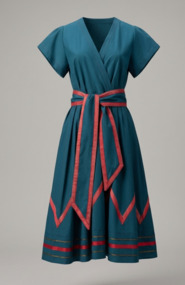
... garment features striking, avant-garde contrast borders in coral-red and gold metallic ribbon. This graphic trim accents the length of the belt, forms a bold, geometric zig-zag pattern around the lower hips, and finishes in parallel horizontal bands directly above the hemline. While the tailored cotton construction...garment features striking, avant-garde contrast borders in coral-red and gold metallic ribbon. This graphic trim accents the length of the belt, forms a bold, geometric zig-zag pattern around the lower hips, and finishes in parallel horizontal bands directly above the hemline. While the tailored cotton construction ...Prue Acton launched her label in Melbourne in 1963. Initially celebrated for capturing the youthful energy of the 1960s "Youthquake" movement, her brand underwent a significant maturity shift during the late 1970s and early 1980s. As her original teenage and twenty-something clientele entered the professional workforce, Acton transitioned her designs from playful boutique mini-dresses into sophisticated, structured, and upscale ready-to-wear pieces. This wrap day dress perfectly exemplifies that evolutionary step. It offers practical utility for the contemporary working woman while maintaining the high-impact visual flair she was known for. This specific garment reflects her obsession with pure, interacting hues. The combination of saturated teal against coral-red and gold metallic trimmings is a masterclass in complementary color dynamics. Instead of relying on traditional printed patterns, she used the structural trim itself to dictate the architecture of the dress. The wrap dress style allowed for physical ease in warmer climates, while the sharp graphic lines gave it an assertive presence. A midi-length day dress in deep teal featuring a wrapped crossover V-neckline, short fluttering tulip sleeves, and a defined waist. The dress is accompanied by a wide, matching self-tie fabric belt. The garment features striking, avant-garde contrast borders in coral-red and gold metallic ribbon. This graphic trim accents the length of the belt, forms a bold, geometric zig-zag pattern around the lower hips, and finishes in parallel horizontal bands directly above the hemline. While the tailored cotton construction echoes late-1970s daywear, the hyper-saturated colorblock palette and bold geometric patterns strongly align with Prue Acton's transition into the vibrant, structured aesthetics of the early 1980s.Label 1: "Prue Acton" Label 2: "Size 14 ..."prue acton, australian fashion -- melbourne -- 1970s, dresses -
Broadmeadows Historical Society & Museum
Clothing - Christening Gown, c. 1930's
... Its handmade construction highlights the domestic craftsmanship and resourcefulness of the era, when many families relied on inherited skills and materials to create meaningful garments. ...A handmade silk christening gown from the 1930s carries deep historical and cultural resonance, particularly given the turbulent context of the decade. The 1930s were marked by global economic hardship due to the Great Depression, as well as rising political tensions leading up to World War II. Despite these challenges, families continued to uphold traditions like christenings, which were seen as vital expressions of faith, hope, and continuity. Silk, a luxurious and delicate fabric, suggests that the gown was made with great care and possibly reserved for a special occasion or a family of some means, even during a time of widespread austerity. The handmade nature of the gown reflects the domestic skills and resourcefulness of women in the home, who often created ceremonial garments using materials they had on hand or inherited. The style of the gown—likely featuring long flowing lines, lace accents, and fine detailing—would have adhered to modest and elegant design conventions of the era. Historically, such a gown serves as a poignant reminder of how personal and religious traditions persisted through adversity. It embodies the resilience of families who maintained cultural rituals despite economic and social upheaval, and it offers insight into the intersection of fashion, faith, and domestic life during a defining period of the 20th century.This handmade silk christening gown, stylistically dated to the 1930s, is a poignant artifact from a decade marked by global economic depression and rising geopolitical unrest. Crafted during a time of widespread hardship, the gown reflects the enduring importance of religious and familial traditions, even in the face of uncertainty. The use of silk—a luxurious and delicate material—underscores the significance of the christening ceremony and suggests a deep familial commitment to preserving cultural rites. Its handmade construction highlights the domestic craftsmanship and resourcefulness of the era, when many families relied on inherited skills and materials to create meaningful garments. As a ceremonial object, the gown embodies themes of resilience, continuity, and hope, offering valuable insight into the social fabric and private lives of families during one of the most challenging periods of the 20th century. Handmade silk christening gown with lace inserts, style suggests it was made in the 1930s.christening, gown, silk, handmade -
Broadmeadows Historical Society & Museum
Clothing - Christening Gown, c. 1900's
... Its construction likely involved skilled handwork, including lace, embroidery, or pintucks, indicative of domestic craftsmanship and the importance placed on family rites of passage. As a garment ...A christening gown made of worsted cotton from the early 20th century is a distinctive artifact that reflects both the textile practices and ceremonial traditions of the time. Unlike the more commonly used fine cottons or silks, worsted cotton—known for its smooth, tightly spun yarn—would have given the gown a slightly firmer texture and greater durability while still maintaining a refined appearance. This choice of fabric suggests a practical yet elegant approach, possibly indicating a middle-class family valuing both quality and longevity in ceremonial garments. The gown likely featured traditional design elements such as a long, flowing silhouette, delicate lace or embroidery, and possibly hand-finished seams or pintucks. These garments were often handmade and passed down through generations, serving as cherished heirlooms. The use of worsted cotton may also reflect regional textile availability or a preference for sturdier materials that could withstand repeated use and laundering. Historically, such a gown embodies the intersection of faith, family heritage, and domestic craftsmanship, offering insight into early 20th-century social customs and material culture. This early 20th-century christening gown, crafted from worsted cotton, is a rare and valuable example of ceremonial infant clothing that reflects both the social customs and textile practices of its time. The use of worsted cotton—a durable, finely spun fabric more commonly associated with suiting or outerwear—distinguishes the gown from the more typical fine cotton or silk examples, suggesting a unique blend of practicality and refinement. Its construction likely involved skilled handwork, including lace, embroidery, or pintucks, indicative of domestic craftsmanship and the importance placed on family rites of passage. As a garment used in baptism, a significant religious and cultural event, the gown embodies themes of purity, tradition, and familial continuity. Its preservation offers insight into early 20th-century material culture, class sensibilities, and the evolving role of textile choices in everyday and ceremonial life.Worsted cotton christening gown from the early 20th century.christening gown, 20th century, worsted cotton
