
Showing 7 items matching "garrison cap"
-
 National Vietnam Veterans Museum (NVVM)
Uniform - Uniform, US Army, Garrison Cap
... Garrison Cap...Garrison Cap...U.S. Army garrison cap with gold trim...Garrison Cap United States Army U.S. Army garrison cap with gold trim Garrison Cap Uniform Uniform, US Army Ace Manufacturing Co. ...U.S. Army garrison cap with gold trimgarrison cap, united states army -
 National Vietnam Veterans Museum (NVVM)
Uniform - Uniform, US Army, Garrison Cap
... Garrison Cap...Garrison Cap...US Garrison Cap. Dark green and braid in colour...Garrison Cap United States Army Garrison AG-434 US Army certified No. 1-2197-A US Garrison Cap. ...US Garrison Cap. Dark green and braid in colourGarrison AG-434 US Army certified No. 1-2197-Agarrison cap, united states army -
 Running Rabbits Military Museum operated by the Upwey Belgrave RSL Sub Branch
Cap
... U.S. Garrison cap. U.S. Marine badge....Headgear WW2 US Army U.S. Garrison cap. U.S. Marine badge. Cap ...U.S. Garrison cap. U.S. Marine badge.headgear, ww2, us army -
 Mont De Lancey
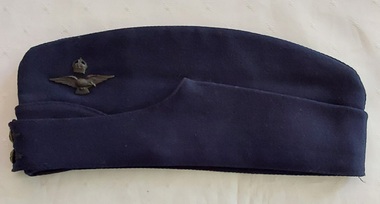
Uniform - Officer's Forage Cap, 1940's
... The blue forage cap (frequently referred to as a side cap, wedge cap, or garrison cap) during World War II was a practical, foldable soft cap widely adopted by air forces and naval units, most notably by the Royal Australian Air Force (RAAF) and Commonwealth aircrews. ...The blue forage cap (frequently referred to as a side cap, wedge cap, or garrison cap) during World War II was a practical, foldable soft cap widely adopted by air forces and naval units, most notably by the Royal Australian Air Force (RAAF) and Commonwealth aircrews. ...The blue forage cap (frequently referred to as a side cap, wedge cap, or garrison cap) during World War II was a practical, foldable soft cap widely adopted by air forces and naval units, most notably by the Royal Australian Air Force (RAAF) and Commonwealth aircrews. In bomber and fighter squadrons, a well-worn, battered forage cap became an informal badge of honor, distinguishing seasoned veterans from new arrivals ("sprogs").A navy blue cotton WW11 Officer's Forage Cap with shaped folded sides. It has a fastening at the front with two small brass buttons with wings and a crown insignia attached. There is a brass badge with an albatross/eagle and a king's crown above. Inside is a black cotton lining with a blue velvet band at the top. There is a white cotton piece of cloth with the cap details stitched inside. The clips to hold the badge on the outside can be seen inside on the lining. Sewn inside the cap on a white piece of cotton is stamped: 'V330 1944 Made in Australia Size 71/8 A-(arrow)F' A sewn name tag 'Sumner' is stitched too.ww11 uniform, ww11 badge, ww11, ww11raaf, ww11 cap, forage cap -
 Mont De Lancey
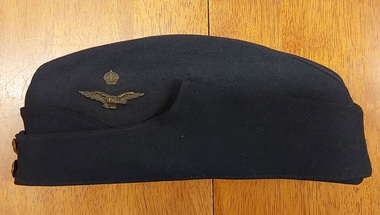
Uniform - Officer's Forage Cap, 1940's
... The blue forage cap (frequently referred to as a side cap, wedge cap, or garrison cap) during World War II was a practical, foldable soft cap widely adopted by air forces and naval units, most notably by the Royal Australian Air Force (RAAF) and Commonwealth aircrews. ...The blue forage cap (frequently referred to as a side cap, wedge cap, or garrison cap) during World War II was a practical, foldable soft cap widely adopted by air forces and naval units, most notably by the Royal Australian Air Force (RAAF) and Commonwealth aircrews. ...The blue forage cap (frequently referred to as a side cap, wedge cap, or garrison cap) during World War II was a practical, foldable soft cap widely adopted by air forces and naval units, most notably by the Royal Australian Air Force (RAAF) and Commonwealth aircrews. In bomber and fighter squadrons, a well-worn, battered forage cap became an informal badge of honor, distinguishing seasoned veterans from new arrivals ("sprogs"). It was worn by Ralph Proctor.A navy blue woollen WW11 Officer's Forage Cap with shaped folded sides. It has a fastening at the front with two small brass buttons with wings and a crown insignia attached. There is attached a brass badge with an albatross/eagle and a king's crown above. Inside is a brown lining with a brown velvet band at the top. A large safety pin on the lining holds the crown closed from the outside. The clips to hold the badges on the outside can be seen inside on the lining. It was issued in 1943.Inside the cap is stamped: 'MV(faded unknown letter)D 58'ww11 uniform, ww11 badge, ww11, ww11raaf, ww11 cap, forage cap -
 Flagstaff Hill Maritime Museum and Village
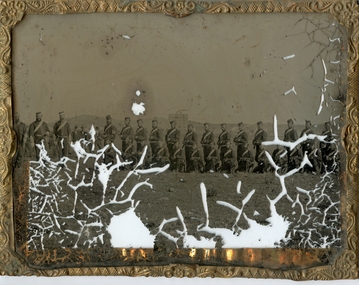
Photograph - Glass plate, circa 1866
... The photograph is also the only example of the early methods of glass plate photography in our collection. flagstaff hill warrnambool shipwrecked coast flagstaff hill maritime museum maritime museum shipwreck coast flagstaff hill maritime village great ocean road glass plate photography 19th century colonial forces military defence volunteer act 1854 volunteer rifle garrison artillery volunteer corps militia militia garrison band pillbox forage caps helpmann manifold and bostock 1853 lee enfield musket tintype Warrnambool Garrison 1860s Cannon Hill Manifold & Bostock flour mill 3-storey building Photograph, rectangular glass plate, positive sepia image. ...This glass plate photograph shows good detail of members of the Warrnambool Garrison posing for their photograph in front of a young township. There are other well-dressed citizens behind them. The three men with frogging on their sleeves were commanders were likely to be commanders. The men are facing north with Cannon Hill and the fortification area in the background. It dates from the 1860s. The firearms held appear to be 1853 pattern Lee Enfield muskets used by the British army in Crimea at this time and in Australia, rather than the later Martini Henry cartridge rifles. The uniforms match other photos of the Warrnambool Garrison Militia and Band in our Collection, taken up until the 1880s. The three storey building in the photograph is likely to be the Manifold & Bostock flour mill, built in 1854 near the ‘cutting’ in Merri Street, which was one of the main streets at the time; if one faced the building’s front from a vantage point and looked south to south-east, the hills around Flagstaff Hill and Cannon Hill would be behind that mill, and the Harbour behind the hills. This is the area of the Fortifications. The glass plate method of photography was widely used during the mid-19th to early-20th century. The donor and maker of the photograph are unknown. Around this time the citizens of Victoria were prospering from the gold rush but felt isolated and uneasy about their security in the colony. In 1854 the Volunteer Act was passed to provide some military defence. In 1858 the Warrnambool Volunteer Rifle Corps was established, disbanded in 1863, then a new Warrnambool Detachment was formed in September 1866. Legislation was passed in 1884 that replaced the volunteers’ corps with a partly paid, permanent Militia Defence Force. The batteries manning the coastal forts of Victoria were termed Garrison Artillery Companies. When the Army was federated in 1901 there were eight Militia Companies in Victoria. Warrnambool and Port Fairy together were known as 8 Coy AGA (Australian Garrison Artillery). Changes to formation and name continued into the 20th century.This photograph is a record of the very early local defence force, circa 1866. The photograph signifies the connection of the colony in Victoria to the growing need for security due to the unrest in Europe at that time. The photograph is also locally significant to the industry of the young township of Warrnambool, showing what is likely to be one of the first flour mills in the town. The photograph is also the only example of the early methods of glass plate photography in our collection. Photograph, rectangular glass plate, positive sepia image. Photograph has brass framed edges that fold over to the back, with mitred corners. The front edges are pressed with a decorative floral pattern. The photograph shows a group of thirty military men, standing or kneeling, in dark uniforms with pillbox forage caps, round-collared jackets with light buttons, light sashes worn from top left shoulder to bottom right side of waist belt, and long, straight-legged trousers. Three of these men have light braid around the buttons on the front of their jackets, light frogging on their sleeve cuffs and stripes on the outside seams of their trousers. The other twenty-seven men have plain uniforms and are holding firearms in their right hands, steadied with their left hands. Other figures are standing behind this group of soldiers, including three or four men wearing top hats, jackets and ties. In the background is a row of buildings. The central building is three stories high. Bare hills are in the far background. The foreground is uneven ground with patches of short grass. Photographer looking towards the south east and Cannon Hill, with the Warrnambool Garrison facing north, ca.1860s.flagstaff hill, warrnambool, shipwrecked coast, flagstaff hill maritime museum, maritime museum, shipwreck coast, flagstaff hill maritime village, great ocean road, glass plate, photography 19th century, colonial forces, military defence, volunteer act 1854, volunteer rifle, garrison artillery, volunteer corps, militia, militia garrison band, pillbox forage caps, helpmann, manifold and bostock, 1853 lee enfield musket, tintype, warrnambool garrison, 1860s, cannon hill, manifold & bostock, flour mill, 3-storey building -
 Tatura Irrigation & Wartime Camps Museum
Photograph
... Captain Maddigan and his family were at Camp 4. madigan captain 1944 camp 4 garrison Black and white photograph of Captain Maddigan, peak cap, kneeling with his 5 year old daughter standing, straddled across his left leg. ...Captain Maddigan and his family were at Camp 4.Black and white photograph of Captain Maddigan, peak cap, kneeling with his 5 year old daughter standing, straddled across his left leg. Behind is a bushy tree and the Australian flag. 2/3 in the photograph an Army hut, right of picture, with hedge and a man behind Captain Maddigan.madigan, captain, 1944, camp 4 garrison
