
Showing 27 items matching "gasoline"
-
 National Vietnam Veterans Museum (NVVM)
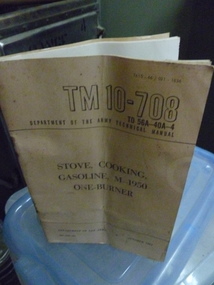
Pamphlet, Stove, Cooking, Gasoline, M-1950 One Burner, 1/10/1951 12:00:00 AM
... Stove, Cooking, Gasoline, M-1950 One Burner...Stove, Cooking, Gasoline, M-1950. One Burner. Dept Of the Army 1951/ TM 10-708...Stove Phamphlet Stove, Cooking, Gasoline, M-1950. One Burner. Dept Of the Army 1951/ TM 10-708 Small buff coloured instruction manual for operation of M-1950 Stove Stove, Cooking, Gasoline, M-1950 One Burner Pamphlet Pamphlet Department Of supply ...Small buff coloured instruction manual for operation of M-1950 StoveStove, Cooking, Gasoline, M-1950. One Burner. Dept Of the Army 1951/ TM 10-708stove, phamphlet -
 Moorabbin Air Museum
Book (Item) - Supplement To Dyke's Automobile And Gasoline Engine Encyclopedia
... Supplement To Dyke's Automobile And Gasoline Engine Encyclopedia...Treating Carburettors , Gasoline Fuel Feed Systems , Air Cleaners , Superchargers , Ricardo Cylinder Head Engine Bearings....Supplement To Dyke's Automobile And Gasoline Engine Encyclopedia Book Supplement To Dyke's Automobile And Gasoline Engine Encyclopedia ...Treating Carburettors , Gasoline Fuel Feed Systems , Air Cleaners , Superchargers , Ricardo Cylinder Head Engine Bearings. -
Emerald Museum & Nobelius Heritage Park
Domestic object - Gasoline Lantern, Coleman, 1936-1942
... ...gasoline...Coleman gasoline lantern, model 242B made 1936-1942. ...Model details on middle section ( near burner) Port Lite - no 242B, instant lighting for gasoline only...Model details on middle section ( near burner) Port Lite - no 242B, instant lighting for gasoline only Coleman gasoline lantern, model 242B made 1936-1942. ...Coleman gasoline lantern, model 242B made 1936-1942. H - 33cm, green enamel top, silver coloured base. No glass or mantle. Branded on base "Coleman - trade mark registered, The sunshine of the night. Model details on middle section ( near burner) Port Lite - no 242B, instant lighting for gasoline onlyBranded on base "Coleman - trade mark registered, The sunshine of the night. Model details on middle section ( near burner) Port Lite - no 242B, instant lighting for gasoline onlycoleman lamp, lantern, gasoline -
 Bendigo Military Museum
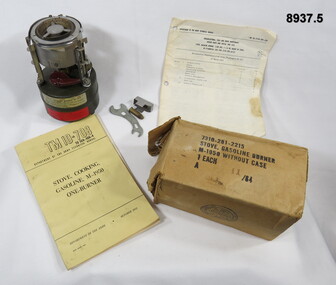
Equipment - PETROL STOVE, Department of Army, 1950
... The one-burner M1950 gasoline cooking stove is a cooking and heating unit. ...“Stove, Cooking Gasoline M-1950 - ne-Burner - Department of Army”...The one-burner M1950 gasoline cooking stove is a cooking and heating unit. ...1. The one-burner M1950 gasoline cooking stove is a cooking and heating unit. The stove is small and light and operates on gasoline. 2. Maitenance spanner and spare gas jet. 3. TM10-708 Department of Army Technical Manual 1951. 4. TM10-708 Repair parts and tool lists. 5. Packaging (cardboard box) Stove Gasoline burner. “Stove, Cooking Gasoline M-1950 - ne-Burner - Department of Army”passchendaele barracks trust, pbt263, equipment, stove, cooking -
4th/19th Prince of Wales's Light Horse Regiment Unit History Room
Technical Manual, United States Government Printing Office, STOVE, COOKING, GASOLINE, M-1950 ONE BURNER, 10/1951
... STOVE, COOKING, GASOLINE, M-1950 ONE BURNER...STOVE, COOKING, GASOLINE, M-1950 ONE BURNER Technical Manual United States Government Printing Office Department of the Army ...Used with single burner petrol stoves issued to vehicle crews from 1960'sUser manual. Department of the Army Technical Manual TM 10-708cooking, stove, field equipment, user manual -
4th/19th Prince of Wales's Light Horse Regiment Unit History Room
Technical Manual, J Williams, Stove, Cooking, Gasoline, M-1950, One Burner, 1951
... Stove, Cooking, Gasoline, M-1950, One Burner...stove petrol TM 10-708 Soft covered booklet Stove, Cooking, Gasoline, M-1950, One Burner Technical Manual J Williams ...Soft covered bookletTM 10-708stove, petrol -
Moorabbin Air Museum
Book (Item) - Supplement To Dyke's Automobile And Gasoline Engine Encyclopedia
... Supplement To Dyke's Automobile And Gasoline Engine Encyclopedia...Haddon , B.Sc Supplement To Dyke's Automobile And Gasoline Engine Encyclopedia Book Supplement To Dyke's Automobile And Gasoline Engine Encyclopedia ...By J . D . Haddon , B.Sc -
 National Vietnam Veterans Museum (NVVM)
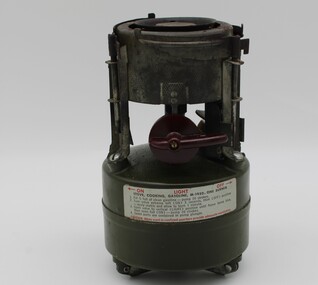
Equipment - Stove, camp
... M-1950, one burner gasoline cooking stove. ...M-1950, one burner gasoline cooking stove. Equipment Stove, camp ...Standard issue item as used by Australian servicemen during the conflict in Vietnam. M-1950, one burner gasoline cooking stove. Refer to media image. -
 National Vietnam Veterans Museum (NVVM)
Equipment - Equipment, Army, 1965
... Stove Gasoline burner M-1950...Stove Stove Gasoline burner M-1950 Personal petrol one burner stove with three swing out feet, and three swing out grate arms. ...Personal petrol one burner stove with three swing out feet, and three swing out grate arms. Petrol tank at baseStove Gasoline burner M-1950stove -
 National Vietnam Veterans Museum (NVVM)
Equipment - Equipment, Army, Field Stove, 1951
... Gasoline field stove with moveable legs and extendable arms for larger dixies...Stove Field Stove Rogers Akron, Ohio 1951 Gasoline field stove with moveable legs and extendable arms for larger dixies Field Stove Equipment Equipment, Army Rogers - Akron ...Gasoline field stove with moveable legs and extendable arms for larger dixiesRogers Akron, Ohio 1951stove, field stove -
 National Vietnam Veterans Museum (NVVM)
Functional Object, Stove
... Portable gasoline stove used by soldiers in Vietnam. Black metal with a maroon tap to operate....Gasoline Stove Portable gasoline stove used by soldiers in Vietnam. ...Portable gasoline stove used by soldiers in Vietnam. Black metal with a maroon tap to operate.gasoline stove -
 National Vietnam Veterans Museum (NVVM)
Equipment - Equipment, Army, 1964
... Stove gasoline burner M-1950. US "Rogers" Akron, Ohio...Stove Stove gasoline burner M-1950. US "Rogers" Akron, Ohio Personal petrol one burner stove with three swing out feet and three swing out grate arms. petrol tank at base Equipment Equipment, Army Rogers-Akron ...Personal petrol one burner stove with three swing out feet and three swing out grate arms. petrol tank at baseStove gasoline burner M-1950. US "Rogers" Akron, Ohiostove -
 Bendigo Military Museum
Equipment - COOKING STOVE
... Green metal Gasoline cylinder, stainless steel burner, brown plastic on/off switch, three metal legs fold out from bottom of cylinder....M1950 Equipment Cooking Stove M-1950 Green metal Gasoline cylinder, stainless steel burner, brown plastic on/off switch, three metal legs fold out from bottom of cylinder. ...One burner stove. M1950Green metal Gasoline cylinder, stainless steel burner, brown plastic on/off switch, three metal legs fold out from bottom of cylinder.M-1950equipment, cooking, stove -
 Maldon Vintage Machinery Museum Inc
Petrol Engine, Early 20th century
... On a brass plate fixed to the cylinder. "Waterloo Boy Gasoline Engine / No. 81491, HP 4 / Waterloo Gasoline Engine Co. / Waterloo Iowa / Patented / August 7 1900, Dec 3 1901, Oct 7 1907 / Other patents pending / Sold by Waterloo Gasoline Engine Co." ...machinery ... engine ... petrol ... metalwork On a brass plate fixed to the cylinder. "Waterloo Boy Gasoline Engine / No. 81491, HP 4 / Waterloo Gasoline Engine Co. / Waterloo Iowa / Patented / August 7 1900, Dec 3 1901, Oct 7 1907 / Other patents pending / Sold by Waterloo Gasoline Engine Co." ...Single cylinder horizontal petrol engine mounted on a 4 wheeled trolley. Two flywheels, one either side, no pulley. Galvanised cylindrical fuel tank mounted on a wooden box in front. Box contains a battery and ignition coil. Trolley has cast iron wheels and is designed for pulling by hand. Painted red and grey. Probably a power source for farm machinery. On a brass plate fixed to the cylinder. "Waterloo Boy Gasoline Engine / No. 81491, HP 4 / Waterloo Gasoline Engine Co. / Waterloo Iowa / Patented / August 7 1900, Dec 3 1901, Oct 7 1907 / Other patents pending / Sold by Waterloo Gasoline Engine Co." On each side of the water tank is an oval white transfer with "Waterloo Boy" above an illustration of a small boy wearing a wide brimmed hat.machinery ... engine ... petrol ... metalwork -
 Bendigo Military Museum
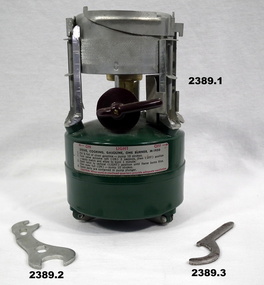
Equipment - PETROL STOVE, Rogers Tool and Die Co Inc, 1951
... .1) Stove, cooking Gasoline, one burner, Model M-1950. .2) Spanner for above stove. .3) Tool for above stove. .4) Cardboard carton for above stove....domestic items-cooking military equipment - army .1) Stove, cooking Gasoline, one burner, Model M-1950. .2) Spanner for above stove. .3) Tool for above stove. .4) Cardboard carton for above stove. ....1) Stove, cooking Gasoline, one burner, Model M-1950. .2) Spanner for above stove. .3) Tool for above stove. .4) Cardboard carton for above stove.domestic items-cooking, military equipment - army -
 Flagstaff Hill Maritime Museum and Village
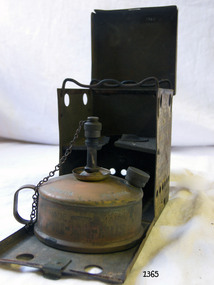
Stove
... Burns auto-fuel benzine, benzoline, gasoline etc. Described as "Original Primus No. 70" "Household, Picnics, Boy Scouts, Motoring, Boating, Camping." ...Burns auto-fuel benzine, benzoline, gasoline etc. Described as "Original Primus No. 70" "Household, Picnics, Boy Scouts, Motoring, Boating, Camping." ...Stove portable Primus in a tin container. Burns auto-fuel benzine, benzoline, gasoline etc. Described as "Original Primus No. 70" "Household, Picnics, Boy Scouts, Motoring, Boating, Camping." Contained in rectangular tin, with metal shelving through which burner protrudes. Two-wire grill to hold containers for cooking. Made in Sweden by A.B.A.Huorth & Co.flagstaff hill, warrnambool, shipwrecked-coast, flagstaff-hill, flagstaff-hill-maritime-museum, maritime-museum, shipwreck-coast, flagstaff-hill-maritime-village -
 Wodonga & District Historical Society Inc
Domestic object - COLEMAN Fuel Iron
... The best known and most commonly found today is the “Cool Blue” enamel Coleman’s 4A gasoline iron. The Coleman 4A gasoline iron was much lighter than the previous ‘sad irons’ and no longer required to be heated on the stove or by charcoal. ...The best known and most commonly found today is the “Cool Blue” enamel Coleman’s 4A gasoline iron. The Coleman 4A gasoline iron was much lighter than the previous ‘sad irons’ and no longer required to be heated on the stove or by charcoal. ...Coleman, originally known for making lanterns, made over 30 different models of irons from 1929 to 1948. They generally came in an enamel coloured finish. The best known and most commonly found today is the “Cool Blue” enamel Coleman’s 4A gasoline iron. The Coleman 4A gasoline iron was much lighter than the previous ‘sad irons’ and no longer required to be heated on the stove or by charcoal. Instead, the pump was used to build up pressure in the fuel tank and a match was lit underneath the iron, making a flame inside the iron that would distribute the heat on the surface. Despite these benefits, fuels irons made ironing a potentially dangerous job. They had a very real possibility of causing a fire or exploding. Gas-pressure irons, that had been manufactured as early as 1900, were eventually replaced by electric-powered steam irons, in the 1970s as an affordable and safer alternative.This item is significant because it is an example of domestic appliances used widely throughout the Wodonga District.A self-heating iron which made from metal and enamel plate which included a small tank for fuel which powered the unit. A small wooden pump was used to build up pressure in the iron’s fuel tank. It has a wooden handle.domestic appliances, coleman fuel irons -
 Coal Creek Community Park & Museum
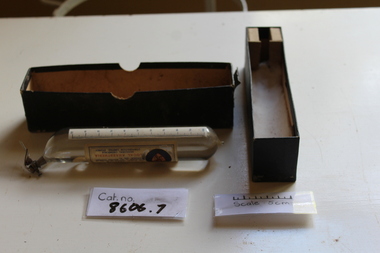
Equipment - Ethyl Chloride
... Chloroethane, commonly known by its old name ethyl chloride, is a chemical compound with chemical formula CH3CH2Cl, once widely used in producing tetraethyllead, a gasoline additive. It is a colorless, flammable gas or refrigerated liquid with a faintly sweet odor. ...Chloroethane, commonly known by its old name ethyl chloride, is a chemical compound with chemical formula CH3CH2Cl, once widely used in producing tetraethyllead, a gasoline additive. It is a colorless, flammable gas or refrigerated liquid with a faintly sweet odor. ...Chloroethane, commonly known by its old name ethyl chloride, is a chemical compound with chemical formula CH3CH2Cl, once widely used in producing tetraethyllead, a gasoline additive. It is a colorless, flammable gas or refrigerated liquid with a faintly sweet odor. Originally, it was proposed as a general anaesthetic, filling the gap between the weaker narcotic nitrous oxide and the more powerful drugs ether and chloroform. 8670.1 - Dark blue cardboard lid. 8670.2 - Dark Blue cardboard box. 8670.3 - Cotton ball padding. 8670.4 - Semi circle cardboard. 8670.5 - Small rectangular boxes (2) placed either side of the top of the cylinder. 8670.6 - Glass cylinder with metal fitting. 8670.7 - Paper label on cylinder.- 100 c.c./- MEDCO./- 3 1/2 fl. oz./- ETHYL CHLORIDE./- Pure./- This conforms to all the requirements of the BRITISH PHARMACOPOEIA. 1932./- LOCAL ANAESTHESIA/- MEDICINAL CHEMICALS CORPOATION LIMITED. SYDNEY. -
 Tramways/East Melbourne RSL Sub Branch - RSL Victoria Listing id: 27511
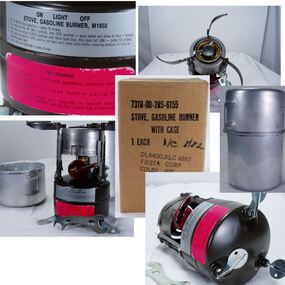
Stove Cooking Gasoline, M-1950 Burner, 2/66
... US Army Rogers M-1950 Stove Portable Gasoline Burner Vietnam Era Removable Hand pump set into base to pressurise fuel Maroon plastic flame control valve handle, that swings left to right through 180 degrees. ...Still fully operational M-1950 Burner Stove Cooking Gasoline ...US Army Rogers M-1950 Stove Portable Gasoline Burner Vietnam Era Removable Hand pump set into base to pressurise fuel Maroon plastic flame control valve handle, that swings left to right through 180 degrees. Purpose built service spanner secured between burner support legs. Operating Instruction have worn off. Significant damage to Safety warning label. Still fully operational1 Gold adhesive label with Operating Instructions 1 Red adhesive label with Safety Warning under instructions -
 City of Moorabbin Historical Society (Operating the Box Cottage Museum)
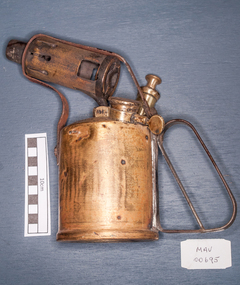
Tools, Blow-torch brass, 20thC
... The US blowlamp was independently developed with a distinctive flared base and was fuelled by gasoline, whereas the European versions used kerosene for safety and low cost....The US blowlamp was independently developed with a distinctive flared base and was fuelled by gasoline, whereas the European versions used kerosene for safety and low cost. ...A blowtorch is a fuel-burning tool used for applying flame and heat to various applications, usually metalworking. Early blowlamps used liquid fuel, carried in a refillable reservoir attached to the lamp. Modern blowtorches are mostly gas-fuelled. Their fuel reservoir is disposable or refillable by exchange. The term "blowlamp" usually refers to liquid-fuelled torches still used in the UK. Liquid-fuelled torches are pressurized by a piston hand pump, while gas torches are self-pressurized by the fuel evaporation. In 1882, a new vaporizing technique was developed by C. R. Nyberg in Sweden, and the year after, the production of the Nyberg blow lamp started. It was quickly copied or licensed by many other manufacturers. The US blowlamp was independently developed with a distinctive flared base and was fuelled by gasoline, whereas the European versions used kerosene for safety and low cost.The family of Mr Howcroft were early settlers in Moorabbin ShireA brass blow-torch B.A. HJOP Co. STOCKHOLM SWEDENblowtorch, stockholm sweden, welding, moorabbin, cheltenham, bentleigh, early settlers -
 Wodonga & District Historical Society Inc
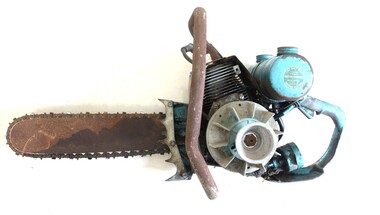
Tool - L-30 Chain saw, Lombard, 1962 - 1964
... On side of fuel tank: "ONE HALF PINT/SAE-30 OIL/ FOR EACH/ GALLON GASOLINE/ MIX WELL IN SEPARATE CONTAINER/BEFORE FILLING" On opposite side: "STARTING INSTRUCTIONS 1: FILL FUEL TANK WITH PROPER FUEL MIXTURE ( AS NOTED ON TANK) 2. ...Hand tools Vintage chainsaws David Mann Mann Wodonga On side of fuel tank: "ONE HALF PINT/SAE-30 OIL/ FOR EACH/ GALLON GASOLINE/ MIX WELL IN SEPARATE CONTAINER/BEFORE FILLING" On opposite side: "STARTING INSTRUCTIONS 1: FILL FUEL TANK WITH PROPER FUEL MIXTURE ( AS NOTED ON TANK) 2. ...This chainsaw was one of the earliest models sold in Australia. It was manufactured by the Lombard company which was established in 1894 when Nathaniel Lombard developed the first practical water wheel governor in Roxbury, Massachusetts, USA. In 1904, the company moved to Ashland, Massachusetts. During the first World War, Lombard Governor produced hydraulic lathes for the manufacture of artillery shells At the conclusion of the war, Lombard expanded into the areas of chain saws and plastic molding injection machines. This model, the L-30 was only produced for 2 years from 1962 - 1964, primarily due to safety concerns and the fact that it did not have any way to sharpen or tighten the chain. This chainsaw was sold by Mann of Wodonga and donated to the Wodonga and District Historical society by David Mann, owner and manager of Mann Wodonga.This item is significant as it was produced for a limited time. It was also sold by a prominent Wodonga business.A single operator chain saw from Lombard, Ashland, Massachusetts, USA. The chainsaw was relatively lightweight but had no safety features such as a chain brake. It was made primarily of sand cast magnesium. The main cylinder was constructed of aluminium with a cast iron sleeve. It had a manual oil pump, the crankshaft operated on ball bearings and it had a maximum rpm of 4,500. See the Model profile in the accompanying Media item for details.On side of fuel tank: "ONE HALF PINT/SAE-30 OIL/ FOR EACH/ GALLON GASOLINE/ MIX WELL IN SEPARATE CONTAINER/BEFORE FILLING" On opposite side: "STARTING INSTRUCTIONS 1: FILL FUEL TANK WITH PROPER FUEL MIXTURE ( AS NOTED ON TANK) 2. FILL OIL RESERVOIR WITH #30 MOTOR OIL 3. CLOSE CHOKE, MOVE LEVER BACK TOWARDS AIR FILTER 4. HOLD THROTTLE WIDE OPEN 5. PULL STARTER HANDLE SLOWLY UNTIL STARTER ENGAGES, THEN GIVE IT A SHARP YANK 6. AS ENGINE WARMS UP, EASE CHOKE LEVER TO OPEN POSITION"hand tools, vintage chainsaws, david mann, mann wodonga -
 Upper Yarra Museum
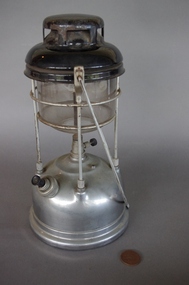
Lamp, Tilley Lamp Company
... This pressure allows a steady flow of the gasoline and a constant light ...This pressure allows a steady flow of the gasoline and a constant light lantern tilley pump pressure mantle kerosene methylated spirits stainless steel lamp kerosene lamp round glass cylinder Base - Sticker Tilley Lamp Model X246 Etched on glass shade Tilley, Durosil, ITI, Heat Resistant. ...http://en.wikipedia.org/wiki/File:Tilley-storm-lantern-X246-May- Tilley storm lantern, this model has been in production since 1964 The Tilley Lamp derives from John Tilley’s invention of the hydro-pneumatic blowpipe in 1813 in England. http://en.wikipedia.org/wiki/Kerosene_lamp#Pressure_lamp Pressure lamps are far more sophisticated than wick lamps and produce a much brighter light, although they can be quite complicated and fiddly to use. This type of lamp is commonly known in the UK as a "Tilley lamp", after a manufacturer of the same name, and in North America as a "Coleman lantern" for similar reasons. A kerosene blowtorch displaying the various aspects of the kerosene burnerA pressure lamp has a fuel tank at the bottom with a small pump to pressurise the kerosene. There is a narrow gap up to the top of the lamp, called a flue, and at the top of the lamp there is a burner (gas outlet). Directly underneath the burner is the mantle, a fabric bag coated with chemicals that incandesce when heated by the gas flame. The burner lamp is known for its brightness. It is so bright because of the amount of pressure that is placed onto the wick. This pressure allows a steady flow of the gasoline and a constant light Tilley Storm Pressure Lantern, model no x246 has a stainless steel base which is filled with kerosene, with a pump used to pressurize the kerosene vapor. Under the base is a sticker.On top is a black hood with vents which sits on the glass heat resistant shade. The glass shade has an etched label. It has a white and pink mantle on the central rod with a long shaped stainless steel handle, this folds down when not in use.Base - Sticker Tilley Lamp Model X246 Etched on glass shade Tilley, Durosil, ITI, Heat Resistant. Made in Englandlantern tilley pump pressure mantle kerosene methylated spirits stainless steel lamp kerosene lamp round glass cylinder -
 City of Moorabbin Historical Society (Operating the Box Cottage Museum)
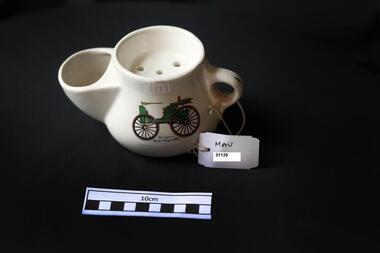
Personal Effects, china shaving mug / scuttle, c1950
... Transfer ; The Duryea Motor Wagon was among the first standardized automobiles and among the first powered by gasoline. Fifteen examples were built by the Duryea Motor Wagon Company of Chicopee, Massachusetts, between 1893 and 1896. ...Transfer ; The Duryea Motor Wagon was among the first standardized automobiles and among the first powered by gasoline. Fifteen examples were built by the Duryea Motor Wagon Company of Chicopee, Massachusetts, between 1893 and 1896. ...Shaving soap scuttles are distinguished from shaving mugs by having a separate area for hot water. The hot water is for dipping a shaving brush into to make a lather with the soap which is then applied to the skin before using the razor. Vintage scuttles are often elaborately decorated. Between 1880 and 1920 is the original time period for the occupational shaving mug. Most men owned a shaving mug, either at home or at a barber shop. Mugs purchased for home use typically were purchased through local stores, had more variety in style but usually went without a name. Barber shops sold mugs with the owners’ names on them partly because they thought that shaving rash came from sharing the same soap. In reality, the rash was not a result of soap but of unsterilized razors. Transfer ; The Duryea Motor Wagon was among the first standardized automobiles and among the first powered by gasoline. Fifteen examples were built by the Duryea Motor Wagon Company of Chicopee, Massachusetts, between 1893 and 1896. Their enterprise followed the first commercially available automobile which was patented by Karl Benz on January 29, 1886, and put into production in 1888. The Duryea Motor Wagon remained in production until 1917. The Duryea brothers entered their horseless carriage in many shows and races. A china shaving mug / scuttle with a car transfer. The mug has a wide spout to hold / insert the shaving brush , a perforated tray opening at the top to hold the soap and a bulbous base for the hot water. car transfershaving equipment, safety razors, cheltenham, early settlers, moorabbin, shaving soap sticks, shaving brushes, shaving scuttles, shaving rash, infectious diseases, barber shops, -
 Flagstaff Hill Maritime Museum and Village
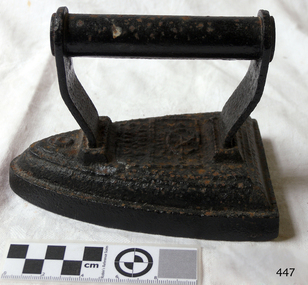
Domestic object - Iron
... In the late nineteenth and early twentieth centuries, there were many irons in use that were heated by fuels such as kerosene, ethanol, whale oil, natural gas, carbide gas (acetylene, as with carbide lamps), or even gasoline. Some houses were equipped with a system of pipes for distributing natural gas or carbide gas to different rooms in order to operate appliances such as irons, in addition to lights. ...In the late nineteenth and early twentieth centuries, there were many irons in use that were heated by fuels such as kerosene, ethanol, whale oil, natural gas, carbide gas (acetylene, as with carbide lamps), or even gasoline. Some houses were equipped with a system of pipes for distributing natural gas or carbide gas to different rooms in order to operate appliances such as irons, in addition to lights. ...Before the introduction of electricity, irons were heated by combustion, either in a fire or with some internal arrangement. An "electric flatiron" was invented by American Henry Seely White and patented on June 6, 1882. It weighed almost 15 pounds (6.8 kg) and took a long time to heat. The UK Electricity Association is reported to have said that an electric iron with a carbon arc appeared in France in 1880, but this is considered doubtful. Two of the oldest sorts of iron were either containers filled with a burning substance, or solid lumps of metal which could be heated directly. Metal pans filled with hot coals were used for smoothing fabrics in China in the 1st century BC. A later design consisted of an iron box which could be filled with hot coals, which had to be periodically aerated by attaching a bellows. In the late nineteenth and early twentieth centuries, there were many irons in use that were heated by fuels such as kerosene, ethanol, whale oil, natural gas, carbide gas (acetylene, as with carbide lamps), or even gasoline. Some houses were equipped with a system of pipes for distributing natural gas or carbide gas to different rooms in order to operate appliances such as irons, in addition to lights. Despite the risk of fire, liquid-fuel irons were sold in U.S. rural areas up through World War II. In Kerala in India, burning coconut shells were used instead of charcoal, as they have a similar heating capacity. This method is still in use as a backup device, since power outages are frequent. Other box irons had heated metal inserts instead of hot coals. From the 17th century, sadirons or sad irons (from Middle English "sad", meaning "solid", used in English through the 1800s[4]) began to be used. They were thick slabs of cast iron, triangular and with a handle, heated in a fire or on a stove. These were also called flat irons. A laundry worker would employ a cluster of solid irons that were heated from a single source: As the iron currently in use cooled down, it could be quickly replaced by a hot one. https://en.wikipedia.org/wiki/Clothes_ironThis iron is typical of the clothes iron used before electric irons superseded it.Salter iron no. 6, painted black but with rust showing through. Salter iron no. 6.flagstaff hill, warrnambool, shipwrecked-coast, flagstaff-hill, flagstaff-hill-maritime-museum, maritime-museum, shipwreck-coast, flagstaff-hill-maritime-village, iron, clothes, laundry -
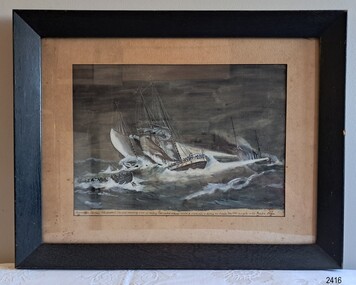 Flagstaff Hill Maritime Museum and Village
Print - Lithograph, sea rescue, R.N. Duffield, Australian cruiser “MELBOURNE” (Tons 5600) rescuing crew of sinking four-masted schooner “HELEN B. STERLING” of Halifax NS Canada, Tons 1343 in a gale in the Pacific Ocean, 19-11-1924
... We then encountered a strong blow from the south-east. We tried the gasoline pump, but the engine broke down, and we had to do the pumping by hand. ...We then encountered a strong blow from the south-east. We tried the gasoline pump, but the engine broke down, and we had to do the pumping by hand. ...This framed lithograph print in watercolour and gouache was produced on November 19th, 1924, by 20th-century marine artist, Mr R.N. Duffield. It depicts the event of a sea rescue that took place two years earlier. The framer was A.L. Frith of Footscray, Melbourne, who actively advertised from 1933 to 1935. The now disbanded Shiplovers' Society of Victoria (1930-2018) donated the print, and it seems likely that this print was framed for that organisation. This graphic image shows the conditions in which the rescue from the wrecked Helen B. Sterling happened. Captain George Harris was master of the American-owned, four-masted windjammer. His wife Edith and their ten-year-old son Leslie were on board, along with a crew of fifteen seamen. The ship set off from Newcastle, NSW, on January 5th, 1922, loaded with a cargo of coal to deliver to the Society Islands and on to San Francisco. Young Leslie later wrote a lively school composition for his teacher about his experiences on board the Helen B Sterling. He tells of a fire that broke out the day after they departed and burned a hole in a beam. Then another troublesome time on the 9th, when a strong gale blew a sail off the ship. Finally, he tells of the highlight of his voyage when, on the 18th January, the ship was right in the path of a strong cyclone, which broke the mainmast. Huge waves crashed over both sides of the deck, meeting in the middle, and the ship began to sink. The rescue from the wreck was an exciting time for the young boy, and even more so when one of his cats survived after being carefully wrapped in a pillowcase and thrown down from the ship for the boy. Reporters later wrote about Leslie’s comments, “... what had grieved him most was the thought that he might never see his two little sisters again”. Captain Harris said in a published statement, “… the gale was the worst he had met in his 12 years’ experience at sea. All went well for the first week. We then encountered a strong blow from the south-east. We tried the gasoline pump, but the engine broke down, and we had to do the pumping by hand. We at once shortened sail, but the sea increased in fury to such an extent that men were washed from the pumps. I was below at 5:30 on Sunday morning [January 22nd, 1922] when the main mast went over the side, … I at once sent out SOS signals, and got word that HMAS Melbourne was coming to our assistance. I had made a mistake with regard to our position, but did not know it until 11:30 o’clock, when I sent out the correct location. This was picked up by the Melbourne and I received the following reply: “We will reach you about 2 am. Keep a good heart. The Melbourne will do all she can.” Our ship was practically awash when we were taken off.” (Ref: the ‘Helen B. Sterling Disaster’, Maitland Weekly Mercury, NSW, 4-2-1922.) Officers from the Royal Australian Navy, Captain Henry J Feakes (later Rear-Admiral) and Commander Wilfrid Ward Hunt, were on board the light cruiser, HMAS Melbourne (1913-1928), when it left Sydney for New Zealand. After the SOS was received, the ship sped at full steam towards the sinking Helen B. Sterling. They found the vessel at about midnight and shone bright search lights on the distressed ship to illuminate the desperate scene. The Melbourne was unable to move close to the schooner, so sixteen seamen, including Commander Hunt, volunteered to man the Melbourne’s lifesaving 12-oared cutter. They rowed the sea boat with great urgency towards the victims of the sinking ship, keen to save lives no matter what the conditions. When the cutter was close to the Sterling, a line was secured between the Sterling and the cutter. The weary, waterlogged and anxious men on board could be rescued, one at a time, in the breeches buoy equipment, which looked like canvas shorts with a lifesaving ring in the waistband. The victims were hauled along the line and pulled aboard by many willing hands. All eighteen crew and passengers were saved, including Captain Harris and his family. The seamen of the Melbourne received a heroes’ welcome when they arrived in New Zealand. The grateful survivors were taken to Auckland, where they received the care and comfort they needed. Melbourne’s Lord Mayor, Cr. Swanston, on behalf of the citizens of Melbourne, formally recognised the heroic rescue efforts of the seamen of the HMAS Melbourne on March 2nd, 1922, at a special presentation. Two large flags, a White Ensign and an Australian “Jack" Flag, were presented to the Captain of HMAS Melbourne, and souvenirs were awarded to the sea boat’s crew and its Commander, Wilfred Ward Hunt. Commander Hunt was also presented with an original watercolour depicting the heroic rescue from the wreck of the Helen B. Sterling, painted just after the event by renowned marine artist Arthur V Gregory (1867-1957), and he received a silver cigarette case bearing the City’s coat of arms and the inscription, "To Commander Ward Hunt from the Citizens of Melbourne as a memento of the rescue of the crew of Helen B. Stirling by H.M.A.S. Melbourne, on 23.1.22". Both the painting and the cigarette case are now treasured items inherited by his grandson; a reminder of “… a very fine naval gentleman who believed in leading by example." R.N. DUFFIELD: - The Lithograph print in our collection by 20th-century English artist R.N. Duffield is dated Nov. 19, 1924. It is very similar to, and possibly created from, the original A V Gregory watercolour presented to Commander Hunt and dated 1922. Mr R.N. Duffield has art works in the Yarmouth Museums, Norfolk Museums Collection; “Orient Liner Otranto …,” and "Convoy of six ships at sea", both painted in watercolour and gouache during the 1940s. Some of his other works, also painted in watercolour and gouache, have been advertised for sale on Internet sites. Some details differ between the original A.V. Gregory and this Lithograph Print: - -the words on the bow on the original watercolour are “Helen B. Sterling, Blain”, which is in Washington, USA, where the Sterling Shipping Company was registered from around 1919; the words on the print are “Helen B. Sterling, Halifax, N S”, for Nova Scotia, Canada, which is the hometown of Sterling Shipping Company founder’s wife, Helen B Sterling. -The watercolour is coloured and has fine details; the print is monochrome - The A V Gregory signed the watercolour in 1922, on the lower left; the print is signed with the Lithographer’s name on the lower right; “R N Duffield, Nov. 19. 1924” ARTHUR VICTOR GREGORY (1867-1957): - A.V. Gregory is a renowned marine artist who worked in watercolour and gouache. He painted actively between 1899 and 1932, creating over 3o0 works. South Melbourne, Victoria, was where he lived and worked. This Lithograph print is significant in that it depicts the rescuing of the passengers and crew of the schooner “Helen B Stirling”. At the time this was a significant event that made most Australian and New Zealand papers because of the involvement of the Australian cruiser “Melbourne”. The image demonstrates the perilous conditions experienced by seafarers. It includes an example of the line and breeches buoy method used to save lives at sea from the 1860s and into the 20th century. It reflects a time in our history when sail and steam ships cruised the world’s seas together, the former trading with a cargo of coal from Newcastle, the latter defending our country in World War I. The print is part of Flagstaff Hill Maritime Museum’s Collection of maritime artworks that depict famous events, vessels and locations, showing the evolution of sea craft, and aiding the interpretation of our maritime history. The Lithograph print is behind glass in a black painted timber frame and mounted under a cream matte. The vivid image depicts a sea rescue in progress. The night scene is illuminated by a light beaming from a steamship, the Cruiser HMAS Melbourne. It reveals figures on the deck of a sinking sailing ship, the schooner Helen B. Sterling, as foaming waves roll across it. The stricken ship has a broken main mast, and a sail has been detached. A small figure is floating in the choppy sea, secured in a breeches buoy that is attached to a rescue line between a lifesaving cutter and the sailing ship. The crewmen in the cutter are ready to haul the shipwrecked victim aboard, while the figures on the foundering ‘Sterling’ watch them. The print’s paper-covered wooden backboard is attached to the frame with small tacks. A metal hanging wire is secured to two dissimilar eyelet screws. Inscriptions include text on the bow of the sinking vessel, a handwritten title below the picture, and a handwritten name in the print’s lower right corner. On the reverse are two oval, black ink stamps and a round cream label with printed text. The hand-painted print was reproduced from a lithograph, signed in the lower right, by R.N. Duffield of England, on November 19th, 1924. A Frith of Footscray, Melbourne framed it. Painted on the ship’s bow: “HELEN B. STERLING / HALIFAX N S” [Nova Scotia, Canada] Handwritten below the print: “AUSTRALIAN CRUISER “MEMBOURNE” (Tons 5600) rescuing crew of sinking four-masted schooner “HELEN B. STERLING” of Halifax NS Canada, Tons 1343 in a gale in the Pacific Ocean.” Handwritten on lower right: “R.N. DUFFIELD / Nov. 19. 1924” (underlined) On paper label: “Phone: / Footscray 398 [some of the text has torn off] / “A. FRITH / PICTURE FRAMER / Manufacturer / 17 Paisley Street / Footscray.“ On both oval stamps: “SHIPLOVERS SOCIETY OF VICTORIA / LIBRARY” flagstaff hill, flagstaff hill maritime museum and village, warrnambool, maritime museum, maritime village, great ocean road, shipwreck coast, lithograph, lithograph print, reproduction print, helen b. sterling, the sterling, american owned schooner, halifax, halifax n s, halifax nova scotia, nova scotia, halifax n s canada, schooner, windjammer, sailing ship, four-masted ship, captain george harris, george harris, edith harris, leslie harris, sterling shipping line, hmas melbourne, hmas melbourne (1), cruiser hmas melbourne, the melbourne, australian cruiser, captain henry j feakes, commander wilfred ward hunt, sinking ship, shipwreck, sea rescue, gale, cyclone, 1922 rescue, shipwreck rescue, breeches buoy, line rescue, rescue line, lifesaving, cutter, cutter melbourne, sea boat, lifesaving crew, 12-oar cutter, shipwreck victim, r.n. duffield, marine artist, nov. 19. 1924, 20th century artist, a frith, footscray picture framer, shiplovers’ society of victoria, shiplovers’ society library, watercolour, a v gregory, arthur victor gregory, melbourne artist, newcastle coal, newcastle nsw, society islands, san fracisco, aukland new zealand, school composition, ship’s cat, sos signal, lord mayor cr. swanston, heroes, cigarette case -
Koorie Heritage Trust
Book, Brady, Maggie, Heavy metal : the social meaning of petrol sniffing in Australia, 1992
... Brady focuses on petrol (gasoline) sniffing in a number of Aboriginal communities to arrive at an understanding of the users' subjective decisions to engage in this behaviour.... ...In Heavy Metal the author attempts to go beyond the socio-political or disease models. Brady focuses on petrol (gasoline) sniffing in a number of Aboriginal communities to arrive at an understanding of the users' subjective decisions to engage in this behaviour.... This informed ethnographic account is the first major published study of contemporary drug use by Aborigines.xii, 223 p. ; ill., maps : 24 cm.In Heavy Metal the author attempts to go beyond the socio-political or disease models. Brady focuses on petrol (gasoline) sniffing in a number of Aboriginal communities to arrive at an understanding of the users' subjective decisions to engage in this behaviour.... This informed ethnographic account is the first major published study of contemporary drug use by Aborigines.petrol sniffing -- australia. | aboriginal australians -- health and hygiene. | aboriginal australians -- substance use. | inhalant abuse -- australia. -
Moorabbin Air Museum
Drawing (item) - Acrylic paintings of Convair 340 Ansett Silhouette comparisons of 767 and Fokker universal Fokker universal Lockheed Electra Boeing 767 727 DC3 Posters of De Havilland drover 727 1987 Moorabbin air show S E 5A instrument panel Ansett 50th anniversary album 31 Beaufighter squadron signed poster FA 18 hornet Sopwith camel Gloster meteor RAAF roundels and insignia F111 Orion P3C Iroquois helicopter FA18 Caribou Ansett 1936 to 1957 Hawker Typhoon Hawker Sea fury Signed poster of various RAAF typhoon squadrons Nieuport biplane RAAF Flying units and Squadrons Australian defence force medals History of RAAF 1921 to 1971 Marshalling signals Battle of Britain survivors article and Poster Lufthansa 747 CRJ200 Kendell airlines Mustang plane and car together m 1988 round Australia race Ansett West Australian airline Damaged Hurricane in workshop Japanese aircraft identification The Last of the Few Qantas recalls 1920 - 1970 MAF serving churches in remote areas Royal flying doctor 1920 - 1978 Douglas C 47 England to Australia 1934 - 1935 Around Australia 1988 CF-650 jet engine airflow Canadair DC-4M north star UIVER KLM memorial flight 1984 also 1934 flight poster Australian Gazette 1710 to 1970 Beaufighters attacking tanker Europe Qantas Air Niugini 4 posters TAA flight deck club Ansett posters Military Helicopters HMAS Albatross 1948 - 1988 RAAF gasoline posters CAC factory photos of Sabre jet manufacture DE Havilland Comet 1934 RAAF military aircraft Wait for help when loading practice bombs RAAF flags Wamira Douglas DC 3 50th anniversary Australian forces badges of rank Emergency access pints for Dakota Wirraway Bristol freighter Wackett Warrigul Boeing Vertol Boomerang Desoutter Koolhoven Gestapo hunters Mosquitos Aarhus, Miscellaneous Aircraft Drawings
... Miscellaneous Aircraft Drawings Drawing Acrylic paintings of Convair 340 Ansett Silhouette comparisons of 767 and Fokker universal Fokker universal Lockheed Electra Boeing 767 727 DC3 Posters of De Havilland drover 727 1987 Moorabbin air show S E 5A instrument panel Ansett 50th anniversary album 31 Beaufighter squadron signed poster FA 18 hornet Sopwith camel Gloster meteor RAAF roundels and insignia F111 Orion P3C Iroquois helicopter FA18 Caribou Ansett 1936 to 1957 Hawker Typhoon Hawker Sea fury Signed poster of various RAAF typhoon squadrons Nieuport biplane RAAF Flying units and Squadrons Australian defence force medals History of RAAF 1921 to 1971 Marshalling signals Battle of Britain survivors article and Poster Lufthansa 747 CRJ200 Kendell airlines Mustang plane and car together m 1988 round Australia race Ansett West Australian airline Damaged Hurricane in workshop Japanese aircraft identification The Last of the Few Qantas recalls 1920 - 1970 MAF serving churches in remote areas Royal flying doctor 1920 - 1978 Douglas C 47 England to Australia 1934 - 1935 Around Australia 1988 CF-650 jet engine airflow Canadair DC-4M north star UIVER KLM memorial flight 1984 also 1934 flight poster Australian Gazette 1710 to 1970 Beaufighters attacking tanker Europe Qantas Air Niugini 4 posters TAA flight deck club Ansett posters Military Helicopters HMAS Albatross 1948 - 1988 RAAF gasoline posters CAC factory photos of Sabre jet manufacture DE Havilland Comet 1934 RAAF military aircraft Wait for help when loading practice bombs RAAF flags Wamira Douglas DC 3 50th anniversary Australian forces badges of rank Emergency access pints for Dakota Wirraway Bristol freighter Wackett Warrigul Boeing Vertol Boomerang Desoutter Koolhoven Gestapo hunters Mosquitos Aarhus ...
