
Showing 5 items matching "gellibrand pile light"
-
 Williamstown Historical Society Inc
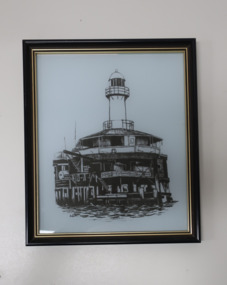
Drawing - Gellibrand Pile Light
... Gellibrand Pile Light...The Gellibrand Pile Light commenced operation on 1 August 1908 and replaced a circular iron vessel with a red light atop. ...A black and white detailed pencil drawing of the Gellibrand Pile Light showing the front with the access stairs. ...The Gellibrand Pile Light commenced operation on 1 August 1908 and replaced a circular iron vessel with a red light atop. ...The Gellibrand Pile Light commenced operation on 1 August 1908 and replaced a circular iron vessel with a red light atop. The new structure with 33 piles was built in the water; the light was then placed on top of the piles. In June 1976 the "Melbourne Trader" collided with the pile light and due to the hazardous situation that developed a decision was made to set fire to the light on 23 June. A black and white detailed pencil drawing of the Gellibrand Pile Light showing the front with the access stairs. The drawing is in a black wooden frame, behind glass. Appears to be: "O.S.M". (at bottom left of drawing) -
 Queenscliffe Maritime Museum
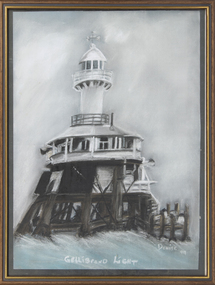
Painting - Pastel painting of the Gellibrand Light, Gellibrand Light
... Point Gellibrand Pile Light...The reef off Point Gellibrand at Williamstown was lit for nearly 120 years by a series of lights, beginning with three separate lightships over the mid-late 1800s, to a pile light which lasted seventy years before it was dramatically destroyed when hit by a ship the Melbourne Trader on the foggy morning of 21 June 1976....A pastel painting of the Gellibrand Pile Light made by Denise Clarke in 1999....The light tower is now on display at Seaworks in Williamstown. Point Gellibrand Pile Light Gellibrand Light; Denise '99 A pastel painting of the Gellibrand Pile Light made by Denise Clarke in 1999. ...The reef off Point Gellibrand at Williamstown was lit for nearly 120 years by a series of lights, beginning with three separate lightships over the mid-late 1800s, to a pile light which lasted seventy years before it was dramatically destroyed when hit by a ship the Melbourne Trader on the foggy morning of 21 June 1976. A pastel painting of the Gellibrand Pile Light made by Denise Clarke in 1999. Gellibrand Light; Denise '99 point gellibrand pile light -
 Williamstown Historical Society Inc
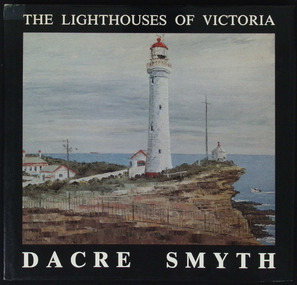
Book - Book - The Lighthouses of Victoria, Smyth, Dacre (1923-2008) et al, The Lighthouses of Victoria. Dacre Smyth. The second book of paintings, poetry and prose, 1980
... ...Gellibrand Pile Light...Lighthouses Gellibrand Pile Light Timeball Tower Lighthouses-Victoria This book contains 41 paintings of lighthouses at various locations around the coast of Victoria. ...This book contains 41 paintings of lighthouses at various locations around the coast of Victoria. Each painting is accompanied by a description and history of the subject lighthouse, and four lines of verse. The first lighthouse depicted is Cape Nelson Lighthouse, near Portland. Moving eastwards along the coast, successive lighthouses are depicted, the last two being at Point Hicks and Gabo Island.Illustrated book, 41 pages Hardcover - blue with gold embossed text on spine Dust jacket - coloured illustration of Cape Nelson Lighthouse, Portland, by Dacre Smyth non-fiction This book contains 41 paintings of lighthouses at various locations around the coast of Victoria. Each painting is accompanied by a description and history of the subject lighthouse, and four lines of verse. The first lighthouse depicted is Cape Nelson Lighthouse, near Portland. Moving eastwards along the coast, successive lighthouses are depicted, the last two being at Point Hicks and Gabo Island. lighthouses, gellibrand pile light, timeball tower, lighthouses-victoria -
 Flagstaff Hill Maritime Museum and Village
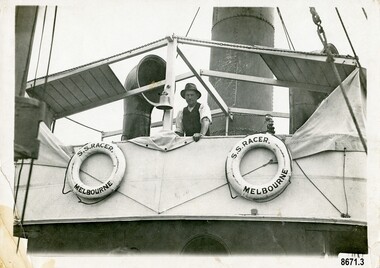
Photograph - Vessel, Steam tug, circa 1920's
... Later he was in charge of two larger boats - the "Alvina" and "Helen Moore" and was engaged in salvaging the Union Steamship vessel "Karkariki" near Gellibrand Pile Light at the entrance to Hobsons Bay. ...Later he was in charge of two larger boats - the "Alvina" and "Helen Moore" and was engaged in salvaging the Union Steamship vessel "Karkariki" near Gellibrand Pile Light at the entrance to Hobsons Bay. ...The ocean Steamtug "Racer" was built in 1886 in Sunderland by "Boolds, Sharer and Company" for the "Queenstown Tug and Shipping Company". It is mentioned in several newspapers that soon afterwards it sank in Queenstown Harbour, Ireland and remained submerged for six months before being raised. It was a steel screw boat with a sluice keel, was 185 tons and 420 feet long. It was purchased around 1889 by the "Melbourne Coal, Shipping and Engineering Company Ltd" as it had sufficient power to work with the huge iron clippers that the company were dealing with. It survived several dangerous incidents on its voyage out to Melbourne. On May 28th in the middle of the night in a heavy gale, the tug was swamped by heavy seas and then several hours later was almost run down by a very large ship (the clipper Loch Vennachar) in full sail. The "Racer" (later owned by the "Melbourne Steamship Company") became one of the fastest and best-known tugs in the Port of Melbourne - working in the port until 1935. The "Racer" was involved in many rescues and dangerous incidents during its 45 years including the attempted rescue of the "Craigburn" near Cape Schanck, the rescue of the "Edina" from a reef near Williamstown and the rescue of the "Netherby" from heavy seas near Inverloch. In March 1930 she was caught by a strong wind when turning in the Yarra River and crashed into the Spencer Street Bridge - resulting in some damage to the scaffolding on the bridge and slight damage to the tug. In 1906 the "Racer" created a record for the fastest tow when it towed the 900-ton barque "Elizabeth Graham" from Sydney to Melbourne in 73 hours. In 1934 it was withdrawn from commission with plans for it to be broken up for scrap metal but was bought by a Melbourne businessman to be converted into a three masted schooner trading between Tasmania and Melbourne. George (Joe) Cunningham was born in 1892 in Geelong. His father, Alexander Cunningham was a ship builder and carpenter. George worked on oceangoing ships as a young man but after his marriage, had a twenty-six year career on Tugboats. He worked as a deckhand on the "Racer" and then worked his way up as a mate and then master on the "Maitland" and "Tooronga". Later he was in charge of two larger boats - the "Alvina" and "Helen Moore" and was engaged in salvaging the Union Steamship vessel "Karkariki" near Gellibrand Pile Light at the entrance to Hobsons Bay. George Cunningham died in 1978. This photograph was one of ten photographs donated to Flagstaff Hill Maritime Museum and Village by Fred Trewartha. Frederick John Fox Trewartha (Fred) was a well-known Warrnambool businessman. He was born in Beeac near Geelong in 1920 and came to Warrnambool with his family as a very young child. He was apprenticed to his father John, as a saddler and later opened his own shop on Raglan Parade. He then moved into working with tarpaulins and canvases for the trucking industry. Fred was keenly interested in photography (and was a member of the Warrnambool Cine Club), yachting and boat building. He kept his yacht moored at Port Fairy for many years and participated in sailing events locally and interstate. He also built boats with his sons. He had the opportunity to meet many older sailors and it's thought this photo (and others in the set) may have been given to him by one of these men. Fred Trewartha died in 2016 in Warrnambool. This item is significant as a reminder of the important role tugboats and their crews played in the maritime history of Melbourne and the surrounding seas. This is a close-up view of a tugboat showing a man leaning against the upper deck. Two lifebuoys (with the words S. S. Racer Melbourne) are attached to the side of the deck and a funnel and an airvent are in the background. A handwritten note in pencil saying "Geo Cunningham on board Racer "is on the back of the photograph. Back - "Geo Cunningham on board Racer" Front (on lifebuoys) - "S. S. RACER MELBOURNE" flagstaff hill maritime museum and village, great ocean road, tugboats, steamtug boats, racer, george cunningham, port of melbourne, melbourne steamship company, rescues, craigburn, steamtug, edina, elizabeth graham, netherby, yarra river, ships, historic maritime photographs, boolds sharer and company, queenstown tug and shipping company, melbourne coal shipping and engineering company limited -
 Williamstown Historical Society Inc
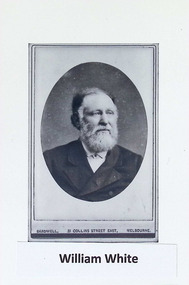
Photograph - William White, Boat Builder
... The business was the best known for producing schooners, tugs, lighters, light boats, and steamers for the NZ west coast trade and was one of the most productive of the early medium scale boat builders. The company also constructed the Gellibrand Lightship in 1860, which was replaced by the pile lighthouse. ...The business was the best known for producing schooners, tugs, lighters, light boats, and steamers for the NZ west coast trade and was one of the most productive of the early medium scale boat builders. The company also constructed the Gellibrand Lightship in 1860, which was replaced by the pile lighthouse. ...William White (1826-1901) arrived from his home on the Isle of Wight in 1852, visited New Zealand and then went onto the Bendigo Gold Fields. He then settled in Williamstown and started building skiffs and dinghies from about 1854 on a site adjacent to the present Blunt's Boatyard, now the site of the Naval Cadet's clubrooms and jetties. He was joined by his brother George in 1856 and they formed W. & G. White Boat Builders, commonly referred to as ‘White’s Slip’. The brothers first ship was Elizabeth which was still afloat as a powder lighter 50 years later. In 1857 William White was commissioned by the Harbour Master, Charles Ferguson, to construct four of Victoria's first lifeboats. The business was the best known for producing schooners, tugs, lighters, light boats, and steamers for the NZ west coast trade and was one of the most productive of the early medium scale boat builders. The company also constructed the Gellibrand Lightship in 1860, which was replaced by the pile lighthouse. The superstructure of the Gellibrand Lightship was removed from the hull and placed on a platform supported by 36 piles. White was also an outspoken Councillor who served the town from 1860-1864. william white, boat builder
